Author: Amy Mayers

  • A change in diet

    A change in diet

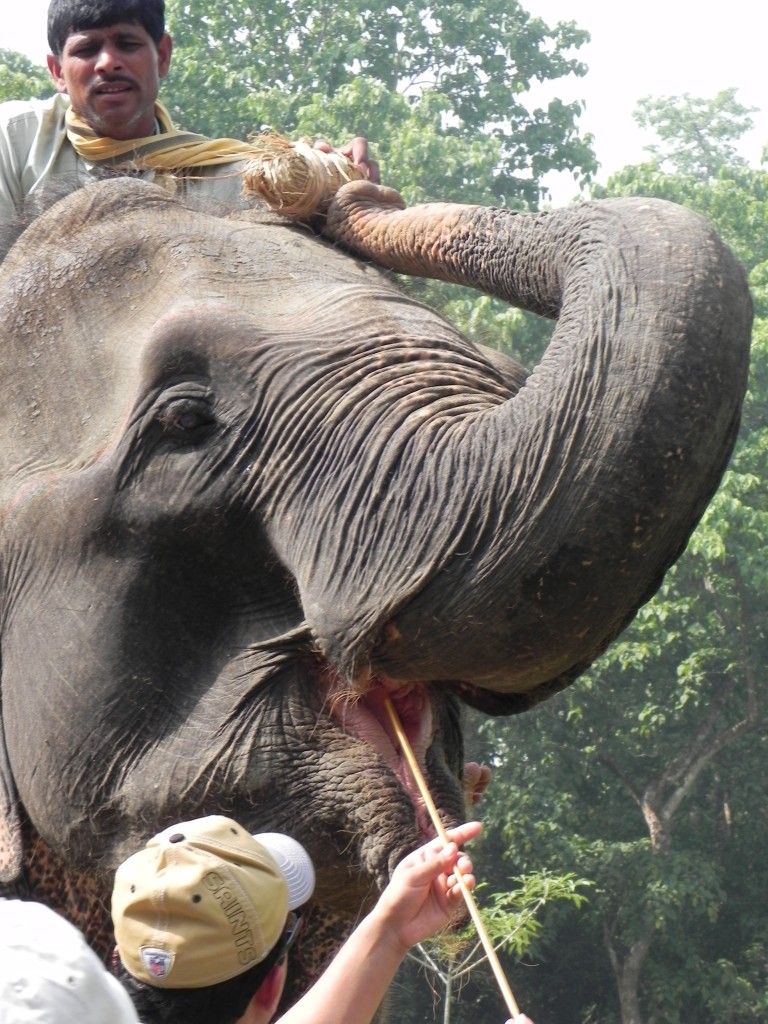
    Sundar Mala & mahout

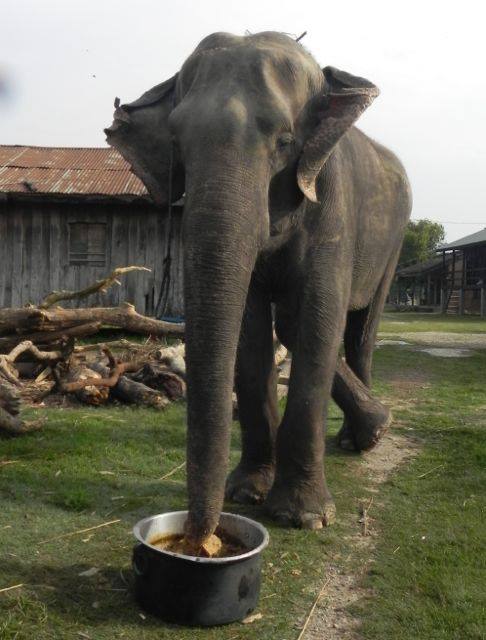
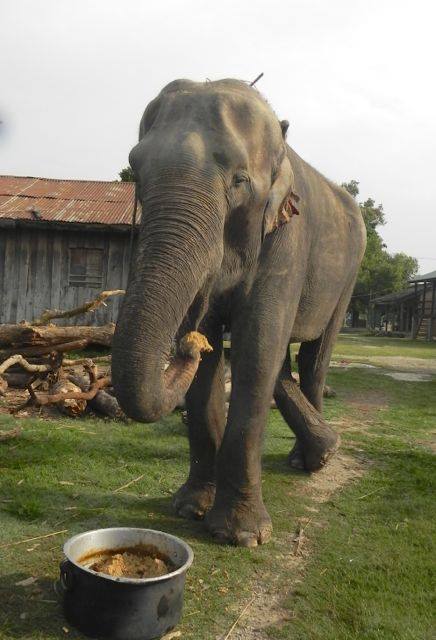
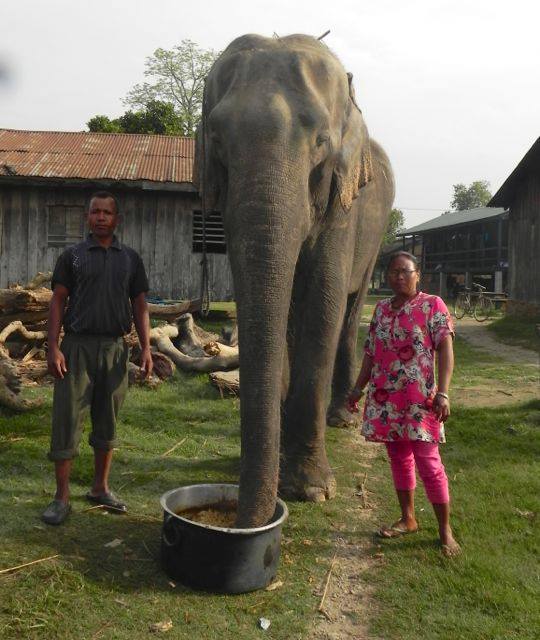
    Sundar Mala is nearly 70 years old and resides at the Sauraha hattisar in Chitwan, Nepal. Recently she began to lose weight, resulting in her removal from her friends Loctandra Kali and Oma Kali, to ensure the other elephants did not eat her food.

    We lobbied for a healthier solution. Our suggestion of a dietary supplement and reunion with her friends was accepted by the mahouts.

    sundar mala

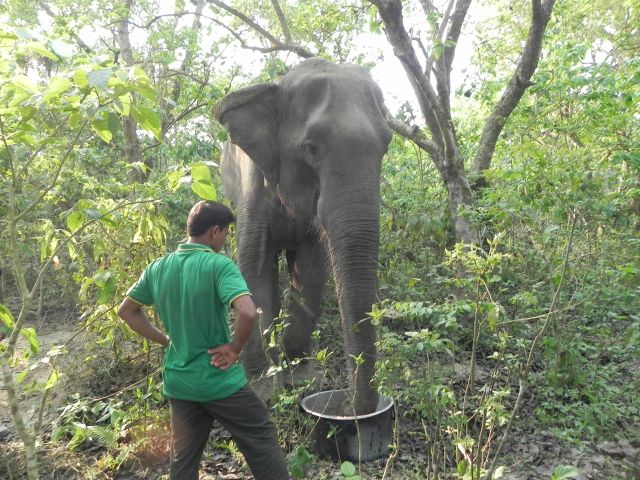
    It took two days for Sundar Mali to acquire a taste for her new diet. She still eats slowly but does not stop until she has eaten it all.

    Sundar Mala eating2

    Sundar Mala eating

  • Help Us Keep Wild Elephants Wild and Captive Elephants Safe!

    Help Us Keep Wild Elephants Wild and Captive Elephants Safe!

    Thanks to your support, EAI is nearing the completion of its year-long project to free 63 working elephants from chains.
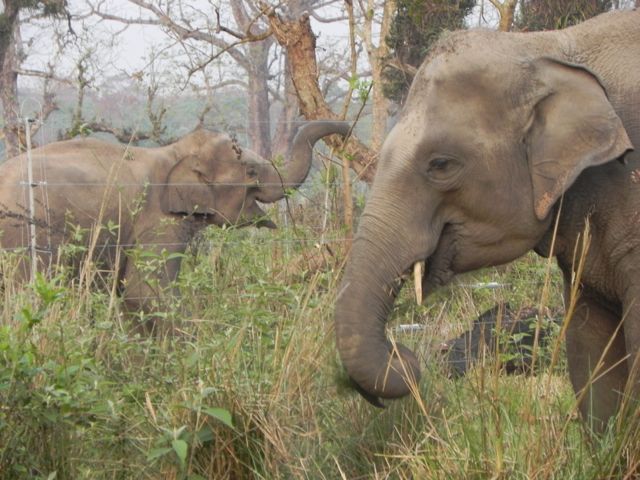
    2 eles chain free

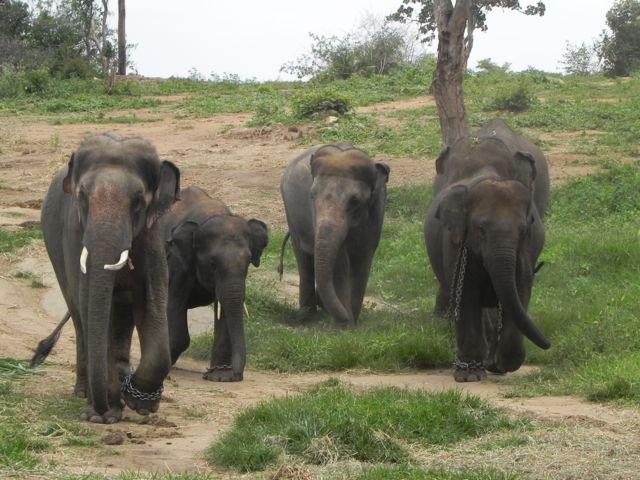
    Elephants who have spent decades shackled by chains are now free to roam spacious mini-sanctuaries for the first time in their lives.

    But now we need your help with an unexpected expense: an elephant-proof perimeter fence to keep wild elephants wild and captive elephants safe.

    Last hattisar: Prototype for a healthy captive elephant environment
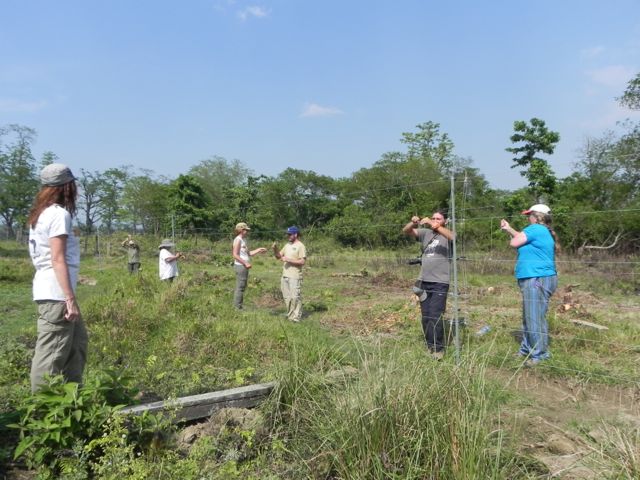
    dscn0321_medFor five weeks, EAI and its tireless volunteers have toiled in sweltering temperatures erecting solar powered corral fencing so that captive-held anti-poaching patrol elephants at one of the government’s 15 hattisars (elephant stables), in Khorsor, Nepal, can be released from their chains forever.

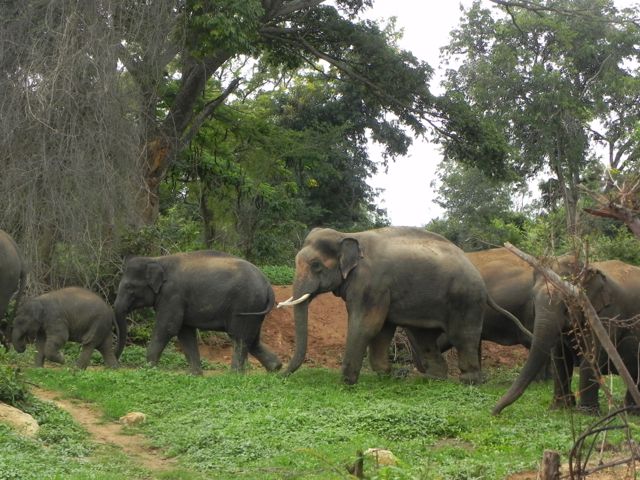
    This hattisar is home to 18 elephants: six females with suckling calves; an older female who acts as auntie, babysitter and wet nurse; a young pregnant female; two adolescents; and two young males who no longer live with their mothers.

    This, the last hattisar in EAI’s Chain Free Means Pain Free project, has the potential to be a prototype for a healthy captive elephant environment and transform elephant management in Nepal.

    But an unlikely culprit threatens the success of the project. His name? Sano Jungli Hatti — small wild elephant
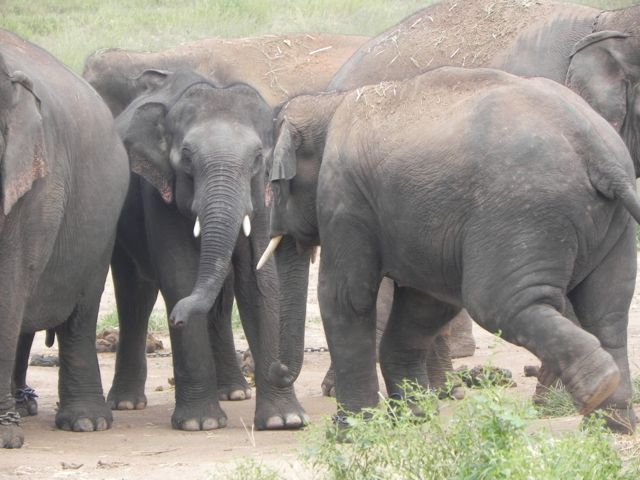
    jungli hatti

    Every night for the past month, sano jungli hatti has visited the hattisar, damaged the newly constructed section of corral fencing and then disappeared into the breaking dawn.

    This wild elephant was dubbed sano jungli hatti because he is less than six feet tall and under 10 years of age. First seen traveling alone more than two years ago, the separation from his wild biological family was many years premature.

    Although the circumstances surrounding his separation remain a mystery, sano jungli hatti’s actions clearly demonstrate that he has adopted the resident elephants in Khorsor as his family.

    It’s not clear if this young elephant is motivated by his desire to procreate or be mothered, but he is willing to disregard the pain of plowing through six strands of solar powered fencing to get to his adopted family.

    Until now, the fence kept out even the most dominant mature wild bulls.

    But this young sano jungli hatti’s destructiveness has created a crisis.
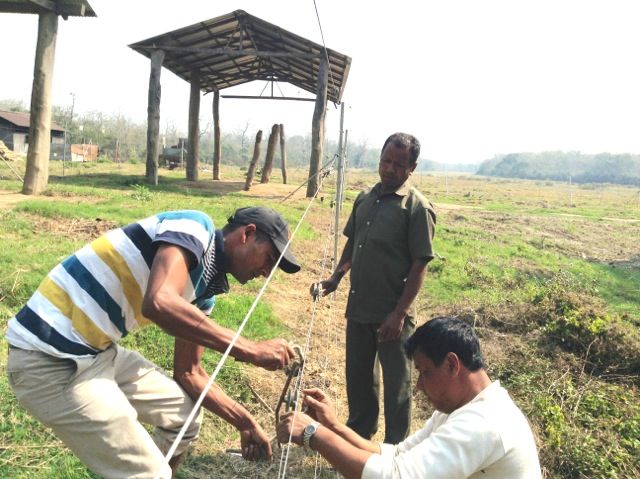
    repairing corral

    Each time sano jungli hatti breaks through the fence, it is repaired.

    It’s not a problem to repair the fence one or two times. But if the fence needs repairing day after day, it is not sustainable.

    If sano jungli hatti continues to break the fence, the resident elephants will be put back on chains.

    We simply cannot allow this to happen.

    Solution: A perimeter fence

    Capturing or relocating jungli hatti is not a viable option.

    Neither is returning all 18 captive-held elephants to chains.

    The answer?

    Build a perimeter fence around the entire 15-acre chain free project to keep wild elephants out and the eighteen resident elephants chain-free.

    The six-foot-high elephant-proof perimeter fence will cover 4,000 running feet. It is estimated to cost $1 per foot, a total of $4,000.

    To ensure the success of our chain free project — to keep sano jungli hatti free and the captive-held elephants chain-free — we must raise the funds for the perimeter fence immediately.
  • The Work Continues to Get Elephants Off Chains

    Good news! Baby Tec Gaj was released from chains.

    Unfortunately, it is not all good news because his mother, Puja Kali, was not.

    Two-year-old, captive-born Tec Gaj and his mother Puja Kali reside in Khorsor, ‪Nepal, at the government breeding center.

    Puja Kali is quite aggressive, known to attack her mahouts even while she is on chains.

    Such aggression is an indication of great suffering, usually on a mental and emotional level.

    Responding to Puja Kali’s aggression with corporal punishment compounds her condition but mahouts find themselves with few alternatives.

    Aggressive behavior exhibited by ‪elephants triggers retaliatory aggressive behavior by the mahouts. Aggression breeds aggression, resulting in a vicious cycle in which neither man nor elephant benefits.

    EAI does not endorse the use of any negative means to manage elephants and we empathize with the position the mahouts and captive-held elephants find themselves in.

    Hopefully, with our continued efforts, the day will come when aggressive elephants will no longer be used for activities that put them and their mahouts in danger. And, mahouts will learn alternative ways to care for their elephants.

  • The Suffering Continues At Nepal’s Top Tourist Destination

    The Suffering Continues At Nepal’s Top Tourist Destination

    EAI‬ has been “boots on the ground” in ‪Nepal for nearly five years. Initially, much of our efforts were focused on improving welfare for the privately owned ‪elephants used for tourist rides.

    We’ve provided free pedicures and husbandry and training advice bi-annually since 2011. But today the safari elephants of ‪Chitwan suffer to the same degree as they did when we first started. As long as ‪tourists pay to ride elephants, the elephants of Nepal will continue to be exploited.

    One way for you to help is by supporting groups actively working to influence tour companies to drop elephant safaris from their tour packages. Elephant Watch Nepal is one such group.

    Old abused ele
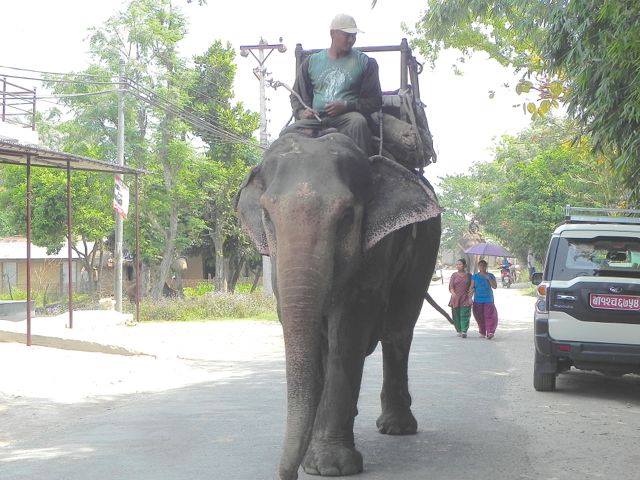
    Six months ago we found this elephant being walked along a busy highway, in the midday scorching sun, on a 30-mile walk back from a party she’d been hired for.

    Today we found her in Sauraha on her way to the tourist ride area.

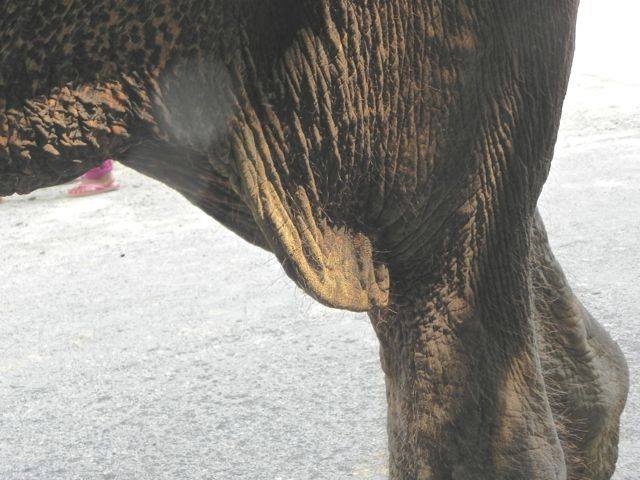
    saggy dehydrated flesh
    Saggy, dehydrated flesh

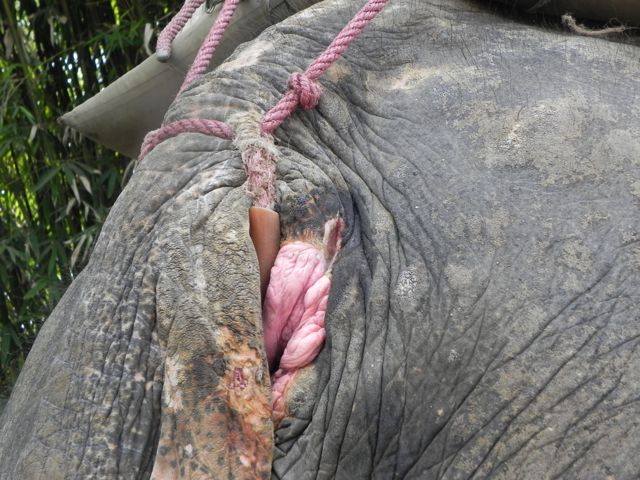
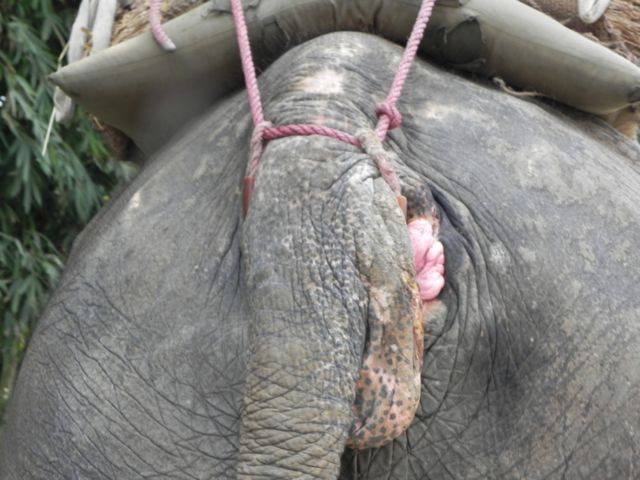
    This old elephant is blind, dehydrated, exhausted, underfed, continually beaten and suffers from deep gouges around her anus from the howdah (saddle) rope.

    Painful wounds caused by nylon ropes
    Painful wounds caused by nylon ropes used to tie the howdah (saddle) on for tourist rides
    torn anus
    Torn anus

    The owner and mahouts are aware of her injury and how to prevent and treat it. But they do nothing to ease her suffering.

  • Sunder the Elephant Embarks on New Life

    sunder__family_bannerghatta_zoo_india-1_med
    Sunder (left) with his new family

    Elephant welfare expert Carol Buckley says rescued elephant is in good hands at model facility.

    More than a month after his rescue from a life of horrific suffering, 15-year-old bull elephant Sunder is enjoying lush forests, cool ponds and the close companionship of 14 other elephants at the Bannerghatta Biological Park (BBP) outside Bangalore, India.

    Sunder’s tragic plight touched the hearts of people from all around the world and galvanized an international social media campaign that helped win his release and recovery.

    sunder_and_family_india_2_med“Sunder has a new life and a fresh start at a wonderful facility,” said Carol Buckley, an expert in innovative approaches to elephant welfare in captivity, who recently visited Sunder in India to design a chain-free facility at the park where he now lives.

    “Thanks to the courage of the Supreme Court of India, which ruled against Sunder’s longtime abusers, the willingness of BBP to accept Sunder for permanent residence and the tireless logistical and legal efforts of PETA India, Sunder’s future looks very bright.”

    Buckley, who founded and leads the US-based nonprofit Elephant Aid International, says BBP has all the desired components for captive elephants. Its 122 acres of diverse habitat include open pasture, shaded forests and ponds, where the elephants are free to roam and play during the day. At night, they are given access to the adjoining national park forest for foraging and exploration.

    The upcoming construction of a custom designed, solar powered, chain-free perimeter fence system to enclose the entire daytime habitat will give the elephants even more autonomy. The fence creates a safe containment area, eliminating the need for mahouts to dictate the elephants’ activities. It should be completed before the end of the year and will be the first constructed at any zoo in India.

    Buckley noted that unlike most elephant facilities throughout the world, BBP’s mahouts manage their captive elephants in a “herder style” manner that supports their physical, emotional and mental health. This style of management acknowledges elephants’ nature as highly social, herd animals, giving them freedom to wander at will while mahouts keep a watchful eye on their whereabouts.

    “Bannerghatta Biological Park, working in partnership with PETA India, offers the world an exemplary model for managing captive-held elephants and the best possible new home for Sunder,” said Buckley. “I’m so grateful for their efforts.”

  • Elephant Aid International Creates First-Ever Elephant Care Center in India

    Hohenwald, TN, October 27, 2011 – Elephant Aid International (EAI), a Carol Buckley Project, announces its official partnership with the Wildlife Rescue & Rehabilitation Centre (WRRC), one of India’s foremost wildlife organizations, to create the first prototype Elephant Care and Rehabilitation Center in Karnataka, Bangalore, India.

    With the endorsement of the Indian government, this private project will serve as a model for future care and rehabilitation centers throughout the country. The center will rehabilitate elephants who have been removed from the confines of zoos, circuses and temples, and offer them a more natural lifestyle, free of chains and negative management techniques.

    Carol Buckley, founder, president and CEO of EAI, will supervise the Center’s development, training of mahouts (elephant handlers) and elephant acquisition and relocation. This first facility will house up to seven elephants.

    “We are honored to partner with WRRC on this landmark project,” said Buckley. “I believe this care center will be a beacon of hope and a challenge for change for people working to improve the lives of captive elephants.

    There is an urgent need for care centers (what are known as sanctuaries in the U.S.) in India. In November 2009, the country’s Central Zoo Authority mandated that all elephants be removed from zoos and placed in alternative facilities better suited to address their needs. India’s wildlife parks and game sanctuaries are not well suited for zoo elephants and, until now, no other alternative existed.

    In August 2010, the Elephant Task Force of India’s Ministry of Environment and Forests issued a set of recommendations, including the creation of state-of-the-art lifetime care centers.

    Designed to provide freedom of movement and a healthy social environment, care and rehabilitation centers will provide a safe place for elephants to escape the abuses of captivity.

    • The centers will support the rehabilitation of elephants suffering from physical and psychological trauma by providing a more naturalistic environment.
    • They will not involve tourism.
    • The grounds will be fenced, eliminating the need to restrain elephants with leg chains.

    All mahouts will be trained in Compassionate Elephant Care techniques, a system developed by Buckley that is based on understanding elephant biology, physiology and psychology; relationship building between the mahouts and their elephants; and positive reinforcement.

    The number of elephants housed at the Center will be limited to ensure there is adequate vegetation for them on-site and in the bordering national forest. The elephants will have access to areas of the forest during daylight hours and will return to the Center at night.

    The Center is based on The Elephant Sanctuary in Tennessee, which Buckley co-founded and led to international recognition as one of the leading models of humane management of elephants in captivity.

  • Elephant Care International’s Sauraha Elephant Health Camp

    Elephant Care International’s Sauraha Elephant Health Camp

    April 21

    Elephant Care International’s Sauraha Elephant Health Camp has been a well-received service for privately owned elephants living outside Chitwan National Park. ECI’s efforts to gain the trust of the thirty-something private owners, who collectively own nearly 50 elephants, has proven successful. The owners are all participating in this health camp, a testament to ECI’s efforts.

    On this second day of the camp, seven elephants showed up for examination. How fortunate I am to be involved. The veterinarians, technicians, mahouts and elephants flowed together in a synchronized dance, collecting throat cultures, nasal drip, blood, urine and fecal samples, body temperature, respiration and pulse. Translators helped bridge the language gap, making the process more efficient.

    The elephants, all Kali (female) so far, have responded to the camp individually, and collectively have demonstrated receptivity to the experience. The reality is that most, if not all, of these girls have never before walked onto a portable scale nor provided the many samples requested of them. They have all responded incredibly well.


    It did not take long for the mahouts to understand that the ECI team prefers that they practice patience with their elephants. For some, the concept of a gentler approach had never been considered but they responded favorably.

    Not surprisingly, the mahouts demonstrated a capacity for innovation when met with the challenge of collecting samples. Some of the younger mahouts responded to sample collection requests with wide eyes and a noncommittal head tilt accompanied by a somewhat nervous giggle.

    The more seasoned mahouts listened intently to the translated directions, then immediately set out to accomplish the task. It soon became evident that the more advanced mahouts reveled in flaunting their superior skills. The resulting competition between mahouts proved beneficial. Overall, the elephants are in good shape. None are overweight. The ankus is not used to pull and push the elephant so hook wounds are not an issue.

    Getting a throat culture with an extra-long Q-tip

    Living on natural substrate and in an appropriate climate has benefited the elephants greatly. Improving the standard of living for these and other elephants in captivity begins with education and improved health care. The elephants of Sauraha, their owners and mahouts have embarked on a journey destined to change their lives for the better. I am so thankful to be a part of the process.