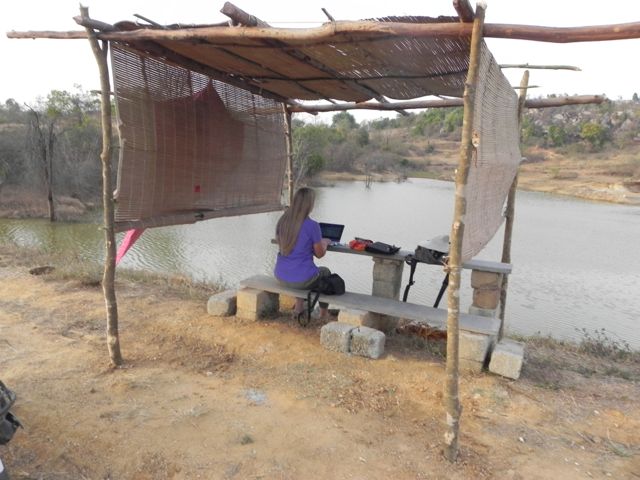
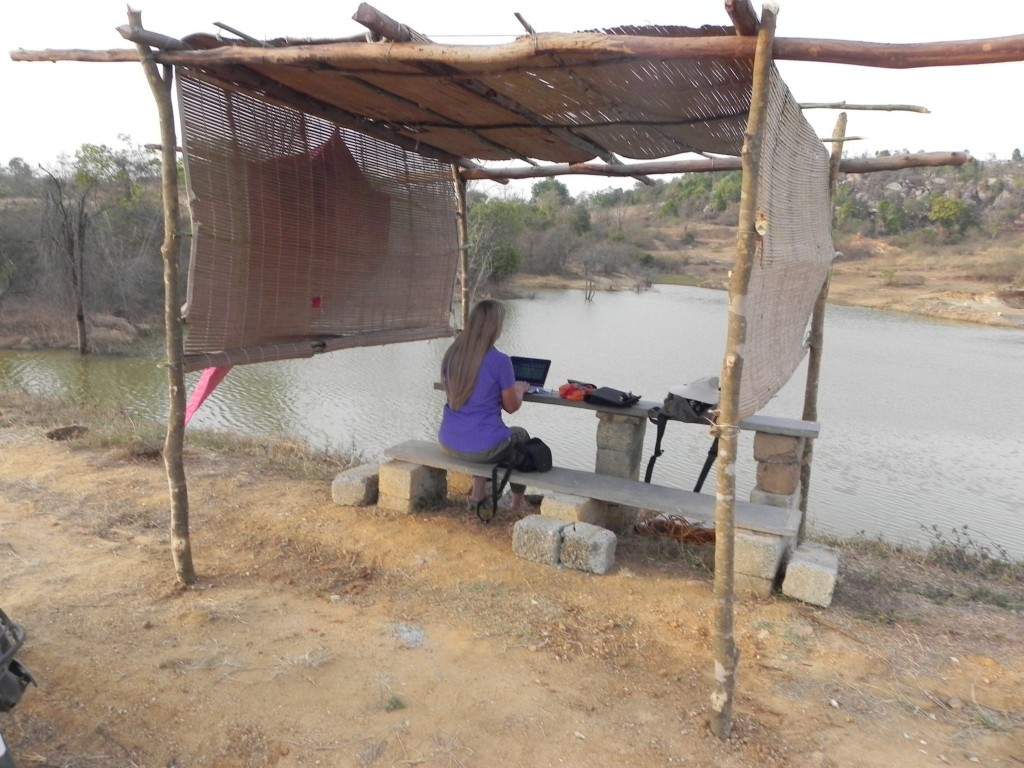
 From my lake-front office, Bannerghatta, India
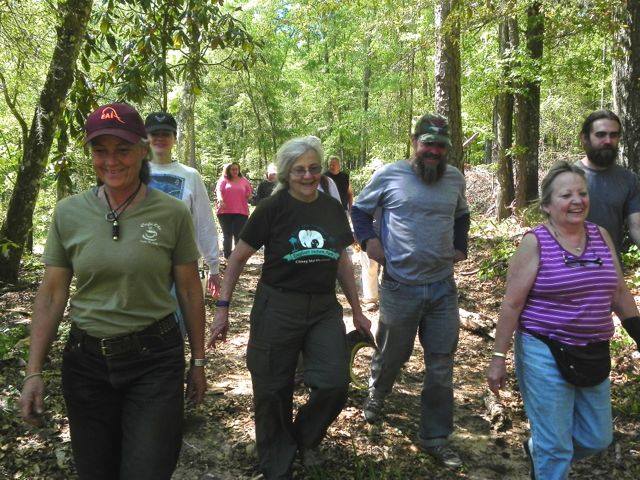
The two months since my arrival in India have been filled — with meetings, brainstorming sessions, hiking through cinder-dry forests and continual reality checks.
It is so important that I am here now—on the care center site—to study the land, the wild elephant activity in the adjacent forest, the habits of the local villagers and the laws that govern land ownership and use. There is so much to learn, I am ever thankful that everyone I am working with speaks fluent English.
The project’s scope widens
The project has remained focused on elephant welfare but its scope and approach has shifted a bit…for the better.
Initially, we planned to have a relatively small plot of land in exchange for the care center elephants being allowed access to the national forest. Allowing elephants nighttime access to the forest is standard practice for the forest department’s captive-held elephants and seemed like a viable solution to limited day time space.
But as I hiked the adjacent national forestland, I was disheartened to see how the forest’s resources are exploited. The forest herself appears to be barely breathing, suffering from over-grazing, intentionally set fires and the destruction of trees by the local villages that border the forest.
Seeing the poor condition of the forest made me realize how the wild elephants are struggling to survive, with not enough food, water or shelter to sustain them. The idea of adding even a few more elephants to the already stressed habitat—reducing wild elephant resources even further—was a deal breaker for me.
Following a frank discussion with the collaborators on the project, we decided to expand the land used for the care center, something close to 200 acres, thereby eliminating the need for the center’s elephants to use the forest.
No chains, no dominance
This change in operations has resulted in positive shifts in the facility design and style of elephant care.
The original plan called for a small plot of land and giving the elephants access to the national forest at night. But I recently learned that allowing the elephants into the forest overnight called for a compromise: the elephants would have been required to wear a drag chain on one leg whenever they were in the forest. The chain helps keep them from being mistaken for wild elephants by villagers and makes it easier for the mahouts to track, retrieve and return them to their home during daylight hours.
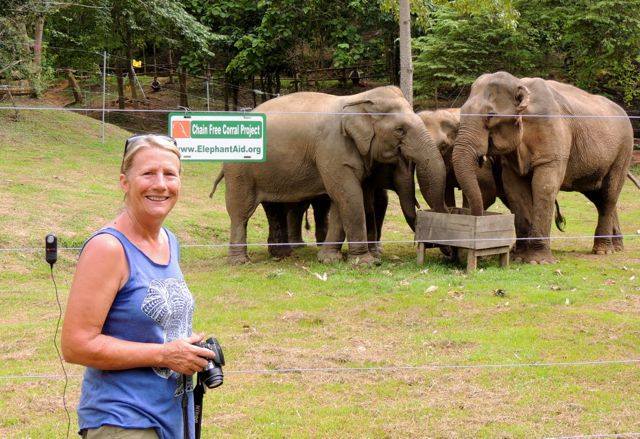
But now, with national forest use no longer an issue, there is no compromise required – chains will have no place at the care center.
You can imagine how excited I am about this unforeseen turn of events! I had almost been convinced that in India elephants will never be completely free of chains. But with our land expansion we will be able to do just that—keep elephants on a large tract of forested land, free of chains and dominance.
Infrastructure development and acquiring land
As result of this positive shift in the design of the project, we need more time for preconstruction development than earlier projected. We must conduct an expanded survey to identify land ownership. Surveying the entire tract of land will provide the legal assurance required prior to constructing the miles of necessary trenching and fencing.
This expansion also requires a follow-up communication to the government informing them of our desire to expand…even before we have begun!
We also have the challenge of acquiring a small parcel of land that is essential to the project but is currently occupied by another person. We have received assurance that this parcel of land—approximately seven acres—can be acquired.
In India, land rights are complicated but well defined, if not always enforced. In some cases property owners hold a deed and are permitted to sell to whomever they choose. In other cases, villagers and tribals who receive land from the government are allowed to pass the land down to family members, but are not allowed to sell outright.
Becoming familiar with the regulations is essential for anyone intending to own, lease or occupy land in India.
I am told that when it comes to land, possession is nine-tenths of the law and even in cases in which the land cannot be sold, occupants can accept payment to vacate. As I understand, once they have vacated the land, another person can occupy it, with stipulations that it be used for some agricultural purpose or forest restoration and it can never be sold. One small parcel of land essential to our project falls in this category.
I am keeping a positive outlook about acquiring this piece of land, which stretches across the edge of the lake, one of the essential areas for our elephants. Negotiations are underway. All I can do right now is wait.
Co-existing with wild elephants
In the meantime, I am tracking the movement and land use of wild elephants in the area. There is one section of the care center land they frequent. All the collaborators have agreed that no care center land used by wild elephants will be blocked to them. Our goal is to be mindful that our project, although well meaning and helpful to captive elephants, not cause hardship to wild elephants who use the land.
We have identified a small corridor just inside the care center property, adjacent to the national forest, where wild elephants leave the forest to enter the care center property. They have a well-established path, which will remain open for their use.
Protecting this wild elephant corridor is another unexpected development that makes me even more excited about the care center project. Being able to create a healthy space for captive elephants to recover and thrive, while at the same time preserving land for wild elephants who migrate through the area, feels like the right thing to do.
Care center and bird sanctuary
With an estimated 180 different species of wild birds in the area, the care center property is already a bird sanctuary. Never before have I been so enthralled by bird watching but from day one I was in awe of the many different birds and their beauty.
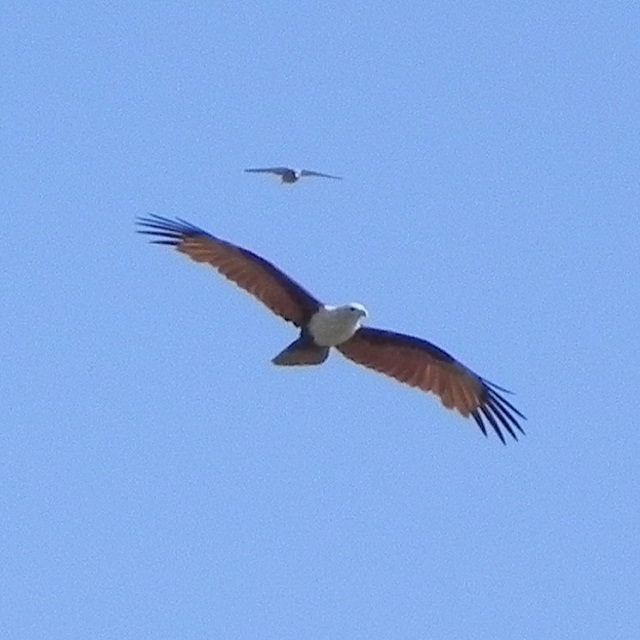
The lakes draw a variety of fishing birds, from the Indian Pond Heron to the regal Brahminy Kite. Their nonstop activity, sometimes entertainingly comical, has sparked my interest in studying these winged creatures with whom I now share my space.
The animated and gutsy Blue Eared Kingfisher was the first to catch my attention. His fishing perch is feet from my outdoor office. The first time I watched him make a catch, I admit to being a bit shocked that this minute blue bundle of constant movement disarmed his prey by bashing its head against a rock.
I’ve observed Brahminy Kites collecting branches for nest building, a trio of Red-Wattled Lapwings singing a chorus, a Black Shoulder Kite dive-bombing to catch a mouse and a Great Cormorant perching on a branch 30 feet above the lake on its awkward looking webbed feet. I’ve seen egrets of every size follow the resident horses, snatching up displaced insects. Then there were the stunning Rufous Treepie, Red Whiskered Bulbul and a pair of White Browed Wagtails who chased a Crested Serpent Eagle away from their favorite tree.
Being able to observe so much winged activity has opened a new world to me.
Survey and land
Surveying the expanded land is the next step required to move forward on this project. Acquiring the seven-acre parcel of land currently in negotiations will come after that, followed by a government endorsement of our expansion. All this needs to be accomplished before beginning construction.
Fencing and trenching
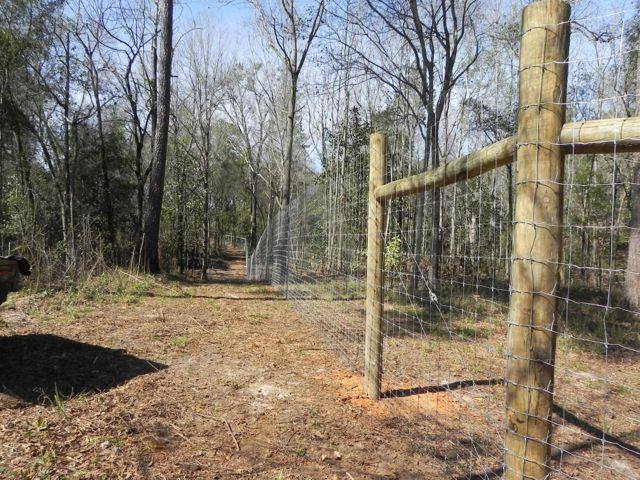
Only after the survey is completed, the extra parcel of land acquired and government approval secured can we begin work on the perimeter trenching and electric fence required to keep wild elephants out and our care center elephants chain-free inside. The fencing is estimated to cost $7 per foot/$36,000 per mile. The approximately four miles of trenching and electric fence will come to about $142,000.
Compare this to the average $100 per foot elephant sanctuaries in the US spend on fencing. For 7 percent of the cost, we can provide a safe and secure, chain-free environment for needy elephants in their authentic natural habitat while simultaneously protecting wild elephants and their land.
I am very anxious to move forward on this project but am cognizant that we cannot overlook any step or detail in our enthusiasm to make the care center a reality. If great journeys are launched one step at a time, who knows where helping one elephant at a time will take us.
Please visit EAI’s Facebook page so I can keep you updated on our progress as it happens!
Thank you for your interest and continued support. This care center promises to be more than any of us ever expected. Thank you for sharing my dream.
Carol