Tag: circus elephants

  • Jenny and Shirley’s reunion

    Jenny and Shirley’s reunion

    Recently, a friend emailed me a question: “During the filming of “The Urban Elephant” documentary, what was going on in your mind (and heart) when Shirley and Jenny were trying to get close to each other?”

    I realize many of you may be curious as well, so I decide to share with all of you.

    “The Urban Elephant” film crew had been at the Sanctuary all day and had just left for dinner when Jenny approached the barn. She and Shirley had not yet met.

    When Jenny first stepped inside the barn she was calm, but when she saw Shirley she became agitated. She reached through the stall toward Shirley, intensely focused on her. Shirley showed little interest but finally responded to Jenny’s attention by stepping close enough to be touched.

    Jenny’s agitation grew. She extended her trunk all the way through the bars, reaching out, touching, talking to Shirley. Shirley stood parallel to the corral allowing Jenny to touch all over her, but continued to show very little interest. Jenny began to work herself up into frenzy, very uncharacteristic behavior for her.

    Scott and I were sitting inside the barn only a few feet away, watching. I was filming.

    Jenny was animated and anxious; she wanted to get closer to Shirley. Shirley remained calm. But when Jenny placed her truck up to Shirley’s mouth, Shirley froze. Her posture changed, she became a little rigid and then turned to look at Jenny. She reached over to touch Jenny’s mouth and what followed was undefinably powerful and life changing for all present.

    Looking straight into Jenny’s eyes, Shirley erupted into a huge baritone roar. Caught completely off guard, I thought a bomb and an earthquake had simultaneously hit the barn. Her bellows ignited Jenny’s bellows, which together literally shook the barn.

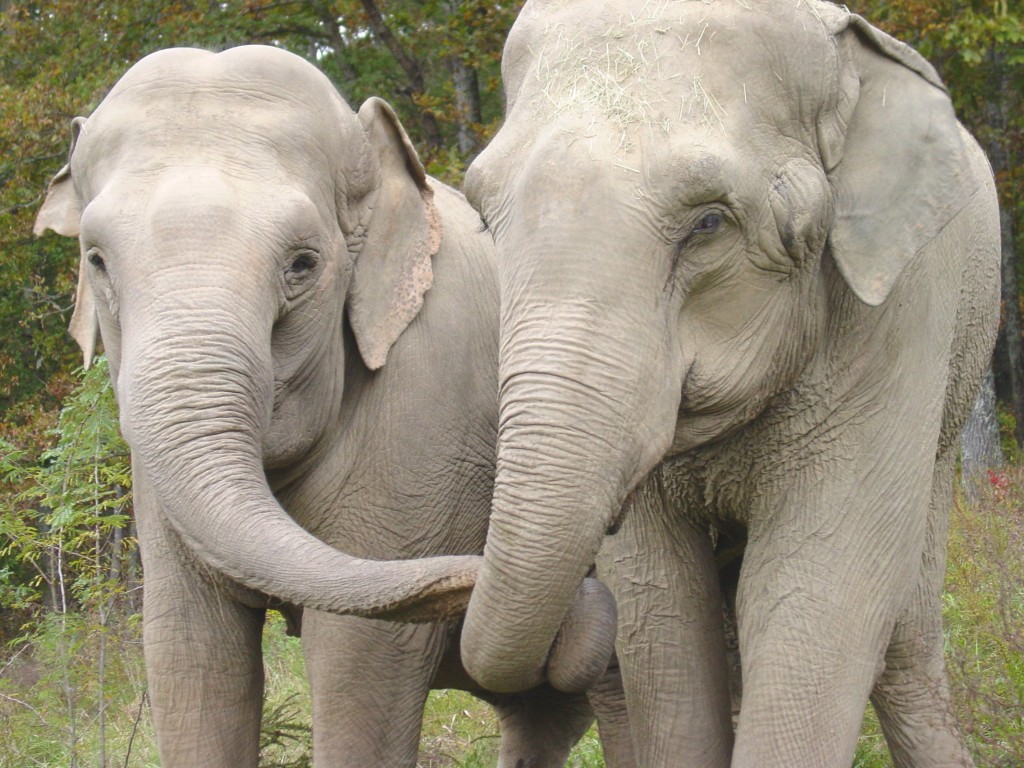
    With her head held high and mouth gaping open, Shirley roared and gently touched all over Jenny’s smiling face. Jenny’s body immediately relaxed as she continued to grope and pull at Shirley through the bars and bellow. The volume of their shared roars was deafening.
    The energy in the barn was so intense I had to step outside the door to catch my breath. Seriously, I could not breathe. I did not yet fully understand what was happening. I had only seen such a display of emotion once before when a baby elephant at a breeding facility was separated from his mother for the first time. The two nearly killed themselves trying to climb over the corral to get back together. Their roars were one and the same with Jenny and Shirley’s.

    This memory flashed though my mind and within seconds I understood. Jenny and Shirley had known each other before and during that time had forged an intensely close relationship. This was a reunion.

    The powerfully joyful vocalizations continued for some time, with Jenny and Shirley groping each other all over. I cannot convey how thick the love was in the air. I was too caught up in the emotional exchange to register just how long this went on but it could have lasted close to 30 minutes.

    By the time the volume of their reunion subsided, Shirley was emitting short, sweet sighs and Jenny had melted into the steel bars that separated them, their trunks draped across each other faces.

    I knew I had just witnessed a miracle, the first of many that I would be privileged to witness in the years to come.

  • Proposed elephant rides in Kentucky

    Tuesday I spoke at a Kentucky Department of Fish and Wildlife Resources (KDFWR) public hearing in opposition to the proposed amendment to state regulation 301KAR2:082. If this amendment passes, elephant rides will be allowed in the state of Kentucky for the first time since 2005.

    KDFWR representatives appeared receptive to the information I provided regarding elephant behavior, harsh trainer treatment and the risks the city accepts when allowing an inherently dangerous exotic animal to share common space with the public. If they grasp the immense risk elephant rides pose, they will surely oppose the amendment.

    What prompted the ban nearly seven years ago was an elephant attack at the Louisville zoo that left a man seriously injured. The elephant, Kenya, was privately owned and contracted by the zoo for elephant rides.

    The day of the attack Kenya was in an off-exhibit area with her trainer. It was standard practice for Kenya to wander around the enclosed area unchained. But while the trainer was distracted in another area of the enclosure, Kenya opened a gate and wandered out into the zoo.

    It was the end of the day and very few zoo visitors were present. A man saw Kenya and walked up to her. Reports indicate that he tried to control her, but she lashed out at him, inflicting serious injury.

    The incident resulted in lawsuits against the zoo, the city and Kenya’s owner. The man recovered and Kenya was not harmed.

    Following the attack, in recognition of the dangers posed by some species of wild and exotic animals, KDFWR banned public contact with a long list of inherently dangerous animals, including elephants.

    One supporter of the ban is the Primate Rescue Center, co-founded by April Truitt.  Many of the species that her organization rescues and protects are included in the ban.

    Currently KDFWR is being lobbied by the Kosair Shriners to amend the regulation and allow elephant rides. The Kosair Shriners continue to offer elephant rides at their annual circus fundraiser in defiance of the regulation. Their position at the meeting was that elephants are not dangerous, at least not the ones they hire.

    Lobbying to stop elephant rides does not guarantee better welfare for elephants but it does provide an opportunity to educate people about the inappropriateness of the activity.

    Send your comments to:

    Ms Rose Mack

    Kentucky Department of Fish and Wildlife Resources

    [email protected]

    (502) 564-5136 (Fax)

  • The Art of Cultural Brokerage: Recreating Elephant-Human Relationship and Community

    An article by Carol Buckley and G.A. Bradshaw, Ph.D., Ph.D., on how sanctuary creates a healing trans-species community in which humans and elephants live together. In sanctuary, the humans function as catalysts, interpreters and negotiators of relational repair for elephants in recovery from trauma.

    Read the full article.

  • Elephant Aid International Creates First-Ever Elephant Care Center in India

    Hohenwald, TN, October 27, 2011 – Elephant Aid International (EAI), a Carol Buckley Project, announces its official partnership with the Wildlife Rescue & Rehabilitation Centre (WRRC), one of India’s foremost wildlife organizations, to create the first prototype Elephant Care and Rehabilitation Center in Karnataka, Bangalore, India.

    With the endorsement of the Indian government, this private project will serve as a model for future care and rehabilitation centers throughout the country. The center will rehabilitate elephants who have been removed from the confines of zoos, circuses and temples, and offer them a more natural lifestyle, free of chains and negative management techniques.

    Carol Buckley, founder, president and CEO of EAI, will supervise the Center’s development, training of mahouts (elephant handlers) and elephant acquisition and relocation. This first facility will house up to seven elephants.

    “We are honored to partner with WRRC on this landmark project,” said Buckley. “I believe this care center will be a beacon of hope and a challenge for change for people working to improve the lives of captive elephants.

    There is an urgent need for care centers (what are known as sanctuaries in the U.S.) in India. In November 2009, the country’s Central Zoo Authority mandated that all elephants be removed from zoos and placed in alternative facilities better suited to address their needs. India’s wildlife parks and game sanctuaries are not well suited for zoo elephants and, until now, no other alternative existed.

    In August 2010, the Elephant Task Force of India’s Ministry of Environment and Forests issued a set of recommendations, including the creation of state-of-the-art lifetime care centers.

    Designed to provide freedom of movement and a healthy social environment, care and rehabilitation centers will provide a safe place for elephants to escape the abuses of captivity.

    • The centers will support the rehabilitation of elephants suffering from physical and psychological trauma by providing a more naturalistic environment.
    • They will not involve tourism.
    • The grounds will be fenced, eliminating the need to restrain elephants with leg chains.

    All mahouts will be trained in Compassionate Elephant Care techniques, a system developed by Buckley that is based on understanding elephant biology, physiology and psychology; relationship building between the mahouts and their elephants; and positive reinforcement.

    The number of elephants housed at the Center will be limited to ensure there is adequate vegetation for them on-site and in the bordering national forest. The elephants will have access to areas of the forest during daylight hours and will return to the Center at night.

    The Center is based on The Elephant Sanctuary in Tennessee, which Buckley co-founded and led to international recognition as one of the leading models of humane management of elephants in captivity.