Tag: elephant abuse

  • The Suffering Continues At Nepal’s Top Tourist Destination

    The Suffering Continues At Nepal’s Top Tourist Destination

    EAI‬ has been “boots on the ground” in ‪Nepal for nearly five years. Initially, much of our efforts were focused on improving welfare for the privately owned ‪elephants used for tourist rides.

    We’ve provided free pedicures and husbandry and training advice bi-annually since 2011. But today the safari elephants of ‪Chitwan suffer to the same degree as they did when we first started. As long as ‪tourists pay to ride elephants, the elephants of Nepal will continue to be exploited.

    One way for you to help is by supporting groups actively working to influence tour companies to drop elephant safaris from their tour packages. Elephant Watch Nepal is one such group.

    Old abused ele
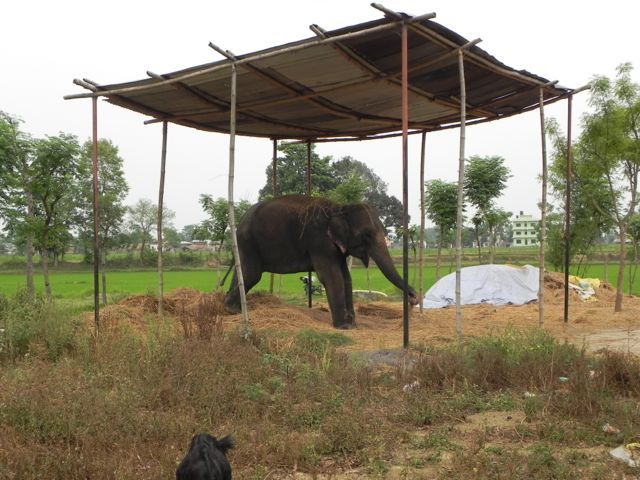
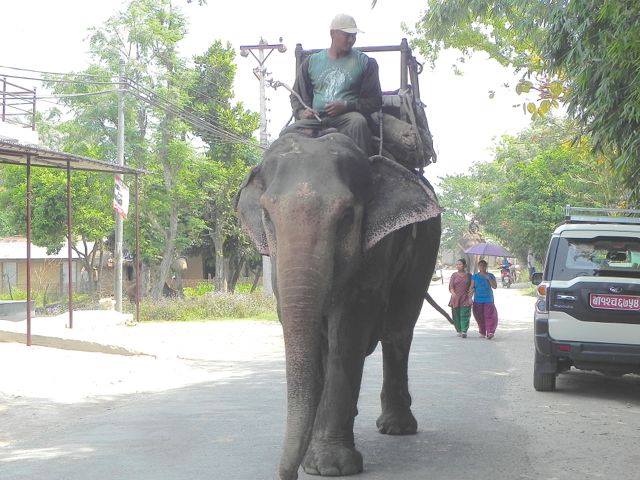
    Six months ago we found this elephant being walked along a busy highway, in the midday scorching sun, on a 30-mile walk back from a party she’d been hired for.

    Today we found her in Sauraha on her way to the tourist ride area.

    saggy dehydrated flesh
    Saggy, dehydrated flesh

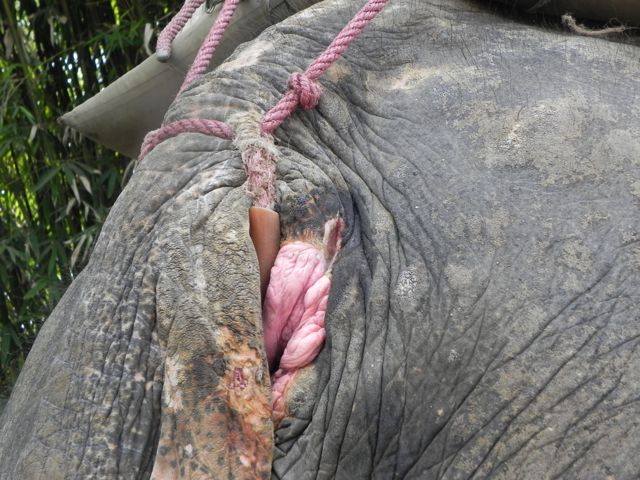
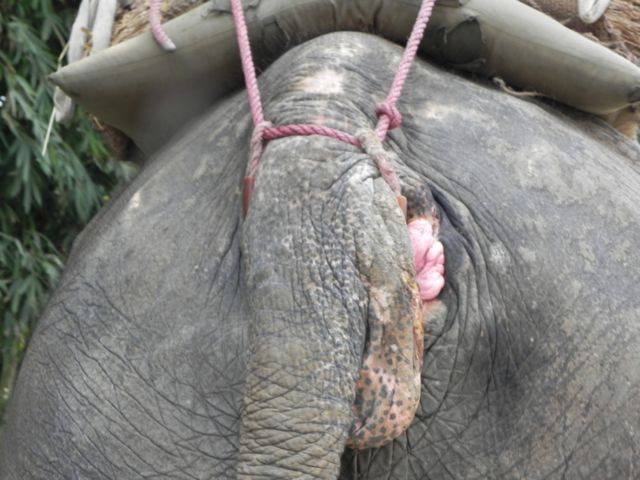
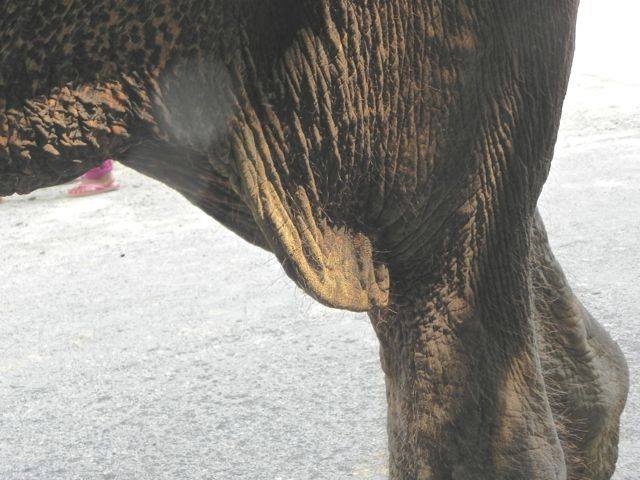
    This old elephant is blind, dehydrated, exhausted, underfed, continually beaten and suffers from deep gouges around her anus from the howdah (saddle) rope.

    Painful wounds caused by nylon ropes
    Painful wounds caused by nylon ropes used to tie the howdah (saddle) on for tourist rides
    torn anus
    Torn anus

    The owner and mahouts are aware of her injury and how to prevent and treat it. But they do nothing to ease her suffering.

  • Sunder the Elephant Embarks on New Life

    sunder__family_bannerghatta_zoo_india-1_med
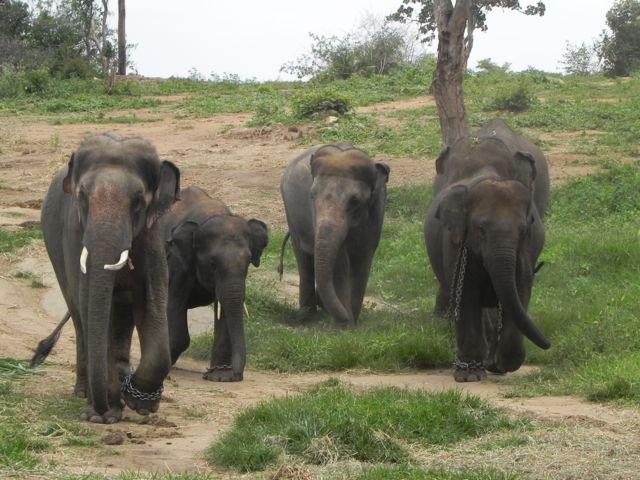
    Sunder (left) with his new family

    Elephant welfare expert Carol Buckley says rescued elephant is in good hands at model facility.

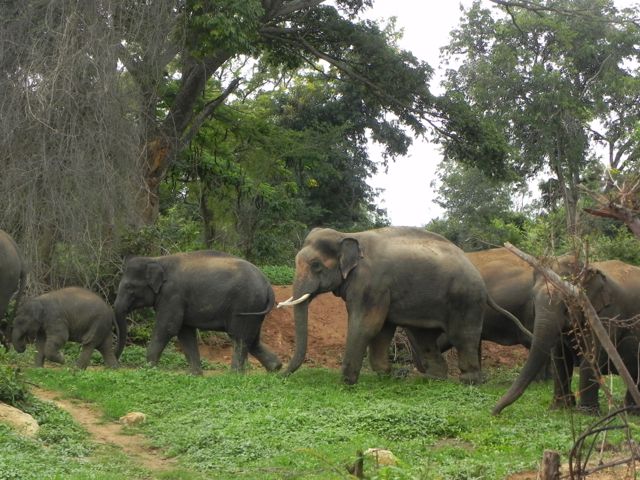
    More than a month after his rescue from a life of horrific suffering, 15-year-old bull elephant Sunder is enjoying lush forests, cool ponds and the close companionship of 14 other elephants at the Bannerghatta Biological Park (BBP) outside Bangalore, India.

    Sunder’s tragic plight touched the hearts of people from all around the world and galvanized an international social media campaign that helped win his release and recovery.

    sunder_and_family_india_2_med“Sunder has a new life and a fresh start at a wonderful facility,” said Carol Buckley, an expert in innovative approaches to elephant welfare in captivity, who recently visited Sunder in India to design a chain-free facility at the park where he now lives.

    “Thanks to the courage of the Supreme Court of India, which ruled against Sunder’s longtime abusers, the willingness of BBP to accept Sunder for permanent residence and the tireless logistical and legal efforts of PETA India, Sunder’s future looks very bright.”

    Buckley, who founded and leads the US-based nonprofit Elephant Aid International, says BBP has all the desired components for captive elephants. Its 122 acres of diverse habitat include open pasture, shaded forests and ponds, where the elephants are free to roam and play during the day. At night, they are given access to the adjoining national park forest for foraging and exploration.

    The upcoming construction of a custom designed, solar powered, chain-free perimeter fence system to enclose the entire daytime habitat will give the elephants even more autonomy. The fence creates a safe containment area, eliminating the need for mahouts to dictate the elephants’ activities. It should be completed before the end of the year and will be the first constructed at any zoo in India.

    Buckley noted that unlike most elephant facilities throughout the world, BBP’s mahouts manage their captive elephants in a “herder style” manner that supports their physical, emotional and mental health. This style of management acknowledges elephants’ nature as highly social, herd animals, giving them freedom to wander at will while mahouts keep a watchful eye on their whereabouts.

    “Bannerghatta Biological Park, working in partnership with PETA India, offers the world an exemplary model for managing captive-held elephants and the best possible new home for Sunder,” said Buckley. “I’m so grateful for their efforts.”

  • Elephant Back Safaris: Misery for Elephants

    Elephant Back Safaris: Misery for Elephants

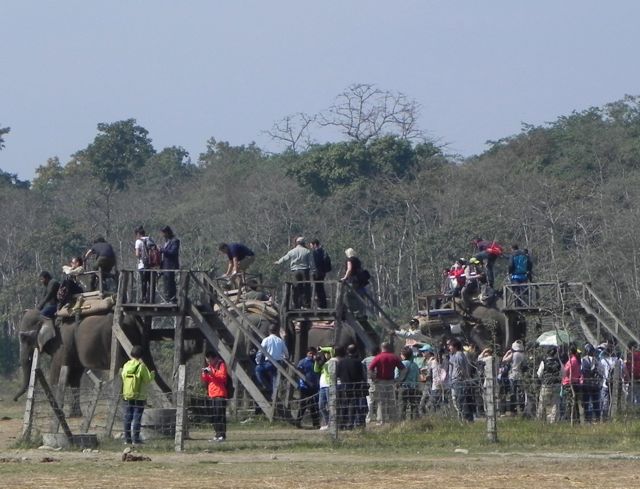
    boarding safari rides

    May 24, 2014, 8:30AM, Sauraha, Nepal.

    The temperature is already 32 degrees Celsius (about 90 degrees Fahrenheit).

    Tens of elephants are already hard at work.

    Each morning at dawn, seven days a week, elephants are saddled up in preparation for another day of carrying tourists on safaris.

    This is the routine the elephants will follow, year in and year out, until they die.

    First, they are forced to lower themselves onto their elbows to accept the saddle. This unnatural position causes pain and irreversible damage to their elbows.

    Next, a heavy canvas pad and ill-fitting howdah (saddle) are placed on their back. The pad and howdah are each so heavy, it takes two men to lift them, one at a time.

    Then, a howdah strap is cinched tightly around their chest, lacerating sensitive flesh in their armpits and cutting the tissue of their breasts.

    A second synthetic rope is tied from the back of the saddle under their tail, ripping deep gashes in the flesh around their anus.

    The life of the safari elephant

    3 eles carrying tourists

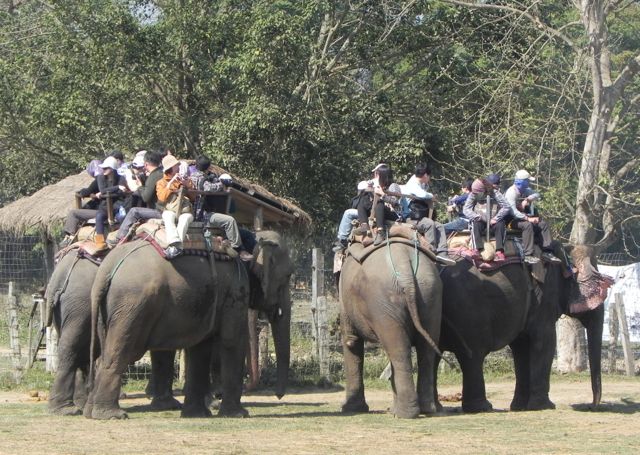
    Safari elephants spend the day carrying tourists — four to six at a time — through the jungle in sweltering heat.

    Elephants are poorly suited for this activity. The pad and howdah cause huge blisters that fester into deep abscesses that can take months to heal.

    According to a study published in the Journal of Experimental Biology, four hours of exercise in the sun causes overheating and can be fatal. Laboring in direct sunlight, carrying too much weight – pad, saddle and tourists — elephants quickly become overheated.

    What does it take to force an elephant to work under such conditions?

    Brutality.

    Mahouts hit the elephants over the head with heavy sticks, metal knives and axes. The wounds remain infected for weeks.

    Bright white scarring can be observed across the forehead of virtually every working elephant in Nepal. The abuse is systematic, accepted by elephant owners, locals and the tourists.

    The images haunt me.

    I can’t help but wonder: Is this the memory of Nepal tourists want to take home with them? And what will it take for them to see the abuse?


  • Elephant abuse in Nepal: Are the mahouts really to blame?

    Elephant abuse in Nepal: Are the mahouts really to blame?

    private owner NepalIt’s easy to look at an elephant shackled by both front feet to the ground, with open wounds, and blame the mahout.

    But I challenge you to learn the facts.

    Elephants belong to hotel owners

    In Chitwan, Nepal, mahouts do not own elephants. Elephants are the private property of hotel owners, who use them to augment their income by offering elephant back safaris to overnight guests and daytrippers coming to Chitwan in search of fun and adventure.
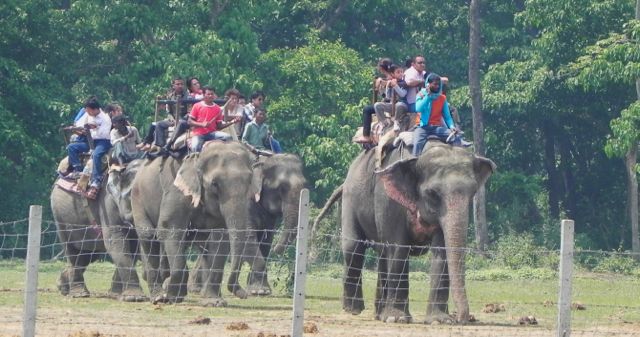
    tourist safariElephant back safaris not only provide a bountiful financial benefit for the owner, they are actually the life’s blood of Chitwan.

    In Sauraha, Chitwan’s tourist destination, every shopkeeper, restaurant owner, hotel, bar, service provider, wilderness guide, money changer, street vendor and orphanage owe their survival to these elephants. Many falsely claim that without elephant safaris, this tourist destination would cease to exist.

    Grueling work schedule

    All day long, 24/7, mahouts and elephants give safari rides in the community forest.
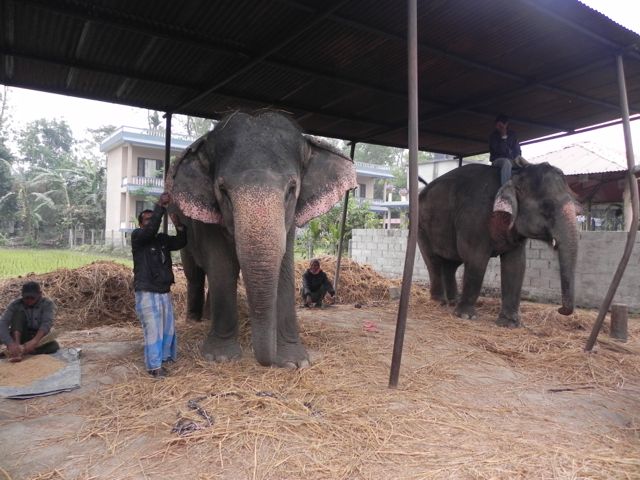
    private owner stableMahouts train, feed and ready the elephants for the rides. It is a grueling job for both.  Up at 4:30am, the pair sets out on the long trek to the safari loading area as the rising sun lights up the morning sky.

    During what is supposed to be a one-hour lunch and rest period, the elephants instead are taken to a riverfront area where tourists mount them to have their photo taken.

    Walking back and forth to the safari ride area, tourist bathing area and home stable, while carrying hundreds of pounds of tourists for hours at a time, takes its toll on elephant and mahout alike.

    At dusk, and even into the dark of night, elephants can be seen silhouetted against the sky trudging down the paved roads of Chitwan toward their home stable.

    Mahouts: Overworked, underpaid and devalued
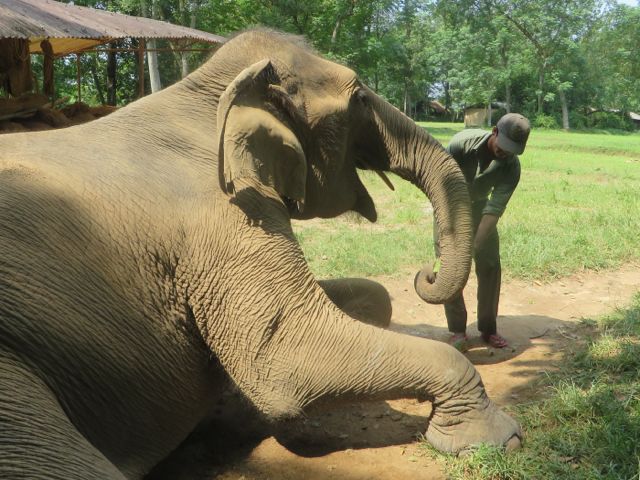
    img_8199-2
    Elephant owners know nothing about elephants and rely on the mahouts to keep the elephants alive and working without killing tourists. This is a heavy burden to put on overworked, underpaid and devalued employees.

    When mahouts “ask for more,” be it food for themselves or the elephants, they are chastised. Many owners view the mahouts as stupid, uneducated and unmotivated and blame them for the elephant’s unsanitary living conditions and poor health.
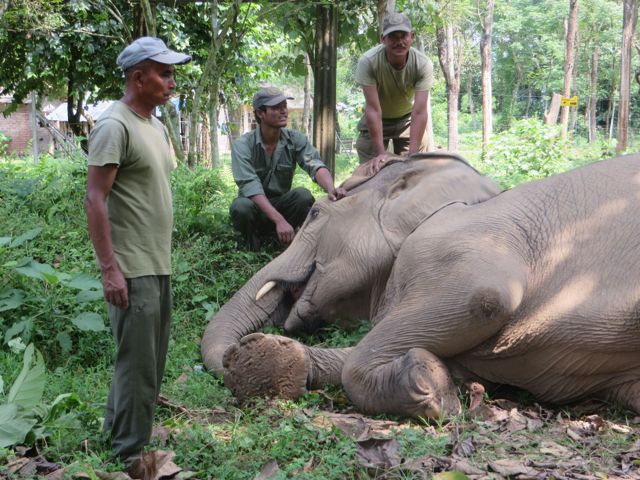
    3 mahouts & ele

    Yet mahouts are not provided even the most basic supplies to ensure the health and wellbeing of the elephants in their care. Owners fail to supply nutritious food but blame the mahouts for the elephant’s poor health. Stables are rancid cesspools because no provision is made for waste disposal. Many stables don’t even have a source of fresh water. For this, the mahout is unjustly blamed.

    A marginalized community
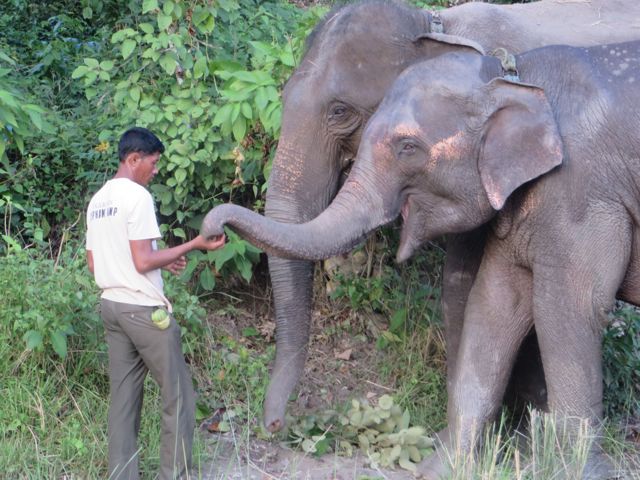
    img_8462
    The truth is that the mahouts are a marginalized community. The custom of treating them as poorly as the elephants is woven into the fabric of society and their living conditions are a mirror image of those of the elephants.

    Mahouts learn their trade on the job, from senior mahouts. Their lot in life dictates they do as they are told without question. They hit the elephants because they are taught they must in order to ensure the elephant does not kill them.

    Still, this does not excuse how the mahouts mistreat the elephants.

    Abuse can be eliminated

    Through education and culture shifting, elephant abuse can be eliminated.

    Demonizing either owners or mahouts is not the solution.

    The first step is understanding why the situation exists and accepting the challenge to help move culture forward.

    Owners must be held responsible and mahouts and tourists must be educated.

    This will result in improved welfare for the elephants in Chitwan.

    How we can help
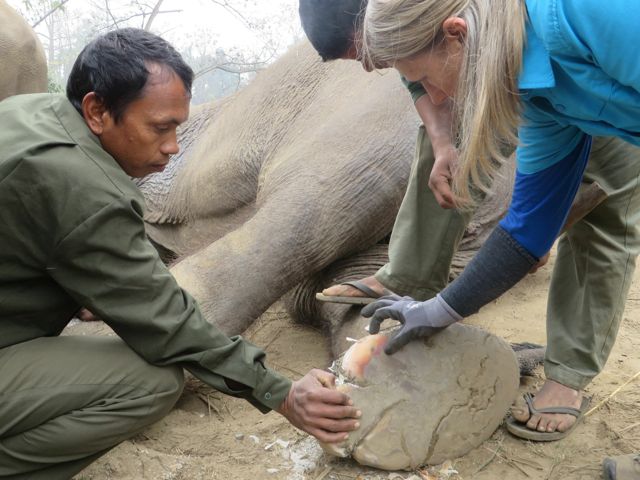
    carol-indicating-how-much-on-ele-foot-with-2-mahouts_medDeveloping sustainable assistance programs is essential. Live demonstrations, educational resources such as videos and manuals, translators and hands-on assistance are needed to improve mahout knowledge and understanding of new approaches to elephant care.

    This is Elephant Aid International’s mission. By providing bi-annual foot trimming; training mahouts and vet techs in the skill of foot trimming; teaching positive reinforcement training philosophy and techniques; and constructing chain-free corrals, we are laying the foundation for positive change.
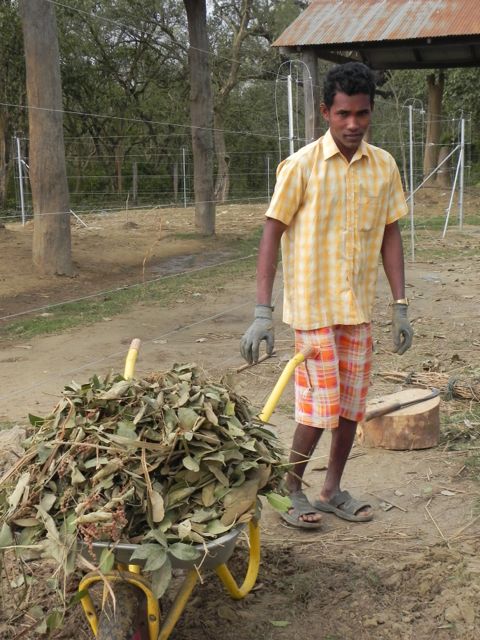
    mahout & wheelbarrow
    EAI doesn’t blame the mahouts. We give them the tools necessary to take better care of their elephants.
  • Proposed elephant rides in Kentucky

    Tuesday I spoke at a Kentucky Department of Fish and Wildlife Resources (KDFWR) public hearing in opposition to the proposed amendment to state regulation 301KAR2:082. If this amendment passes, elephant rides will be allowed in the state of Kentucky for the first time since 2005.

    KDFWR representatives appeared receptive to the information I provided regarding elephant behavior, harsh trainer treatment and the risks the city accepts when allowing an inherently dangerous exotic animal to share common space with the public. If they grasp the immense risk elephant rides pose, they will surely oppose the amendment.

    What prompted the ban nearly seven years ago was an elephant attack at the Louisville zoo that left a man seriously injured. The elephant, Kenya, was privately owned and contracted by the zoo for elephant rides.

    The day of the attack Kenya was in an off-exhibit area with her trainer. It was standard practice for Kenya to wander around the enclosed area unchained. But while the trainer was distracted in another area of the enclosure, Kenya opened a gate and wandered out into the zoo.

    It was the end of the day and very few zoo visitors were present. A man saw Kenya and walked up to her. Reports indicate that he tried to control her, but she lashed out at him, inflicting serious injury.

    The incident resulted in lawsuits against the zoo, the city and Kenya’s owner. The man recovered and Kenya was not harmed.

    Following the attack, in recognition of the dangers posed by some species of wild and exotic animals, KDFWR banned public contact with a long list of inherently dangerous animals, including elephants.

    One supporter of the ban is the Primate Rescue Center, co-founded by April Truitt.  Many of the species that her organization rescues and protects are included in the ban.

    Currently KDFWR is being lobbied by the Kosair Shriners to amend the regulation and allow elephant rides. The Kosair Shriners continue to offer elephant rides at their annual circus fundraiser in defiance of the regulation. Their position at the meeting was that elephants are not dangerous, at least not the ones they hire.

    Lobbying to stop elephant rides does not guarantee better welfare for elephants but it does provide an opportunity to educate people about the inappropriateness of the activity.

    Send your comments to:

    Ms Rose Mack

    Kentucky Department of Fish and Wildlife Resources

    [email protected]

    (502) 564-5136 (Fax)

  • The Art of Cultural Brokerage: Recreating Elephant-Human Relationship and Community

    An article by Carol Buckley and G.A. Bradshaw, Ph.D., Ph.D., on how sanctuary creates a healing trans-species community in which humans and elephants live together. In sanctuary, the humans function as catalysts, interpreters and negotiators of relational repair for elephants in recovery from trauma.

    Read the full article.

  • a need for change, right here at home

    I recently returned from a lengthy trip to Asia, where I taught traditional mahouts (trainers) a gentler, more humane way of training and working with captive elephants.

    Viewing the undercover video exposing the abuse of Tai, the elephant star of “Water for Elephants,” was unnerving. The techniques circus trainers in America use are identical to the traditional, antiquated and abusive methods of breaking and training elephants used by mahouts in Asia that have been handed down for centuries.

    As in Asia, American circuses embody tradition, animal abuse for public entertainment. Being involved in the circus for nearly fifteen years gave me ample exposure to this abuse. Even though we have made huge advances in our knowledge about elephant intelligence and suffering, this tradition has, sadly, thus far failed to evolve.

    There is an alternative to these harsh training methods, if indeed elephants must be trained. I am pioneering the field of positive reinforcement training in the traditional free contact environment in Asia. Although I do not condone the commercial use of elephants, I am realistic enough to know that my personal concerns will not put a stop to the shows and rides that exploit elephants there. Only through education targeted at elephant trainers, mahouts, and the insatiable public can the abuse be curtailed and eventually stopped.

    It is uncanny that Tai’s abuse was exposed as result of her portrayal of an abused elephant in “Water for Elephants.” By enforcing existing regulations and strengthening laws to protect the innocent, the antiquated training practices of the circus in America can be eradicated.

    I am of the firm belief that if the only way an elephant can be on public display is to be dominated with harsh control methods then we, as a society, are required to forfeit the opportunity to have elephants in captivity.