Tag: elephant calves

  • The Work Continues to Get Elephants Off Chains

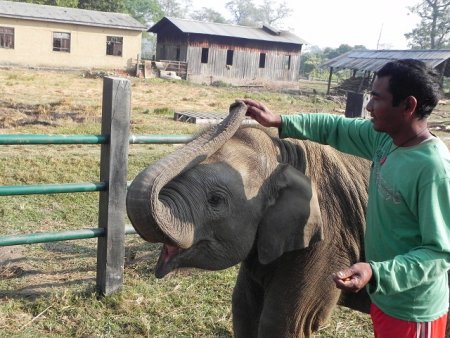
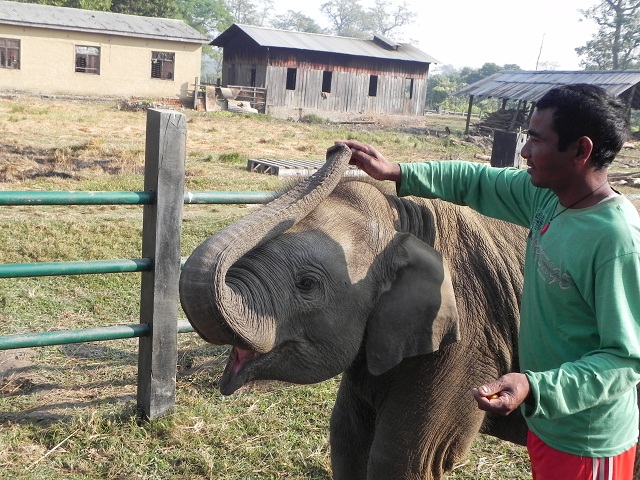
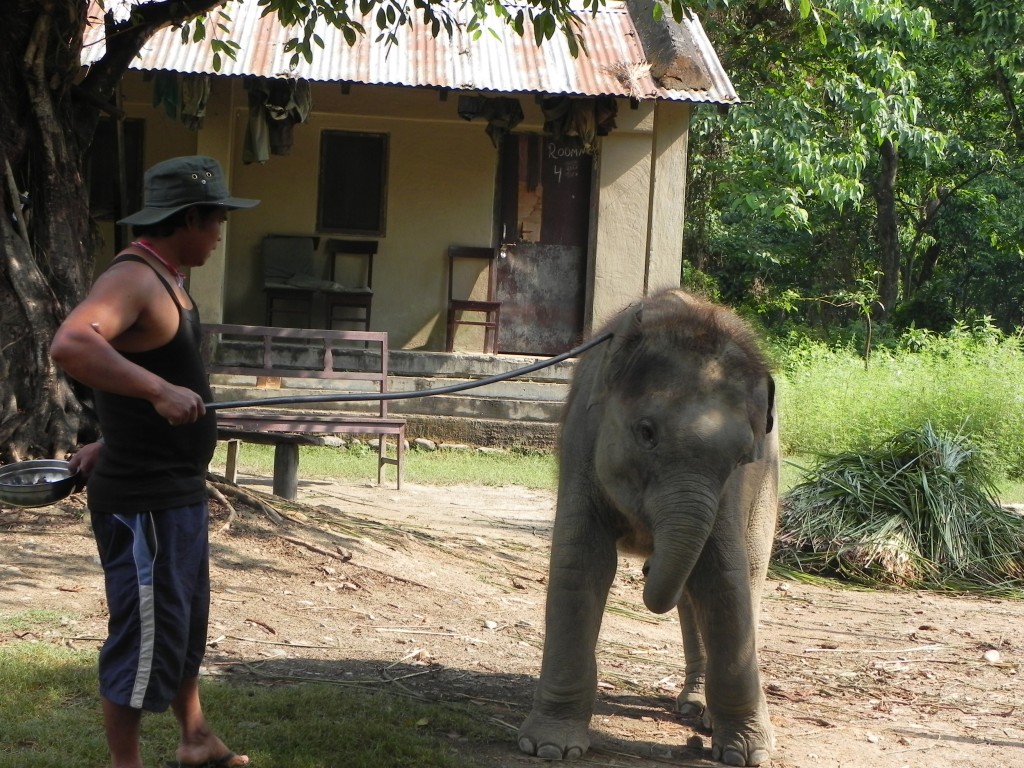
    Good news! Baby Tec Gaj was released from chains.

    Unfortunately, it is not all good news because his mother, Puja Kali, was not.

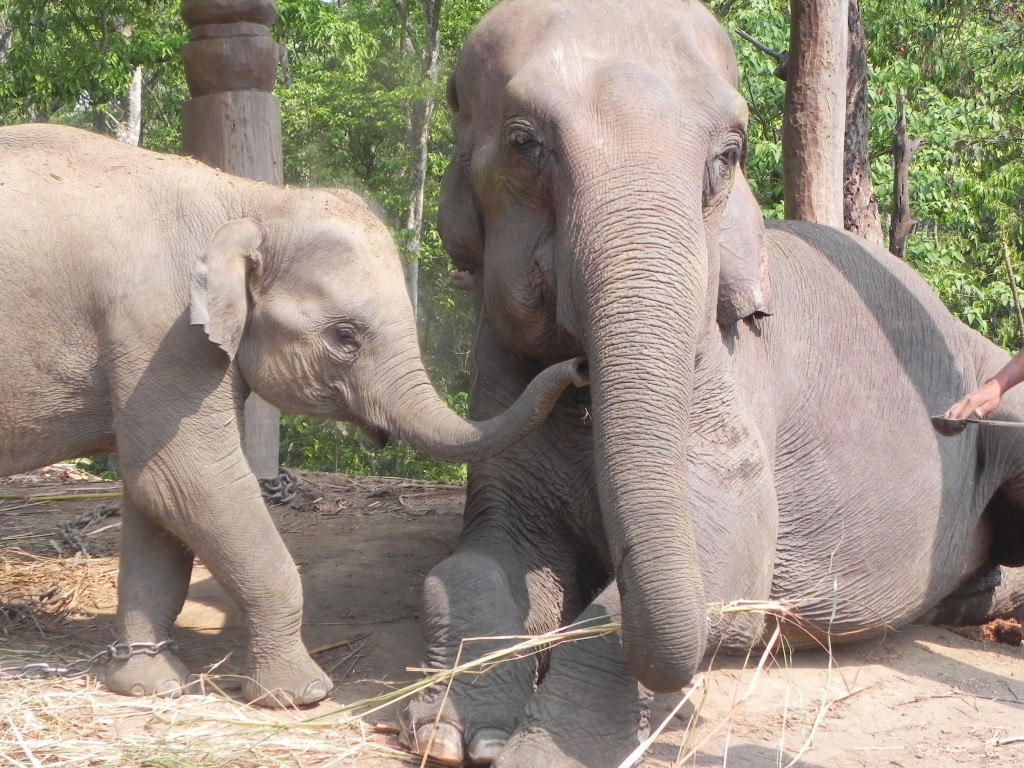
    Two-year-old, captive-born Tec Gaj and his mother Puja Kali reside in Khorsor, ‪Nepal, at the government breeding center.

    Puja Kali is quite aggressive, known to attack her mahouts even while she is on chains.

    Such aggression is an indication of great suffering, usually on a mental and emotional level.

    Responding to Puja Kali’s aggression with corporal punishment compounds her condition but mahouts find themselves with few alternatives.

    Aggressive behavior exhibited by ‪elephants triggers retaliatory aggressive behavior by the mahouts. Aggression breeds aggression, resulting in a vicious cycle in which neither man nor elephant benefits.

    EAI does not endorse the use of any negative means to manage elephants and we empathize with the position the mahouts and captive-held elephants find themselves in.

    Hopefully, with our continued efforts, the day will come when aggressive elephants will no longer be used for activities that put them and their mahouts in danger. And, mahouts will learn alternative ways to care for their elephants.

  • Blending of Two Worlds

    Blending of Two Worlds

    Haatha, hati, hatti, hathi, are all words referring to the Asian elephant. Kipling, in his infamous Jungle Book, gave life to his supporting character, naming him Colonel Hathi.

    There is something pure and powerful about the Colonel as the representative of an entire species. He becomes more than himself: he is the conduit to the world of elephants, their ancient culture and lives.

    I am continually amazed by the impact elephants have on people. Even those who have never been in the presence of an elephant can become obsessed with protecting them. It is as if elephants can reach into your soul and light a spark that defies reason. Their culture is complex, their nature compassionate and resilience indefinable.

    A wild bull joins Sunder and friends

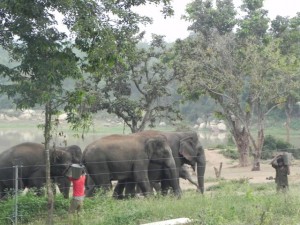
    Recently I experienced a scene that touched me deeply. I was at the Bannerghatta Biological Park (BBP) in India to inspect the chain free-enclosure I’d designed for Sunder and his new family.

    The staff excitedly told me that a young wild elephant had entered the enclosure 15 days prior and remained inside. I found this disconcerting. I imagined the young bull to be frightened and holed up in the back reaches of the 122 acres, hiding from the scary humans who surrounded the entrance and exit of the enclosure.

    As I walked the fence line inspecting the corral, there were signs of another inspection. The young bull had made his rounds, leaving footprints and signs of dusting and foraging along the fence line on the inside, but no damage. I had no doubt that he was looking for a way out.

    Yet, although the fence was newly completed and would not be operational until after my inspection, this jungle, pronounced junglee (wild) hatti (elephant) did not breach it. The solar power energizer had not yet been turned on, the fence wasn’t yet powered, so the bull would have felt no discomfort if he pushed through it to escape. I was curious why he hadn’t.

    The jungle hatti appears

    About two hours later, the mahouts became active, calling to each other and moving to the exterior of the enclosure, closer to the fence line. The mahouts understand the danger of wild elephants; I was told they were afraid of this hatti because he was wild.

    When I first saw the jungle hatti my heart melted. He was just a kid, maybe 10 years old. His skin pigment was much darker than that of the two captive-held BBP residents who accompanied him into the clearing. The three stuck together like glue, with the jungle hatti sandwiched in the middle.

    The mahouts nervously checked their escape routes. The jungle hatti tensed when they started yelling to warn each other that the wild one had emerged from the forest. I was in awe at the scene unfolding.

    Once the hatti and his friends converged with other herd members, the tension in the air dissipated. All the elephants appeared quite comfortable with their wild cousin. In fact, they seemed to know each other quite well.

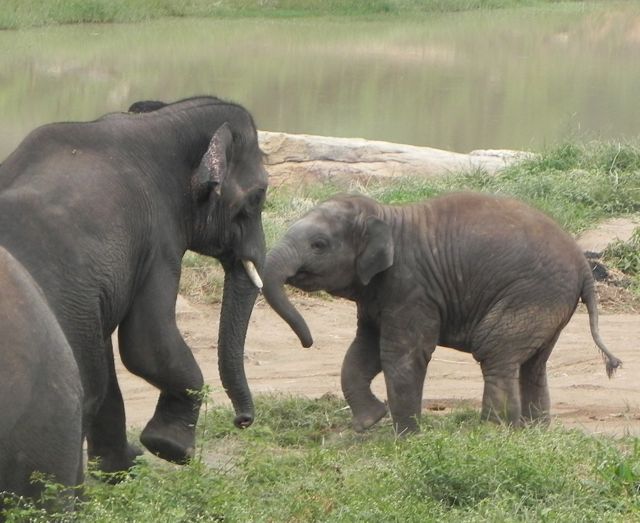
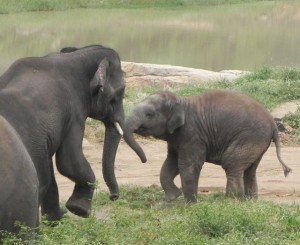
    Shiva, the baby of the herd, could not get enough of his wild friend. He followed him around, pushed and shoved on his legs and trunk, trying to get the jungle hatti to play. What a sight — tiny Shiva and this wild 10-year-old, acting as if their interactions were common place. And perhaps they were.

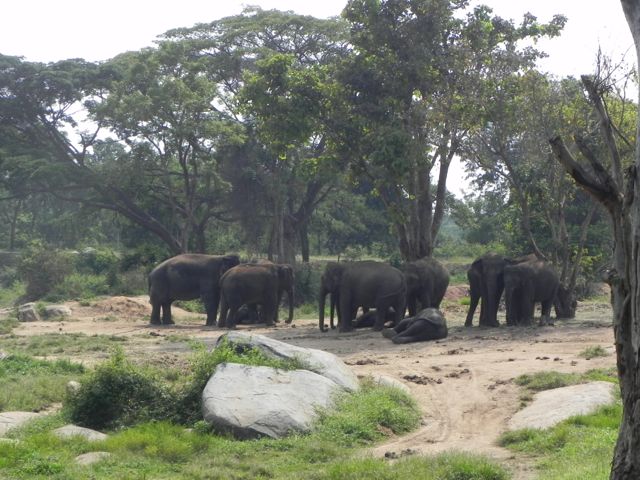
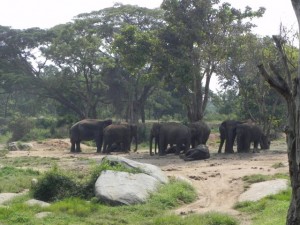
    During the daytime hours, the BBP herd is on exhibit in the drive-through safari section of the Park, corralled in a pasture area with a sizable pond. The new 122-acre chain free enclosure eliminates the need for the elephants to be chained during the day to contain them.

    But at night, the entire herd is released in the nearby National Park to forage and commune with wild elephants. Captivity is a burden for elephants but this arrangement, releasing the elephants into the wild overnight, is genius and the healthiest captive situation I am aware of in India.

    An adoptive family

    Throughout the day, the jungle hatti continued to interact with the entire herd. When Shiva became too much of a pest, as a younger sibling sometimes is, the jungle hatti pushed Shiva off his feet. Without a single vocalization Shiva’s mother and aunt instantly moved in on either side of him.

    I realized I was holding my breath when the elephants relaxed and returned to eating. Shiva got up, brushed himself off and went right back to pestering the jungle hatti.

    It was then that I understood the relations was familiar. For whatever reason the jungle hatti left his biological family and had joined the BBP family. And they had accepted him.

    He grazed with them, swam with them, dusted with them, communed with them. The only thing he had not yet done in the past two weeks was to leave the corral with them, but it was time.

    Food and friends entice

    The mahouts wanted suggestions how to get the jungle hatti to leave the corral. After I assured them that food and the companionship of his friends would entice the wild one to leave the corral, the mahouts had the confidence to implement a plan.

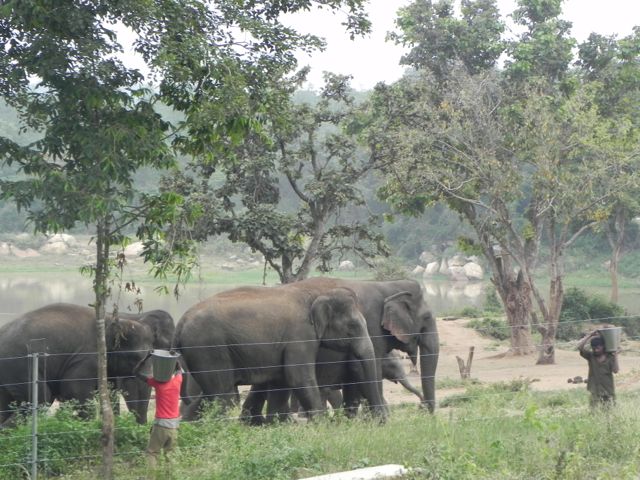
    At 5pm, amidst anticipatory rumbles and trumpets, the food truck arrived. Buckets of prepared treats were unloaded, each containing supplemental, softball-size rice balls. Elephants and mahouts alike were in high gear, vocalizing and dashing around on opposite sides of the corral fence.

    The young jungle hatti resumed his position sandwiched between the two other juveniles as they raced back and forth in unison, moving like a perfectly synchronized school of fish. His head and tail were raised, his eyes bugged. He was afraid, prompted by the noisy humans on the other side of the fence.

    The jungle hatti and his bodyguards hung back while the other elephants were called from the corral. There was organized confusion as the elephants ran in every direction to their appointed mahout and food bucket. As mahouts gently placed the freshly prepared nutritious food balls inside the gaping mouths of their respective charges, the jungle hatti and friends continued to pace the inside of the corral.

    Finally, it was time to see if the plan would work. The empty buckets had been gathered and, along with the nervous mahouts, were sitting in the back of the truck that stood ready to speed away if necessary.

    As the jungle hatti and his escorts made a wide circle back toward the lake, one brave mahout opened the gate.

    The jungle hatti nervously approached the open gate with his friends close on either side. At one point he broke ranks and turned to run away, but his friends quickly sandwiched him and helped guide him out through the open gate. He was seriously frightened but clearly he trusted his friends.

    Once through the gate, it was all butts, raised tails and trumpets of excitement as the entire herd stampeded off toward the National Park.

    The mahouts were all smiles as the elephants disappeared over the hill into the forest.

    I have never before observed a more powerfully moving sight. This herd of elephants–some wild caught decades ago, some rescued from temples, some captive born at BBP–and one wild boy who chose them for his new family.


  • A precious soul lost

    A precious soul lost

    It’s been a pretty intense week. A two-year-old female calf at the breeding center was diagnosed with herpes. Even though she received treatment, she passed away two days later.

    Herpes is near-epidemic among elephants in the US and recently reared its ugly head in Chitwan. Young calves between the ages of one and three seem to be most susceptible but there are records of juveniles and adults dying from the disease as well.

    You’ll remember Bhadra, the fabulous flaming redhead we trained with positive reinforcement in Sauraha, Nepal. He died of the herpes virus last year, shortly before his second birthday. His mahout was so devastated that he left his job and returned to his home village.

    Famciclovir, the treatment of choice for herpes, is not available in Nepal and must be imported from India. A small elephant can require as many as 1000 pills to fight the virus. The exorbitant cost—75 cents per pill—and large quantity needed, made stockpiling the medication impossible.

    The calf was given available medication and was under treatment and constant surveillance as I arrange for a shipment of Famciclovir from friends at Wildlife SOS-India. Unfortunately, the drug did not arrive in time to save her. She died in the night with her mother stoically standing by. Records indicate that even with Famciclovir many calves do not survive.

    I accompanied the team for the necropsy and somber burial; both were done with the utmost respect. All the mahouts were present and, for the first time in my observation, near silent. As Dr. Gaihre led the exploratory necropsy, examining and collecting tissue samples for lab work, the mahouts dug a grave. It was a sad and sobering experience. This calf had the classic symptoms of herpes–severe hemorrhaging–but otherwise was a very healthy elephant.

    When it came time to lay her body to rest, I instinctively glanced around for wild flowers to place on her grave, just as we always did at the Sanctuary. After her precious body was covered with a sparkling clean white linen cloth, incense was lit and ceremonial red powder and flowers were sprinkled over her covered body. When the flowers I collected left my hand and floated down into her grave, a wave of gentle remembering engulfed my heart as I thought of the beloved elephants who had lived and died at the Sanctuary. At this moment we were all one, sharing the loss of a sacred soul.

    The senior wildlife staff presided over the burial. Although the words spoken over her grave were in Nepalese and foreign to my ear, I knew exactly what the prayers were. It was the same ceremony, the same prayers uttered each time we buried another precious elephant at the Sanctuary. Like never before, I felt a connection with the mahouts who care as deeply for their elephants as we do ours.

    Preparing for next time

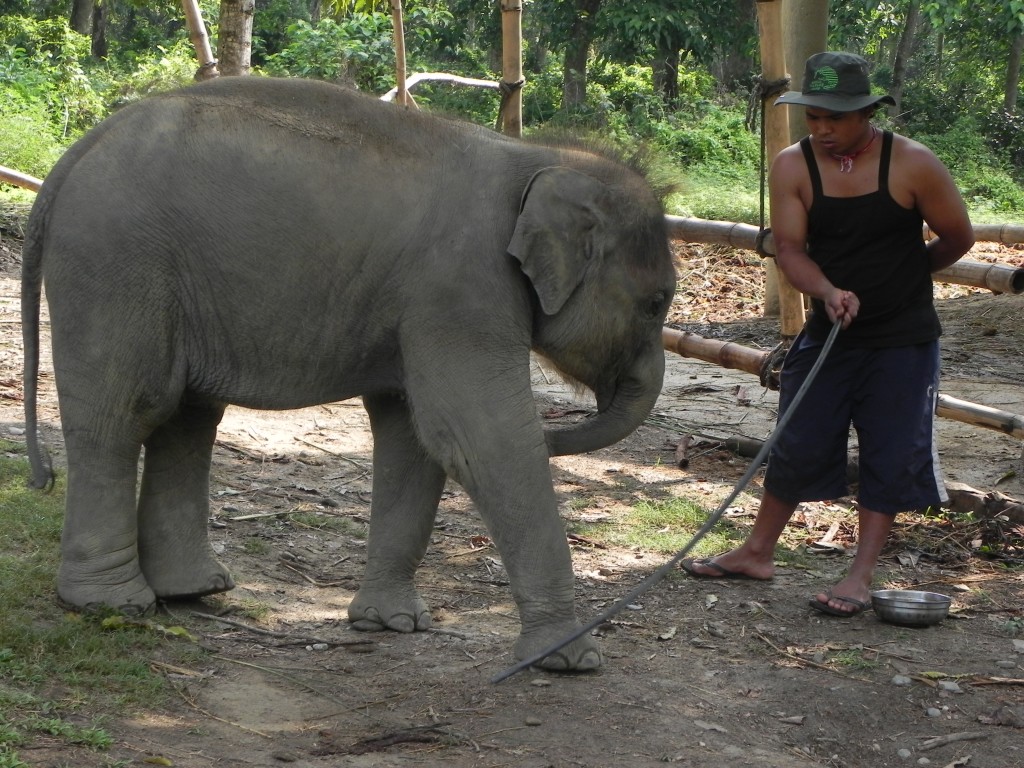
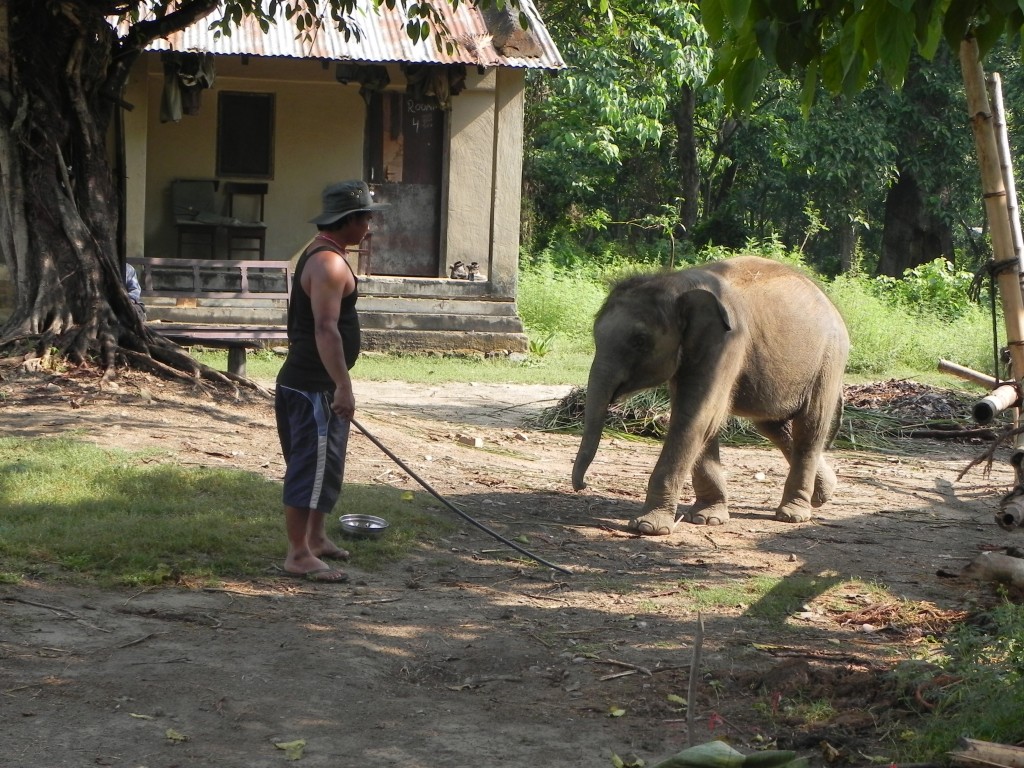
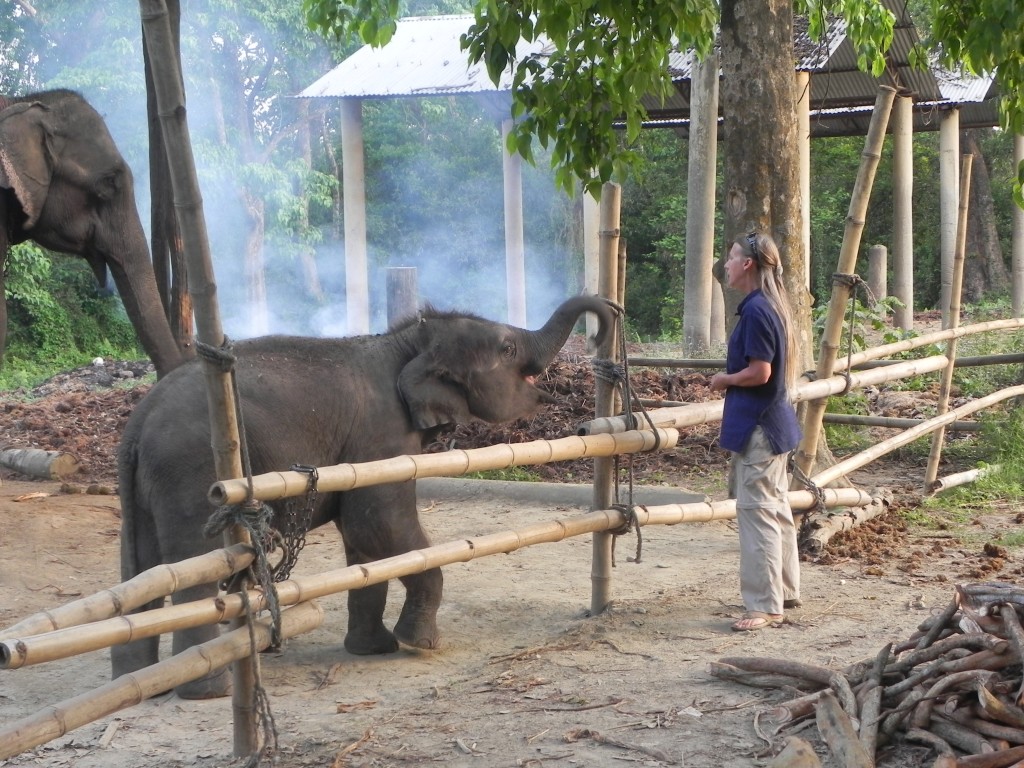
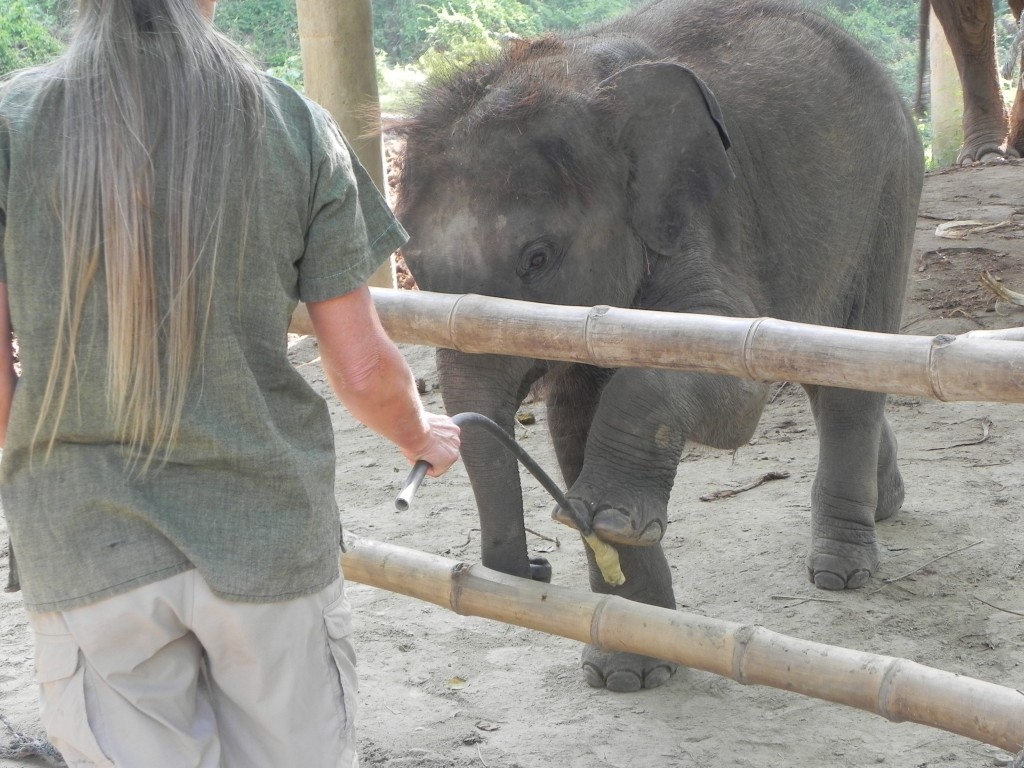
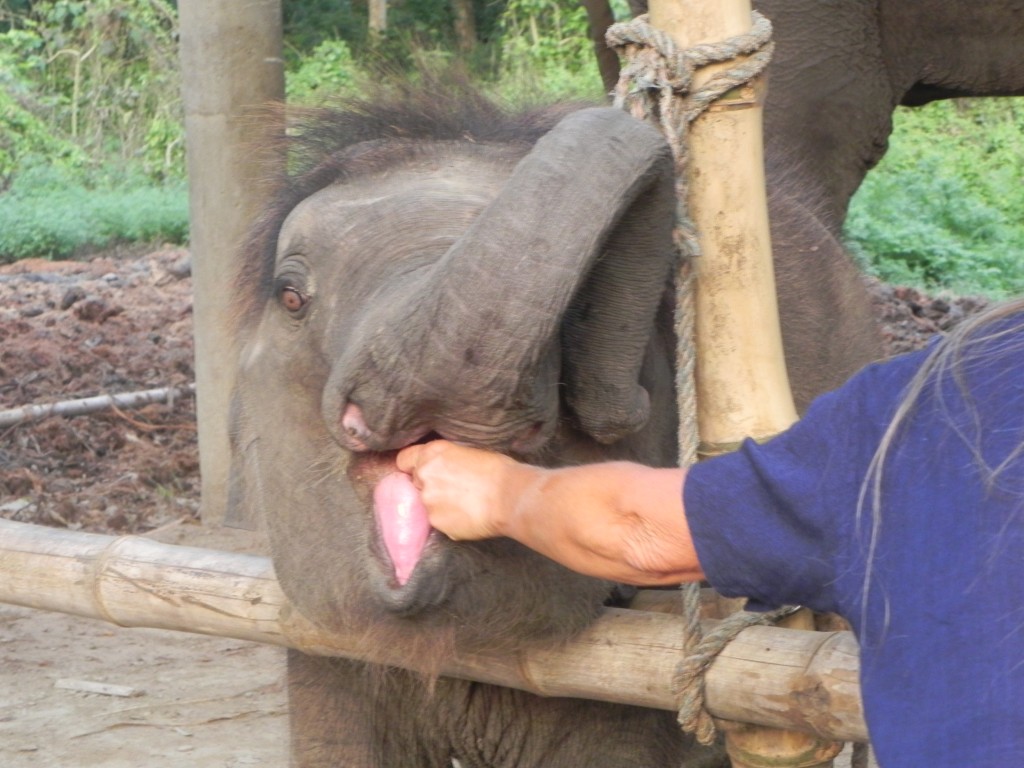
    The signs of herpes include dark spots on the tongue. By checking the tongue twice a day, the disease can be diagnosed in the early stages. In an effort to monitor the other three young calves at the breeding center, I was asked to train them for tongue examinations, a request that I was happy to fulfill.

    checking tonguesThe first day of training was a heart-lifting success. We were able to get the calves to place their trunks on their foreheads—for a tasty piece of banana—and took photos of their tongues.

    Additionally, I ordered Famciclovir. Even though the drug may expire before it can be used, I feel strongly that having it on-hand whenever possible is important.  We were not able to help one precious elephant but if the disease strikes again we will be better prepared.

  • Seeds of Change

    Seeds of Change

    April 13

    My work in Sauraha has come to an end, at least for the time being.  Seeds of change have been planted. From the looks of it, some seeds are already growing, quietly shifting the soil around their sprouting roots. Experiencing the fruits of my labor so instantaneously fills me with hope.

    Yesterday when Kiran and I arrived for Bhadra’s morning session we were told that Ramji, his mahout, was off making preparations for the New Year’s Day celebration. I jumped at the chance to work with Bhadra in Ramji’s absence.  But my excitement was quickly doused when Bhadra made it perfectly clear that he would work with me but under protest.

    After completing each request Bhadra would do a mini mock lunge from behind the protective barrier. It seemed that he was clearly bothered about something to do with me. He was responding but being snotty. I have seen this type of behavior before when training a new mahout who struggles to keep pace with an advanced elephant student. I did not make that analogy until sometime later.

    The next day, the motivation behind Bhadra’s behavior became apparent. In our absence, Ramji had risen to a challenge from Kiran to prove his skill with Bhadra within three months. The ultimate goal: to show everyone how far he could take Bhadra with positive reinforcement training.

    Ramji proved his skills beyond question when he surprised us by calling Bhadra from the protection of the corral and proceeded to ask him to present his feet and ears, move to the side, back up and put his head down. I was stunned. They were fabulous. Ramji, all cool, calm, and collected, Bhadra listening intently and responding to each verbal cue. I wish you could have been there to see it for yourself, but I did catch it on video. This type of breakthrough must be documented in order for others to believe.

    Needless to say, Kiran was pleasantly surprised at the immediate progress in less than a week!  Ramji obviously took the challenge seriously, resulting in a display that had me grinning from ear to ear, joyful with disbelief.

    Ramji earned much deserved respect today, and Bhadra…well, he already has my heart. He has now joined the ranks of the “MIGHTY TYKES,” the young elephants in Thailand and now Nepal participating in this important case study of positive reinforcement training. These youngsters are the hope of the future: what they teach us and their mahouts will shape elephant training of the future. They are demonstrating how positive reinforcement training can be used with captive elephants in a hands-on working situation.  We owe them and their mahouts a great debt of gratitude.

    Kiran knew instinctively that witnessing Bhadra and Ramji’s incredible accomplishments would make my day, my last in Sauraha. It was wonderful to see how proud he was. Kiran has been an invaluable asset throughout the training process. I doubt he realizes the role he has played in this cultural shift of mahout attitudes, which has the potential to change the future for captive elephants. The future is bright indeed.

    I left Sauraha today with a heavy heart, heavy with the joy of knowing that we have planted a seed. I for one cannot wait to see how it grows.

  • a fiery red head

    a fiery red head

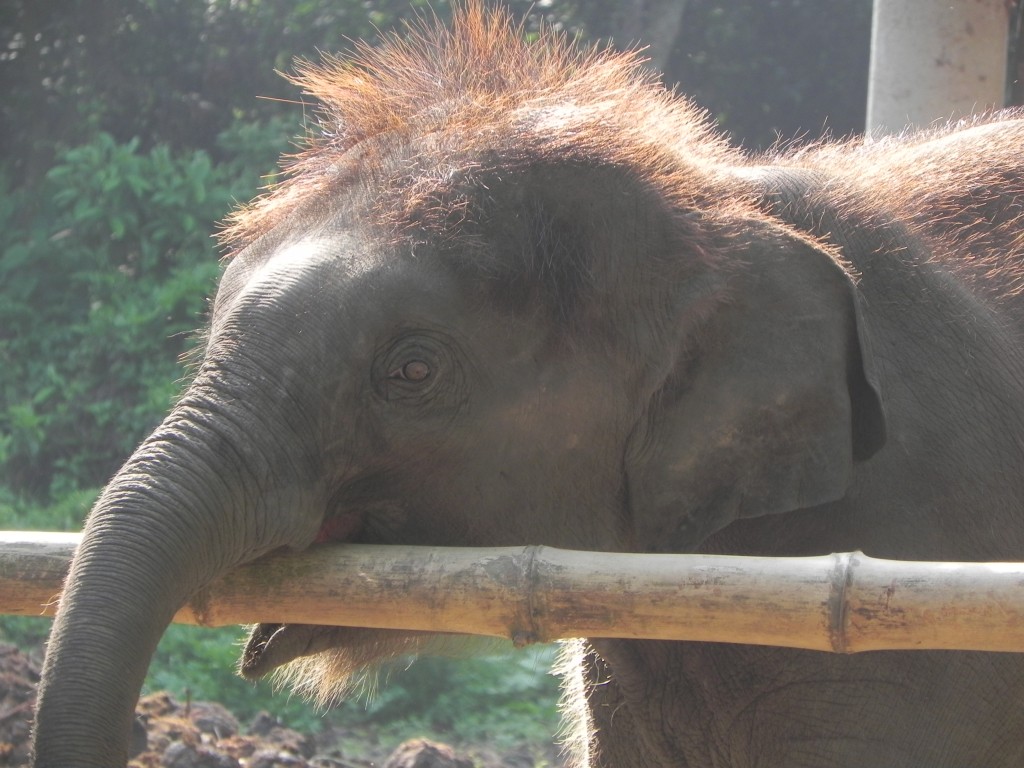
    I’ve got a new heartthrob. He is smart, dark and seriously handsome, with a full head of fiery red hair! Admittedly on the young side, Bhadra still lives with his mom and spends the entire day gallivanting in the Chitwan National Forest.

    We met two days ago and have spent only limited time together but let me tell you this little boy is smart. He is my latest ele-student, one year old and full of spunk and sweetness. There goes another piece of my heart!

    Bhadra lives at a private resort on the border of Chitwan National Park with his mother, his sister and other non-related family. The resort has been closed for a couple of years, making life that much easier on this elephant family. No tourist rides, just lazy days in the forest and short training sessions, when Bhadra gets to demonstrate to his mahouts what elephants are capable of when trained through positive reinforcement.

    The mahouts have been fabulous, very interested and engaged. Bhadra has only had four 15-minute sessions over the past two days and now responds to agot (come here) and ra (stand still), and presents his pow (foot), kan (ear) and thuk mud (head) when asked. Things were a little slow getting started because Bhadra surprised me by not liking bananas or apples. His mahouts knew exactly what he would like — molasses. One taste of the favored treat and he was all ears, head and feet!

    What a blessing it has been to work with him. Hopefully together we have planted a seed with these young mahouts.

  • Kasara Camp

    Kasara Camp

    Today I traveled many kilometers through Chitwan National Park to reach my foot trimming clients. To get there, I hiked to the river’s edge, boarded a small sailing vessel, crossed a river and drove through a magnificent forest, crossing over creeks on what I would call barely-bridges (as opposed to sturdy concrete ones). It was a wonderful adventure!

    When I reached the river, the tourists were packed like sardines in their low-rider boats with a boatman steering them lazily down river. Dr. Geare, the head Government veterinarian at Chitwan National Park, Chitra, a vet tech who works with Dr. Geare, and I were ushered onto our private dugout canoe with removable seats (little wooden stools that fold up against the side of the canoe when not in use), which silently glided across the river to the sand bank on the opposite side.

    Our driver magically appeared. We climbed into a truck and I must say had a ride of my life. It was only after we picked up several young soldiers hoofing it back to camp that I was able to release my firm grip on the door frame, the only thing keeping me from bouncing out of my seat and hitting head on the roof. The weight of the men in the back gave the truck better traction and kept the back end from bouncing up and down like a trampoline. It was a great ride through a beautiful forest.

    Within minutes a wild boar had crossed the road, male peacocks could be seen and heard sounding their calls, a monkey clung to the side of a tree, a couple of deer flashed by and too many muggers (crocs) sunned themselves along the back of a small creek.

    Our destination was the Kasara forest camp where four government elephants live. What a shift from Sauraha. Don’t get me wrong — Sauraha is a nice place for the government elephants — but in Kasara the elephants are really living in the forest. If I could only get rid of the chains and hobbles and put up some hot wire fencing, I would really feel as if I was helping them. Okay, one thing at a time — first feet trimming and then more freedom!

    Kiran was not with us today, but Chitra also excels at foot trimming. Upon arrival, I found that instead of the three elephants I was expecting there were actually four. Three elephants were scheduled for foot trims which is why they made it on the list, or maybe it was because the fourth elephant actually is unnamed. She is Laxmi Kali’s year-old calf. When I asked her name, a slight hesitation was followed by, “Her name is Laxmi’s calf.”

    After spending several days trimming the feet of privately owned elephants, I must admit that today really highlighted the differences from those owned by the government. The government mahouts seem to have a much better relationship with their elephants. They do not yell incessantly nor strike their elephants absentmindedly, which is good because Chitra and Dr. Geare had already heard my request for no pit neu. Actually, my request has grown more sophisticated following an impromptu Nepalese lesson I had last night. I was told that no pit neu is nonsensical and that the proper way to get my point across in proper Nepalese is hati lie na pita, which translated means, “Do not hit the elephant.”

    The foot trimming went smoothly, with the mahouts seeing for the first time how to administer proper foot care. They were very interested and helpful, and each appeared proud when his elephant’s trimming was completed.

    Just as we were finishing up with Laxmi Kali, her calf decided that it was time for a drink and let out a boisterous “I’m thirsty!” yell. Mom immediately threw her hind leg in the air to get up, a fair warning to the mahouts that she really needed to respond to her calf. We all laughed, knowing how the babies call the shots. Laxmi jumped to her feet and baby got the drink she was so thirsting for.