Tag: elephantrescue

  • Sunder the Elephant Embarks on New Life

    sunder__family_bannerghatta_zoo_india-1_med
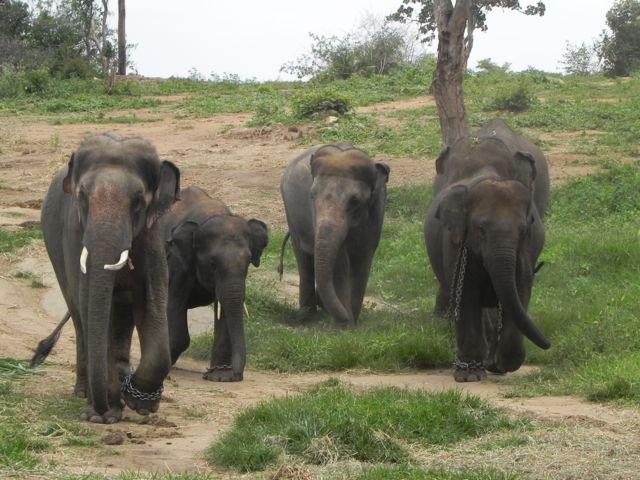
    Sunder (left) with his new family

    Elephant welfare expert Carol Buckley says rescued elephant is in good hands at model facility.

    More than a month after his rescue from a life of horrific suffering, 15-year-old bull elephant Sunder is enjoying lush forests, cool ponds and the close companionship of 14 other elephants at the Bannerghatta Biological Park (BBP) outside Bangalore, India.

    Sunder’s tragic plight touched the hearts of people from all around the world and galvanized an international social media campaign that helped win his release and recovery.
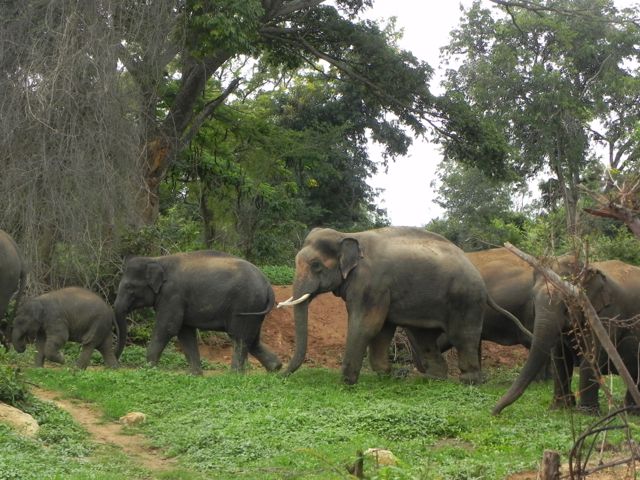
    sunder_and_family_india_2_med“Sunder has a new life and a fresh start at a wonderful facility,” said Carol Buckley, an expert in innovative approaches to elephant welfare in captivity, who recently visited Sunder in India to design a chain-free facility at the park where he now lives.

    “Thanks to the courage of the Supreme Court of India, which ruled against Sunder’s longtime abusers, the willingness of BBP to accept Sunder for permanent residence and the tireless logistical and legal efforts of PETA India, Sunder’s future looks very bright.”

    Buckley, who founded and leads the US-based nonprofit Elephant Aid International, says BBP has all the desired components for captive elephants. Its 122 acres of diverse habitat include open pasture, shaded forests and ponds, where the elephants are free to roam and play during the day. At night, they are given access to the adjoining national park forest for foraging and exploration.

    The upcoming construction of a custom designed, solar powered, chain-free perimeter fence system to enclose the entire daytime habitat will give the elephants even more autonomy. The fence creates a safe containment area, eliminating the need for mahouts to dictate the elephants’ activities. It should be completed before the end of the year and will be the first constructed at any zoo in India.

    Buckley noted that unlike most elephant facilities throughout the world, BBP’s mahouts manage their captive elephants in a “herder style” manner that supports their physical, emotional and mental health. This style of management acknowledges elephants’ nature as highly social, herd animals, giving them freedom to wander at will while mahouts keep a watchful eye on their whereabouts.

    “Bannerghatta Biological Park, working in partnership with PETA India, offers the world an exemplary model for managing captive-held elephants and the best possible new home for Sunder,” said Buckley. “I’m so grateful for their efforts.”
  • Bunny

    Bunny

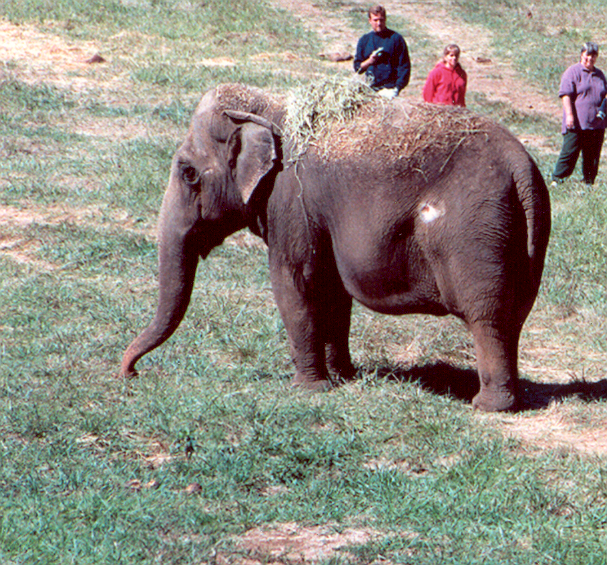
    Bunny — what a sensitive and loving lady. It was a joy to bring her to the Sanctuary. Her immersion into the habitat and bonds with the other elephants exceeded even our wildest dreams. She made an immediate and complete transition into Sanctuary life. In fact, she was the first elephant to sleep under the stars and was responsible for her sisters beginning to sleep outdoors overnight as well.

    I spent five years working for Bunny’s release from the Mesker Park Zoo in Evansville, IN. The zoo had been her home for four decades. From the time my effort began, I placed a weekly phone call to the zoo to discuss Bunny and her possible relocation. Ron Young, the zoo director, and Ted Grannan, the assistant director, were gracious but firm: Bunny would never leave the zoo.

    They continued to accept my calls and humor my periodic visits, but their response to my interest in discussing Bunny’s relocation was a consistent no. I realized that these were kind and caring people. My goal was to familiarize them with the Sanctuary so they could understand what we had to offer to their beloved Bunny.

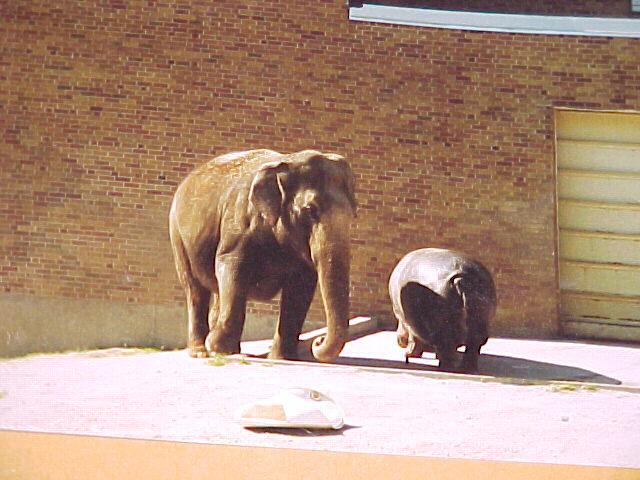
    On one of my many visits to the zoo, Bunny was having “play time” with her next-door neighbor Daisy, a hippo. They had lived in adjacent enclosures for four decades. On special occasions Daisy was allowed into Bunny’s yard for a visit. It was quite cute to watch, but sad to realize how these two had to rely on another very different species for companionship. Bunny gently herded Daisy around the yard, as much as one can herd a hippo, with Daisy paying little attention.

    My persistence began to pay off, but in a roundabout way. Ron soon began passing my phone calls off to Ted, who remained pleasant and engaging. He would listen patiently to my latest update and end the conversation with the zoo’s mantra, “Bunny will never leave the Mesker Park Zoo.”  My no-pressure-but-let-me-tell-you-this approach was sincere — and effective. We shared a common interest in Bunny’s welfare, which soon brought us closer together. My message began to get through and I saw that Ted was beginning to question the wisdom of their position.

    Until this time, I was told that Bunny could not be moved for a myriad of reasons, including that it would break her heart to leave the zoo. With stories about our other retirees as evidence to contradict that concern, Ron finally admitted that the idea simply could not be considered because the Association of Zoos and Aquariums (AZA) would not allow it.

    After years of open communication and education I was able to demonstrate that Bunny not only deserved to move to the Sanctuary but her very health depended on it. Her enclosure offered limited natural substrate and her pool had been empty for years. As result of years spent on the hard surfaces of her exhibit, Bunny had developed a chronic foot disease that could soon develop into osteomyilis. This captivity-induced disease is responsible for the deaths of nearly all adult captive Asian elephants living in zoos. Bunny was on her way to being yet another statistic but I knew that Sanctuary life could spare her such a fate.

    Bunny was surrounded by a loving staff, attentive veterinarian and adoring public. They began to grasp the gravity of Bunny’s condition and, ultimately, the people responsible for Bunny’s care, including Ron and Ted, became the champions for her release.

    On September 29, 1999, Bunny arrived at the Sanctuary. Her retirement was celebrated by two communities united by one deeply loved elephant.