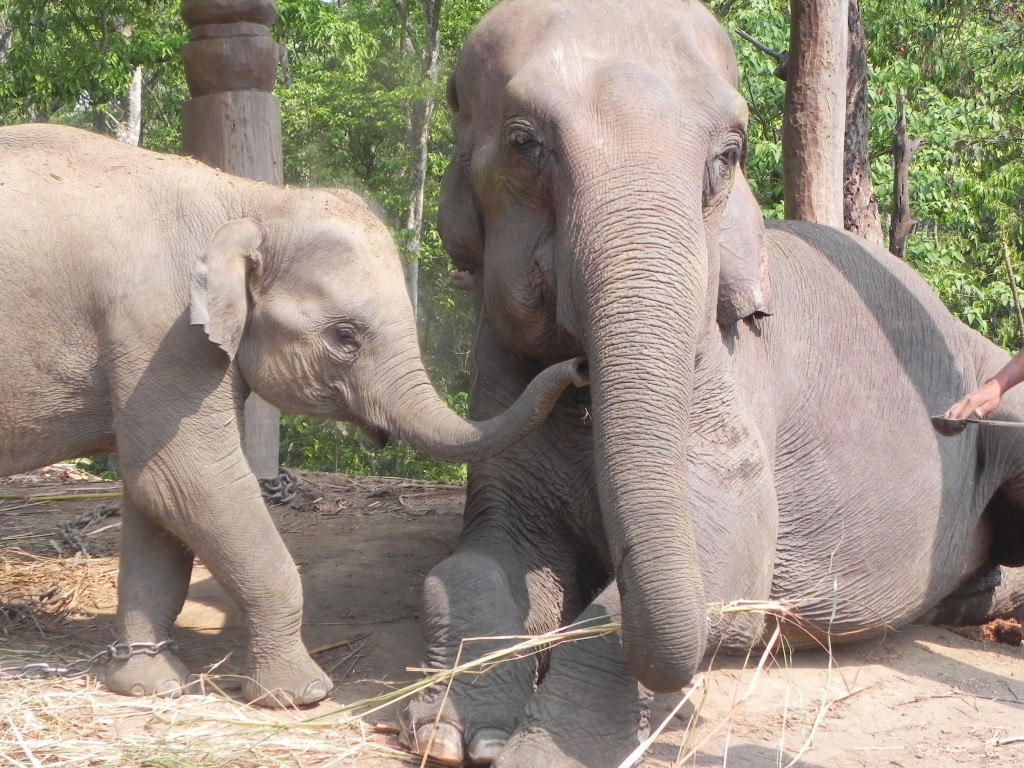
It was a 10-hour drive through mountains on rough roads. The 19-year-old driver of our rental truck scared the daylights out of all of us with his speeding, passing trucks on blind curves and nearly missing oncoming vehicles. Oh man — it was a stressful ten hours!
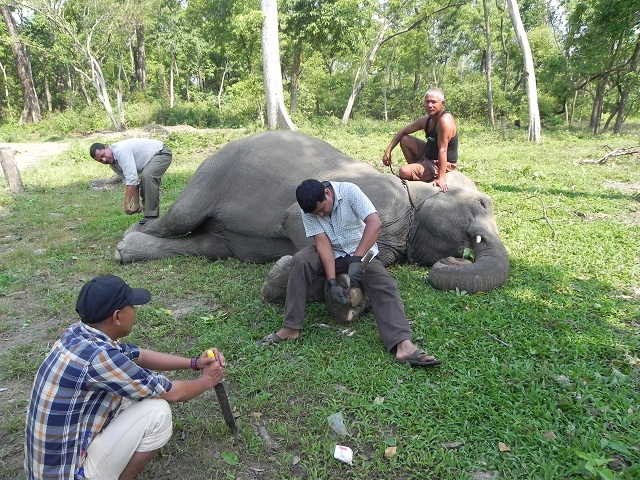
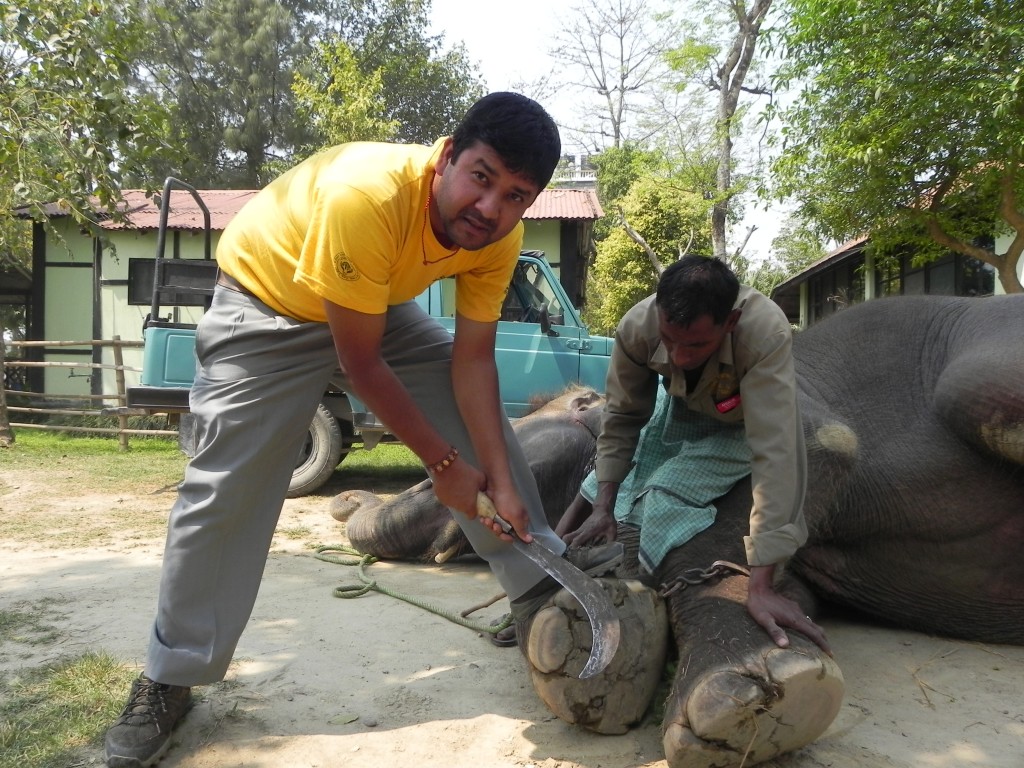
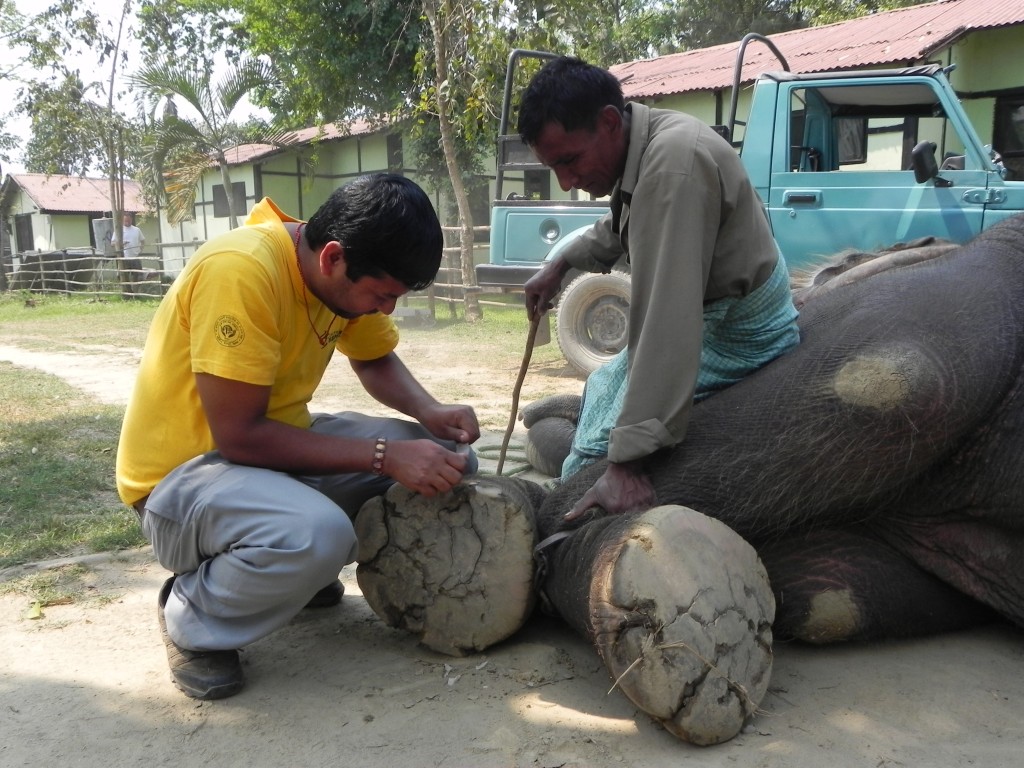
But our foot trimming program was a grand success. We had a fabulous trimming team: Dr. Gairhe; Kiran the vet tech; Hira, Kirti Kali’s phanet (head mahout) from the NTNC hattisar; and I.
Our students included Chantelle, our intern; Surajan, a new friend and translator; and the vet tech from Bardia.
In two short days we trimmed the feet of 24 government and privately owned elephants.
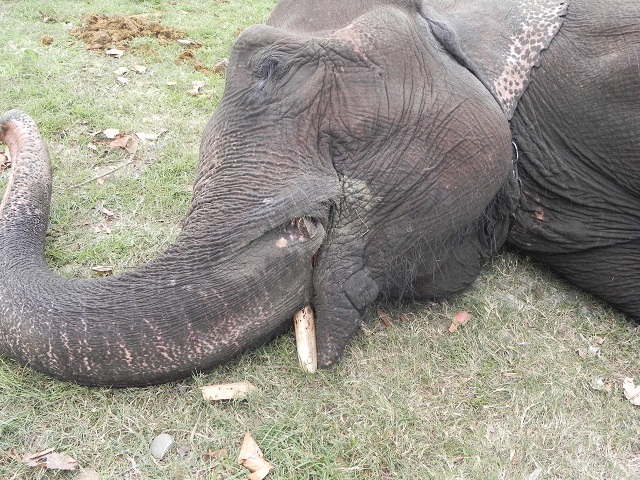
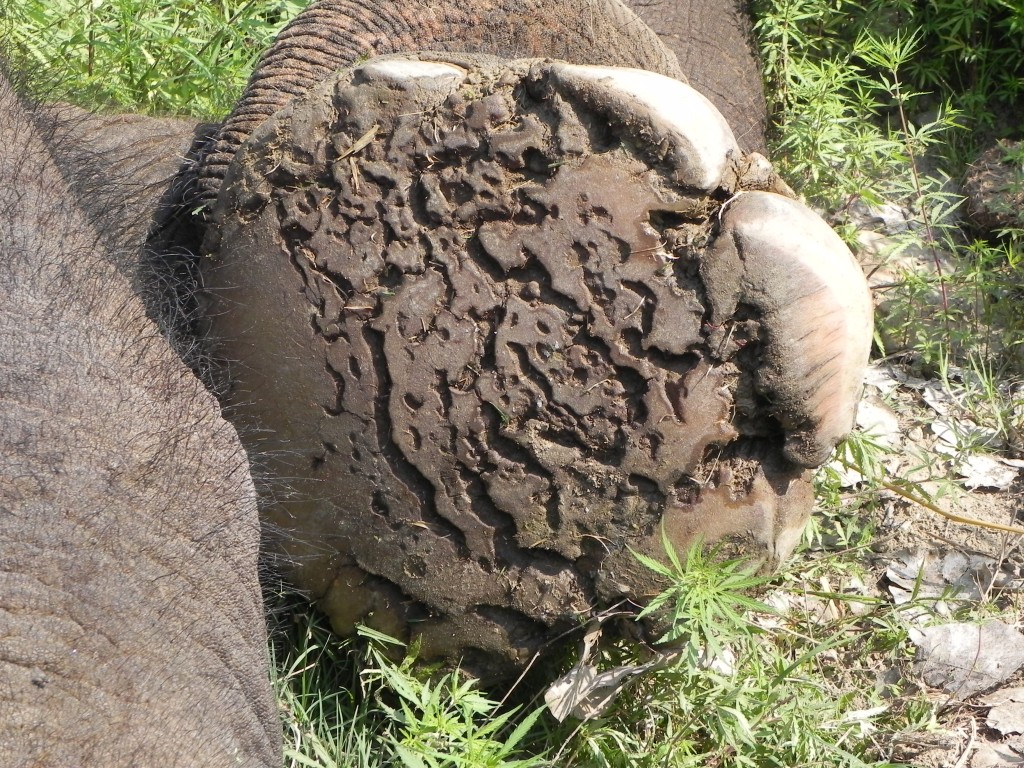
Honestly, the condition of the privately owned elephant’s feet was criminal, similar to the privately owned elephants in Chitwan. Their pads were dry, cracked and severely overgrown. The nails were equally as dry and overgrown and many had splits and deep cracks.
Private owner, broken shelter
I am always shocked to see how poorly the privately owned elephants are kept, especially since they are the breadwinners for their owners.
The good news is that 24 more elephants received pedicures and their mahouts were introduced to foot care. With time things can change for these over-used, abused and neglected elephants…I hope.
A huge thank-you goes out to the trimming team. Without their enthusiasm and hard work we could not have accomplished our goal to provide foot care for elephants in Bardia!
You can make a difference in the life of a captive elephant by supporting our Foot Care project. Thanks for your help.
It’s been a pretty intense week. A two-year-old female calf at the breeding center was diagnosed with herpes. Even though she received treatment, she passed away two days later.
Herpes is near-epidemic among elephants in the US and recently reared its ugly head in Chitwan. Young calves between the ages of one and three seem to be most susceptible but there are records of juveniles and adults dying from the disease as well.
You’ll remember Bhadra, the fabulous flaming redhead we trained with positive reinforcement in Sauraha, Nepal. He died of the herpes virus last year, shortly before his second birthday. His mahout was so devastated that he left his job and returned to his home village.
Famciclovir, the treatment of choice for herpes, is not available in Nepal and must be imported from India. A small elephant can require as many as 1000 pills to fight the virus. The exorbitant cost—75 cents per pill—and large quantity needed, made stockpiling the medication impossible.
The calf was given available medication and was under treatment and constant surveillance as I arrange for a shipment of Famciclovir from friends at Wildlife SOS-India. Unfortunately, the drug did not arrive in time to save her. She died in the night with her mother stoically standing by. Records indicate that even with Famciclovir many calves do not survive.
I accompanied the team for the necropsy and somber burial; both were done with the utmost respect. All the mahouts were present and, for the first time in my observation, near silent. As Dr. Gaihre led the exploratory necropsy, examining and collecting tissue samples for lab work, the mahouts dug a grave. It was a sad and sobering experience. This calf had the classic symptoms of herpes–severe hemorrhaging–but otherwise was a very healthy elephant.
When it came time to lay her body to rest, I instinctively glanced around for wild flowers to place on her grave, just as we always did at the Sanctuary. After her precious body was covered with a sparkling clean white linen cloth, incense was lit and ceremonial red powder and flowers were sprinkled over her covered body. When the flowers I collected left my hand and floated down into her grave, a wave of gentle remembering engulfed my heart as I thought of the beloved elephants who had lived and died at the Sanctuary. At this moment we were all one, sharing the loss of a sacred soul.
The senior wildlife staff presided over the burial. Although the words spoken over her grave were in Nepalese and foreign to my ear, I knew exactly what the prayers were. It was the same ceremony, the same prayers uttered each time we buried another precious elephant at the Sanctuary. Like never before, I felt a connection with the mahouts who care as deeply for their elephants as we do ours.
Preparing for next time
The signs of herpes include dark spots on the tongue. By checking the tongue twice a day, the disease can be diagnosed in the early stages. In an effort to monitor the other three young calves at the breeding center, I was asked to train them for tongue examinations, a request that I was happy to fulfill.
The first day of training was a heart-lifting success. We were able to get the calves to place their trunks on their foreheads—for a tasty piece of banana—and took photos of their tongues.
Additionally, I ordered Famciclovir. Even though the drug may expire before it can be used, I feel strongly that having it on-hand whenever possible is important. We were not able to help one precious elephant but if the disease strikes again we will be better prepared.
Working in Asia the past two years I have learned a tremendous amount about how culture and tradition affect collaborative conservation efforts. Among the most important lessons is the need to ensure project sustainability. No matter how groundbreaking or beneficial the project promises to be, it must be sustainable to be successful.
Ways to sustain the project must be identified during the planning stage, otherwise the effort put into it will have been wasted. Sustainability determines success and people ensure sustainability.
Before returning to Chitwan, I wondered if our chain-free yard pilot project for Sweetie Kali, aka Prakriti Kali, would prove to be sustainable. Although I prepared myself for less, I hoped the mahouts had truly embraced this welfare project. Success hinged on their acceptance of this approach to elephant care, which is nearly the polar opposite to their tradition.
As I approached the elephant stables I saw Sweetie Kali foraging in her personal forest. The dense scrubs were a faint memory but the mature trees were standing tall, providing shade and enrichment, just as they had when we built the yard last May.
I was pleased and honestly a bit relieved to see that the chain-free fence was in pristine condition. The staff, under the direction of Chiran Pokheral, the officer in charge, did a fabulous job of ensuring the success of our pilot project.
It’s my nature to push headlong into the next project forgetting to take a moment to bask in the glow of a collaborative project well done. It is too easy to get swept away in the excitement of something new and forget to thank the people responsible for making everything happen.
In addition to Paspat and the mahouts, who were completely receptive to the changes in their routine that a chain-free yard required, many other individuals, including Chiran Pokheral, Dr. Gairhe, Ram Kumar, Babu Ram, Nandu, Vishnu and Dibyendu and his crew, made this project possible. Without their support and assistance, this project would never have come to fruition, much less become sustainable.
Special thanks goes to Chiran Pokheral who, after securing the required clearances, made sure I had access to plumbers, electricians and day laborers, and the cooperation of everyone needed to complete the project. Without Chiran we would still be dreaming about a chain-free yard instead of watching Prakriti Kali thrive in it.
Dr. Gairhe, the senior government veterinarian, also played a key role in the project’s success. A true conservationist, Dr. Gairhe’s endorsement and oversight of the project provided the much-needed assurance at the government level.
Now that I am back in Sauraha, it’s time to identify a location for the second chain-free yard. This yard will be for Man Kali and her three-and-a-half month old calf Hem Gaj. Once again we turn to Chiran Sir, Dr. Gairhe and the NTNC staff to lead us in our effort to improve elephant welfare in Nepal.
When Paspat, the mahout supervisor at National Trust for Nature Conservation, asked about a water trough for Sweetie Kali, I nearly fell off my chair. Seriously— his question was a shocker because captive elephants are not given free-choice access to anything in Asia. The belief is that allowing them to make choices will spoil them for their mahouts. The great fear is that if elephants experience a sense of freedom and are content, they will refuse to respond to their mahouts.
The fact that Paspat asked for a water trough reinforced my belief that he genuinely cares about his elephants’ welfare. Even in the United States— land of the brave, home of the free—many captive elephants are not given free-choice access to water.
I was deeply touched by Paspat’s request—so outside of the normal thinking of mahouts—and I assured him I would make it happen. The grin that spread across his face when he understood my response was priceless.
It struck me that this might be the first time Paspat was in a position to create a practice contrary to tradition. A chill ran up my spine as I looked long and hard at this man, who supported the chain-free yard concept and suggested free-choice water. Even though we do not share one word of a common language, I felt the connection loud and clear.
First stop: the concrete factory
After securing the required authorization to add a water trough to Sweetie Kali’s yard, I posed my challenge to Kiran, the veterinary tech/nail cutter extraordinaire. He was excited to help.
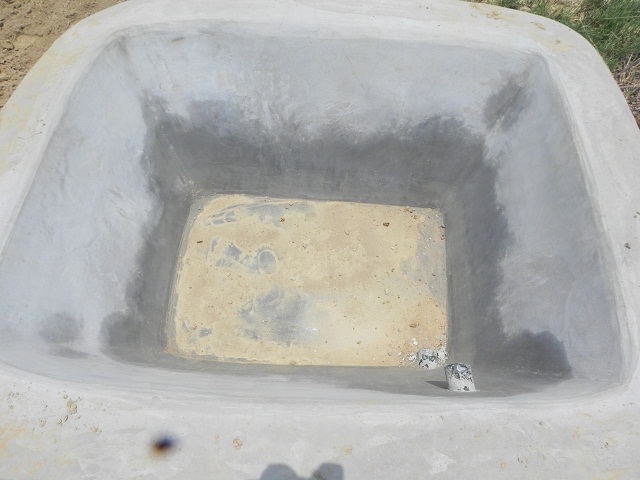
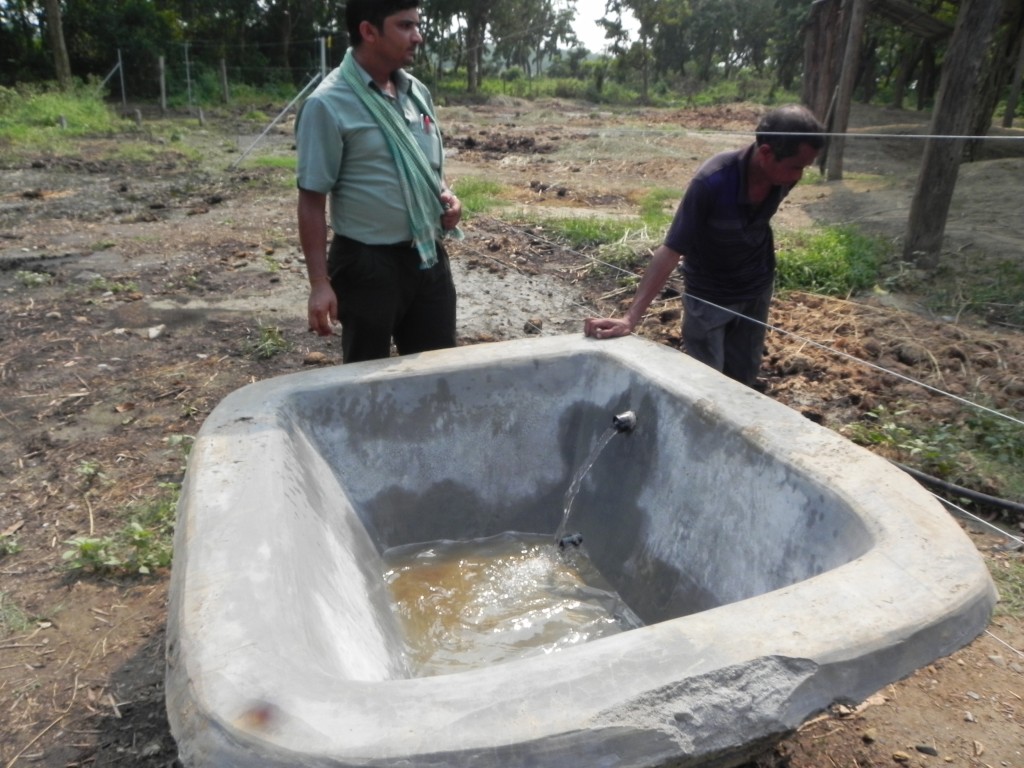
I explained what I needed: a sturdy, bathtub-shaped, concrete drinking trough, with inlet and outlet holes, heavy enough that Sweetie Kali cannot knock it over.
In his broken English Kiran said he knew a man who could make the trough for us. So off we went on his motorcycle, zooming down the pothole-rutted village road toward the other side of town.
We arrived at the concrete factory. There was a yard full of custom-made concrete posts for building supports and culverts used for septic tanks but I did not see anything that vaguely resembled a water trough.
I also did not see a single person.
Kiran parked his bike and charged over to a three-sided shack, calling out to someone. There was a man inside who was fast asleep.
Kiran entered the building without so much as knocking. The man, who was lying on a thin mattress on a wood-frame sleeping platform, was the soundest sleeper I ever saw. Kiran was nearly yelling—and the guy did not move. It was only when Kiran shook him that he awoke.
Midday is nap time as it is too hot to do much else. The bewildered look on the shopkeeper’s face was not as result of being woken abruptly but out of surprise to see us out and active in the sweltering heat.
The man rubbed his sleepy eyes as he sat up, trying to understand what Kiran was asking. I watched—which is how things work when you don’t speak the language—once again ever thankful for Kiran’s willingness to be my translator.
Finally the man seemed to understand what we wanted and began asking questions. Kiran included me in the three-way animated conversations, complete with crude drawing on the shop’s dirt floor. We decided on the width, length, height and wall thickness. I kept emphasizing to Kiran that it had to be heavy and strong enough that Sweetie Kali cannot pull it over or break it.
We decided on a free-standing version because if the trough was ground-level, dirt would get into it.
There was much discussion about the wall thickness and amount of steel bar required to make it strong enough. Explaining the inlet and drain holes was a bit challenging. When I finally saw the shopkeeper’s eyes light up in comprehension, I knew he understood what we wanted.
I kept pushing for an estimate but the shopkeeper was reluctant to give one. He had never created a trough before and clearly did not want to underestimate the cost. After much prodding on Kiran’s part, though, we had a bid in hand and commitment that he would start on our project the next day. I was so excited!
How would he actually make it?
At no time during the process did I think to ask how he would create the mold for the trough. He would build a frame out of two by fours and plywood and pour the concrete in, of course. How else?
The concrete factory was halfway between Kiran’s house and Sauraha. He passed the shop each morning on his way to pick me up for foot trimming and kept me apprised of the progress. Indeed, work had begun immediately, as promised, with an estimated curing time of ten days.
The wait was excruciating, so after about five days I just had to check on progress myself.
When we arrived the yard was empty. My heart sank when I saw nothing that resembled a water trough. But as we drove slowly toward the back of the yard, which borders a neighbor’s cornfield, I saw it.
The mold was not what I expected but, considering available resources, it made perfect sense. A hole the exact dimensions of the outside of the trough had been dug into the earth, then the concrete was poured and molded by hand. It was stunning!
I could not help but ask how he would get that heavy trough out of the ground. Kiran laughed and explained that several men would pull the trough from the ground by hand and load it onto a wagon for delivery. I did not think to ask how it would be off-loaded into Sweetie Kali’s yard.
The trough arrives
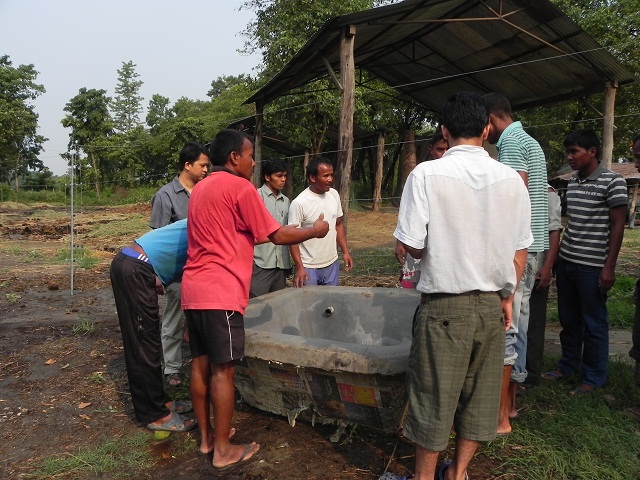
The day finally arrived and the wagon carrying the water trough was backed into Sweetie’s yard. All the mahouts gathered around, very willing to be of assistance.
I watched as the deliverymen discussed the best way to unload this 700-pound tub of concrete and steel. The weight and slick bottom of the trough made it a dangerous situation.
They decided to park the wagon at an angle, place a large tire on the ground just below the tailgate and slide the trough off the trailer onto the tire. I kept my nose out of the planning but two things nagged at me—the steep angle of the trailer and the weight of the trough. But, the deliverymen were in charge, so I kept my mouth shut.
Then it happened, catching the men by surprise. One tug on the trough sent it careening toward the open end of the wagon—and all the men. As it picked up speed, the men scattered. I heard my own “oh no!” pierce the silence as the trough became airborne, turned in mid-air and landed with a thump on its side, feet from its intended landing spot on the tire.
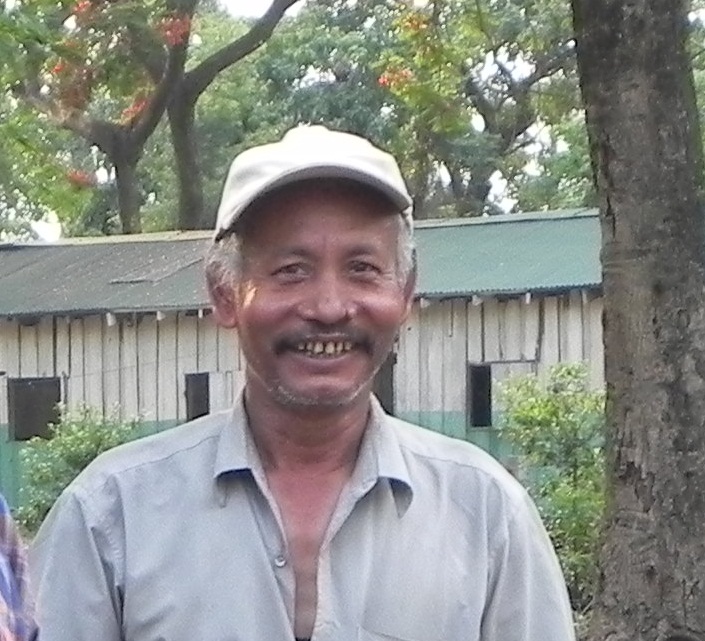
I scanned the scene to see if the trough had landed on anyone. The area was clear and everyone looked fine. But then I noticed Paspat rapidly exiting the scene with Babu Ram close behind. He was holding his hand high in the air. It was then that I saw blood running down his hand.
Paspat had caught his hand between the trough and the bed of the trailer, slicing across the top of it from thumb to baby finger. It was not a pretty sight.
Nandu fired up his motor cycle. Paspat climbed aboard, but not before washing the blood from his good hand so as not to soil the bike. With the entire group looking on in silence, Paspat was raced to the local clinic, hand held high above his head to help slow the bleeding.
The men wrestled the trough into place in a most unceremonious manner. The accident had dampened everyone’s spirits.
Within minutes we learned that Paspat had no broken bones, but the muscles in his hand were pressed back toward his wrist. The muscles were massaged back into place and he received twelve stitches. The biggest concern was infection. Paspat is diabetic so the doctor was concerned about how well he would heal.
Hand healed, trough in place
More than a week has passed and I am happy to report that Paspat’s hand healed without complication.
As for the trough, it is a work of art. Every angle is perfect, all the surfaces smooth to ensure that Sweetie does not scratch her trunk and that it is easy to keep clean. I marveled at the amount of work that went into the mold and the craftsmanship it required. I could not have been happier.
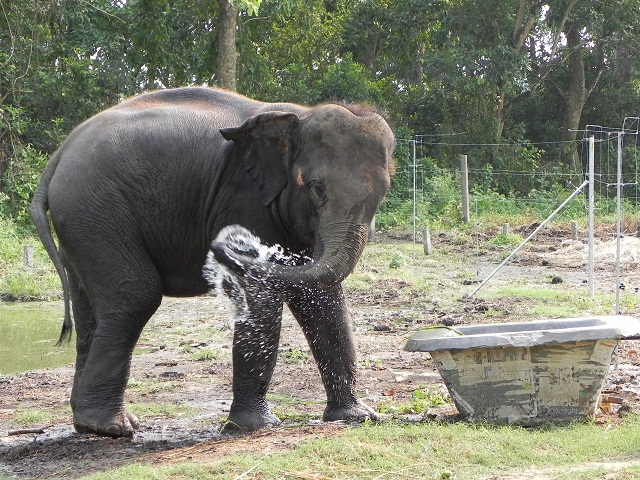
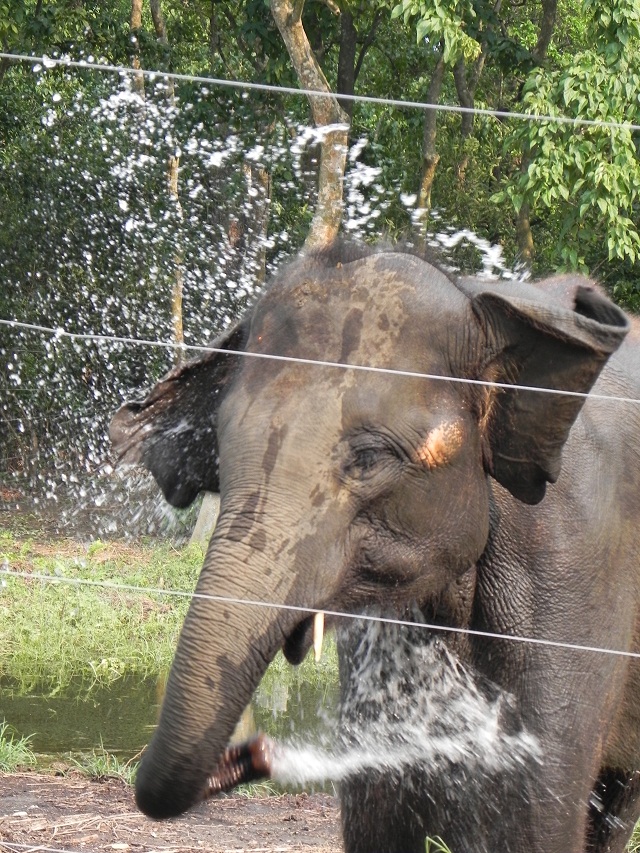
Sweetie Kali wasted no time making use of her trough. The mahouts seem to enjoy watching her almost as much as she enjoys splashing, bathing and drinking.
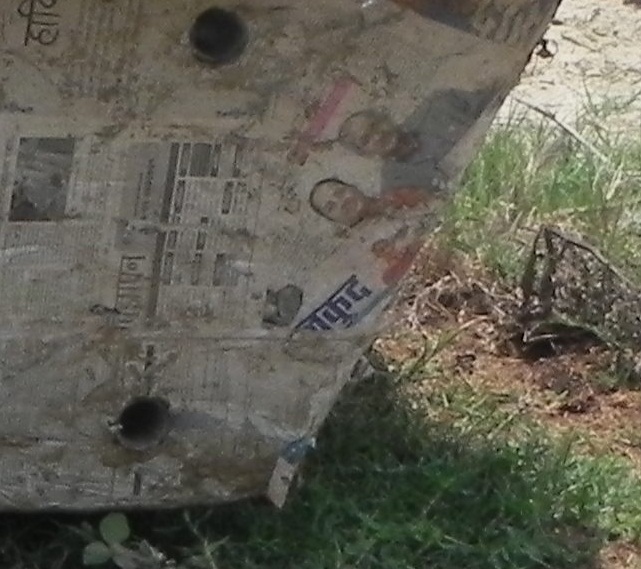
Some of you commented on the newspaper that covers the outside of the trough, making it look like papier mache. The newspaper was used to line the inside of the earthen mold to keep the concrete clean; now it’s nearly one with the concrete so the mahouts decided to leave it.
A huge thank-you goes to the mahouts for their willingness to try something new and to all the supporters who underwrote the cost of adding this trough to Sweetie Kali’s yard.
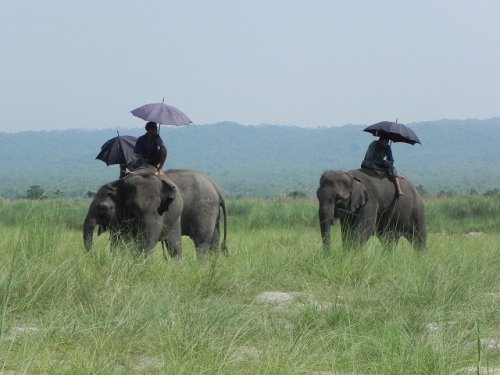
When Nandu learned that I wanted to accompany Sweetie Kali on her anti-poaching patrol he directed me to Ram Kumar who graciously cleared my request with Paspat, the mahout supervisor. Realizing how much is lost in translation, I felt it best to experience Sweetie’s patrol duty first hand. I planned to walk instead of ride, which, for the most part, I did.
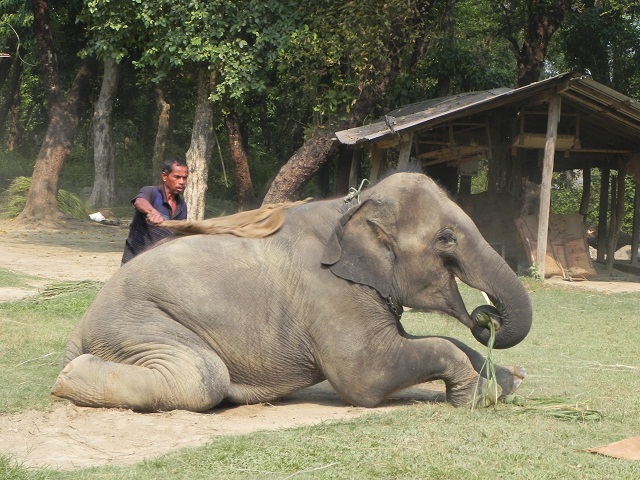
It was reassuring to watch Sweetie Kali voluntarily exit her yard without hesitation. The deepest concern shared by mahouts was that after being chain-free she would refuse to respond to her mahout. That fear has proven to be unfounded. Puntea, Sweetie’s phonet (lead mahout) used a burlap bag to “slap off” the thick layer of fine dirt Sweetie had spent the last several hours throwing on her back. In places where the dirt was very thick he struck her firmly with blunt side of his crew pa (machete), creating an avalanche of silt cascading to the ground.
This approach to sweeping dirt off Sweetie appears a bit rough and indeed it is. But she showed no concern, moving gracefully from a lying, to half-sitting and then standing position to accommodate the process. I did catch myself questioning—for the umpteenth time–why the mahouts handle their elephants in such a rough manner. Nothing is gentle — not a touch or a word; no silent tactile moment of praise.
Reconsidering the decision to walk
In seconds we were on our way, me with a satchel of essentials — camera, water, hat, umbrella and Chap Stick — and Puntea perched on Sweetie Kali’s back with the multi-functional burlap bag as a seat cushion. He carried a small wooden switch and badly tattered umbrella. I noticed immediately that he was not carrying a bottle of water and mistakenly took it as a sign that our outing would not be rugged.
Keeping pace with Sweetie on foot was no problem. Her mahout allowed her to amble at a comfortable speed.
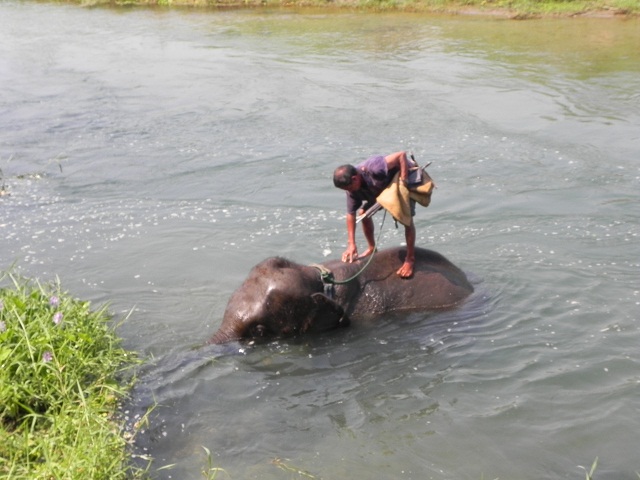
Our first stop was the river — spectacular. With ease, Sweetie Kali submerged herself in the water with Puntea still perched atop her back. He managed not to get so much as a toe wet — for what reason I don’t know, since it was already sweltering hot. Following one word commands, Sweetie tilted from side to side in the strong current, bobbing like a buoy.
At this point I realized my plan to make this excursion on foot was flawed. The current would make crossing a challenge but the bigger issue was slithering down the river in our direction—a large crocodile. Apologizing to Sweetie for the extra burden, I clambered aboard and we crossed safely to the opposite shore.
Grass: food and trimming tool
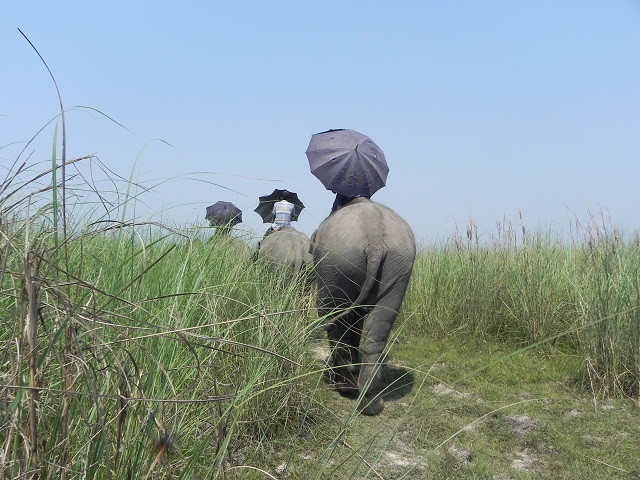
In front of us lay a vast grassland, high as an elephant’s eye, as the saying goes. In stark contrast, in the hazy distance rose a mountain range dense in vegetation, its forest seeming to pulsate in the early morning heat.
As Sweetie effortlessly ambled through the tall grass she reached to the side, grasped a trunkful of grass, pulled it tight and, with her next step, severed it at the soil line with a strike of her foot. All this without missing a step.
I remember watching in awe at the Sanctuary the first time I watched Jenny cutting grass in the same manner as she grazed. With each step she’d grab a trunkful of grass, casually swung her foot forward and effortlessly sever the grass with her toenails. There is quite a hypnotizing, even relaxing, rhythm to this action. The abrasive quality of grass works as a natural trimming tool; this is one way elephants keep their nails, cuticles and pads trimmed to a healthy length.
Joining the patrol
We traveled in complete silence for some time, umbrellas balanced overhead to shade ourselves from the scorching sun. But soon the silence was pierced when from out of nowhere we were joined by two young elephants and their mahouts. For the next five hours the mahouts chattered nonstop, like school girls at a slumber party. Since I don’t speak the language, I soon drifted off into my own world, taking in every scent and plant and animal sighting.
Two hours into our patrol we approached a circle of high arching trees where many elephants and mahouts had gathered. Some mahouts were sprawled out, fast asleep on elephant back, while others napped on the ground while elephants grazed close by.
In the middle of the partially shaded clearing an energetic young mahout was putting his equally young elephant through what appeared to be a training exercise.
I breathed a sigh of relief to think we were about to take a break. I was ready to continue this excursion on foot as planned. But instead of stopping we crossed through the clearing, exiting the other side.
The next hour-and-a-half was spent in serious patrolling, or at least that is how it appeared. The mahouts ventured off the trail continually, ducking under low hanging trees scouring the undergrowth for “something.” Obviously they never found what they were looking for or I would know what it was.
Rest stop
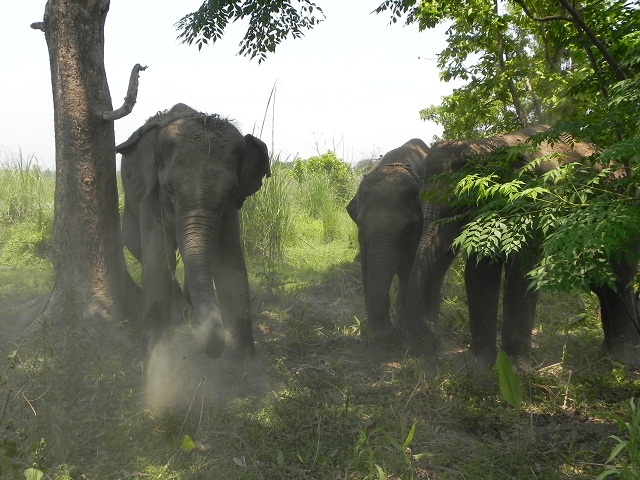
Then we came upon a circle of towering shade trees that created the perfect place for a rest stop. We no sooner disembarked when all three elephants moved outside the circle to cover their bodies with a fine layer of dirt flung effortlessly onto their backs.
I watched silently, wondering if they would exchange tactile greeting or show any sign of recognition. Although they stood centimeters from each other, they acted as if the other did not exist. The lack of physical interaction seemed so unnatural, and unfortunate. These three girls, close to the same age, have so much in common, including knowing that forming relationships with each other was discouraged by their mahouts.
They grazed the tall grass while we napped, burlap bags used as bed rolls. About fifteen minutes into our slumber Sweetie Kali tiptoed over to my sleeping spot. I felt her approach. When realizing she intended to make a personal visit I casually propped myself up into a sitting position from where I could quickly stand if need be — and cleared my throat. I would have loved to share a special moment with Sweetie but the truth is, we do not have a relationship and having her so close could be dangerous.
I know from experience that even while asleep, mahouts are on high alert. Hearing my unspoken warning sign, Puntea got to his feet and Sweetie retreated to the company of the other elephants.
My role
One trade-off that I have reconciled myself with is that I am a distant figure in the lives of these elephants. It is not appropriate to insert myself into their lives. I am here to improve their welfare. It is not about me having the chance to form a close relationship with them; it is about me encouraging the mahouts to form a healthy relationship with them. When we establish the retirement home things will be different and I will have a close relationship with all the residents, but for these elephants who are not under my direct care, a relationship between us would only complicate their lives.
The mahout-elephant relationship
The day was long and hot for everyone concerned. When we reached an offshoot of the river the elephants submerged while the mahouts quenched their thirst from a spring oozing from the side of the bank. All parties drank their fill.
The next hour was spent leisurely grazing the sandy grassland that borders the river. When we finally crossed we were immediately immersed in a dense vibrant forest. The temperature dropped by at least ten degrees, the trees blocked the glare and penetrating heat from the sun.
Umbrellas were closed and stored, mine in my satchel and others, hung by the handle from the back of the mahout’s shirt. What a novel idea and handy hanging location; the neckline of the shirt works perfectly.
Tree branches invaded the trail, making passage difficult. I was told that the noise in the trees was monkeys but I never caught a glimpse of one. Spotted deer and birds were abundant. At least one tiger had walked the same sandy path recently, leaving behind huge paw prints. Seeing the size of the prints made me reconsider—once again— my decision to walk instead of ride.
Soon and without a verbal farewell, our fellow patrollers turned off at different paths, disappearing into the dense bush, on their way to a different hattisar. As we traveled the last mile of our patrol I was lost in thought about the relationship between mahout and elephant. It is a strange one — no outward display of affection, no praise, continual directions and corrections. It takes a strong individual to do this job day in and day out, both elephant and human.
I am sincerely grateful, as I know are Sweetie Kali and the entire NTNC staff, for your generosity toward the creation of Sweetie Kali’s chain-free yard.
The funds raised to date cover the cost of Sweetie’s one-acre power fence enclosure, which she has immersed herself in from day one; her custom water trough, which will be installed tomorrow; and two shovels and a new wheel barrel requested by the mahout staff.
The mahouts are so proud of this pilot project.
The second half of the funding goal was intended for a training wall, which is not necessary at this time. Those funds can be raised at a later date and the wall built in a few months when I return to Nepal.
So, consider this fundraiser a grand success! Pat yourselves on the back. Without you this history-making event would not be possible. Together we have created the first chain-free elephant corral in Nepal, hopefully starting a trend that will change how captive elephants are kept in Asia!
This e-newsletter kicks off EAI’s first fundraising projects for Nepal this year. I hope you will help make it a success by telling your friends and neighbors how far the US dollar stretches in Nepal. Be part of the solution, one world, one elephant at a time!
No more chains
Between trimming feet and brainstorming about a retirement center for elephants in Sauraha, Nepal, we—you, I and all of EAI’s supporters—are about to embark on a very exciting pilot project at the National Trust for Nature Conservation Biodiversity Conservation Center (NTNC-BCC) hattisar (elephant stable).
Pursuing last year’s recommendation to create chain-free enclosures for the BCC’s five forest patrol elephants, Naresh Subedi, an EAI advisor, and other NTNC officials have enthusiastically agreed to allow EAI to build a chain-free enclosure to demonstrate its functionality.
No chains = cooperative elephants
This is huge. It gives us the opportunity to show mahouts how cooperative elephants can become when allowed the freedom to move around unrestricted.
Eight-year-old Sweetie Kali will be the lucky recipient of this new and improved yard, where she will be off chains 24/7.
In addition to the direct benefits to her psychological and physical wellbeing, Sweetie Kali will demonstrate to the mahouts and NTNC administrators that elephants do not “go wild” when allowed to spend unsupervised time off chains.
Sweetie Kali, her fellow herd members and most of the government elephants are taken to the forest each day. Although they spend eight hours a day wandering the forest foraging for food, they are still under the strict control of their mahouts. Their lives are measurably better than those of privately owned elephants, who are required to give rides to tourists all day and are tethered in a stable overnight.
But, together with NTNC, we can do better.
Sweetie Kali and positive changes to come
Sweetie Kali was chosen because she is the youngest elephant in the herd, born at the NTNC-BCC. Her incessant head bobbing is a concern for the mahouts and management alike. The staff was witness to the onset of her stereotypical behavior, which started when she turned 3, following her formal training and induction into the traditional world of chains.
Currently, all the elephants are tethered under their own private shelters. Once everyone is comfortable that the fence provides the security necessary, chances are that Sweetie’s mother will be allowed to join her in the yard. Imagine what a moving reunion that will be.
The new chain-free yard will allow Sweetie Kali to engage in natural behaviors she has been prevented from in the past. She will be able to explore her new yard, dust herself to her heart’s content, create mud wallows and feel the soothing sensation of scratching on a huge tree. Instead of sleeping tethered between two poles, she will sleep in any soft and comfortable location she chooses.
EAI’s goal is to get this corral up and functioning before I leave Nepal in June. That is a rather optimistic expectation but I am determined to move the project forward as quickly as possible.
Vishnu Narain, a collaborative partner in our Bannerghatta, India, care center project, operates IBEX Gallagher, a power fence company. We could not be more fortunate to have this connection. I have his bid in hand and a commitment to install the fence as soon as we are ready.
Training and foot care wall — a prototype for Asia
If we built only the electric fence for the corral it would mean a world of improvement for Sweetie and would keep the cost of the project down. But a training and foot care wall—a two-sided, free standing, steel pipe structure—is essential to our efforts to improve elephant welfare in Nepal. Once the wall is in place, foot care will become a required duty of each mahout, integrated into their elephant care responsibilities, and all the NTNC-BCC and government elephants in Sauraha will have access to it.
The cost of the electric fence, including area preparation, materials, shipping and installation, is estimated to be $3,240. The training and foot care wall, including pipe, delivery, welding, concrete and labor, nearly doubles the cost of the project. I believe this will be $6,000 well spent as it will create a prototype that can be duplicated throughout Asia.
Help us hire a veterinarian to oversee our Nepal projects!
EAI has the exciting opportunity to engage a veterinarian in Sauraha, Chitwan National Park. The timing is perfect!
This is our third year in Sauraha. With the ongoing foot care and mahout training and the new chain-free enclosure and training and foot care wall, it is essential that we hire a veterinarian to coordinate and supervise our activities. It will also be much easier to expand EAI’s welfare projects in Nepal with a professional in place.
Simply building a chain-free corral and a training and foot care wall for the mahouts and their elephants is not enough. We also need to formalize our Compassionate Elephant Care training and create incentives to encourage the mahouts to become more engaged in all aspects of their elephants’ care and wellbeing. Once our collaborative effort to create an elephant retirement home is realized, our veterinarian will monitor the daily care of the resident elephants.
In addition to overseeing EAI’s projects in my absence, our veterinarian will work closely with Dr. Gairhe, the senior government veterinarian, assisting in wildlife captures, rhino counts and regular animal management activities undertaken by NTNC-BCC.
EAI will be responsible for the vet’s salary as well as all necessary equipment, lab work, travel and any other expenses we deem appropriate. Resumes are currently being reviewed.
Our budget for the first year is $15,000. Yes, you read that right — $15,000 includes the veterinarian’s salary and other costs associated with his/her work for EAI.
Update: Elephant Care and Rehabilitation Center Project, Bannerghatta, India
Earlier this year I learned that a portion of the land intended for our care center project was designated as revenue land.
Revenue land is owned by the government and designated for agricultural use or forest restoration. There are cases when the government can gift this land but the recipient must abide by strict use requirements and restrictions, is never allowed to sell it and the government has the legal right to reclaim it.
The process to acquire permission to use revenue land in India moves slowly and must take into consideration the villagers’ needs and legal rights.
EAI collaborating partner Vishnu Narain reports that progress continues for the care center. He has met with local government officials and regulators, who expressed support of the project.
EAI is taking a wait-and-see attitude on this project. Once we have written authorization from the government to fence off and use the land for the intended purpose of an elephant care center, EAI will once again become active in the process moving forward.
I look forward to keeping you up to date on our exciting new projects.
Please visit EAI’s Facebook page so we can keep you updated on our progress as it happens!
Today’s foot trimming adventure was over the top, a marathon day with Dr. Gairhe—the senior government veterinarian—leading the way.
Kiran and Chitran, the two vet tech/3rd year foot trimming students, and I fit perfectly in the back seat of the full-size pickup truck…or so I thought when we all piled in. If it had not been for the road conditions, the ride would have been…well, let’s say, less memorable. I’m not complaining — far from it — and I enjoyed every minute of our 14-hour adventure.
One thing that struck me this time in Nepal is realizing my unconscious expectation of comforts that I take for granted in the US. Sitting between two large men, bouncing down a seriously bumpy road and being slammed side-to-side like bumper cars, I realized that I accepted this assignment with an unreasonable expectation of transportation comfort. The reality of the situation made me laugh.
The Nepalese don’t fret over physical discomfort, they simply accept it. So when I started joking about the guys staying on their own side of the seat, it soon became a humorous game. When Kiran would absent mindedly crowd my space, I drew an imaginary line between us and said, “You have crossed the line,” and like two adolescents we’d crack up with laughter. Soon everyone got into the game of not invading each other’s space, so when Kiran flopped his entire arm over Chitran’s leg, he was abruptly chastised—jokingly. Everyone broke out into hysterical laughter. It was refreshingly silly to experience such discomfort and be able to laugh about it together.
Humor aside, I realized that if I continued to be thrown back and forth between the football player-size shoulders on either side of me, I was going to be very sore, if not crippled by the end of the day, so I pulled rank (age, actually) and claimed the window seat. This was much better for me as I could press myself against the door and hang onto the armrest for security.
Four outposts, seven elephants and a canoe like a swimming pool
Our mission for the day was to visit four government outposts to trim the feet of seven elephants. Our first stop was Gadini outpost, a place we visited last year. After driving for nearly two hours we arrived on the bank of a beautiful river. The flimsy wooden canoe that would carry us to our destination was on the opposite side of the river. The boat man soon appeared and to my amusement proceeded to bail out the canoe—it had taken on quite a bit of water—before heading in our direction.
In order to board in peaceful waters we hiked a short distance upstream. The day was already steamy hot. Tiny frogs scattered as we approached the water’s edge, disappearing into the calm shallows.
Our canoe was waiting when we arrived and we gingerly climbed aboard. A real man, or woman for that matter, sits on the floor of the boat. But customs are changed for foreigners. The government guard post on our side of the river provided tiny wooden seats for our canoeing comfort—and to keep our backsides dry. I kind of wondered where the life jackets were, since the canoe was already taking on water through cracks in the flimsy wooden planks strapped together with giant metal staples. To add to the drama, Dr. G asked “Can you swim?” I can’t remember not knowing how to swim, and wondered the level of fear one would experience crossing this fast-moving river in a boat that resembled a swimming pool, not knowing how to swim.
With a smooth push off from a ten-foot bamboo pole, the boat master expertly guided us into the swiftly moving current. The water picked up volume and speed and within minutes we were deposited on the opposite bank without incident. We disembarked and hiked the short distance into the forest to the outpost. The forest was lush and green and teaming with active, boisterous bird life.
Gadini outpost: Healthy feet and relaxed elephants
Namastes were exchanged and then it was right to work. Kiran requested that the crew pa (machete) be sharpened, which is effectively done on a large rock with sand. No power sharpening tools here: they use the available resources and manage just fine.
Elephants Sano Chanchal Kali and Rampyari were tethered under separate shelters bordered by the forest. The stables were clean and the girls looked on calmly.
With a simply utterance of bite (lie down), Sano Chanchal Kali slowly folded to the ground without resistance or concern. We were all so pleased to see that her pads were healthy and evenly worn and her nails were only slightly overgrown.
As I took “before” photos, put on my girly gloves and prepared my exacto blades, which are also kind of girly, the guys were already trimming excess nail with precision that is hard to imagine when using a machete. I am in awe of how well the men handle this tool, but they grow up using it, starting with cutting grass to feed livestock and later as a knife to cut anything.
Sano Chanchal Kali took this special time of hati la na pita (don’t hit the elephant) to drop off into a fairly sound sleep for most of her trimming. She shifted to her other side without resistance and allowed us to give her one of the most beautiful pedicures to date!
Almost in an identical fashion to her sister, Rampyri folded to the ground following a simple verbal command. The mahouts have gotten the word: if you want this crew to trim feet, no hitting allowed. Refreshing for us and for the elephant. Rampyri’s feet were another pleasant surprise, pads evenly worn and supple, nails only slightly overgrown and no sign of decay or infection. The crew commented on “what easy feet” these were.
Our work in this camp was completed in record time thanks to the healthy condition of the elephants’ feet and the relationship they share with their mahouts.
Honestly, I can’t remember if we had our home cooked meal at this outpost or the next — those details seem to blur together — but I do remember that to get to the second outpost we got back into the canoe and floated downstream for some time. A black egret fished on the shoreline ahead and a white breasted Kingfisher swooped past us in pursuit of a meal. Without any initial sign of elephant or mahout life, we landed again on the riverbank and hiked a short distance to the second camp.
These camps are inside the national forest, which, in this location, is an island. Dr. G told us that wild bulls do not cross the river encircling this island. No one knows why, but as result of this phenomenon, captive bulls can be kept on the island without fear of being attacked by wild bulls.
Kurauli post: More healthy feet and easy pedicures
As with Gideni, the elephants at Kurauli post were aware of our arrival. Dhirendra Kali and Gandaki Kali, were waiting—mahouts casually mounted on top—surveying the approaching team.
Before having hardly a chance to settle in, I heard “bit” followed by “raw,” which meant our first client had reclined and was awaiting her pedicure. We now operate quite smoothly as a crew. While I unpacked trimming tools, gloves and camera, the others examined the client’s feet and prepared for trimming by sharpening the machetes.
We all commented on how great Dhirendra Kali’s feet looked. I liked the pattern I was seeing. The more remote the outpost, the better condition the elephants and their feet were in, the more skilled the mahouts were and the less pressure the elephants experienced when requests were made for their compliance. But of course, they were living in their element with the river nearby, sheltered under giant trees, on natural substrate and plenty of exercise combing the forest for poachers.
With such healthy feet, there was little work for the crew. Shave off overgrown nails a little, check for decayed areas and she was done. Another easy pedicure!
When Dhirendra Kali left the trimming area she let out a “Queenie-squeak.” It transported me back in time to the Sanctuary overlook at the Q-barn with Minnie, Lottie and Queenie playing in the mud, Queenie making her distinctive squeaks nonstop. Dhirendra Kali’s gentle sound brought back a very a pleasant memory for me. I accepted it as the gift it was.
But this was not time for daydreaming because Gandaki Kali was already in place and waiting for her pedicure. I was pleased to see that her nails and pads were also healthy and only slightly overgrown.
It is so encouraging to see that these elephants are getting sufficient exercise, on appropriate substrate, which is why their feet are so healthy.
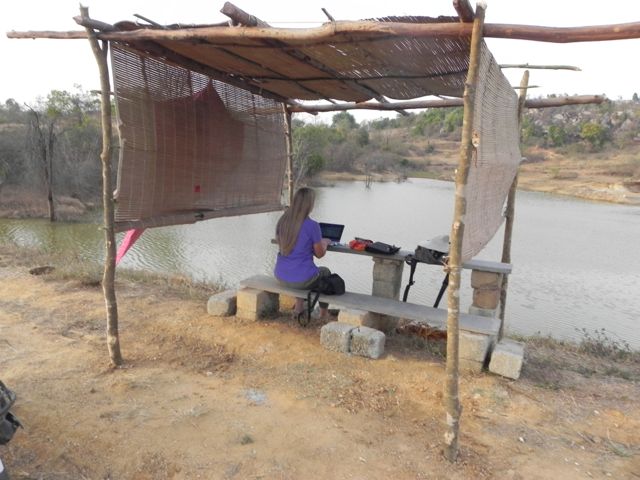
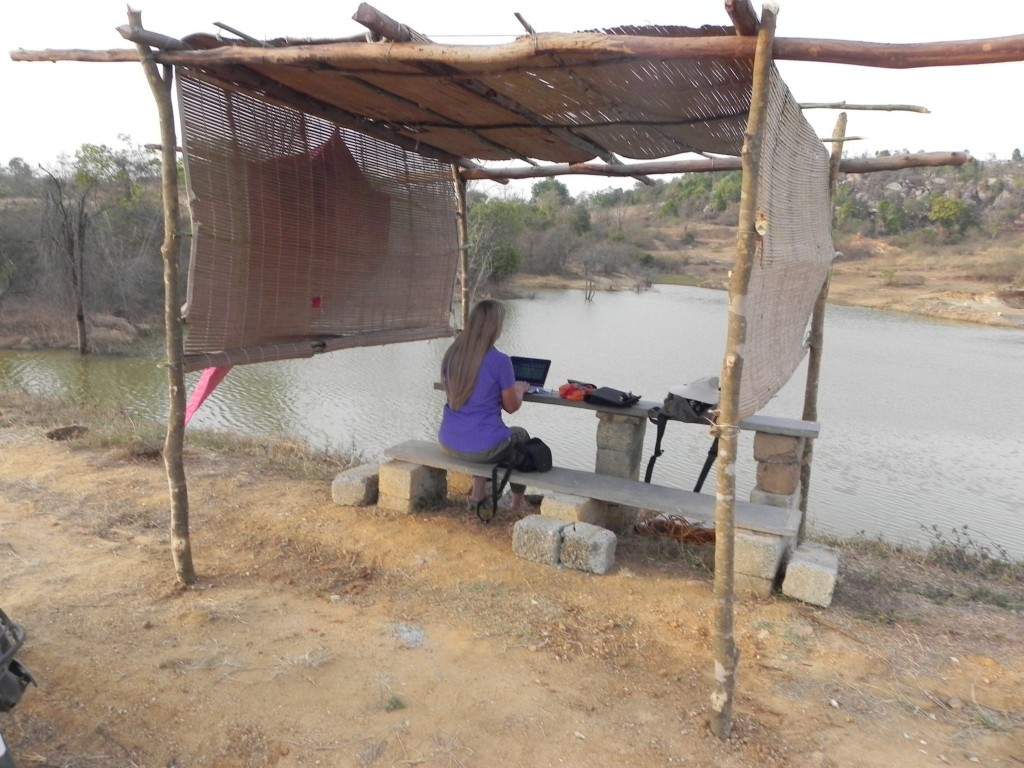
The two months since my arrival in India have been filled — with meetings, brainstorming sessions, hiking through cinder-dry forests and continual reality checks.
It is so important that I am here now—on the care center site—to study the land, the wild elephant activity in the adjacent forest, the habits of the local villagers and the laws that govern land ownership and use. There is so much to learn, I am ever thankful that everyone I am working with speaks fluent English.
The project’s scope widens
The project has remained focused on elephant welfare but its scope and approach has shifted a bit…for the better.
Initially, we planned to have a relatively small plot of land in exchange for the care center elephants being allowed access to the national forest. Allowing elephants nighttime access to the forest is standard practice for the forest department’s captive-held elephants and seemed like a viable solution to limited day time space.
But as I hiked the adjacent national forestland, I was disheartened to see how the forest’s resources are exploited. The forest herself appears to be barely breathing, suffering from over-grazing, intentionally set fires and the destruction of trees by the local villages that border the forest.
Seeing the poor condition of the forest made me realize how the wild elephants are struggling to survive, with not enough food, water or shelter to sustain them. The idea of adding even a few more elephants to the already stressed habitat—reducing wild elephant resources even further—was a deal breaker for me.
Following a frank discussion with the collaborators on the project, we decided to expand the land used for the care center, something close to 200 acres, thereby eliminating the need for the center’s elephants to use the forest.
No chains, no dominance
This change in operations has resulted in positive shifts in the facility design and style of elephant care.
The original plan called for a small plot of land and giving the elephants access to the national forest at night. But I recently learned that allowing the elephants into the forest overnight called for a compromise: the elephants would have been required to wear a drag chain on one leg whenever they were in the forest. The chain helps keep them from being mistaken for wild elephants by villagers and makes it easier for the mahouts to track, retrieve and return them to their home during daylight hours.
But now, with national forest use no longer an issue, there is no compromise required – chains will have no place at the care center.
You can imagine how excited I am about this unforeseen turn of events! I had almost been convinced that in India elephants will never be completely free of chains. But with our land expansion we will be able to do just that—keep elephants on a large tract of forested land, free of chains and dominance.
Infrastructure development and acquiring land
As result of this positive shift in the design of the project, we need more time for preconstruction development than earlier projected. We must conduct an expanded survey to identify land ownership. Surveying the entire tract of land will provide the legal assurance required prior to constructing the miles of necessary trenching and fencing.
This expansion also requires a follow-up communication to the government informing them of our desire to expand…even before we have begun!
We also have the challenge of acquiring a small parcel of land that is essential to the project but is currently occupied by another person. We have received assurance that this parcel of land—approximately seven acres—can be acquired.
In India, land rights are complicated but well defined, if not always enforced. In some cases property owners hold a deed and are permitted to sell to whomever they choose. In other cases, villagers and tribals who receive land from the government are allowed to pass the land down to family members, but are not allowed to sell outright.
Becoming familiar with the regulations is essential for anyone intending to own, lease or occupy land in India.
I am told that when it comes to land, possession is nine-tenths of the law and even in cases in which the land cannot be sold, occupants can accept payment to vacate. As I understand, once they have vacated the land, another person can occupy it, with stipulations that it be used for some agricultural purpose or forest restoration and it can never be sold. One small parcel of land essential to our project falls in this category.
I am keeping a positive outlook about acquiring this piece of land, which stretches across the edge of the lake, one of the essential areas for our elephants. Negotiations are underway. All I can do right now is wait.
Co-existing with wild elephants
In the meantime, I am tracking the movement and land use of wild elephants in the area. There is one section of the care center land they frequent. All the collaborators have agreed that no care center land used by wild elephants will be blocked to them. Our goal is to be mindful that our project, although well meaning and helpful to captive elephants, not cause hardship to wild elephants who use the land.
We have identified a small corridor just inside the care center property, adjacent to the national forest, where wild elephants leave the forest to enter the care center property. They have a well-established path, which will remain open for their use.
Protecting this wild elephant corridor is another unexpected development that makes me even more excited about the care center project. Being able to create a healthy space for captive elephants to recover and thrive, while at the same time preserving land for wild elephants who migrate through the area, feels like the right thing to do.
Care center and bird sanctuary
With an estimated 180 different species of wild birds in the area, the care center property is already a bird sanctuary. Never before have I been so enthralled by bird watching but from day one I was in awe of the many different birds and their beauty.
The lakes draw a variety of fishing birds, from the Indian Pond Heron to the regal Brahminy Kite. Their nonstop activity, sometimes entertainingly comical, has sparked my interest in studying these winged creatures with whom I now share my space.
The animated and gutsy Blue Eared Kingfisher was the first to catch my attention. His fishing perch is feet from my outdoor office. The first time I watched him make a catch, I admit to being a bit shocked that this minute blue bundle of constant movement disarmed his prey by bashing its head against a rock.
I’ve observed Brahminy Kites collecting branches for nest building, a trio of Red-Wattled Lapwings singing a chorus, a Black Shoulder Kite dive-bombing to catch a mouse and a Great Cormorant perching on a branch 30 feet above the lake on its awkward looking webbed feet. I’ve seen egrets of every size follow the resident horses, snatching up displaced insects. Then there were the stunning Rufous Treepie, Red Whiskered Bulbul and a pair of White Browed Wagtails who chased a Crested Serpent Eagle away from their favorite tree.
Being able to observe so much winged activity has opened a new world to me.
Survey and land
Surveying the expanded land is the next step required to move forward on this project. Acquiring the seven-acre parcel of land currently in negotiations will come after that, followed by a government endorsement of our expansion. All this needs to be accomplished before beginning construction.
Fencing and trenching
Only after the survey is completed, the extra parcel of land acquired and government approval secured can we begin work on the perimeter trenching and electric fence required to keep wild elephants out and our care center elephants chain-free inside. The fencing is estimated to cost $7 per foot/$36,000 per mile. The approximately four miles of trenching and electric fence will come to about $142,000.
Compare this to the average $100 per foot elephant sanctuaries in the US spend on fencing. For 7 percent of the cost, we can provide a safe and secure, chain-free environment for needy elephants in their authentic natural habitat while simultaneously protecting wild elephants and their land.
I am very anxious to move forward on this project but am cognizant that we cannot overlook any step or detail in our enthusiasm to make the care center a reality. If great journeys are launched one step at a time, who knows where helping one elephant at a time will take us.
Please visit EAI’s Facebook page so I can keep you updated on our progress as it happens!
Thank you for your interest and continued support. This care center promises to be more than any of us ever expected. Thank you for sharing my dream.
It is time for me to return to Asia. My Elephant Care and Rehabilitation Center is calling.
Learning from my past, I have decided to stop for a least one second to stand in the glow of this monumental moment. This time around I plan to rejoice in each tiny success, revel in each new development and give thanks for the progress made each and every day. I look forward to the challenge of staying in the moment as much as I can, recognizing that each unique moment will slip by without acknowledgement if I don’t make the effort to cherish it.
So many people are with me on this journey. I feel you shoulder-to-shoulder traveling with me and, of course, those at my back, pushing me forward. This is truly a time of celebration. Thanks for joining me on this fabulous journey.
I recently sent the following appeal to EAI’s loyal supporters. The response has been overwhelming.
Our Elephant Care and Rehabilitation Center project in Bangalore, India, finally received the government endorsement we have been waiting for. I cannot tell you how excited I am that we are finally able to move forward on this project to provide a humane home for elephants in India. I know you share my enthusiasm.
The property for the center has been secured. It is fantastic — complete with two large ponds, woods and pasture area — and it borders a national forest that we have received government permission to use.
Can you believe it? Our elephants will be allowed to use the national forest as if it were their home! This really is a dream come true!
In the surprisingly short time since I founded EAI, it has already had a notable impact on the welfare of captive elephants living in Thailand, Nepal and India. Hundreds of elephants have received pedicures and mahouts have been introduced to a kinder, gentler way to manage their elephants.
And now we are preparing to create a care and rehabilitation center – the first of its kind – that promises to change how captive elephants live in Asia.
Helping one elephant at a time takes the efforts of many. I need your help now.
Before we can rescue even one elephant we must complete the infrastructure including perimeter fencing, construct chain-free corrals and build night shelters to provide protection from wild elephants and poachers. A sanitary water collection and containment system must be installed to ensure a continuous supply of clean water. And we need a small vet clinic to support each elephant’s recovery following his/her rescue.
Elephants like 12-year-old Menaka, who will be our first resident. Chained in a temple for most of her life, Menaka has experienced horrors we cannot even imagine. She spent day and night standing on concrete, forced to stand at attention in the hot sun for hours and bless temple worshipers. Whenever Menaka attempted to move, she was punished harshly with bullhooks. At night she was left alone and hungry, with heavy chains tied around her legs; her attempts to free herself caused painful wounds that went untreated.
Fortunately, once Menaka arrives at the center, her life will be forever changed and her past will become a distant memory.
I can’t wait to see the gleam in young Menaka’s eyes when she enters her chain-free corral and realizes her new-found freedom.
The cost of the infrastructure required to provide sanctuary for needy elephants like Menaka is estimated at $200,000.
I have complete confidence that we can reach this goal. But, I cannot accomplish this alone. I depend on you to help me make this dream a reality.
Your donation can help Menaka be the first of many elephants rescued to our care center. They will make history, living proof of a better, kinder way of caring for elephants living in captivity.
Please help us meet our goal. As with all my projects, every dollar you contribute goes directly to helping the elephants.
I know we have a big job ahead of us. But my experience of creating The Elephant Sanctuary in Tennessee has taught me that we can accomplish anything we set our mind to. Together we can create this care center, a solution for India’s suffering elephants and a model for the rest of Asia.
Thank you for your support and for being a part of the solution!
Carol Buckley
P.S. Please contact me if you have questions or suggestions.
Today I traveled many kilometers through Chitwan National Park to reach my foot trimming clients. To get there, I hiked to the river’s edge, boarded a small sailing vessel, crossed a river and drove through a magnificent forest, crossing over creeks on what I would call barely-bridges (as opposed to sturdy concrete ones). It was a wonderful adventure!
When I reached the river, the tourists were packed like sardines in their low-rider boats with a boatman steering them lazily down river. Dr. Geare, the head Government veterinarian at Chitwan National Park, Chitra, a vet tech who works with Dr. Geare, and I were ushered onto our private dugout canoe with removable seats (little wooden stools that fold up against the side of the canoe when not in use), which silently glided across the river to the sand bank on the opposite side.
Our driver magically appeared. We climbed into a truck and I must say had a ride of my life. It was only after we picked up several young soldiers hoofing it back to camp that I was able to release my firm grip on the door frame, the only thing keeping me from bouncing out of my seat and hitting head on the roof. The weight of the men in the back gave the truck better traction and kept the back end from bouncing up and down like a trampoline. It was a great ride through a beautiful forest.
Within minutes a wild boar had crossed the road, male peacocks could be seen and heard sounding their calls, a monkey clung to the side of a tree, a couple of deer flashed by and too many muggers (crocs) sunned themselves along the back of a small creek.
Our destination was the Kasara forest camp where four government elephants live. What a shift from Sauraha. Don’t get me wrong — Sauraha is a nice place for the government elephants — but in Kasara the elephants are really living in the forest. If I could only get rid of the chains and hobbles and put up some hot wire fencing, I would really feel as if I was helping them. Okay, one thing at a time — first feet trimming and then more freedom!
Kiran was not with us today, but Chitra also excels at foot trimming. Upon arrival, I found that instead of the three elephants I was expecting there were actually four. Three elephants were scheduled for foot trims which is why they made it on the list, or maybe it was because the fourth elephant actually is unnamed. She is Laxmi Kali’s year-old calf. When I asked her name, a slight hesitation was followed by, “Her name is Laxmi’s calf.”
After spending several days trimming the feet of privately owned elephants, I must admit that today really highlighted the differences from those owned by the government. The government mahouts seem to have a much better relationship with their elephants. They do not yell incessantly nor strike their elephants absentmindedly, which is good because Chitra and Dr. Geare had already heard my request for no pit neu. Actually, my request has grown more sophisticated following an impromptu Nepalese lesson I had last night. I was told that no pit neu is nonsensical and that the proper way to get my point across in proper Nepalese is hati lie na pita, which translated means, “Do not hit the elephant.”
The foot trimming went smoothly, with the mahouts seeing for the first time how to administer proper foot care. They were very interested and helpful, and each appeared proud when his elephant’s trimming was completed.
Just as we were finishing up with Laxmi Kali, her calf decided that it was time for a drink and let out a boisterous “I’m thirsty!” yell. Mom immediately threw her hind leg in the air to get up, a fair warning to the mahouts that she really needed to respond to her calf. We all laughed, knowing how the babies call the shots. Laxmi jumped to her feet and baby got the drink she was so thirsting for.
Foot trimming with the privately owned elephants started yesterday. Once again Kiran, a veterinary technician working with NTNC and the government in Chitwan National Park, came through, setting up the foot trimming schedule and arranging for the elephants to be at the stable.
Sona Kali laid down to expose feet in dire need of trimming. Her back pads were okay but the nails on all four feet were severely overgrown, decayed and split. The pads of her front feet had deep black tracks of bacteria.
The first difficulty we experienced was the mahout’s failure to respond to Kiran’s direction. At first I thought he was ignoring Kiran and then it seemed he did not understand what Kiran was saying. Araw means stop and, even if you don’t speak Nepalese, a mahout would know that word because they use it with their elephants continually. But when Kiran said “araw,” the mahout kept cutting. Without hesitation, Kiran took the knife and continued the trimming himself. The mahout training was a bit slow at first but when he finally started following Kiran’s directions, it seemed that he could end up being a good foot trimmer.
Kiran’s and my partnership is well established. He starts with the big cutting, shaving down the overgrown nails, and I follow up with digging out the rotten areas, taking off more of the overgrown nail and shaping everything into place. It is a pleasure to work with him, not only because he does a good job but because he takes pride in doing a good job. When I am deep in concentration focused on a problem area Kiran will say, “Carol, please,” which I have come to understand means “move out of the way with that sissy knife and let me cut away more of that excess nail.” I am happy to oblige him because I can save my energy for sculpting. I must admit that Sona Kali’s feet had me sweating — they were definitely the most overgrown so far. We were able to trim her nails into shape but the thick tracks of bacteria were so deep between the toes of her front feet, it will take several follow-up visits over the next many weeks to bring her feet back to health.
With all that Kiran has done to make this Nepal Mobile Pedicure Parlor a success, I want to raise some funds to show appreciation. There are forty private owned elephant here in Sauraha so we have our work cut out for us, but the effort is worth it: the elephants will have healthier feet and the mahouts will acquire additional skills. The truth is that I could not have provided this service without Kiran’s assistance.
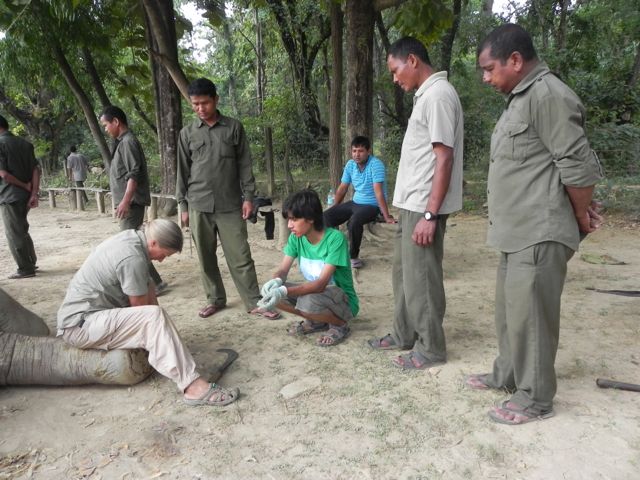 But our foot trimming program was a grand success. We had a fabulous trimming team: Dr. Gairhe; Kiran the vet tech; Hira, Kirti Kali’s phanet (head mahout) from the NTNC hattisar; and I.
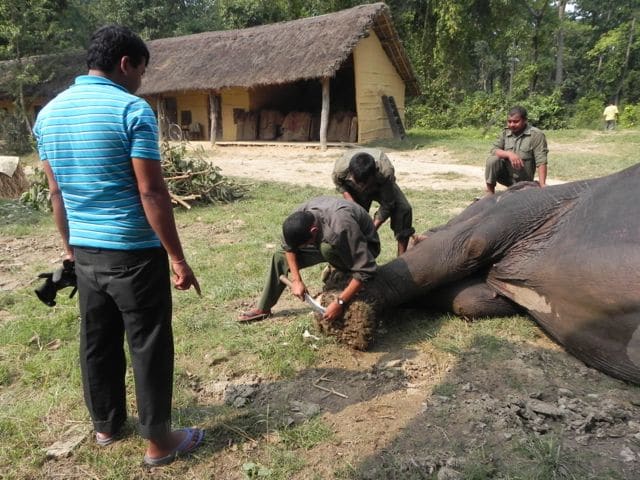 In two short days we trimmed the feet of 24 government and privately owned elephants.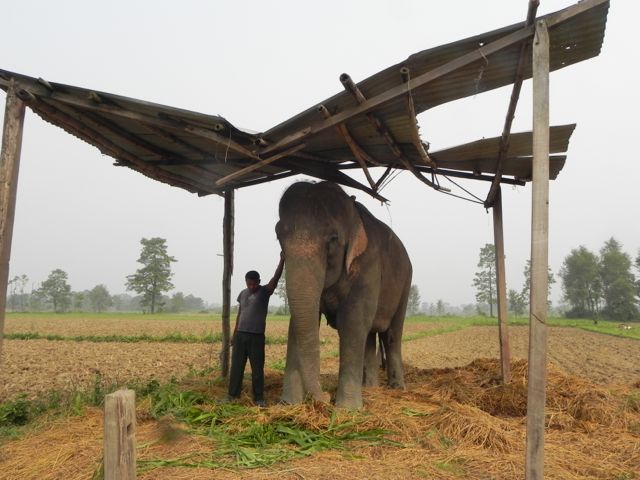
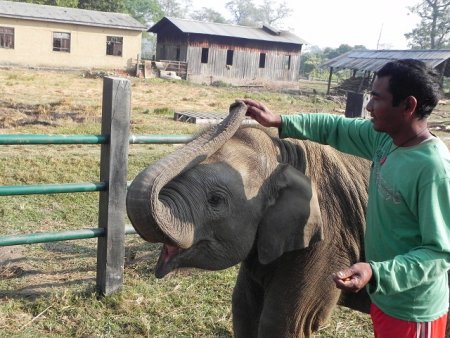
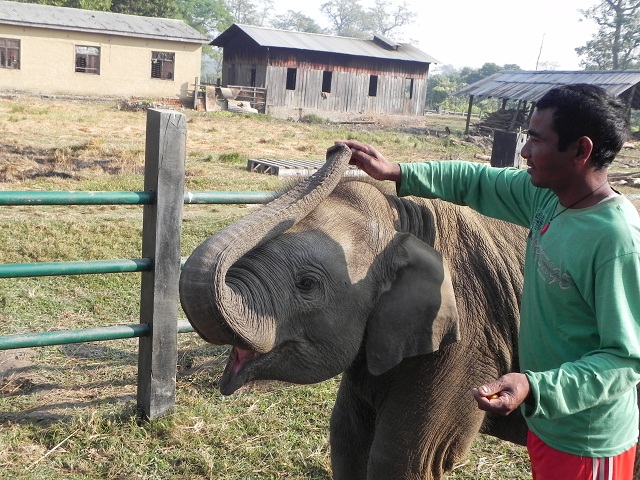
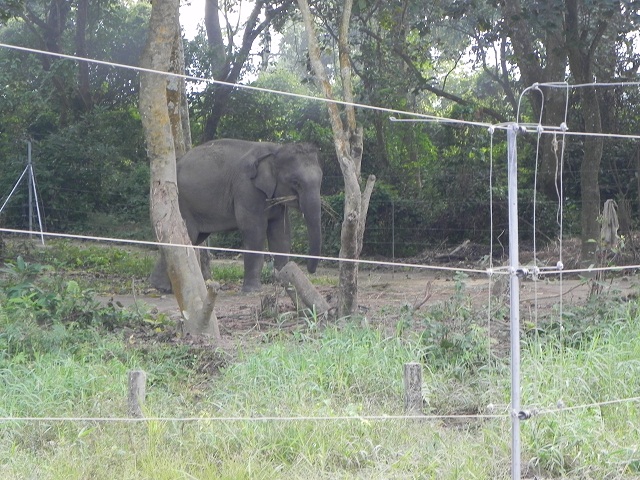
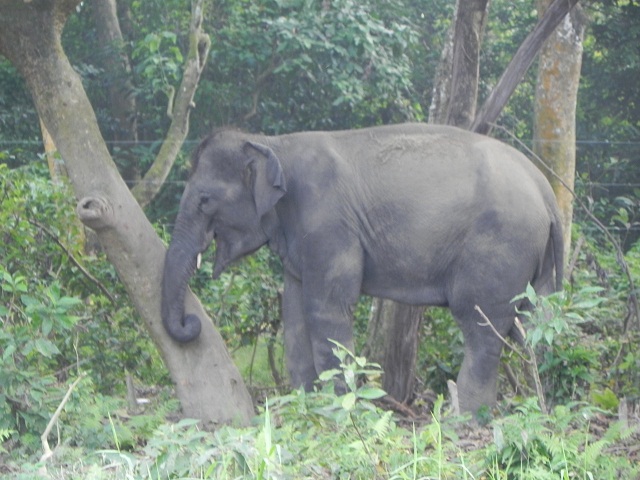
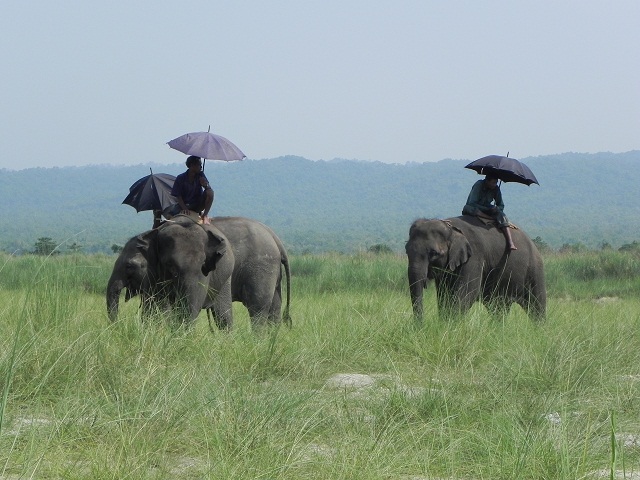
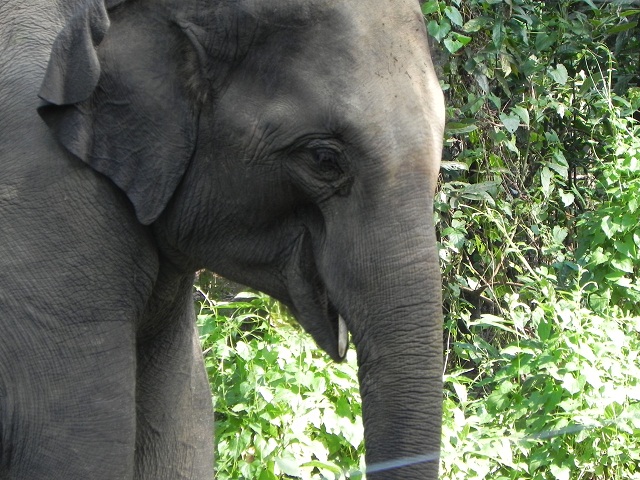
 Eight-year-old Sweetie Kali will be the lucky recipient of this new and improved yard, where she will be off chains 24/7.
 Currently, all the elephants are tethered under their own private shelters. Once everyone is comfortable that the fence provides the security necessary, chances are that Sweetie’s mother will be allowed to join her in the yard. Imagine what a moving reunion that will be.
 Revenue land is owned by the government and designated for agricultural use or forest restoration. There are cases when the government can gift this land but the recipient must abide by strict use requirements and restrictions, is never allowed to sell it and the government has the legal right to reclaim it.