Tag: human elephant conflict

  • Capture is an ill-conceived solution to human-elephant conflict

    Capture is an ill-conceived solution to human-elephant conflict

    Corbett Tiger Reserve eles

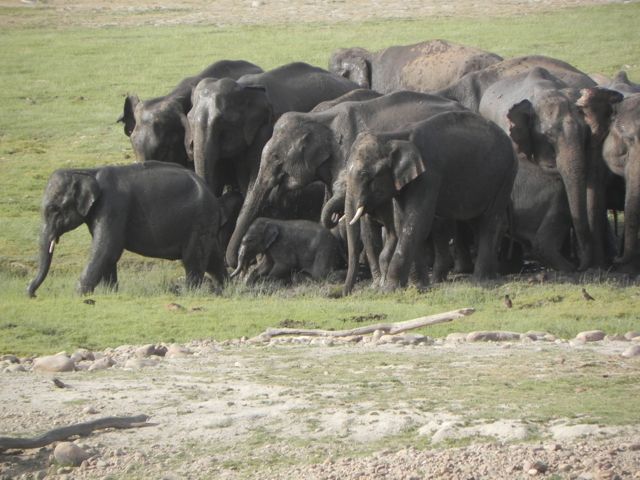
    The competition between humans and elephants for space and resources has reached an all-time high in India. The problem stems from both species’ dependence on forest resources for survival.

    Elephants leave their forest home in search of food. Until villagers are given alternative means to meet their daily needs without depleting forest resources, the problem will continue.

    Lacking a well-thought-out plan to combat the problem, the Indian government continues to resort to crisis management. Always a step behind the problem, they have failed in their responsibility to the welfare of marginalized people and wild elephants.

    Capturing elephants is an ill-conceived, short-term solution to a long-term problem. Although it is ethically repugnant to some, others have no problem incarcerating wild elephants to a life in chains.  How a people who profess to believe that Ganesh is god can capture and torture his likeness is disturbing.

    To avoid a continued escalation of the problem, the government must devise a way to protect the village people, the wild elephants and their forest home.

    Potential solutions to these pressing problems need immediate and thoughtful consideration. The future of the forest, wildlife and the villagers who encroach upon the forest are at stake. Ignoring any aspect of the problem will result in failure–a loss for humans and uncertain future for India’s forests and elephants.

    Some foreign NGOs recognize the need to relocate villages and open elephant corridors and are pursuing initiatives. But most efforts by local and foreign NGOs to create protected areas for elephants at no expense to the government have, to date, been thwarted.  Government resistance to outsiders bankrolling solutions to the human elephant problem seems counterintuitive and bewildering.

    Read more:

  • blessing the land

    blessing the land

    I’ve seen footprints and elephant boluses and heard stories about the herds of wild elephants that frequent the area, but last night at 10:35pm I heard proof — my first wild elephant trumpet. It sounded like s/he was just outside my front door. The familiar sound brought an instant smile to my face. I stood motionless on my porch listening for more, any other sign of elephants. But there was only pitch dark and silence. I figured the music maker had moved on. But honestly, just hearing that one joyful trumpet was enough for me, for now.

    I’ve been thinking deeply about our project, wondering what impact, if any, it will have on the wild ones. Of course my desire is to do no harm, so educating myself regarding wild elephant activity in the region is imperative.

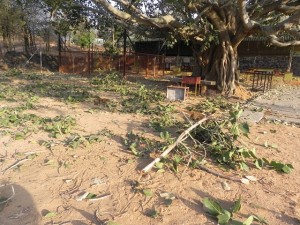
    This morning as I recounted the elephant music of the night before, the resident security man came roaring up on his scooter to announce that he had seen a herd of elephants. The night before they entered the property through a wide opening in the forest wall and proceeded to feast on bamboo, a fruitless mango tree and the huge Banyan tree that dwarfs the outdoor classroom area used occasionally for schoolchildren from Bangalore.

    Several piles of manure suggested the size of the herd and age of some of its members. From the fertilizer they left behind it appeared that this herd included at least two youngsters, one only a few months old.

    This sandal is a size 7, so you can see how small this calf’s foot is.

    Out of curiosity we tracked the elephants’ movements, following piles of manure, footprints and discarded vegetation. A horizontal chain that extended across a dirt road lay in two pieces on the ground. The heavy lock that previously held it together was splayed open and discarded. Most likely one of the larger elephants stood on the chain until the lock gave way.

    The amount of damage done was nil unless you consider leaf litter and a couple of broken branches a problem. After filling their bellies, the herd appeared to leave the way they entered.

    I am getting such an education — wild elephant lifestyles in the Bannerghatta forest 101. Living on the land shared by wild elephants is a gift and a responsibility. I look forward to the days and weeks ahead. I am realizing that this project has the potential to be much more than anticipated. One world, one elephant at a time has taken on a much more complicated meaning.

    One world, one elephant at a time — both wild and captive.

  • thinking about the big picture

    thinking about the big picture

    Things are progressing well with the care center — lots of discussion, meetings and scouting the land. But this time around the process is quite different from when my Tennessee sanctuary dream was becoming a reality. This time things are moving slower, every step evaluated and reevaluated by the team of people involved.

    Vishnu is well respected for his conservation efforts by area property owners. At a meeting yesterday I learned that his land is unique to the area as he is honoring and restoring the forest with no motivation of capital gain. Apparently, over the years, many have tried to persuade Vishnu to turn the place into a high-end resort, but he has resisted all offers.

    I love the fact that the land has been honored, forest replanted, wildlife respected and only limited numbers of humans allowed to bird watch and escape from the city.

    Vishnu would be the first to admit he never imagined his restoration would benefit captive elephants. But there is a low-level, nearly undetectable hum here, like something is ready to unfold, blossom or be born. The land is ready to serve elephants again.

    I am intrigued by what I am learning about the ways of wild elephants in a semi-urban environment. The fact that they can avoid trouble is nearly inconceivable with the degree of human encroachment surrounding their habitat. Putting myself in their skin is frightening. Every step they take brings them too close to human settlements. Everywhere they turn there is a road, a village, a rock quarry. They have no space and no safe haven; they must spend a great deal of time stressed by this mounting pressure, no doubt resulting in the same types of illness anyone experiences when exposed to constant low-level stress.

    Being an optimistic person by nature I will not say the situation for wild elephants is hopeless, but being realistic, I admit it would appear that their chances of survival are slim. A major shift in the universal consciousness regarding our planet, resources and all life would need to occur, and quite soon, for mega vertebrates such as elephants, to survive in a free state on our planet.

    Not a day goes by without horror stories regarding elephants, both captive and wild, making headlines worldwide. In India alone, several stories appear daily, chronicling human/elephant conflict, elephants mowed down by trains, buses and trucks driving through national forests, elephants electrocuted on tea garden estates by live electrical wires left dangling intentionally to curb trespassers. Ganesha is alive in the hearts of the people in Asia but the connection to his live counterpart seems to have been severed.

    To date I have not seen a wild elephant in the forest bordering the care center, and honestly I believe I prefer not to. I can only imagine the toll the challenge of survival has taken on them. Where I would hope to see a calm and majestic inhabitant of the natural world, I am afraid I would see someone much different, a pale image of who s/he was before the human madness overtook their well-balanced world.

    The care center will be a beacon, a haven for a few needy elephants and an example for other conservationists to emulate. But time is not on the side of the elephants, captive or wild. I can’t say for certain that our small project will change reality for elephants…but like I said, I am an optimist and stranger things have happened.

  • Scouting Around

    While scouting the land today I found elephant boluses (dung) scattered along a granite hilltop on the care center property. The granite is spectacular, with sheered layers and huge natural depressions. During monsoon season rainwater fills the many depressions, creating a series of watering holes, some deep enough for an elephant to wallow in. Judging from the age of the dung, monsoon season is probably when the elephant was here.

    While exploring another area of the elephant-lake shoreline I found footprints from a single elephant… Where he exited the water is quite muddy so his footprints were well preserved. They weren’t recent but they were BIG.

    I have been thinking a lot about the wild elephants that use this land. Their corridors must be reestablished and protected or wild elephants will not survive. I would trash my plans for a captive elephant care center if giving this land to the wild elephants would make a difference, but the reality is that 200 acres will not fix the problem.

    Guarding the national forest from further human invasion is an important step toward fixing the problem. One of the reasons Vishnu bought this land was to act as a steward for wild elephant land . He wanted to stop human encroachment, at least in this area. If more landowners took this perspective, things could turn around for elephants. They need land, connecting corridors and stewards willing to protect the land.

    The care center borders the national forest. Years back, in an effort to keep wild elephants from leaving the forest to raid crops, the Forest Department erected miles of stone walls. Unfortunately, with villagers growing crops just feet from the walls, the temptation is too great. Elephants—usually a lone bull— pushes over a section of the wall. It is an easy task for a full-grown male, who lowers his massive head and pushes until a section of the wall topples, creating an opening. After seeing a couple of these breaches in the walls, I am growing ever more thankful for my Indian collaborators.

    Vishnu has lived on this land for years, accumulating quite a bit of knowledge about wild elephants. He is required to know the species because his company is one that installs electric fences designed to keep wild elephants and villagers separate. I recently learned that he installed the fencing at Corbett National Park. Last year, while visiting with Christy Williams, I had the opportunity to observe the effectiveness of Vishnu’s fencing enclosing the compound where I was staying, smack in the middle of the forest. Late one night I noticed a juvenile bull standing close to the fence. He stood there for quite some time, several minutes for sure. He appeared to be contemplating something, perhaps the likelihood of being able to get through the fence. Or maybe he was just as curious about us as we were of him. Either way, the fence held him out.

    After a few more days of scouting, I believe we’ll be able to decide on the location of the perimeter fencing. This is a very exciting time. I do miss the presence of elephants but I realize they would be a huge distraction. I need to stay focused on the project. The elephants will be here soon enough!