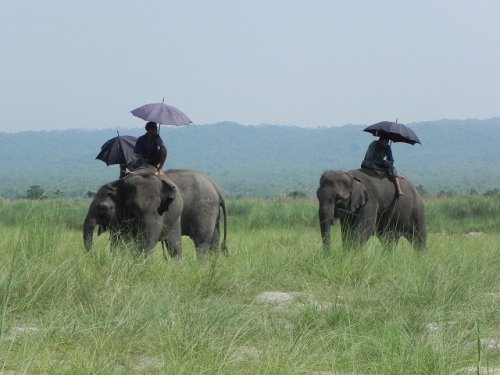
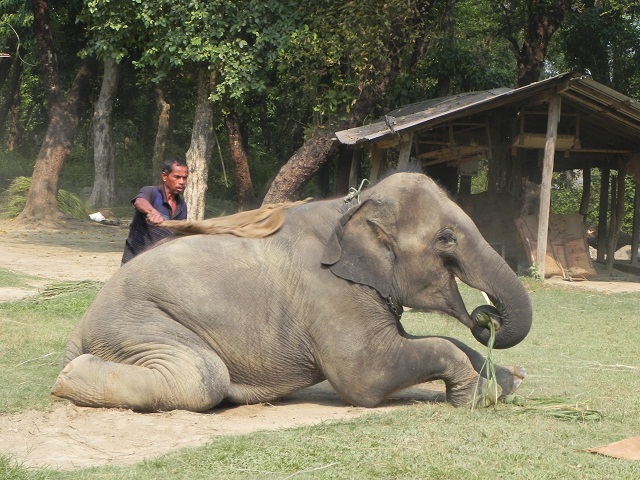
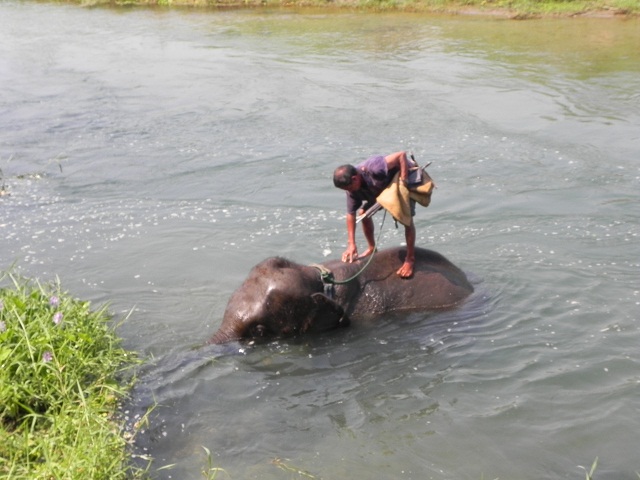
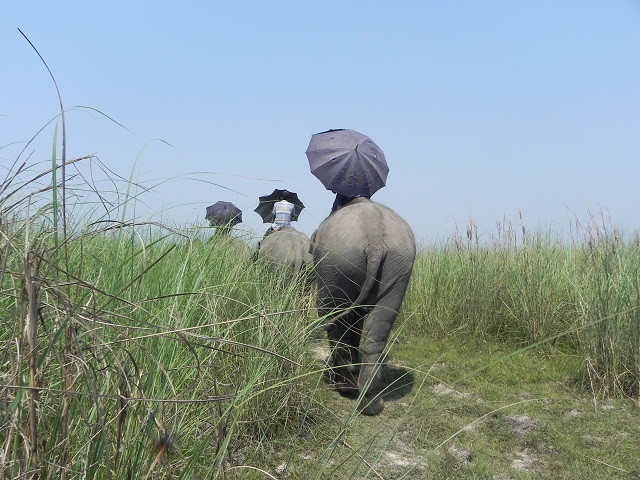
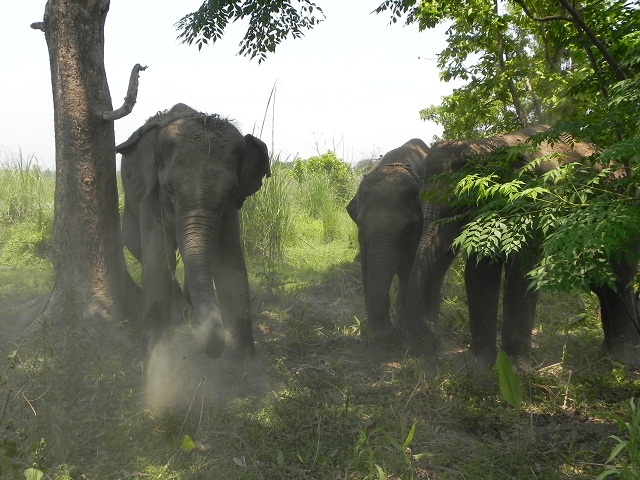
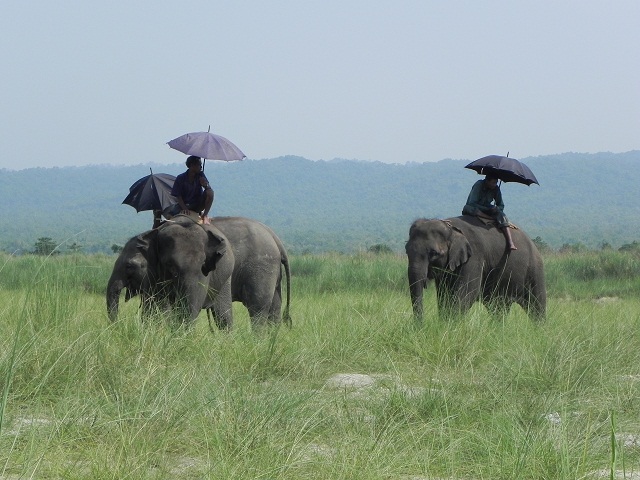
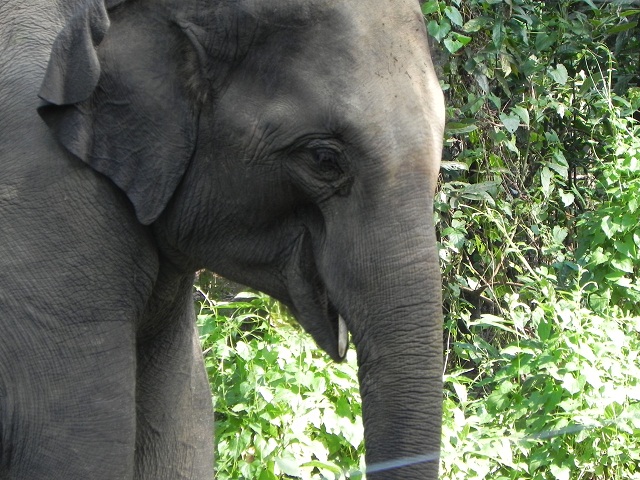
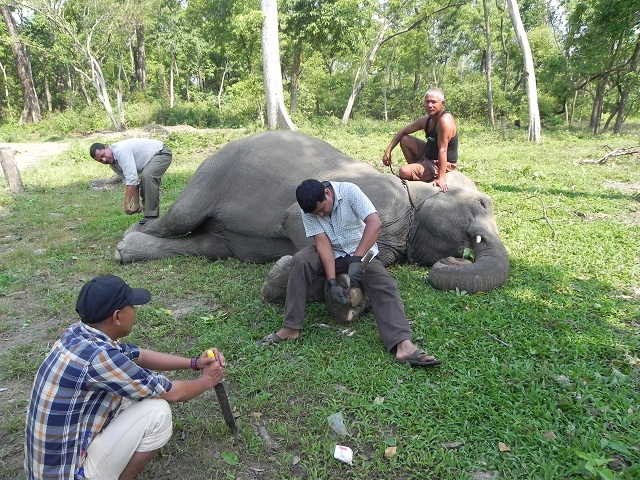
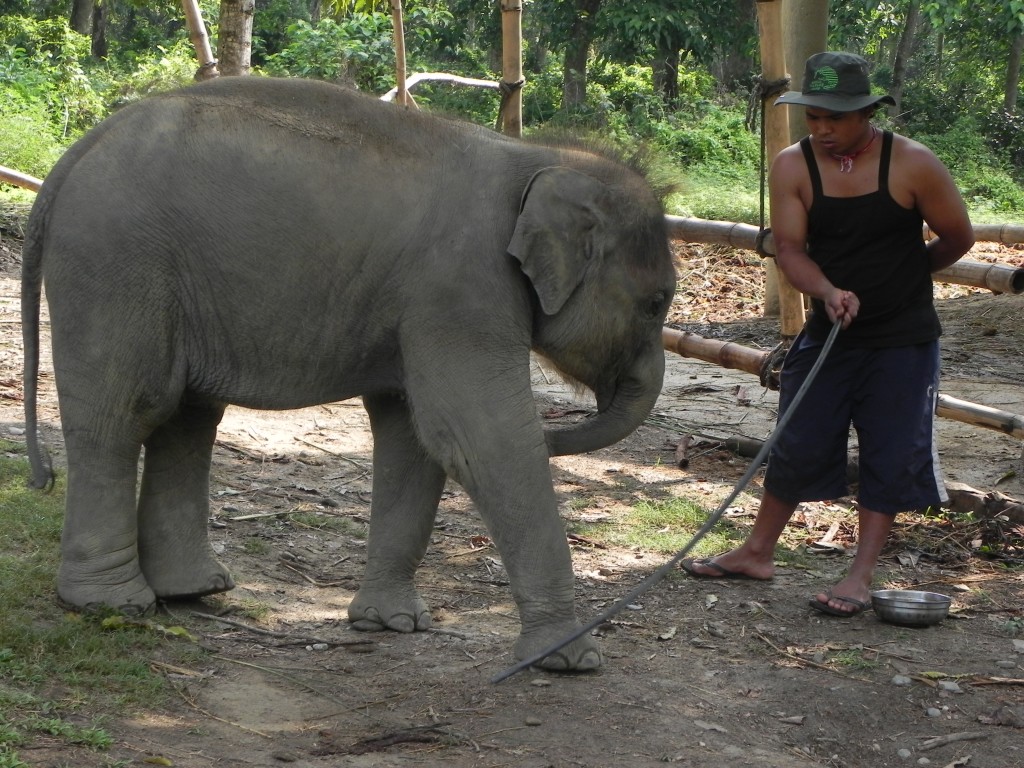
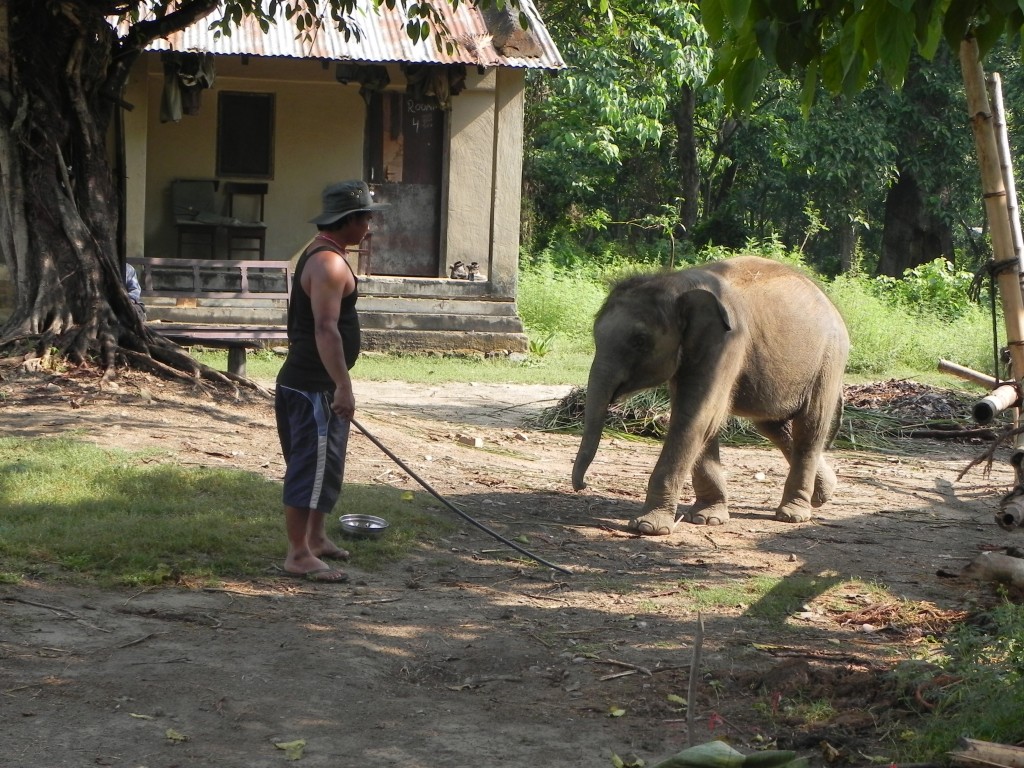
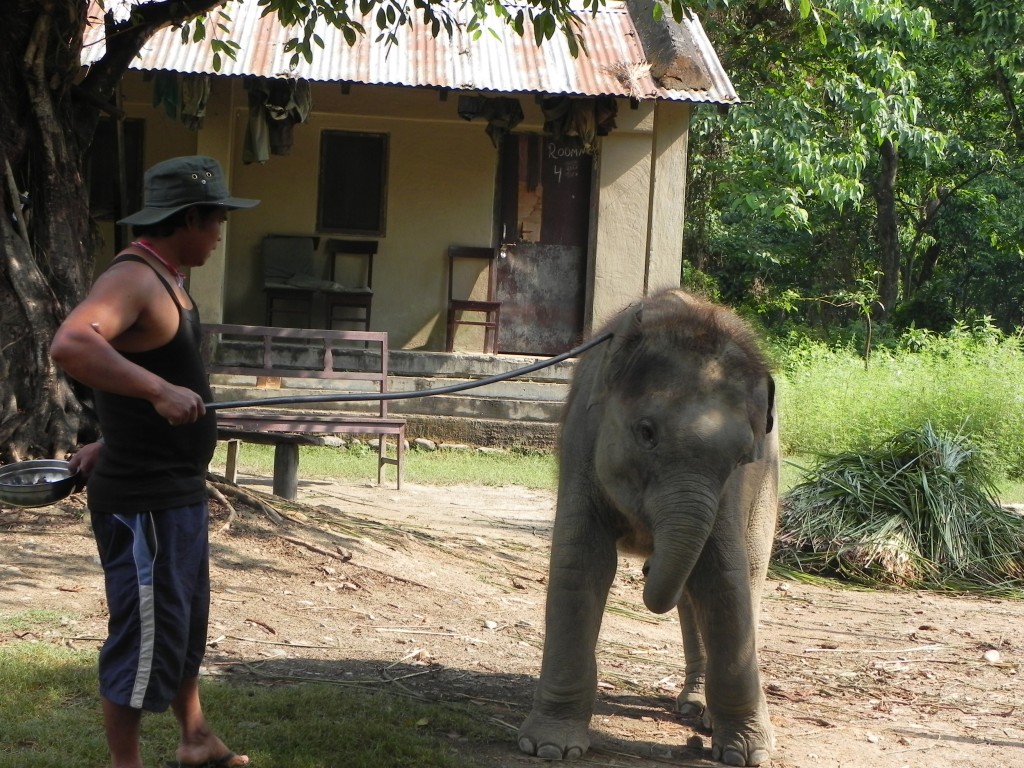
A new feature in National Geographic, “Captive Elephants Freed From a Life in Chains highlights EAI’s work in Nepal. Carol tells the magazine that “getting [the elephants] ‘chain-free and pain free’ is a start toward improving the lives of captive elephants across Asia.’”
Tag: mahouts
-

Unchained: New Documentary on EAI
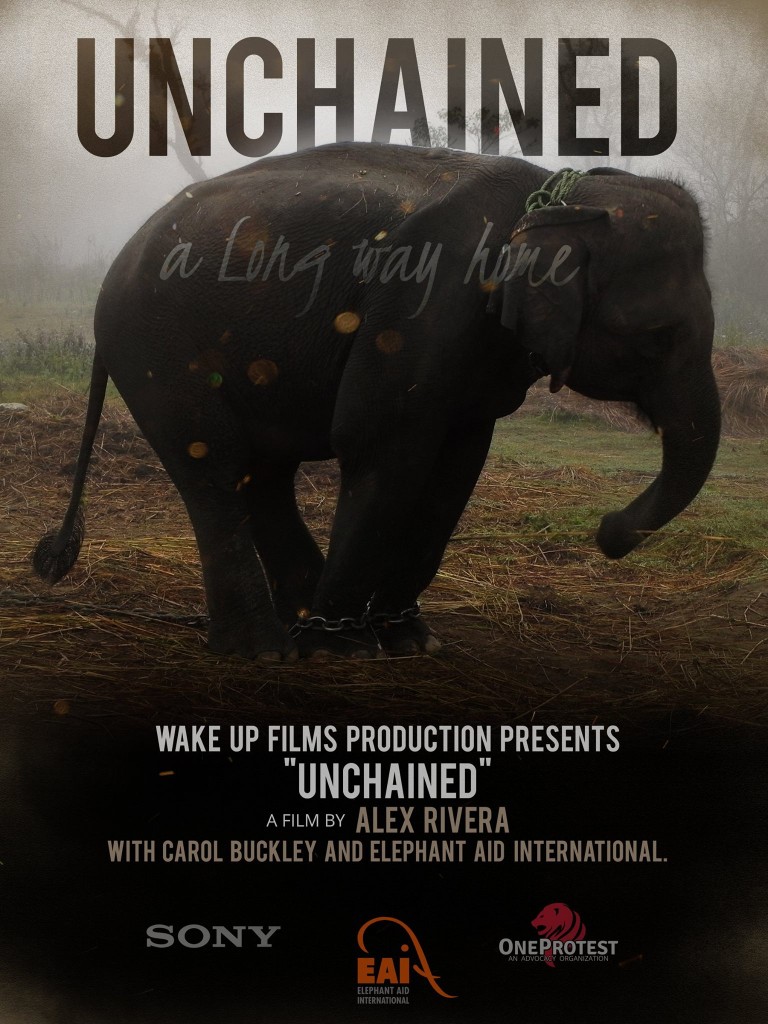
A new documentary on the work of Carol Buckley and EAI improving elephant welfare throughout Asia has been selected for the 15th annual Wild & Scenic Film Festival.
“Unchained” follows Carol and her team in their quest to enhance captive elephant welfare in Nepal. Using gentle persuasion and showing by example that there is a better way to treat elephants in captivity, Carol takes a phased, pragmatic approach to changing attitudes that relies on winning the buy-in of owners and mahouts (elephant handlers).
Watch the trailer.
Learn more from the Unchained Facebook page.
-

The Suffering Continues At Nepal’s Top Tourist Destination
EAI has been “boots on the ground” in Nepal for nearly five years. Initially, much of our efforts were focused on improving welfare for the privately owned elephants used for tourist rides.
We’ve provided free pedicures and husbandry and training advice bi-annually since 2011. But today the safari elephants of Chitwan suffer to the same degree as they did when we first started. As long as tourists pay to ride elephants, the elephants of Nepal will continue to be exploited.
One way for you to help is by supporting groups actively working to influence tour companies to drop elephant safaris from their tour packages. Elephant Watch Nepal is one such group.

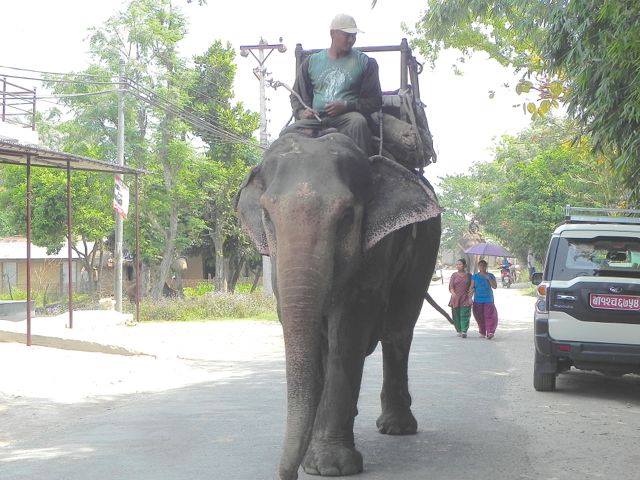
Six months ago we found this elephant being walked along a busy highway, in the midday scorching sun, on a 30-mile walk back from a party she’d been hired for.Today we found her in Sauraha on her way to the tourist ride area.

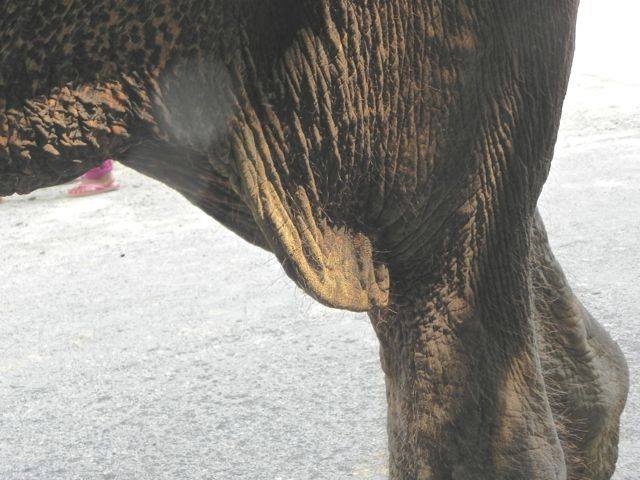
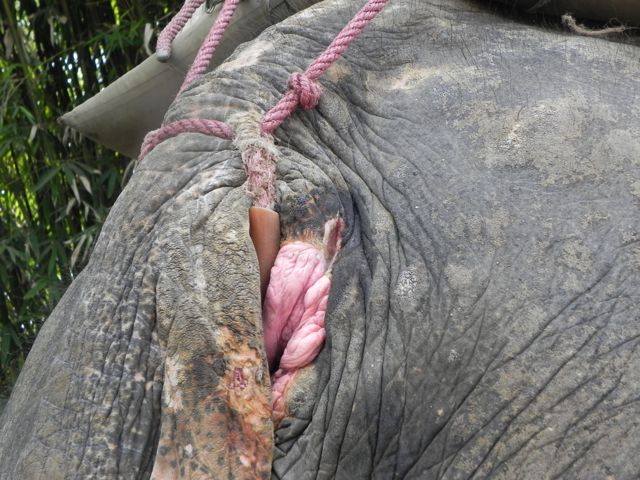
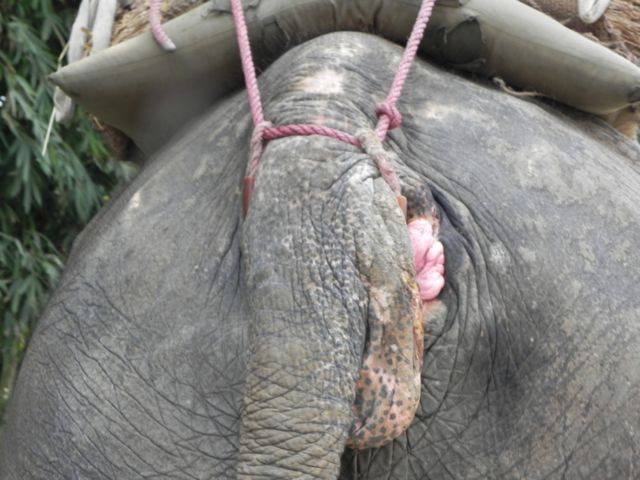
Saggy, dehydrated flesh This old elephant is blind, dehydrated, exhausted, underfed, continually beaten and suffers from deep gouges around her anus from the howdah (saddle) rope.

Painful wounds caused by nylon ropes used to tie the howdah (saddle) on for tourist rides 
Torn anus The owner and mahouts are aware of her injury and how to prevent and treat it. But they do nothing to ease her suffering.
-

Bahabur’s surgery
Oct 17th
[Warning: This post includes graphic photos.]
My first morning in Assam, I awoke to learn there was an elephant emergency.
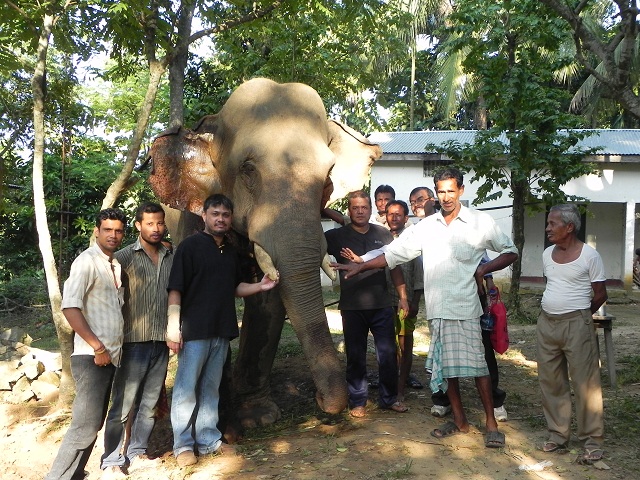
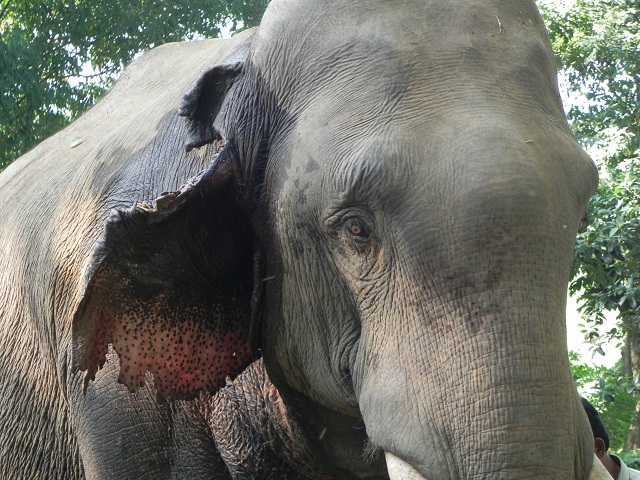
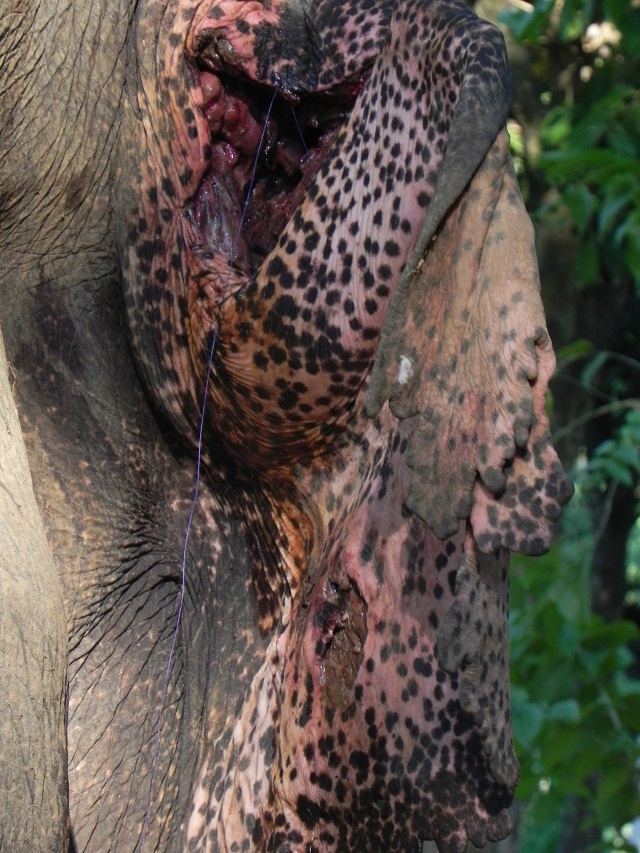
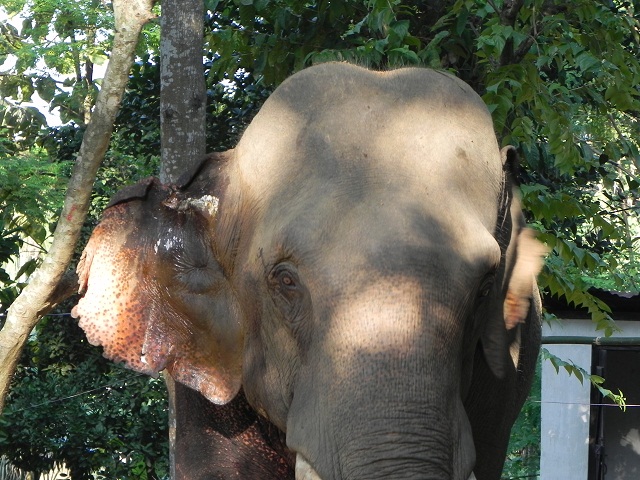
Thirty-five-year-old, Bahabur, a skilled koonki (elephants trained to assist mahouts in the capture, training and management of wild elephants) who only days before successfully pulled a wild rhino from a mud bog nearly lost his right ear in a fight with a wild bull elephant.
Bahabur is intimately familiar with both captive and wild elephants. He lives with a non-related herd of koonki elephants whose job it is to assist their wild kin by participating in human-elephant conflict mitigation.
When wild elephants emerge from the forest in search of food and water, they raid crops and create havoc. In an effort to protect both elephants and humans, Bahabur and his herd, guided by their mahouts, becomes a formidable barrier between wild elephants and trouble, literally saving the wild elephants’ lives.
Many elephants are killed as result of crop raiding–poisoned, shot, electrocuted, their mouths blown apart by bomb-laden food. These koonkis are the front line of protection for their brethren and the villagers whose encroachment and farming activity create such a dangerous situation for everyone involved.
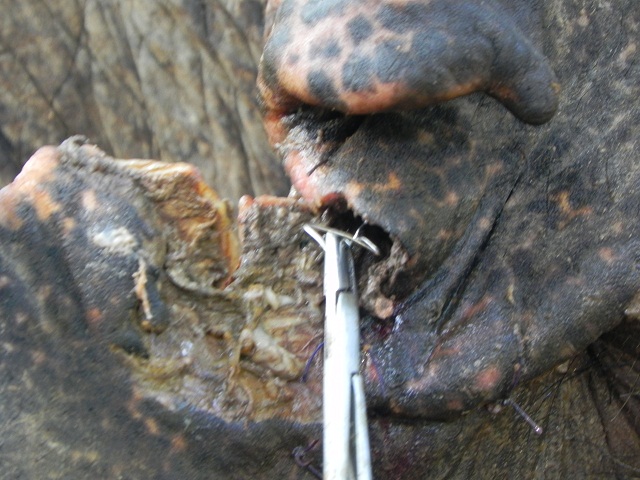
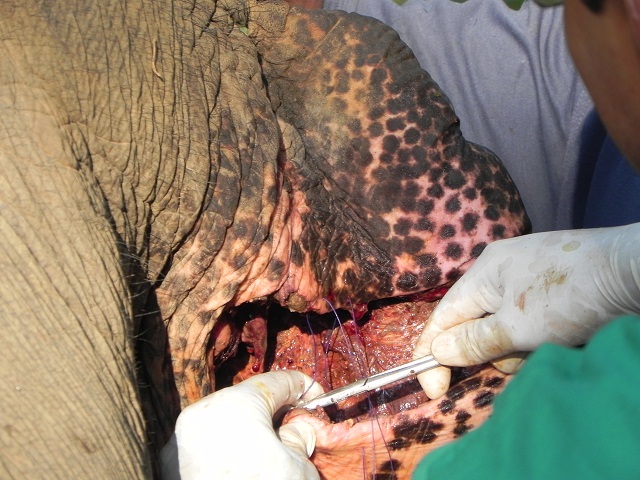
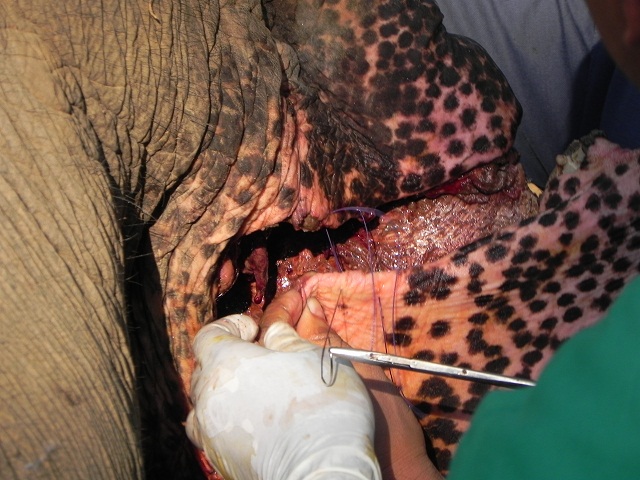
Bahabur stood motionless, his right ear ripped in half, dangling painfully under its own weight. The cartilage was ripped apart at the top ridge of his ear. The flesh that covered the back of his ear was torn from the ear, creating a huge gaping pocket between the skin and cartilage. It was a seriously gruesome sight and no doubt painful.
The attack had happened eight to 12 hours before, after Bahabur, just coming into his annual musth season, had uprooted his tether tree and headed straight into trouble.
Mahouts tracked Bahabur and received no resistance when they instructed him to return home.
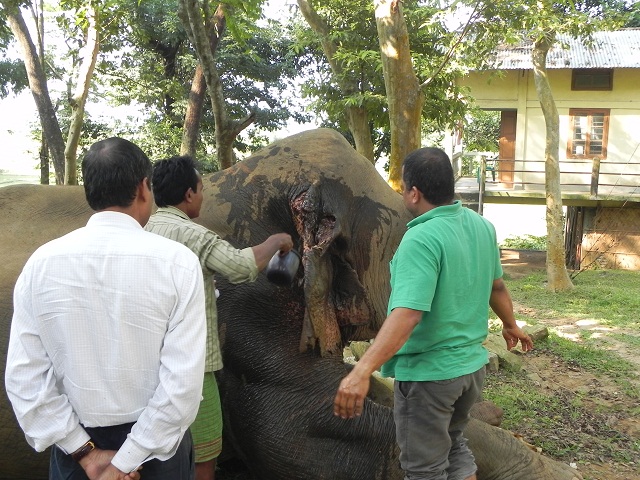
The expert mahout staff managed Bahabur while Drs. Bhupen Sarma and Anjan Talukdar assessed the injury. In a natural self-medicating fashion, Bahabur had packed the gaping wound with dirt, which needed to be removed before surgery could begin.
Without complaint Bahabur reclined in a half-sitting position, giving the veterinarians access to the wound. No one yelled, hit or in any way badgered Bahabur. Instead they spoke calmly and confidently, patiently waiting for Bahabur to respond to their commands and get comfortably situated.
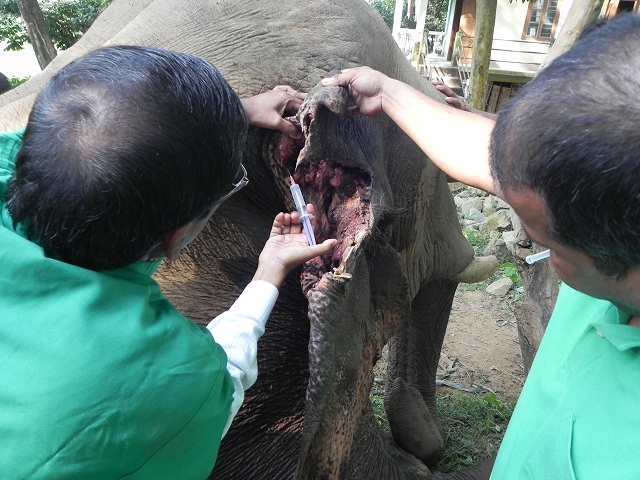
In soft tones, treatment instructions were given. The wound was cleaned, flushed out with clean water and Betadine.
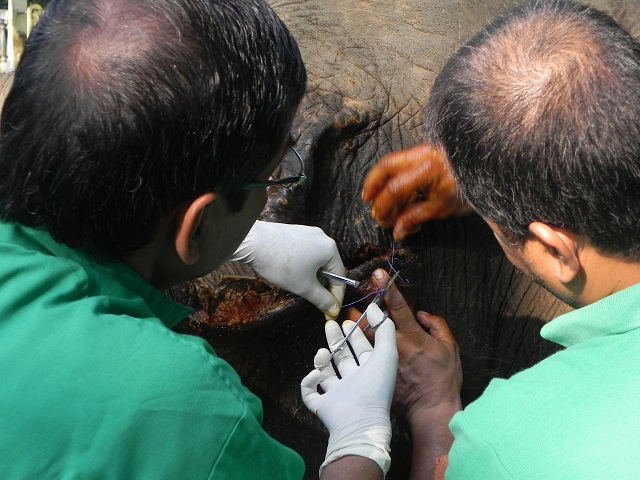
The veterinarians and mahouts worked seamlessly together, voices low as they repaired the half-severed ear of this full-grown bull elephant.
From time to time Bahabur needed to stand in order to readjust and, I believe, to distract himself from the pain. After a few seconds standing he would once again respond to the patient command given by his mahout to recline.
With only a local anesthetic to deaden the pain in the area to be sutured, Bahabur’s ear was expertly reconstructed; the torn cartilage stitched together with sutures and ripped flesh reconnected. The result was amazing.
Bahabur is a mesmerizing example of this highly evolved, profoundly intelligent species, who for so long has captured my respect and awe.
-

Drag Chains and Training
Elephant’s World posted two videos on YouTube last week of me training a young elephant named Jon (you can view them here and here). I was surprised to see the videos and happy to know they exist.
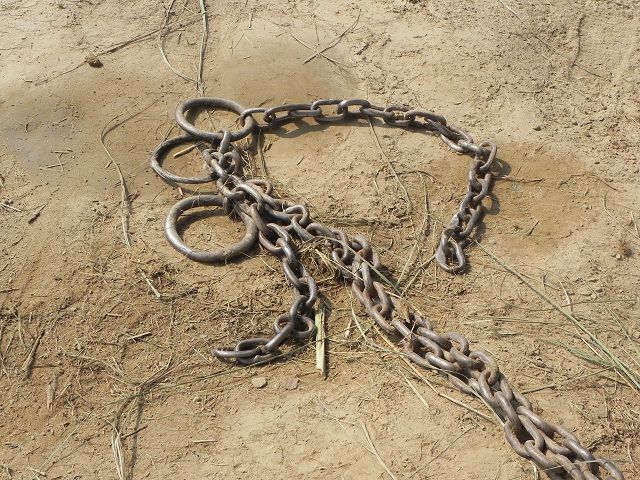
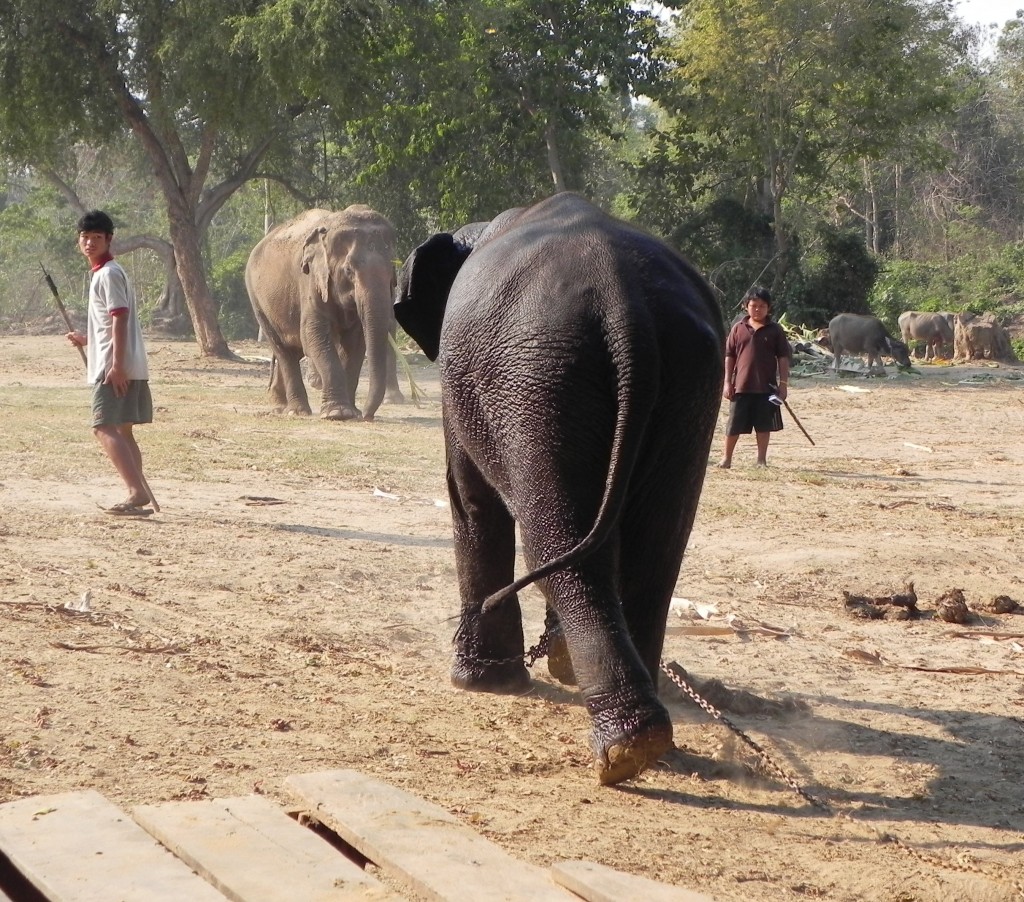
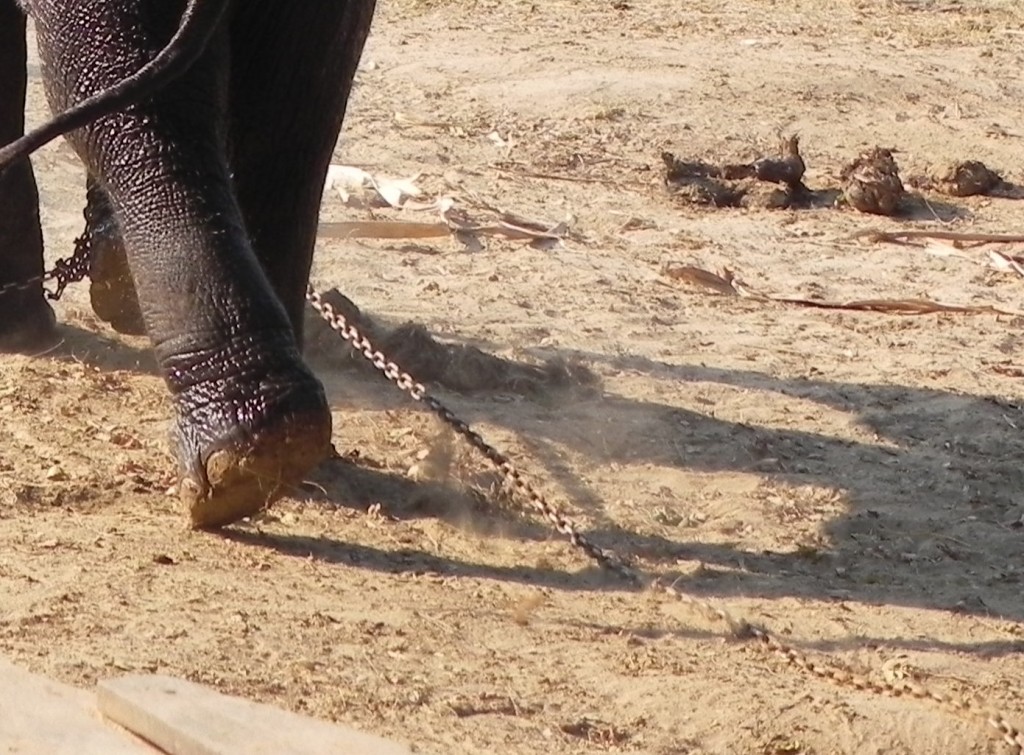
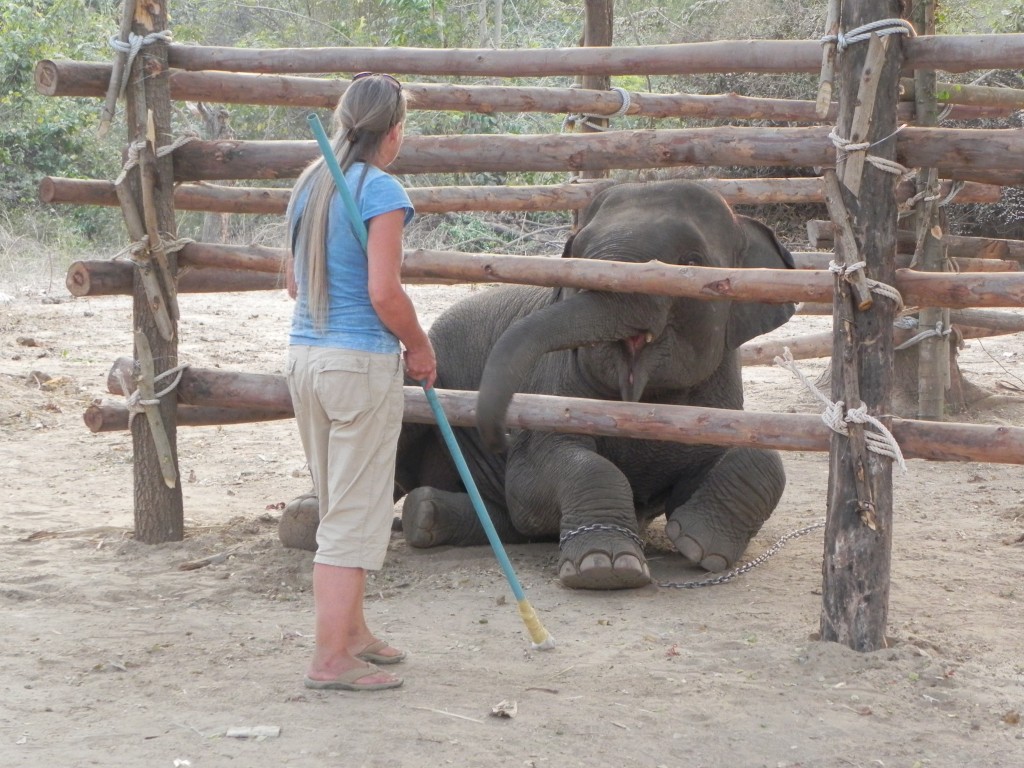
Many people found the videos interesting and some have asked why Jon is wearing a chain. The chain is called a drag chain; in Asia it is used to prevent an elephant from running away. One end of the long chain is fastened around an elephant’s wrist and the other end drags behind.
When a mahout is afraid that his elephant will run away, he puts a drag chain on him. If the elephant runs, the mahout wraps the loose end of the chain around a tree to stop him.
The mahouts at Elephant’s World were resistant to non-dominance training and even more resistant to removing Jon’s drag chain. In order to be allowed to demonstrate positive reinforcement target training, I agreed to the drag chain for the first two sessions. One end of the chain was on Jon’s ankle and the other end was loose.
My adherence to their tradition gave the mahouts time to get comfortable with the new training method I offered. They observed firsthand that Jon was more interested in the training game than in trying to get away.
Jon showed such promise that after the second training session the mahouts agreed to remove the chain.
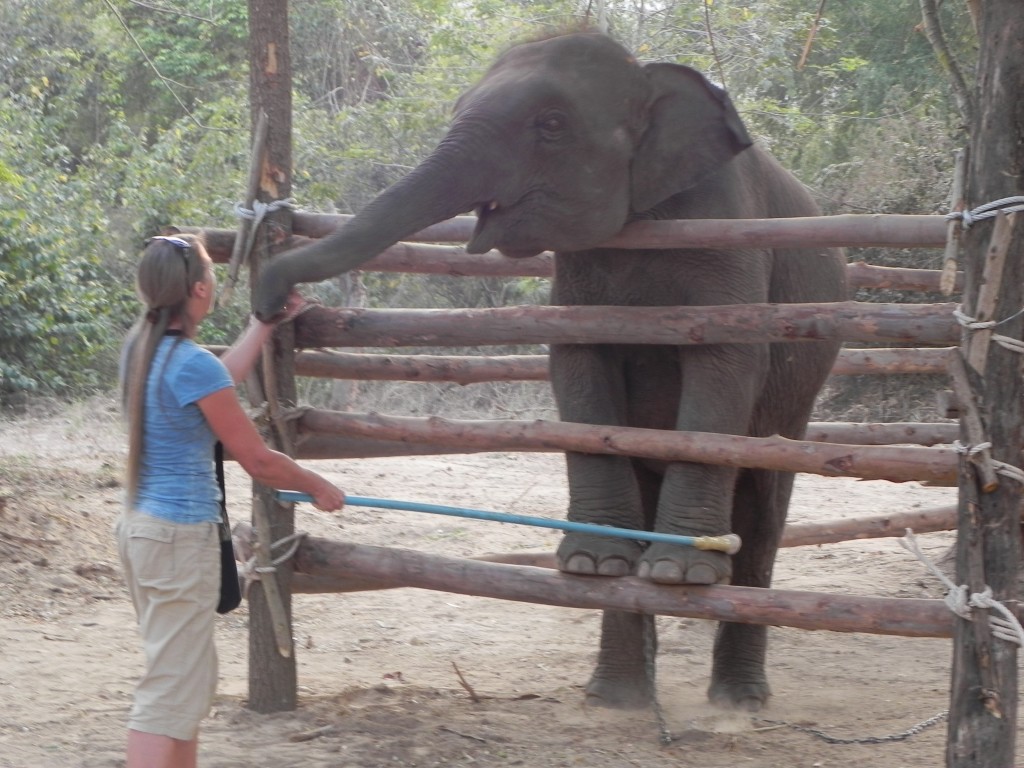
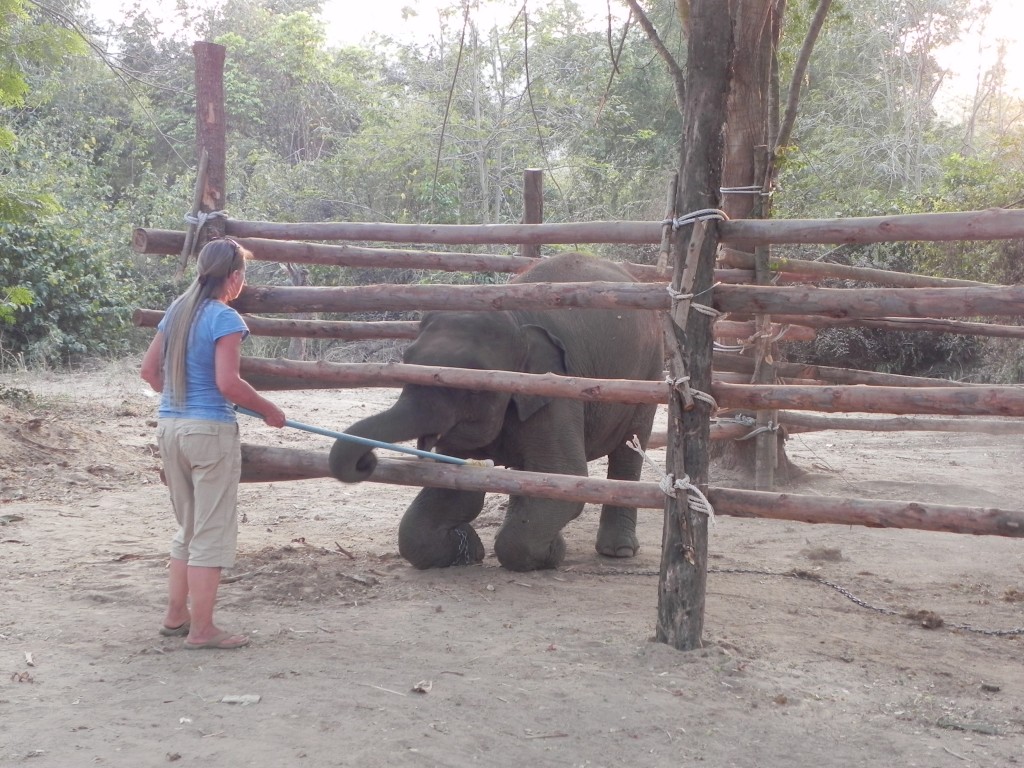
There have also been questions about the “stick” used during training. The stick, or target as it is called, is a flexible pole with a soft cushion on the end. Watch my training tutorial to see how the target is used and learn the basic concept of target training.
The goal is to teach an elephant the name/word for different body parts, such as foot, head, ear, side, etc. Once understood—which takes most elephants only minutes to grasp—the elephant will voluntarily offer that body part when asked. The key is to ask, not demand, and always provide praise and a treat as a reward.
Before watching the videos of Jon’s training sessions, I suggest that you view the tutorial a couple of times. Then watch Jon’s first training session and see if you can identify what body parts Jon is learning. Notice that when Jon becomes frustrated he walks away, but returns almost immediately to try again.
Positive Reinforcement Target Training gives the elephant the freedom to walk away, take a moment to reflect on what is happening and return when he is ready to try again. Walking away reduces frustration and increases the elephant’s willingness to participate.You will also notice in the video that Jon offers behaviors–kneel and lie down. This is common in initial training sessions. Many times the elephant will offer what s/he already knows before starting to “problem solve” and figure out what the trainer is trying to teach.
Learning to think for themselves is the first thing the elephants learn. After that, training is a breeze.
-

Sweetie Kali’s Water Trough

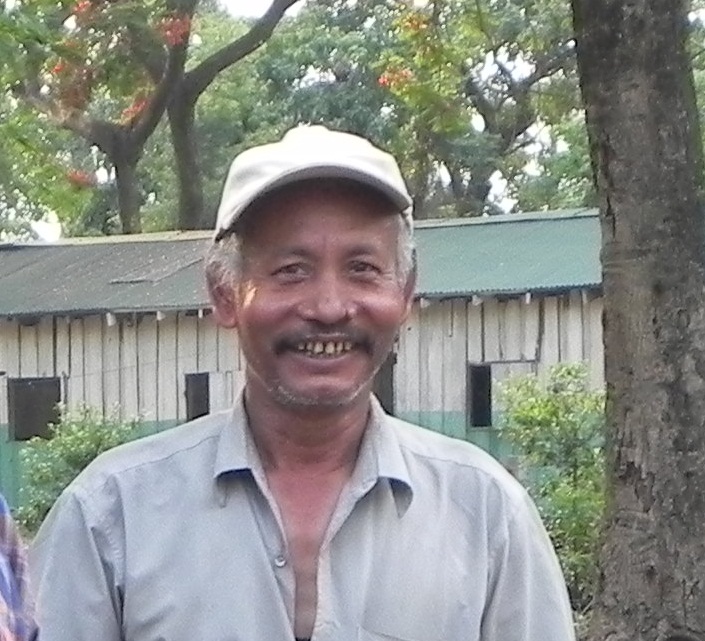
Paspat, mahout supervisor When Paspat, the mahout supervisor at National Trust for Nature Conservation, asked about a water trough for Sweetie Kali, I nearly fell off my chair. Seriously— his question was a shocker because captive elephants are not given free-choice access to anything in Asia. The belief is that allowing them to make choices will spoil them for their mahouts. The great fear is that if elephants experience a sense of freedom and are content, they will refuse to respond to their mahouts.
The fact that Paspat asked for a water trough reinforced my belief that he genuinely cares about his elephants’ welfare. Even in the United States— land of the brave, home of the free—many captive elephants are not given free-choice access to water.
I was deeply touched by Paspat’s request—so outside of the normal thinking of mahouts—and I assured him I would make it happen. The grin that spread across his face when he understood my response was priceless.
It struck me that this might be the first time Paspat was in a position to create a practice contrary to tradition. A chill ran up my spine as I looked long and hard at this man, who supported the chain-free yard concept and suggested free-choice water. Even though we do not share one word of a common language, I felt the connection loud and clear.
First stop: the concrete factory
After securing the required authorization to add a water trough to Sweetie Kali’s yard, I posed my challenge to Kiran, the veterinary tech/nail cutter extraordinaire. He was excited to help.
I explained what I needed: a sturdy, bathtub-shaped, concrete drinking trough, with inlet and outlet holes, heavy enough that Sweetie Kali cannot knock it over.
In his broken English Kiran said he knew a man who could make the trough for us. So off we went on his motorcycle, zooming down the pothole-rutted village road toward the other side of town.
We arrived at the concrete factory. There was a yard full of custom-made concrete posts for building supports and culverts used for septic tanks but I did not see anything that vaguely resembled a water trough.
I also did not see a single person.
Kiran parked his bike and charged over to a three-sided shack, calling out to someone. There was a man inside who was fast asleep.
Kiran entered the building without so much as knocking. The man, who was lying on a thin mattress on a wood-frame sleeping platform, was the soundest sleeper I ever saw. Kiran was nearly yelling—and the guy did not move. It was only when Kiran shook him that he awoke.
Midday is nap time as it is too hot to do much else. The bewildered look on the shopkeeper’s face was not as result of being woken abruptly but out of surprise to see us out and active in the sweltering heat.
The man rubbed his sleepy eyes as he sat up, trying to understand what Kiran was asking. I watched—which is how things work when you don’t speak the language—once again ever thankful for Kiran’s willingness to be my translator.
Finally the man seemed to understand what we wanted and began asking questions. Kiran included me in the three-way animated conversations, complete with crude drawing on the shop’s dirt floor. We decided on the width, length, height and wall thickness. I kept emphasizing to Kiran that it had to be heavy and strong enough that Sweetie Kali cannot pull it over or break it.
We decided on a free-standing version because if the trough was ground-level, dirt would get into it.
There was much discussion about the wall thickness and amount of steel bar required to make it strong enough. Explaining the inlet and drain holes was a bit challenging. When I finally saw the shopkeeper’s eyes light up in comprehension, I knew he understood what we wanted.
I kept pushing for an estimate but the shopkeeper was reluctant to give one. He had never created a trough before and clearly did not want to underestimate the cost. After much prodding on Kiran’s part, though, we had a bid in hand and commitment that he would start on our project the next day. I was so excited!
How would he actually make it?
At no time during the process did I think to ask how he would create the mold for the trough. He would build a frame out of two by fours and plywood and pour the concrete in, of course. How else?
The concrete factory was halfway between Kiran’s house and Sauraha. He passed the shop each morning on his way to pick me up for foot trimming and kept me apprised of the progress. Indeed, work had begun immediately, as promised, with an estimated curing time of ten days.
The wait was excruciating, so after about five days I just had to check on progress myself.
When we arrived the yard was empty. My heart sank when I saw nothing that resembled a water trough. But as we drove slowly toward the back of the yard, which borders a neighbor’s cornfield, I saw it.
The mold was not what I expected but, considering available resources, it made perfect sense. A hole the exact dimensions of the outside of the trough had been dug into the earth, then the concrete was poured and molded by hand. It was stunning!I could not help but ask how he would get that heavy trough out of the ground. Kiran laughed and explained that several men would pull the trough from the ground by hand and load it onto a wagon for delivery. I did not think to ask how it would be off-loaded into Sweetie Kali’s yard.
The trough arrives
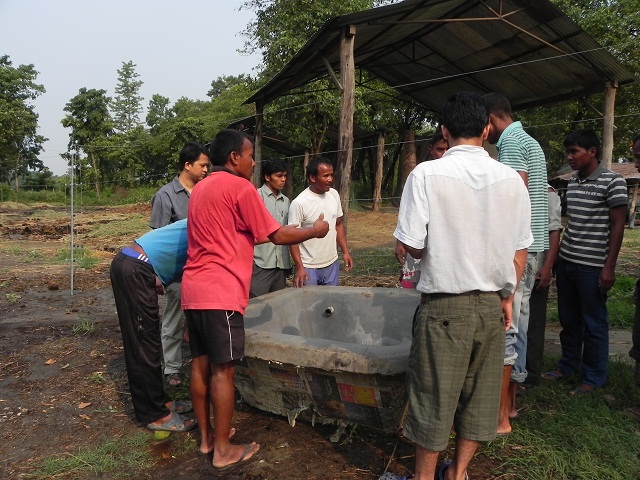
The day finally arrived and the wagon carrying the water trough was backed into Sweetie’s yard. All the mahouts gathered around, very willing to be of assistance.
I watched as the deliverymen discussed the best way to unload this 700-pound tub of concrete and steel. The weight and slick bottom of the trough made it a dangerous situation.
They decided to park the wagon at an angle, place a large tire on the ground just below the tailgate and slide the trough off the trailer onto the tire. I kept my nose out of the planning but two things nagged at me—the steep angle of the trailer and the weight of the trough. But, the deliverymen were in charge, so I kept my mouth shut.
Then it happened, catching the men by surprise. One tug on the trough sent it careening toward the open end of the wagon—and all the men. As it picked up speed, the men scattered. I heard my own “oh no!” pierce the silence as the trough became airborne, turned in mid-air and landed with a thump on its side, feet from its intended landing spot on the tire.
I scanned the scene to see if the trough had landed on anyone. The area was clear and everyone looked fine. But then I noticed Paspat rapidly exiting the scene with Babu Ram close behind. He was holding his hand high in the air. It was then that I saw blood running down his hand.
Paspat had caught his hand between the trough and the bed of the trailer, slicing across the top of it from thumb to baby finger. It was not a pretty sight.
Nandu fired up his motor cycle. Paspat climbed aboard, but not before washing the blood from his good hand so as not to soil the bike. With the entire group looking on in silence, Paspat was raced to the local clinic, hand held high above his head to help slow the bleeding.
The men wrestled the trough into place in a most unceremonious manner. The accident had dampened everyone’s spirits.
Within minutes we learned that Paspat had no broken bones, but the muscles in his hand were pressed back toward his wrist. The muscles were massaged back into place and he received twelve stitches. The biggest concern was infection. Paspat is diabetic so the doctor was concerned about how well he would heal.
Hand healed, trough in place
More than a week has passed and I am happy to report that Paspat’s hand healed without complication.
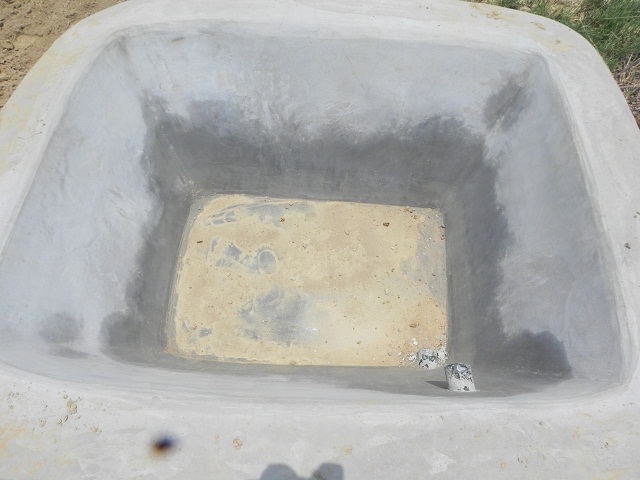
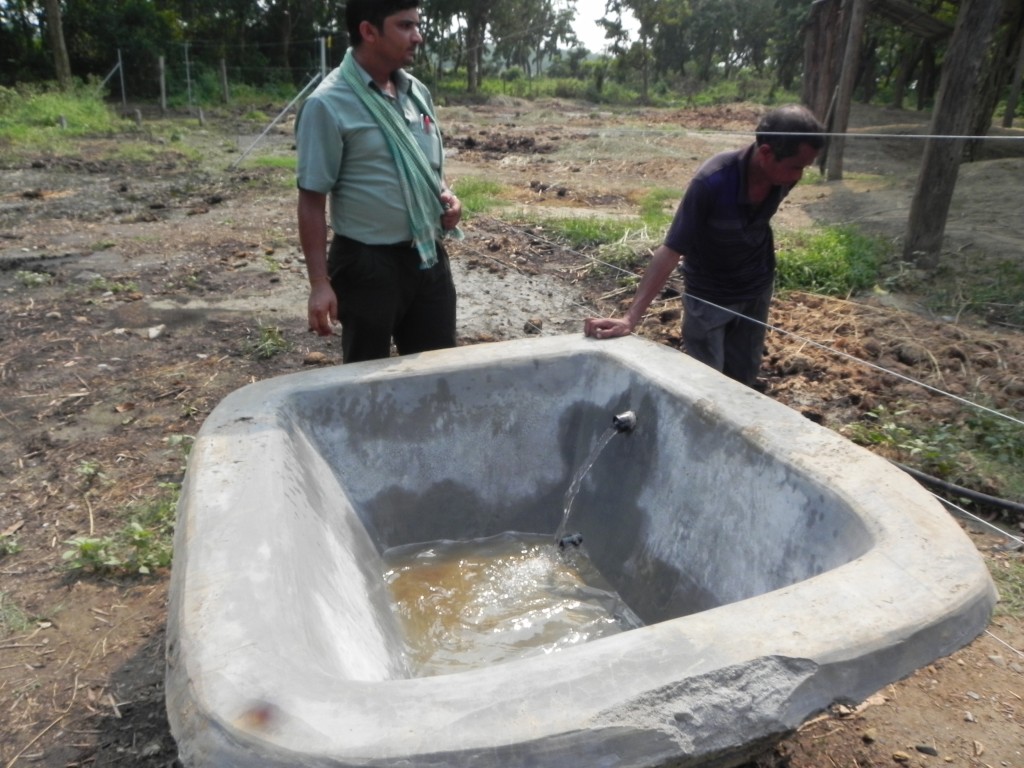
As for the trough, it is a work of art. Every angle is perfect, all the surfaces smooth to ensure that Sweetie does not scratch her trunk and that it is easy to keep clean. I marveled at the amount of work that went into the mold and the craftsmanship it required. I could not have been happier.
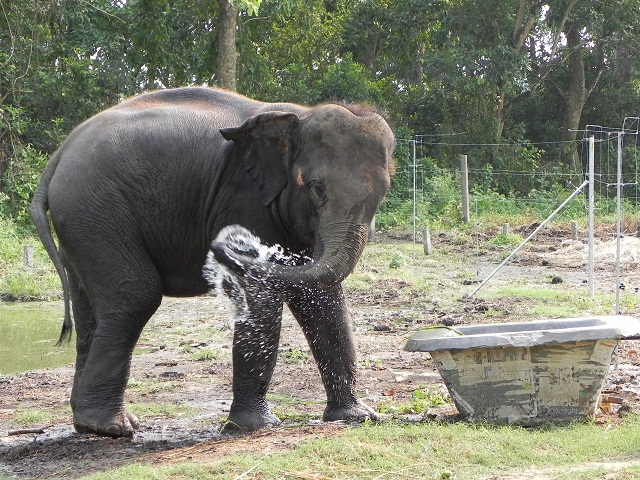
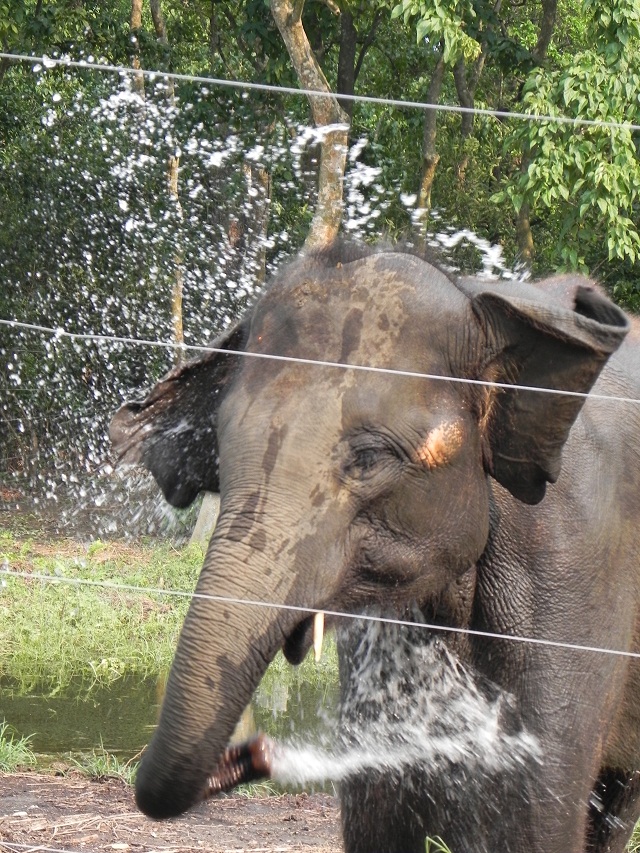
Sweetie Kali wasted no time making use of her trough. The mahouts seem to enjoy watching her almost as much as she enjoys splashing, bathing and drinking.
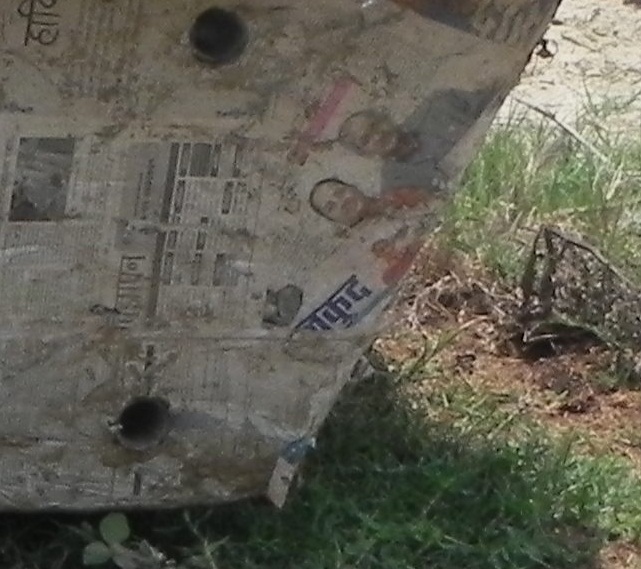
Some of you commented on the newspaper that covers the outside of the trough, making it look like papier mache. The newspaper was used to line the inside of the earthen mold to keep the concrete clean; now it’s nearly one with the concrete so the mahouts decided to leave it.
A huge thank-you goes to the mahouts for their willingness to try something new and to all the supporters who underwrote the cost of adding this trough to Sweetie Kali’s yard.
Thank you all so much.
-

On Patrol
When Nandu learned that I wanted to accompany Sweetie Kali on her anti-poaching patrol he directed me to Ram Kumar who graciously cleared my request with Paspat, the mahout supervisor. Realizing how much is lost in translation, I felt it best to experience Sweetie’s patrol duty first hand. I planned to walk instead of ride, which, for the most part, I did.
It was reassuring to watch Sweetie Kali voluntarily exit her yard without hesitation. The deepest concern shared by mahouts was that after being chain-free she would refuse to respond to her mahout. That fear has proven to be unfounded.
Puntea, Sweetie’s phonet (lead mahout) used a burlap bag to “slap off” the thick layer of fine dirt Sweetie had spent the last several hours throwing on her back. In places where the dirt was very thick he struck her firmly with blunt side of his crew pa (machete), creating an avalanche of silt cascading to the ground.This approach to sweeping dirt off Sweetie appears a bit rough and indeed it is. But she showed no concern, moving gracefully from a lying, to half-sitting and then standing position to accommodate the process. I did catch myself questioning—for the umpteenth time–why the mahouts handle their elephants in such a rough manner. Nothing is gentle — not a touch or a word; no silent tactile moment of praise.
Reconsidering the decision to walk
In seconds we were on our way, me with a satchel of essentials — camera, water, hat, umbrella and Chap Stick — and Puntea perched on Sweetie Kali’s back with the multi-functional burlap bag as a seat cushion. He carried a small wooden switch and badly tattered umbrella. I noticed immediately that he was not carrying a bottle of water and mistakenly took it as a sign that our outing would not be rugged.
Keeping pace with Sweetie on foot was no problem. Her mahout allowed her to amble at a comfortable speed.
Our first stop was the river — spectacular. With ease, Sweetie Kali submerged herself in the water with Puntea still perched atop her back. He managed not to get so much as a toe wet — for what reason I don’t know, since it was already sweltering hot. Following one word commands, Sweetie tilted from side to side in the strong current, bobbing like a buoy.At this point I realized my plan to make this excursion on foot was flawed. The current would make crossing a challenge but the bigger issue was slithering down the river in our direction—a large crocodile. Apologizing to Sweetie for the extra burden, I clambered aboard and we crossed safely to the opposite shore.
Grass: food and trimming tool
In front of us lay a vast grassland, high as an elephant’s eye, as the saying goes. In stark contrast, in the hazy distance rose a mountain range dense in vegetation, its forest seeming to pulsate in the early morning heat.
As Sweetie effortlessly ambled through the tall grass she reached to the side, grasped a trunkful of grass, pulled it tight and, with her next step, severed it at the soil line with a strike of her foot. All this without missing a step.
I remember watching in awe at the Sanctuary the first time I watched Jenny cutting grass in the same manner as she grazed. With each step she’d grab a trunkful of grass, casually swung her foot forward and effortlessly sever the grass with her toenails. There is quite a hypnotizing, even relaxing, rhythm to this action. The abrasive quality of grass works as a natural trimming tool; this is one way elephants keep their nails, cuticles and pads trimmed to a healthy length.
Joining the patrol
We traveled in complete silence for some time, umbrellas balanced overhead to shade ourselves from the scorching sun. But soon the silence was pierced when from out of nowhere we were joined by two young elephants and their mahouts. For the next five hours the mahouts chattered nonstop, like school girls at a slumber party. Since I don’t speak the language, I soon drifted off into my own world, taking in every scent and plant and animal sighting.Two hours into our patrol we approached a circle of high arching trees where many elephants and mahouts had gathered. Some mahouts were sprawled out, fast asleep on elephant back, while others napped on the ground while elephants grazed close by.
In the middle of the partially shaded clearing an energetic young mahout was putting his equally young elephant through what appeared to be a training exercise.
I breathed a sigh of relief to think we were about to take a break. I was ready to continue this excursion on foot as planned. But instead of stopping we crossed through the clearing, exiting the other side.
The next hour-and-a-half was spent in serious patrolling, or at least that is how it appeared. The mahouts ventured off the trail continually, ducking under low hanging trees scouring the undergrowth for “something.” Obviously they never found what they were looking for or I would know what it was.
Rest stop
Then we came upon a circle of towering shade trees that created the perfect place for a rest stop. We no sooner disembarked when all three elephants moved outside the circle to cover their bodies with a fine layer of dirt flung effortlessly onto their backs.I watched silently, wondering if they would exchange tactile greeting or show any sign of recognition. Although they stood centimeters from each other, they acted as if the other did not exist. The lack of physical interaction seemed so unnatural, and unfortunate. These three girls, close to the same age, have so much in common, including knowing that forming relationships with each other was discouraged by their mahouts.
They grazed the tall grass while we napped, burlap bags used as bed rolls. About fifteen minutes into our slumber Sweetie Kali tiptoed over to my sleeping spot. I felt her approach. When realizing she intended to make a personal visit I casually propped myself up into a sitting position from where I could quickly stand if need be — and cleared my throat. I would have loved to share a special moment with Sweetie but the truth is, we do not have a relationship and having her so close could be dangerous.
I know from experience that even while asleep, mahouts are on high alert. Hearing my unspoken warning sign, Puntea got to his feet and Sweetie retreated to the company of the other elephants.
My role
One trade-off that I have reconciled myself with is that I am a distant figure in the lives of these elephants. It is not appropriate to insert myself into their lives. I am here to improve their welfare. It is not about me having the chance to form a close relationship with them; it is about me encouraging the mahouts to form a healthy relationship with them. When we establish the retirement home things will be different and I will have a close relationship with all the residents, but for these elephants who are not under my direct care, a relationship between us would only complicate their lives.
The mahout-elephant relationship
The day was long and hot for everyone concerned. When we reached an offshoot of the river the elephants submerged while the mahouts quenched their thirst from a spring oozing from the side of the bank. All parties drank their fill.The next hour was spent leisurely grazing the sandy grassland that borders the river. When we finally crossed we were immediately immersed in a dense vibrant forest. The temperature dropped by at least ten degrees, the trees blocked the glare and penetrating heat from the sun.
Umbrellas were closed and stored, mine in my satchel and others, hung by the handle from the back of the mahout’s shirt. What a novel idea and handy hanging location; the neckline of the shirt works perfectly.
Tree branches invaded the trail, making passage difficult. I was told that the noise in the trees was monkeys but I never caught a glimpse of one. Spotted deer and birds were abundant. At least one tiger had walked the same sandy path recently, leaving behind huge paw prints. Seeing the size of the prints made me reconsider—once again— my decision to walk instead of ride.
Soon and without a verbal farewell, our fellow patrollers turned off at different paths, disappearing into the dense bush, on their way to a different hattisar. As we traveled the last mile of our patrol I was lost in thought about the relationship between mahout and elephant. It is a strange one — no outward display of affection, no praise, continual directions and corrections. It takes a strong individual to do this job day in and day out, both elephant and human.
-

Fundraising for Sweetie Kali’s chain-free corral a success!

Sweetie Kali I am sincerely grateful, as I know are Sweetie Kali and the entire NTNC staff, for your generosity toward the creation of Sweetie Kali’s chain-free yard.
The funds raised to date cover the cost of Sweetie’s one-acre power fence enclosure, which she has immersed herself in from day one; her custom water trough, which will be installed tomorrow; and two shovels and a new wheel barrel requested by the mahout staff.
The mahouts are so proud of this pilot project.
The second half of the funding goal was intended for a training wall, which is not necessary at this time. Those funds can be raised at a later date and the wall built in a few months when I return to Nepal.
So, consider this fundraiser a grand success! Pat yourselves on the back. Without you this history-making event would not be possible. Together we have created the first chain-free elephant corral in Nepal, hopefully starting a trend that will change how captive elephants are kept in Asia!
-
Update on Nepal pilot project
Starting on May 8th, 2012, I put everything on hold while I focused exclusively on Sweetie Kali’s new chain-free corral. The bandh (country-wide strike) caused a bit of delay in the beginning, forcing the fence crew to wait several hours at the Nepal boarder before entering. Clearing customs with 400 KG of power fence materials added to the delay.
Upon arrival, Dibyandu Ghosh, the contractor, explained that his fences are not only functional but beautiful as well. He was not exaggerating. No matter the challenge—including keeping a captive elephant in while at the same time keeping wild bulls out—he never balked and consistently came up with solutions that were both functional and visually pleasing.Realizing that I did not speak the local language, Dibyendu quickly identified the go-to man, Paspat, the mahout supervisor. They hit it off immediately, as if they had worked together for years.
Once construction started, it progressed quickly. Each morning Sweetie Kali would leave her stable for a day of patrolling and grazing the forest, leaving several men working diligently around her yard. Each evening she returned to be chained in her stable with the men still busy at work. She was soon encircled by the project.
As the fence began to take shape, the mahouts became more interested. Seeing is a powerful tool to grasping a concept. By the end of four days, the corral had been completed and everyone gathered to witness Sweetie Kali’s release.I wouldn’t say that anyone was apprehensive, but there was definitely a feeling of doubt. One researcher with years of wild elephant and rhino experience commented that the mahouts would now have to be with Sweetie Kali constantly since she would be off chains. His comment caught me off guard but showed clearly that the chain-free concept was difficult for them to comprehend. While I tried to explain that the fencing is what contains her, making a mahout unnecessary, his reasoning was revealed. He stated his concern that without the mahouts Sweetie Kali would not be able to function, would not know what to do, where to walk, even how to walk. I was dumbfounded. My response was, just watch, she will do just fine.

I thought long and hard about this mindset — that elephants cannot function without their mahouts ordering them around. It actually made me sad to have to accept how misunderstood elephants truly are.
The chains come off
When Sweetie Kali’s chains were removed for the final time, she stood motionless next to her mahout. Indeed, she was waiting for instruction, expecting discipline if she acted without direction.
Her mahout obviously did not comprehend his role either. When he was told to walk away from Sweetie Kali and leave the yard, he stood frozen, apparently confused.
When the mahout finally left the yard, it took a matter of moments for Sweetie to realize she was chain-free. She took a tentative step away from her stable area and abruptly stopped, ears perked, anticipating a sharp correction. When no correction was forthcoming, she relaxed a bit and began to walk the fence line. Unable to let go, the mahout also hovered at the fence line. Sweetie Kali was clearly apprehensive. The other mahouts, administrators and vet techs looked on in anticipation.
I grabbed some kuchi (rice and molasses wrapped in grass) and tried to get the mahout to walk the fence line into the forest and throw the kuchi deep inside. As always, training the elephant trainers is always more difficult than training the elephant, so it took several attempts, in his native tongue, for the mahout to understand that he was not to hand feed the kuchi, but to disperse it in the habitat.Chain-free environment and free-choice food are two equally incomprehensible concepts to most mahouts. But after much-repeated instruction from his peers, Sweetie Kali’s mahout finally, almost reluctantly, hurled the last kuchi into the forest.
That was Sweetie Kali’s signal that she was free to roam the premises. The last thing everyone saw of her was her petite backside as she disappeared into the dense brush. I felt like saying, “Sweetie Kali has left the building!” but realized my humor would be lost on this crowd.Bundles of fresh cut grass were deposited on the edge of her forest to be consumed at her leisure and the tech set up watch to record Sweetie Kali’s behavior until dark.
Reinforcing: No chains
The next morning, Sweetie was still nowhere in sight, which pleased everyone tremendously. As I sat in the open-air mahout hut reveling in the success of the project, Sweetie’s mahout entered her yard. Watching silently, I wondering if the schedule had changed; was she going to the forest early or was there a special tracking program? But then I realized that the mahout intended to chain Sweetie Kali under her shelter.
I leapt from my seat. With as much composure as possible I rallied the mahouts, telling them, “No chains, no chains.” My heart sank but then Paspat, the mahout supervisor, appeared out of nowhere. Usually a quiet, mild-mannered guy, he barreled over to the mahout with raised voice and expressive body language to deal with the situation.The mahout explained that he wanted to stick to Sweetie’s normal morning routine, which of course included chaining, but was told, in no uncertain terms, that chaining was not allowed. He now clearly understood his directions. When the drama died down I suggested that the chains be removed from the stable area so they would not “accidentally” be used.
New routines
That afternoon when Sweetie returned to the hattisar and was released into her yard, she knew exactly what to do. Without hesitation she made a beeline for the forest and did not come out again until it was dinnertime.
Before mealtime, kuchi and bundles of grass are stored outside each shelter, inches from the elephants’ reach. The routine is to feed the kuchi first, placing them at the elephants’ feet, and then piling the fresh-cut grass within reach. The elephant knows from years of experience that dinner is served precisely at 6 pm.
Being chain-free meant Sweetie Kali was free to approach the inviting pile of food and beg to be fed early, thereby creating a situation where she might begin to bob in frustration.
Everything had been progressing so well, I wanted to avoid creating such a situation. Getting the mahout to disperse the cuchie in the forest earlier than Sweetie Kali’s normal feeding time was not a problem, but then I saw that he put all her grass in one pile under her shelter.
His fellow mahouts were all talking at the same time, telling him to take the grass to the forest. But he simply ignored them and walked away.
This time Paspat did not come to the rescue. I was the only one who did not know he was off-grounds. Luckily, another official appeared and after several phone calls got the mahout to return. In a melodramatic display of unwillingness, he dragged the grass to the proper location—and then stomped off, muttering that he would not take orders from junior mahouts.By the next day Sweetie Kali’s mahout was over his seniority snit and began to show great pride in the accomplishments of his elephant.
Many thanks
That’s it, the entire story. Every day, Sweetie Kali immerses herself in her personal forest when she is back at the hattisar. She comes out to play in the dirt pit or chase birds and was seen and heard dashing in and out of the trees during the last big storm, but otherwise she is basically unseen except by Ganash, the young tech assigned to her behavior study, which he has taken on with great seriousness. Recording her behavior is an important tool for documenting her response to chain-free living.When Sweetie Kali leaves for her daily patrol of the forest, I inspect for habitat damage. I am pleasantly surprised at how little damage there is. She excavated a relatively small sleeping area, sheltered by huge trees and another smaller area for dusting. Aside from the thick curtains of edible hanging vines that are rapidly thinning, the damage is minimal.

I have so many people to thank for the success of this pilot project including all the staff at NTNC-BCC, the forest department, Naresh, Ram Kumar, Chitran, Dr. Gairhe, Paspat, Nandu, Babu, Kiran, Ganash, Veena and Vishnu at IBEX Gallagher, Dibyendu and crew and especially the mahouts, because without their cooperation, the project would not have been possible.And finally, I thank Sweetie Kali for unknowingly volunteering to participate in this important pilot project, one that will undoubtedly have a huge impact on how captive elephants are kept in Nepal.
Please visit EAI’s Facebook page so I can keep you updated on our progress as it happens!
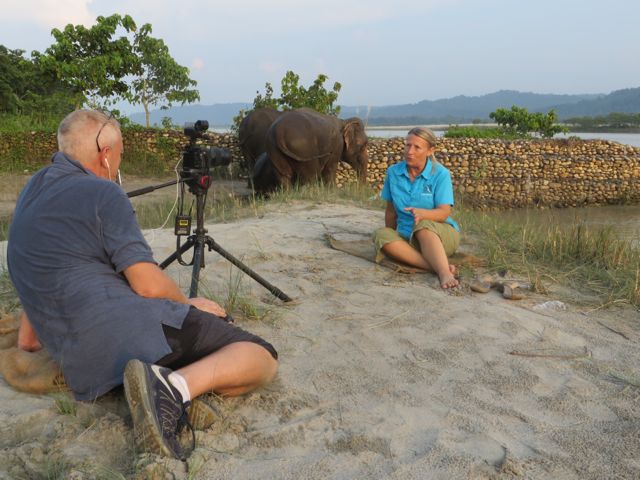
-

Forest Dwellers
Today’s foot trimming adventure was over the top, a marathon day with Dr. Gairhe—the senior government veterinarian—leading the way.
Kiran and Chitran, the two vet tech/3rd year foot trimming students, and I fit perfectly in the back seat of the full-size pickup truck…or so I thought when we all piled in. If it had not been for the road conditions, the ride would have been…well, let’s say, less memorable. I’m not complaining — far from it — and I enjoyed every minute of our 14-hour adventure.
One thing that struck me this time in Nepal is realizing my unconscious expectation of comforts that I take for granted in the US. Sitting between two large men, bouncing down a seriously bumpy road and being slammed side-to-side like bumper cars, I realized that I accepted this assignment with an unreasonable expectation of transportation comfort. The reality of the situation made me laugh.
The Nepalese don’t fret over physical discomfort, they simply accept it. So when I started joking about the guys staying on their own side of the seat, it soon became a humorous game. When Kiran would absent mindedly crowd my space, I drew an imaginary line between us and said, “You have crossed the line,” and like two adolescents we’d crack up with laughter. Soon everyone got into the game of not invading each other’s space, so when Kiran flopped his entire arm over Chitran’s leg, he was abruptly chastised—jokingly. Everyone broke out into hysterical laughter. It was refreshingly silly to experience such discomfort and be able to laugh about it together.
Humor aside, I realized that if I continued to be thrown back and forth between the football player-size shoulders on either side of me, I was going to be very sore, if not crippled by the end of the day, so I pulled rank (age, actually) and claimed the window seat. This was much better for me as I could press myself against the door and hang onto the armrest for security.
Four outposts, seven elephants and a canoe like a swimming pool
Our mission for the day was to visit four government outposts to trim the feet of seven elephants. Our first stop was Gadini outpost, a place we visited last year. After driving for nearly two hours we arrived on the bank of a beautiful river. The flimsy wooden canoe that would carry us to our destination was on the opposite side of the river. The boat man soon appeared and to my amusement proceeded to bail out the canoe—it had taken on quite a bit of water—before heading in our direction.
In order to board in peaceful waters we hiked a short distance upstream. The day was already steamy hot. Tiny frogs scattered as we approached the water’s edge, disappearing into the calm shallows.
Our canoe was waiting when we arrived and we gingerly climbed aboard. A real man, or woman for that matter, sits on the floor of the boat. But customs are changed for foreigners. The government guard post on our side of the river provided tiny wooden seats for our canoeing comfort—and to keep our backsides dry. I kind of wondered where the life jackets were, since the canoe was already taking on water through cracks in the flimsy wooden planks strapped together with giant metal staples. To add to the drama, Dr. G asked “Can you swim?” I can’t remember not knowing how to swim, and wondered the level of fear one would experience crossing this fast-moving river in a boat that resembled a swimming pool, not knowing how to swim.
With a smooth push off from a ten-foot bamboo pole, the boat master expertly guided us into the swiftly moving current. The water picked up volume and speed and within minutes we were deposited on the opposite bank without incident. We disembarked and hiked the short distance into the forest to the outpost. The forest was lush and green and teaming with active, boisterous bird life.
Gadini outpost: Healthy feet and relaxed elephants
Namastes were exchanged and then it was right to work. Kiran requested that the crew pa (machete) be sharpened, which is effectively done on a large rock with sand. No power sharpening tools here: they use the available resources and manage just fine.
Elephants Sano Chanchal Kali and Rampyari were tethered under separate shelters bordered by the forest. The stables were clean and the girls looked on calmly.
With a simply utterance of bite (lie down), Sano Chanchal Kali slowly folded to the ground without resistance or concern. We were all so pleased to see that her pads were healthy and evenly worn and her nails were only slightly overgrown.
As I took “before” photos, put on my girly gloves and prepared my exacto blades, which are also kind of girly, the guys were already trimming excess nail with precision that is hard to imagine when using a machete. I am in awe of how well the men handle this tool, but they grow up using it, starting with cutting grass to feed livestock and later as a knife to cut anything.
Sano Chanchal Kali took this special time of hati la na pita (don’t hit the elephant) to drop off into a fairly sound sleep for most of her trimming. She shifted to her other side without resistance and allowed us to give her one of the most beautiful pedicures to date!
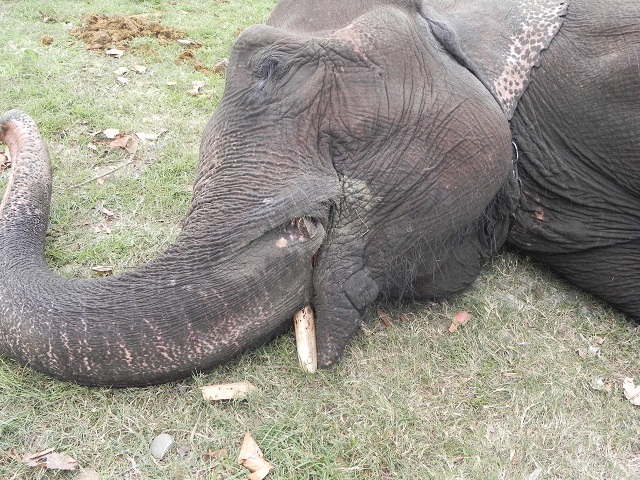
Almost in an identical fashion to her sister, Rampyri folded to the ground following a simple verbal command. The mahouts have gotten the word: if you want this crew to trim feet, no hitting allowed. Refreshing for us and for the elephant. Rampyri’s feet were another pleasant surprise, pads evenly worn and supple, nails only slightly overgrown and no sign of decay or infection. The crew commented on “what easy feet” these were.
Our work in this camp was completed in record time thanks to the healthy condition of the elephants’ feet and the relationship they share with their mahouts.
Honestly, I can’t remember if we had our home cooked meal at this outpost or the next — those details seem to blur together — but I do remember that to get to the second outpost we got back into the canoe and floated downstream for some time. A black egret fished on the shoreline ahead and a white breasted Kingfisher swooped past us in pursuit of a meal. Without any initial sign of elephant or mahout life, we landed again on the riverbank and hiked a short distance to the second camp.
These camps are inside the national forest, which, in this location, is an island. Dr. G told us that wild bulls do not cross the river encircling this island. No one knows why, but as result of this phenomenon, captive bulls can be kept on the island without fear of being attacked by wild bulls.
Kurauli post: More healthy feet and easy pedicures
As with Gideni, the elephants at Kurauli post were aware of our arrival. Dhirendra Kali and Gandaki Kali, were waiting—mahouts casually mounted on top—surveying the approaching team.
Before having hardly a chance to settle in, I heard “bit” followed by “raw,” which meant our first client had reclined and was awaiting her pedicure. We now operate quite smoothly as a crew. While I unpacked trimming tools, gloves and camera, the others examined the client’s feet and prepared for trimming by sharpening the machetes.
We all commented on how great Dhirendra Kali’s feet looked. I liked the pattern I was seeing. The more remote the outpost, the better condition the elephants and their feet were in, the more skilled the mahouts were and the less pressure the elephants experienced when requests were made for their compliance. But of course, they were living in their element with the river nearby, sheltered under giant trees, on natural substrate and plenty of exercise combing the forest for poachers.
With such healthy feet, there was little work for the crew. Shave off overgrown nails a little, check for decayed areas and she was done. Another easy pedicure!
When Dhirendra Kali left the trimming area she let out a “Queenie-squeak.” It transported me back in time to the Sanctuary overlook at the Q-barn with Minnie, Lottie and Queenie playing in the mud, Queenie making her distinctive squeaks nonstop. Dhirendra Kali’s gentle sound brought back a very a pleasant memory for me. I accepted it as the gift it was.
But this was not time for daydreaming because Gandaki Kali was already in place and waiting for her pedicure. I was pleased to see that her nails and pads were also healthy and only slightly overgrown.
It is so encouraging to see that these elephants are getting sufficient exercise, on appropriate substrate, which is why their feet are so healthy.
To be continued….
-
Ngo-Hok, aka Jon, at Elephant’s World
Elephant’s World was one of the locations where I was fortunate to introduce positive reinforcement target training. I will return there to continue training, and to consult on facility development and elephant training and care.
During my last visit, Elephant’s World owner agreed to the idea of constructing a large fenced-in area so the elephants can be kept off chains. Fundraising is underway and hopefully by the time I return to Thailand in the fall, the fence will be in place.
Ngo-Hok, aka Jon, the young male elephant with whom I worked, has a history of aggression. Personally, I believe he was emotionally scarred by the traditional brutal training he received prior to coming to Elephant’s World. From the first session he responded enthusiastically to positive reinforcement target training. I was at Elephant’s World for only about a week, but during that time Ngo-Hok/Jon excelled at demonstrating to the mahouts that he can learn and will respond favorably, at least to this technique of training.
Unfortunately, the language barrier was a challenge. The mahouts tried to understand what I was telling them but they simply could not. Even though Ngo-Hok/Jon was brilliant during his target training sessions, the mahouts failed to continue the training after I left.
The staff needs further training to grasp the concept and develop the technique of this training which is so foreign to them. I look forward to returning to Elephant’s World to continue the training. This time I will recruit a translator, which is the only way to ensure that the mahouts understand the philosophy and learn the technique.
Following is an interview that an Elephant’s World volunteer did with Piza, Ngo-Hok/Jon’s mahout. The volunteer posed the questions as if I had asked them.
Q: How is Ngo-Hok/Jon doing?
A: He is doing better since the last time you saw him. Sometimes he is stubborn, and then I cannot climb on this back. He is more often around the other elephants, during swimming and eating, but I have to stay close to him because he is playful and annoys the older female.
He is now very close with Rom Sai, the full-grown tusker, like a father and son. He has escaped a couple of times in the last months but he comes back to stay with Rom Sai. When eating together, he likes to take food from the other elephants. Only Rom Sai will allow this. I believe the other elephants will hit him if I am not there.
Last evening I didn’t take him to the forest because he did not let me get on his back earlier in the day — he was stubborn. In this way I am trying to teach him. Also, after he is stubborn he will try to escape when I take him out of the forest. I am trying to teach him that if he obeys and allows me on his back, he will be rewarded with a trip to the forest.
Ngo-Hok/Jon is growing; he is now taller than me. In one month he has gained about 10 kgs. He now weighs close to 800 kgs and eats about 80 kgs a day.
Q: Do you think Ngo-Hok/Jon can stay with the other elephants?
A: He can stay with other elephants. He can stay close to Rom Sai, who will protect him. For now he can stay with the females as well because they are older women and he is still young. But as he gets older and new female elephants come in, it will be a problem.
Q: How do you feel around Ngo-Hok/Jon since he tried to hurt you?
A: I feel better around him now, but have to be careful all the time. After the accident I was a little bit afraid, but not anymore. When I am with him anyone can come close, but if I am not there, people cannot come close. If I have one day off, Jon is put on hobbles because the other mahouts cannot deal with him. Right now Ngo-Hok/Jon only listens to me.
Q: Is there anything else you’d like to tell Carol?
A: I think she should come again and see Ngo-Hok/Jon for herself.
-

Seeds of Change
April 13
My work in Sauraha has come to an end, at least for the time being. Seeds of change have been planted. From the looks of it, some seeds are already growing, quietly shifting the soil around their sprouting roots. Experiencing the fruits of my labor so instantaneously fills me with hope.
Yesterday when Kiran and I arrived for Bhadra’s morning session we were told that Ramji, his mahout, was off making preparations for the New Year’s Day celebration. I jumped at the chance to work with Bhadra in Ramji’s absence. But my excitement was quickly doused when Bhadra made it perfectly clear that he would work with me but under protest.
After completing each request Bhadra would do a mini mock lunge from behind the protective barrier. It seemed that he was clearly bothered about something to do with me. He was responding but being snotty. I have seen this type of behavior before when training a new mahout who struggles to keep pace with an advanced elephant student. I did not make that analogy until sometime later.
The next day, the motivation behind Bhadra’s behavior became apparent. In our absence, Ramji had risen to a challenge from Kiran to prove his skill with Bhadra within three months. The ultimate goal: to show everyone how far he could take Bhadra with positive reinforcement training.
Ramji proved his skills beyond question when he surprised us by calling Bhadra from the protection of the corral and proceeded to ask him to present his feet and ears, move to the side, back up and put his head down. I was stunned. They were fabulous. Ramji, all cool, calm, and collected, Bhadra listening intently and responding to each verbal cue. I wish you could have been there to see it for yourself, but I did catch it on video. This type of breakthrough must be documented in order for others to believe.

Needless to say, Kiran was pleasantly surprised at the immediate progress in less than a week! Ramji obviously took the challenge seriously, resulting in a display that had me grinning from ear to ear, joyful with disbelief.
Ramji earned much deserved respect today, and Bhadra…well, he already has my heart. He has now joined the ranks of the “MIGHTY TYKES,” the young elephants in Thailand and now Nepal participating in this important case study of positive reinforcement training. These youngsters are the hope of the future: what they teach us and their mahouts will shape elephant training of the future. They are demonstrating how positive reinforcement training can be used with captive elephants in a hands-on working situation. We owe them and their mahouts a great debt of gratitude.
Kiran knew instinctively that witnessing Bhadra and Ramji’s incredible accomplishments would make my day, my last in Sauraha. It was wonderful to see how proud he was. Kiran has been an invaluable asset throughout the training process. I doubt he realizes the role he has played in this cultural shift of mahout attitudes, which has the potential to change the future for captive elephants. The future is bright indeed.
I left Sauraha today with a heavy heart, heavy with the joy of knowing that we have planted a seed. I for one cannot wait to see how it grows.