Tag: national trust for nature conservation

  • Report: Chain-Free Project, National Trust for Nature Conservation — Biodiversity Conservation Center

    Report: Chain-Free Project, National Trust for Nature Conservation — Biodiversity Conservation Center

    Chain-Free Hattisar Project
    National Trust for Nature Conservation – Biodiversity Conservation Center
    Chitwan, Nepal

    REPORT

    Project completed Jan 10, 2013
     Department of National Parks and Wildlife Conservation
    Jhamak Karki, Chief Warden-Chitwan National Park
    Dr. Kamal Gairhe, Senior Wildlife Veterinarian-Chitwan National Park

    National Trust for Nature Conservation
    Naresh Subedi, Senior Conservation Officer
    Chiranjibi Pd. Pokheral, Senior Conservation Officer-Biodiversity Conservation Center
    Babu Ram Lamichhane, Conservation Officer-Biodiversity Conservation Center
    Dr. Arjun Pandit, Staff Veterinarian- Biodiversity Conservation Center

    In collaboration with

    Elephant Aid international-USA
    Carol Buckley, Founder and CEO

    INTRODUCTION

    In January 2013, construction was completed on a solar-powered chain-free hattisar at the National Trust for Nature Conservation’s Biodiversity Conservation Center (NTNC-BCC).

    This first-of-its-kind pilot project was developed to study the benefits of working elephants in Nepal living chain-free.

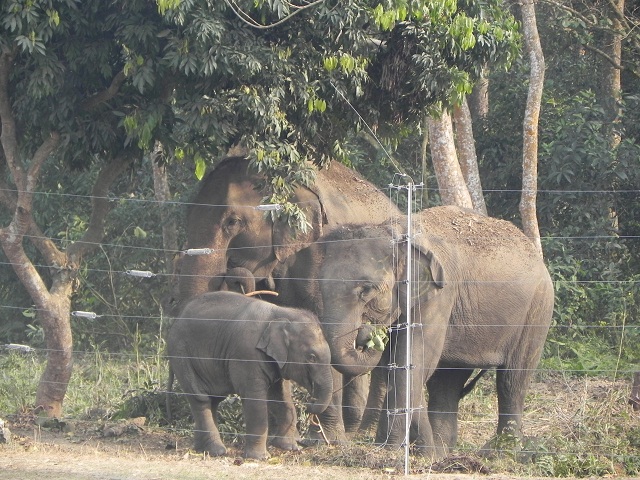
    Six elephants, ranging from seven months to seventy-plus years, currently live in five interconnected chain-free corrals designed to improve their welfare.

    The elephants spend an average of fifteen hours in the hattisar each day. In the past they were hobbled by both front legs, chained under a shelter that prevented natural posturing and healthy physical activity.

    Now, living in the chain-free corral, each elephant is free to move at will and engage in natural behavior such as dusting, foraging, sleeping, bathing, walking, playing. In the case of Man Kali and her children, eight-year-old daughter Prakriti Kali and seven-month-old son Hem Gaj, this related family is able to engage in normal social behavior.

    Corral construction and operating system

    The corral’s operating system is a solar-powered energizer with a double battery back-up. Three hours of sunlight is required to keep the batteries charged for 10 days.

    Specifically designed for wildlife, the corral administers a mild shock upon contact. Due to the pulsating current, it is virtually harmless. Being highly sensitive to the clicking sound of the current, most elephants avoid the fence without ever coming into contact with it.
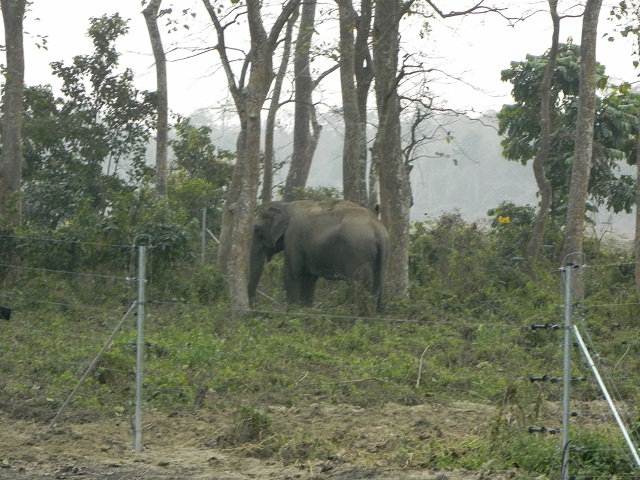
    The chain-free hattisar consists of five interconnected corrals on approximately two-and-one-half acres of open and wooded land.

    The corrals stand seven feet tall, constructed of rust-free steel posts and six strands of high tensile wire. Each post is encased in a protective tope.

    Each corral has a front, back and side gate for ease of access for cleaning, feeding, moving elephants in and out and providing socialization opportunities.

    The energizer and batteries are housed inside the mahout residence; two solar panels that charge the batteries are attached to the roof of the residence.

    Each corral is equipped with a cut-off switch enabling independent operation.

    This design has proven successful in many areas of Asia to prevent entry by wild bull elephants.
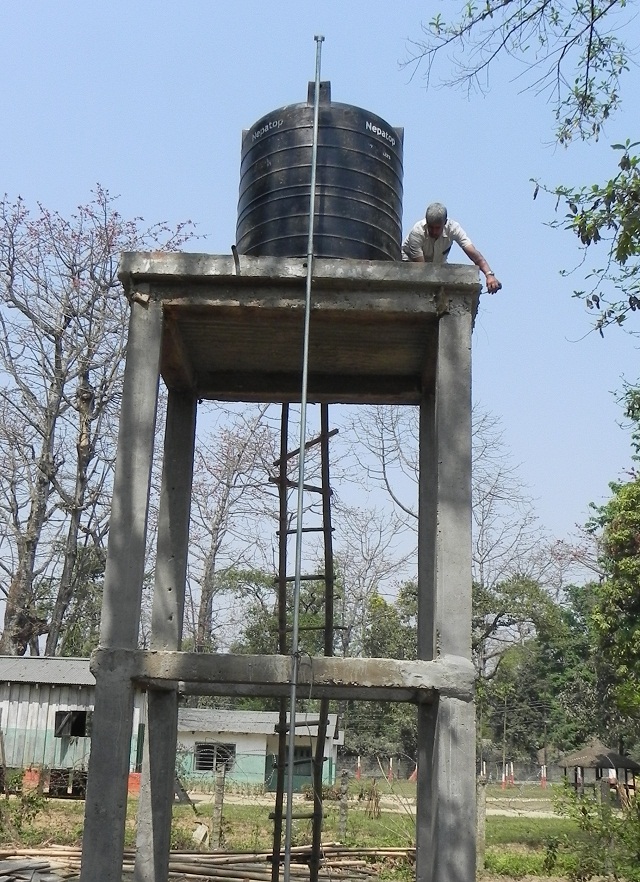
    Fresh water is stored in an elevated water tank and troughs are filled by gravity feed.
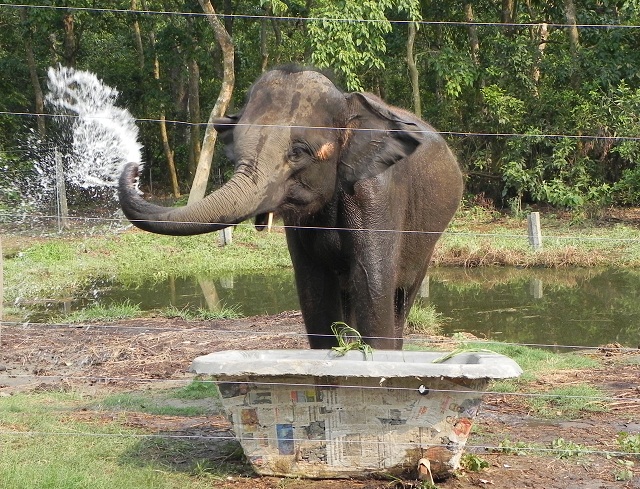
    water trough reduced 3
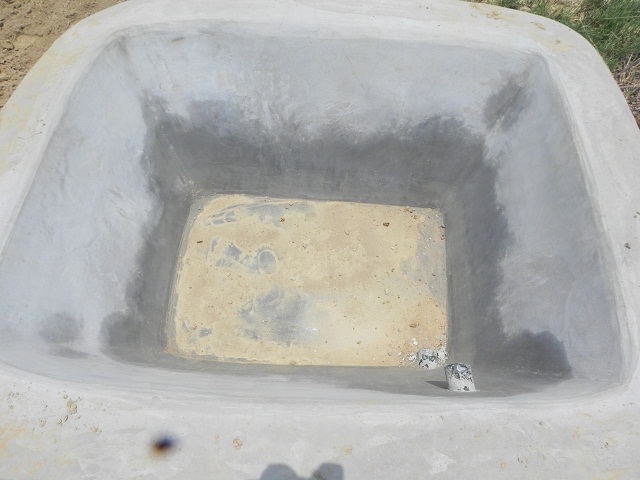
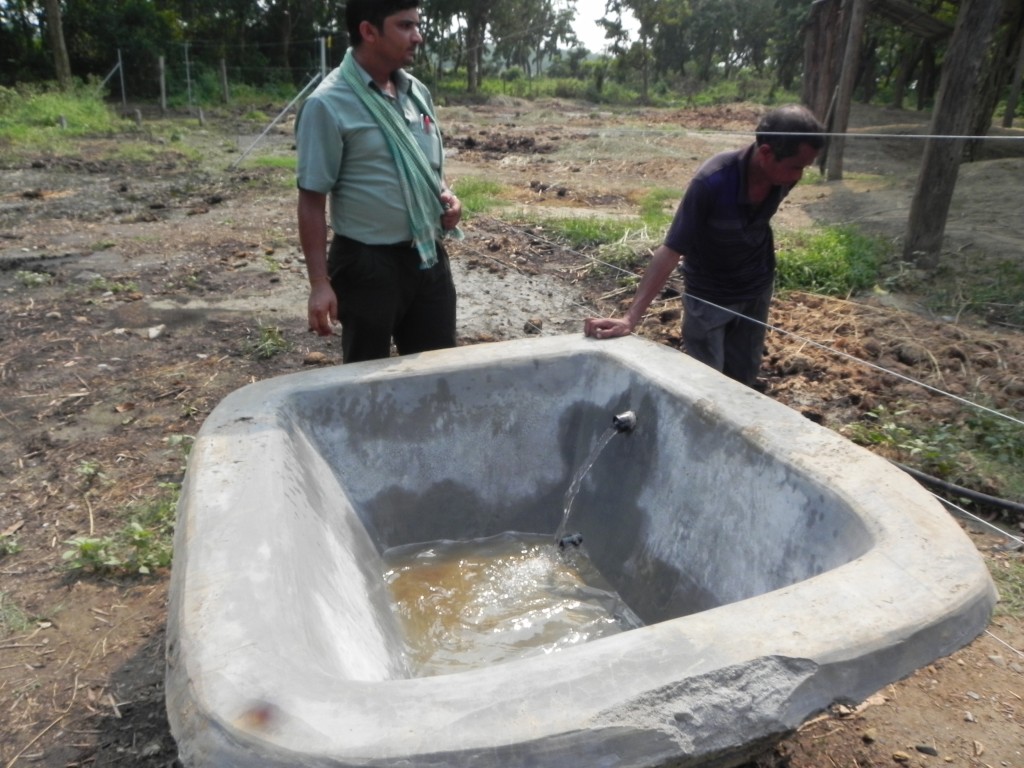
    All corrals have a custom-made concrete water trough that provides clean water.

    Healthy trees are an important component of the chain-free corrals, providing shade, browse and a natural scratching surface.

    To prevent serious damage to trees from elephant tusking activity, protectors were built around select trees.

    GOALS AND OBJECTIVES

    • Reduce or eliminate stereotypical behavior caused by chaining
    • Eliminate low-level long-term stress caused by chaining
    • Increase physical activity
    • Encourage engagement in natural species-specific behavior such as  foraging, dusting, bathing, walking, playing, socializing and exploring
    • Eliminate injuries and bone and joint damage
    • Improve foot health
    • Maintain elephants’ compliance with mahout authority

    METHODS

    • Ethogram
    • Husbandry protocol
    • Management protocol
    • Feeding protocol

    1.   ETHOGRAM

    In order to quantify the effectiveness of the chain-free corral, an ethogram spreadsheet was created to track a list of natural and stereotypical behaviors, including walking, eating, dusting, playing, exploring, drinking, socializing, sleeping and exhibiting stereotypic behaviors.

    2.     HUSBANDRY PROTOCOL

    Manure removal and corral cleanliness standards were established to ensure the highest level of hygiene.

    3.    MANAGEMENT PROTOCOL

    Training and management practices for inside the corral were established to give elephants a sense of freedom and security.

    4.    FEEDING PROTOCOL

    Changes to traditional feeding practices were established to promote activity and alleviate boredom.

    PROGRESS AND PRELIMINARY RESULTS

    Each elephant spends approximately 15 hours each day in the chain-free corrals. The remainder of their time is spent in Chitwan National Park engaged in grass collecting, anti-poaching patrols and conservation work and jungle safaris.

    Upon first introduction to the chain-free corrals, each elephant calmly explored the area, foraging, dusting and scratching on trees. Each evening they dig in the soft dirt of the forest, creating a comfortable sleeping spot; none return to the stable area to sleep.

    The related family of Man Kali, Prakriti Kali and Hem Gaj are housed together. They bonded immediately when united in the chain-free corral and continue to exhibit healthy elephant behavior, with Prakriti Kali assuming the role of big sister to Hem Gaj.

    A survey was conducted to track the behavior of the elephants toward the mahouts and drivers. Mahout compliance has not changed. Each elephant continues to respond favorably to mahouts and drivers—both inside and outside the corral—at the same high level as before being released from chains.

    Photographic records are being kept to track foot health and bone and joint conditions.

    Collectively, the elephants’ behavior represents a substantial improvement in natural activity and reduction in stress and stereotypical behavior.

    CONCLUSION

    The goal to eliminate stress from chaining and the resulting stereotypic behavior is realized. Adherence to the new feeding protocol ensures that both Prakriti Kali and Mel Kali do not engage in stereotypic, food anticipatory behavior. Since being introduced into the chain-free corral hattisar, all elephants engage in appropriate, beneficial, species-specific behavior; respond favorably to their mahouts; and appear to be calm and comfortable in their new environment, indications that the project is meeting its goals and objectives.
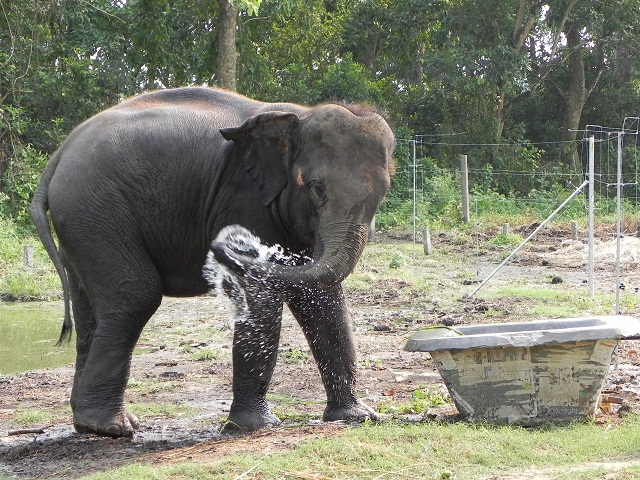
  • Sweetie Kali’s Water Trough

    Sweetie Kali’s Water Trough

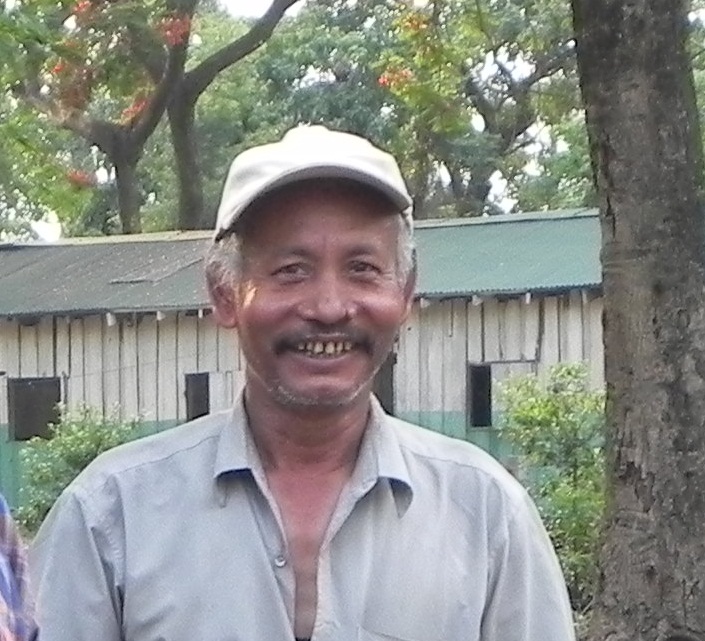
    Paspat, mahout supervisor

    When Paspat, the mahout supervisor at National Trust for Nature Conservation, asked about a water trough for Sweetie Kali, I nearly fell off my chair. Seriously— his question was a shocker because captive elephants are not given free-choice access to anything in Asia. The belief is that allowing them to make choices will spoil them for their mahouts. The great fear is that if elephants experience a sense of freedom and are content, they will refuse to respond to their mahouts.

    The fact that Paspat asked for a water trough reinforced my belief that he genuinely cares about his elephants’ welfare. Even in the United States— land of the brave, home of the free—many captive elephants are not given free-choice access to water.

    I was deeply touched by Paspat’s request—so outside of the normal thinking of mahouts—and I assured him I would make it happen. The grin that spread across his face when he understood my response was priceless.

    It struck me that this might be the first time Paspat was in a position to create a practice contrary to tradition. A chill ran up my spine as I looked long and hard at this man, who supported the chain-free yard concept and suggested free-choice water. Even though we do not share one word of a common language, I felt the connection loud and clear.

    First stop: the concrete factory

    After securing the required authorization to add a water trough to Sweetie Kali’s yard, I posed my challenge to Kiran, the veterinary tech/nail cutter extraordinaire. He was excited to help.

    I explained what I needed: a sturdy, bathtub-shaped, concrete drinking trough, with inlet and outlet holes, heavy enough that Sweetie Kali cannot knock it over.

    In his broken English Kiran said he knew a man who could make the trough for us. So off we went on his motorcycle, zooming down the pothole-rutted village road toward the other side of town.

    We arrived at the concrete factory. There was a yard full of custom-made concrete posts for building supports and culverts used for septic tanks but I did not see anything that vaguely resembled a water trough.

    I also did not see a single person.

    Kiran parked his bike and charged over to a three-sided shack, calling out to someone. There was a man inside who was fast asleep.

    Kiran entered the building without so much as knocking. The man, who was lying on a thin mattress on a wood-frame sleeping platform, was the soundest sleeper I ever saw. Kiran was nearly yelling—and the guy did not move. It was only when Kiran shook him that he awoke.

    Midday is nap time as it is too hot to do much else. The bewildered look on the shopkeeper’s face was not as result of being woken abruptly but out of surprise to see us out and active in the sweltering heat.

    The man rubbed his sleepy eyes as he sat up, trying to understand what Kiran was asking. I watched—which is how things work when you don’t speak the language—once again ever thankful for Kiran’s willingness to be my translator.

    Finally the man seemed to understand what we wanted and began asking questions. Kiran included me in the three-way animated conversations, complete with crude drawing on the shop’s dirt floor. We decided on the width, length, height and wall thickness. I kept emphasizing to Kiran that it had to be heavy and strong enough that Sweetie Kali cannot pull it over or break it.

    We decided on a free-standing version because if the trough was ground-level, dirt would get into it.

    There was much discussion about the wall thickness and amount of steel bar required to make it strong enough. Explaining the inlet and drain holes was a bit challenging. When I finally saw the shopkeeper’s eyes light up in comprehension, I knew he understood what we wanted.

    I kept pushing for an estimate but the shopkeeper was reluctant to give one. He had never created a trough before and clearly did not want to underestimate the cost. After much prodding on Kiran’s part, though, we had a bid in hand and commitment that he would start on our project the next day. I was so excited!

    How would he actually make it?

    At no time during the process did I think to ask how he would create the mold for the trough. He would build a frame out of two by fours and plywood and pour the concrete in, of course. How else?

    The concrete factory was halfway between Kiran’s house and Sauraha. He passed the shop each morning on his way to pick me up for foot trimming and kept me apprised of the progress. Indeed, work had begun immediately, as promised, with an estimated curing time of ten days.

    The wait was excruciating, so after about five days I just had to check on progress myself.

    When we arrived the yard was empty. My heart sank when I saw nothing that resembled a water trough. But as we drove slowly toward the back of the yard, which borders a neighbor’s cornfield, I saw it.

    The mold was not what I expected but, considering available resources, it made perfect sense. A hole the exact dimensions of the outside of the trough had been dug into the earth, then the concrete was poured and molded by hand. It was stunning!

    I could not help but ask how he would get that heavy trough out of the ground. Kiran laughed and explained that several men would pull the trough from the ground by hand and load it onto a wagon for delivery. I did not think to ask how it would be off-loaded into Sweetie Kali’s yard.

    The trough arrives

    The day finally arrived and the wagon carrying the water trough was backed into Sweetie’s yard. All the mahouts gathered around, very willing to be of assistance.

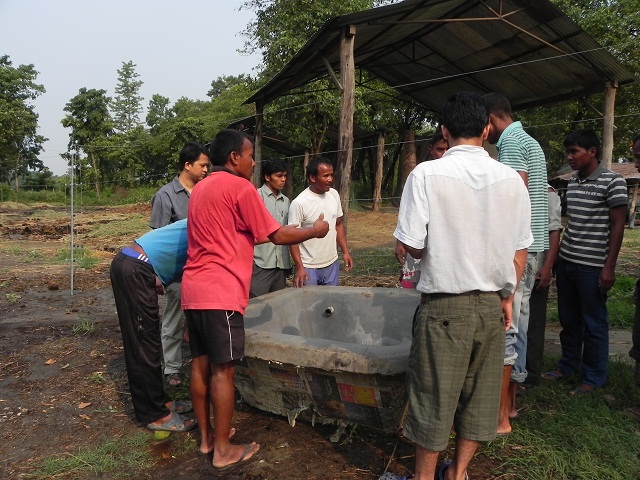
    I watched as the deliverymen discussed the best way to unload this 700-pound tub of concrete and steel. The weight and slick bottom of the trough made it a dangerous situation.

    They decided to park the wagon at an angle, place a large tire on the ground just below the tailgate and slide the trough off the trailer onto the tire. I kept my nose out of the planning but two things nagged at me—the steep angle of the trailer and the weight of the trough. But, the deliverymen were in charge, so I kept my mouth shut.

    Then it happened, catching the men by surprise. One tug on the trough sent it careening toward the open end of the wagon—and all the men. As it picked up speed, the men scattered. I heard my own “oh no!” pierce the silence as the trough became airborne, turned in mid-air and landed with a thump on its side, feet from its intended landing spot on the tire.

    I scanned the scene to see if the trough had landed on anyone. The area was clear and everyone looked fine. But then I noticed Paspat rapidly exiting the scene with Babu Ram close behind. He was holding his hand high in the air. It was then that I saw blood running down his hand.

    Paspat had caught his hand between the trough and the bed of the trailer, slicing across the top of it from thumb to baby finger. It was not a pretty sight.

    Nandu fired up his motor cycle. Paspat climbed aboard, but not before washing the blood from his good hand so as not to soil the bike. With the entire group looking on in silence, Paspat was raced to the local clinic, hand held high above his head to help slow the bleeding.

    The men wrestled the trough into place in a most unceremonious manner. The accident had dampened everyone’s spirits.

    Within minutes we learned that Paspat had no broken bones, but the muscles in his hand were pressed back toward his wrist. The muscles were massaged back into place and he received twelve stitches. The biggest concern was infection. Paspat is diabetic so the doctor was concerned about how well he would heal.

    Hand healed, trough in place

    More than a week has passed and I am happy to report that Paspat’s hand healed without complication.

    As for the trough, it is a work of art. Every angle is perfect, all the surfaces smooth to ensure that Sweetie does not scratch her trunk and that it is easy to keep clean. I marveled at the amount of work that went into the mold and the craftsmanship it required. I could not have been happier.

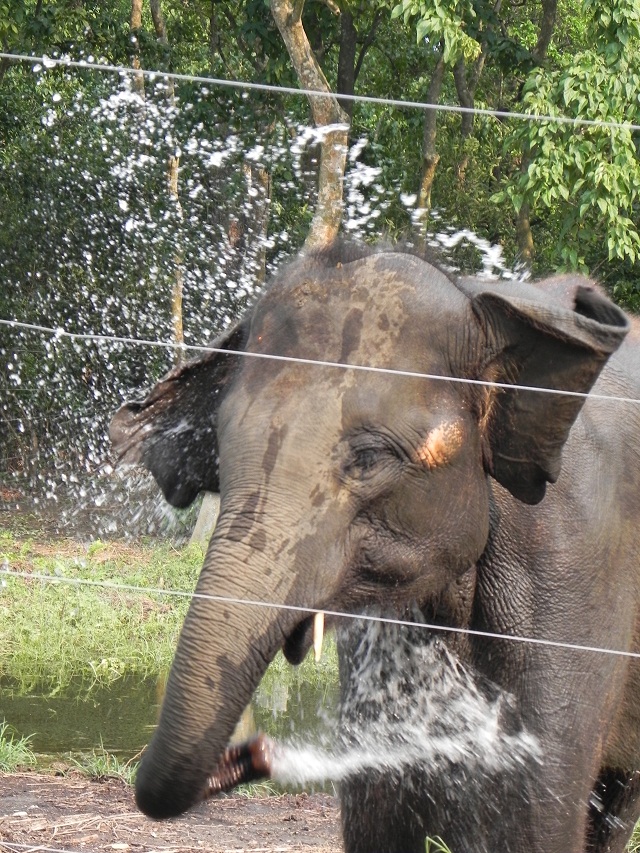
    Sweetie Kali wasted no time making use of her trough. The mahouts seem to enjoy watching her almost as much as she enjoys splashing, bathing and drinking.


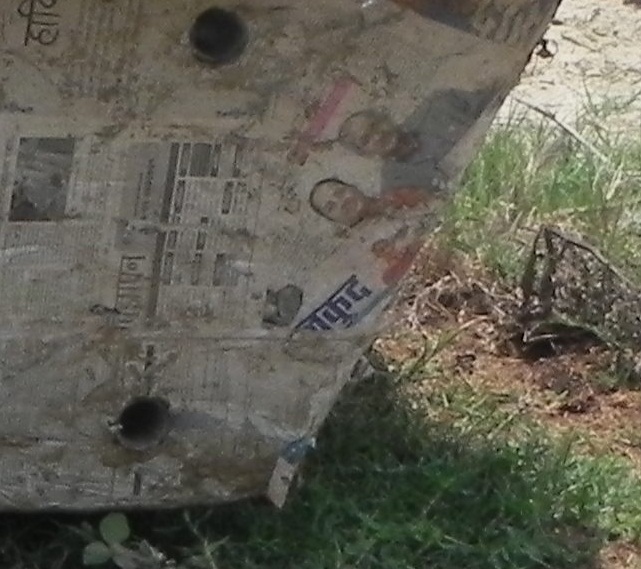
    Some of you commented on the newspaper that covers the outside of the trough, making it look like papier mache. The newspaper was used to line the inside of the earthen mold to keep the concrete clean; now it’s nearly one with the concrete so the mahouts decided to leave it.

    A huge thank-you goes to the mahouts for their willingness to try something new and to all the supporters who underwrote the cost of adding this trough to Sweetie Kali’s yard.

    Thank you all so much.

  • Update on Nepal pilot project

    Starting on May 8th, 2012, I put everything on hold while I focused exclusively on Sweetie Kali’s new chain-free corral. The bandh (country-wide strike) caused a bit of delay in the beginning, forcing the fence crew to wait several hours at the Nepal boarder before entering. Clearing customs with 400 KG of power fence materials added to the delay.

    Dibyandu Ghosh and PaspatUpon arrival, Dibyandu Ghosh, the contractor, explained that his fences are not only functional but beautiful as well. He was not exaggerating. No matter the challenge—including keeping a captive elephant in while at the same time keeping wild bulls out—he never balked and consistently came up with solutions that were both functional and visually pleasing.

    Realizing that I did not speak the local language, Dibyendu quickly identified the go-to man, Paspat, the mahout supervisor. They hit it off immediately, as if they had worked together for years.

    Once construction started, it progressed quickly. Each morning Sweetie Kali would leave her stable for a day of patrolling and grazing the forest, leaving several men working diligently around her yard. Each evening she returned to be chained in her stable with the men still busy at work. She was soon encircled by the project.

    watching Sweetie KaliAs the fence began to take shape, the mahouts became more interested. Seeing is a powerful tool to grasping a concept. By the end of four days, the corral had been completed and everyone gathered to witness Sweetie Kali’s release.

    I wouldn’t say that anyone was apprehensive, but there was definitely a feeling of doubt. One researcher with years of wild elephant and rhino experience commented that the mahouts would now have to be with Sweetie Kali constantly since she would be off chains. His comment caught me off guard but showed clearly that the chain-free concept was difficult for them to comprehend. While I tried to explain that the fencing is what contains her, making a mahout unnecessary, his reasoning was revealed. He stated his concern that without the mahouts Sweetie Kali would not be able to function, would not know what to do, where to walk, even how to walk. I was dumbfounded. My response was, just watch, she will do just fine.

    mahout group

    I thought long and hard about this mindset — that elephants cannot function without their mahouts ordering them around. It actually made me sad to have to accept how misunderstood elephants truly are.

    The chains come off

    When Sweetie Kali’s chains were removed for the final time, she stood motionless next to her mahout. Indeed, she was waiting for instruction, expecting discipline if she acted without direction.

    Her mahout obviously did not comprehend his role either. When he was told to walk away from Sweetie Kali and leave the yard, he stood frozen, apparently confused.

    When the mahout finally left the yard, it took a matter of moments for Sweetie to realize she was chain-free. She took a tentative step away from her stable area and abruptly stopped, ears perked, anticipating a sharp correction. When no correction was forthcoming, she relaxed a bit and began to walk the fence line. Unable to let go, the mahout also hovered at the fence line. Sweetie Kali was clearly apprehensive. The other mahouts, administrators and vet techs looked on in anticipation.

    feeding cuchie to KaliI grabbed some kuchi (rice and molasses wrapped in grass) and tried to get the mahout to walk the fence line into the forest and throw the kuchi deep inside. As always, training the elephant trainers is always more difficult than training the elephant, so it took several attempts, in his native tongue, for the mahout to understand that he was not to hand feed the kuchi, but to disperse it in the habitat.

    Chain-free environment and free-choice food are two equally incomprehensible concepts to most mahouts. But after much-repeated instruction from his peers, Sweetie Kali’s mahout finally, almost reluctantly, hurled the last kuchi into the forest.

    Kali's backsideThat was Sweetie Kali’s signal that she was free to roam the premises. The last thing everyone saw of her was her petite backside as she disappeared into the dense brush. I felt like saying, “Sweetie Kali has left the building!” but realized my humor would be lost on this crowd.

    Bundles of fresh cut grass were deposited on the edge of her forest to be consumed at her leisure and the tech set up watch to record Sweetie Kali’s behavior until dark.

    Reinforcing: No chains

    mahout hutThe next morning, Sweetie was still nowhere in sight, which pleased everyone tremendously. As I sat in the open-air mahout hut reveling in the success of the project, Sweetie’s mahout entered her yard. Watching silently, I wondering if the schedule had changed; was she going to the forest early or was there a special tracking program? But then I realized that the mahout intended to chain Sweetie Kali under her shelter.

    Papsat and KaliI leapt from my seat. With as much composure as possible I rallied the mahouts, telling them, “No chains, no chains.” My heart sank but then Paspat, the mahout supervisor, appeared out of nowhere. Usually a quiet, mild-mannered guy, he barreled over to the mahout with raised voice and expressive body language to deal with the situation.

    The mahout explained that he wanted to stick to Sweetie’s normal morning routine, which of course included chaining, but was told, in no uncertain terms, that chaining was not allowed. He now clearly understood his directions. When the drama died down I suggested that the chains be removed from the stable area so they would not “accidentally” be used.

    New routines

    That afternoon when Sweetie returned to the hattisar and was released into her yard, she knew exactly what to do. Without hesitation she made a beeline for the forest and did not come out again until it was dinnertime.

    Before mealtime, kuchi and bundles of grass are stored outside each shelter, inches from the elephants’ reach. The routine is to feed the kuchi first, placing them at the elephants’ feet, and then piling the fresh-cut grass within reach. The elephant knows from years of experience that dinner is served precisely at 6 pm.

    Being chain-free meant Sweetie Kali was free to approach the inviting pile of food and beg to be fed early, thereby creating a situation where she might begin to bob in frustration.

    Everything had been progressing so well, I wanted to avoid creating such a situation. Getting the mahout to disperse the cuchie in the forest earlier than Sweetie Kali’s normal feeding time was not a problem, but then I saw that he put all her grass in one pile under her shelter.

    His fellow mahouts were all talking at the same time, telling him to take the grass to the forest. But he simply ignored them and walked away.

    dragging grassThis time Paspat did not come to the rescue. I was the only one who did not know he was off-grounds. Luckily, another official appeared and after several phone calls got the mahout to return. In a melodramatic display of unwillingness, he dragged the grass to the proper location—and then stomped off, muttering that he would not take orders from junior mahouts.

    By the next day Sweetie Kali’s mahout was over his seniority snit and began to show great pride in the accomplishments of his elephant.

    Many thanks

    GanashThat’s it, the entire story. Every day, Sweetie Kali immerses herself in her personal forest when she is back at the hattisar. She comes out to play in the dirt pit or chase birds and was seen and heard dashing in and out of the trees during the last big storm, but otherwise she is basically unseen except by Ganash, the young tech assigned to her behavior study, which he has taken on with great seriousness. Recording her behavior is an important tool for documenting her response to chain-free living.

    When Sweetie Kali leaves for her daily patrol of the forest, I inspect for habitat damage. I am pleasantly surprised at how little damage there is. She excavated a relatively small sleeping area, sheltered by huge trees and another smaller area for dusting. Aside from the thick curtains of edible hanging vines that are rapidly thinning, the damage is minimal.

    NTNC-BCC

    Sweetie KaliI have so many people to thank for the success of this pilot project including all the staff at NTNC-BCC, the forest department, Naresh, Ram Kumar, Chitran, Dr. Gairhe, Paspat, Nandu, Babu, Kiran, Ganash, Veena and Vishnu at IBEX Gallagher, Dibyendu and crew and especially the mahouts, because without their cooperation, the project would not have been possible.

    And finally, I thank Sweetie Kali for unknowingly volunteering to participate in this important pilot project, one that will undoubtedly have a huge impact on how captive elephants are kept in Nepal.

    Please visit EAI’s Facebook page so I can keep you updated on our progress as it happens!

  • EAI’s May e-newsletter

    Two exciting new projects are underway in Nepal!

    This e-newsletter kicks off EAI’s first fundraising projects for Nepal this year. I hope you will help make it a success by telling your friends and neighbors how far the US dollar stretches in Nepal. Be part of the solution, one world, one elephant at a time!

    No more chains

    Between trimming feet and brainstorming about a retirement center for elephants in Sauraha, Nepal, we—you, I and all of EAI’s supporters—are about to embark on a very exciting pilot project at the National Trust for Nature Conservation Biodiversity Conservation Center (NTNC-BCC) hattisar (elephant stable).

    Pursuing last year’s recommendation to create chain-free enclosures for the BCC’s five forest patrol elephants, Naresh Subedi, an EAI advisor, and other NTNC officials have enthusiastically agreed to allow EAI to build a chain-free enclosure to demonstrate its functionality.

    No chains = cooperative elephants

    This is huge. It gives us the opportunity to show mahouts how cooperative elephants can become when allowed the freedom to move around unrestricted.

    Sweetie KaliEight-year-old Sweetie Kali will be the lucky recipient of this new and improved yard, where she will be off chains 24/7.

    In addition to the direct benefits to her psychological and physical wellbeing, Sweetie Kali will demonstrate to the mahouts and NTNC administrators that elephants do not “go wild” when allowed to spend unsupervised time off chains.

    Sweetie Kali, her fellow herd members and most of the government elephants are taken to the forest each day. Although they spend eight hours a day wandering the forest foraging for food, they are still under the strict control of their mahouts. Their lives are measurably better than those of privately owned elephants, who are required to give rides to tourists all day and are tethered in a stable overnight.

    But, together with NTNC, we can do better.

    Sweetie Kali and positive changes to come

    Sweetie Kali

    Sweetie Kali was chosen because she is the youngest elephant in the herd, born at the NTNC-BCC. Her incessant head bobbing is a concern for the mahouts and management alike. The staff was witness to the onset of her stereotypical behavior, which started when she turned 3, following her formal training and induction into the traditional world of chains.

    Sweetie Kali shelterCurrently, all the elephants are tethered under their own private shelters. Once everyone is comfortable that the fence provides the security necessary, chances are that Sweetie’s mother will be allowed to join her in the yard. Imagine what a moving reunion that will be.

    The new chain-free yard will allow Sweetie Kali to engage in natural behaviors she has been prevented from in the past. She will be able to explore her new yard, dust herself to her heart’s content, create mud wallows and feel the soothing sensation of scratching on a huge tree. Instead of sleeping tethered between two poles, she will sleep in any soft and comfortable location she chooses.

    EAI’s goal is to get this corral up and functioning before I leave Nepal in June. That is a rather optimistic expectation but I am determined to move the project forward as quickly as possible.

    Sweetie Kali fence

    Vishnu Narain, a collaborative partner in our Bannerghatta, India, care center project, operates IBEX Gallagher, a power fence company. We could not be more fortunate to have this connection. I have his bid in hand and a commitment to install the fence as soon as we are ready.

    Training and foot care wall — a prototype for Asia

    If we built only the electric fence for the corral it would mean a world of improvement for Sweetie and would keep the cost of the project down. But a training and foot care wall—a two-sided, free standing, steel pipe structure—is essential to our efforts to improve elephant welfare in Nepal. Once the wall is in place, foot care will become a required duty of each mahout, integrated into their elephant care responsibilities, and all the NTNC-BCC and government elephants in Sauraha will have access to it.

    The cost of the electric fence, including area preparation, materials, shipping and installation, is estimated to be $3,240. The training and foot care wall, including pipe, delivery, welding, concrete and labor, nearly doubles the cost of the project. I believe this will be $6,000 well spent as it will create a prototype that can be duplicated throughout Asia.

    Help us hire a veterinarian to oversee our Nepal projects!

    EAI has the exciting opportunity to engage a veterinarian in Sauraha, Chitwan National Park. The timing is perfect!

    This is our third year in Sauraha. With the ongoing foot care and mahout training and the new chain-free enclosure and training and foot care wall, it is essential that we hire a veterinarian to coordinate and supervise our activities. It will also be much easier to expand EAI’s welfare projects in Nepal with a professional in place.

    Simply building a chain-free corral and a training and foot care wall for the mahouts and their elephants is not enough. We also need to formalize our Compassionate Elephant Care training and create incentives to encourage the mahouts to become more engaged in all aspects of their elephants’ care and wellbeing. Once our collaborative effort to create an elephant retirement home is realized, our veterinarian will monitor the daily care of the resident elephants.

    In addition to overseeing EAI’s projects in my absence, our veterinarian will work closely with Dr. Gairhe, the senior government veterinarian, assisting in wildlife captures, rhino counts and regular animal management activities undertaken by NTNC-BCC.

    EAI will be responsible for the vet’s salary as well as all necessary equipment, lab work, travel and any other expenses we deem appropriate. Resumes are currently being reviewed.

    Our budget for the first year is $15,000. Yes, you read that right — $15,000 includes the veterinarian’s salary and other costs associated with his/her work for EAI.

    Update: Elephant Care and Rehabilitation Center Project, Bannerghatta, India

    Earlier this year I learned that a portion of the land intended for our care center project was designated as revenue land.

    care center property - BannerghattaRevenue land is owned by the government and designated for agricultural use or forest restoration. There are cases when the government can gift this land but the recipient must abide by strict use requirements and restrictions, is never allowed to sell it and the government has the legal right to reclaim it.

    The process to acquire permission to use revenue land in India moves slowly and must take into consideration the villagers’ needs and legal rights.

    EAI collaborating partner Vishnu Narain reports that progress continues for the care center. He has met with local government officials and regulators, who expressed support of the project.

    EAI is taking a wait-and-see attitude on this project. Once we have written authorization from the government to fence off and use the land for the intended purpose of an elephant care center, EAI will once again become active in the process moving forward.

    I look forward to keeping you up to date on our exciting new projects.

    Please visit EAI’s Facebook page so we can keep you updated on our progress as it happens!

  • Sweetie Kali

    Upon returning to the National Trust for Nature Conservancy in Chitwan, I was surprised and pleased to see Sweetie Kali still there. Last year I was told she was to be moved to the zoo in Kathmandu.

    Sweetie is less than ten years old so it was difficult for me to understand such a move. In Chitwan, Sweetie has daily access to the forest, the river, free grazing and foraging and lots of other elephants –: a life that provides benefits she would not experience in an urban zoo.

    Today I saw little Sweetie Kali moving at a fast clip, of her own motivation, across the expanse of community forest that borders Chitwan National Park. She and seven of her counterparts were in pursuit of a rhino that was to be radio collared. Gracefully moving faster than the other elephants she accompanied — all were her seniors — Sweetie Kali exuded pride and self confidence.

    I found myself caught in a quandary: why was I feeling positive about Sweetie’s engagement in this rhino search?

    It seems that I had allowed myself to let go of my personal opinion that Sweetie should not be working and allowed myself to experience Sweetie’s reaction to her involvement. Her self-motivation was obvious; there was no fear or apprehension or even hesitation on her part. Quite the contrary. A hint of a smile graced her baby face when she was able, without prodding, to overtake the other elephants in her group.

    The fact that Sweetie was part of the search party is testament to her skill and confidence level. Each elephant must contain the confidence to remain in pursuit, even when charged by an angry rhino. Sweetie has proven that she’s got what it takes: not fear of her mahout but confidence in him and most important, in herself.

    Sweetie’s mahout rode gallantly atop her bare neck, projecting the image of a proud father. He never struck her or yelled, but encouraged her to challenge herself to move faster than the others, cutting them off and gaining rank.

    The look on her face was priceless — she reveled in the game. Her age gave her an advantage. Being young, Sweetie does not suffer the aches and pains experienced by her elders. Her gate was smooth as a still lake and her attitude reeked of confidence.

    I saw young Sweetie Kali and all the forest patrol elephants in a different light today. These elephants will never return to a life in the wild; they will spend their entire life in servitude to man. Within such parameters, I cannot think of a better way for them to live than amongst their comrades, immersed in the forests, engaged in stimulating elephant-friendly activity that keeps them fit and confident.

    No, I am not advocating that captive elephants should work for their keep, but they do. What I do support is that they be treated with kindness and respect and allowed to live a life as close to nature as possible. I believe that we can improve upon the life of forest patrol elephants, making improvements to their welfare. But short of returning them to a safe wilderness (which does not exist), these captive elephants are the lucky ones.