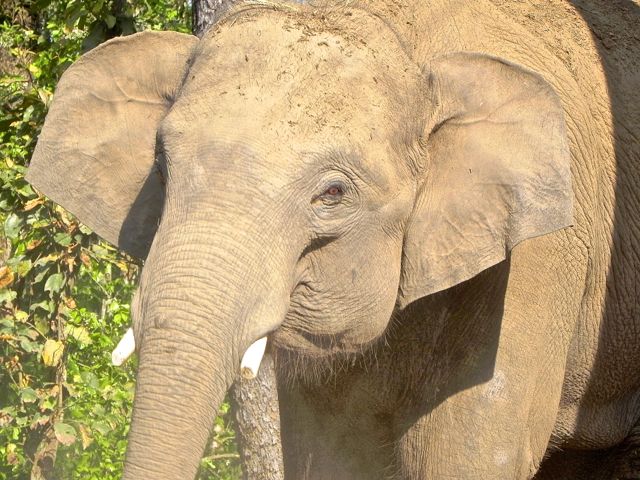
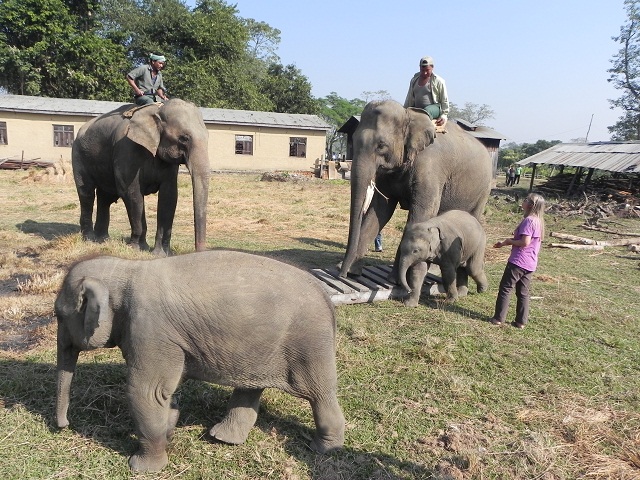
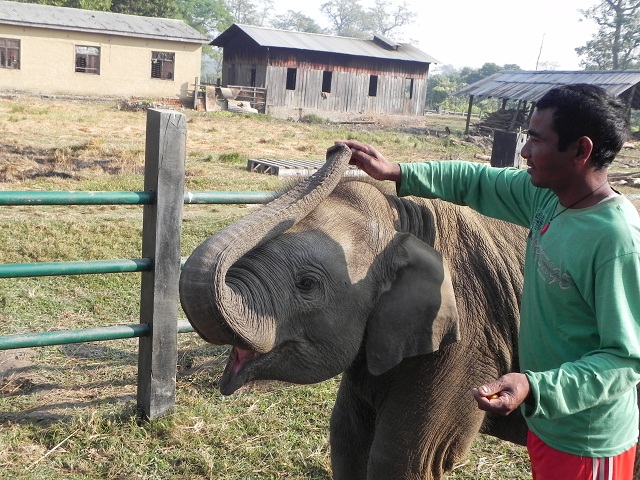
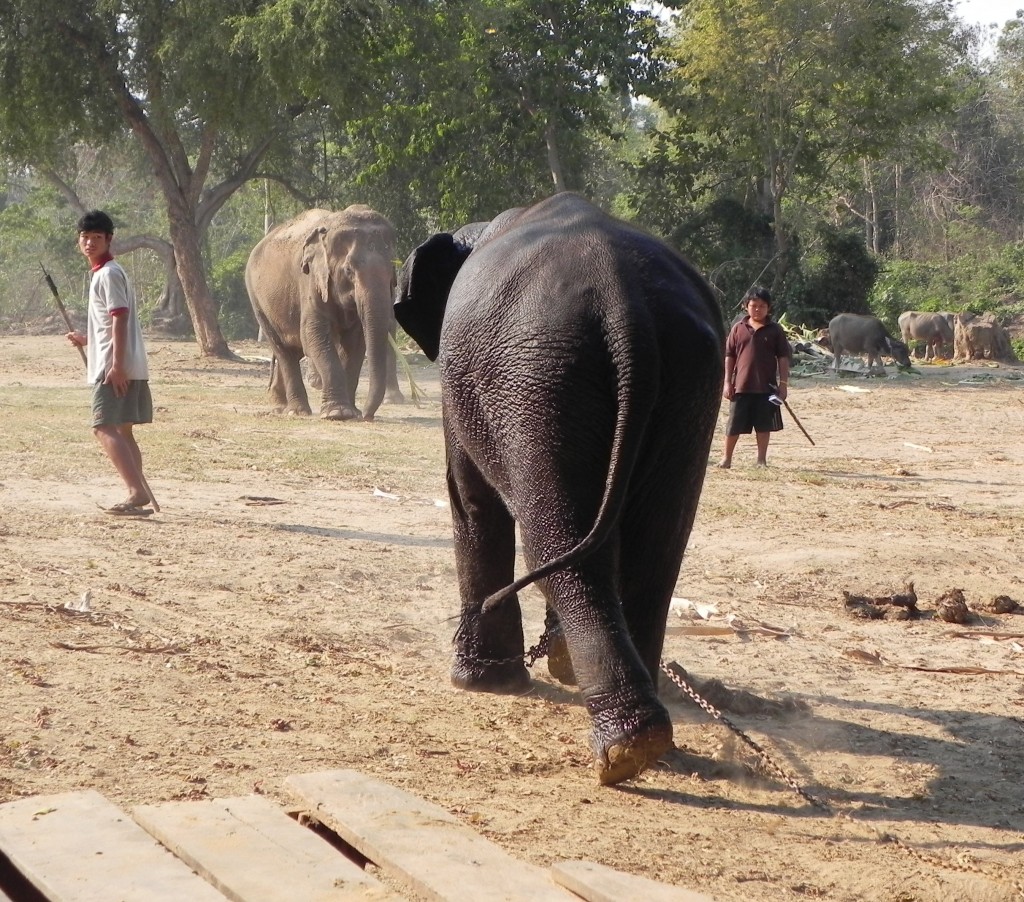
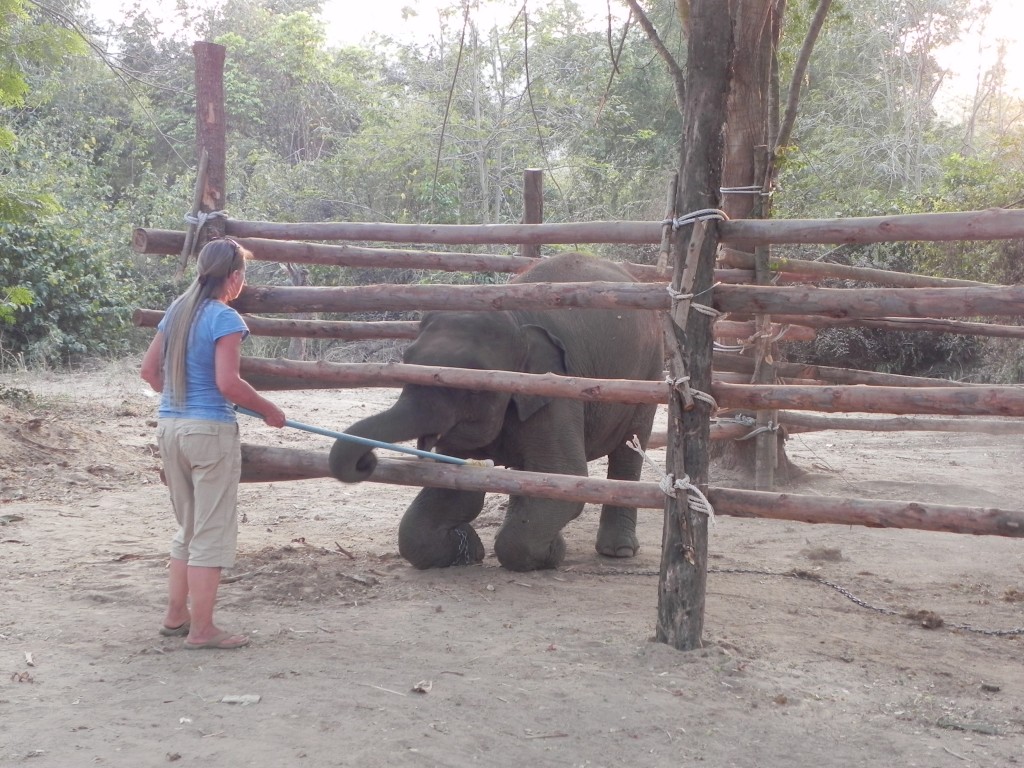
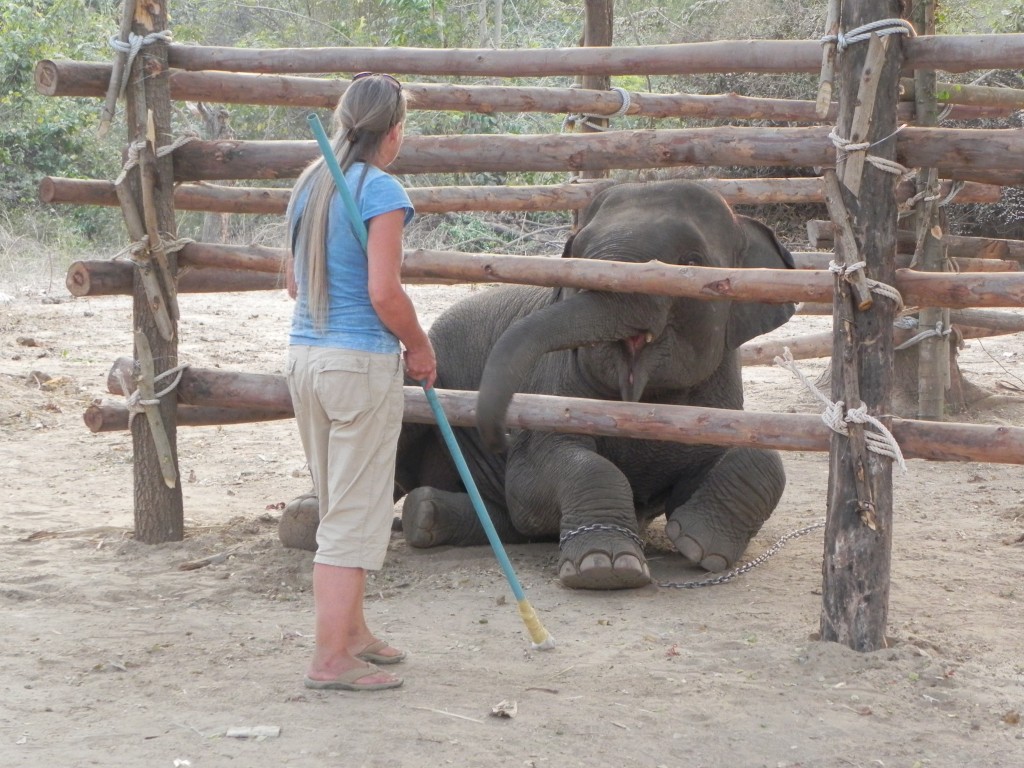
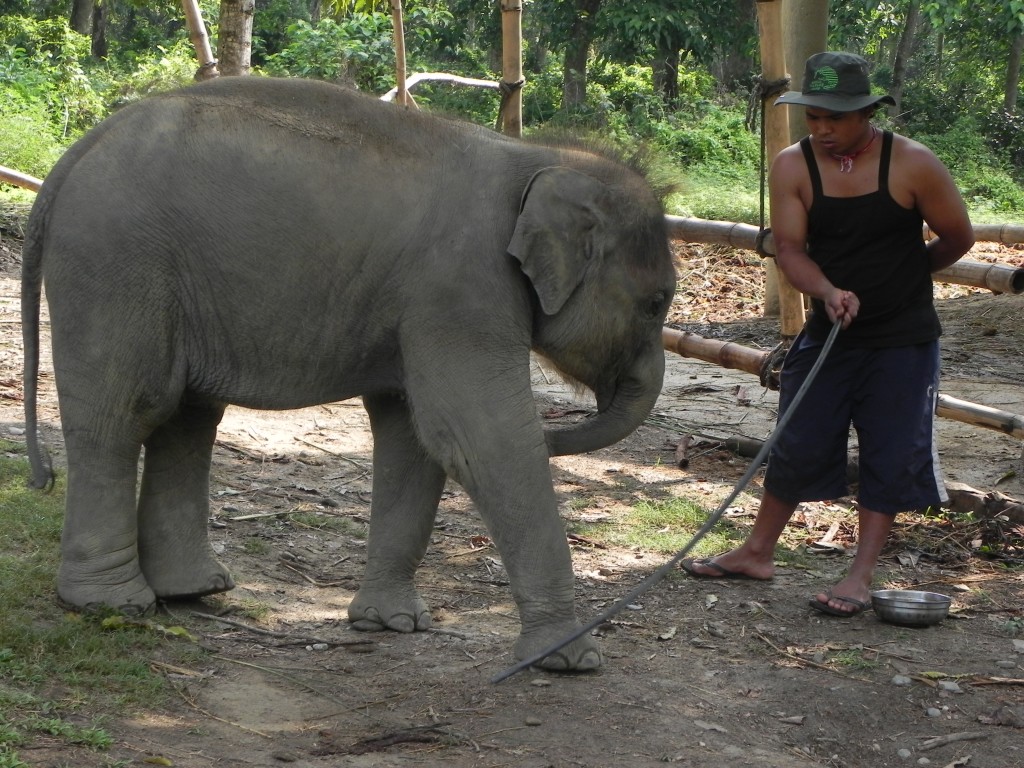
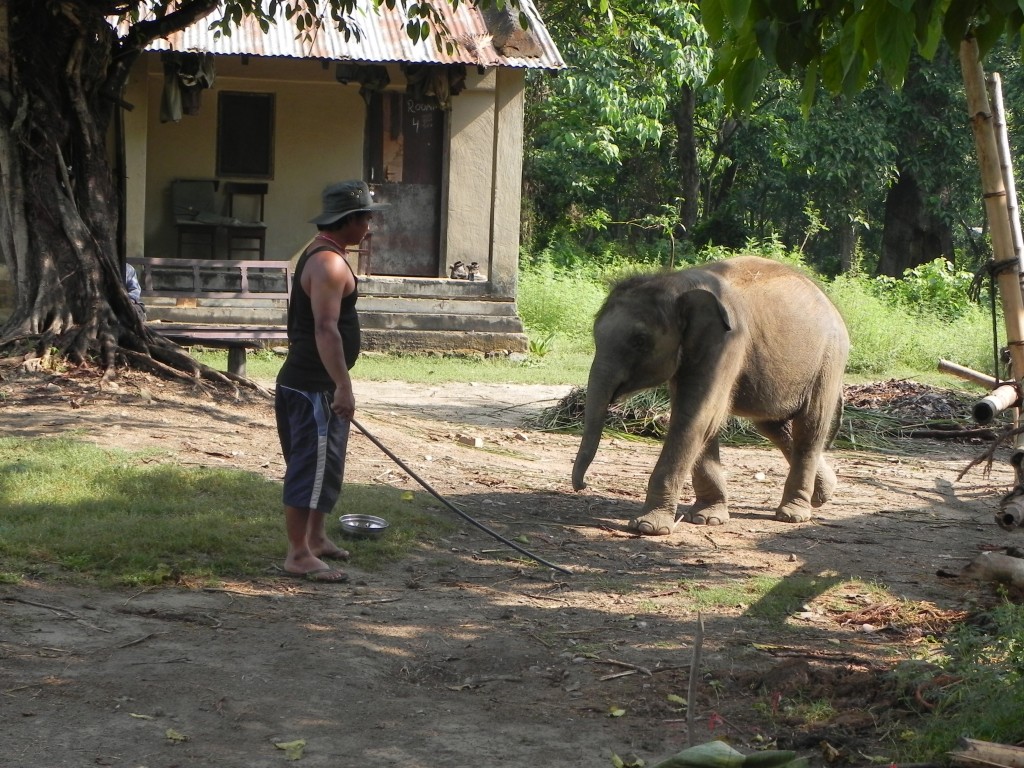
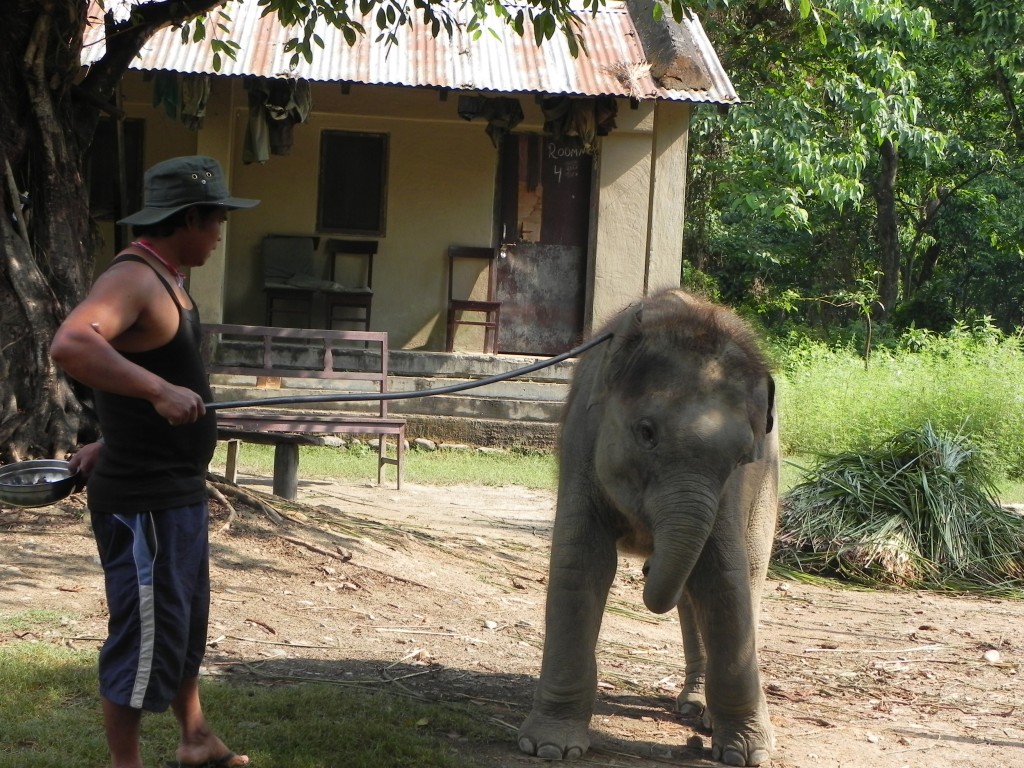
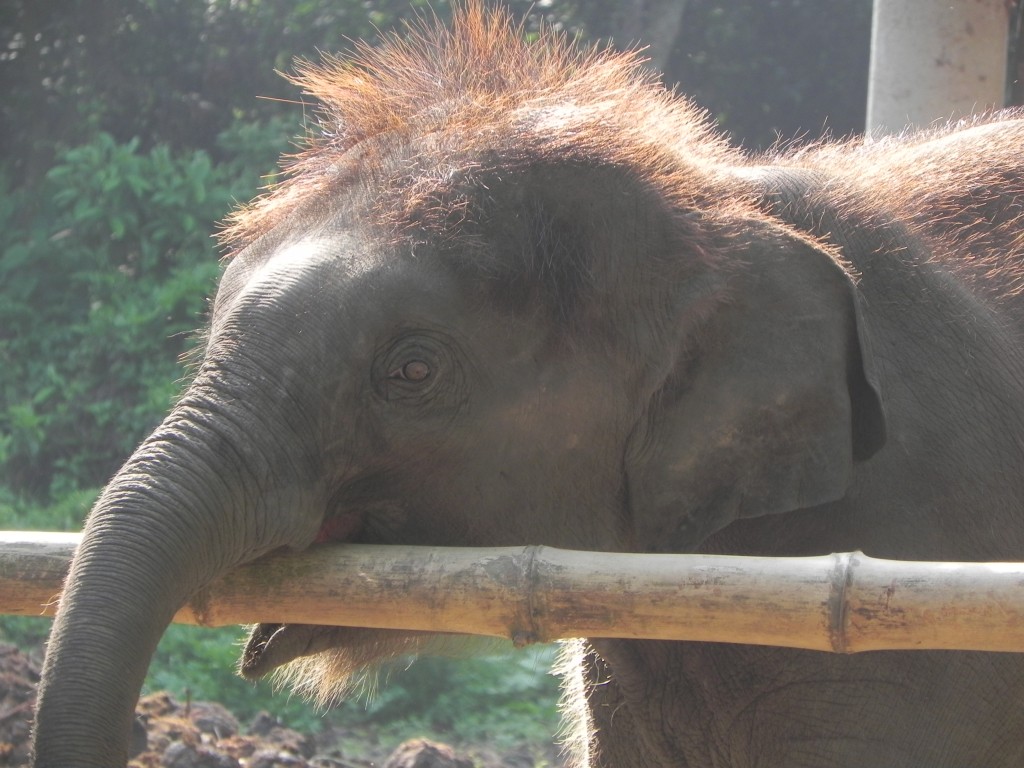
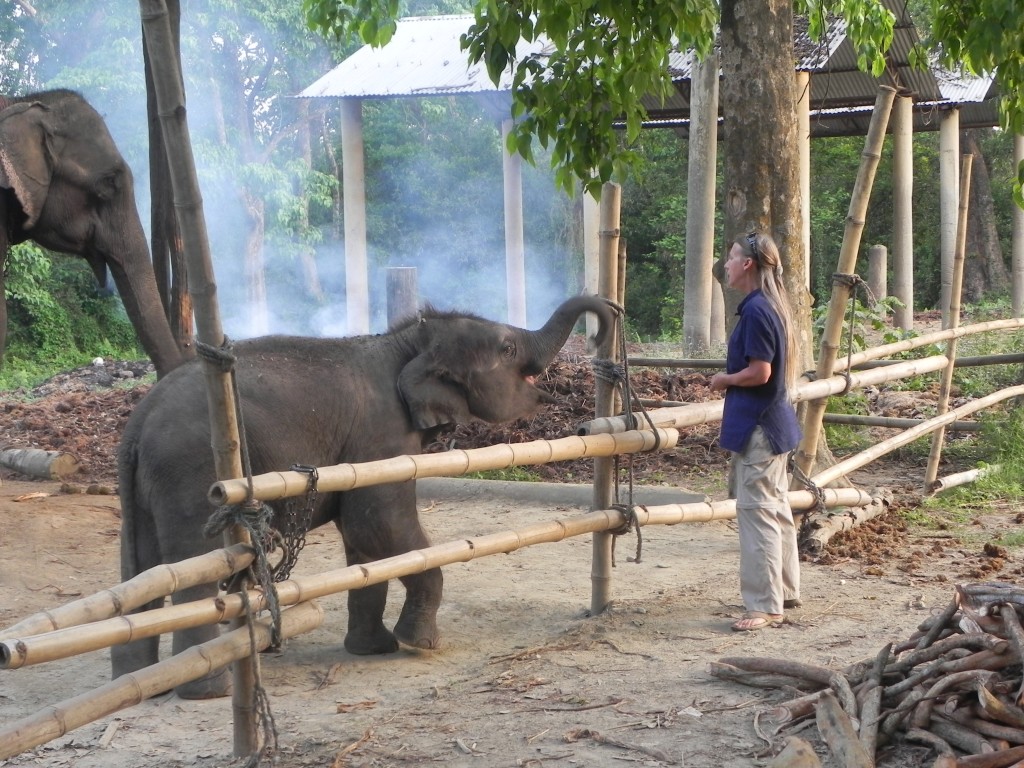
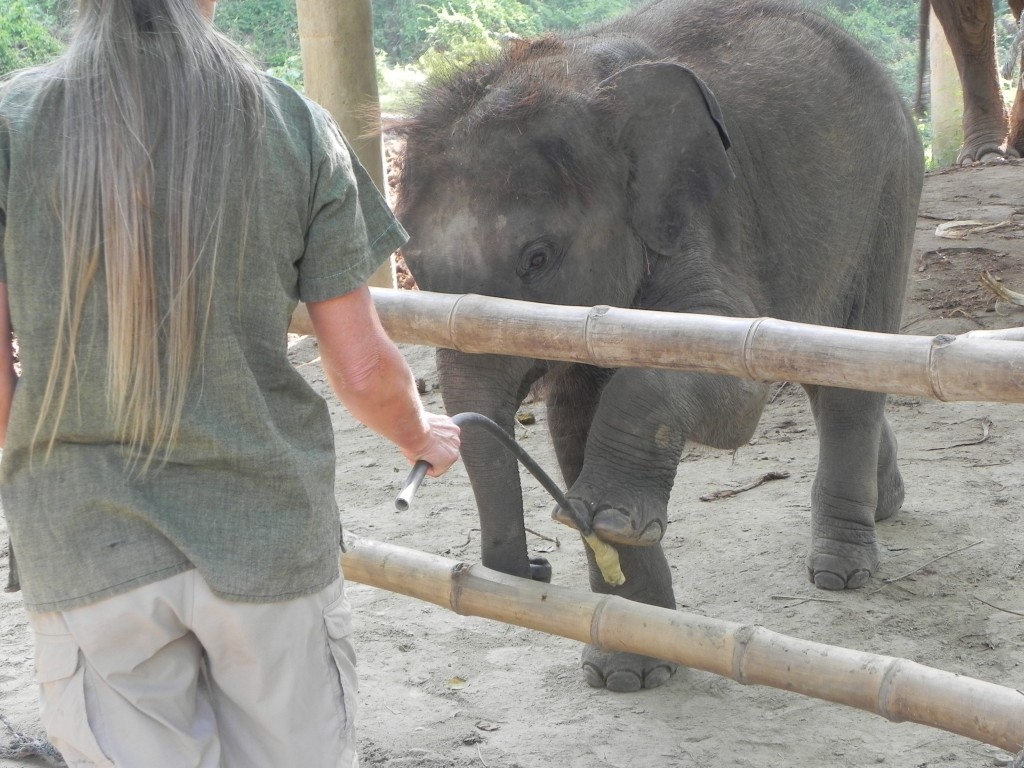
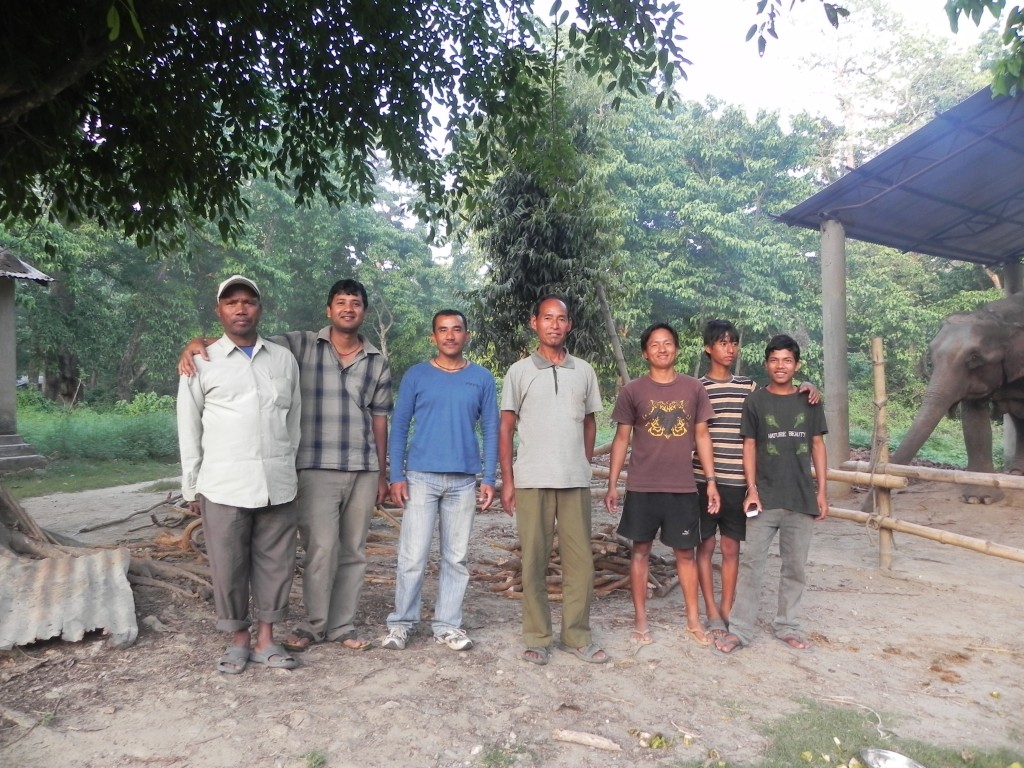
Himal Gaj is a six-year-old captive born elephant. His father is the dominant wild bull in the area. His mother is a wild born, captive resident of the elephant breeding center at Khosor, Chitwan, Nepal.
Himal Gaj was one of five young elephants trained together at the breeding center several months ago. Until their formal training, they lived with their mothers.
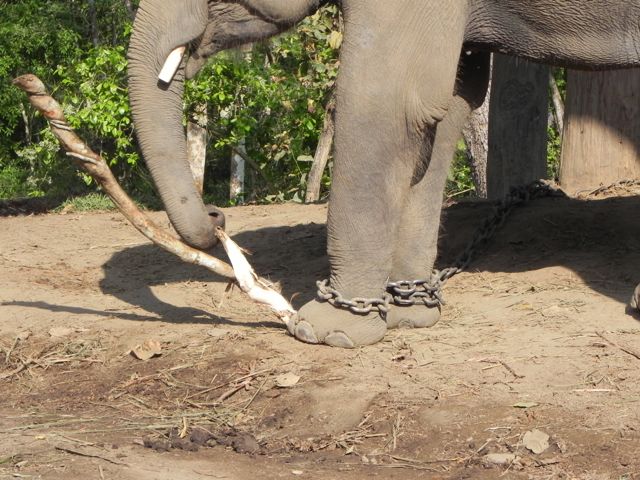
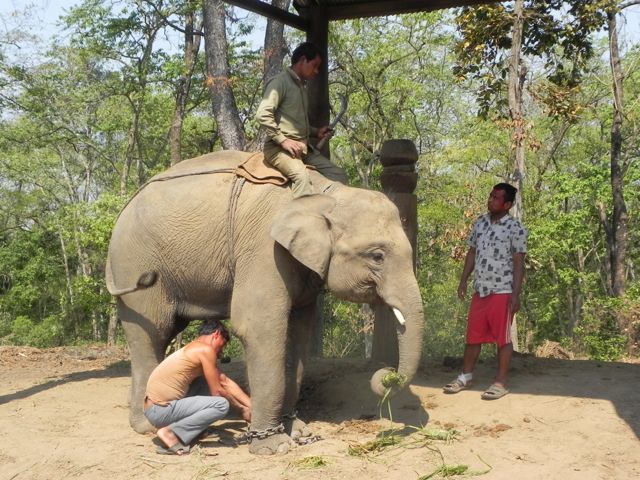
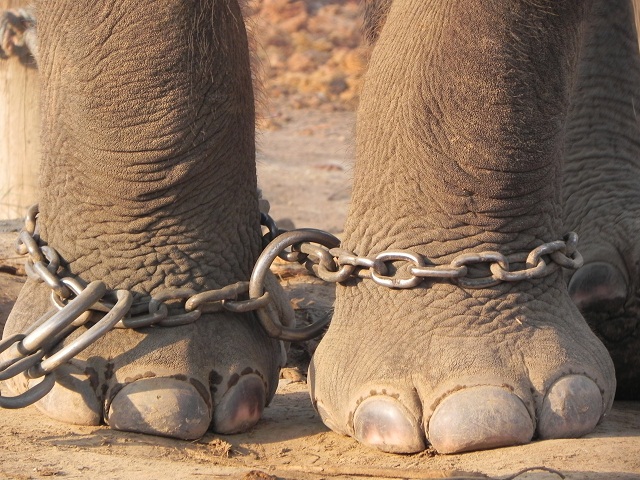
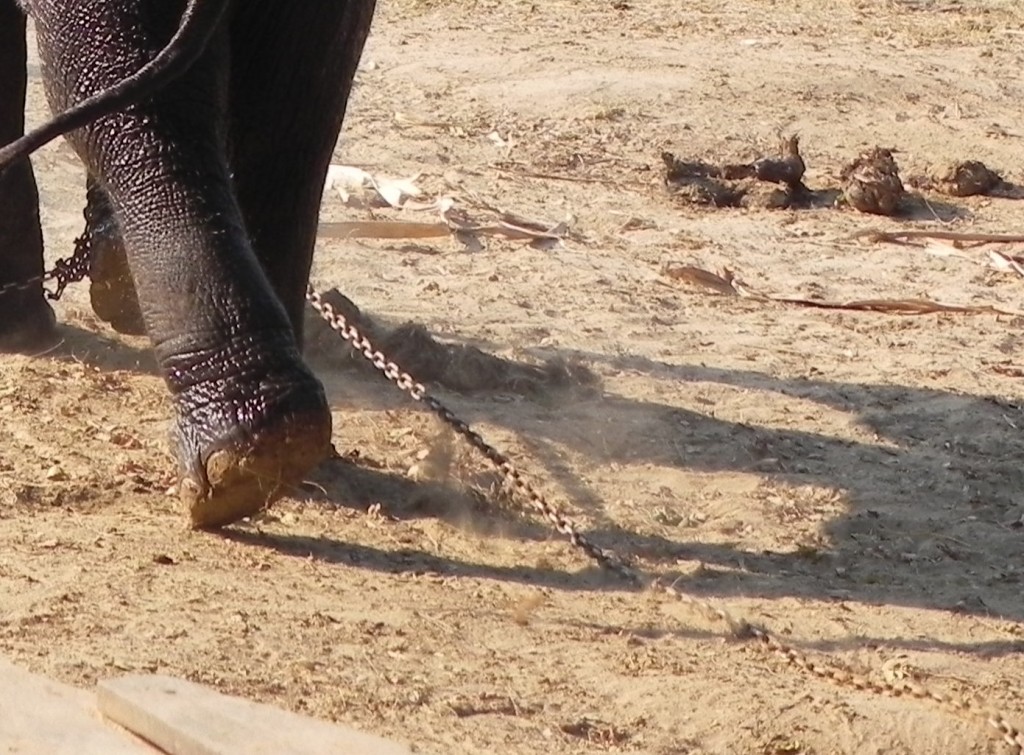
All five elephants were chained from the age of three months. Chaining is the practice all over Asia. Domestic livestock and captive elephants are tied or chained. It is the cheapest way to keep them in one place.
The training technique used with Himal Gaj and the others at the breeding center was a deviation from the traditional pujan, a brutal breaking of spirit. Introduced by a foreign NGO, a mixture of traditional methods was used—including the use of koonkie elephants, negative reinforcement and punishment—combined with positive reinforcement techniques known to be successful with domestic horses.
Unfortunately, once training began, Himal Gaj showed signs of aggression and resistance. He was frightened by the training process and responded poorly to his mahouts. A few months later his training was deemed unsuccessful.
No video, photographic or written records exist to document the daily training process and Himal Gaj’s progress and difficulties.
But it does not take such documentation to see that Himal Gaj is a very insecure individual.
Although Himal Gaj responds well when his mahout is riding, his weakness is responding to commands when his mahout is on the ground.
Himal Gaj is a good example of the importance of sound training techniques, mahout training and follow through.
Captive elephants are not domesticated—they are wild animals living in a captive environment. Even generations born in captivity are not domesticated. The scientific process of breeding selected individuals for specific traits is the process required to create a domestic species. This has never been undertaken with elephants.
In the case of all elephants born at the breeding facility in Khosor, the mothers are wild born living in captivity and the fathers are wild born living in the wild.
Himal Gaj’s mahouts are as gentle as I have seen anywhere. They are patient but frustrated. What the training process failed to do was give them the tools necessary to help Himal Gaj learn.
As a result, all are left feeling like failures. Without intervention, Himal Gaj is doomed to be a dangerous elephant for the remainder of his life.
The good news is that the mahouts and Kamal Kunwar, the chief commanding officer of Chitwan National Park, are receptive to Himal Gaj receiving additional training. His private training course will begin soon.
This is such exciting news. I feared Himal Gaj would remain a lost cause in the minds of the mahouts. But before his chain-free corral is completed Himal Gaj, will be well on his way to understanding what is expected of him and his mahouts will have gained the humane tools to understand and assist him in his training process.
I am back in Nepal. So much has happened during my first month here!
I accepted a kind offer from the National Trust for Nature Conservation’s Biodiversity Conservation Center to live on-grounds. It was a good decision. There is always something interesting going on, local and foreign students visiting and opportunities to learn about the work of the many conservationists on NTNC-BCC’s staff.
We have already trimmed feet at the two government centers, NTNC and some private stables, but foot trimming has taken a back seat to other projects for now.
Expanding the chain-free corral in a big way
When I arrived, the first order of business was identifying a location for an additional chain-free corral at NTNC-BCC for Man Kali and her new calf. After I described my long-term aspirations for NTNC’s elephants, senior staff suggested that we petition to expand our chain-free corral pilot project to include the entire hattisar (elephant compound). I was deliriously happy with the idea that we might be given permission to convert the entire hattisar all at once.
Chitwan National Park’s chief warden and senior veterinarian, the Department of National Parks and Wildlife Conservation’s ecologist and NTNC’s officer-in-charge explored the idea and unanimously endorsed it. The project is scheduled to begin December 15th.
The funds to build the expanded corral were donated by EAI’s dedicated supporters including a most generous and timely donation from the Harrison Sanford Jackson estate. This donation has come at the perfect time for EAI to make a serious impact on elephant welfare in Nepal with this chain-free hattisar, the first of its kind in the country.
Not only does the chain-free corral expansion mean that all six NTNC-BCC hattisar elephants will never again be shackled, the design enables them to socialize with each other.
Reuniting the family
Knowing the importance of the mother and calf bond, you can imagine how excited I was when Dr. Gairhe, Chitwan National Park’s senior government veterinarian, suggested that the family group at NTNC be allowed to live together in the same corral.
Even though Prakriti Kali and her mother both live in the same hattisar, they have not been allowed to socialize for four years, since Prakriti Kali was formally trained. This practice of separation is traditional, meant to break the mother/calf bond.
But onlookers can see that the bond between Prakriti Kali and her mother is still strong. On occasion when they are relatively close, Prakriti Kali rumbles, her mom responds and Prakriti Kali instantly assumes a posture that the mahouts refer to as “four feet together”: an awkward, stereotypical posture she exhibits when she appears to be soliciting comfort.
Dr. Gaihre’s recommendation and the blessing of PasPat, the mahout supervisor, means that Prakriti Kati will be reunited with her biological mother after four years of separation. She will also meet her baby brother Hem Gaj, for the very first time. Together the three will share a chain-free space designed specifically for them.
Anyone who has witnessed the reunion of Shirley and Jenny in the award-winning documentary “The Urban Elephant” can imagine what this reunion will look and sound like. Elephant reunions–there is nothing more moving.
Watch this short video on EAI’s work and hear from Prakriti Kali’s (aka Sweetie Kali) mahout about the difference a chain-free corral has made in her life:
A life lost to herpes
Shortly after I arrived in Nepal, a two-year-old calf at the Government Breeding Center succumbed to the herpes virus. This insidious disease is relatively new to Nepal but has claimed the lives of many captive-born elephants in the US, where extensive research is being conducted.
The loss of any elephant is heart wrenching, but to lose a baby is particularly difficult. The mahouts were quite obviously grief stricken as they gathered in near-silence to bury one of the youngest members of their family. Incense was burned and prayers given as the mahouts dropped flowers into her grave. One of the young veterinarians in attendance said that the mahouts view the elephant as having personhood status. To them, losing this calf was the same as losing a family member.
Since herpes is a virus, there is no vaccination to guard against it. It appears and kills quickly, usually within days of the first signs (lethargy and dark spots on the tongue). The medication prescribed to help combat the disease has had mixed results and, as I found out, is not available in Nepal. Thankfully, our friends at Wildlife SOS-India came to our rescue. Dr. Yaduraj spent days locating the volume of drug required. After three shippers refused to ship to Nepal, he found one who was willing. There was one last delay—when the package was returned to Wildlife-SOS for additional address information—then it was finally sent on its way. Our sincerest thanks go to Dr. Yaduraj for his assistance purchasing and shipping the medication to us.
Getting accurate weights in case
All babies and their mothers at the breeding center were weighed. If any of the babies become ill, Dr. Gaihre will be able to prescribe an accurate dose of medicine.
If treatment is needed, the veterinarian must know the patient’s weight in order to prescribe the accurate dose of medication. It was decided that all the elephants should be weighed in the event another baby is stricken with the virus. There is a scale on-grounds but the elephants needed to be trained to step onto the platform. They all did great but the calves were especially fabulous. They all took their turn to step onto the platform. None showed a bit of fear; each of them walked confidently across the platform to receive a tasty treat.
Checking tongues
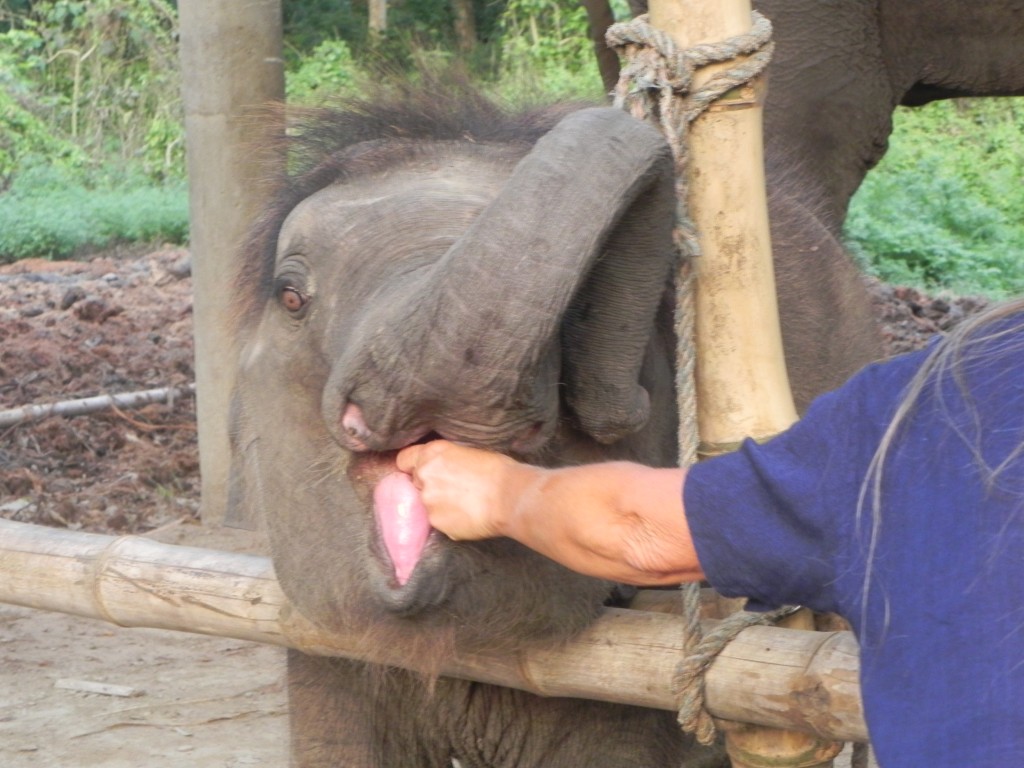
As an added precautionary measure, the babies were also trained for tongue examinations, a simple and painless procedure to detect the disease in its early stages.
The babies were willing participants in the Compassionate Elephant Care training method, which uses only positive reinforcement. Within three days all the calves were happily laying their trunk back across their forehead and sticking out their tongue for their reward: a juicy orange slice. With the trunk and tongue in this position mahouts can easily examine the calf’s tongue for abnormalities.
EAI paid for a shipment of medication used to combat herpes and worked with mahouts to show them how to train the babies for tongue examinations.
The mahouts are now checking the babies’ tongues twice a day–once in the morning before going to the forest and then again in the evening when they return. Hopefully the virus will not strike again but, if it does, the mahouts’ vigilance could make all the difference.
Still fighting for Mali
Efforts to move Mali from her solitary existence in a zoo in the Philippines to a sanctuary in Thailand continue. An op ed by Carol comparing Mali’s life to that of Tina, who came to live at The Elephant Sanctuary, appeared this summer in a paper in the Philippines. Since then, Carol’s op ed has also appeared in Sri Lanka’s Sunday Times and, most recently, the Bangkok Post.
And now we are three
EAI will soon celebrate its third anniversary. It’s hard to believe we have come so far and accomplished so much in such a short period of time.
We have been able to do so much – and have such an impact – because you share our dream and continue to support the important work we do. With so many needy elephants in situations that, at times, are overwhelming, it is essential to know that you are backing our efforts to make life better for captive-held elephants in Asia.
It doesn’t matter if we are building chain-free corrals, teaching mahouts to handle their elephants in a gentler manner, providing pedicures to any elephant in need or stockpiling medicine to treat baby elephants infected with the herpes virus, you are always there to make sure that we are able to provide swift and humane assistance, one elephant at a time.
We cannot do it without you. At a time when elephants are fighting for their very existence across Asia and Africa, you help EAI make a real difference. I know you will remember these hardworking and many times neglected elephants in your year-end giving.
2013 promises to be another year of challenges and change for the better. I look forward to continuing our work together.
It’s been a pretty intense week. A two-year-old female calf at the breeding center was diagnosed with herpes. Even though she received treatment, she passed away two days later.
Herpes is near-epidemic among elephants in the US and recently reared its ugly head in Chitwan. Young calves between the ages of one and three seem to be most susceptible but there are records of juveniles and adults dying from the disease as well.
You’ll remember Bhadra, the fabulous flaming redhead we trained with positive reinforcement in Sauraha, Nepal. He died of the herpes virus last year, shortly before his second birthday. His mahout was so devastated that he left his job and returned to his home village.
Famciclovir, the treatment of choice for herpes, is not available in Nepal and must be imported from India. A small elephant can require as many as 1000 pills to fight the virus. The exorbitant cost—75 cents per pill—and large quantity needed, made stockpiling the medication impossible.
The calf was given available medication and was under treatment and constant surveillance as I arrange for a shipment of Famciclovir from friends at Wildlife SOS-India. Unfortunately, the drug did not arrive in time to save her. She died in the night with her mother stoically standing by. Records indicate that even with Famciclovir many calves do not survive.
I accompanied the team for the necropsy and somber burial; both were done with the utmost respect. All the mahouts were present and, for the first time in my observation, near silent. As Dr. Gaihre led the exploratory necropsy, examining and collecting tissue samples for lab work, the mahouts dug a grave. It was a sad and sobering experience. This calf had the classic symptoms of herpes–severe hemorrhaging–but otherwise was a very healthy elephant.
When it came time to lay her body to rest, I instinctively glanced around for wild flowers to place on her grave, just as we always did at the Sanctuary. After her precious body was covered with a sparkling clean white linen cloth, incense was lit and ceremonial red powder and flowers were sprinkled over her covered body. When the flowers I collected left my hand and floated down into her grave, a wave of gentle remembering engulfed my heart as I thought of the beloved elephants who had lived and died at the Sanctuary. At this moment we were all one, sharing the loss of a sacred soul.
The senior wildlife staff presided over the burial. Although the words spoken over her grave were in Nepalese and foreign to my ear, I knew exactly what the prayers were. It was the same ceremony, the same prayers uttered each time we buried another precious elephant at the Sanctuary. Like never before, I felt a connection with the mahouts who care as deeply for their elephants as we do ours.
Preparing for next time
The signs of herpes include dark spots on the tongue. By checking the tongue twice a day, the disease can be diagnosed in the early stages. In an effort to monitor the other three young calves at the breeding center, I was asked to train them for tongue examinations, a request that I was happy to fulfill.
The first day of training was a heart-lifting success. We were able to get the calves to place their trunks on their foreheads—for a tasty piece of banana—and took photos of their tongues.
Additionally, I ordered Famciclovir. Even though the drug may expire before it can be used, I feel strongly that having it on-hand whenever possible is important. We were not able to help one precious elephant but if the disease strikes again we will be better prepared.
Elephant’s World posted two videos on YouTube last week of me training a young elephant named Jon (you can view them here and here). I was surprised to see the videos and happy to know they exist.
Many people found the videos interesting and some have asked why Jon is wearing a chain. The chain is called a drag chain; in Asia it is used to prevent an elephant from running away. One end of the long chain is fastened around an elephant’s wrist and the other end drags behind.
When a mahout is afraid that his elephant will run away, he puts a drag chain on him. If the elephant runs, the mahout wraps the loose end of the chain around a tree to stop him.
The mahouts at Elephant’s World were resistant to non-dominance training and even more resistant to removing Jon’s drag chain. In order to be allowed to demonstrate positive reinforcement target training, I agreed to the drag chain for the first two sessions. One end of the chain was on Jon’s ankle and the other end was loose.
My adherence to their tradition gave the mahouts time to get comfortable with the new training method I offered. They observed firsthand that Jon was more interested in the training game than in trying to get away.
Jon showed such promise that after the second training session the mahouts agreed to remove the chain.
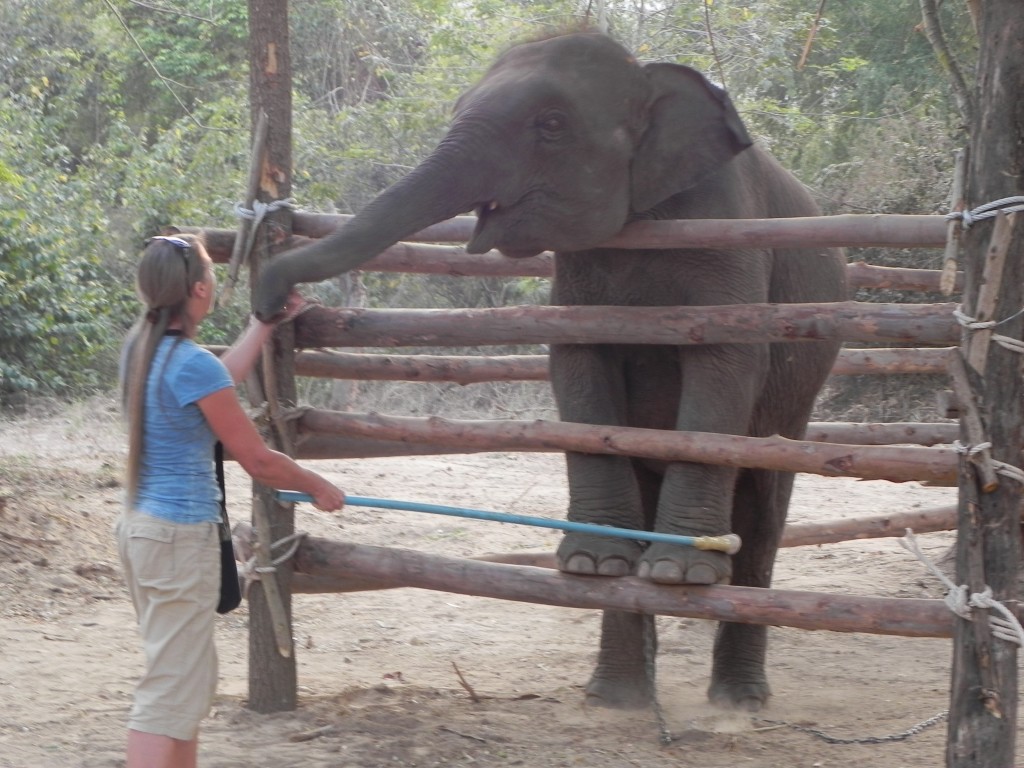
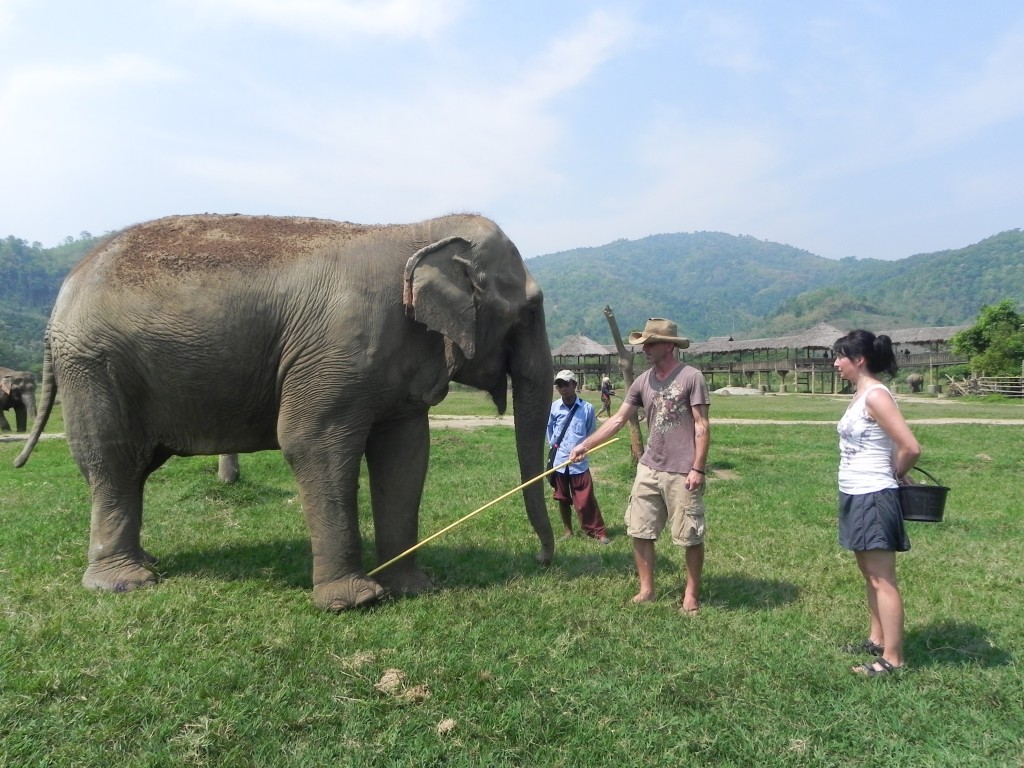
There have also been questions about the “stick” used during training. The stick, or target as it is called, is a flexible pole with a soft cushion on the end. Watch my training tutorial to see how the target is used and learn the basic concept of target training.
The goal is to teach an elephant the name/word for different body parts, such as foot, head, ear, side, etc. Once understood—which takes most elephants only minutes to grasp—the elephant will voluntarily offer that body part when asked. The key is to ask, not demand, and always provide praise and a treat as a reward.
Before watching the videos of Jon’s training sessions, I suggest that you view the tutorial a couple of times. Then watch Jon’s first training session and see if you can identify what body parts Jon is learning. Notice that when Jon becomes frustrated he walks away, but returns almost immediately to try again.
Positive Reinforcement Target Training gives the elephant the freedom to walk away, take a moment to reflect on what is happening and return when he is ready to try again. Walking away reduces frustration and increases the elephant’s willingness to participate.
You will also notice in the video that Jon offers behaviors–kneel and lie down. This is common in initial training sessions. Many times the elephant will offer what s/he already knows before starting to “problem solve” and figure out what the trainer is trying to teach.
Learning to think for themselves is the first thing the elephants learn. After that, training is a breeze.
Last year I had the honor of working with a young, energetic elephant named Jon. He was a recent rescue, living at Elephant’s World, a Thai-run facility outside of Bangkok.
To my surprise, two videos of Jon’s first training sessions showed up on YouTube (here and here). I was unaware that the videos even existed.
Watching Jon brought back a flood of memories: his intelligence, how he dealt with his initial distrust and confusion and how well he masked his fear. His energy was explosive and outdone only by his genius.
I can’t help but smile remembering his antics and eagerness to understand this new “game” — and his determination to prove that he could do anything!
During this trip to India I basically sequestered myself in Bannerghatta, singularly focused on the care center project. As my pending departure loomed I realized that I had failed to visit other projects. There really is so much to see—elephant welfare-wise—in India, I was kicking myself for not setting aside time to further my education.
Literally days before my visa was to expire I received an email invitation from Kertick and Geeta of Wildlife SOS to visit their facilities in Agra. True to my nature, I hesitated at first — not because I did not want to visit their bear and elephant facilities but because my flight was already booked and I did not want to pay the flight change fee.
Fortunately, my flight from Bangalore to Kathmandu had a plane change in Delhi, the airport I needed to fly into for Wildlife SOS. I was able to postpone the second leg of the flight, giving me almost three days to spend with the Wildlife SOS staff at both their bear and elephant facilities.
The visit would have been perfect if Kertick and Geeta were in the country but they were in California, presenting at the PAWS elephant summit and other venues. In their absence, their expert staff took care of all arrangements, which made my visit very comfortable. I hope Geeta, Ketrick and I will meet in the next few weeks, as they plan to come to Nepal to observe my work in Sauraha.
The work Geeta, Kertick and staff have done to rescue and rehabilitate dancing bears is nothing short of miraculous. The facilities are well designed, with expansive yards, spotless night houses and a dedicated and knowledgeable team of caregivers and veterinarians.
I was in the education hut sitting on a couch viewing one of many informative videos about dancing bears and the plight of other Indian wildlife, when something—light as a feather—touched my shoulder. I assumed it was an insect and reached up to gently brush it away without taking my eyes off the screen.
Without a sound or advance warning more than the gentle shoulder tap that I mistook for an insect, something much heavier than an insect, maybe four or five pounds, warm and hairy, jumped onto my head. I froze and whatever-it-was froze. I had no idea what it was. It was completely silent and warm, grasping my hair in what felt like many tiny hands.
Not being able to see what was perched on my head was indeed unnerving, and no one else seemed to be around. I trusted that I would not have been put into this room alone with anything dangerous so I considered my options. Yelling for assistance was out. Reaching up to remove my head ornament seemed risky. And waiting for someone to come to my rescue seemed unrealistic.
My decision was to slowly reach towards my head to see what would happen. The “thing” leapt from my head across the room to a chair and then back to my head again. Her movement was quick but as she was flying through the air getting ready to land on my head again I saw the “thing” was a young capuchin monkey.
Even though I am comfortable with captive wild animals I respect them by keeping my distance because I feel interaction is not in their best interest. But this little creature obviously felt differently. She leap frogged from her chair to my head a couple of times and then remained perched on my head. With no staff in sight I realized I would need to deal with this little bundle of curious energy on my own. I was not opposed, I just did not want to do anything wrong, not having been around a primate before.
Gently untangling my hair from her tiny fingers she allowed me to remove her from my head and lower her to the couch. We looked at each other—too cute is all I can say—as she ever so confidently climbed into my lap, took hold of my hand and placed it on her belly. There was no misunderstanding this gesture — she wanted a tummy rub.
I admit to being in heaven while at the same time wondering how I could justify having a monkey in my lap. In the end I did not try to justify it, I simply accepted the experience as the gift it was and enjoyed every second she remained in my lap. A few minutes later one of the resident Great Dane rescues showed up, sending her dashing from the room.
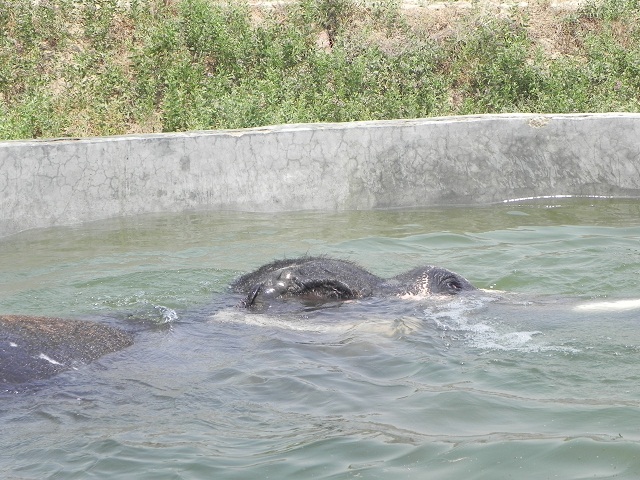
Escorted by staff veterinarians we first toured the bear facilities and then drove a short distance to the temporary elephant facility. Set up on five or six acres of land, the elephant facility is a good start for the rescued elephants. The facility is well designed, with stables for shade and nighttime, sand piles to avoid hard surfaces, a steel corral stable for bulls and a circular concrete pool that is the high point of everybody’s day.
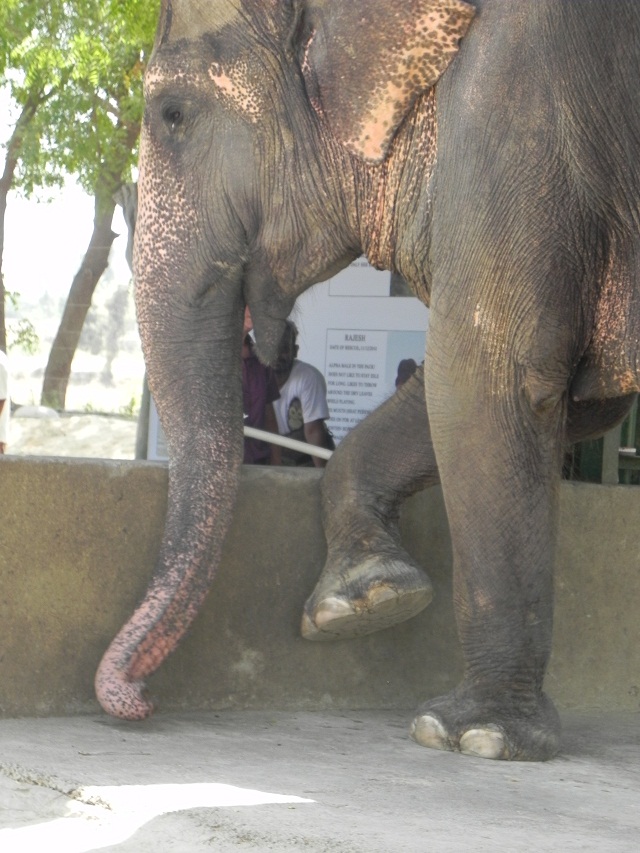
It was amusing to watch Rajesh, a beautiful full-grown bull with massive tusks, submerged for hours, gently bobbing around in the pool.
I did a little foot care and target training to give the vets, mahouts and elephants an idea of what was to come in the future. The mahouts have already changed how they work with the elephants to a great degree. The harsh tone and demanding commands are still used but the ankus and infliction of pain are not. I could see the mahouts are being won over to other ways of working with their elephants — it was exciting to see the progress they have already made.
Kartick and Geeta have plans to move the elephants to a very large tract of land. I have decided to accept their invitation to be involved in this project and recommend that you visit their site and support their work for rescued bears and elephants.
I recently returned from a lengthy trip to Asia, where I taught traditional mahouts (trainers) a gentler, more humane way of training and working with captive elephants.
Viewing the undercover video exposing the abuse of Tai, the elephant star of “Water for Elephants,” was unnerving. The techniques circus trainers in America use are identical to the traditional, antiquated and abusive methods of breaking and training elephants used by mahouts in Asia that have been handed down for centuries.
As in Asia, American circuses embody tradition, animal abuse for public entertainment. Being involved in the circus for nearly fifteen years gave me ample exposure to this abuse. Even though we have made huge advances in our knowledge about elephant intelligence and suffering, this tradition has, sadly, thus far failed to evolve.
There is an alternative to these harsh training methods, if indeed elephants must be trained. I am pioneering the field of positive reinforcement training in the traditional free contact environment in Asia. Although I do not condone the commercial use of elephants, I am realistic enough to know that my personal concerns will not put a stop to the shows and rides that exploit elephants there. Only through education targeted at elephant trainers, mahouts, and the insatiable public can the abuse be curtailed and eventually stopped.
It is uncanny that Tai’s abuse was exposed as result of her portrayal of an abused elephant in “Water for Elephants.” By enforcing existing regulations and strengthening laws to protect the innocent, the antiquated training practices of the circus in America can be eradicated.
I am of the firm belief that if the only way an elephant can be on public display is to be dominated with harsh control methods then we, as a society, are required to forfeit the opportunity to have elephants in captivity.
Elephant’s World was one of the locations where I was fortunate to introduce positive reinforcement target training. I will return there to continue training, and to consult on facility development and elephant training and care.
During my last visit, Elephant’s World owner agreed to the idea of constructing a large fenced-in area so the elephants can be kept off chains. Fundraising is underway and hopefully by the time I return to Thailand in the fall, the fence will be in place.
Ngo-Hok, aka Jon, the young male elephant with whom I worked, has a history of aggression. Personally, I believe he was emotionally scarred by the traditional brutal training he received prior to coming to Elephant’s World. From the first session he responded enthusiastically to positive reinforcement target training. I was at Elephant’s World for only about a week, but during that time Ngo-Hok/Jon excelled at demonstrating to the mahouts that he can learn and will respond favorably, at least to this technique of training.
Unfortunately, the language barrier was a challenge. The mahouts tried to understand what I was telling them but they simply could not. Even though Ngo-Hok/Jon was brilliant during his target training sessions, the mahouts failed to continue the training after I left.
The staff needs further training to grasp the concept and develop the technique of this training which is so foreign to them. I look forward to returning to Elephant’s World to continue the training. This time I will recruit a translator, which is the only way to ensure that the mahouts understand the philosophy and learn the technique.
Following is an interview that an Elephant’s World volunteer did with Piza, Ngo-Hok/Jon’s mahout. The volunteer posed the questions as if I had asked them.
Q: How is Ngo-Hok/Jon doing?
A: He is doing better since the last time you saw him. Sometimes he is stubborn, and then I cannot climb on this back. He is more often around the other elephants, during swimming and eating, but I have to stay close to him because he is playful and annoys the older female.
He is now very close with Rom Sai, the full-grown tusker, like a father and son. He has escaped a couple of times in the last months but he comes back to stay with Rom Sai. When eating together, he likes to take food from the other elephants. Only Rom Sai will allow this. I believe the other elephants will hit him if I am not there.
Last evening I didn’t take him to the forest because he did not let me get on his back earlier in the day — he was stubborn. In this way I am trying to teach him. Also, after he is stubborn he will try to escape when I take him out of the forest. I am trying to teach him that if he obeys and allows me on his back, he will be rewarded with a trip to the forest.
Ngo-Hok/Jon is growing; he is now taller than me. In one month he has gained about 10 kgs. He now weighs close to 800 kgs and eats about 80 kgs a day.
Q: Do you think Ngo-Hok/Jon can stay with the other elephants?
A: He can stay with other elephants. He can stay close to Rom Sai, who will protect him. For now he can stay with the females as well because they are older women and he is still young. But as he gets older and new female elephants come in, it will be a problem.
Q: How do you feel around Ngo-Hok/Jon since he tried to hurt you?
A: I feel better around him now, but have to be careful all the time. After the accident I was a little bit afraid, but not anymore. When I am with him anyone can come close, but if I am not there, people cannot come close. If I have one day off, Jon is put on hobbles because the other mahouts cannot deal with him. Right now Ngo-Hok/Jon only listens to me.
Q: Is there anything else you’d like to tell Carol?
A: I think she should come again and see Ngo-Hok/Jon for herself.
My return flight to Los Angeles leaves from Bangkok, which was the perfect excuse to go back to Elephant Nature Park one more time to see the progress made by Chang Yim and Karl.
Yim never ceases to impress me. He has made yet another transition from Karl to his new mahout, Lai. Karl has worked diligently over the past many weeks training Lai, and Yim has been a real trouper. There is no doubt in my mind that Chang Yim will miss the special relationship between him and Karl, but Yim has a bigger mission. He has the opportunity to teach a “traditional” mahout a different way, a more humane and gentler way to manage him and his family members. This move from Karl to Lai is actually quite monumental in the big picture…Yim is the catalyst for change. I am so proud to know him.
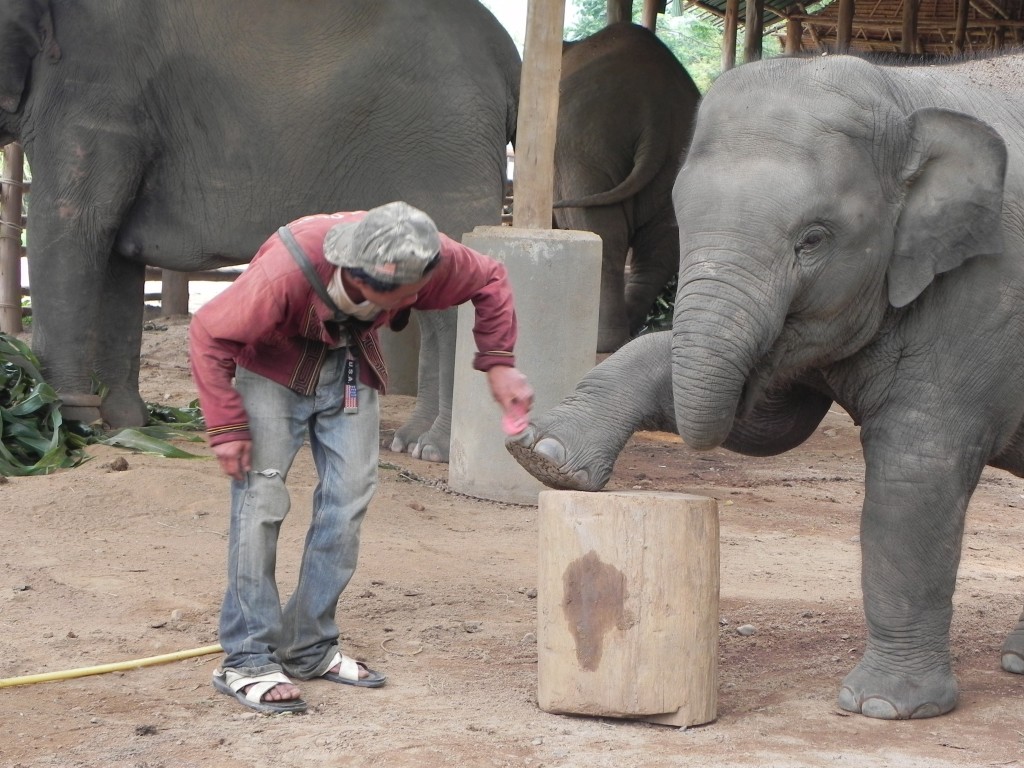
In addition to satisfying my curiosity about Yim’s progress, my return to ENP was to give Karl some pointers on training the elephants to place their leg on the trimming stool recently built for back foot trims. Once the elephants are trained, I will be able to return and finish the foot care clinic I started.
Mae Tee and Mae Kham Geao were our first students. The initial hurdle was getting the ladies to start thinking for themselves, no easy task for elephants who for decades had been conditioned not to think. The training was slow and at times appeared to be at a standstill, but, I could see the wheels slowly beginning to turn in their heads. Patience was the key.
After two days, my time at the park was up. Karl was well on his way to conditioning Mae Tee and Mae Kham Geao to voluntarily lift their back legs, a requirement in order to slide a trimming stood underneath for support. I felt torn leaving—I always do—but I had confidence that Karl would do just fine.
Today, a little before four, I received a call from Karl. At first I was apprehensive because Faa Mai is experiencing some unidentified health issue. But the news was all good: Faa Mai seems a little better. But the reason Karl had called was not to update me on Faa Mai, it was to tell me that Mae Tee and Mae Kham Geao got it! They were lifting their back legs off the ground and suspending them in the air when asked. The both of them!
What do you bet they talked about it over the past two days? It comes as no surprise that both ladies, dear friends who spend all their time together, figured out what Karl wanted in the same training session. Karl was so pleased, and WOW — what can I say. I am so proud of everyone involved in this work: Karl, Dam (the Maes’ mahout), Jody and Sophie (treat givers) and especially Maes Tee and Kham Geao, the ladies of the hour. I sure wish I could have been there to share in the cheers and congratulations showered on the ladies, but I was there in spirit. Planting the seed and seeing it grow, one World, one elephant at a time — in this case, two elephants at a time!
My work in Sauraha has come to an end, at least for the time being. Seeds of change have been planted. From the looks of it, some seeds are already growing, quietly shifting the soil around their sprouting roots. Experiencing the fruits of my labor so instantaneously fills me with hope.
Yesterday when Kiran and I arrived for Bhadra’s morning session we were told that Ramji, his mahout, was off making preparations for the New Year’s Day celebration. I jumped at the chance to work with Bhadra in Ramji’s absence. But my excitement was quickly doused when Bhadra made it perfectly clear that he would work with me but under protest.
After completing each request Bhadra would do a mini mock lunge from behind the protective barrier. It seemed that he was clearly bothered about something to do with me. He was responding but being snotty. I have seen this type of behavior before when training a new mahout who struggles to keep pace with an advanced elephant student. I did not make that analogy until sometime later.
The next day, the motivation behind Bhadra’s behavior became apparent. In our absence, Ramji had risen to a challenge from Kiran to prove his skill with Bhadra within three months. The ultimate goal: to show everyone how far he could take Bhadra with positive reinforcement training.
Ramji proved his skills beyond question when he surprised us by calling Bhadra from the protection of the corral and proceeded to ask him to present his feet and ears, move to the side, back up and put his head down. I was stunned. They were fabulous. Ramji, all cool, calm, and collected, Bhadra listening intently and responding to each verbal cue. I wish you could have been there to see it for yourself, but I did catch it on video. This type of breakthrough must be documented in order for others to believe.
Needless to say, Kiran was pleasantly surprised at the immediate progress in less than a week! Ramji obviously took the challenge seriously, resulting in a display that had me grinning from ear to ear, joyful with disbelief.
Ramji earned much deserved respect today, and Bhadra…well, he already has my heart. He has now joined the ranks of the “MIGHTY TYKES,” the young elephants in Thailand and now Nepal participating in this important case study of positive reinforcement training. These youngsters are the hope of the future: what they teach us and their mahouts will shape elephant training of the future. They are demonstrating how positive reinforcement training can be used with captive elephants in a hands-on working situation. We owe them and their mahouts a great debt of gratitude.
Kiran knew instinctively that witnessing Bhadra and Ramji’s incredible accomplishments would make my day, my last in Sauraha. It was wonderful to see how proud he was. Kiran has been an invaluable asset throughout the training process. I doubt he realizes the role he has played in this cultural shift of mahout attitudes, which has the potential to change the future for captive elephants. The future is bright indeed.
I left Sauraha today with a heavy heart, heavy with the joy of knowing that we have planted a seed. I for one cannot wait to see how it grows.
I’ve got a new heartthrob. He is smart, dark and seriously handsome, with a full head of fiery red hair! Admittedly on the young side, Bhadra still lives with his mom and spends the entire day gallivanting in the Chitwan National Forest.
We met two days ago and have spent only limited time together but let me tell you this little boy is smart. He is my latest ele-student, one year old and full of spunk and sweetness. There goes another piece of my heart!
Bhadra lives at a private resort on the border of Chitwan National Park with his mother, his sister and other non-related family. The resort has been closed for a couple of years, making life that much easier on this elephant family. No tourist rides, just lazy days in the forest and short training sessions, when Bhadra gets to demonstrate to his mahouts what elephants are capable of when trained through positive reinforcement.
The mahouts have been fabulous, very interested and engaged. Bhadra has only had four 15-minute sessions over the past two days and now responds to agot (come here) and ra (stand still), and presents his pow (foot), kan (ear) and thuk mud (head) when asked. Things were a little slow getting started because Bhadra surprised me by not liking bananas or apples. His mahouts knew exactly what he would like — molasses. One taste of the favored treat and he was all ears, head and feet!
What a blessing it has been to work with him. Hopefully together we have planted a seed with these young mahouts.
A target is a tool — a flexible pole with a spongy end — used to shape behaviors. Its purpose is to create a focal point, a benign object for the elephant to focus on.
To start, we touch Chang Yim’s head gently and say “target.” When he makes contact, we blow a whistle and give him a treat. Chang Yim quickly connects the whistle with the touch and, of course, the treat with the whistle. Throughout the training we touch the target to different parts of Chang Yim’s body — his foot, ear, leg and side — following the same process, giving each body part a name.
When Chang Yim understands what we want, he responds by touching the appropriate body part to the target. The whistle sounds and he receives a reward, a treat. In moments, Yim makes the connection. He is quickly learning his ear, head, side, feet and back.
The purpose of this training is to gain Chang Yim’s cooperation for medical procedures and foot care. He is never told no and can never fail, which helps boost his self-confidence and willingness to engage in the game. Done properly, the training becomes a much-anticipated activity that Chang Yim freely participates in.