Carol was recently interviewed for KBOO radio’s Voices for the Animals program. “Listen and prepare to be inspired and moved by this remarkable journey of love and hope.”
FACT: With the help of EAI, a total of 106 elephants have been released from chains forever in Nepal, Thailand and India. Read more about the project here.
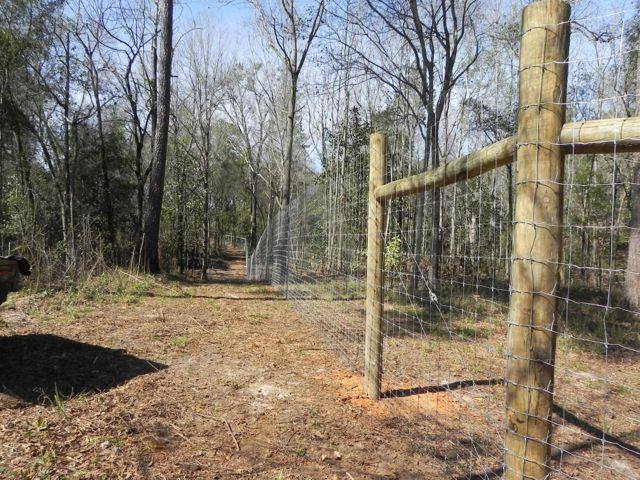
To provide privacy for the resident elephants and security for the neighbors, Elephant Aid International is constructing a double fence system for Elephant Refuge North America. 30,000 feet of 8 foot high fencing takes some time and effort to install and our crew from Topnotch Fencing is doing an amazing job!
We’re creating the next generation of sanctuary for elephants in captivity… And we couldn’t continue this incredible journey without you. Please consider donating by clicking here — every dollar helps. Thank you for your support!
Lotus stood perfectly still while her mahout removed the chain from her ankle. Next came Pang Dow and, last, Wassana, a land mine victim who lost part of her foot several years ago in an explosion.
They were unaware that their next few steps would be monumental.
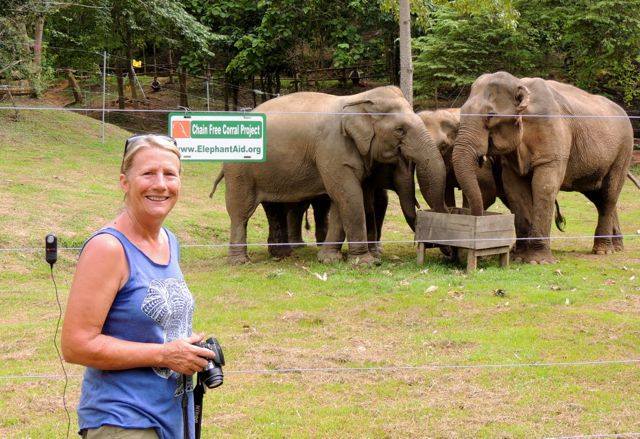
Lovely Lotus led the small herd, the family she chose after arriving at Boon Lott’s Elephant Sanctuary (BLES). She walked in the direction of the corral. For a split second she hesitated at the gate opening. A calculating glance from gate post to gate post and the open span between and she was satisfied that it was safe to lead her family inside. Almost in slow motion, Lotus entered the chain-free corral.
I held my breath, knowing from experience the joy the elephants, their caregivers and the crew that only hours before had completed this first solar powered chain-free corral in Thailand, would feel.
Pang Dow and Wassana followed close behind Lotus, less than inches apart, as they silently flowed into the expansive corral filled with vegetation and clusters of trees. The air was buzzing with anticipation. The elephants knew something was up. How could they not? Half a dozen people gave off quite a collective energy as we watched in hopeful anticipation of the elephants’ reaction to their new found freedom.
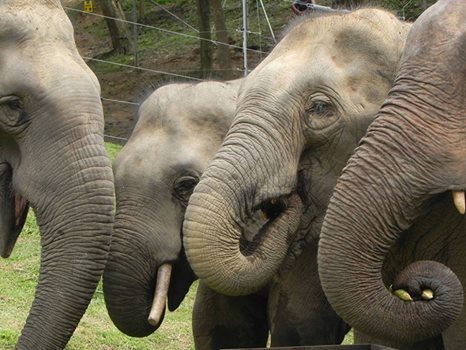
Lotus, Pang Dow and Wassana cleared the gate opening, walked single file for less than 50 feet and then erupted into excited squeaks and trumpets. They broke line and huddled together, a tangle of trunks and tails, chattering excitedly, gently touching each other in reassurance.
The mahouts stayed silent to ensure the elephants knew they were free to do as they pleased–a novel experience for a captive-held elephant, especially in countries like Thailand, where elephants are a commodity used for tourist entertainment, always under the control of a mahout.
Before finding sanctuary at BLES, Wassana, Lotus and Pang Dow did not know freedom of any kind. Now they were about to experience the next level of freedom–autonomy. The ability to make their own choices about where they walk, when and with whom. What they eat, where they sleep and, most important, who they share their life with.
It took mere seconds for all three to realize they were free to wander at will. They moved like a school of fish, close together, in step with each other, exploring as one. Happy squeaks, trumpets, chattering and ground thumps echoed across the hilly terrain.
They soon forgot the humans who observed from outside the corral. They were in their own world, with their family, free from chains, to interact and share the natural habitat together.
After sampling the tender vegetation underfoot, they made their way into a thicket of trees. With low rumbles and tender chirps they disappeared into their personal mini-sanctuary.
Each time I witness the release of an elephant from chains, I am flooded with such deep emotion and with such gratitude, it’s as if it’s the first time I’ve experienced such a joyful event.
I see their immediate shift, their letting go of the past. They accept the gift provided and without looking back immerse themselves in their new found freedom.
I know that we have given a gift so great it transforms them. Being witness to an elephant’s release is life changing, the most powerful experience I’ve ever had.
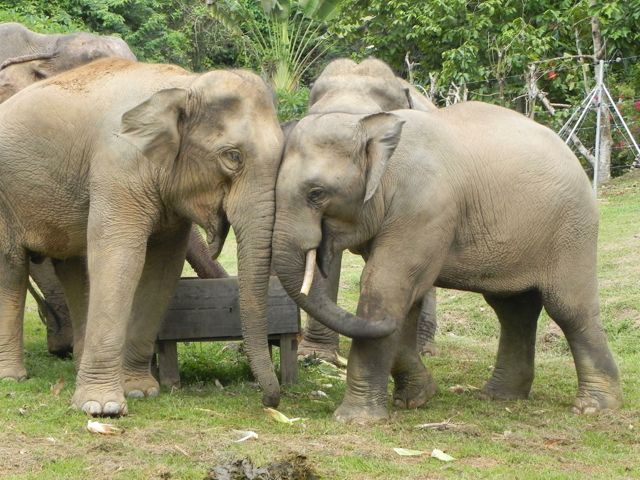
Elephants living in captivity are stripped of everything meaningful in their lives; autonomy, freedom of choice, family. Sanctuary life begins to restore some of these things. Although most captive-held elephants will never experience a real family of their own, they form bonds as deep and meaningful with unrelated others as if they were biologically related.
The pure joy an elephant exhibits when given a resemblance of freedom is what drives me to do more. Chain free does mean pain free to these elephants. It is an honor to give back some of what has been taken away.
Watch their release:
and their introduction to their new chain-free corral:
After nearly two years of preparation and numerous setbacks our chain-free corral project In Thailand is scheduled to begin July 12th.
In October 2013, I visited two sites–Friends of the Asian Elephant (FAE) and Boon Lott’s Elephant Sanctuary (BLES)–to map areas for chain-free corrals. The corral locations were identified and construction plans laid out. Everyone was excited about giving their well-cared-for elephants more autonomy and physical freedom within a safe and secure jungle environment.
This is when things became challenging.
I soon learned that Thailand did not have a supplier for the materials we use for solar powered chain-free corrals. The closest supplier was IBEX Galleger in India. All materials would have to be shipped from India via the wholesaler in New Zealand.
Stopped at the border
The plan was to build the corrals last October.
I monitored the progress of the materials shipment from my US office. The Indian fence crew would fly to Thailand to oversee the arrival of materials, while the staff at BLES stood by, ready to receive the delivery. Partners in three countries experienced a great deal of anticipatory anxiety.
As soon as the materials arrived from New Zealand, they were transported from Bengaluru, India, to the coast and loaded onto a cargo ship, which crossed the Bay of Bengal and docked in Bangkok, Thailand. They cleared customs without a hitch.
This is when we hit a major snag.
The Indian crew was supposed to receive the delivery in order to avoid a hefty unloading and storage fee.
But the crew was stopped at Thai immigration to verify their residence while in Thailand.
BLES’s phone and internet were not working so there was no way for Thai immigration to verify the crew’s destination. Emails flew back and forth among continents, to no avail. We couldn’t reach BLES.
After a couple of hours, Thai immigration refused the crew entry and sent them back to India.
Unfortunately, the project had already exceeded the estimated cost even before the materials were loaded onto the cargo ship. This latest development didn’t help. At this point, the costs threatened to skyrocket.
Everything falls into place
Thanks to this experience, the Indian crew was afraid to return to Thailand.
I set out to find qualified installers in Thailand. No luck. No one in Thailand wanted to take on the job, as they were unfamiliar with the corral system.
After weeks of searching, I decided to try to convince the Indian crew to try again. They were leery, so it took months to finally convince them. By the time they finally agreed, they were working on a new project in India, and unavailable to return to Thailand until later this year.
But here we are, several months later, heading to Thailand once again.
We don’t have to worry about the materials–they are safely stored at BLES.
Pre-construction is already underway at FAE and they are clearing the fence line as we speak. It will be cleared and ready for my arrival on July 12.
The plan is to get all the corner posts set at both FAE and BLES before the fence crew arrives on the 18th.
All we have to worry about is getting the crew into Thailand. This time I plan to be standing outside immigration at the airport with a working cell number, ready to handle any problems that might arise.
This project has been a serious challenge but I have no doubt that it will be well worth every bit of frustration and anxiety when we see the elephants released into their new chain-free corrals.
Thank you for helping us create the first solar powered chain-free corrals at Boon Lott’s Elephant Sanctuary and Friends of the Elephant Hospital in Thailand.
Elephant’s World posted two videos on YouTube last week of me training a young elephant named Jon (you can view them here and here). I was surprised to see the videos and happy to know they exist.
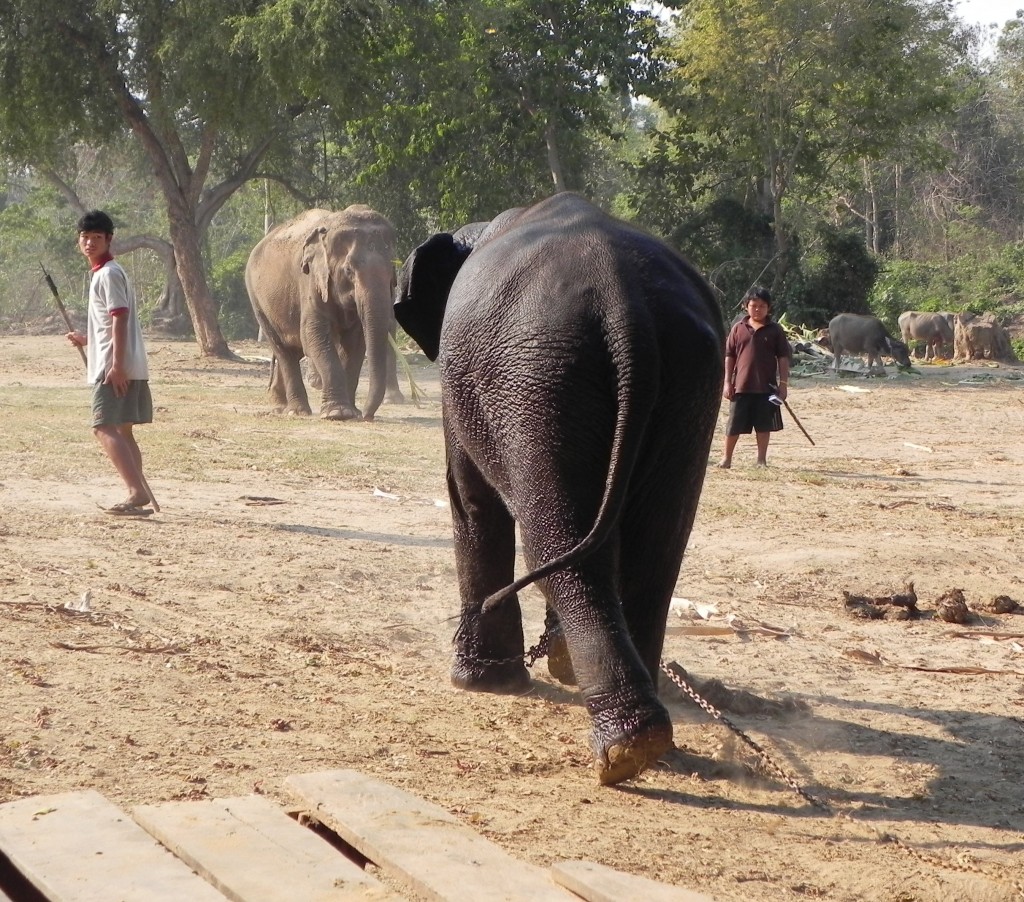
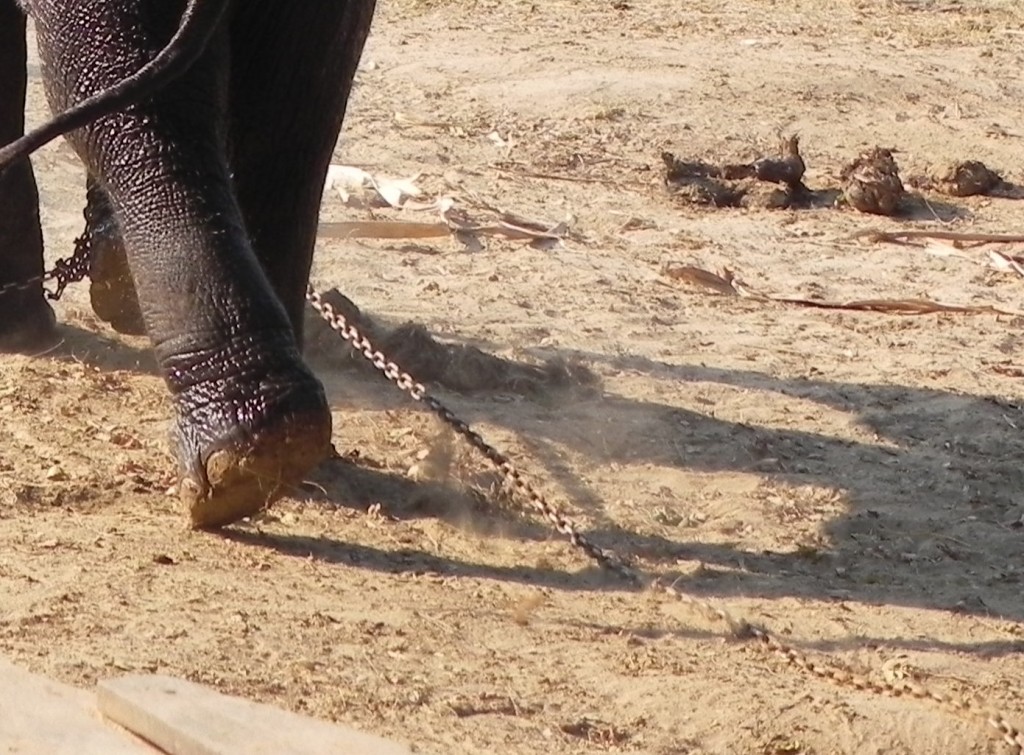
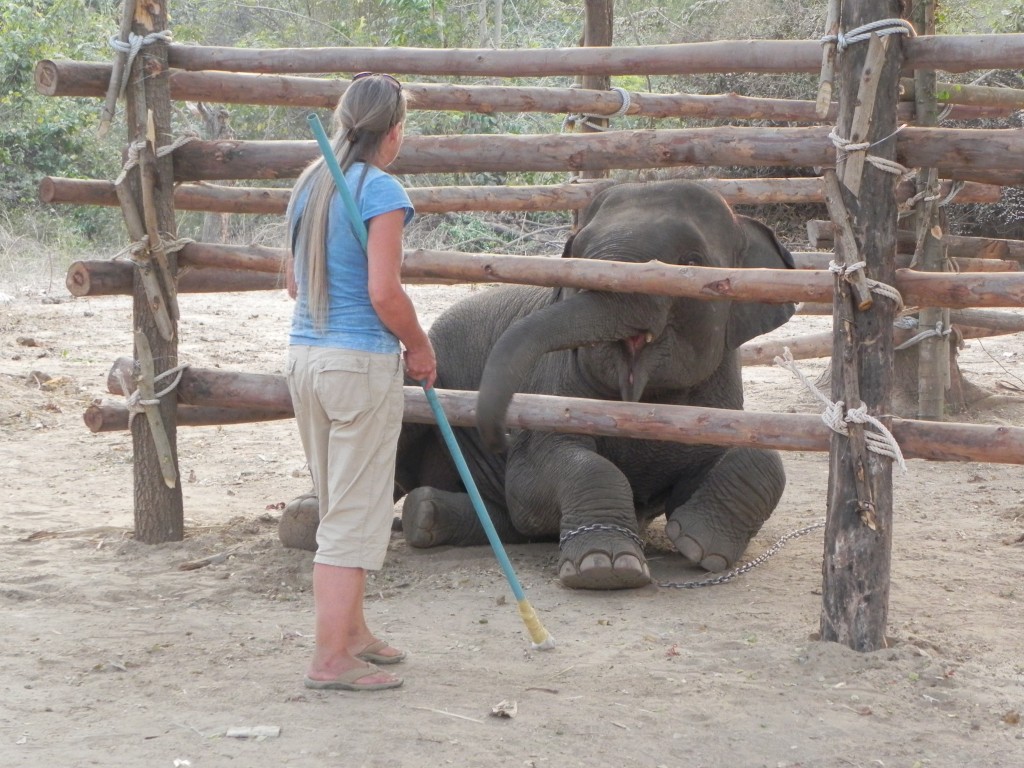
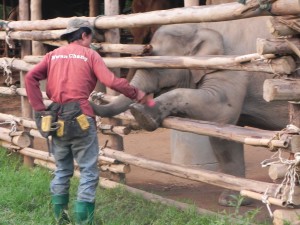
Many people found the videos interesting and some have asked why Jon is wearing a chain. The chain is called a drag chain; in Asia it is used to prevent an elephant from running away. One end of the long chain is fastened around an elephant’s wrist and the other end drags behind.
When a mahout is afraid that his elephant will run away, he puts a drag chain on him. If the elephant runs, the mahout wraps the loose end of the chain around a tree to stop him.
The mahouts at Elephant’s World were resistant to non-dominance training and even more resistant to removing Jon’s drag chain. In order to be allowed to demonstrate positive reinforcement target training, I agreed to the drag chain for the first two sessions. One end of the chain was on Jon’s ankle and the other end was loose.
My adherence to their tradition gave the mahouts time to get comfortable with the new training method I offered. They observed firsthand that Jon was more interested in the training game than in trying to get away.
Jon showed such promise that after the second training session the mahouts agreed to remove the chain.
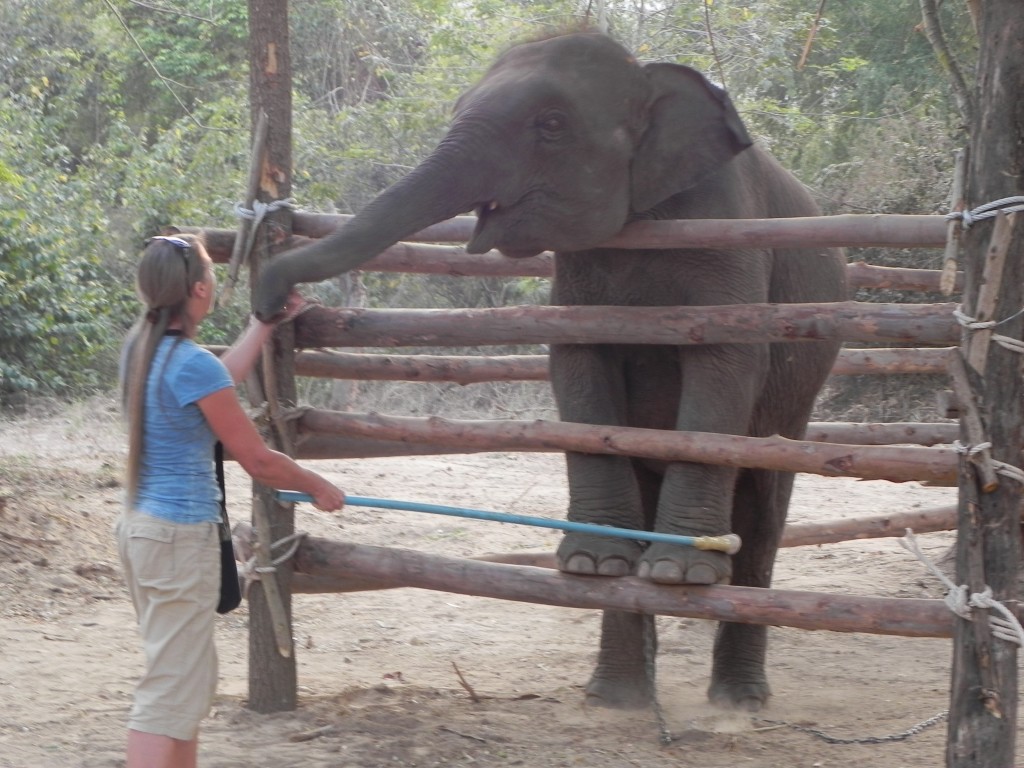
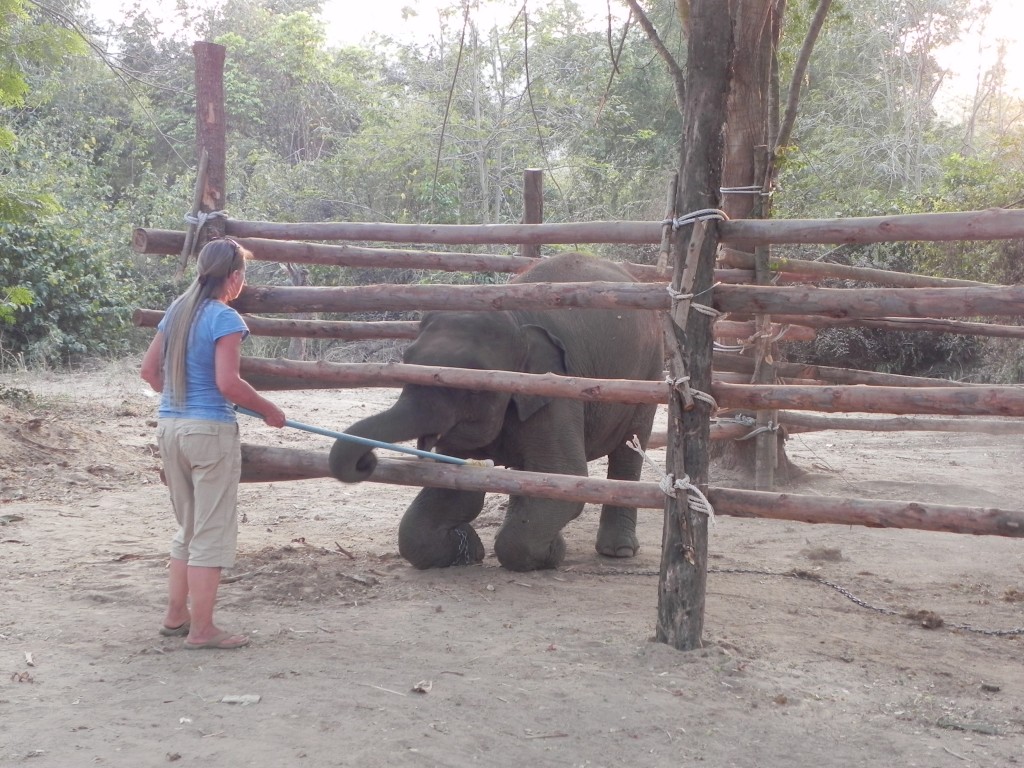
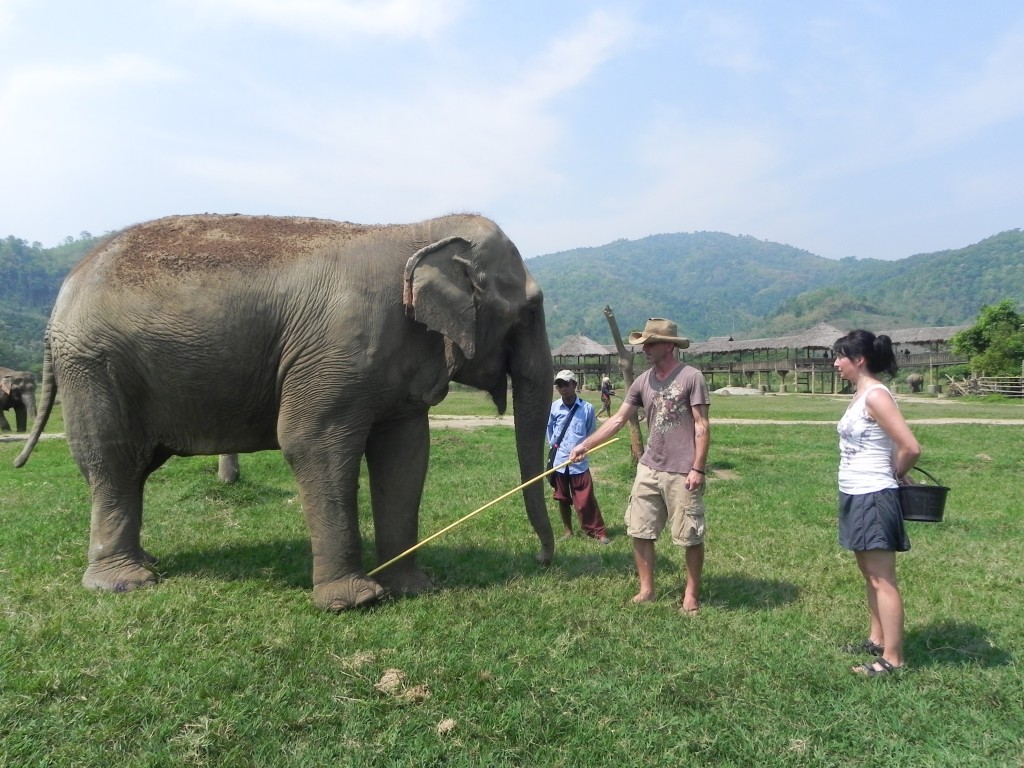
There have also been questions about the “stick” used during training. The stick, or target as it is called, is a flexible pole with a soft cushion on the end. Watch my training tutorial to see how the target is used and learn the basic concept of target training.
The goal is to teach an elephant the name/word for different body parts, such as foot, head, ear, side, etc. Once understood—which takes most elephants only minutes to grasp—the elephant will voluntarily offer that body part when asked. The key is to ask, not demand, and always provide praise and a treat as a reward.
Before watching the videos of Jon’s training sessions, I suggest that you view the tutorial a couple of times. Then watch Jon’s first training session and see if you can identify what body parts Jon is learning. Notice that when Jon becomes frustrated he walks away, but returns almost immediately to try again.
Positive Reinforcement Target Training gives the elephant the freedom to walk away, take a moment to reflect on what is happening and return when he is ready to try again. Walking away reduces frustration and increases the elephant’s willingness to participate.
You will also notice in the video that Jon offers behaviors–kneel and lie down. This is common in initial training sessions. Many times the elephant will offer what s/he already knows before starting to “problem solve” and figure out what the trainer is trying to teach.
Learning to think for themselves is the first thing the elephants learn. After that, training is a breeze.
Last year I had the honor of working with a young, energetic elephant named Jon. He was a recent rescue, living at Elephant’s World, a Thai-run facility outside of Bangkok.
To my surprise, two videos of Jon’s first training sessions showed up on YouTube (here and here). I was unaware that the videos even existed.
Watching Jon brought back a flood of memories: his intelligence, how he dealt with his initial distrust and confusion and how well he masked his fear. His energy was explosive and outdone only by his genius.
I can’t help but smile remembering his antics and eagerness to understand this new “game” — and his determination to prove that he could do anything!
Elephant’s World was one of the locations where I was fortunate to introduce positive reinforcement target training. I will return there to continue training, and to consult on facility development and elephant training and care.
During my last visit, Elephant’s World owner agreed to the idea of constructing a large fenced-in area so the elephants can be kept off chains. Fundraising is underway and hopefully by the time I return to Thailand in the fall, the fence will be in place.
Ngo-Hok, aka Jon, the young male elephant with whom I worked, has a history of aggression. Personally, I believe he was emotionally scarred by the traditional brutal training he received prior to coming to Elephant’s World. From the first session he responded enthusiastically to positive reinforcement target training. I was at Elephant’s World for only about a week, but during that time Ngo-Hok/Jon excelled at demonstrating to the mahouts that he can learn and will respond favorably, at least to this technique of training.
Unfortunately, the language barrier was a challenge. The mahouts tried to understand what I was telling them but they simply could not. Even though Ngo-Hok/Jon was brilliant during his target training sessions, the mahouts failed to continue the training after I left.
The staff needs further training to grasp the concept and develop the technique of this training which is so foreign to them. I look forward to returning to Elephant’s World to continue the training. This time I will recruit a translator, which is the only way to ensure that the mahouts understand the philosophy and learn the technique.
Following is an interview that an Elephant’s World volunteer did with Piza, Ngo-Hok/Jon’s mahout. The volunteer posed the questions as if I had asked them.
Q: How is Ngo-Hok/Jon doing?
A: He is doing better since the last time you saw him. Sometimes he is stubborn, and then I cannot climb on this back. He is more often around the other elephants, during swimming and eating, but I have to stay close to him because he is playful and annoys the older female.
He is now very close with Rom Sai, the full-grown tusker, like a father and son. He has escaped a couple of times in the last months but he comes back to stay with Rom Sai. When eating together, he likes to take food from the other elephants. Only Rom Sai will allow this. I believe the other elephants will hit him if I am not there.
Last evening I didn’t take him to the forest because he did not let me get on his back earlier in the day — he was stubborn. In this way I am trying to teach him. Also, after he is stubborn he will try to escape when I take him out of the forest. I am trying to teach him that if he obeys and allows me on his back, he will be rewarded with a trip to the forest.
Ngo-Hok/Jon is growing; he is now taller than me. In one month he has gained about 10 kgs. He now weighs close to 800 kgs and eats about 80 kgs a day.
Q: Do you think Ngo-Hok/Jon can stay with the other elephants?
A: He can stay with other elephants. He can stay close to Rom Sai, who will protect him. For now he can stay with the females as well because they are older women and he is still young. But as he gets older and new female elephants come in, it will be a problem.
Q: How do you feel around Ngo-Hok/Jon since he tried to hurt you?
A: I feel better around him now, but have to be careful all the time. After the accident I was a little bit afraid, but not anymore. When I am with him anyone can come close, but if I am not there, people cannot come close. If I have one day off, Jon is put on hobbles because the other mahouts cannot deal with him. Right now Ngo-Hok/Jon only listens to me.
Q: Is there anything else you’d like to tell Carol?
A: I think she should come again and see Ngo-Hok/Jon for herself.
My return flight to Los Angeles leaves from Bangkok, which was the perfect excuse to go back to Elephant Nature Park one more time to see the progress made by Chang Yim and Karl.
Yim never ceases to impress me. He has made yet another transition from Karl to his new mahout, Lai. Karl has worked diligently over the past many weeks training Lai, and Yim has been a real trouper. There is no doubt in my mind that Chang Yim will miss the special relationship between him and Karl, but Yim has a bigger mission. He has the opportunity to teach a “traditional” mahout a different way, a more humane and gentler way to manage him and his family members. This move from Karl to Lai is actually quite monumental in the big picture…Yim is the catalyst for change. I am so proud to know him.
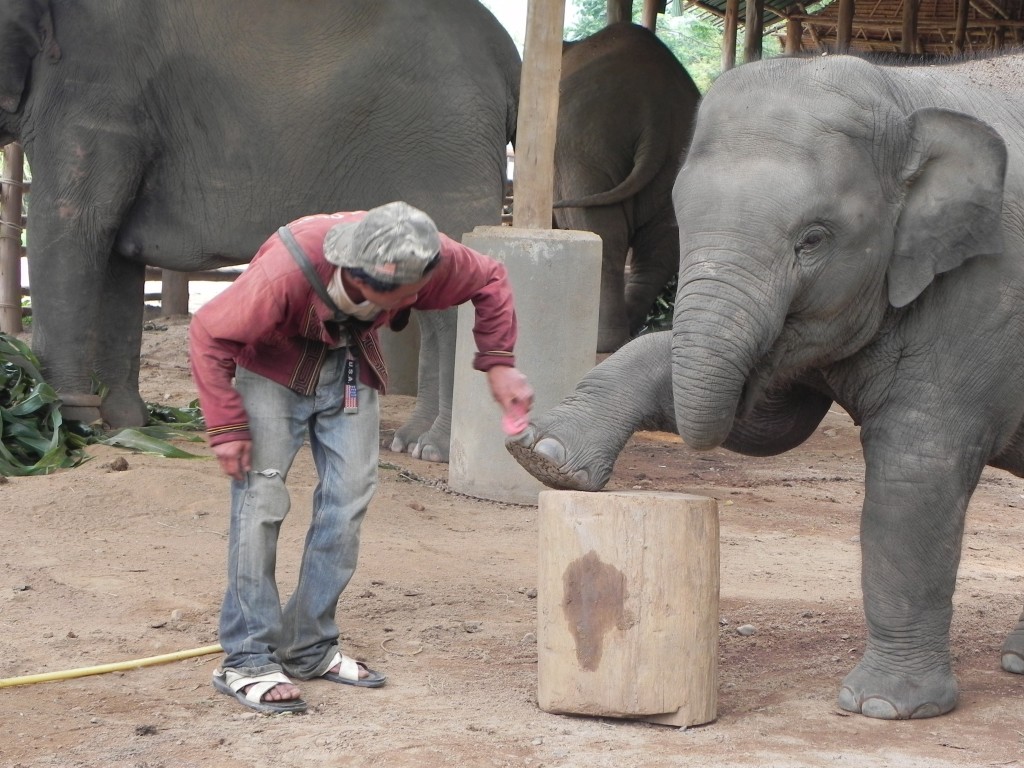
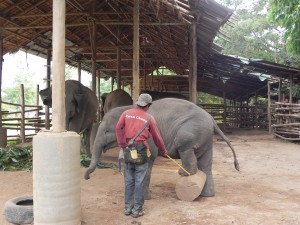
In addition to satisfying my curiosity about Yim’s progress, my return to ENP was to give Karl some pointers on training the elephants to place their leg on the trimming stool recently built for back foot trims. Once the elephants are trained, I will be able to return and finish the foot care clinic I started.
Mae Tee and Mae Kham Geao were our first students. The initial hurdle was getting the ladies to start thinking for themselves, no easy task for elephants who for decades had been conditioned not to think. The training was slow and at times appeared to be at a standstill, but, I could see the wheels slowly beginning to turn in their heads. Patience was the key.
After two days, my time at the park was up. Karl was well on his way to conditioning Mae Tee and Mae Kham Geao to voluntarily lift their back legs, a requirement in order to slide a trimming stood underneath for support. I felt torn leaving—I always do—but I had confidence that Karl would do just fine.
Today, a little before four, I received a call from Karl. At first I was apprehensive because Faa Mai is experiencing some unidentified health issue. But the news was all good: Faa Mai seems a little better. But the reason Karl had called was not to update me on Faa Mai, it was to tell me that Mae Tee and Mae Kham Geao got it! They were lifting their back legs off the ground and suspending them in the air when asked. The both of them!
What do you bet they talked about it over the past two days? It comes as no surprise that both ladies, dear friends who spend all their time together, figured out what Karl wanted in the same training session. Karl was so pleased, and WOW — what can I say. I am so proud of everyone involved in this work: Karl, Dam (the Maes’ mahout), Jody and Sophie (treat givers) and especially Maes Tee and Kham Geao, the ladies of the hour. I sure wish I could have been there to share in the cheers and congratulations showered on the ladies, but I was there in spirit. Planting the seed and seeing it grow, one World, one elephant at a time — in this case, two elephants at a time!