Blog

  • Last Day of the Health Camp

    Last Day of the Health Camp

    Close to 50 elephants participated in Dr. Mikota’s elephant health camp. Today was the final day, at least for the elephant examinations. Over the next several days samples will continue to be processed, with results reported to the owners of the elephants.

    This is precedent-setting work. The owners voluntarily participated — enthusiastically, in fact. Today one of the proud owners provided information about his recently acquired elephant, complete with physical and behavioral information.

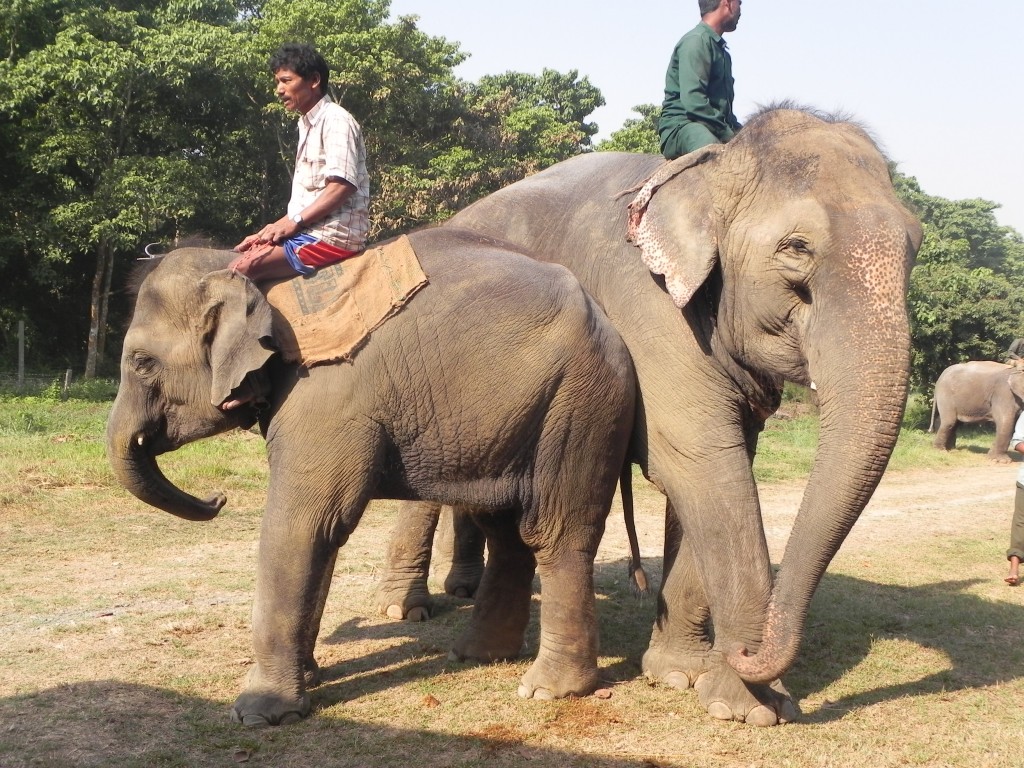
    When one of the elephants became nervous about the exam, another mahout mounted on a young elephant  brought his elephant close to “her friend” with favorable results. The nervous elephant immediately settled down. The younger elephant touched her friend around her mouth and stomach in an obviously reassuring way. Their display of  friendship was tender and the mahout’s sensitivity was refreshing.
    Our work is not done. While samples are being processed, records made and treatments prescribed, Dr. Mikota will pursue other community-related projects that will enhance elephant welfare while benefiting the community. As soon as these projects get the official go-ahead I will report on them. They are all very exciting.

    Sauraha is a close knit community. Even though tourism is the backbone of their financial support, the daily activity of earning a living and caring for their families is the activity that is observed each day, from dawn until dusk.

    These are a happy people. Their connection to mother earth is the common thread that ties them together. Busy building new homes, resorts, replenishing dirt for planting, tending to the rice paddies, planting young plants that will later feed their family and tending to their animals is what occupies their daylight hours. The heat and absence of air conditioning brings them out onto rustic porches and stoops bordering the earthen roads after dusk. Children chase each other through the darkness while dogs cavort freely, homeless or not. The heat is forever present but a lightness fills the air. You are one with the community with a simple but genuine head nod and namaste, which brings a beaming smile to a previously serious face. All is one; all is well with the world.

  • Elephant Care International’s Sauraha Elephant Health Camp

    Elephant Care International’s Sauraha Elephant Health Camp

    April 21

    Elephant Care International’s Sauraha Elephant Health Camp has been a well-received service for privately owned elephants living outside Chitwan National Park. ECI’s efforts to gain the trust of the thirty-something private owners, who collectively own nearly 50 elephants, has proven successful. The owners are all participating in this health camp, a testament to ECI’s efforts.

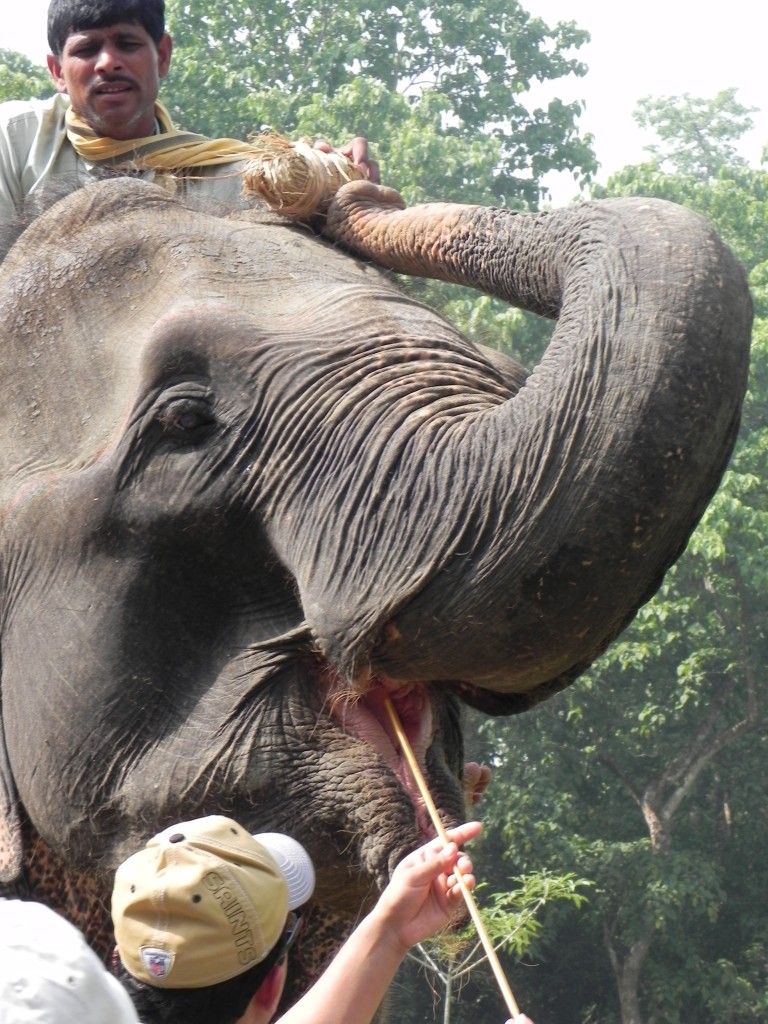
    On this second day of the camp, seven elephants showed up for examination. How fortunate I am to be involved. The veterinarians, technicians, mahouts and elephants flowed together in a synchronized dance, collecting throat cultures, nasal drip, blood, urine and fecal samples, body temperature, respiration and pulse. Translators helped bridge the language gap, making the process more efficient.

    The elephants, all Kali (female) so far, have responded to the camp individually, and collectively have demonstrated receptivity to the experience. The reality is that most, if not all, of these girls have never before walked onto a portable scale nor provided the many samples requested of them. They have all responded incredibly well.


    It did not take long for the mahouts to understand that the ECI team prefers that they practice patience with their elephants. For some, the concept of a gentler approach had never been considered but they responded favorably.

    Not surprisingly, the mahouts demonstrated a capacity for innovation when met with the challenge of collecting samples. Some of the younger mahouts responded to sample collection requests with wide eyes and a noncommittal head tilt accompanied by a somewhat nervous giggle.

    The more seasoned mahouts listened intently to the translated directions, then immediately set out to accomplish the task. It soon became evident that the more advanced mahouts reveled in flaunting their superior skills. The resulting competition between mahouts proved beneficial. Overall, the elephants are in good shape. None are overweight. The ankus is not used to pull and push the elephant so hook wounds are not an issue.

    Getting a throat culture with an extra-long Q-tip

    Living on natural substrate and in an appropriate climate has benefited the elephants greatly. Improving the standard of living for these and other elephants in captivity begins with education and improved health care. The elephants of Sauraha, their owners and mahouts have embarked on a journey destined to change their lives for the better. I am so thankful to be a part of the process.

  • The Flow of Life

    April 20

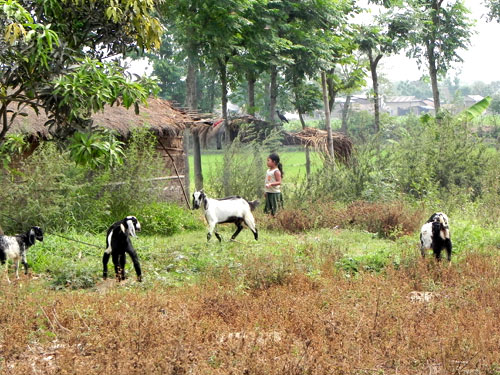
    Activity begins early in Sauraha, not surprising since as the day unfolds the temperature rises to a sweltering level. At sunrise the air has a refreshing coolness about it. The community comes to life as goats and water buffalo are taken from their night quarters to grazing areas. Upside down handmade woven baskets are righted, allowing the contents — live chickens — free access to hunt and peck at their leisure.

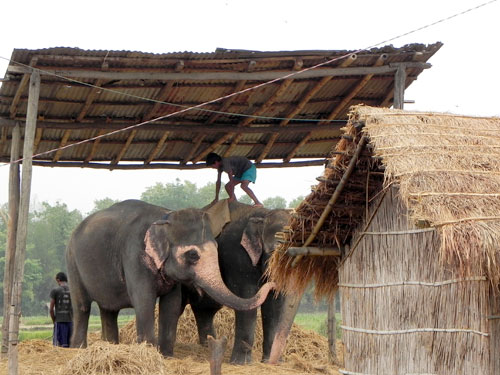
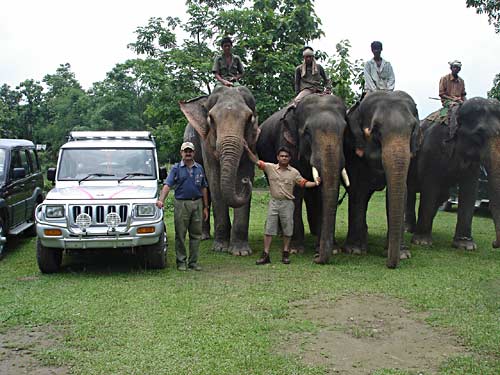
    The NTNC elephants silently head out of their personal stables, mahout on board, to collect the following day’s supply of fresh-cut elephant grass. The privately owned elephants adhere to a different routine and a different diet. Not permitted inside the national park, the privately owned elephants eat grass that is cut seasonally in bulk and stacked, forming a hut-type structure next to their mahout’s house. This grass is stored for months at a time, much like the baled hay fed to elephants in zoos and circuses worldwide.

    By contrast, elephants owned by the government and NTNC, a NGO (nongovernmental organization) have access to the forest areas, where grass is plentiful. They collect their own fresh-cut grass daily. This activity has many benefits, including that the elephants eat high-quality good-tasting fodder and spend hours engaging with their natural habitat.

    Life in captivity is restrictive but access to home range forests brings these elephants closer to their roots and provides them with an opportunity to walk, forage and bathe in the environment they are adapted to. If elephants are to be maintained in captivity, keeping them in range countries definitely has benefits.

  • Elephants Everywhere

    Elephants Everywhere

    April 18

    The town of Sauraha borders on Chitwan National Park and is a world away from Kathmandu. What an inspiring place. Exotic bird vocalizations fill what otherwise would be a serene silence. Every manner of chirp, caw, twitter and call creates an exhilarating backdrop for this pleasant forest atmosphere.

    The people and the local dogs are refreshingly friendly!  The traditional namaste greeting, hands clasped together at chest level accompanied by a polite head bow, encourages interaction, bridging an otherwise seemingly insurmountable gap caused by the language barrier.  But with this bow and respectful greeting, cultures merge and friendships are born. For the veteran members of the ECI team, friendships with the locals are rekindled and strengthened; everyone is extremely happy to see the foreign vet team back in Sauraha.

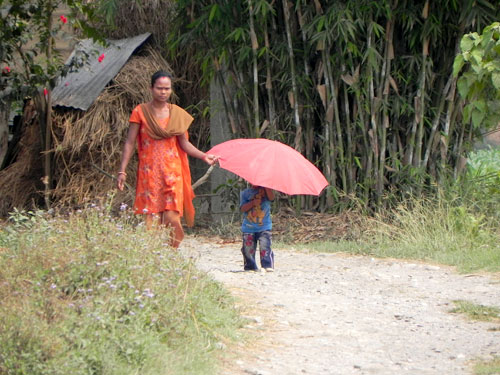
    The short walk from our lodging into town is rich with color and contrast.  Beautifully clad women, parasol in hand, gracefully walking down dirt roads flanked by tethered buffalo, foraging goats, a scattering of chickens and elephants. It is surreal; in less than a half-mile stretch of road, nine elephant stables dot the landscape. These elephants, used for tourist safaris, appear no more out of place here than the family dog in the backyards of suburban America.

    Today was a day for silent observation as each turn in the rugged road brought another stable and tethered elephant into view.  In their mini-environments, elephants stand under a covered stable with a water source to one side, the mahouts residence directly in front and a trough for disposing dung directly behind. Under foot is an ample supply of fresh-cut “elephant grass.” The elephants appeared calm and relatively uninterested in passers-by, even though most are only a few feet off of the road. Once I get over the culture shock of seeing elephants literally around every corner I will concentrate on getting to know each elephant and their history, and of course I will share that information with you.

  • Meeting Pawan Kali

    Meeting Pawan Kali

    April 16

    As I sit here composing my blog update the electricity has gone off, resulting in the steady hum of backup generators adding to the pulse of the city.  A thin stream of smoke gracefully dances skyward from the mosquito coil in the middle of my room. After hesitating at the door frame, a small furry rodent scurried across the open doorway as two geckos cling to the ceiling directly overhead. They are as still as silence, imitating a wall painting…they are so cute!

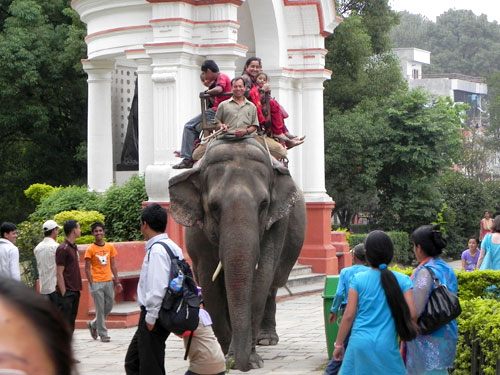
    Today’s activities included meetings at the National Trust for Nature Conservation (NTNC) and the Central Zoo.  Dr. Susan Mikota has developed quite a reputation here in Nepal; she is held in high esteem. While at the zoo we were given a tour, met some of the zoo staff and, from a respectable distance, met Pawan (paw-wan) Kali, the pride of the zoo.

    Pawan Kali is believed to be in her 60s. She is stately and beautiful, an impressive Kali (female) elephant who stands close to 11 feet tall.  I was told that Tuesdays are recognized by the zoo as the day to honor Ganesh.  On this day, Pawan Kali and local residents are treated to a well received tradition: the zoo provides special food that the public can hand feed to Pawan Kali. We were not witness to this weekly ritual but there is no doubt that both Pawan Kali and the local residents enjoy the special activity.

    During my conversation with Dr. Jeewan (g-wan) Thapa, the zoo’s veterinarian, I learned that plans are being considered to retire Pawan Kali to the National Trust Nature Conservancy stable at Chitwan National Park. Not having visited the facility yet I can’t say what this change would mean for Pawan Kali, who has lived at the zoo for nearly 35 years.  I questioned Jeewan about how Pawan Kali might respond to the move and he responded confidently that she would have no problem. Interestingly enough, Pawan Kali lived at the NTNC prior to moving to the zoo. It is unclear if she would be reunited with any of her former herd members but wouldn’t that be exciting if her return meant a reunion. Just the fact that Pawan Kali will once again live with elephants after being alone for so long is a very exciting prospect.

  • A Rooftop View

    A Rooftop View

    April 15

    Today members of Dr. Susan Mikota’s  Elephant Care International team met with representatives from  the Center for Molecular Dynamics – Nepal to discuss their collaborative work on elephant DNA. This is seriously promising work that will provide yet another diagnosis tool for elephant diseases. The full extent of the application of this study is yet to be realized but without a doubt this is important work for captive elephant welfare.

    The rooftop view from the CMDN lab was staggeringly impressive, equal only to the depth of brilliance, enthusiasm and dedication exhibited by CMDN’s International Director Dibesh(Da-besh) Karmacharya and Country Director Sameer (Sue-mar) Dixit.  Although full underwriting has yet to be secured for the current DNA project, the benefits of this research will be immeasurable.  As evidence of their dedication to elephant welfare, CMDN has agreed to move forward on the project, which involves hours of lab work, processing hundreds of samples collected by Dr. Mikota’s team.

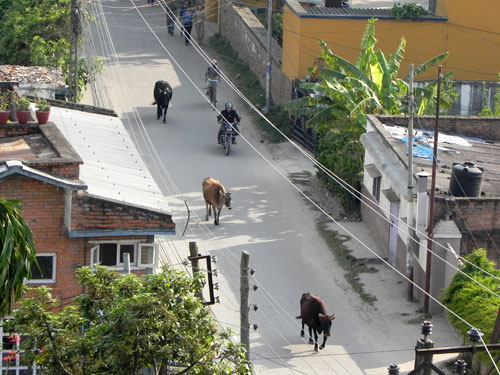
    From my perch on the roof top a scene familiar to city dwellers caught my eye. Down below, casually ambling along a busy city street, were several cows, a sacred and revered animal in Nepal. While cars and motorcycles gave the animals a wide berth to ensure their safety, the cows meandered along, seemingly undisturbed by the hustle and bustle of the city—their destination known to only them.

  • I’ve Arrived

    I’ve Arrived

    April 14, 2010

    I have arrived!  Surprise, today is Nepal’s New Year’s Day! Not a coincidence I am sure. The flight was easy; I spent most of it sleeping.  Upon arrival, I was pleasantly surprised by the low noise level and lack of high energy activity that is standard at most airports; the energy was peaceful.

    I scanned the crowd of waiting drivers displaying handmade signs with names scribbled in different styles and sizes looking for my name, when from the crowd emerged a young man. Between his hands he was holding a sign bearing my name and he wore a huge smile as he questioned, “Carol Buckley?”  A surge of joy ran through me as I returned the smile. I had arrived!

    It was a short drive to Thamel through crowded streets, and I mean crowded, with cars, pedestrians, buses, motor bikes and rickshaws crisscrossing over every inch of the narrow road. Surprisingly the congestion was stimulating and I was thankful that the air quality was not what I expected; it was not at all offensive. Colors blurred as we sped past every size and shape shop that lined the narrow pothole riddled streets.

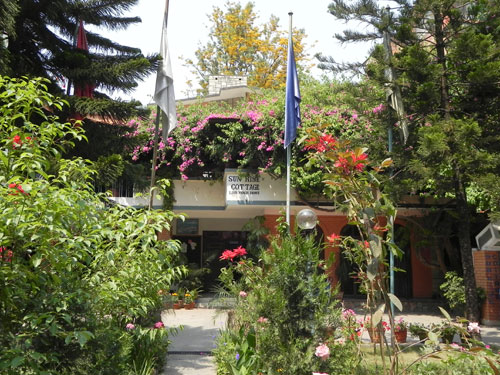
    The main road leading to my lodging, The Sun Rise Cottage, billed as “like your home,” was blocked in preparation for the New Year’s Day celebration. Color was bursting out everywhere — flowers, lights, fabrics…and music. What a fabulous welcome!

    And how wonderful that the standard greeting is namaste. I feel like I have really arrived home.

    Namaste,

    Carol

  • Anticipation

    My adventure begins when the plane touches down in Kathmandu, Nepal, on April 14. I will spend the first few days familiarizing myself with my new surroundings, the society and the people.  Kathmandu will be my initial introduction to Nepal’s elephant culture.

    It is my good fortune to be joining a highly skilled and seriously motivated veterinary team. Meetings are scheduled with NGOs and government officials in order for the team to be brought up-to-date on several projects.  As a new member of the team, I will focus on absorbing as much information as is humanly possible.  After less than a week in Kathmandu, we will travel southeast to Chitwan, to administer veterinary care to tens of elephants over the next several weeks.

    Elephants have been my focus and the driving force in my life since I was 20 years old. Although travel has always been my second love, my work at the Sanctuary has kept me virtually home-bound.  I have no regrets, only gratitude for the years spent providing a safe haven for elephants. The Sanctuary is the manifestation of my dream; a significant component of my life’s work. Without question, I will always cherish the memories and relationships that I have developed with all my Girls.  As my future unfolds I realize that I have found a way to combine my two true loves by traveling to assist elephants.

    It is hard to contain my excitement at the prospect of being of assistance to so many elephants.

    Carol

  • Elephant Aid International

    Elephant Aid International

    These elephants benefit from the mobile health care program I established over five years ago.

    Welcome to my new blog! I am so excited to share this great news with you. Never one to stand around and watch the grass grow, I decided to create a new nonprofit organization called

    Elephant Aid International.

    I guess that makes all of you ELEAIDS.

    The mission of Elephant Aid International is to assist elephants worldwide…one elephant at a time. I believe in the power of one, that every elephant counts. On my travels I will be searching for opportunities to learn about elephant and mahout life in Nepal, India and Thailand. Whenever and wherever possible, I hope to impart what elephants have taught me about non-dominance passive-control management and the sanctuary life style.

    It is my good fortune to be invited by elephant experts to participate in field work, elephant medical care and even brainstorming with other like-minds for the creation of elephant sanctuaries in Nepal and India. I am focusing on the future, thankful for this opportunity to be of service on a much grander scale.  This trip is humbling, a fabulous opportunity to further my studies of this magnificent species and a chance to give back.

    Imagine the prospect of sharing what I have learned from our girls to benefit their relatives, in their homeland. It is more than I ever dreamed possible. Talk about coming full circle and paying it forward.

    I can’t wait to see what the future holds. My flight to Kathmandu leaves April 12. After a pit stop in Bangkok I join up with a team of veterinarians and technicians for the first leg of my trip. I will blog as often as possible to include you in the adventure and, of course, introduce you to each and every elephant I am blessed to meet along the way. The future is indeed BRIGHT.

    Namaste,

    Carol