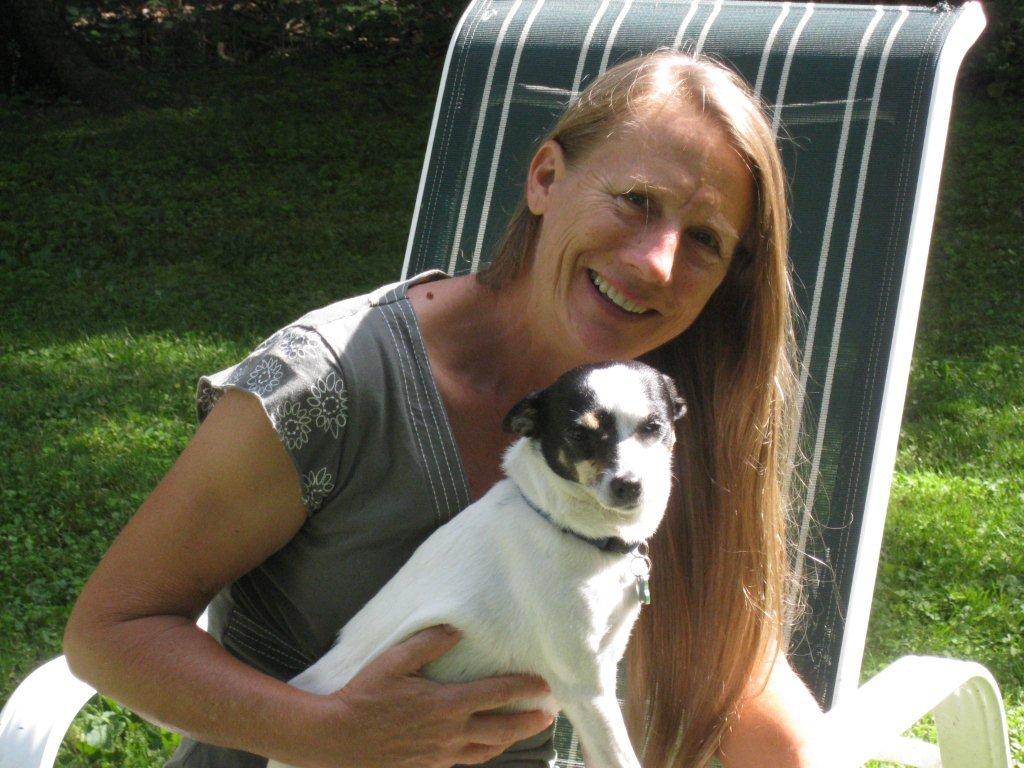
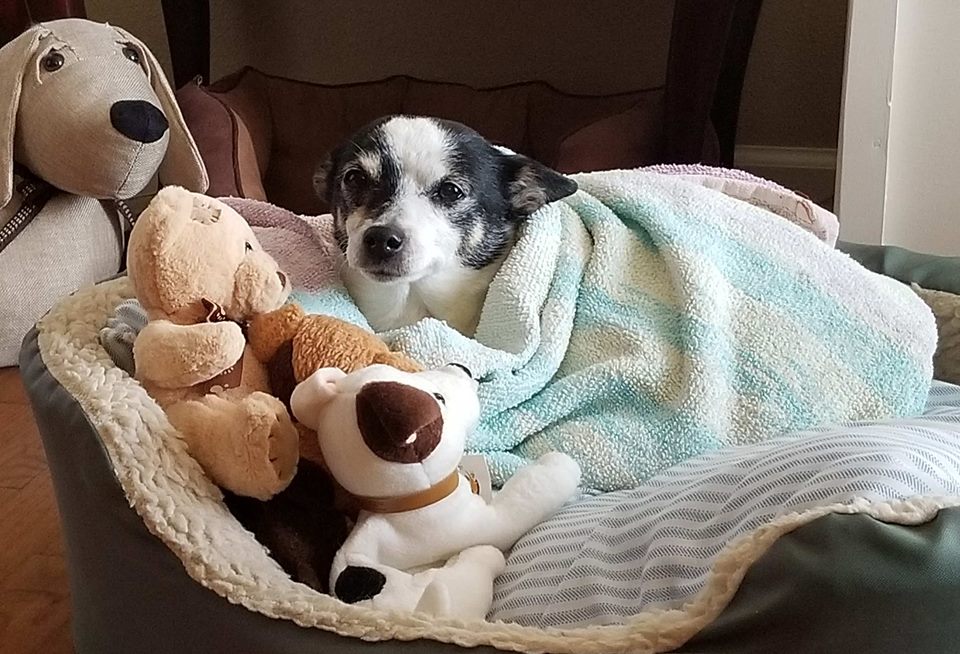
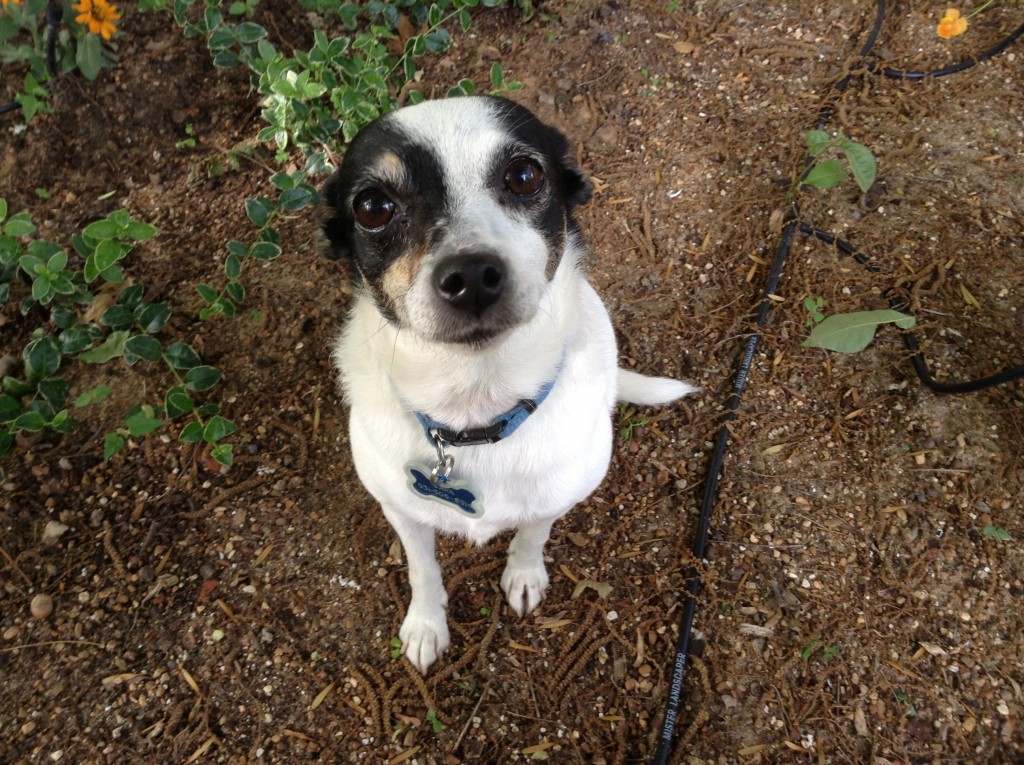
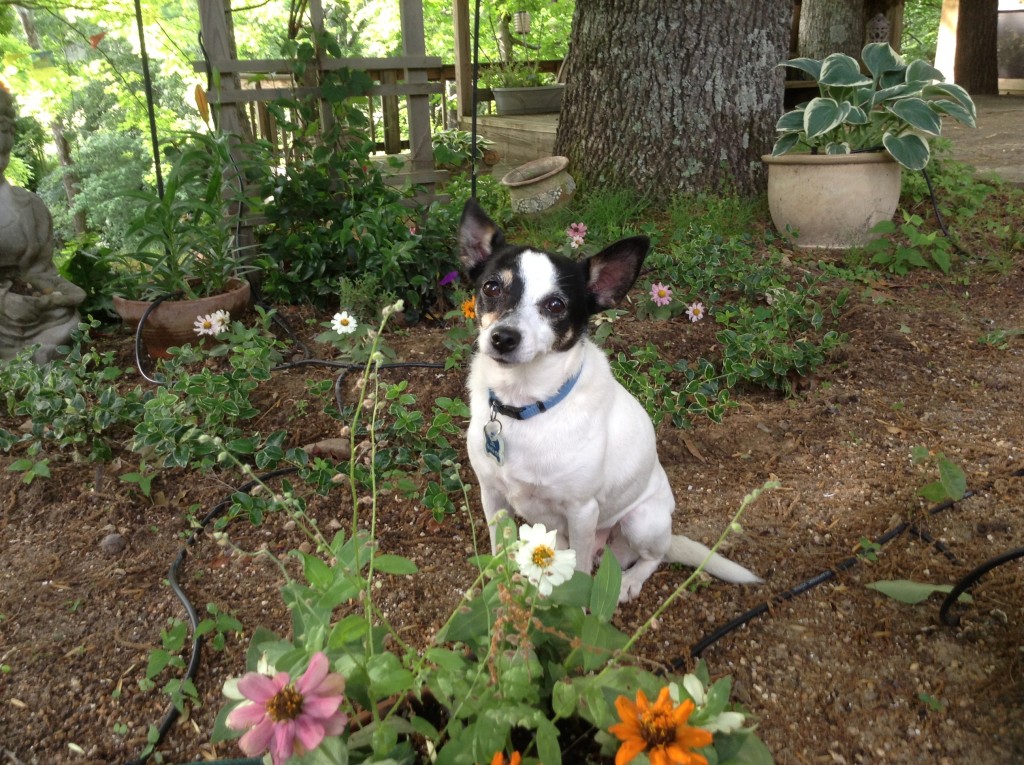
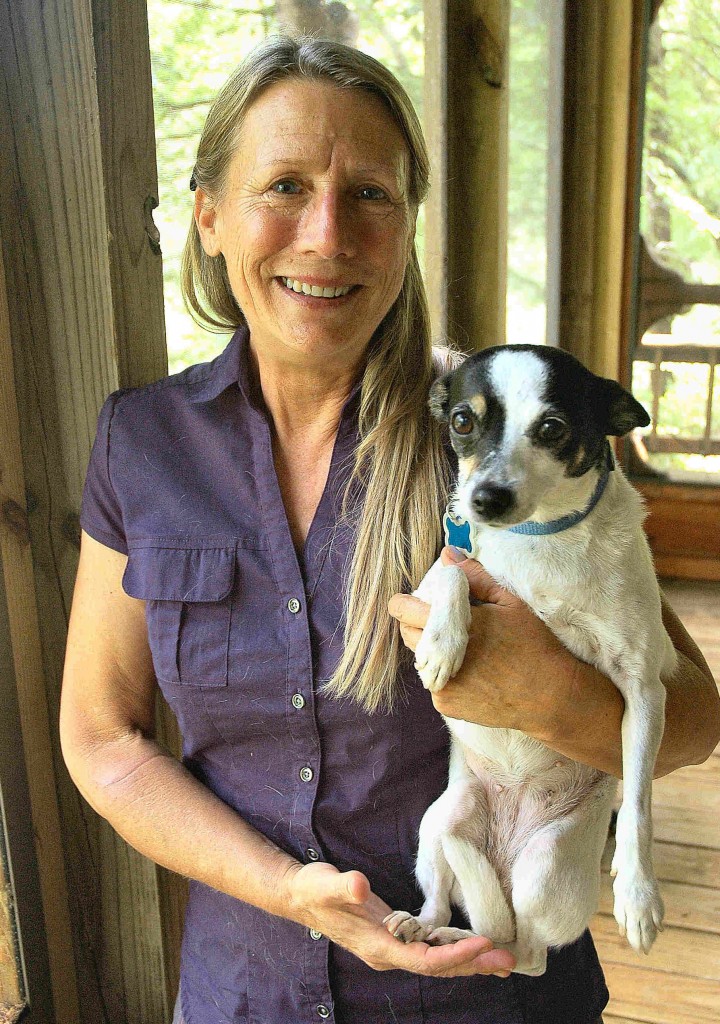
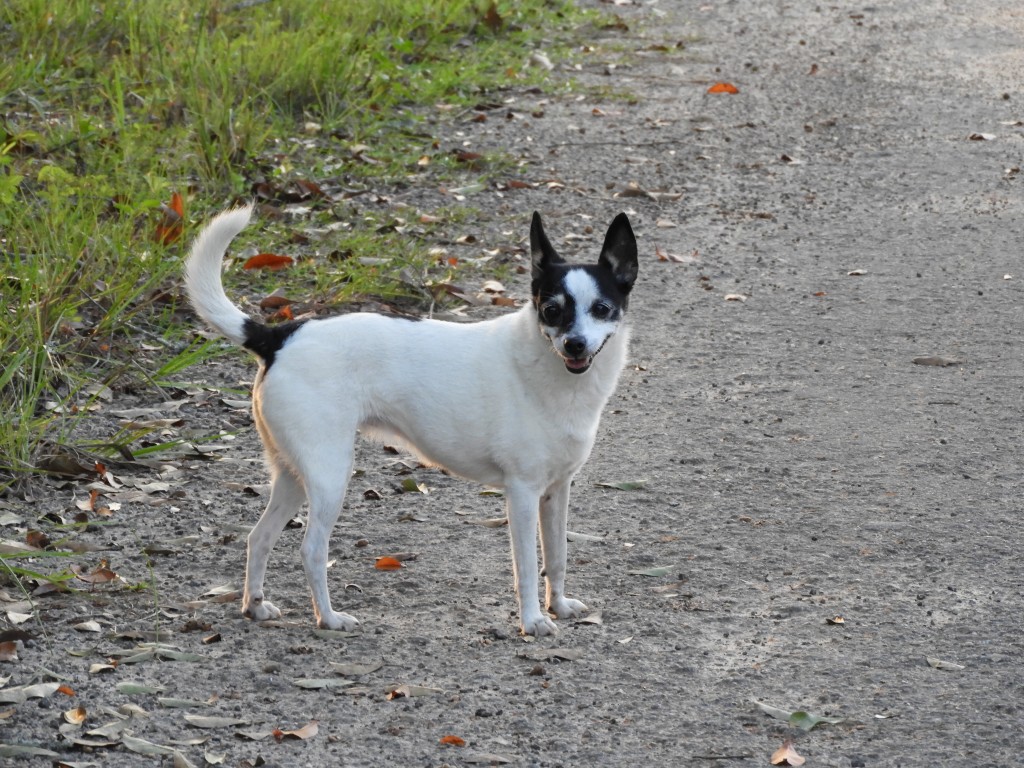
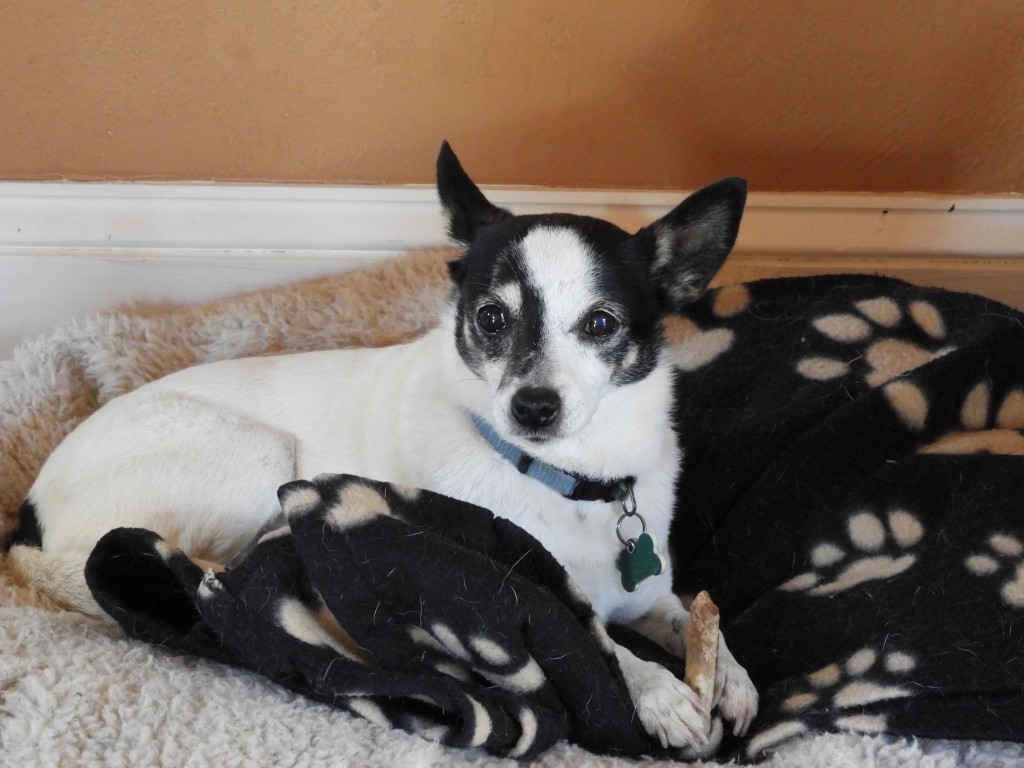
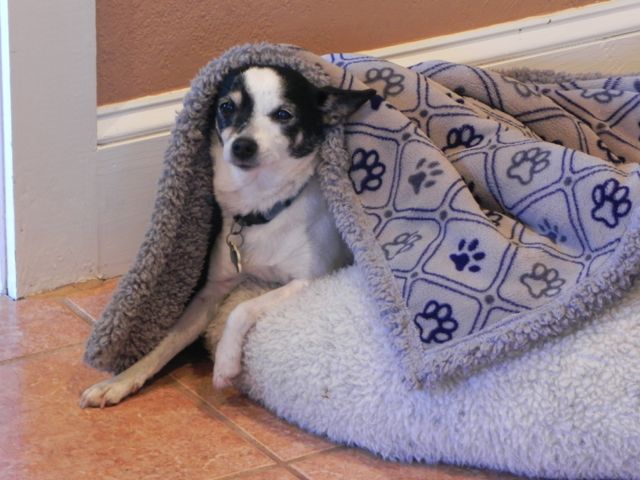
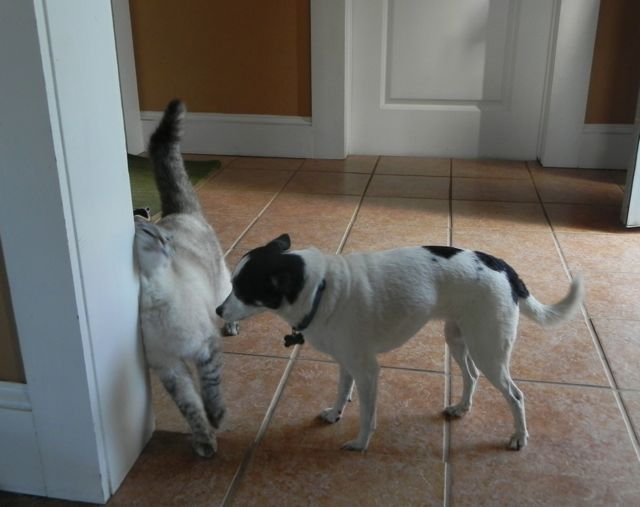
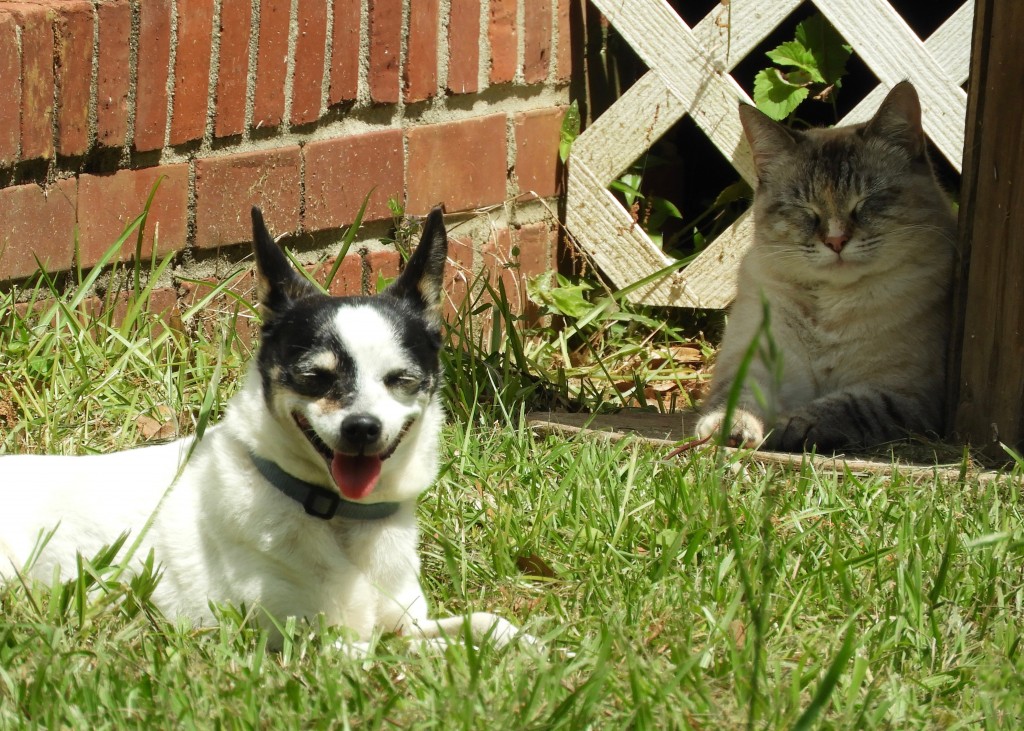
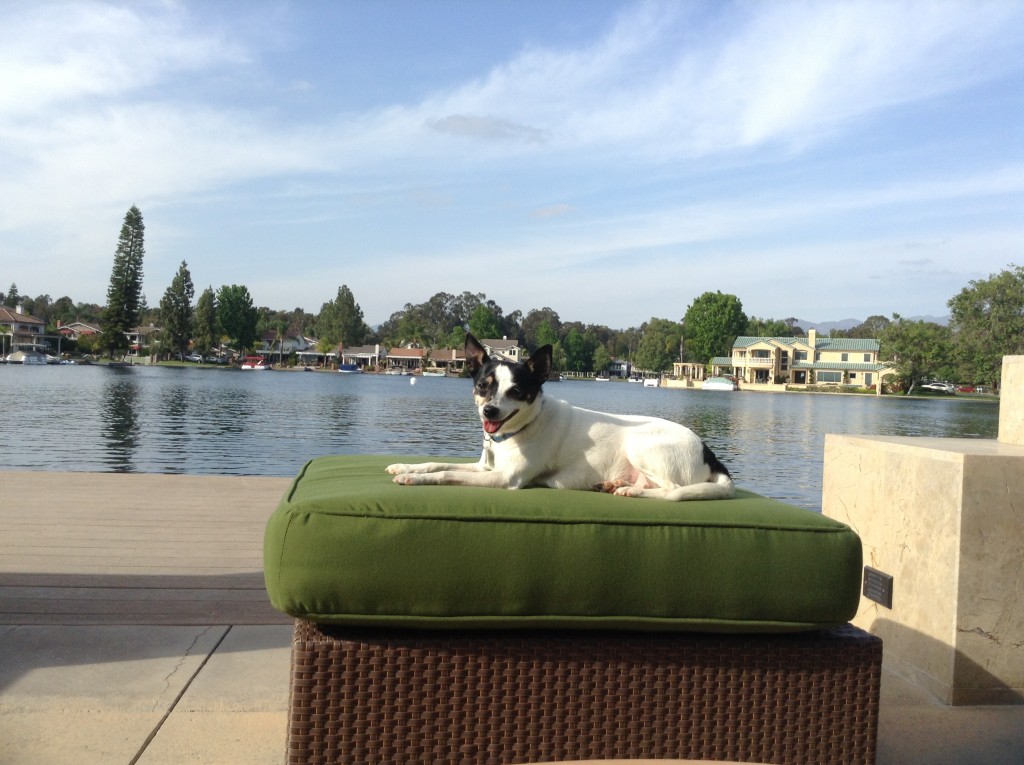
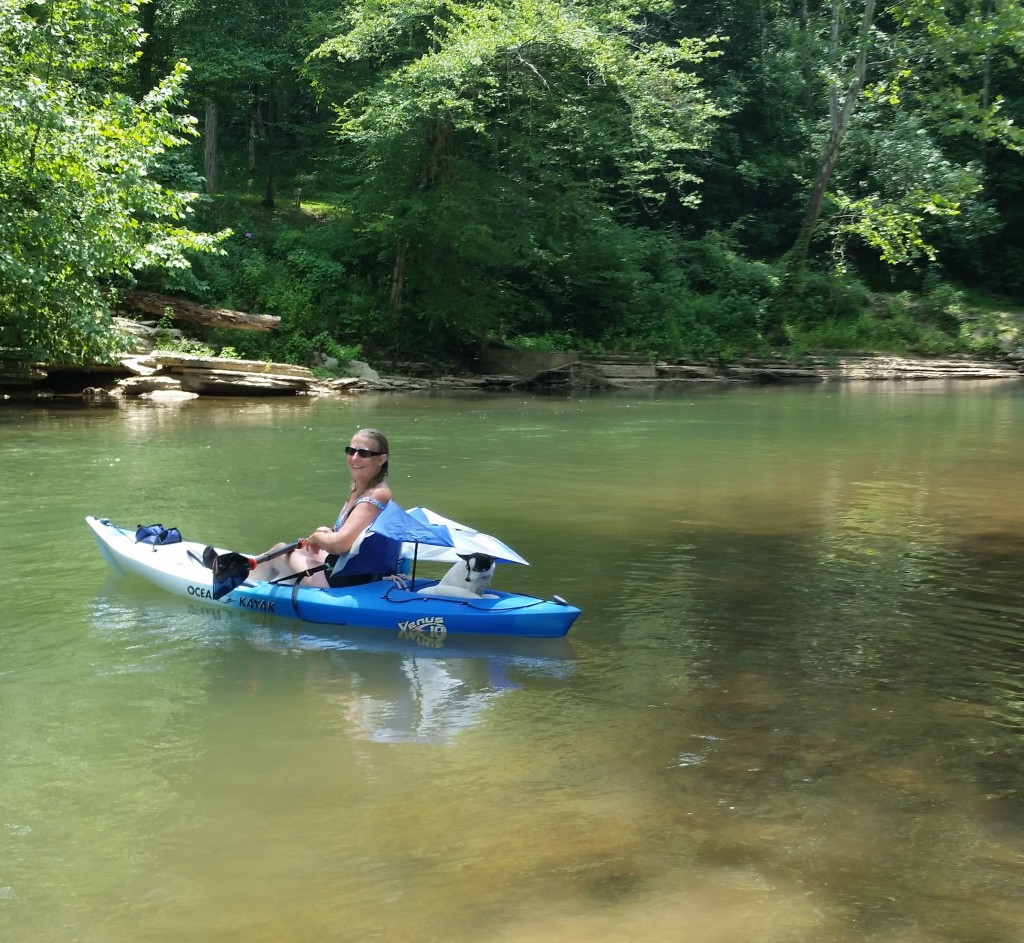
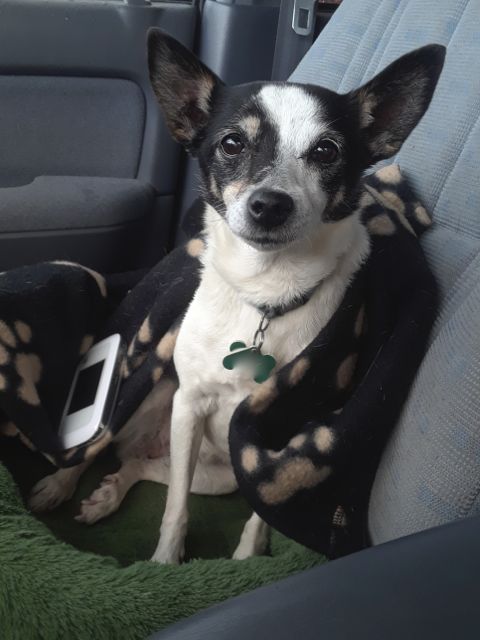
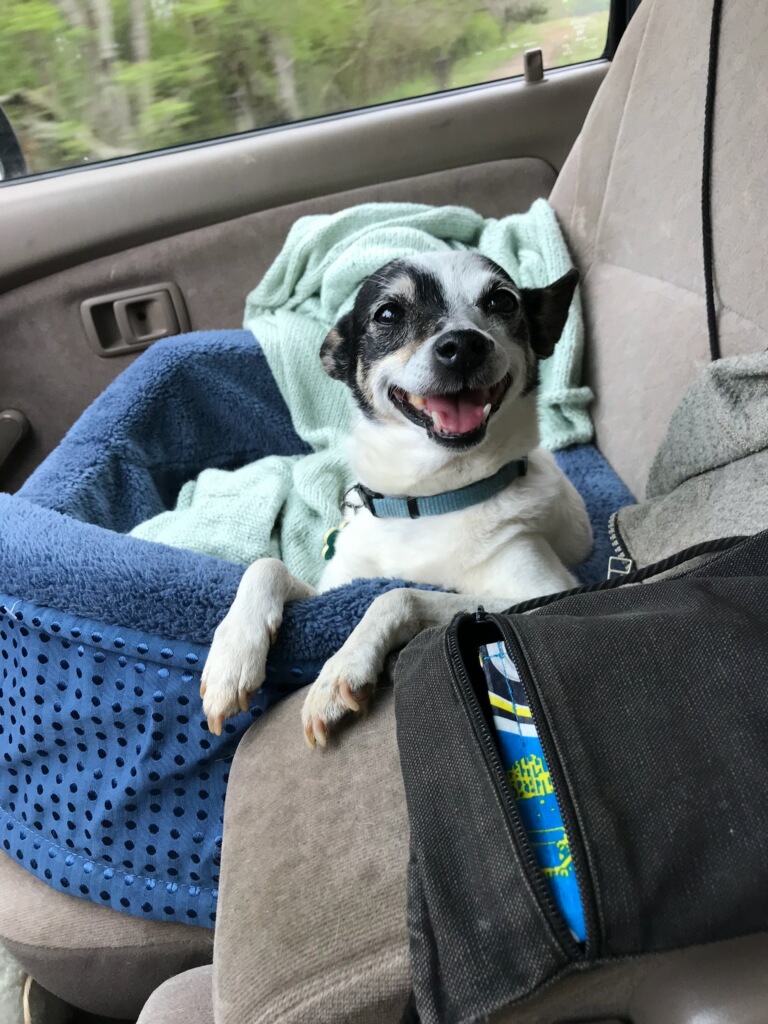
For as long as I can remember I have been blessed with a loving human family and an affinity for nonhuman animal companions. With six kids in the family my Mom had her hands full, but she indulged my heart for animals. Even in high school friends knew the best birthday surprise they could give me would be a new farmyard friend or other animal to add to my family. My mother worried about what she viewed as an unnaturally strong love for animals. My dad not so much. But when he learned that my first job was cleaning kennels at a local pet store, my Dad voiced his concern. Protectively he said, “Do something else. You don’t want to clean up animal shit your whole life.” He was wrong, because cleaning cages gave me the opportunity to meet and start to understand animals as individuals, deeply sensitive loving beings. He really did not understand when I told him how happy the job made me. Well, 66 years have passed since my birth and I have been blessed to have so many special beings come into my life, the latest to leave this planet is Java. Yes, I am grieving her now, it is natural, and the process is becoming less intense, somehow soothing. Java’s passing and me grieving her passing is different than any other time one of my animal companions passed. This loss is not softened by the presence of another animal family member. For the past 10 years it has been me and Java. And now I am alone with my loss. As result I am feeling, with every cell of my body, the profound love we shared. I am feeling it fully, embracing and honoring it. I am alone without another loving animal distracting me from my painful yet illuminating process. No licking away my tears making me feel less pain. And this is good because I am fully here, in the moment, immersed in the realization that I love nonhuman animals as deeply as any of my cherished human friends and family. LOVE is LOVE. It knows no species. It is one pure and powerful energy that transcends any cultural judgement or prejudice. In her passing Java taught me how deeply I love and that my love is not diluted when given outside the human species. I am humbled by this gift that Java has given me in her passing. Love you Java.
World Animal Day was created to help raise the status of animals to improve welfare standards around the globe. It is befitting to commemorate this day by paying tribute to four elephants in Nepal who recently died. Each made profound contributions to wildlife conservation efforts for more than five decades. I am forever grateful for everything these amazing beings taught me.
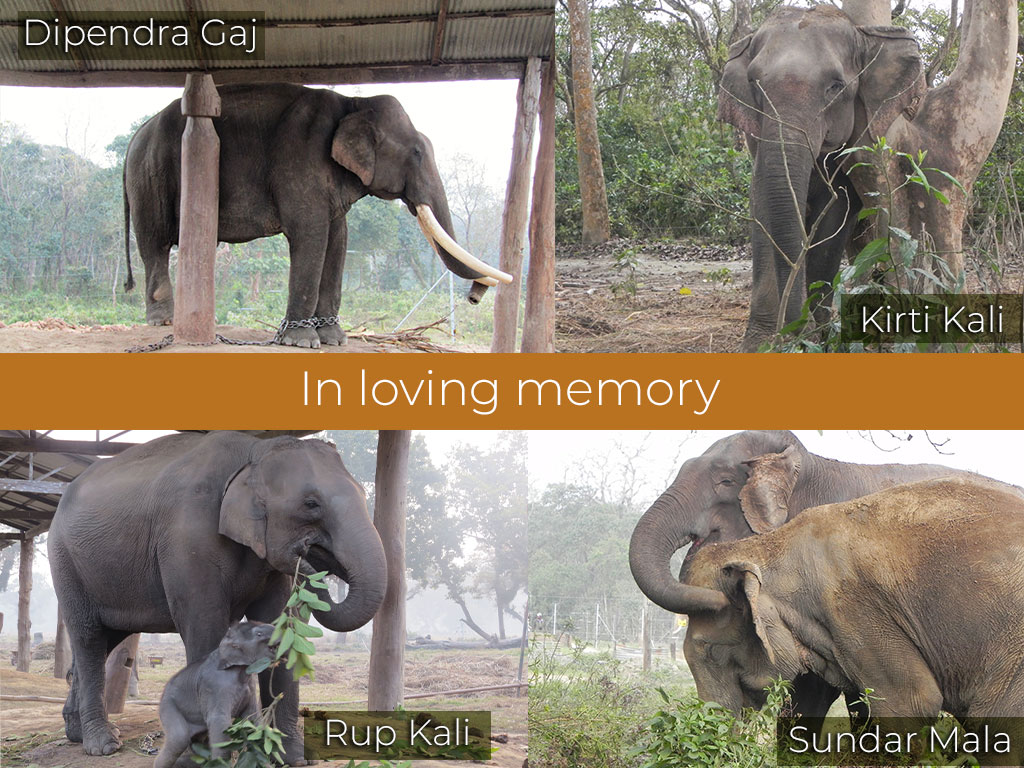
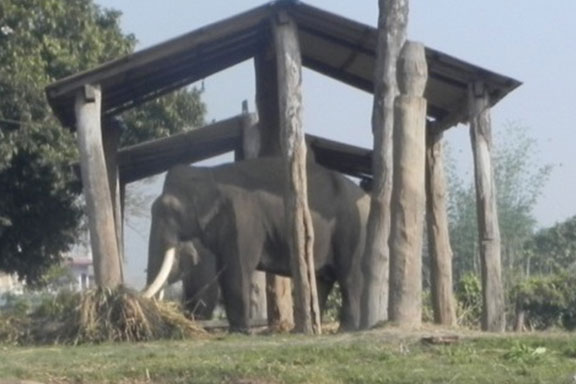
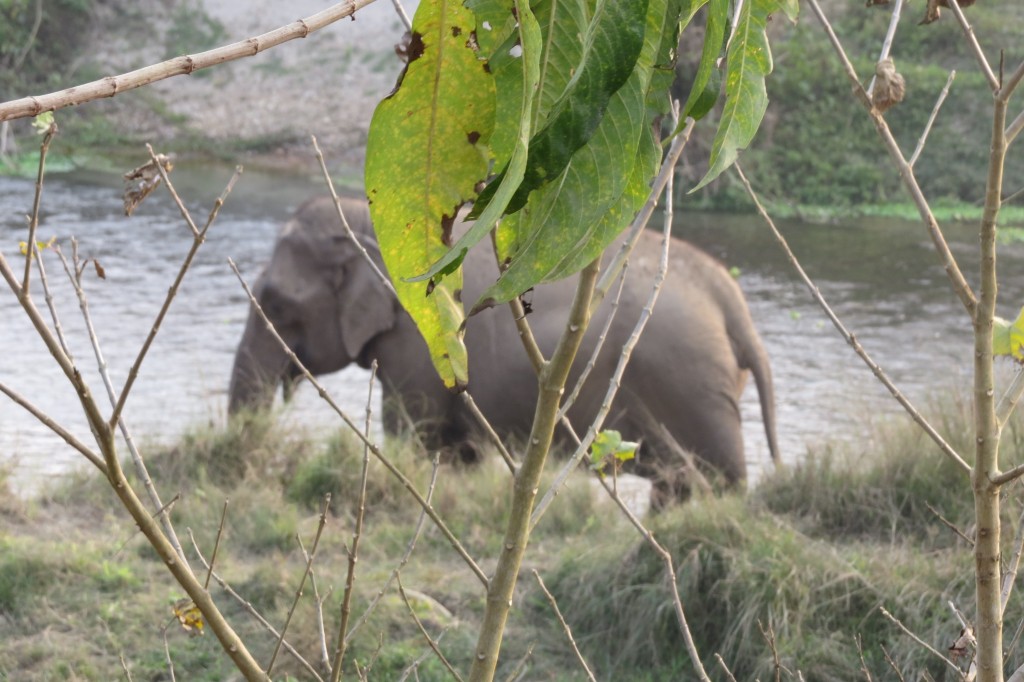
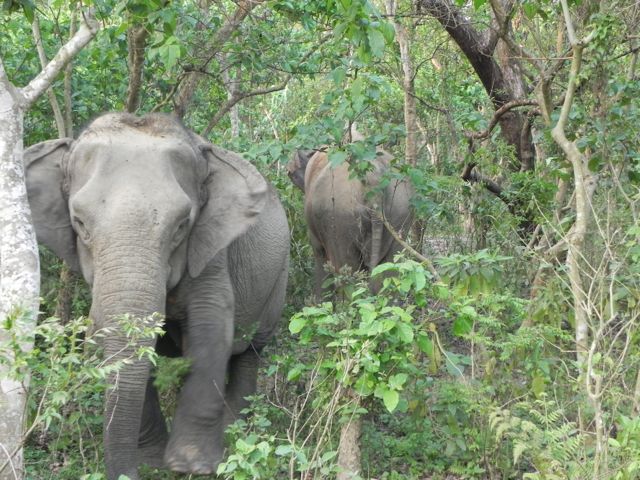
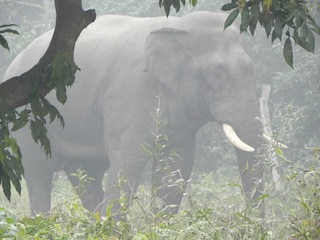
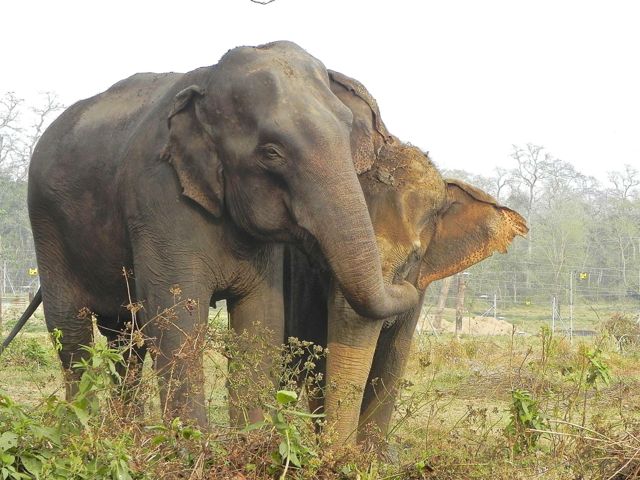
Dipendra Gaj, Rup Kali, Kirti Kali and Sundar Mala were all members of a select group of anti-poaching patrol elephants deployed daily in Chitwan National Park. For decades they worked dawn to dusk protecting wildlife. When they returned to their shelter each evening, their front feet were shackled together with heavy chains to restrict their movement. They spent every night of their lives isolated from fellow elephants, including their offspring.
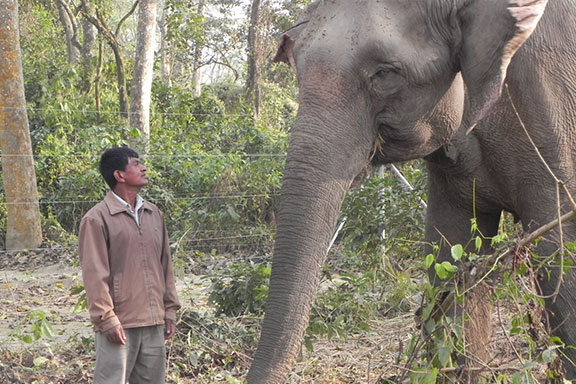
Captive life for these elephants was never easy. Neither were the lives of their mahouts (keepers). Together these conservation rangers did their jobs obediently, rain or shine, day in and day out. Their success at protecting wild rhinos and tigers is the pride of the conservation world.
Elephants, of course, are an endangered species, designated by Nepal as a heritage animal. These four elephants were wild born, but because they ended up in captivity, their value was diminished in the eyes of their human overlords.
I honor these elephants by sharing their stories, by telling the truth about who they were, how they lived and how much they contributed to conservation in Chitwan National Park. In speaking openly about these four brave elephants, I hope not to cause outrage and protests, but to bring about change for their surviving captive-held brethren.
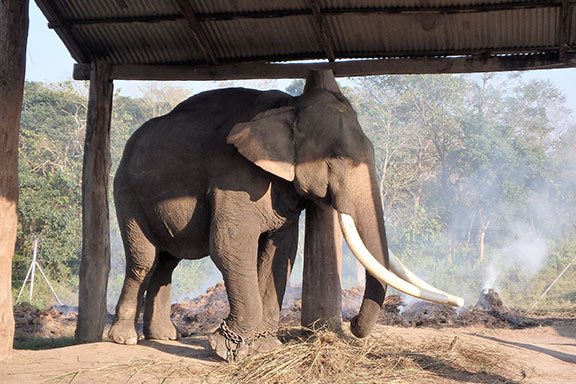
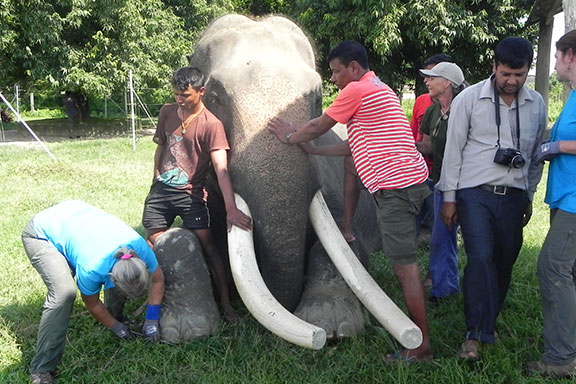
Dipendra Gaj was a magnificent bull who was resigned to his duty. Forced to comply with every demand made upon him, he never lost his sense of self. He seemed to overlook the demeaning aspects of his life and remain proud of being an impressive bull elephant. It was my greatest honor to trim his feet twice a year. His superior cognitive abilities and willingness to accept care made his mahouts so very proud. Dipendra Gaj died in his mid 50’s–too young–after losing his battle with the human strain of tuberculosis.
Rup Kali was a wise mother and grandmother. Captured from the wild at a young age, she was forced into servitude. Her official anti-poaching patrol duty spanned nearly 60 years.
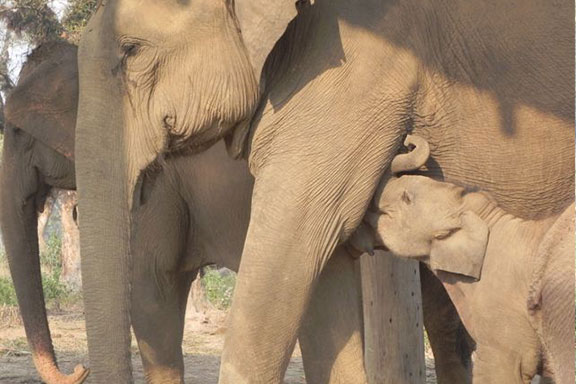
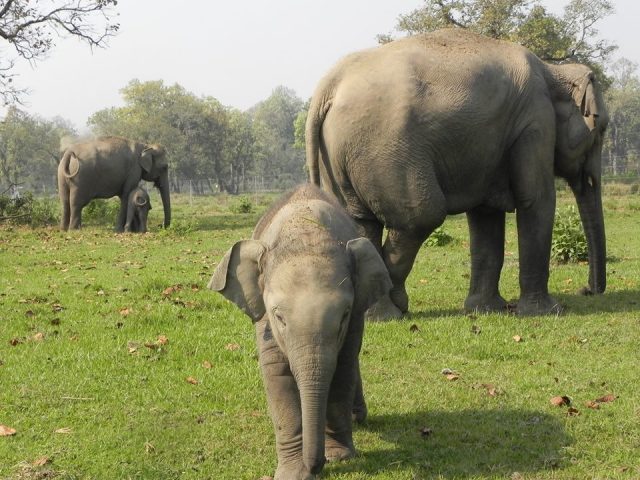
When we first met Rup Kali, she was “auntie” to two calves, one four months old, and the other five months. The calves were left unchained so they were free to wander through the hattisar (elephant stable) to socialize with the chained adults. They developed a deep relationship with Rup Kali, spending more time with her than with their own mothers. Rup Kali responded by developing milk and nursing both calves.
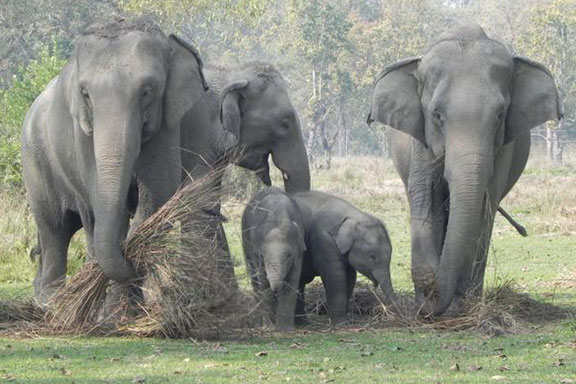
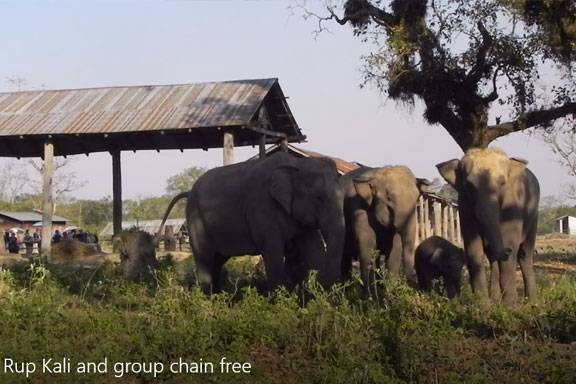
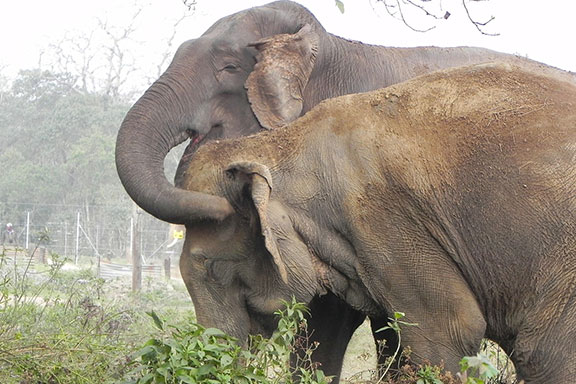
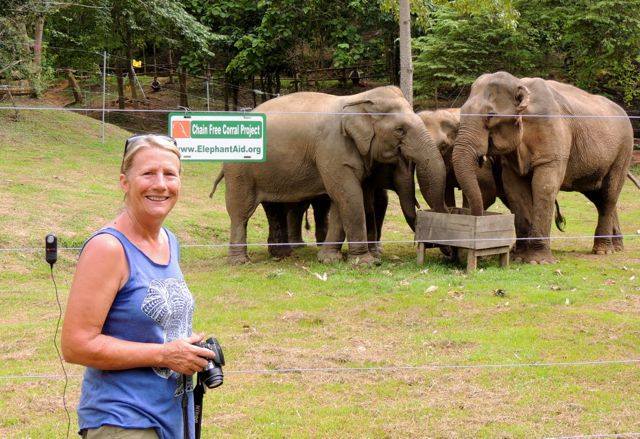
In 2015, Rup Kali was released into a chain-free corral built by EAI, which she shared with the two calves and their mothers. The elephants were overwhelmed by their new circumstances and melted into one another, forming the unbreakable bonds elephant families are renowned for.
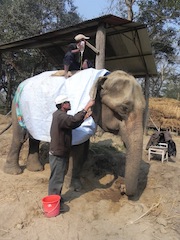
Later, Rup Kali was moved to a remote hattisar where she was semi-retired. After losing her last set of teeth, she became thin. EAI provided her with a coat this past winter, which she wore willingly. This spring, Rup Kali died of natural causes. She was in her seventies.
Kirti Kali had a long, documented history of conservation work and giving tourist rides. She was a member of a group of elephants who were isolated from each other under separate tin shelters, and never allowed to socialize.
Kirti Kali was one of two elephants who provided elephant back safaris in Chitwan National Park. Her anti-poaching patrol duties meant long days in the sweltering summer heat and harsh winter cold. She was also required to provide tourist rides every dawn and dusk. The majority of riders were Nepali VIPs receiving special tours of the park (all other safaris take place outside the park in buffer zone forests). It was reported that the funds she generated paid staff salaries.
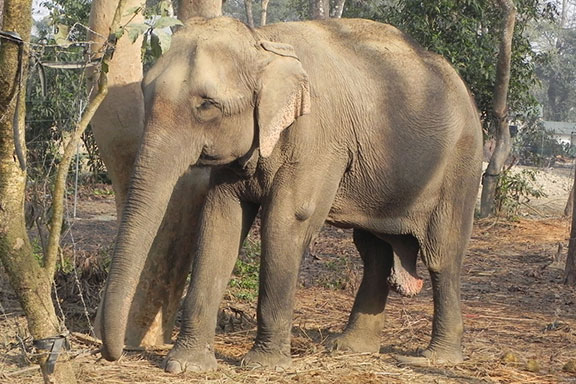
Midlife, Kirti Kali developed a severe case of carcinomas that affected her gait and subsequently her foot health. Over time she became thin and remained that way until her death.
In 2014, Kirti Kali was one of five elephants to receive a chain-free corral built by EAI. At first, her mahouts resisted allowing her to live chain-free since she had a history of aggression. But shortly after the other elephants went chain free, Kirti Kali did as well. She proved to be a star resident of chain-free living, remaining calm, responsive and nonaggressive.
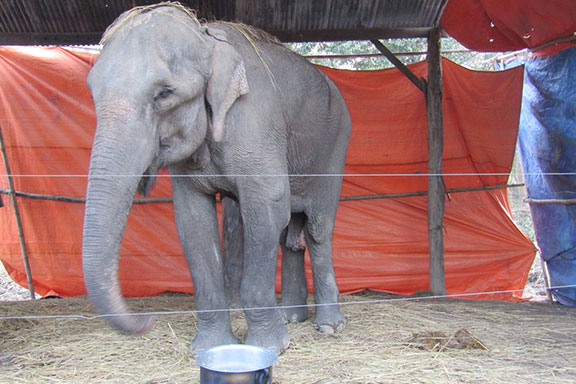
Last winter, Kirti Kali’s health deteriorated, which meant she no longer had to give rides. Tarps were erected around her stable to help block the cold wind, and EAI provided a coat to keep her warm.
This spring, Kirti Kali died after years of suffering from the human strain of tuberculosis. Her contribution to conservation was as great as her suffering. She was almost 60 years old.
Sundar Mala was another wild-caught elephant who spent her entire captive life working anti-poaching patrols protecting Nepal’s wildlife. Although age is sometimes difficult to confirm, I was told that she was close to 60 years old when we first met. She was severely thin and suffering from foot disease.
In 2015, after living chained in isolation most of her life, Sundar Mala was released into a chain-free corral built by EAI. She and Oma Kali, a senior elephant who had been crippled by a wild bull, bonded instantaneously and remained inseparable until Oma Kali died two years later.
Sundar Mala was the first recipient of a winter coat. It took some convincing for the government to grant permission for EAI to provide the custom-made garment, but thanks to Sundar Mala’s complete acceptance of her coat, many other elephants in need have since received them as well.
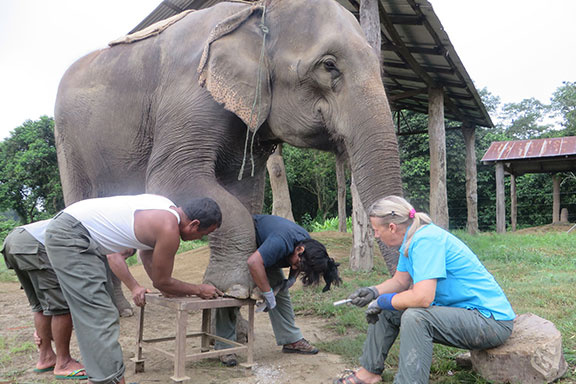
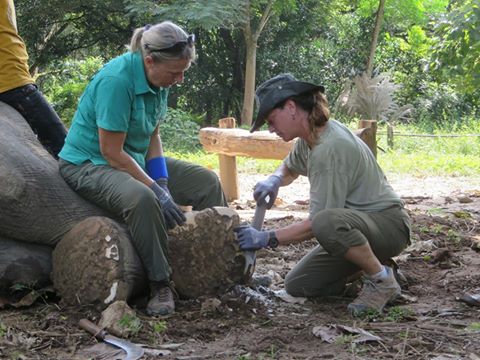
During our bi-annual foot trimming visits, Sundar Mala was always the first client. She was unable to lie down, but quickly learned how to place her feet on a platform so that her nails and foot pads could be trimmed. It was always a group effort, with two to three mahouts and me gently maneuvering her feet into place and trimming, while yet another person provided treats, her favorite part. Sundar Mala’s calmness, cooperation and gentle engagement was humbling.
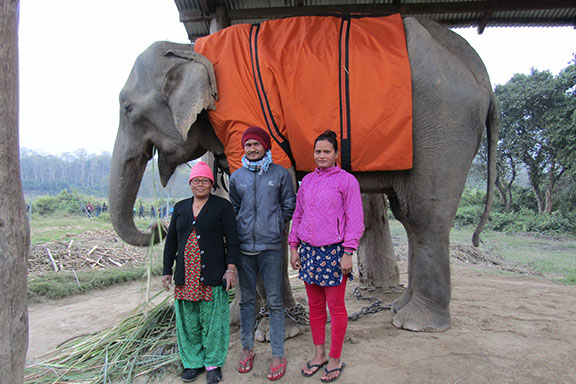
Last winter, I heard Sundar Mala’s health was deteriorating. We offered support in the form of supplemental food and a new coat. She wore her coat with a sense of pride, posing with her team of mahouts and well wishers. With the deepest sadness, I learned Sundar Mala just passed away. She was reportedly in her mid-70’s.
I can only hope the sacrifices made by these and other elephants we have lost does not go unnoted. They are heroes of the greatest magnitude, wild-caught elephants who rose to the challenges forced upon them. Their contributions to the success of human endeavors cannot go unrecognized, nor the cost they paid in their service to humans and other animals.
With our deepest respect, rest in peace, Dipendra Gaj, Rup Kali, Kirti Kali and Sundar Mala.
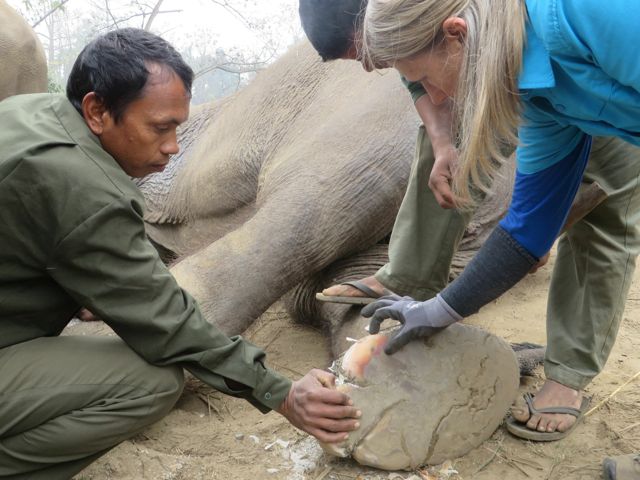
Recently I had the opportunity to provide emergency foot care for an elephant in Nepal. I am currently in the US and Chanchal Kali, the elephant with the split nail, lives in Nepal. The injury was not the biggest challenge, our opposite locations was.
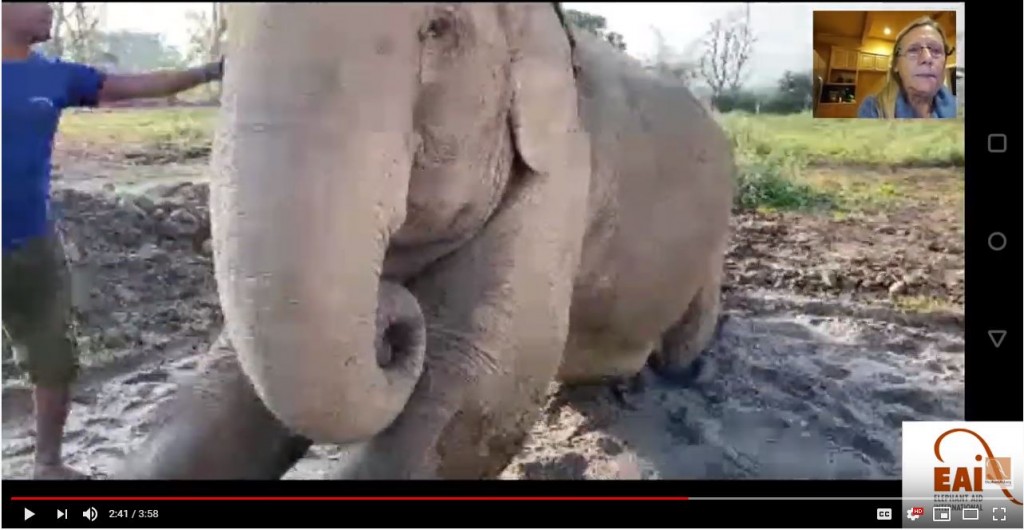
Since I have interns in Nepal, I believed that I could assemble a team. But addressing this particular injury was something my interns were not confident about, they needed guidance. So I decided to test technology. Hopefully conducting the nail trimming procedure remotely, using a live feed, would work? We had to try. So, Donna of Direct Aid Nepal organized the mahouts and Chanchal Kali. Lena of Association Moey made sure her staff, both interns of mine, were available to help. And just by chance, Annette, one of my advanced interns, just happened to be in Nepal at the time. Our team was assembled and ready to give it a try.
At 8am Nepali time, 9pm EST we connected via Whatsapp. As we expected the wifi was weak, the connection dropped several times. But even with the intermittent disconnects, I was able to view the toe and provide step by step instruction. Sanjay and Annette trimmed, Sweta translated and managed the live feed, Donna provided treats, and Chanchal Kali and her mahouts were incredibly cooperative and calm. The crack was deep and causing her pain. Thanks to a successful procedure the pressure is off the crack and the mahouts will monitor as she heals.
Thank goodness for this technology which enabled us to provide quality care for an elephant in need, halfway around the world. Go Team!
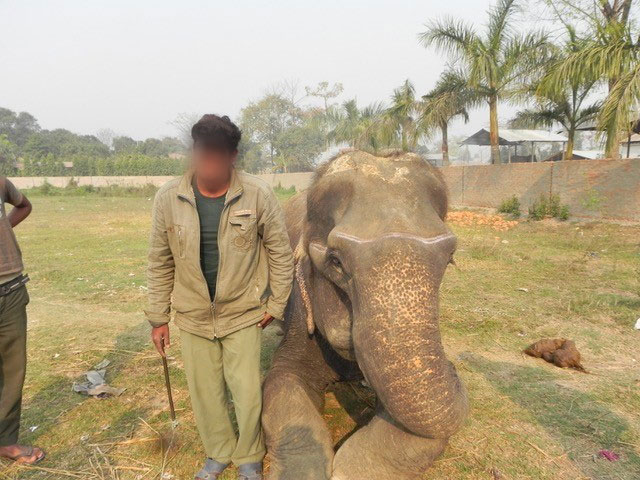
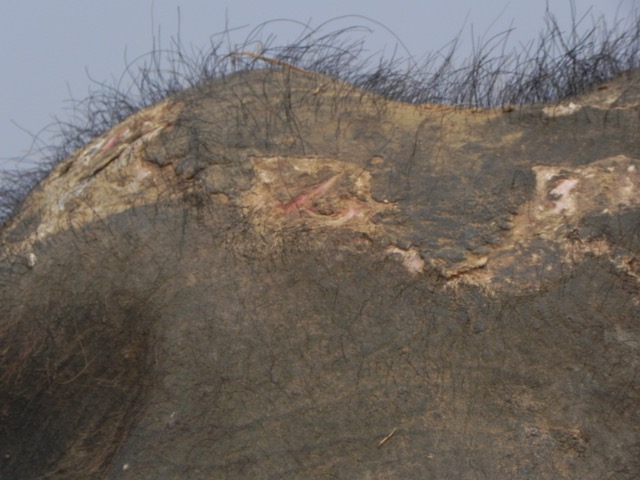
These photos of captive-held elephants in Asia are not unique. I am posting them to document what happens when an elephant is struck on the head with a stick, ankus (elephant hook), axe or other weapon. They illustrate how these elephants suffer for the tourist industry.
The practice of hitting an elephant on the head with force is traditional across Asia. Abusive dominance is believed to be the only way to control an elephant. It is the form of dominance and punishment taught to and expected of mahouts (handlers).
It’s easy to blame the mahout but, if we do, that blame is misplaced. Mahouts are poorly educated and paid, low-status workers. According to the cast system, if they want to work , they do what they are told, without question.
It might be hard for us as westerners to comprehend such blind obedience but in many Asian countries, it is expected of low-status citizens.
Tourists are key
Rather than blaming the mahout we should look hard and long at those who control the mahouts — elephant owners and supervisors — and those who finance the system, tourists.
Yes, tourists are key. Tourists pay to get close and interact with elephants. In many cases, unscrupulous supervisors and owners force mahouts to allow the dangerous interactions tourists want, making the mahout responsible for their safety.
I have witnessed many examples of young children of higher social standing demand that a mahout allow them to interact with his elephant in a dangerous manner. The mahout and his elephant are required to oblige their whims. These privileged adolescents will even strike the elephant and mahout with a weapon to demonstrate their position of power.
Hitting and striking
The mahout is required to keep his elephant under control at all times. When an elephant does not respond quickly to a command, the mahout is, by training, required to strike him/her forcibly with a weapon across the bony surface of the forehead.
Hitting an elephants’ skull with force causes a thunderous noise and vibration inside the head, as well as physical pain.
Repeated hitting causes tissue damage. After several harsh blows, the tissue is irreversibly damaged. It abscesses, dies, rots away, scabs over and then sloughs off, leaving a light colored scar.
An elephant’s physical response to injury is no different from that of humans’. The process from injury to scar takes weeks, during which time the elephant is suffering painfully.
No research has been conducted to evaluate the damage done to an elephants’ brain by beatings and subsequent infection. It is known, however, that mammals can contract encephalitis from a brain infection.
What you can do
When you travel in Asia you’ll see that most elephants used in the tourist industry have wounds and scars from being beaten. The abuse is driven by tourists’ desire to interact with elephants, requiring mahouts to use force to control their elephants during the interactions.
Here are three ways you can reduce the suffering of captive-held elephants and contribute to change:
• Eliminate elephant rides, bathing, painting, entertaining, selfies and hand feeding from your bucket list. If you refrain from direct contact with an elephant, the handler has no need to abuse his elephant to accommodate and protect you.
• Educate friends and family who plan to visit Asia about the how elephants are used in the tourist industry.
• Support only organizations that offer ele-friendly programs. Ele-friendly programs prohibit direct physical contact between tourists and elephants. Instead, they allow you to observe the elephants from a safe distance as they go about their daily routine.
Immediately following EAI’s public announcement that Mundi would be moved to Elephant Refuge North America (ERNA) mid-March, EAI received an email from Puerto Rico’s Department of Natural Resources (DNR) cancelling the contract for the move. The email cited no violations of the contract, but stated that DNR is considering other facilities for Mundi.
EAI has adhered to all the terms of the contract, which has been in effect for 18 months, so the purported cancellation came as a complete surprise.
EAI CEO Carol Buckley immediately began trying to get more information but received no response from Puerto Rico officials.
Since then:
DNR Secretary Tania Vázquez contacted Carol to apologize for her lack of communication since assuming authority over Mundi weeks prior. She informed Carol that she would be visiting prospective locations for Mundi’s placement, including ERNA and The Elephant Sanctuary in Tennessee (TES).
Secretary Vázquez offered no explanation for duplicating the thorough research conducted more than 18 months earlier by a committee assigned by the governor and first lady. She did, however, disclose that TES was hosting her visit.
Secretary Vázquez visited ERNA on January 15 for three hours, then traveled to TES.
EAI was advised that since it was in full compliance with all terms of the contract, the cancellation was invalid. EAI then hired attorney Neysa Gonzales of the Jorge R. Jimenez Law Office in Puerto Rico, who also questioned the validity of the cancellation.
Gonzales tried to arrange meetings with all parties to the contract but received only one response, from the Department of Sports, the original signatory of the contract. The department stated that since authority over Mundi had recently been transferred to DNR, it was no longer involved.
Gonzales also informed TES about EAI’s contract with the government of Puerto Rico but received no response.
After continued silence from the DNS secretary, EAI filed a petition for injunction for a legal solution.
On Wednesday, February 20, EAI CEO Carol Buckley and EAI Secretary/Treasurer Leslie Pon Tell-Schreiber traveled to Puerto Rico to appear in court. They sought immediate relief and a decision on whether the contract cancellation is legal.
Late on the day before the hearing, the defense filed a motion for dismissal, stating that the case should be heard in civil court, where the proceedings could drag on for years. EAI asserts that the contract should be enforced and Mundi moved as soon as possible.
On March 1, 2019, the judge determined that the plaintiff (EAI) could not prove that there is irreparable damage. This means the judge will not hear the case in her court and that the case would need to be heard in civil court.
We will continue to report updates on this page.
Contract Milestones
On August 30, 2017: In compliance with Puerto Rico Law 154 the Governor Hon. Richard Rossello Nevares, in a written document, ordered the transfer of Mundi the elephant to Elephant Refuge North America. Read the document.
On May 23, 2018, the Department of Recreation and Sports, represented by its Secretary, Hon. Adriana G. Sanchez Parés, signed a formal Transfer Contract with Elephant Aid International for the female African elephant known as “Mundi” of the Dr. Juan A. Rivero Zoo. The Contract signed by the parties was valid until December 31, 2020. Read the original contract in Spanish. Read a translated copy of the contract in English.
November 2018: EAI announced on their Facebook page that Mundi would be moved from Puerto Rico to Elephant Refuge North America mid-March 2019.
December 2018: Authority over Mundi the elephant was transferred from the Department of Recreation and Sports of the Government of Puerto Rico to the Department of Natural Resources.
On December 28, 2018, the Secretary of the Department of Natural Resources of the Government of Puerto Rico, Tania Vázquez Rivera, submitted a written communication to EAI. The letter argued that because the EAI sanctuary was not ready to receive the elephant immediately in order to preserve its life the Agreement was rescinded. Read the letter.
EAI Founder and CEO Carol Buckley recently completed a comprehensive guide to rehabilitating captive-held elephants so they can be released into a wild environment. The guide draws on Carol’s four decades of hands-on experience to present detailed instructions for facility construction and assessing, interacting with and healing traumatized elephants. Although the paper is written for caregivers and those working in direct contact with elephants, anyone interested in the rehabilitation process will find it of value.
In the video above, EAI Founder and CEO Carol Buckley explains to the Primera Hora audience how ERNA is tailor-made for elephants.
Mundi holds a special place in the hearts of the people of Puerto Rico. So it’s no surprise that some Puerto Ricans are skeptical about moving her off the island. Fortunately, Governor Ricardo Rosselló Nevares recently reaffirmed that he stands by his decision to move Mundi to Elephant Refuge North America (ERNA).
When Puerto Rico’s newspaper Primera Hora interviewed EAI Founder and CEO Carol Buckley earlier this month, she used it as an opportunity to speak directly to Puerto Ricans.
“Your hearts are in the right place,” she said. “You’re hesitant and you don’t want her to go. All I can say is, I appreciate how you feel for Mundi and I guarantee that once you see her here and you see how she thrives here, your minds will change and you will be exceedingly happy.”
Sarah Shaw believes that some people are fortunate to live multiple lives in the span of one lifetime. Sarah recently embarked on her fourth life, as the founder of the Nature Defense Foundation and the Sindisa Sanctuary, a 125-acre off-grid paradise for rescued animals and retreat for humans to “re-wild their souls.”
In her first life as a dancer, Sarah probably never envisioned that one day she’d be spending four days a week checking water lines, fencing and bee hives, and concerning herself with the foot health of horses, alpacas, Choctaw ponies, pigs and a mule.
From an early age through her teens, Sarah devoted her life to dancing – talented enough to become a three-year member of the Alvin Ailey American Dance Theater, until an injury forced her to question her life’s direction. That’s when Sarah entered her second life, as a Boston University student. While pursuing her political science degree, Sarah interned with the Wilderness Society where her earliest interest in environmental issues sparked.
After graduation from Boston University, Sarah returned to her home state of California and began her third life as a fashionista/entrepreneur. Tapping into her dance company costume knowledge, Sarah began making fashionable clothing to sell to boutiques. “It started as typical 80’s lycra-dance garb, but it grew really fast and did really well,” said Sarah. Soon, she was managing three of her own upscale clothing boutiques in the San Francisco Bay area.
“But my weekend passion project was volunteering for a local dog rescue in San Francisco. I’d pack my Mini Cooper with dogs, wash and groom them, and help prepare them for foster homes.”
It was also during her entrepreneurial life when Sarah got involved with documentary projects, including Louie Psihoyos’ “The Cove,” a film about brutal practices with marine mammals, and “Racing Extinction,” which follows undercover activists trying to stave off human-made mass extinction.
Inspired by Dame Daphne Sheldrick’s “Love, Life and Elephants: An African Love Story,” Sarah traveled to the continent several times, including volunteering at a South African elephant sanctuary. Burned out after 15 years of clothing boutique management, Sarah sold her stores and bought the 125-acre northern California property, intending to create her own sanctuary for retired zoo and circus elephants.
Sarah followed the work of Elephant Aid International (EAI) founder, Carol Buckley, for a year before cold calling her to seek advice. “While I had made several calls to other sanctuaries, Carol was the only one who would talk to me and answer my many questions about whether or not my property was the right place for an elephant sanctuary. After getting to know Carol a little bit I ended up joining her elephant foot care clinic in Nepal for two weeks to get some hands-on experience with Carol and the elephants.”
Almost simultaneously, Sarah took on another elephant-sized challenge. Sarah’s grandparents had created a family foundation in the 1960’s, but in 2015 they decided to reorganize it into two separate foundations: one that Sarah’s cousin would manage, focusing on social justice and prison reform, and the other that Sarah would steward, concentrating on animal welfare and the environment. “Nature Defense Foundation was an inherited role, and one that came upon me quickly and unexpectedly, but would allow me to affect real change,” said Sarah. “My work with NDF is every day no matter where I am. My relationships with about half of my grantees is very deep and hands on.”
Nature Defense Foundation made a $500,000 grant to Elephant Aid International in 2016 that, combined with an anonymous donor and a secured loan, allowed it to purchase the $2.5 million Attapulgus, Georgia property for Elephant Refuge North America (ERNA). While Sonoma County refused to issue a permit for Sarah to launch her own elephant sanctuary in California, Sarah continues to channel her passion for elephant welfare as an EAI Executive Council member, one of EAI’s most generous benefactors, and the driving force behind EAI’s most recent $50,000 Crowdrise matching campaign.
The Zulu word for “rescue and rehabilitate,” Sindisa has now become central to Sarah’s fourth life, as a place where farm animals can mend and people can unwind, unplug, get muddy with pigs, and learn the truth about farm animals in our food system. “There is amazing energy at this place. We have eight of the approximately 200 remaining Native American Choctaw Ponies left in the U.S. Watching the herd run across the ridge and witnessing their freedom is magical.”
Sarah’s plan is to grow Sindisa into its full potential, hosting group retreats and developing animal welfare curriculum for area schools. EAI is proud to count Sarah as part of its Founding Herd, and someone who is dedicating her fourth life to raising awareness around the fact that all animals are sentient beings who deserve fundamental rights and compassion.
In 2013, Mel Kali, the senior member of the National Trust for Nature Conservation’s elephant herd, fell ill. It was winter, it was cold and she was suffering from pneumonia.
Being in her early 70s and in poor body condition, her prognosis was not good. In fact, staff told me there was nothing they could do and that she was dying.
Mel Kali’s chain-free corral had been completed only recently. It struck me that after all her years of service she wouldn’t benefit from her new found physical freedom. I was overcome at the thought that nothing could be done medically to ease her pain or address her condition.
Mel Kali had served the Trust well for decades, performing daily anti-poaching surveillance, transporting wildlife researchers and generating funds by providing tourist rides. She was mentioned in many research papers and was even featured in a book, which noted her bravery when encountering tigers inside Chitwan National Park.
It saddened me that Mel Kali would be allowed to suffer and die without any effort to ease her pain. I felt helpless and ineffective.
A new plan
As I sat watching Mel Kali, I knew I wanted to help her one more time. I had a good relationship with the mahouts and knew that if I asked, they would convince management to let me arrange for treatment for her. Even if she did not survive, she would not suffer.
The mahouts could see I was distraught. But when they tried to comfort me by saying there was nothing we could do, I told them of my plan. All were immediately on board.
I arranged for the best veterinary care available — Kiran Rijal, a local vet tech under the direction of senior government veterinarian Dr. Gairhe.
Within hours Mel Kali’s corral was abuzz with mahouts, veterinary assistance and hope. We were all working together to help her. Her mahout sat on top of her head holding bags of meds and fluids while Kiran attached intravenous drips to the veins in the back of her ears. We administered vitamins and antibiotics to help her fight off the infection that threatened to take her life. And Shanti Chaudhary, head mahout Paspat’s daughter-in-law and a dear friend of mine, sat down at her sewing machine to create a blanket to keep Mel warm.
The energy in the hattisar (elephant stable) was alive with hope and camaraderie. Any sense of helplessness was gone. We were united in our effort to help Mel Kali, who was cooperative in every way. There is no doubt she was aware we were doing all we could to help her.
After three days of around-the-clock care it was obvious that Mel was going to recover. So much had changed. In addition to administering medicine, fluids and supplements, we reevaluated Mel’s diet. We added extra rations, including a giant cauldron of cooked rice with molasses and gram, a source of protein, to put weight back on her emaciated body.
EAI put out a call for help and our supporters responded generously. Their donations paid for Mel Kali’s medical treatments, blanket and daily rice and molasses rations for the next many months.
But what followed next was a surprise, without question the most exciting thing to come from her recovery.
Mel Kali was officially retired.
Retired and thriving
The action was unprecedented. Mel Kali was the first elephant in the history of Nepal to be retired. No longer would she give elephant rides. No longer would she be used as a transport vehicle for researchers. And no longer would she spend long days engaged in anti-poaching patrols. Instead, Mel Kali was to begin a new chapter in her life as a free roaming elephant.
Once she was fully recovered, Mel Kali was escorted to the banks of the Rapti River, a short distance from her hattisar, each morning. Then her mahout-escort would say, “Okay go, you’re free.”
Without hesitation Mel Kali would wade into the middle of the river and pause to take several refreshing drinks before continuing to cross into Chitwan National Park. She had no escort, no mahout, no riders, no one to direct her movement or dictate her actions. She had complete autonomy to do whatever she wanted.
What she wanted was to disappear into the dense jungle each and every day. She was free to wander for the rest of the day and even overnight if she so desired. Many days she could be seen in the company of Renaldo, the resident wild bull elephant. It seems they enjoyed each other’s company.
Five adventure-filled years later, Mel Kali continues to thrive. Most evenings she returns to the hattisar on her own. As she approaches the riverside tourists point and exclaim in excitement, “Jungle hatti!” (wild elephant), unaware that Mel Kali is not wild. She wades across the river, scales the embankment (avoiding the curious tourists) and makes her way to the back side of her corral. Many times she has to stop on the narrow dirt footpath until awestruck tourists scamper out of the way. Never does she show aggression or pay any attention to the two-leggeds snapping selfies as she passes by.
In anticipation of her return, a mahout stands ready to open the gate to her corral.
Like a queen returning to her throne, Mel ambles to the front of her spacious chain-free corral to partake of her cauldron of freshly cooked rice and molasses, a treat that her mahouts enjoy providing as much as she enjoys eating.
Five years ago when Mel Kali fell ill, no one expected her to live past a few months. No one expected her to gain weight and the confidence to live free. No one expected to see her spend every day free of human dominance.
No one but me.
Today Mel Kali is not only the most famous elephant in all of Chitwan National Park, she is also known as the healthiest elephant in the region. She is living a new model in the world of captive-held elephants, a model that respects her lifetime of service and recognizes that freedom from human control is her birthright.
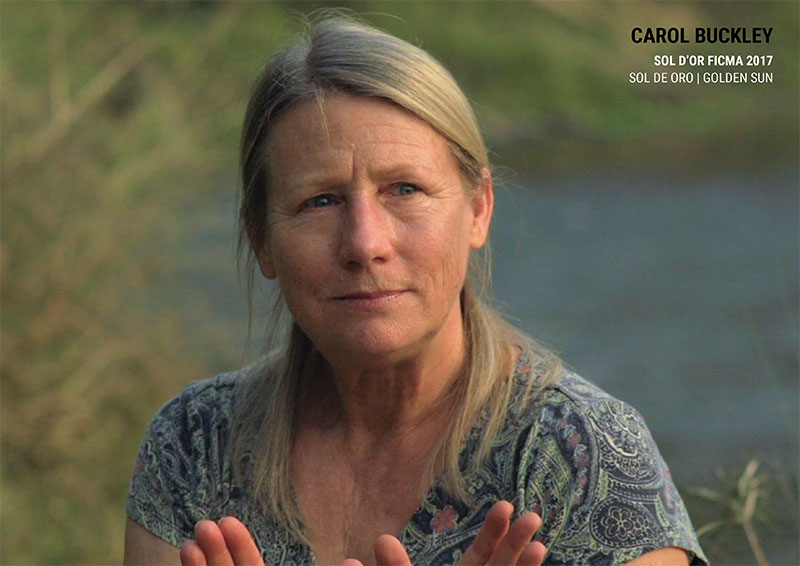
The Barcelona International Environmental Film Festival (FICMA) announced Elephant Aid International (EAI) Founder and CEO Carol Buckley as the recipient of the festival’s Golden Sun award for 2017. This prestigious award recognizes individuals and organizations helping to educate, sensitize and raise consciousness in values of respect for the environment and human-and-animal life.
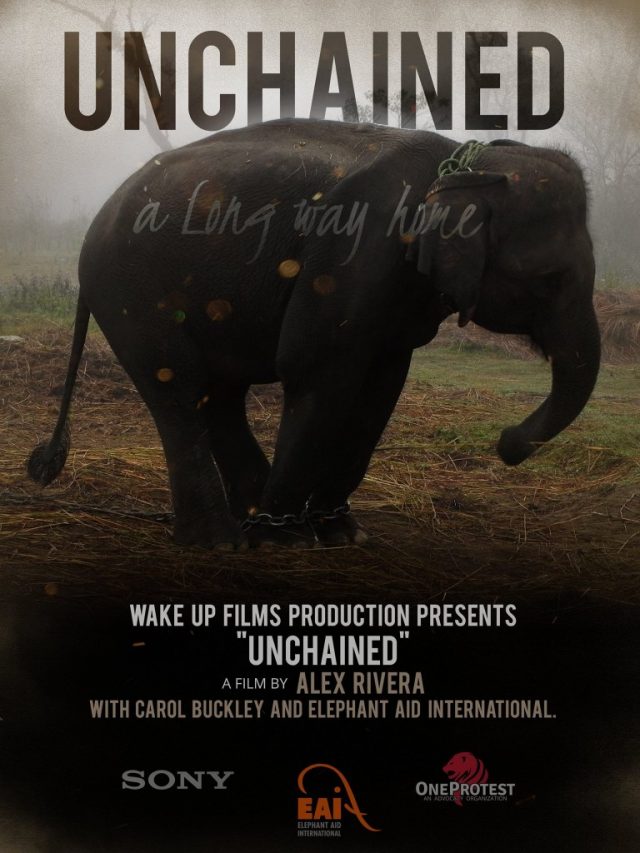
The documentary UNCHAINED, which follows Carol’s work to enhance captive elephant welfare in Nepal, will be shown at the festival to share possible solutions to the situation of elephants on our planet. Carol will be in Barcelona during the festival to receive the Golden Sun award in person on November 9, 2017.
In awarding the Golden Sun, FICMA described Carol as “one of the most prestigious persons to talk about the situation of elephants on our planet and that is working for their dignity.” Carol joins other notable animal welfare leaders who have received the Golden Sun including Jane Goodall and Jacques Cousteau.
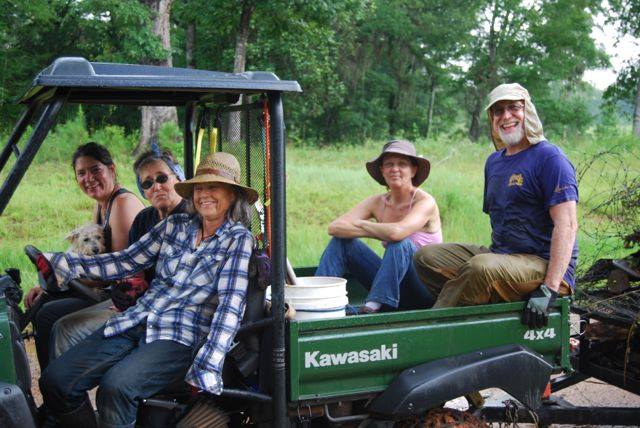
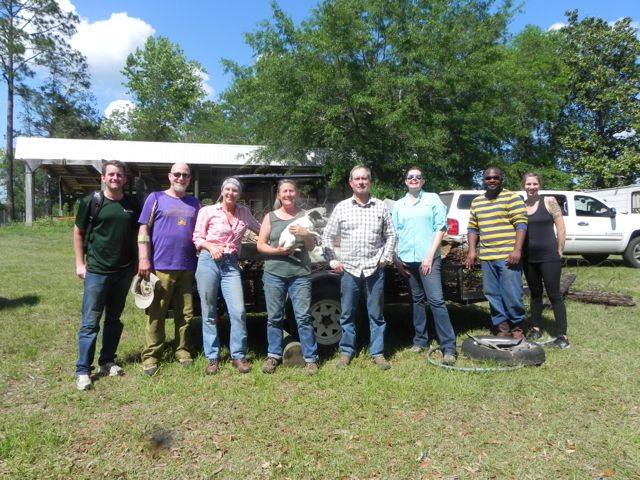
We had fabulous weather for our Volunteer Day. You should join us! We have openings every Saturday through the summer.
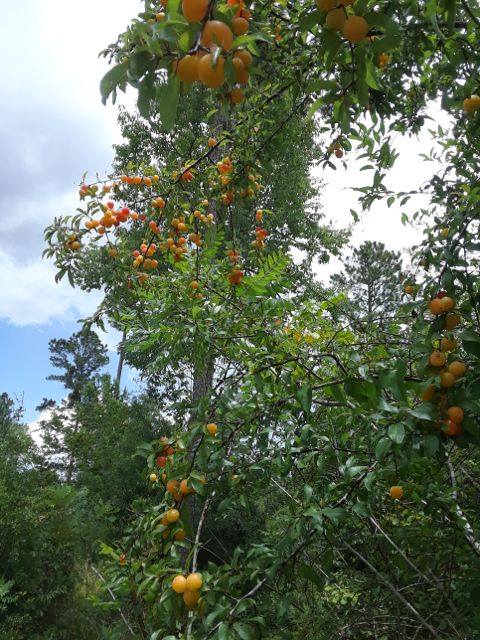
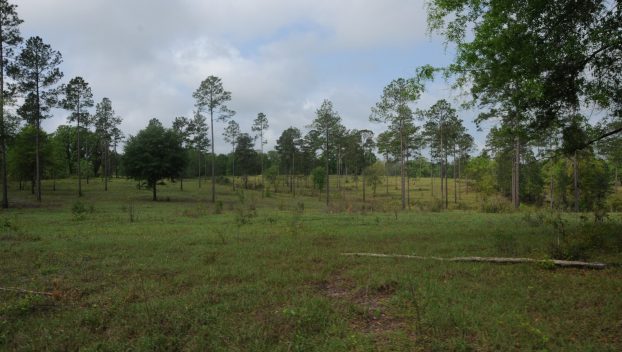
The habitat at Elephant Refuge North America is full of edible wild grasses and fruits. The plums are nearly ripe. Abundant low hanging fruit for elephants!
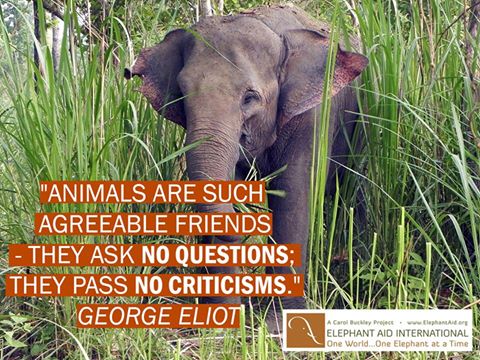
These beautiful beings are meant to be appreciated, not controlled.
“I have no photo to post, no video to stream but a need to share one of the many reasons I love living in Attapulgus, GA…” – Carol Buckley
Do you know of a theater or upcoming film festival that would screen UNCHAINED? Do you have a friend with an in-home theater who’d like to host a screening? Or a theatre you can use for a fundraiser? You hosting the screening as a fundraiser for EAI will help to spread the word. Please help us bring this impactful film to a theater near you! For more information about the film, click here.
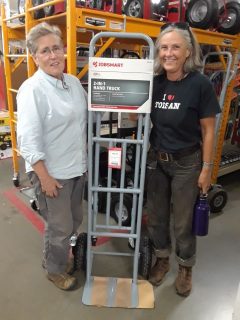
If you’re unable to volunteer in person, you can always contribute to the cause by buying EAI an item from our wishlist. We are so grateful for your continued support!
“I don’t think people really understand why elephants held in traditional environments are so unwell. It is because, at least in the Western world, the focus is on the physical. But in order for an elephant to thrive the focus needs to be on the emotional first and then the physiological.” Read more.
Share with us: Have you ever seen an elephant in his or her natural habitat?
When ERNA is completed and the elephants arrive, EAI will feature a live stream — which will allow you to witness the beautiful beings without harming them. Learn more.
Culture around the use of wild and endangered animals is changing right here in the USA.
Osteomyelitis is a bacterial infection that causes the toe bones to disintegrate, leading to the elephant’s physical collapse and subsequent death. This can be avoided with proper foot care. Learn more.
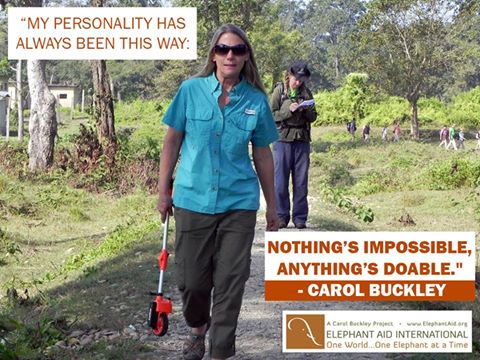
“Carol Buckley was born determined – an independent thinker who believed in challenging limits, no matter how formidable.”
We have many more volunteer days planned for the month of June. Are you attending any? We’d love your help!
We are grateful to Scott Pittman, founder of the Permaculture Institute in New Mexico, for his recent visit to ERNA — where he contributed his extensive expertise to our plans for sustainable design and living. We are very excited by what we learned. Thank you, Scott!