Category: Other animals

  • the adventure continues

    the adventure continues

    Wow what a day, I mean what a week! It was harder than expected to leave Mee Chok, Lom and all the magnificent elephants at BLES. I hopped on a plane from Sukhothai to Bangkok after sharing some final moments before takeoff with Kat, Hope and two very special BLES supporters.

    Upon landing, I found myself on an hour-long drive across town to the Southern bus station, followed by a three-hour bus ride to Kanchanaburi. Whirlwind is a good description.

    I keep forgetting to factor in things like: it can take two hours to drive 20 miles in the city traffic. Always interesting, there is never  a dull moment with tourist buses blasting music from the front of the cab…outside not inside, motorbikes snaking their way through the tangled vehicles and cars, cabs and trucks filling in every available gap. And bus stations can be a well-lit street corner or a three-story complex the size of a football stadium. Oh, what a thrill…and I made all of my connections with time to spare.

    Kanchanaburi was buzzing when I arrived, locals eating in the brightly illuminated food stands lining the sidewalks. I was taken a bit off guard when the bus stopped, everyone exited and I saw my duffle bag sitting in the street next to the bus. Upon exiting the bus, a kindly sokow driver approached and asked where I needed to go.

    Here’s the other thing that really amazes me: these taxi, tuk-tuk and sokow drivers all seem to know every guesthouse, hotel and restaurant in their city. My poor pronunciation does not prevent them from finally figuring out what I am saying, no matter how much I butcher the word. Patient and kind is how I would describe the Thai people.

    My latest adventure was not over upon exiting the bus. I got to my guesthouse, the easy to pronounce Bamboo House, to find out that my reservation had not been entered it into their reservation book. It seemed that this is not a rare occurrence. The owner gently drilled me on the exact time and day I had called to make my reservation and I soon realized she was trying to find out which staff member keeps forgetting to write down reservations. It was nearly midnight and I did not have a room but, really, there was no reason to get upset. If there is one thing that Thailand has, it is an abundance of guesthouses. I resorted to what has served me well in Asia: I asked for help.

    The proprietor, who had been awakened by the night watchman, was standing in her nightgown and robe behind the counter, obviously mortified by the mistake. She kept apologizing as she hurriedly made a call to another guesthouse, which I found equally as charming. Within minutes, a motorbike with sidecar and recently-awakened-from-sleep driver arrived. I was ushered, bulging duffle bag and all, onto the narrow side-car platform that serves as a seat for passengers. With much copchuncaws (“thank you very much”) and respectful bowing, I was off to the Morning House, my home for the night.

    In the morning, I have an appointment with the founder of Elephants World, a new facility about 30 minutes outside of Kanchanaburi. I have heard little about the place and am anxious to see it firsthand.

    The young Thai founder of Elephants World is a veterinarian. His project is in partnership with a local man who supports animal welfare and wants his land to be put to good use for elephants. Animal welfare is not an attitude that you might think of when referring to the Thais, but I believe attitudes are beginning to shift. The land owner is known to rescue young water buffalo whose mothers are being sent to slaughter. I asked what he makes the buffalo do and was told by Dr. Prasitphol that he makes them “walk and eat”; translated, that means that he allows them to just be buffalo. Apparently he and Dr. Prasitphol also have a soft heart for stray dogs, because together they have rescued and care for nearly 100 street dogs at their perspective homes.

  • blessings abound

    Waking up with a sense of gratefulness is a gift, one that we create for ourselves. Recognizing the power we have over our mood and life experience is empowering. Things don’t happen to us, they happen and we react. How we react is dictated by many things deep and personal, but make no mistake, we have the ability to turn lemons into lemonade!

    This morning a tiny rust-red squirrel scampered along the wood railing of my bedroom balcony. She froze for a few seconds as these delightful creatures do, perfectly framed by the window that instantly transformed her into a quaint picture. Expertly balancing on two legs, she nibbled an acorn held in her delicate front paws. I know this squirrel, or would like to believe I do.

    Earlier this year, while playing fetch with Java, I noticed movement through the small circular opening in a bluebird box that hung from a front yard sycamore tree. At first I thought the box must be infested with ants or some kind of wasp because the bluebirds had successfully raised two clutches of chicks this season. On closer examination, I saw fresh nesting material moving around seemingly unassisted and realized that whatever was in there was big. When I spoke, all movement ceased. I decided to move away and inspect later.

    Java dashed after the ball, hopping like a rabbit, totally enthralled with the game until spent. Some time had passed and the box appeared quiet. Peering inside the hole I saw no movement. Fully expecting that whatever was inside before had vacated, I spoke quietly and gently tapped on the side of the box. Nothing, not a sound nor a movement; the nesting material was motionless. Slipping the locking mechanism free, I slowly tilted the front wall of the box down, opening it just a few inches. This was enough to get a glimpse of what was inside. Filling the entire inside of the box was fresh brown grasses woven into a nest of sorts, but it was not a bird nest. Even with the door slightly open the nest maintained its shape. Through the small opening in the nest wall, I could see a tiny “thing”. I thought it was dead but looking closer I saw it move slightly. In the center of the nest lay a sleeping mammal; tiny, naked, bigger than a mouse, but unidentifiable without closer investigation. Realizing that the creature in the nest was indeed alive I quickly closed the box and secured the latch.

    My imagination raced, flashing images of exotic never-before discovered cave dwelling creatures. My discovery brought me joy. It was sweet and magical, an unexpected pleasure.

    I monitored the bird box for days, announcing myself with soft words and gentle tapping on the door. When I could see no activity, I would carefully lower the front door of the box enough to peer inside. Each day brought the glorious knowing that the baby inside was thriving, growing bigger by the minute. Her size seemed to triple each time I saw her. After a short time she had grown temendously and was soon covered with reddish brown fur. Then, finally I caught a glimpse of her elusive mother. I never saw her entering or leaving the box; that she did in complete secrecy. But one day I saw her scampering away from the box, through the tree branches close to her nest. I was tickled to discover that mom is my long-time neighbor, a red squirrel that I have admired since my arrival.

    I monitored baby for three weeks. The day before she left her nest, she greeted me when I approached, peering out, big-eyed and curious. For what seemed like an eternity our eyes locked.  Fearlessly she looked me straight in the eye, so inquisitive, so calm. I felt the soft fabric of a white cloud-blessing engulf me. Namaste, I said. The next day the box was empty.

    Now each morning I am audience to the hurried activities of two beautiful red squirrels, darting to and fro. Leaping gracefully from oak to sycamore; disappearing around the back side of the tree when I am too close. My neighbors are extremely busy this time of year and I am ever grateful for their activities.

  • Reunion

    Reunion

    July 16

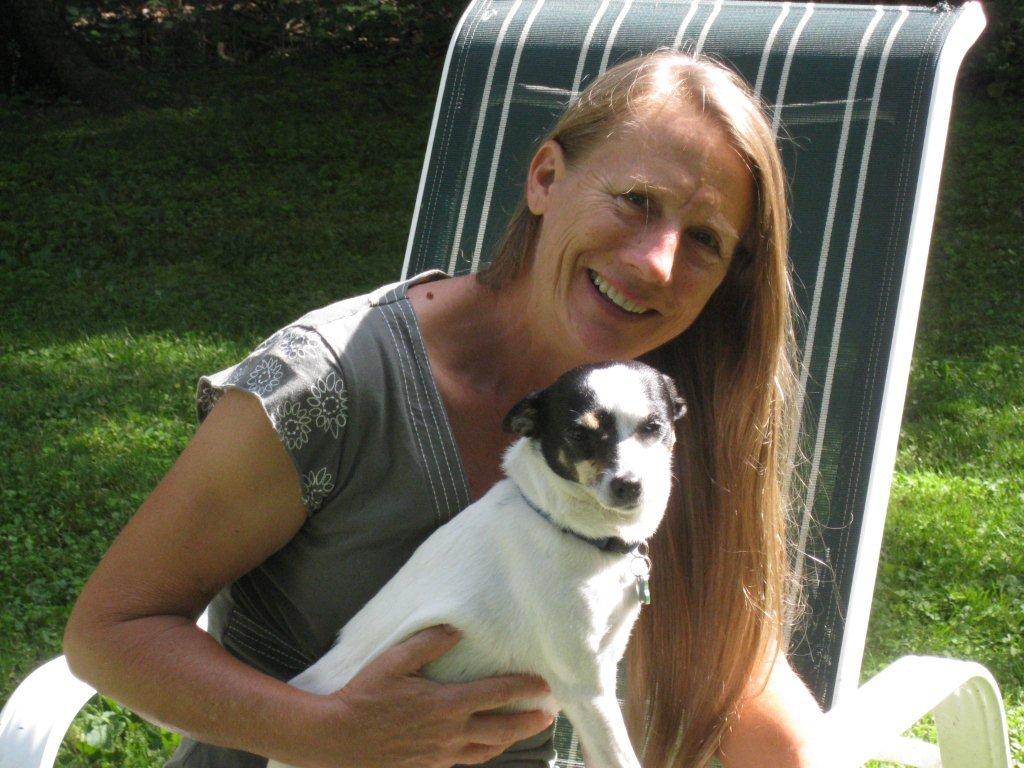
    Java and I are reunited. She looks marvelous. Java’s Auntie Kate provided a loving home for her in my absence. I am eternally grateful.

    Java managed to maintain her girlish figure thanks to her new circle of admirers resisting the temptation give her “just one more treat.”  Believe me, I know the will power it takes to resist those big brown eyes begging for another treat. A huge thank you goes out to all who resisted the temptation.

    Although Java showed little interest in the neighbor dogs, she enjoyed her thrice daily runs in the Woods at Hughes. From what I hear Val, Steve, and Cyrus were definitely to her liking, with Steve having the lap of choice.

    Thanks to everyone who made this transition and temporary separation a positive experience for Java.

  • Corbett National Park

    Corbett National Park

    June 4-6, 2010

    I put off writing about Corbett National Park because I wanted to be sure my entry did it justice.

    This park was perfect in nearly every way. Even the guest houses were fenced to ensure wildlife protection. The first night, just after dark, I learned why.

    Under a cloak of darkness a young tusker approached the entrance to the compound. His ivory tusks gave him away, glistening under the fluorescent moonlight. He stood perfectly still, close enough to touch, close enough to drop a heavy tusk on the hot wire, which would immediately short out and give him access. He waited, I waited. He turned and walked away, hopefully to return another night…

    The flight to Delhi was uneventful, even pleasant. I realized the comfort I derive from familiarity. I was in my element, having flown more times than I can remember. My heart went out to these people wandering aimlessly through the plane trying to figure out where to sit. As I watched, it struck me that some passengers — in fact, most of the Indian passengers — were having problems because aisle and seat numbers were in English.

    Within minutes of arrival I was in my car and on the way to Corbett Tiger Reserve. This park is known for its tigers and elephants. I arrived too late in the day to go into the park, which is where my lodging was, so I stayed in a guest house. It was hot, sticky and not inside the park, but I knew it was a temporary delay. The next morning I found myself struggling to communicate with the young man who had been hired to drive me, the guest house manager who was trying to get me checked out of my room and a tour guide who showed up to help me. I was not sure if the guide had really been sent to assist me or just saw me as a potential tour client. So I made the best of it and got in line at the Forest Department office, hoping I would get a ticket inside.

    As luck would have it, an English speaking man was in line in front of me. Go figure — for the past many weeks I had seen very few non-Asian people, most of whom spoke English as a second language. When I balked at booking an overnight in a coed dorm room, the man turned to me and said — in perfect English, I might add — “My wife and I are booking the dorm room if that makes you more comfortable about booking there.” Yes, that did it. If an English speaking woman was going to be in the dorm room that would work for me. It turned out that the three of us would spend a fair bit of time together over the next two days.

    Dr. Christy Williams had made the arrangements for my time in India. As a result, I was seeing many things I would have otherwise not been privy to. Our mutual goal was that I see all of the different ways elephants live and are cared for in India, both in the wild and captivity. So far I was having an extensive exposure to both, but I never expected what I saw in Corbett.

    Up at dawn, the jeeps fanned out in different directions. Most tourists wanted to see tigers; my driver and guide knew I only had eyes for elephants. Pratap Sing was a knowledgeable and enthusiastic guide; his English was fairly good. He introduced himself and confirmed that I wanted to spend my time observing elephants. A huge smile spread across his face as he instructed the driver to reverse a few hundred yards and then head in the opposite direction of the other vehicles.

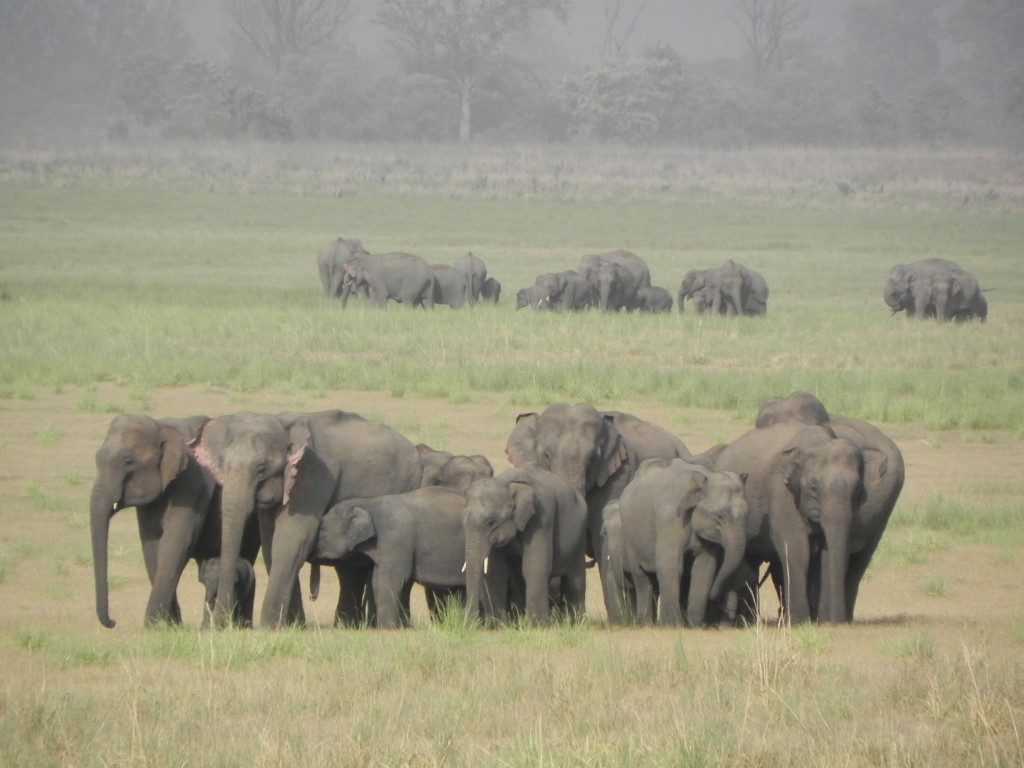
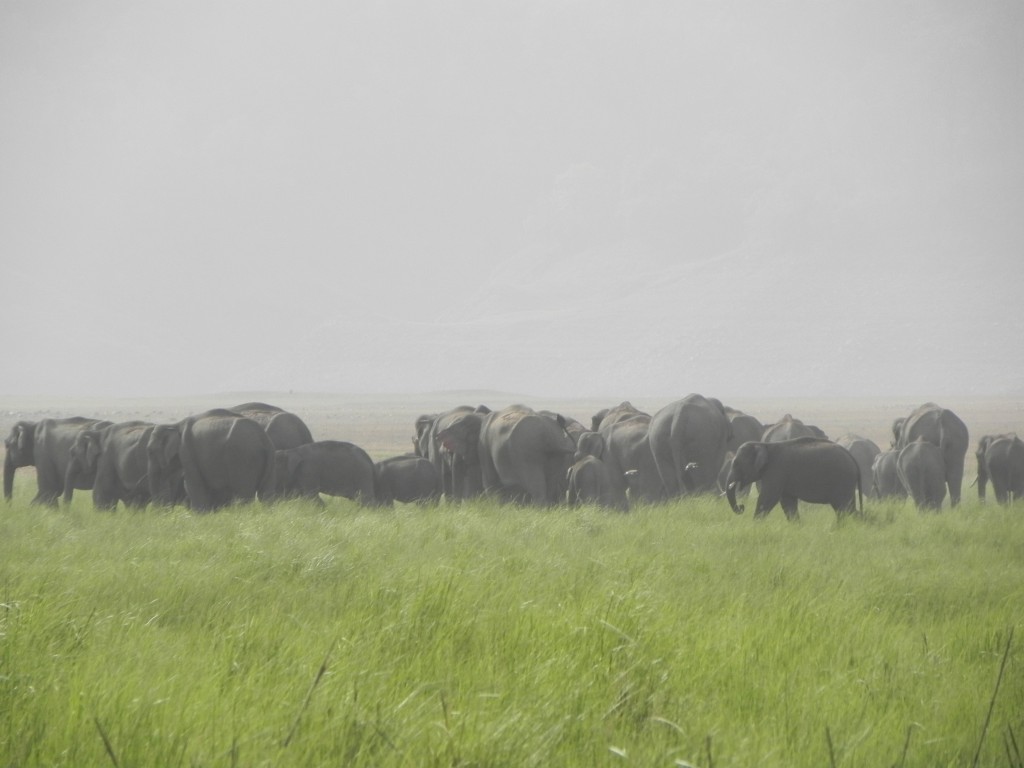
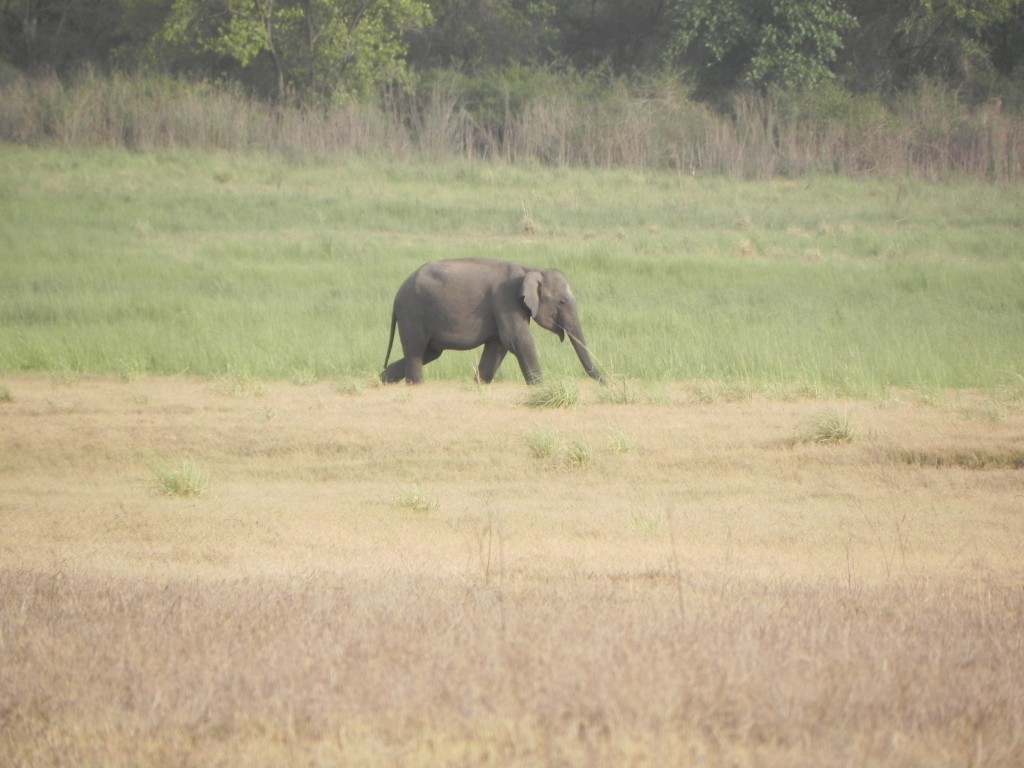
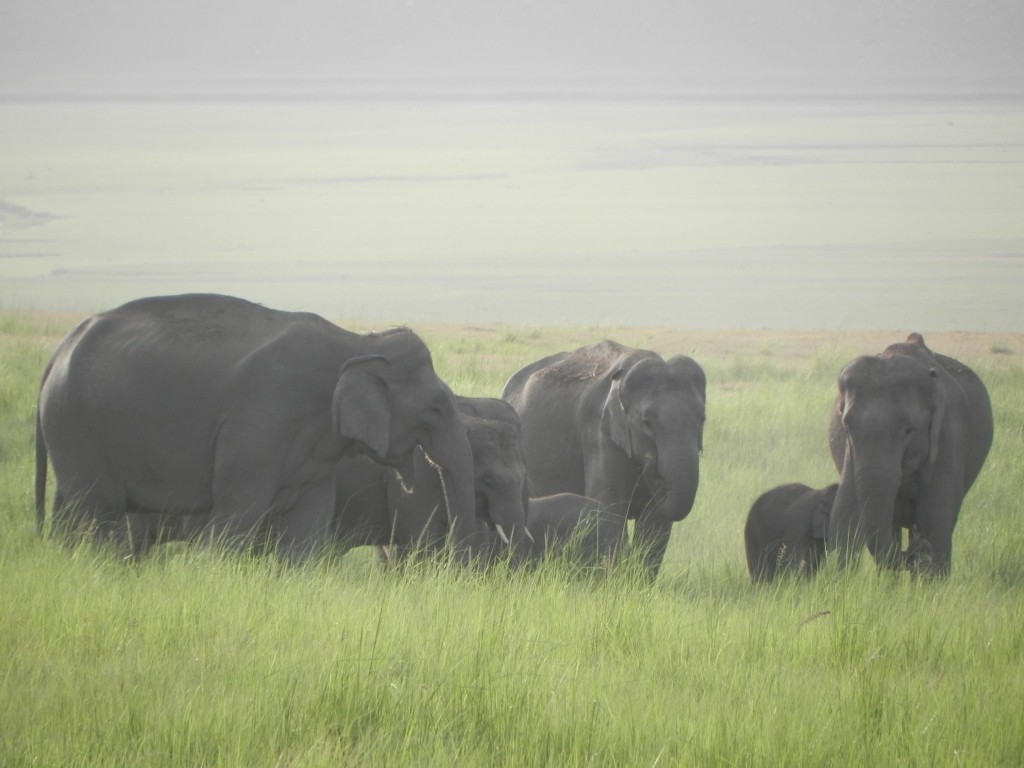
    The forest was impressive, with mature trees and dense vegetation. As we emerged from the forest into a sea of pasture the sight was like Jurassic Park — elephants everywhere. There were four families grazing this morning, more than 100 elephants in total. Within a couple of hours there would be little trace of them as they would retreat back into the forest during the hot midday hours. But for now they grazed contently.
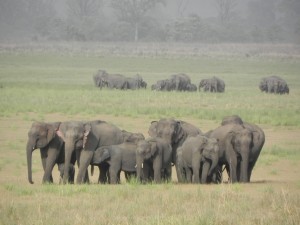
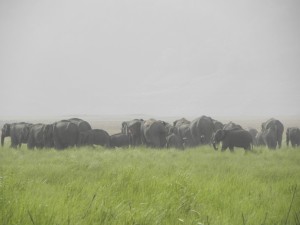
    I watched as each family moved in unison, forming a tight knit group around the babies when vehicles got close. The four herds did not intermingle, although I did observe an interesting sight. Two adults and a calf broke away from their herd. The calf darted out ahead with the adults in fast pursuit. One adult stepped in front of the other, stopping her abruptly. The calf returned to her mother. They all changed directions but then the mother and calf spun around in the opposite direction again and started running. Again the other cow cut them off. This went on for almost fifteen minutes; all three maneuvering back and forth across the empty expanse between two herds.

    At first it looked like the calf was trying to run away. But later it seemed that one adult was trying to prevent the calf and other adult from leaving the herd. As the dance unfolded, it became obvious that the mother and calf wanted to visit the neighboring herd and the other adult was trying to prevent them. In the end the mother and calf succeeded in joining the other herd, followed by vocalizations and many trunk embraces. Apparently they were related.
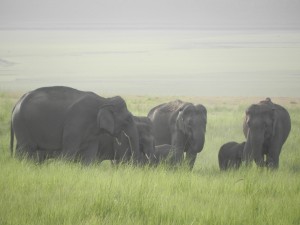
    Amazingly, there appeared to be an equal number of calves to adults in all four families. With the exception of the one mother and calf and a tusker, the herds did not mix.
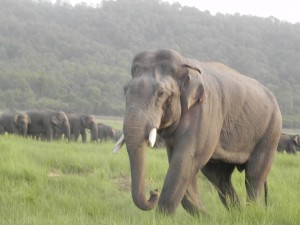
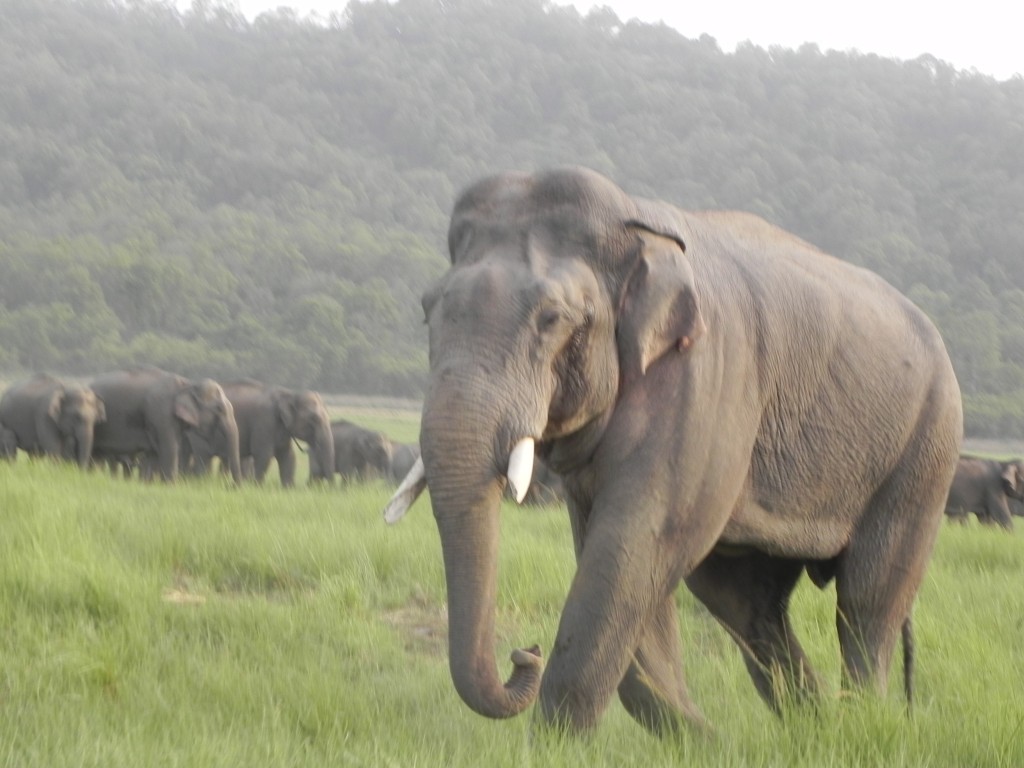
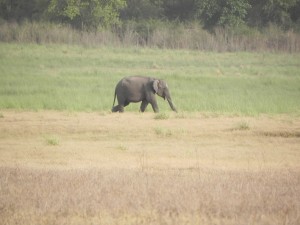
    A magnificent bull casually meandered across the grasslands, fusing with each herd calmly and methodically. The females showed awareness of his approach, but not the calves — they were deep in play. The adult females would halt their feeding activity and stand still silently. As the tusker approached, they would gracefully turn from him and, in most cases, take a step or two in the opposite direction. None ran but neither did they approach him. The majority of females displayed a bit of tension upon the male’s approach and seemed to relax after he left.

    The tusker calmly approached a few females, scented them and, after remaining for a few minutes, moved on to another area, another herd. He was in full-blown musth. Anyone in the grassland area with a decent sense of smell, could detect his presence. His pungent odor wafted across the vast area, carried by the gentle breeze.

    The mesmerizing scene lowered my heart rate and sharpened my senses. I took in the panoramic vision of nature’s finest. I spent hours just breathing in the live image of elephant family activity. Each family had several young calves. All were nonstop activity. The sight of so many young elephants intermingled with aunts, mothers, sisters and young brothers was touching. Although I wished he had been able to grasp the gift that stood directly in front of him, even the impatient fidgeting of my bored young driver was easy to dismiss.
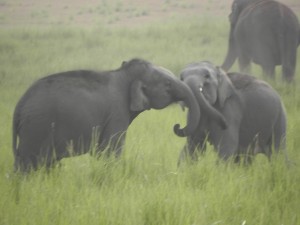
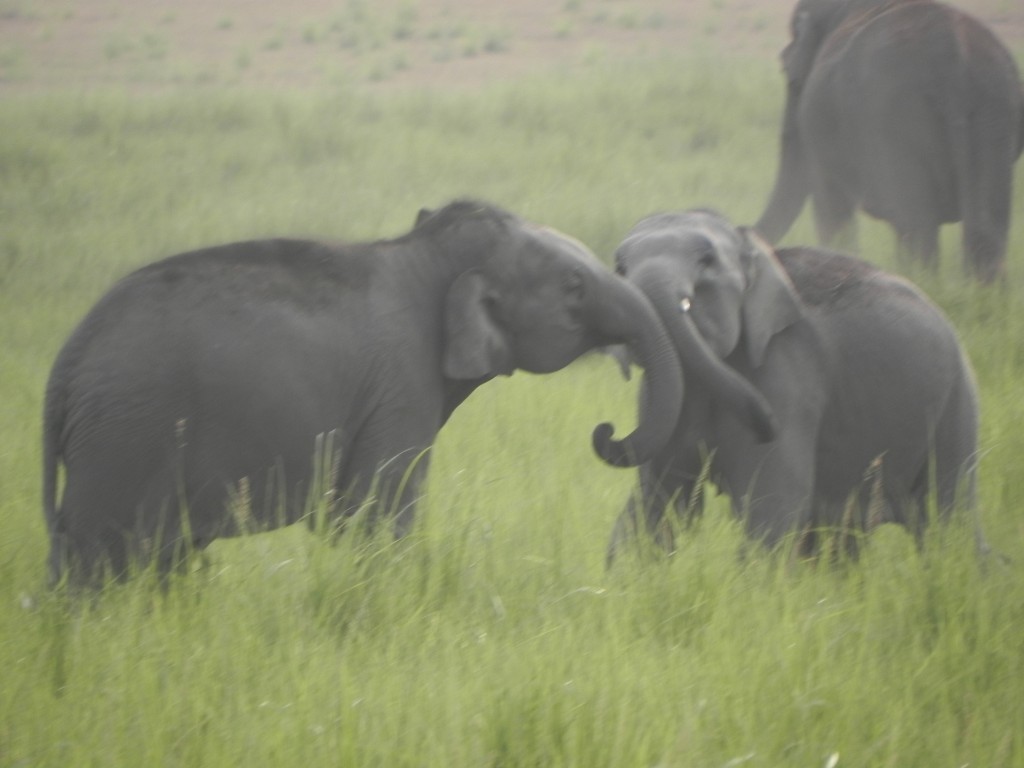
    The calves raced around the others, pushing head to head with entangled trunks draped over each others face. The male calves appeared to be more physically assertive but the females held their ground most of the time. Whenever the ele-play involved two young males the action would accelerate.

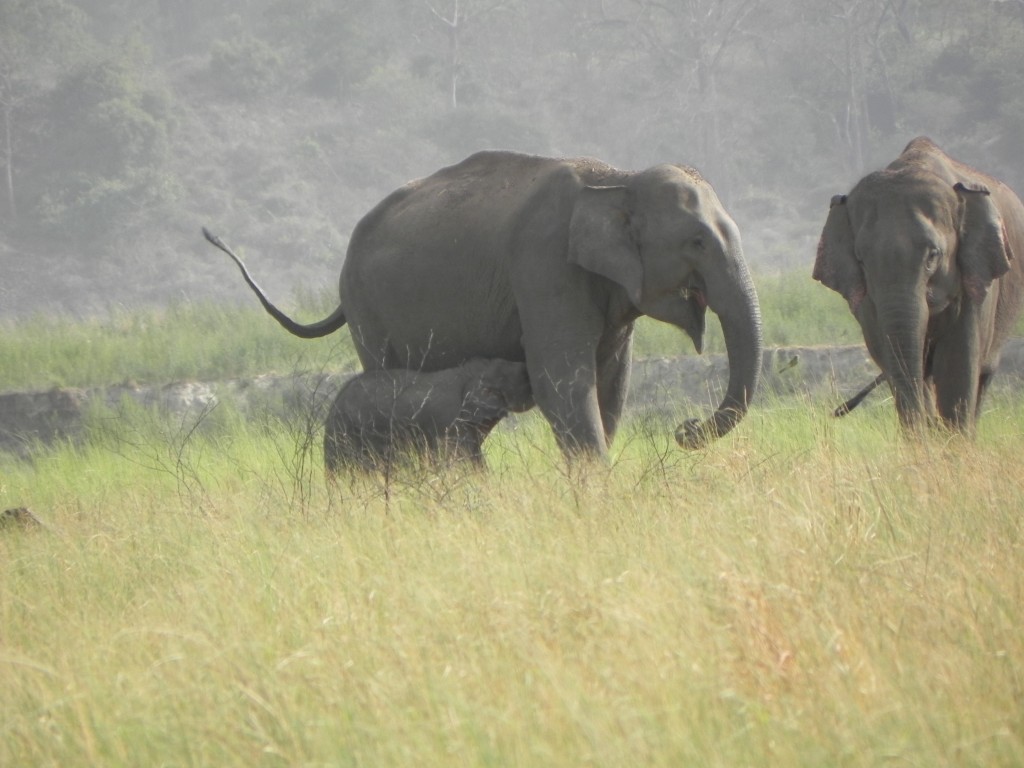
    Mock breeding and competitive pushing matches dominated the interaction. One young male, determined to demonstrate his superior strength, pushed his playmate down to the ground, all in play. The other male took full advantage of the opportunity to tumble to the ground, roll around in the tall grass and toss his legs into the air in glee. These calves played nonstop, with the exception of a periodic pit stop when they refueled from mom or an auntie.
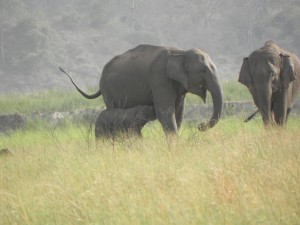
    It is amazing to watch a calf interact with their family; everyone is a babysitter. Young siblings engage in the roughhousing, obviously refraining from using their full strength on the little ones. The young sisters and female cousins are particularly gentle with the calves.

    As the herds relax, they spread out along the horizon. It is only when the calves call out and run to their mothers that the group protectively closes up like a clam shell, calves hidden in the center.

    I was fortunate to observe these elephant families for two full days and a third morning. They were strikingly healthy. One herd, the dominant herd, could be identified because each member was just a little overweight! Christy explained that the dominant herd controls the best feeding areas and, as a result, gain more weight.

    Knowing that our financial support in a small way has helped these elephants remain free and safe brings me great joy. To watch the families interacting, living the life meant for them, I could not help but wish this for all of India’s elephants. Safe freedom…it is possible. Protection of wildlife and the habitats they require to survive should be a priority, not only for India but for the every country.
  • 4th of July

    Happy 4th of July!

    It was a relief to know there would be no loud fireworks to scare the 60+ dogs that have found sanctuary at The Elephant Nature Park. When the sun goes down so does human activity and the noise level…well most of the time. The past couple of nights have been the exception. The dogs have been engaging in dog culture.

    Their lives are different from anything you might experience in the US: they are free roaming. Like in India and Nepal, the dogs in Thailand actually have their own culture. They are loved, fed and cared for by humans, but they are also allowed to be dogs in the most basic way. They have self-designated packs and form close bonds with fellow pack members.

    In addition to providing ample freedom for the dogs, their freedom brings with it dog disagreements. It takes some time for most of us to appreciate that allowing the dogs their culture means leaving them alone when they are establishing the pack hierarchy.  It’s hard to stand back but that is the best thing. Their boisterous yelping and barking is usually as bad as it gets.

  • Rajaji National Park

    June 6

    Today I traveled from Corbett Tiger Reserve to Rajaji National Park. It was great to finally have an opportunity to spend time with Christy Williams, who oversees wild elephants and rhinos throughout Asia for the World Wildlife Fund. A more knowledgeable and committed person you will not find.

    I was fortunate to start working with Christy a decade ago, when we provided financial support for some of his elephant research. Over the past decade Christy’s work has resulted in priceless data about the movement, feeding behavior and breeding activity of the elephants that reside in both Corbett and Rajaji National Parks.

    The first thing I noticed as we entered the park, aside from the absence of tourists, was a concrete wall that ran parallel to the road inside the park. There is a serious human-elephant conflict problem in this area. From the proximity of the large city that bumps up to the park’s boundary, conflict would be expected. The wall has succeeded in preventing the elephants from leaving the park as long as it stretches, but the wall ends at the riverbed. Christy explained that the elephants learned almost immediately to walk down the wall to the river bottom where the wall ends and simply exit the park at that point.

    Unfortunately, the conflict that is taking place outside the park is due to the human activity inside the park. Local tribal families live inside the park. The Forest Department has tried to move the families, even offering them free land as an incentive. So far only a few families have taken the government up on the offer.

    As a result, the trees and grass inside the park are being decimated. Trees are virtually stripped of branches and leaves to provide fodder for the many head of cattle owned by the tribal families. Additionally, the cattle themselves overgraze the grasses, resulting in a need for the elephants to exit the park to find food. As a result of the overgrazing, weeds have invaded, replacing the grass land with vegetation that is not suitable for elephants.

    Christy is determined to protect this jewel of a national park and the animals indigenous to the area. Each challenge has a solution and Christy discussed the many solutions that are available to the Forest Department. Spending time with such a motivated, highly dedicated human brings me hope for the future of wild elephants in India.

    As soon as we arrived at the guest house, tea was served and then we headed out on a trek. It was fabulous. I saw firsthand the damage to the vegetation and the department’s efforts to insure that the animals had ample access to water. Although I did not see elephants, evidence of their presence was all around, from fresh footprints by the watering holes to twisted tree branches, a sign that elephants had been tugging on them for food.

    As the sunlight faded, a Sambar deer vocalized. Over a short period of time other warning calls sounded many times. These calls seemed to make a full circle around us. Easily recognized as the warning that a tiger had been detected, the Sambar deer informs the entire forest when a tiger is on the prowl.

    Nighttime fell on some very content people who savored every moment of being in this wild habitat.

  • abundant wildlife

    June 3, 2010

    This morning I really hated to pack my bags and leave the Annimalai Tiger Reserve. Its towering bamboo stands, peaceful setting and intensely beautiful landscape was spellbinding.  This forest was different from the others I’ve visited. The late afternoon haze draped over the trees like a delicate silk scarf. Upon entering the forest I felt strangely transported from the present.

    The Rest House that was arranged for my stay sat in a prime location on a hill, overlooking a grassy area grazed by wildlife. It was build by the British in 1926, and had a fine air about it. The large high ceiling rooms and expansive porch was delicious.

    After dark, when I went outside to shake the caked dirt off my tennis shoes, I heard a rustle coming from behind. Conditioned to the realities of these wild habitats, I silently retreated inside the window lined porch. Darkness prevailed with the exception of a porch light that I had flipped on when I exited.

    In moments I saw movement, something was emerging from the dark. It was a full-grown female wild boar. I stood in awe of this chance opportunity to witness the nighttime adventure of this wild and potentially dangerous animal, just outside my reach. I was later told that wild boars have been known to fight off a tiger for up to an hour.

    Yes, I had silently hoped the sound maker was an elephant but it is probably best that instead this equally wild but smaller forest inhabitant showed itself. The boar took no notice of me, but went about her business, scouring the ground for something tasty to eat.

    I rose with the sun, a new habit that I have developed since arriving on the Asian continent. My nocturnal ways have shifted to meet the pattern of the local people: up early, to bed by 10. No more staying on the computer until 2am!

    From my perch on the hilltop, which provides a panoramic view of the mountain (ghate) range, I watched the sun rise, appreciating the birds and other creatures whose vocalizations echoed above the forest canopy. A large family of spotted deer grazed nearby on the immense naturally manicured lawn. Young deer of every size frolicked playfully under the watchful tender eyes of their mothers, while the three males in their midst attentively surveyed the landscape.

    Tea was served.

    Driving down the mountain gave me time to reflect on the beauty of this biodiverse forest, home to so many endangered and precious animals. The Forest Department is responsible for protecting the forest and its inhabitants. From my perspective, the men on the ground are seriously dedicated to their work. Even as I left the reserve I saw more species of animals I had not already seen. In two days time, I saw wild elephants, wild boar, forest chicken, spotted deer, bonnet monkey, three striped squirrel, samber deer, malabar giant squirrel, unidentified red headed wood pecker and wild hare. And as our vehicle neared the check point, where crossing would mean leaving the mystical world of the forest, a barking deer froze in his tracks just off to the side of the road.

  • such beautiful forests

    June 2

    All I can say is  sensory overload, starting with the forest rest house built in 1926 and including the wildlife and spectacular landscape.

    While catching up on some journaling, the first monsoon rain of the season passed over. Pre-storm, a family of bonnet monkeys silently scurried across the expansive pasture area in front of the rest house. They disappeared into a large stand of bamboo. They could be heard deep inside the bamboo, apparently well aware of the approaching storm. With the family safe they would wait out the storm.

    The wind picked up, sky clouded over and the rain began, It was glorious. After about 30 minutes the storm passed and the skies cleared. A mature deer with a huge set of antlers was calling and then stepped into the clearing. He continued moving along the tree line, calling several times. He lifted his nose into the air, twisted it along with his head, scenting. Before long, female deer began sprinting across an open area, clearly nervous. Each adult female was accompanied by a very young calf. The bravest of the females led the way for others, who followed in the direction of the male.

    Over the next few minutes a young monkey was seen collecting something edible, then disappeared back into the thick bamboo. This bamboo is mammoth. It grows in large clumps and I can’t begin to guess how tall it is. A giant squirrel was the next creature to catch my eye as he scampered along a tree branch, hesitated for a moment and then disappeared into the forest cover. A small woodpecker landed in a nearby tree and a baby wild boar, focused on his mission, ran with a very rigid gait across the front lawn toward the back of the rest house, toward the kitchen door.

    Each forest I’ve visited is unique, as if it is its own person, related but individual from the next. In this forest, the giant bamboo creates a mystical feeling. The giant stands gave rise to the imagination; ancient times, undiscovered worlds, the land of bamboo, deep within the forest, reflecting dappled light, shaggy stocks snapped by wind or elephant, creating a memorizing aura, almost magic.

    Finally it was 5pm — time to make the seven-kilometer drive to the elephant camp. The drive permitted time to assimilate to the special world shared by elephant and tribal caregivers. Leaving the modern world behind, entering Anaimalai Tiger reserve was like stepping into a parallel world.

    I am told that 85 tribal families live in this village. Actually they make up the village which consists of mahouts,  kavadis and laborers who assist with maintenance of the forest. These are indigenous people who traditionally have maintained elephant.  The culture of society lived by these people is compatible with the culture of captive elephants. The two cultures mesh perfectly. It appears that when the tribals are well established and able to care for their families they provide a seriously important service for the elephant and the forest department. Without bull hooks, knives or anything more than a small branch they maintain a working relationship with their elephant.

  • Temple elephant

    Temple elephant

    June 1, 2010

    Today I left Mudumalai for Coimbatore. Each place I stay has a distinct flavor, subtle differences that catch me by surprise. At first glance it seems that all the places are alike, but indeed, that perception is not correct.

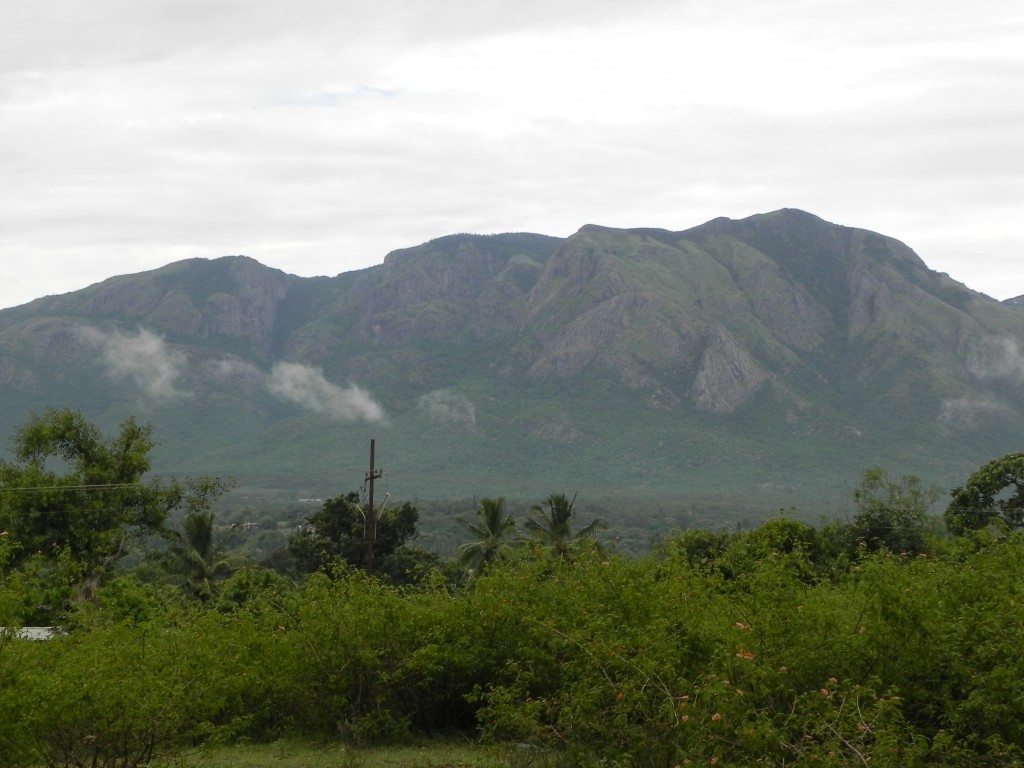
    The view from my India Institute of Science guesthouse provided an ever-changing array of activities; I nearly wore my camera out.

    The spectacular mountain range directly in front of me.

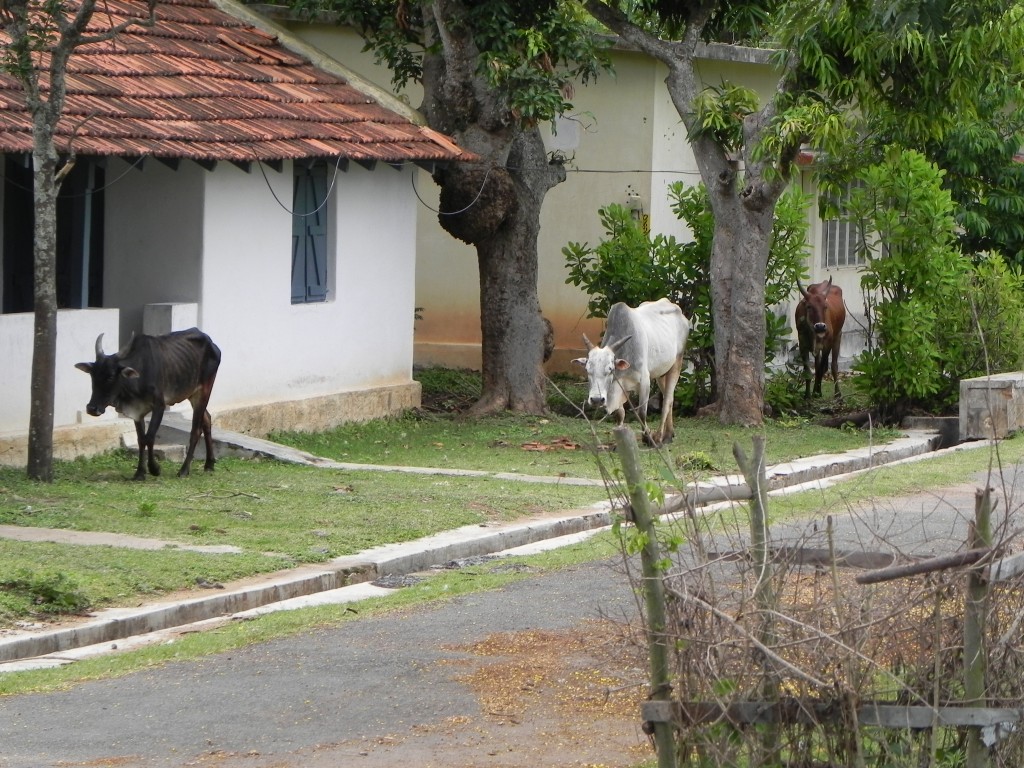
    Free roaming cattle even closer.

    It has taken a bit of behavior modification on my part to stand back and observe the nonhuman animal life that is part and parcel of this culture. The animals are really not accustomed to being approached. They flee if too much attention is given to them. So I have learned to be satisfied with simply watching the cats, dogs, cattle, goats and pigs, just as I do the wild boar, monkeys and elephants, all going about their lives in complete synchronicity with one another.

    Unique to any other place I have visited so far is the piped music coming from a towering speaker in the local village. The first night in Mudumalai, an hourly bell sounded from the loud speaker followed by a kind sounding message in a woman’s voice. I don’t know what the message was but from the tone of her voice, she was wishing everyone well.

    On the first morning, when I heard the music and identified it was coming from the village area I thought to myself, “What if you are a villager and don’t want to listen to that particular music at that time?” Then I realized that it is a cultural thing. These villages seem to function as a group, many individuals and family providing different services to the community. Although each person is an individual, I believe that ultimately they operate as one. In such a social community I realize that group music could indeed be appreciated as a gift.

    The drive to Coimbatore took us through some pretty treacherous mountains; when they say hairpin turn they are not kidding! The views were breathtaking. I continue to be overwhelmed by the richness of this culture and the mosaic of color, texture and sounds, all nature dependent.

    It has taken me this long to finally realize that India is very animal welfare conscience. Learning something new is much easier than relearning, which explains my delay in recognizing just how welfare conscious the people are. Throughout the wildlife sanctuaries and national forests signs are posted instructing visitors not to harass, feed or touch the animals.

    In Mudumalai, a main thoroughfare cuts through the park, providing access to two large cities. The traffic is nonstop. Along this stretch of road it is illegal to stop your vehicle or take photos. Signage with animated photographs reminds the traffic to drive slow, not disturb the animals and protect wildlife and the forest.

    Without exception, forest officials, veterinarians and biologists all speak with one tongue when it comes to animal welfare. Animal welfare is understood as an integral part of the forest department’s responsibility. How refreshing to hear a high-ranking officer state that elephants should be treated without abuse and that their welfare is paramount. Listening as one official stated that elephants have feelings, too, brought a smile to my face and courage to my heart. Efforts for animal welfare are not considered controversial here in India.

    Coimbatore was a pleasant surprise. The travel books warned that it was void of anything to do but that could not be more untrue. A bustling modern city, Coimbatore was actually a nice break, another variation of scenery and culture, as well as the home to the WWF India offices. I was escorted to two temples and just as my luck would have it our timing was perfect.

    After driving through communities with roads hardly wide enough for a single jeep, we arrived at the Patteeswarar Temple.  I was instructed to leave my slippers (shoes) in the jeep as slippers are not permitted in the temple. The moment we arrived at the ornate stone entrance I was overwhelmed by the sheer massiveness of the structure towering overhead. I snapped out of my trance when I heard, “Madam, madam, the elephant.”  I realized almost too late that their calls were meant for me. I nearly missed seeing the full-grown elephant exiting the temple, walking mere inches behind me.

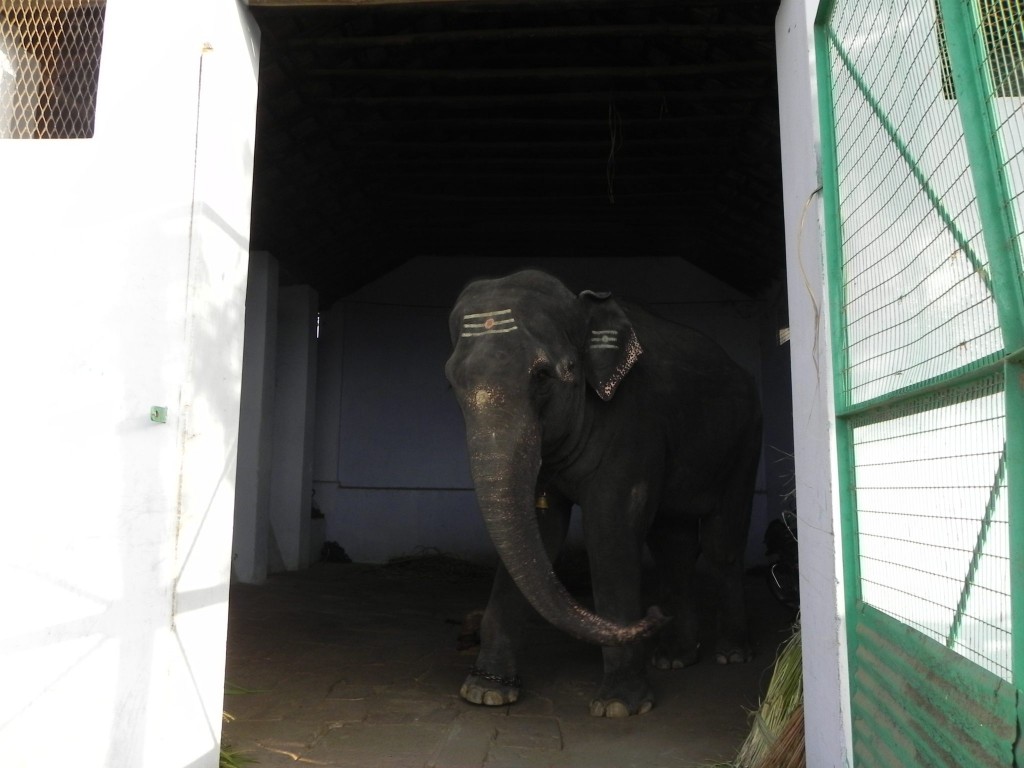
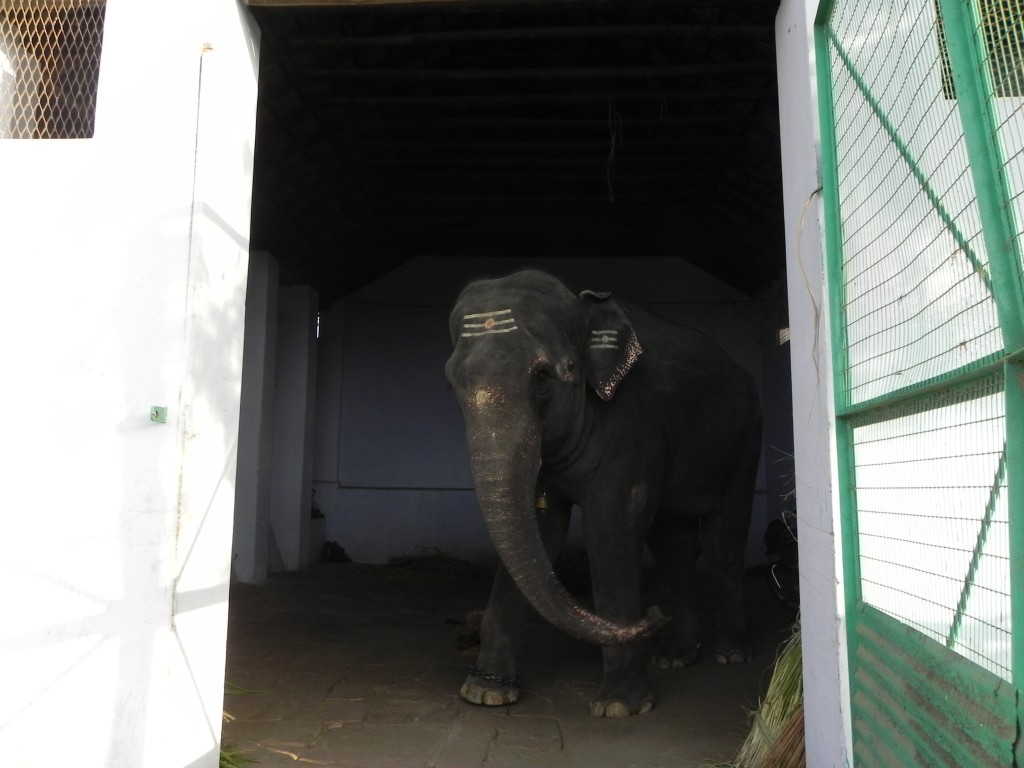
    Kalyani has been the solitary female pachyderm resident of the temple for the past 17 years. Although the manager did not know her exact age she looked to be in her early thirties. Her daily temple duties concluded, Kalyani was heading home to her stable for the night.

    Running, I tried to get ahead of Kalyani to take photos but her long legs hampered my efforts. Remember, I had left my slippers in the car so indeed I was barefoot. My escort/translators kept pace. The scene must have been comical: one crazy barefoot American lady and two well-dressed local men running along with the elephant with a vehicle following close behind.  I really had to laugh. It is moments like this that I am reminded of how kind and helpful everyone has been, assisting with my fact finding mission on elephants.

    Just when I succeeded in getting ahead of Kalyani and in position to take photos, the Phandis made a right turn along with Kalyani who ducked into the doorway of her stable. With precision executed with silent direction, Kalyani maneuvered herself into place for chaining. Her stable was a concrete structure with a metal screen door.  I snapped as many photos as I could as Kalyani was secured for the evening.  Fodder was laid out and two motorcycles that were leaning up against the wall were removed. In a matter of moments, it couldn’t have been a minute, Kalyani was secured in her stable and the mahout was ushering me out so he could close and lock the screen door.

    The mahout indulged me for a few minutes as I asked questions that were translated to him. How old is she, how long has she been here? Does she go for grazing? Does she go for bathing? How much time does she spend at the temple? By this time the mahout clearly was done with all the questions and gestured that he was leaving. I looked at the screen door that divided Kalyani from the outside world and then surveyed the surrounding area. Kalyani’s stable was on a quaint, narrow dirt road with crowded residences and shops lining both sides of the street. I asked the mahout if he slept here with Kalyani and he said no, that he lived close by.

    On the way out I noticed an expansive area with the lush vegetation, places where Kalyani could easily have foraged for food, providing her not only with live vegetation but also relaxation, distraction and natural substrate.

    As I was still pondering Kalyani’s existence, we received permission to visit another temple elephant. We had gone to the temple earlier but the elephant was not there. Many times it’s difficult to gain permission from privately run temples so getting an invite was exciting.

    Congestion is a way of life in India’s cities. Every manner of vehicle crowds onto the roadways and jockeys for a position closer to the finish line. I won’t lie and say I have become accustomed to being a passenger in this driver’s mayhem. I was excited to see my next temple elephant……

  • Mudumalai Tiger Reserve

    Mudumalai Tiger Reserve

    May 30

    Finally…I have seen my first wild elephants. Two small herds: one with four females — two adults with two young calves; the other with two young calves, two adults and an adolescent tusker. They grazed on the tender grass growing in the speckled shade, protected from the direct sunlight by a mature canopy. Our presence went undetected as we, following the rules, did not stop our vehicle. It was a calming sight to behold.

    My time was spent meeting the forest authorities, including veterinarian Dr. Kalai, who toured me through the facility. The pride he has for his work was obvious. Knowledgeable and engaging, Dr. Kalai was a fountain of information about how the camp operates.

    It makes sense that the wealth of knowledge Asia’s experts possess about their elephants is unmatched by any other nation. Living with this indigenous species has provided Asia with a wealth of knowledge, not only of elephant life in the wild and captivity but, more recently, the challenge that is threatening the Asian elephant’s existence: human-elephant conflict. The forest personnel, professors, biologists and researchers I’ve met all show a genuine desire to find solutions before it is too late. So many bright and dedicated people unified to save this flagship species so important to its habit and fellow creatures, including mankind.

    This forest camp is expertly run from top to bottom. In the food prep area the camp elephants’ diets were listed on a huge board with the ingredients and supplements included in individual diets. I got my first look at the “cooked” diets I had heard so much about. Lined up in neat rows on the diet table were blocks of precooked foods recently removed from their moulds.  Some were topped with salt and other additives, sitting ready for the next stage in the process of elephant diet making.

    Sanctuary volunteers who tired of the endless produce chopping which dominated their service at the Sanctuary have nothing on the assistant mahouts in these camps. They are solely responsible for measuring, cooking, moulding and finally hand mixing each elephant’s diet, a process that demands precision and effort, not to mention repetition. Needless to say I was impressed.

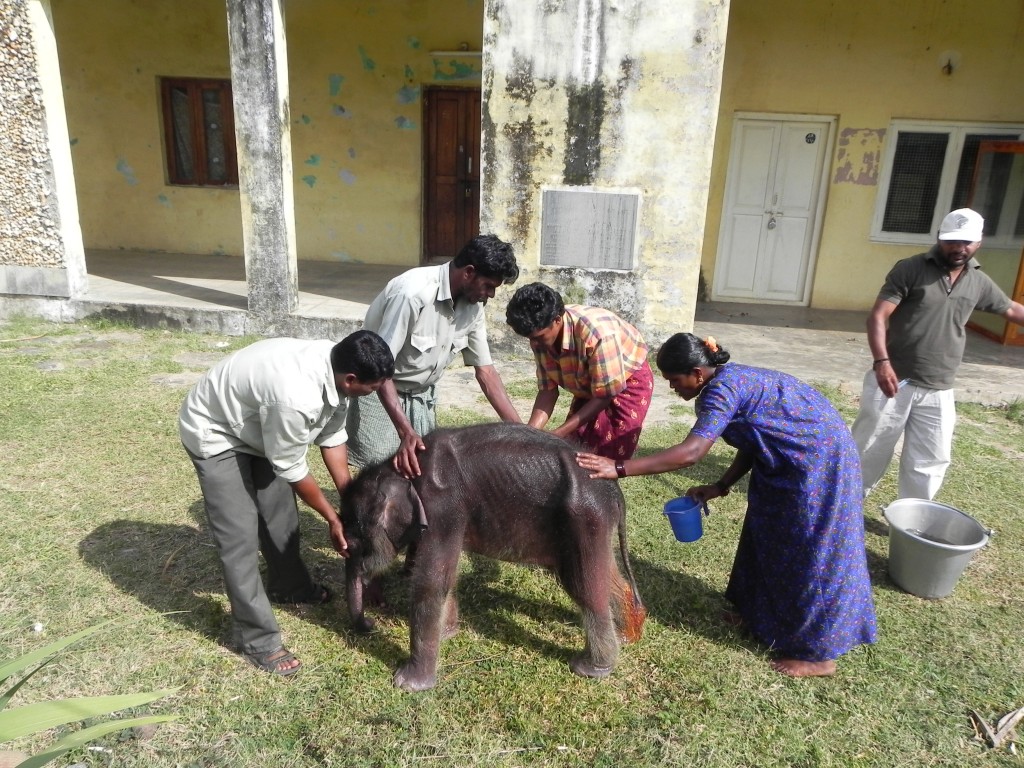
    Only a few days before my visit an infant calf had to be rescued after being attacked by a crocodile. He survived the attack but his mother and family could not be located. Every effort possible is made to avoid bringing a calf into captivity but in this case there was no other choice.

    I observed firsthand that, indeed it takes a village, or should I say a tribe, to hand raise an elephant calf. The family responsible for this calf’s care had only recently turned over parenting of a young female calf they had raised for the past three years. They surely needed a break from the constant demand of a baby but took the new orphan in without question.

    Watching the parenting dance the family gracefully engaged in was mesmerizing. The father of the family was the calf’s primary caregiver. The matriarch prepared and provided the formula. The veterinarian directed veterinary care, which was provided by the veterinary technician. Each person has a role to play in the calf’s care. An older child assisted with tasks to support the calf’s care and medical treatment and a young granddaughter babysat, expertly I must say. They did not actually fawn over the calf but provided the security he needed. So young, he was obviously unable to understand his circumstances. Relying on survival instinct he followed around after a warm body. I am told that in a few weeks he will differentiate between the warm bodies but for now any warm body will do.

    His wounds were deep and treatment was painful. Throughout, his entire family showed care and gentleness, their skills expert, their compassion palatable. My heart went out to this little guy, who was sort of walking in a fog but, if he had to be separate from his mother and herd, he could not have been in better hands.

  • CUPA

    May 24

    I spent the day with Suparna Ganguly, a trustee of CUPA, Compassion Unlimited Plus Action,  a well-respected animal welfare NGO doing fabulous work in India.

    In addition to running a dog and cat shelter, CUPA operates a rehabilitation facility outside of the city, adjacent to the Bannerghatta Biological Park. Suparna is actively involved in many animal welfare projects, with welfare of elephants in captivity currently a main focus.

    CUPA underwrites the cost of care, including the mahout’s salary, for an elephant confiscated from a temple who is currently residing at the zoo.

    The rehabilitation facility sits on seven acres enclosed by a substantial electric fence.  The village is on one side and the wilderness on the other.  Wild elephants come down into the village and raid the farmer’s fields so the government is constructing a block wall to keep the elephants out. From what I understand the wall has been under construction for a few years and is now close to completion.

    CUPA’s rehab facility was built on land donated by the government, on the elephant side of the wall. Only two nights back a wild bull elephant took down several sections of the electric fence, giving him full access to the rehab facility. He did no damage to the buildings but he did eat a couple banana trees, sampled a few other varieties of trees and no doubt was observed by the rehabbing monkeys, since the banana trees he ate were inches from their cage.  He damaged more fencing on his way out as he exited on the opposite side from where he entered. It was sort of surreal to be inspecting a fence that so recently was damaged by a wild bull elephant.

    I toured the spotless grounds with cages, aviaries, ICU and a surgery room. The varieties of the soon-to-be-released birds and mammals were mostly foreign to me, some quite rare.

    When the veterinarian appeared, we were ushered off to one of the flight cages to release several kites who were ready to be set free. Being unfamiliar with the process, I was dumbfounded when a handsome adult bird, the size of a large rooster, was handed to me for release. The timid creature held his/her head down, mouth open and held very still, no doubt quite scared.

    “Throw it up into the air!” I was told. I scanned the immediate area for a fairly unobstructed flight route and threw the bird skyward. With little effort she spread her wings with grace and precision, catching the hot-air draft and flew off. What a thrill to be able to set this magnificent bird free. I have never experienced anything like it.

    In fairly quick succession four birds were released, leaving several more in the flight cage. Their time for release would come soon. As we walked back toward the building I glanced up to see five gently soaring kites overhead. The newly released birds were floating, catching a draft, swooping down and then back up again, riding the invisible sky waves. The new arrivals to the sky had been joined by another of their kind; now all five danced over the rehab facility, blessing the place that had protected them and given them back their freedom.

    The main reason for my visit to the rehab facility was to evaluate it for elephants. I learned that CUPA hopes to acquire an adjacent 55-acre parcel of land and develop it for elephants. The land, once over-used by the villagers, is beginning to recover. The grasses are spreading and a few trees have begun to grow.  A rock formation that was used as a quarry now serves as a water basin, holding hundreds of gallons of rain water.

    We walked the property as I listened to the plans to create room, initially for two rescued elephants. India’s new regulations requiring all zoo elephants to be moved to sanctuaries has caused quite a stir in the country, with strong opinions on both sides of the issue. CUPA would like to create a prototype of what can be done in an effort to move the process forward.

    We discussed, among other things, available water, shade and access to the adjacent government-owned forest land for the elephants’ night release. There is a lot to consider but the fact that India wants to make internal changes to address elephant welfare is incredibly encouraging. I am honored that my input has been solicited.

  • Each Government Forest Camp and Wilderness Sanctuary is Different

    Each Government Forest Camp and Wilderness Sanctuary is Different

    May 18

    Today’s health camp was held at Pabitora, a wilderness sanctuary where nine elephants reside. National parks and wilderness sanctuaries are government-run and hold different classifications, with national parks holding a higher ranking. In both cases the animals are protected and tourism is not aggressively commercially marketed .

    At 16 square kilometers, Pabitora is considered small but it protects the largest concentration of Indian rhino in the world. Their renowned breeding success is enhanced thanks to the cooperation of the local people; poaching is not a problem. The landscape is unbelievably beautiful with a year-round clean river running through it; by all accounts Pabitora is an Eden.

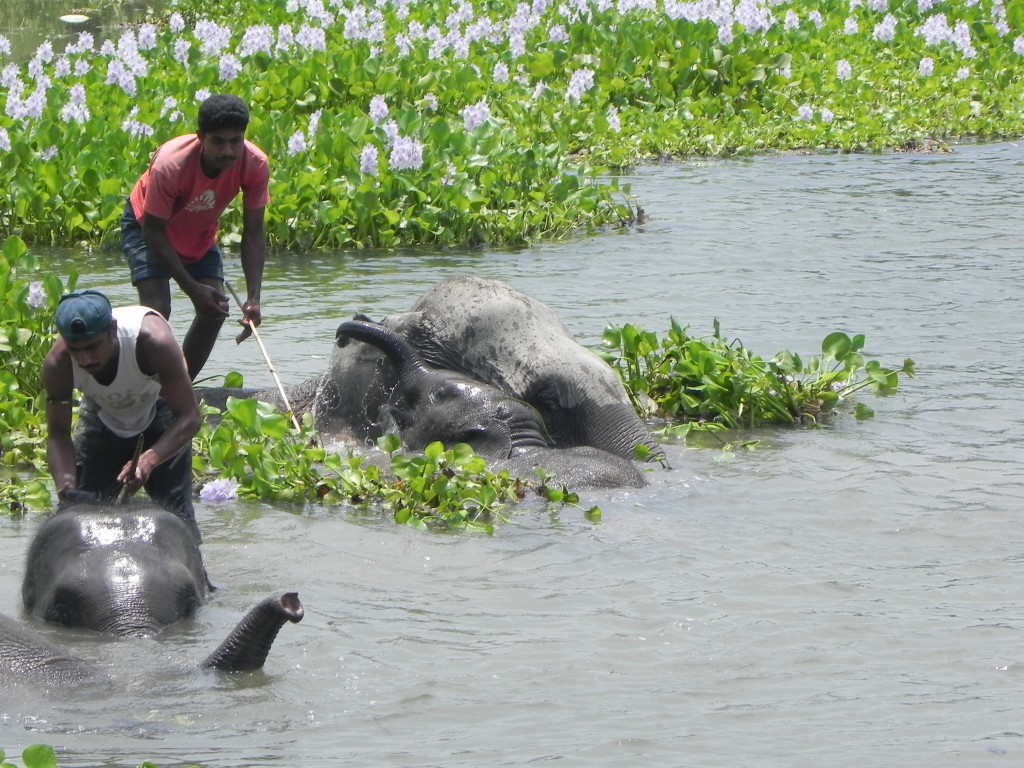
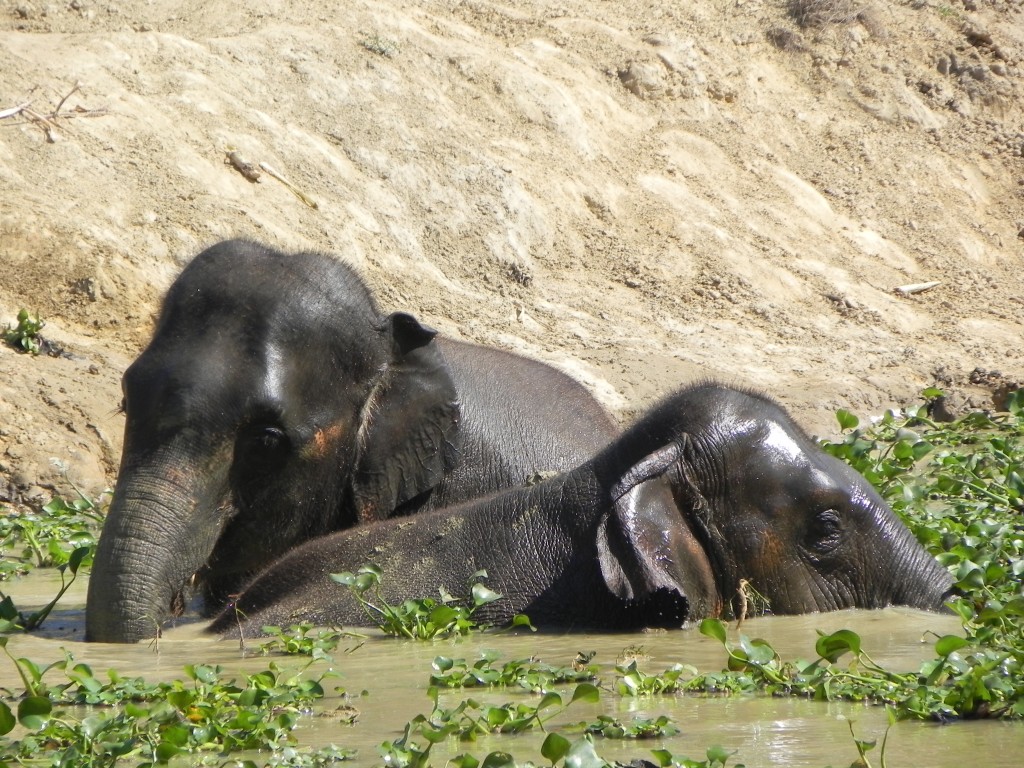
    The elephants were beginning to gather when we arrived. Some had just finished their morning bath while others where just taking the plunge. Bishwajit stuck close to his mother as she carefully maneuvered the river bank entering the shallows. At four months of age Bishwajit is already an expert swimmer, resembling a 500-pound bobbing cork.

    Phulmati is an experienced mother, calm and confident. She never lost sight of her lively calf as she gracefully waded around him. When she lowered herself in the shallows to allow her Phandis (lead mahout) to scrub her skin with a fistful of vegetation, little Bishwajit took full advantage. His comical play included climbing on his ever-patient mother’s face and over her head, concluding with a belly flop off the other side. In between submarine dives Bishwajit would surface and extend his tiny trunk, making contact with his mother’s face every thirty seconds or so.

    Bohagi, Phulmati’s first calf, is already five years old and recently completed her formal training. I looked closely to see if I could find the scars I was confident she would be wearing as result of the training process but to my surprise there were none.

    By the time Bishwajit and his mother emerged from the river, the camp was well underway. The males here outnumbered the females six to three. Two of the males, Naga and Rudra, were recently moved to the sanctuary from the Guwahati Zoo. Even though, in theory, the move is in their best interest as now they live in a natural habitat with access to clean water and live vegetation, their initial introduction was problematic. Bikaram, the sanctuary’s resident mature male was not impressed with the new arrivals and was extremely aggressive toward them. Determining if and how captive males should be introduced to semi-wild environments already occupied by mature males is a subject that will need to be studied to ensure the welfare of all concerned.

    Each elephant has a Phandis, their trainer and caregiver, who attends to their needs, takes them on anti-poaching patrols and ensures they spend many hours each day in prime grazing and foraging habitat. I know we would love to think of these elephants as being free to wander at will and do as they please but that is not possible. The parks are not fenced and human settlements encircle the national parks and wildlife sanctuaries. In the recent past some captive elephants have been released into the wild only to pay a horrific price when they wandered outside the boundaries of their protection and become a pest to the locals. Of the options, including illegal logging, tourist safaris and unemployment, which can be disastrous for their welfare, it would appear that these elephants are in the best situation currently available to them.

    Consistent with Dr. Sarma’s other camps, the elephants received a thorough physical examination, inoculations, fecal exams and deworming when needed. A large abscess on Phulmati’s back right leg was the biggest issue of the day.  Unfortunately for Phulmati, some time back a veterinarian had administered a high volume of drug at a single injection site, resulting in an infection. Dr. Sarma had been called in to address the problem and was pleased at the condition of the wound since his last visit. While dressing the wound he remarked that it was healing nicely.

    Bishwajit was full of himself, desperate for someone to play with. He figure-eighted under his mom’s belly and around her legs as she patiently accepted her abscess treatment. Cleaning out the wound and placing new dressing inside took about 15 minutes, during which time the ever-active calf made a nuisance of himself. At his tender age he knows no authority except his mother, thank goodness for that. And in the case of his mom, like most experienced elephant moms, Bishwajit could do no wrong. When he found that the humans would not engage in elephant games he targeted a nearby dog, promptly chasing it off.

    During the camp, all the elephants, Phandis and mahouts mingled around the site. Only after all the elephants had completed a physical examination and treatment did the exit process begin. A seemingly discarded piece of burlap was silently grasped and effortlessly flung by an elephant over her head to the waiting Phandis. Serving as a seat cushion of sorts, the rider placed the burlap just behind the elephant’s shoulder blades. He settled comfortably on the burlap, draped his legs behind her ears and tucked his feet on the inside of the neck rope.  Each Phandis signaled to his elephant in foot-language and the elephants responded. In a synchronized dance they fanned out in different directions, all leading to the same place, the forest.

    Now the elephants will spend hours grazing and foraging and later in the day they will patrol their home. Protecting the endangered rhinos is their job. Considering the alternatives for elephants living in captivity in Asia, theirs is a relatively good life.

    bath time before health camp examination