Category: Other animals

  • So Much To Learn

    May 17

    I have spent the past several days traveling with Dr. K.K. Sarma, Ph.D., and his team of skilled veterinarians, assistants and driver, to various elephant health camps in Assam. I have seen and learned so much. The experience gives me hope for the elephants in this region.

    Dr. Sarma is an Associate Professor in the Department of Surgery and Radiology at the College of Veterinary Science, AAU Khanapara, Guwahati, Assam, India. Spending time with such a dedicated professional has caused me to realize that although we may be spread across this planet, elephant caregivers share the same mind, the same vision: a more humane and healthy existence for elephants.

    Years ago, I held a hardline opinion against providing assistance for elephants held in captivity in Asia. But several years ago my opinion changed as I came to believe that regardless of how I feel personally about the deprived life captivity provides, elephants suffer in captivity and require our assistance. A person who influenced my change of mind was Mr. A. Christy Williams, who at the time was completing his studies focused on wild elephant populations in the Northern National Parks of India.  After being much impressed by Christy’s work I decided that The Elephant Sanctuary should do what we could to initiate a pilot program to assist privately owned elephants in need in Asia. We collaborated with Christy and later Dr. Sarma to create a Mobile Veterinary Care program in Assam.

    This program has been supported by the Sanctuary for years. It has been seriously successful thanks to Dr. Sarma’s expertise and dedication to elephant health care. You can always tell a true elephant devotee — they will drop everything at a moment’s notice, at great cost to themselves and their bank account, to assist a needy elephant.

    About five years ago, Christy informed me that Dr. Sarma’s camps were increasing in demand. He was traveling great distances on a regular basis and Christy felt that a valuable addition to the project would be a reliable vehicle. Not only was Dr. Sarma not being paid for his services, he used his own vehicle for travel. Christy wondered if the Sanctuary would consider entering into a formal agreement to support Dr. Sarma’s work for another five years.

    This request came at a time when the Sanctuary was experiencing increased support as result of the National Geographic documentary that featured the reunion of Jenny and Shirley. This proposed commitment by the Sanctuary would require a large upfront expenditure to purchase a four-wheel drive vehicle for the mobile veterinary care work. I saw this commitment as a way of paying forward the support we were experiencing. There was no question in my mind that the Sanctuary was well advised to increase our support of Dr. Sarma’s important service.

    In addition to setting up elephant health camps, where elephants arrive en mass at a predetermined location, Dr. Sarma tends to individual elephants whenever called upon.  Over the 20 plus years that Dr. Sarma has provided free veterinary care to the elephants of Assam, he has developed a well-deserved reputation. His work is extensive; he assists as many as 400 elephants in this region, resulting in a wealth of experience. On any occasion possible, time off or after hours, you will find Dr. Sarma in pursuit of better health care for the elephants of Assam. Teaching at the Veterinary College is his profession but caring for the elephants of Assam is Dr. Sarma’s passion.

    Attending three days of scheduled camps and a bull recovering from partial paralysis of the left side of his body has meant driving great distances. From Guwahati we drove to our first camp in Lamari, then Satsimalu, and then Biswanath Chariali in the Sonitar District. Driving through the countryside of Assam plays tricks on me because it looks and feels just like the landscape of Hohenwald, Tennessee. This elephant country with its lush vegetation, humidity, streams, rivers, pastures and forest lands is a mirror image of The Elephant Sanctuary. I do wonder how I found the pearl of place in America that so resembles and perfectly fits the needs of Asian elephants.

    This past week I have been fortunate to document Dr. Sarma and his team attending to forty-four elephants…so far: calves, datals (tusker), maikis (mikee) females, and makhanas (mock-naw) naturally tuskless males, ranging from a few months of age to 60 years. The camps are well organized, well attended and attract more than the elephants it is organized to help. The locals come out in droves and, unlike any public gathering I have ever observed involving elephants, all of the bystanders are respectful, quiet and reserved.

    The level of respect shown to the elephants, their mahouts and the veterinary team was an eye opener for me. Imagine close to 20 elephants, many of them mature males, gathered in an area half the size of a football field. Each elephant is assigned a number. When their number is called, the elephant and mounted mahout jockey into place. Other elephants, some riderless, left untethered and munching on cut banana trees, shift to make room for the next patient.

    As result of the elephant gathering, a sea of local people congregated to watch the open-air clinic. At first I was concerned about the crowd of people but quickly noticed that they respectfully keep their distance. Not once did a person, adult or child, need to be reprimanded for getting too close, becoming a nuisance or teasing an elephant. This phenomenon alone caused me to look on the people of Assam in admiration.

    In this culture the elephant is a god, which may begin to explain the respectful attitude I observed.  But it is more than that. As time passed some of the village children and men would move in closer, especially when an elephant reclined on its side to receive an injection or have the foot pads examined. Crowded around in complete silence, their curiosity was palatable. Although shoulder to shoulder, watching intensely, they were never in the way.

    At the camps a full body examination is conducted. Eyes are checked, fecals done and any wounds or problems discussed and treated. In the case of logging elephants, the mahouts provide details about any trauma or accidents that their elephant may have sustained during the course of their work. The mahouts are very engaged in the discussion about their elephant’s health and appear completely receptive to recommendations made by Dr. Sarma and his team.

    Surprisingly, contrary to what I had expected to find, the elephants appear healthy, in good weight, calm and cared for. I saw little of the scarring and wounds I feared I would see. According to Dr. Sarma, the biggest problem he encounters is parasites. Thanks to the trust he has developed with the mahouts and owners, Dr. Sarma is allowed to provide worming medicine, inoculations for tetanus, Vitamin B shots and mineral supplements.

    At one of the camps, three of the elephants were pregnant. The Phandis of these mothers-to-be proudly posed for a photograph, displaying the bag of mineral supplement provided by Dr. Sarma. Even though each man remained silent, their faces could not hide the pride they felt for their elephant.

    The elephants of Assam have an obvious advantage over elephants living in captivity in other areas of the world. These elephants, although in human care, live in wilderness areas. They spend the majority of their time grazing and foraging on natural vegetation, walk and sleep on natural substrate and are sheltered from the sun by the forest canopy. With the exception of the privately owned elephants who are taken to neighboring countries for logging, the elephants of Assam are not overworked. Most are used for anti-poaching patrols of the national parks to protect not only rhinos but other treasured and endangered animals.

    Participating in Dr. Sarma’s health camps have caused me to consider what more we can do to help him help the elephants of Assam. I am thinking that a small laboratory would be a welcome asset. It would not need to be lavish; just the basics would enable Dr. Sarma and his team to do even more. Fecals are done in the field but blood must be transported back to Guwahati to be processed. Given his own lab, I believe Dr. Sarma would be able to conduct additional non-invasive testing in a timely manner, all under his direct supervision.

    When I get access to internet where I can upload photos I will.

    Namaste
  • Back to Kathmandu

    May 9

    The flight from Chitwan to Kathmandu provided a magnificent view of the mountain range that surrounds the bustling city; it was magnificent.

    Joy, our trusted driver, and Rishi, the proprietor of the Sunrise Cottage, were waiting for me at the baggage claim when I arrived. For domestic flights the baggage claim is an open-sided structure covered with a tin roof, expertly staffed. No luggage leaves the sight without a claim ticket…of course I could not find mine! After some discussion between the baggage attendant and Rishi an allowance was made. Rishi provided the baggage attendant assurances and a business card just in case it turned out that I was actually stealing the backpack, and off we went. Minutes later I found my baggage claim ticket and we all had a good laugh.

    Arriving at the Sunrise Cottage was like a reunion. My momentary apprehension about arriving solo, minus the elephant care team which I had so identified with for the past month, was obviously a wasted concern. I felt right at home. The bandh of the past week had driven many of the tourists from the city, leaving me with the pick of the rooms. I decided on a second floor room with walls of windows on two sides which looked out onto an ancient gnarled tree that felt like the mother herself.

    Knowing my way around town was invigorating. I needed a few supplies and felt strangely empowered navigating through the sea of noisy vehicles and preoccupied tourists mingling through the richly colorful shops. Stocking up on staples such as laundry detergent and batteries gave me the sense of being a local. This destination, not really Kathmandu but the suburb of Thamel, is a starting point for the hugely popular activity of trekking. Interestingly enough, the tourists include few Americans.

    On this, my last night in Thamel, I headed to my favorite eating establishment located on the border of tourist-ville and the local turf. Tucked a few feet off of the busy road, and I do mean a few feet, it is a tiny place. I literally have to duck my head to get through the door. Seating is familiar, some might say crowded, but that is the flavor of the place. I comfortably settled into a seat by a wall of open windows and studied the menu while two young boys played hide and seek in the shadows.

    After I ordered, the place began to fill up, which is not hard to do when you only have a few tables. Some VIPs had gathered in the back room. A group of trekkers arrived with a large dog in tow and slid into the table directly in front of me. Even though dogs are all over the place, my experience has taught me that they are not seen as companion animals or pets. Instead they are treated more like wild or feral animals, allowed to come and go at will. If they choose to stay around your house or establishment they are, most of the time, allowed, as long as they do not become a nuisance. Even if a dog stays at your house continually, it is not customary to feed him/her regularly.

    I know it may sound cruel but, according to custom, dogs are not allowed indoors. They are viewed as dirty, disease-infested animals. This attitude is held even by many veterinarians and stems from the reality that dogs can infect humans with rabies. Since there are no requirements for dogs to be vaccinated against rabies, it is understandable that the culture has developed to not associate with dogs on a personal level.

    Dogs customarily have a life of their own, free to run the streets, hanging out in the locations of their choice throughout the day and night. Not surprisingly, the dog the foreigners had brought into the restaurant was causing quite a stir, especially with the young boys who abandoned their game of hide and seek to stare at the dog. Not only was this dog large, he was on a leash and he was inside their restaurant.

    When my food arrived so did a large group of young people. There were only two small unoccupied tables. Since I was sitting at a table for four I offered to share my table. The group graciously accepted. I learned that this group was traveling from China. We had a wonderful conversation and I left feeling enriched by the evening’s experience.

    I was scheduled to fly from Kathmandu to Kolkata (Calcutta) the following morning. The next leg of my adventure was about to begin.  But I had one last thing to do…present the donations made by Pawan Kali’s supporters to the zoo.

    Namaste

  • The Flow of Life

    April 20

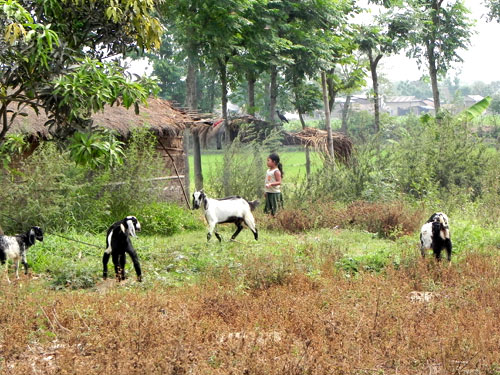
    Activity begins early in Sauraha, not surprising since as the day unfolds the temperature rises to a sweltering level. At sunrise the air has a refreshing coolness about it. The community comes to life as goats and water buffalo are taken from their night quarters to grazing areas. Upside down handmade woven baskets are righted, allowing the contents — live chickens — free access to hunt and peck at their leisure.

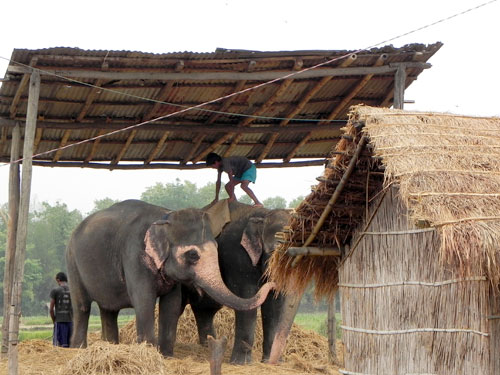
    The NTNC elephants silently head out of their personal stables, mahout on board, to collect the following day’s supply of fresh-cut elephant grass. The privately owned elephants adhere to a different routine and a different diet. Not permitted inside the national park, the privately owned elephants eat grass that is cut seasonally in bulk and stacked, forming a hut-type structure next to their mahout’s house. This grass is stored for months at a time, much like the baled hay fed to elephants in zoos and circuses worldwide.

    By contrast, elephants owned by the government and NTNC, a NGO (nongovernmental organization) have access to the forest areas, where grass is plentiful. They collect their own fresh-cut grass daily. This activity has many benefits, including that the elephants eat high-quality good-tasting fodder and spend hours engaging with their natural habitat.

    Life in captivity is restrictive but access to home range forests brings these elephants closer to their roots and provides them with an opportunity to walk, forage and bathe in the environment they are adapted to. If elephants are to be maintained in captivity, keeping them in range countries definitely has benefits.

  • Elephants Everywhere

    Elephants Everywhere

    April 18

    The town of Sauraha borders on Chitwan National Park and is a world away from Kathmandu. What an inspiring place. Exotic bird vocalizations fill what otherwise would be a serene silence. Every manner of chirp, caw, twitter and call creates an exhilarating backdrop for this pleasant forest atmosphere.

    The people and the local dogs are refreshingly friendly!  The traditional namaste greeting, hands clasped together at chest level accompanied by a polite head bow, encourages interaction, bridging an otherwise seemingly insurmountable gap caused by the language barrier.  But with this bow and respectful greeting, cultures merge and friendships are born. For the veteran members of the ECI team, friendships with the locals are rekindled and strengthened; everyone is extremely happy to see the foreign vet team back in Sauraha.

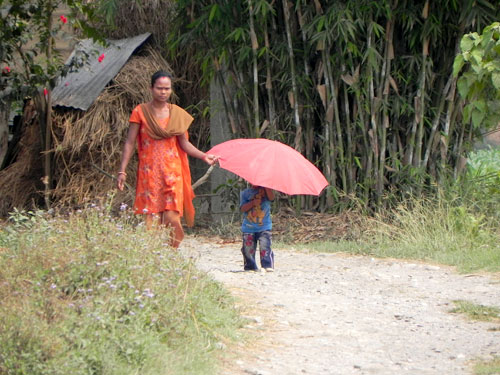
    The short walk from our lodging into town is rich with color and contrast.  Beautifully clad women, parasol in hand, gracefully walking down dirt roads flanked by tethered buffalo, foraging goats, a scattering of chickens and elephants. It is surreal; in less than a half-mile stretch of road, nine elephant stables dot the landscape. These elephants, used for tourist safaris, appear no more out of place here than the family dog in the backyards of suburban America.

    Today was a day for silent observation as each turn in the rugged road brought another stable and tethered elephant into view.  In their mini-environments, elephants stand under a covered stable with a water source to one side, the mahouts residence directly in front and a trough for disposing dung directly behind. Under foot is an ample supply of fresh-cut “elephant grass.” The elephants appeared calm and relatively uninterested in passers-by, even though most are only a few feet off of the road. Once I get over the culture shock of seeing elephants literally around every corner I will concentrate on getting to know each elephant and their history, and of course I will share that information with you.

  • A Rooftop View

    A Rooftop View

    April 15

    Today members of Dr. Susan Mikota’s  Elephant Care International team met with representatives from  the Center for Molecular Dynamics – Nepal to discuss their collaborative work on elephant DNA. This is seriously promising work that will provide yet another diagnosis tool for elephant diseases. The full extent of the application of this study is yet to be realized but without a doubt this is important work for captive elephant welfare.

    The rooftop view from the CMDN lab was staggeringly impressive, equal only to the depth of brilliance, enthusiasm and dedication exhibited by CMDN’s International Director Dibesh(Da-besh) Karmacharya and Country Director Sameer (Sue-mar) Dixit.  Although full underwriting has yet to be secured for the current DNA project, the benefits of this research will be immeasurable.  As evidence of their dedication to elephant welfare, CMDN has agreed to move forward on the project, which involves hours of lab work, processing hundreds of samples collected by Dr. Mikota’s team.

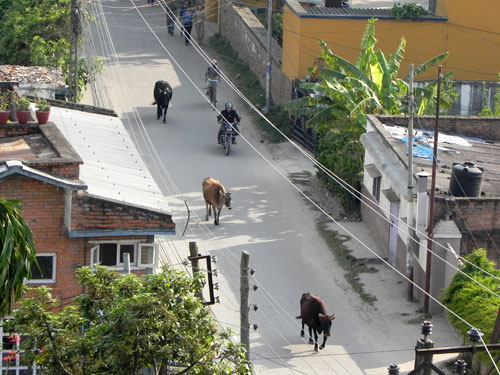
    From my perch on the roof top a scene familiar to city dwellers caught my eye. Down below, casually ambling along a busy city street, were several cows, a sacred and revered animal in Nepal. While cars and motorcycles gave the animals a wide berth to ensure their safety, the cows meandered along, seemingly undisturbed by the hustle and bustle of the city—their destination known to only them.