Tag: asia

  • Elephant abuse in Nepal: Are the mahouts really to blame?

    Elephant abuse in Nepal: Are the mahouts really to blame?

    private owner NepalIt’s easy to look at an elephant shackled by both front feet to the ground, with open wounds, and blame the mahout.

    But I challenge you to learn the facts.

    Elephants belong to hotel owners

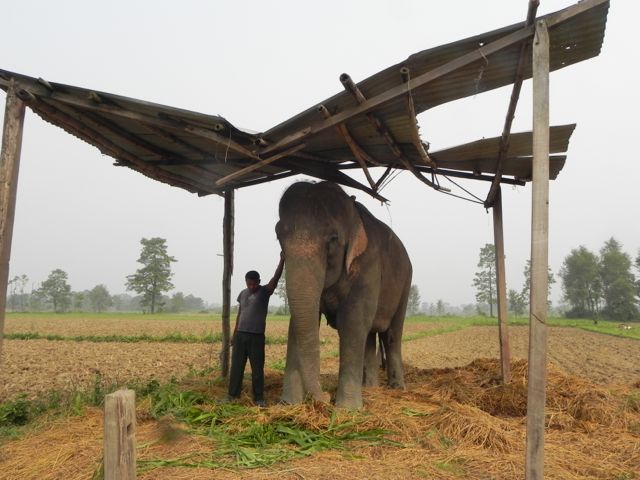
    In Chitwan, Nepal, mahouts do not own elephants. Elephants are the private property of hotel owners, who use them to augment their income by offering elephant back safaris to overnight guests and daytrippers coming to Chitwan in search of fun and adventure.
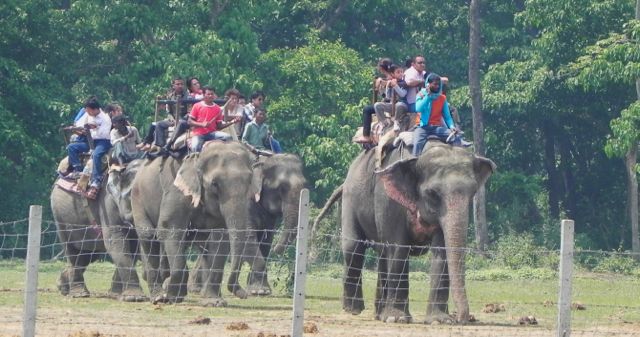
    tourist safariElephant back safaris not only provide a bountiful financial benefit for the owner, they are actually the life’s blood of Chitwan.

    In Sauraha, Chitwan’s tourist destination, every shopkeeper, restaurant owner, hotel, bar, service provider, wilderness guide, money changer, street vendor and orphanage owe their survival to these elephants. Many falsely claim that without elephant safaris, this tourist destination would cease to exist.

    Grueling work schedule

    All day long, 24/7, mahouts and elephants give safari rides in the community forest.
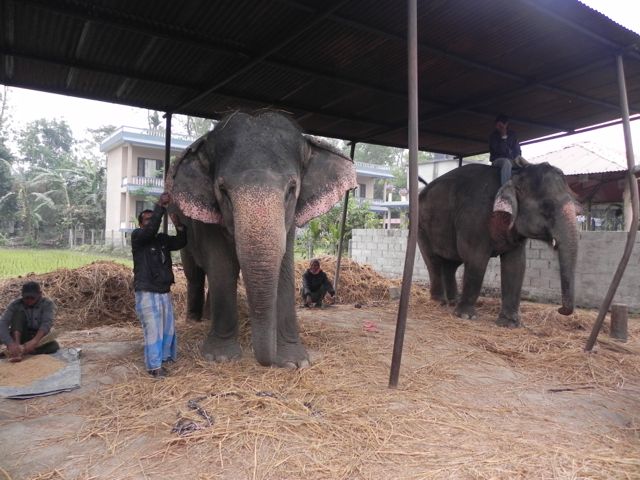
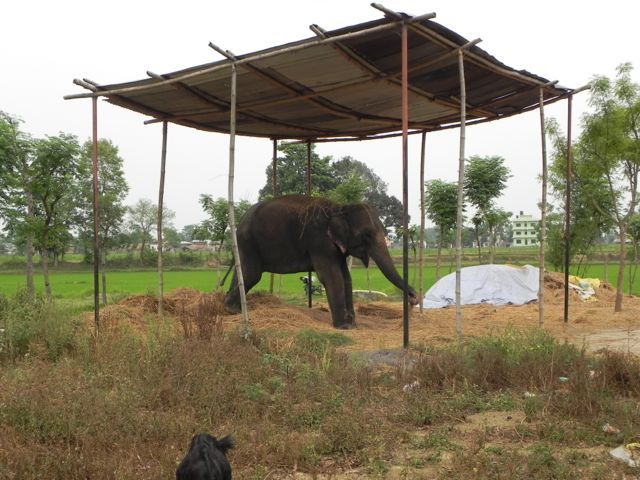
    private owner stableMahouts train, feed and ready the elephants for the rides. It is a grueling job for both.  Up at 4:30am, the pair sets out on the long trek to the safari loading area as the rising sun lights up the morning sky.

    During what is supposed to be a one-hour lunch and rest period, the elephants instead are taken to a riverfront area where tourists mount them to have their photo taken.

    Walking back and forth to the safari ride area, tourist bathing area and home stable, while carrying hundreds of pounds of tourists for hours at a time, takes its toll on elephant and mahout alike.

    At dusk, and even into the dark of night, elephants can be seen silhouetted against the sky trudging down the paved roads of Chitwan toward their home stable.

    Mahouts: Overworked, underpaid and devalued
    img_8199-2
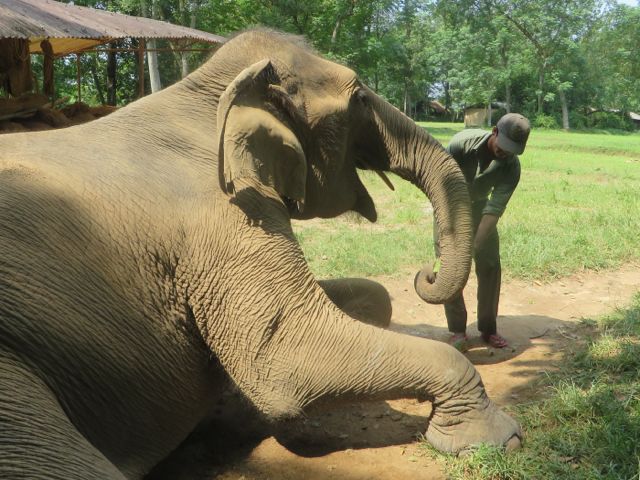
    Elephant owners know nothing about elephants and rely on the mahouts to keep the elephants alive and working without killing tourists. This is a heavy burden to put on overworked, underpaid and devalued employees.

    When mahouts “ask for more,” be it food for themselves or the elephants, they are chastised. Many owners view the mahouts as stupid, uneducated and unmotivated and blame them for the elephant’s unsanitary living conditions and poor health.
    3 mahouts & ele

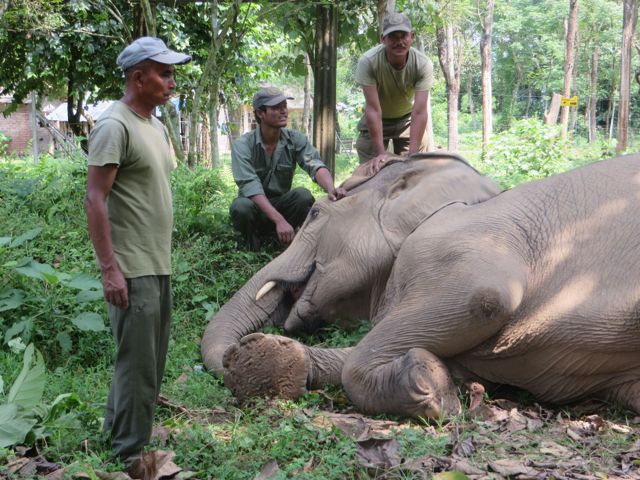
    Yet mahouts are not provided even the most basic supplies to ensure the health and wellbeing of the elephants in their care. Owners fail to supply nutritious food but blame the mahouts for the elephant’s poor health. Stables are rancid cesspools because no provision is made for waste disposal. Many stables don’t even have a source of fresh water. For this, the mahout is unjustly blamed.

    A marginalized community
    img_8462
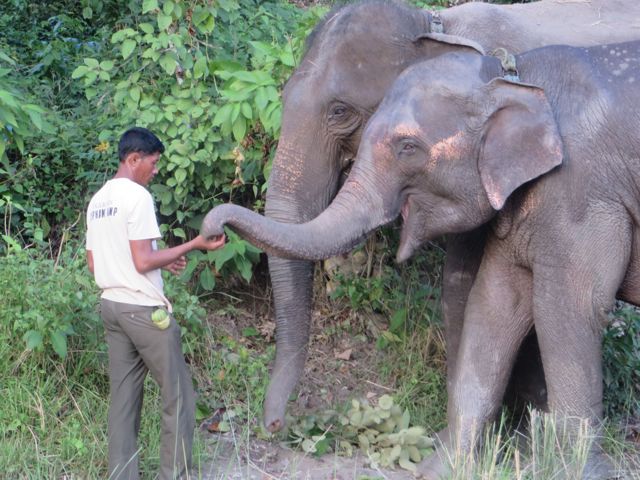
    The truth is that the mahouts are a marginalized community. The custom of treating them as poorly as the elephants is woven into the fabric of society and their living conditions are a mirror image of those of the elephants.

    Mahouts learn their trade on the job, from senior mahouts. Their lot in life dictates they do as they are told without question. They hit the elephants because they are taught they must in order to ensure the elephant does not kill them.

    Still, this does not excuse how the mahouts mistreat the elephants.

    Abuse can be eliminated

    Through education and culture shifting, elephant abuse can be eliminated.

    Demonizing either owners or mahouts is not the solution.

    The first step is understanding why the situation exists and accepting the challenge to help move culture forward.

    Owners must be held responsible and mahouts and tourists must be educated.

    This will result in improved welfare for the elephants in Chitwan.

    How we can help
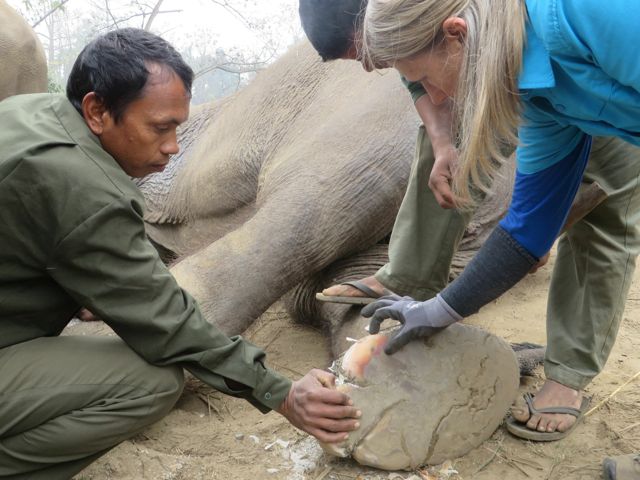
    carol-indicating-how-much-on-ele-foot-with-2-mahouts_medDeveloping sustainable assistance programs is essential. Live demonstrations, educational resources such as videos and manuals, translators and hands-on assistance are needed to improve mahout knowledge and understanding of new approaches to elephant care.

    This is Elephant Aid International’s mission. By providing bi-annual foot trimming; training mahouts and vet techs in the skill of foot trimming; teaching positive reinforcement training philosophy and techniques; and constructing chain-free corrals, we are laying the foundation for positive change.
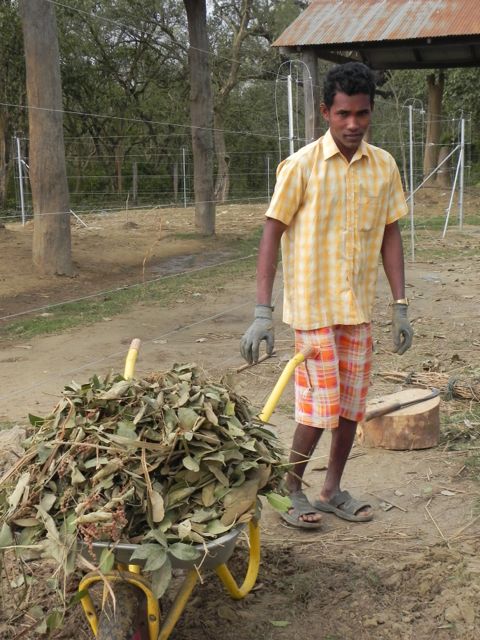
    mahout & wheelbarrow
    EAI doesn’t blame the mahouts. We give them the tools necessary to take better care of their elephants.
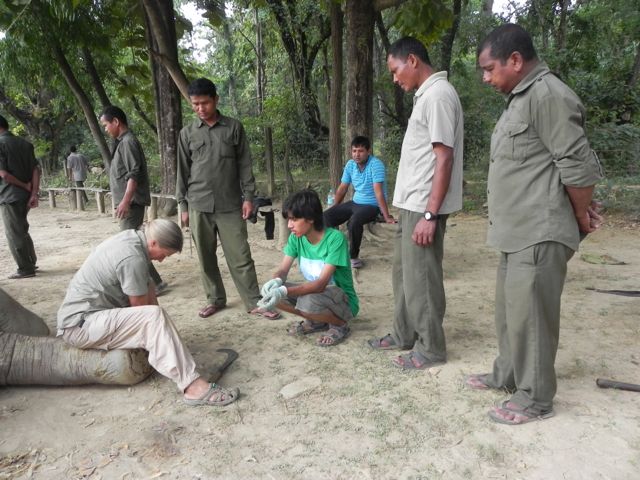
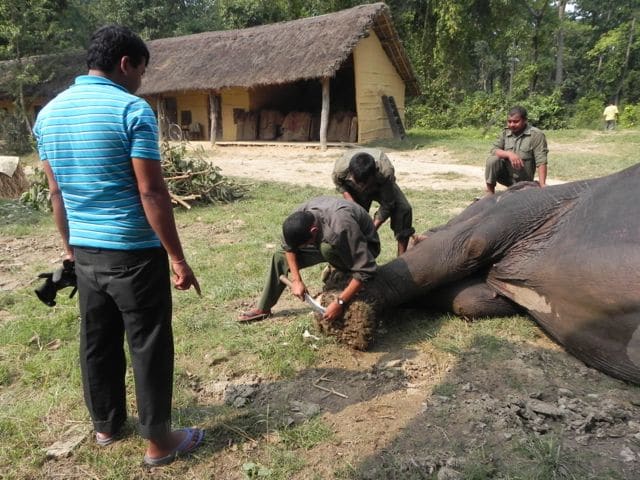
  • Foot Trimming in Bardia, Nepal

    Foot Trimming in Bardia, Nepal

    I’m back from Bardia. What an adventure!

    It was a 10-hour drive through mountains on rough roads. The 19-year-old driver of our rental truck scared the daylights out of all of us with his speeding, passing trucks on blind curves and nearly missing oncoming vehicles. Oh man — it was a stressful ten hours!

    Carol et al in BardiaBut our foot trimming program was a grand success. We had a fabulous trimming team: Dr. Gairhe; Kiran the vet tech; Hira, Kirti Kali’s phanet (head mahout) from the NTNC hattisar; and I.

    Our students included Chantelle, our intern; Surajan, a new friend and translator; and the vet tech from Bardia.

    foot trimming BardiaIn two short days we trimmed the feet of 24 government and privately owned elephants.

    Honestly, the condition of the privately owned elephant’s feet was criminal, similar to the privately owned elephants in Chitwan. Their pads were dry, cracked and severely overgrown. The nails were equally as dry and overgrown and many had splits and deep cracks.

    broken shelter
    Private owner, broken shelter

    I am always shocked to see how poorly the privately owned elephants are kept, especially since they are the breadwinners for their owners.

    The good news is that 24 more elephants received pedicures and their mahouts were introduced to foot care. With time things can change for these over-used, abused and neglected elephants…I hope.

    A huge thank-you goes out to the trimming team. Without their enthusiasm and hard work we could not have accomplished our goal to provide foot care for elephants in Bardia!

    You can make a difference in the life of a captive elephant by supporting our Foot Care project. Thanks for your help.


  • Capture is an ill-conceived solution to human-elephant conflict

    Capture is an ill-conceived solution to human-elephant conflict

    Corbett Tiger Reserve eles

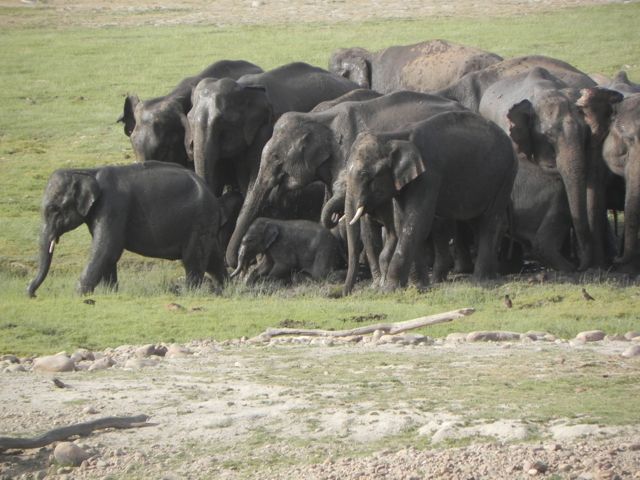
    The competition between humans and elephants for space and resources has reached an all-time high in India. The problem stems from both species’ dependence on forest resources for survival.

    Elephants leave their forest home in search of food. Until villagers are given alternative means to meet their daily needs without depleting forest resources, the problem will continue.

    Lacking a well-thought-out plan to combat the problem, the Indian government continues to resort to crisis management. Always a step behind the problem, they have failed in their responsibility to the welfare of marginalized people and wild elephants.

    Capturing elephants is an ill-conceived, short-term solution to a long-term problem. Although it is ethically repugnant to some, others have no problem incarcerating wild elephants to a life in chains.  How a people who profess to believe that Ganesh is god can capture and torture his likeness is disturbing.

    To avoid a continued escalation of the problem, the government must devise a way to protect the village people, the wild elephants and their forest home.

    Potential solutions to these pressing problems need immediate and thoughtful consideration. The future of the forest, wildlife and the villagers who encroach upon the forest are at stake. Ignoring any aspect of the problem will result in failure–a loss for humans and uncertain future for India’s forests and elephants.

    Some foreign NGOs recognize the need to relocate villages and open elephant corridors and are pursuing initiatives. But most efforts by local and foreign NGOs to create protected areas for elephants at no expense to the government have, to date, been thwarted.  Government resistance to outsiders bankrolling solutions to the human elephant problem seems counterintuitive and bewildering.

    Read more:

  • Report: Chain-Free Project, National Trust for Nature Conservation — Biodiversity Conservation Center

    Report: Chain-Free Project, National Trust for Nature Conservation — Biodiversity Conservation Center

    Chain-Free Hattisar Project
    National Trust for Nature Conservation – Biodiversity Conservation Center
    Chitwan, Nepal

    REPORT

    Project completed Jan 10, 2013

     Department of National Parks and Wildlife Conservation
    Jhamak Karki, Chief Warden-Chitwan National Park
    Dr. Kamal Gairhe, Senior Wildlife Veterinarian-Chitwan National Park

    National Trust for Nature Conservation
    Naresh Subedi, Senior Conservation Officer
    Chiranjibi Pd. Pokheral, Senior Conservation Officer-Biodiversity Conservation Center
    Babu Ram Lamichhane, Conservation Officer-Biodiversity Conservation Center
    Dr. Arjun Pandit, Staff Veterinarian- Biodiversity Conservation Center

    In collaboration with

    Elephant Aid international-USA
    Carol Buckley, Founder and CEO

    INTRODUCTION

    In January 2013, construction was completed on a solar-powered chain-free hattisar at the National Trust for Nature Conservation’s Biodiversity Conservation Center (NTNC-BCC).

    This first-of-its-kind pilot project was developed to study the benefits of working elephants in Nepal living chain-free.

    Six elephants, ranging from seven months to seventy-plus years, currently live in five interconnected chain-free corrals designed to improve their welfare.

    The elephants spend an average of fifteen hours in the hattisar each day. In the past they were hobbled by both front legs, chained under a shelter that prevented natural posturing and healthy physical activity.

    Now, living in the chain-free corral, each elephant is free to move at will and engage in natural behavior such as dusting, foraging, sleeping, bathing, walking, playing. In the case of Man Kali and her children, eight-year-old daughter Prakriti Kali and seven-month-old son Hem Gaj, this related family is able to engage in normal social behavior.

    Corral construction and operating system

    The corral’s operating system is a solar-powered energizer with a double battery back-up. Three hours of sunlight is required to keep the batteries charged for 10 days.

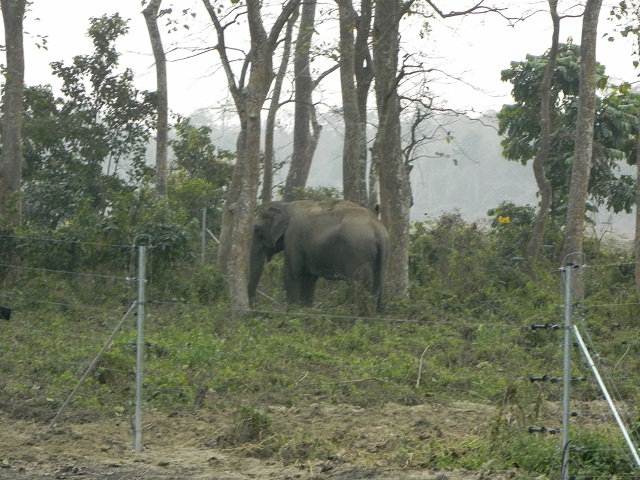
    Specifically designed for wildlife, the corral administers a mild shock upon contact. Due to the pulsating current, it is virtually harmless. Being highly sensitive to the clicking sound of the current, most elephants avoid the fence without ever coming into contact with it.

    The chain-free hattisar consists of five interconnected corrals on approximately two-and-one-half acres of open and wooded land.

    The corrals stand seven feet tall, constructed of rust-free steel posts and six strands of high tensile wire. Each post is encased in a protective tope.

    Each corral has a front, back and side gate for ease of access for cleaning, feeding, moving elephants in and out and providing socialization opportunities.

    The energizer and batteries are housed inside the mahout residence; two solar panels that charge the batteries are attached to the roof of the residence.

    Each corral is equipped with a cut-off switch enabling independent operation.

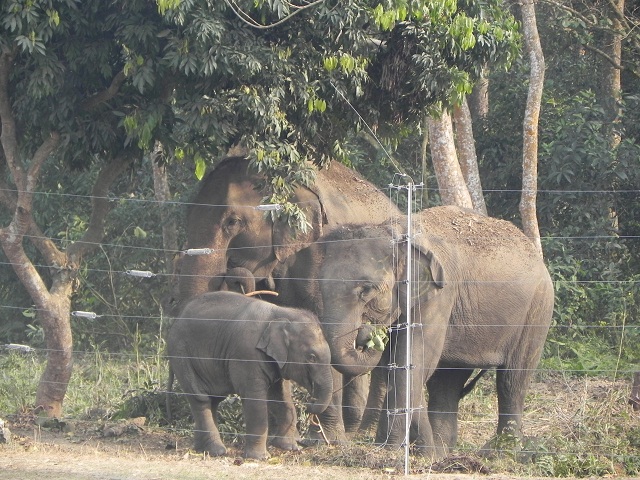
    This design has proven successful in many areas of Asia to prevent entry by wild bull elephants.

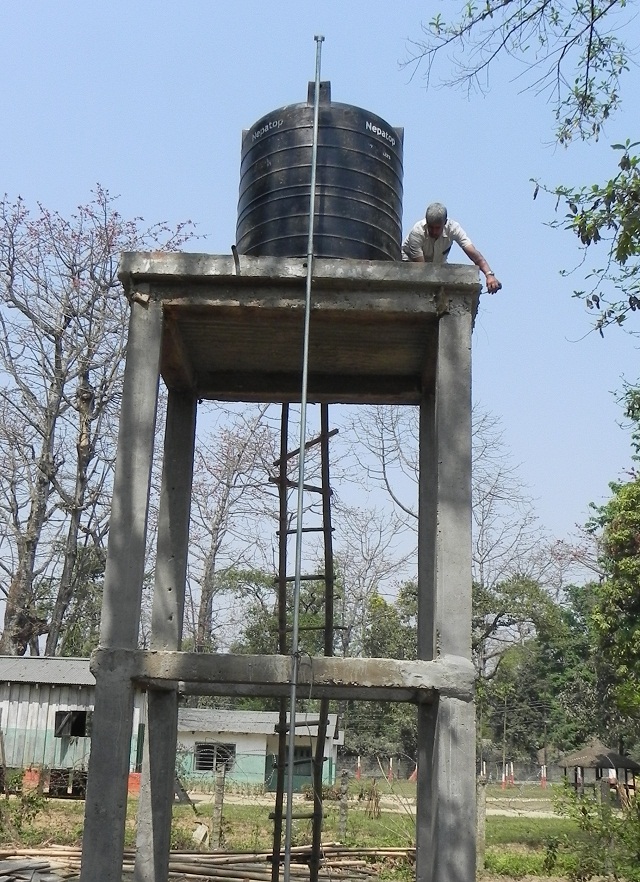
    Fresh water is stored in an elevated water tank and troughs are filled by gravity feed.

    water trough reduced 3
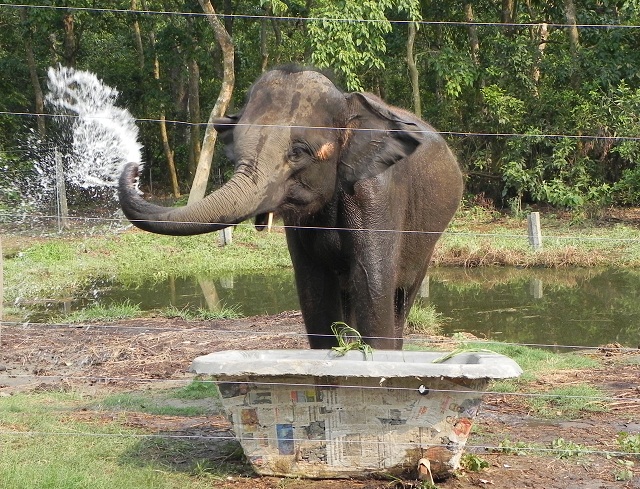
    All corrals have a custom-made concrete water trough that provides clean water.

    Healthy trees are an important component of the chain-free corrals, providing shade, browse and a natural scratching surface.

    To prevent serious damage to trees from elephant tusking activity, protectors were built around select trees.

    GOALS AND OBJECTIVES

    • Reduce or eliminate stereotypical behavior caused by chaining
    • Eliminate low-level long-term stress caused by chaining
    • Increase physical activity
    • Encourage engagement in natural species-specific behavior such as  foraging, dusting, bathing, walking, playing, socializing and exploring
    • Eliminate injuries and bone and joint damage
    • Improve foot health
    • Maintain elephants’ compliance with mahout authority

    METHODS

    • Ethogram
    • Husbandry protocol
    • Management protocol
    • Feeding protocol

    1.   ETHOGRAM

    In order to quantify the effectiveness of the chain-free corral, an ethogram spreadsheet was created to track a list of natural and stereotypical behaviors, including walking, eating, dusting, playing, exploring, drinking, socializing, sleeping and exhibiting stereotypic behaviors.

    2.     HUSBANDRY PROTOCOL

    Manure removal and corral cleanliness standards were established to ensure the highest level of hygiene.

    3.    MANAGEMENT PROTOCOL

    Training and management practices for inside the corral were established to give elephants a sense of freedom and security.

    4.    FEEDING PROTOCOL

    Changes to traditional feeding practices were established to promote activity and alleviate boredom.

    PROGRESS AND PRELIMINARY RESULTS

    Each elephant spends approximately 15 hours each day in the chain-free corrals. The remainder of their time is spent in Chitwan National Park engaged in grass collecting, anti-poaching patrols and conservation work and jungle safaris.

    Upon first introduction to the chain-free corrals, each elephant calmly explored the area, foraging, dusting and scratching on trees. Each evening they dig in the soft dirt of the forest, creating a comfortable sleeping spot; none return to the stable area to sleep.

    The related family of Man Kali, Prakriti Kali and Hem Gaj are housed together. They bonded immediately when united in the chain-free corral and continue to exhibit healthy elephant behavior, with Prakriti Kali assuming the role of big sister to Hem Gaj.

    A survey was conducted to track the behavior of the elephants toward the mahouts and drivers. Mahout compliance has not changed. Each elephant continues to respond favorably to mahouts and drivers—both inside and outside the corral—at the same high level as before being released from chains.

    Photographic records are being kept to track foot health and bone and joint conditions.

    Collectively, the elephants’ behavior represents a substantial improvement in natural activity and reduction in stress and stereotypical behavior.

    CONCLUSION

    The goal to eliminate stress from chaining and the resulting stereotypic behavior is realized. Adherence to the new feeding protocol ensures that both Prakriti Kali and Mel Kali do not engage in stereotypic, food anticipatory behavior. Since being introduced into the chain-free corral hattisar, all elephants engage in appropriate, beneficial, species-specific behavior; respond favorably to their mahouts; and appear to be calm and comfortable in their new environment, indications that the project is meeting its goals and objectives.

  • in the dark of night

    A hauntingly familiar sound of clanking chains passed by my window, so close I thought perhaps my wall would be crushed. The clink clink clink of cold metal bracelets was unmistakable; an escapee was passing by my room in his effort to disappear into the freedom of the bordering National Park.

    Switching off the lights to avoid attracting attention, I pushed open the screen door and stepped into the darkness.

    The rattle of chains chilled me to the bone as a silhouette passed in front of me. First one and then a second, moving silently except for the clanging of the chain hobbles secured around the front ankles of the smaller elephant.

    On this, the night before I leave Sauraha, I wondered why I was to witness another unbearable scene of captive elephant suffering.

    The escapee had entered through the front gate at NTNC-BCC and slowed when he found himself fenced in. The second elephant, a koonki, was being used to subdue and calm the young male, whose ivory glistened in the moonlight.

    When the bull stopped, the mahout began to speak in a soft but firm tone. He told his elephant, the koonki, to bite, which means to stretch out on her sternum. By assuming this vulnerable position, the elephant appeared to bring comfort to the escapee.

    It was then that I saw a mahout precariously perched on top of the young bull, no doubt frightened half out of his wits, with nothing at all to secure himself.

    As soon as the koonki reclined, a command was given for the bull to recline, which he did without hesitation. The reality is that he was frightened and I believe the mahouts involved realized this. As soon as he reclined the mahouts switched elephants and the koonki left silently.

    A little more rattling of the chains and the hobbles were removed, and the young bull moved swiftly back from where he’d come–the government hattisar (elephant stable) next door.

    Not willing to witness the brutal scene I assumed would follow, I called out into the night, no pita (don’t hit). No response. As the elephant and mahout passed my room I called out again, which was when I saw a flashlight-wielding man walking behind the elephant.

    “Government center hattie (elephant)?” I asked.

    “Yes, Raj, from the government center,” he politely replied.

    “The elephant is afraid,” I said. ”Do not add to his misery by beating him.”

    “You are foot trimming lady, right?” he asked. “You trimmed Raj a few days ago–he had a bad nail.”

    “Be kind, Raj is a wild animal,” I said.

    ”No, not a wild elephant, government elephant,” was his reply.

    “Yes, a government elephant and wild,”  I said.

    There we stood under a bright near-full moon discussing the fact that although these elephants are living in captivity they remain wild animals, never formally domesticated and always to remain wild. When I said they deserve to be treated with compassion because of their circumstances, the mahout nodded in polite agreement. He spoke surprisingly good English and appeared to understand what I was saying. In seconds he vanished into the darkness, leaving me to contemplate what I had just witnessed.

    For some time I stood listening to hear if Raj would be brutalized for his attempted escape. But this night I would not have to be reminded of the elephant suffering that permeates this tourist destination in Nepal. The only sound that pierced the night air was the soft repetition of forest birds and chirping insects.

  • A Blessing

    A Blessing

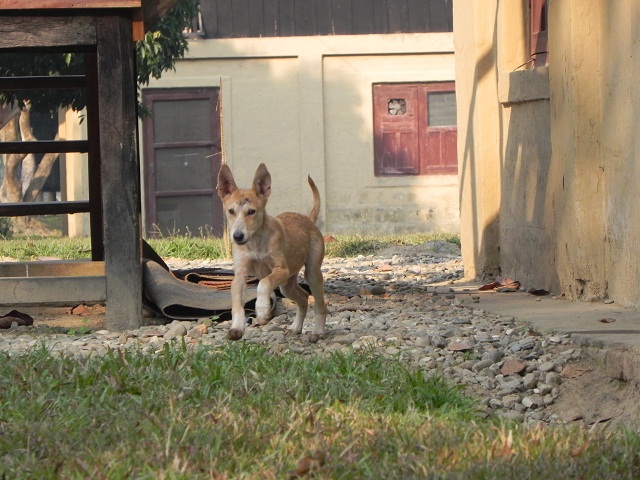
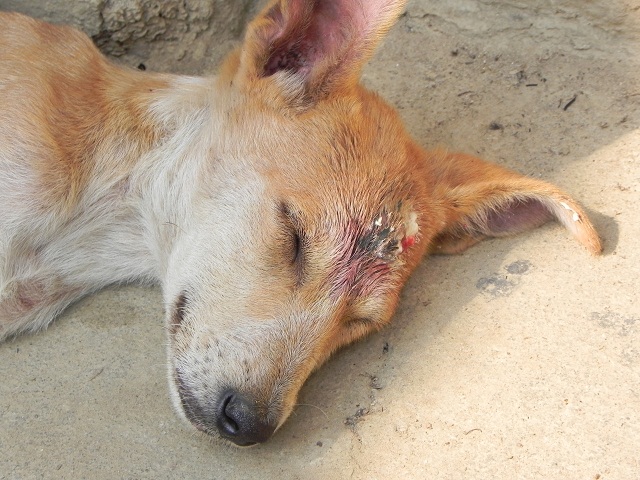
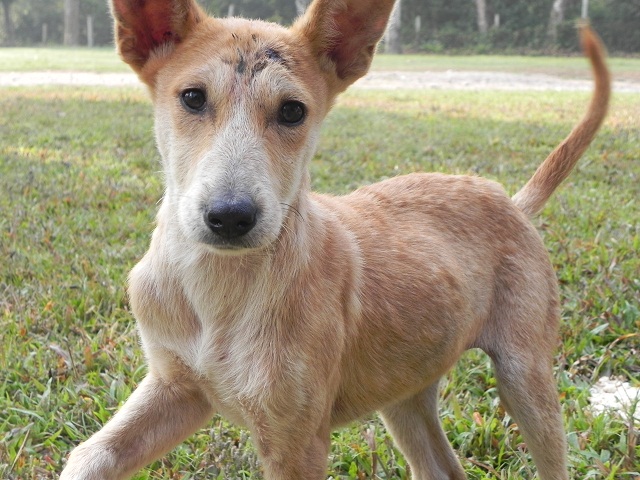
    Like another piece of discarded trash tossed to the side of the road, a young puppy lay prone, unnoticed. At first glance I thought she was dead but then I saw her labored breathing and heard her pitiful whimper.

    Passers-by did just that–passed by without as much as a glance in her direction. Not until I sat down next to her did any human take notice. Sadly, it was not the dying puppy that caught their attention but the curious sight of a foreigner sitting on the ground comforting a dying dog.

    I have come to accept that dogs do not hold a place in the hearts of many people. Unfortunately, at least one religion teaches that dogs are the incarnation of a person who in a former life did something unspeakable. As result, that soul reincarnates in the body of a dog, destined to spend a lifetime homeless, scavenging for food, and in many cases, brutalized by humans.

    With the influence of western culture in Asia, some are beginning to see dogs in a bit of a different light. But for one little puppy it was almost too late.

    While sitting with the puppy, paying homage by witnessing her passing, I watched the sea of people walk past. Some were curious, some smiled. The westerners showed concern, most Asians were repelled. I was appalled.

    After a few minutes her breathing became shallow. She showed no sign of consciousness; she was comatose.  Ten minutes passed, then fifteen and then thirty. Sensing the need for this pup to die in a quiet, peaceful place, I picked her up and carried her home. I wasn’t sure she would survive the short walk but I knew it was better than lying on the side of a gravel road surrounded by indifference.

    Interestingly, many local Nepalese I passed on my way home expressed interest, even concern. They wanted to know what happened to the pup. When I said “pita”–someone hit her in the head with a rock–they were silent.

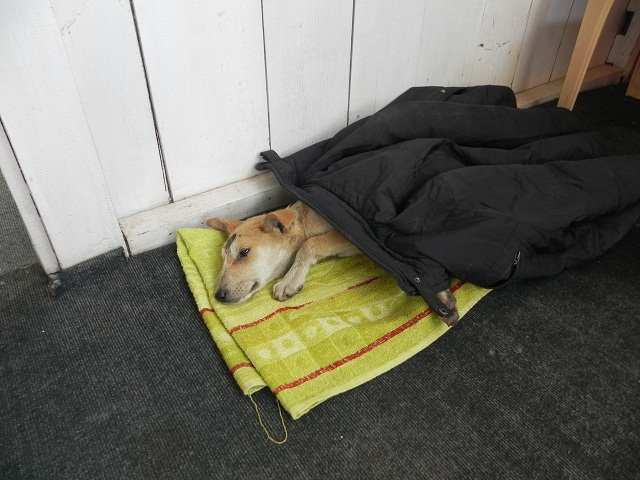
    I prepared a soft bed with a thick winter coat and some towels and laid her lifeless body down on what I thought would be her deathbed. A dose of Arnica Montana seemed to slow her rapid breathing and helped ease her pain. She wasn’t able to see or hear me and I wonder if she even felt me. But I did my best to surround her with as much love as I could as she made her transition to the other side.

    A few more doses of Arnica Montana and she started breathing normally and dropped into a deep sleep. And then to my surprise, she woke up. She was able to drink but barely able to stand without falling.  Her forehead was swollen and painful.  She seemed to have suffered some brain trauma because her motor skills, eyesight, sense of smell and hearing were all affected.

    Quite by coincidence, a team of vets that was providing a rabies clinic in the area, found out about the pup and came by to examine her. They confirmed that a blow to the head caused a deep-seated injury resulting in brain trauma. Only time would tell if she would recover. She received medication to address possible infection and pain, and to reduce the swelling in her brain.

    She rested a lot, ate and drank well, but found walking a bit challenging. Due to the trauma she kept walking in circles to the left.

    It has been a week since I found “Little Girl” dying in the road and she is steadily recovering. Her circling to the left is nearly gone and her coordination is at about 90 percent. Her hearing, sight and smell are still affected but she is slowly regaining them as well.

    This little street puppy has been an unexpected blessing, and now comes the greatest challenge: finding a good home for her in a culture not accustomed to caring for dogs, especially one with special needs.

    While the search to find her a good home continues, Little Girl will live with me, recuperating and learning to play tug of war with a sock.

  • ke garne…what to do?

    I have held off writing this blog for weeks hoping that my experience was anecdotal. I also wondered if sharing my experience and expressing my concern could be beneficial or would simply broaden the already huge culture gap that divides humans who view all beings as sentient and those who do not. As the situation continues to repeat itself over and over again I realize—even though I am still unsure of the outcome—that an expression of my concern is required.

    Over the past four months I have been immersed in creating a healthy environment for six captive held elephants in Nepal. The challenge to improve their welfare is relatively easy, their transition seemingly effortless. The problems we experience are not with the elephants, it’s with people.

    Although the facility where I am working is a private NGO conducting wildlife conservation studies, the general public feels it is their right to enter the grounds and act in any manner they please, which at a minimum consists of invading the animals’ personal space to take photos—not of the animal but of themselves standing next to the animal. Sadly, the animal is insignificant; it is a photo of themselves that they wish to save for prosperity.

    It has become increasingly distressing to witness the degree to which people disregard and abuse animals. Even authority figures are unable to protect captive held wildlife and wild animals from insidious abuse by humans.

    This exasperating situation is repeated all over Asia, where wildlife, both captive and in-situ, find themselves harassed by frenzied mobs of non-empathetic humans.

    Take, for example, the recent craze in Coimbatore forests in India, where crowds of people gather on a regular basis to incite wild elephants to become aggressive. Who has the power to change the mindset that gives people permission to harass wild animals on this grand scale? Where is common decency? And where does religion come into play in the cultural abuse of non-human animals?

    It has been my observation that policing authorities have little influence on crowds of people unless batons and violence are employed. A seemingly docile crowd can erupt into an angry, violent mob in seconds. The trigger that transforms a crowd of people is simple: ask someone to stop doing what s/he is doing.

    For example, request that a person not enter a private area and your request will be met with a refusal,  followed by immediate argument. All the while, the offender will continue to enter the premises, totally ignoring the request.

    The problem is compounded if the person is not alone but accompanied by others, which is most often the case. Everyone will equally ignore the request and add their voice to the argument. The volume of verbal resistance increases until a confrontation ensues, with the offending crowd encircling the requester, yelling their refusal in an attempt to intimidate.

    The offenders appear to cross all lines of common decency, causing stress and trauma to the wildlife, who have no other way to respond but to become aggressive to protect themselves. At this point the animal is viewed as the offender and made to suffer further for his/her response to the abusive crowd of unruly people.

    Trying to stop the abuse

    I wonder almost every day what can be done to prevent widespread, systematic animal abuse. Education is the most obvious, but until such time as a new generation can be sensitized to the pain and suffering of non-human animals, the question remains, what can be done to protect the innocent?

    We have tried posting signs, which are torn down and spat upon. Placing an educator in key locations to speak with the public, both about the wildlife and the appropriate human behavior in the presence of wildlife, proved equally ineffective. The public argues, demands to be allowed past the barrier, pushes past, verbally abuses the educator and demands to touch, feed and have their photo taken touching the captive wildlife.

    I witness crowds of people taunting wild animals and intentionally abusing domestic livestock and street dogs on a regular basis. The lack of empathy and even malice shown toward non-human animals is mirrored in the manner in which a rioting crowd responds to authority figures. On too many occasions I have witnessed a complete disregard and disrespect for a reasonable and legal request, such as “please do not feed, tease, hit or touch the animal.” Surprisingly, many people appear to view these activities as one of their inalienable rights.

    It is not possible for me to turn my back and walk away when animals are being abused. As result, on too many occasions, I have become the focus of an enraged crowd of near-violent humans ready to bash my head in because I have told them to stop harassing the elephants, to not hit the dog or even to refrain from tormenting the baby rhino.  Admittedly, nothing I have tried has worked to stop the violence except to stand between the tormentors and the animal they have targeted. But this approach is not sustainable. So then, what to do?

    Fencing has been used to keep captive wildlife in. Until a new empathetic generation emerges it appears the same approach must be taken to keep the human wildlife out.

  • A precious soul lost

    A precious soul lost

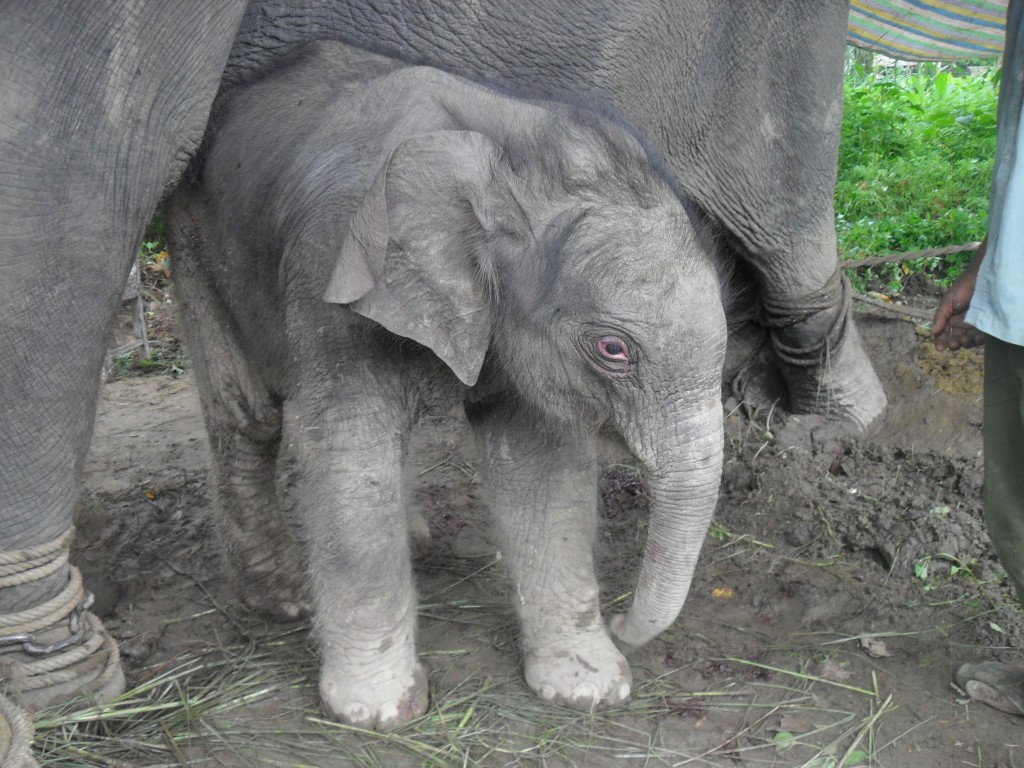
    It’s been a pretty intense week. A two-year-old female calf at the breeding center was diagnosed with herpes. Even though she received treatment, she passed away two days later.

    Herpes is near-epidemic among elephants in the US and recently reared its ugly head in Chitwan. Young calves between the ages of one and three seem to be most susceptible but there are records of juveniles and adults dying from the disease as well.

    You’ll remember Bhadra, the fabulous flaming redhead we trained with positive reinforcement in Sauraha, Nepal. He died of the herpes virus last year, shortly before his second birthday. His mahout was so devastated that he left his job and returned to his home village.

    Famciclovir, the treatment of choice for herpes, is not available in Nepal and must be imported from India. A small elephant can require as many as 1000 pills to fight the virus. The exorbitant cost—75 cents per pill—and large quantity needed, made stockpiling the medication impossible.

    The calf was given available medication and was under treatment and constant surveillance as I arrange for a shipment of Famciclovir from friends at Wildlife SOS-India. Unfortunately, the drug did not arrive in time to save her. She died in the night with her mother stoically standing by. Records indicate that even with Famciclovir many calves do not survive.

    I accompanied the team for the necropsy and somber burial; both were done with the utmost respect. All the mahouts were present and, for the first time in my observation, near silent. As Dr. Gaihre led the exploratory necropsy, examining and collecting tissue samples for lab work, the mahouts dug a grave. It was a sad and sobering experience. This calf had the classic symptoms of herpes–severe hemorrhaging–but otherwise was a very healthy elephant.

    When it came time to lay her body to rest, I instinctively glanced around for wild flowers to place on her grave, just as we always did at the Sanctuary. After her precious body was covered with a sparkling clean white linen cloth, incense was lit and ceremonial red powder and flowers were sprinkled over her covered body. When the flowers I collected left my hand and floated down into her grave, a wave of gentle remembering engulfed my heart as I thought of the beloved elephants who had lived and died at the Sanctuary. At this moment we were all one, sharing the loss of a sacred soul.

    The senior wildlife staff presided over the burial. Although the words spoken over her grave were in Nepalese and foreign to my ear, I knew exactly what the prayers were. It was the same ceremony, the same prayers uttered each time we buried another precious elephant at the Sanctuary. Like never before, I felt a connection with the mahouts who care as deeply for their elephants as we do ours.

    Preparing for next time

    The signs of herpes include dark spots on the tongue. By checking the tongue twice a day, the disease can be diagnosed in the early stages. In an effort to monitor the other three young calves at the breeding center, I was asked to train them for tongue examinations, a request that I was happy to fulfill.

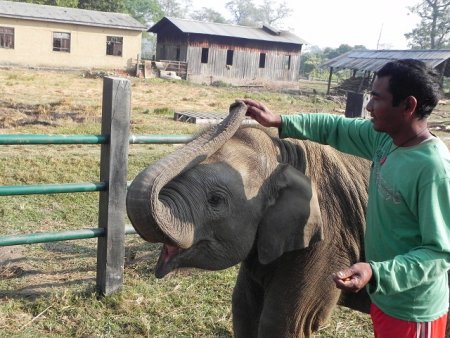
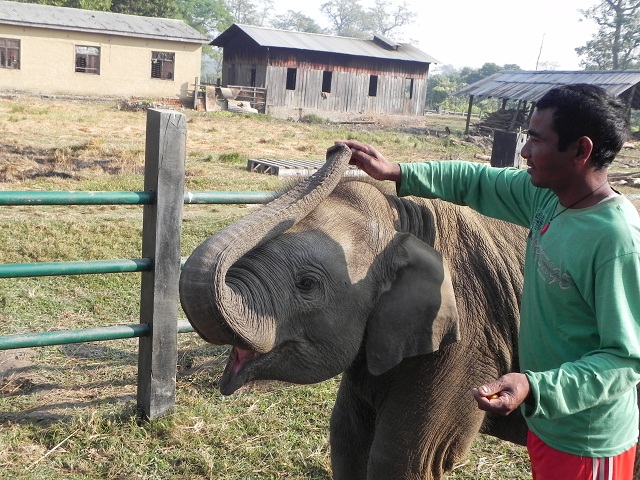
    checking tonguesThe first day of training was a heart-lifting success. We were able to get the calves to place their trunks on their foreheads—for a tasty piece of banana—and took photos of their tongues.

    Additionally, I ordered Famciclovir. Even though the drug may expire before it can be used, I feel strongly that having it on-hand whenever possible is important.  We were not able to help one precious elephant but if the disease strikes again we will be better prepared.

  • Back in Sauraha, Chitwan, Nepal

    Back in Sauraha, Chitwan, Nepal

    Working in Asia the past two years I have learned a tremendous amount about how culture and tradition affect collaborative conservation efforts. Among the most important lessons is the need to ensure project sustainability. No matter how groundbreaking or beneficial the project promises to be, it must be sustainable to be successful.

    Ways to sustain the project must be identified during the planning stage, otherwise the effort put into it will have been wasted. Sustainability determines success and people ensure sustainability.

    Before returning to Chitwan, I wondered if our chain-free yard pilot project for Sweetie Kali, aka Prakriti Kali, would prove to be sustainable. Although I prepared myself for less, I hoped the mahouts had truly embraced this welfare project. Success hinged on their acceptance of this approach to elephant care, which is nearly the polar opposite to their tradition.


    As I approached the elephant stables I saw Sweetie Kali foraging in her personal forest. The dense scrubs were a faint memory but the mature trees were standing tall, providing shade and enrichment, just as they had when we built the yard last May.


    I was pleased and honestly a bit relieved to see that the chain-free fence was in pristine condition. The staff, under the direction of Chiran Pokheral, the officer in charge, did a fabulous job of ensuring the success of our pilot project.

    It’s my nature to push headlong into the next project forgetting to take a moment to bask in the glow of a collaborative project well done. It is too easy to get swept away in the excitement of something new and forget to thank the people responsible for making everything happen.

    In addition to Paspat and the mahouts, who were completely receptive to the changes in their routine that a chain-free yard required, many other individuals, including Chiran Pokheral, Dr. Gairhe, Ram Kumar, Babu Ram, Nandu, Vishnu and Dibyendu and his crew, made this project possible. Without their support and assistance, this project would never have come to fruition, much less become sustainable.

    Special thanks goes to Chiran Pokheral who, after securing the required clearances, made sure I had access to plumbers, electricians and day laborers, and the cooperation of everyone needed to complete the project. Without Chiran we would still be dreaming about a chain-free yard instead of watching Prakriti Kali thrive in it.

    Dr. Gairhe, the senior government veterinarian, also played a key role in the project’s success. A true conservationist, Dr. Gairhe’s endorsement and oversight of the project provided the much-needed assurance at the government level.

    Now that I am back in Sauraha, it’s time to identify a location for the second chain-free yard. This yard will be for Man Kali and her three-and-a-half month old calf Hem Gaj. Once again we turn to Chiran Sir,  Dr. Gairhe and the NTNC staff  to lead us in our effort to improve elephant welfare in Nepal.

  • Bahabur’s surgery

    Bahabur’s surgery

    Oct 17th

    [Warning: This post includes graphic photos.]

    My first morning in Assam, I awoke to learn there was an elephant emergency.

    Thirty-five-year-old, Bahabur, a skilled koonki (elephants trained to assist mahouts in the capture, training and management of wild elephants) who only days before successfully pulled a wild rhino from a mud bog nearly lost his right ear in a fight with a wild bull elephant.

    Bahabur is intimately familiar with both captive and wild elephants. He lives with a non-related herd of koonki elephants whose job it is to assist their wild kin by participating in human-elephant conflict mitigation.

    When wild elephants emerge from the forest in search of food and water, they raid crops and create havoc. In an effort to protect both elephants and humans, Bahabur and his herd, guided by their mahouts, becomes a formidable barrier between wild elephants and trouble, literally saving the wild elephants’ lives.

    Many elephants are killed as result of crop raiding–poisoned, shot, electrocuted, their mouths blown apart by bomb-laden food. These koonkis are the front line of protection for their brethren and the villagers whose encroachment and farming activity create such a dangerous situation for everyone involved.

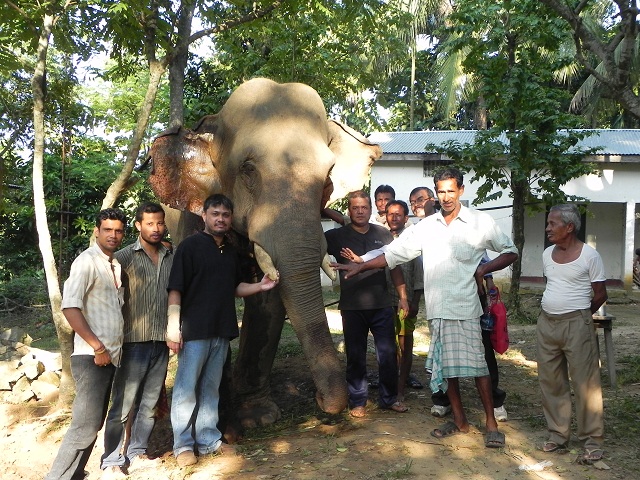
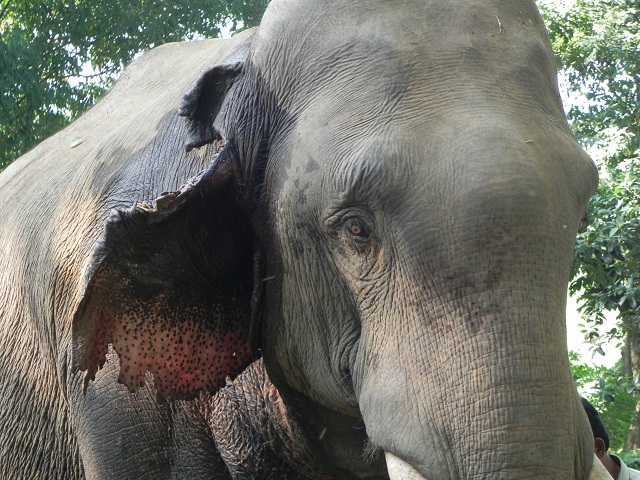
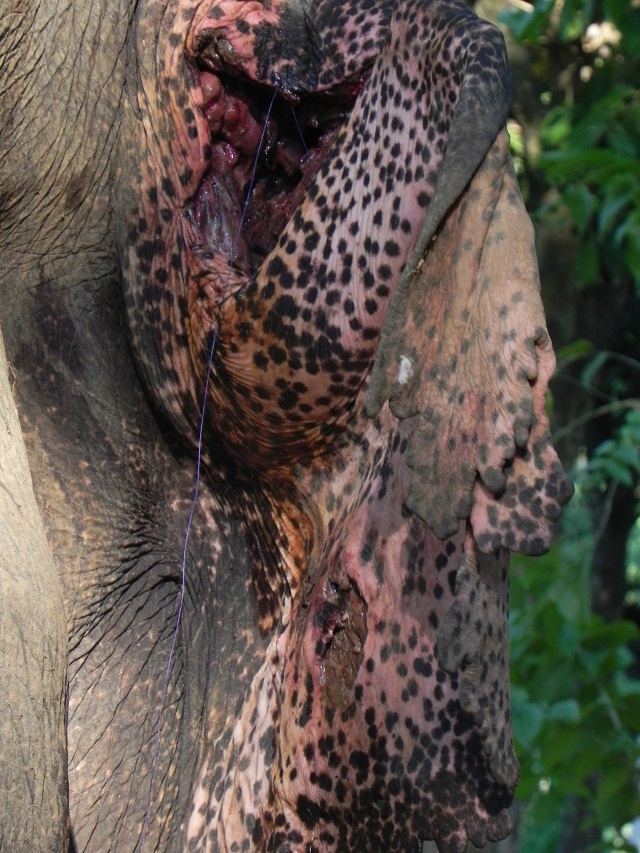
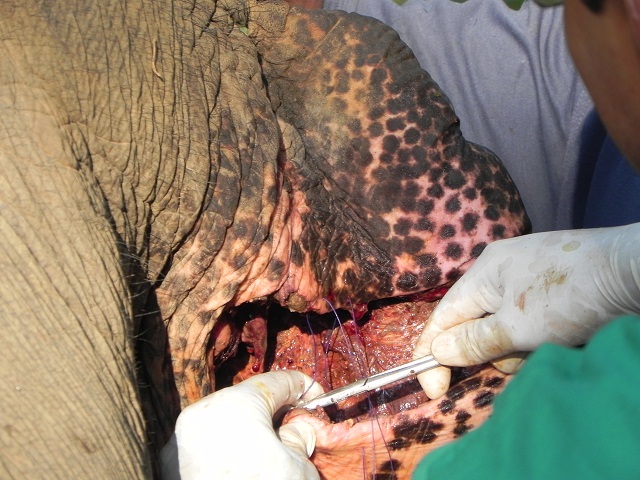
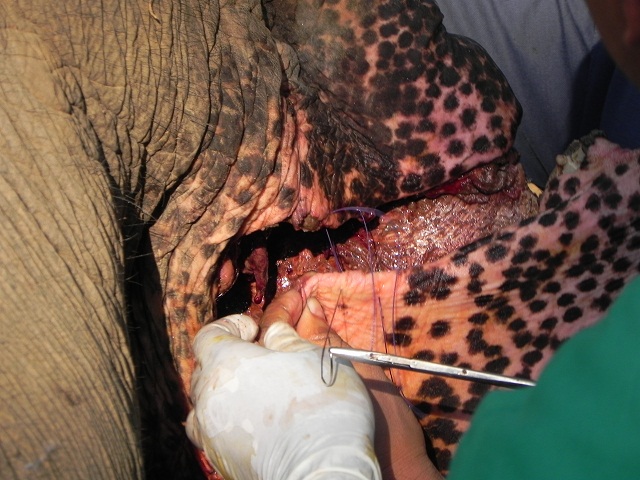
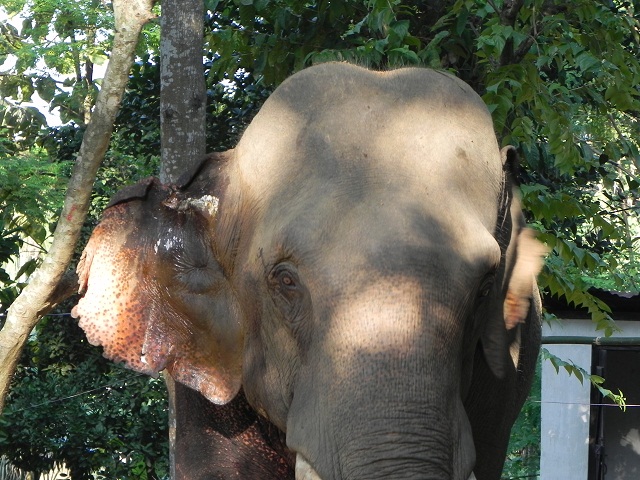
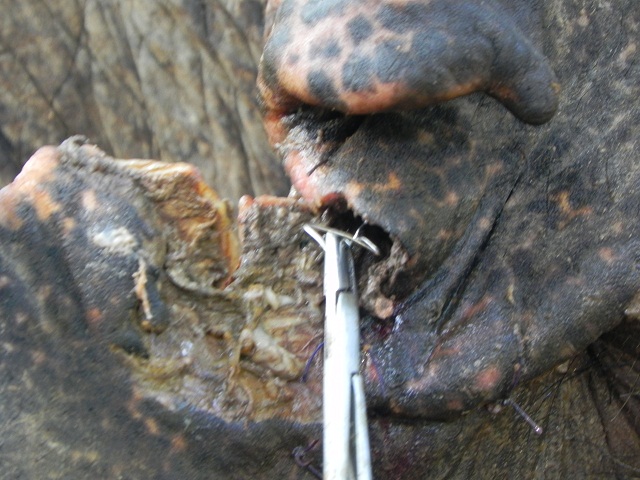
    Bahabur stood motionless, his right ear ripped in half, dangling painfully under its own weight. The cartilage was ripped apart at the top ridge of his ear. The flesh that covered the back of his ear was torn from the ear, creating a huge gaping pocket between the skin and cartilage. It was a seriously gruesome sight and no doubt painful.

    The attack had happened eight to 12 hours before, after Bahabur, just coming into his annual musth season, had uprooted his tether tree and headed straight into trouble.

    Mahouts tracked Bahabur and received no resistance when they instructed him to return home.

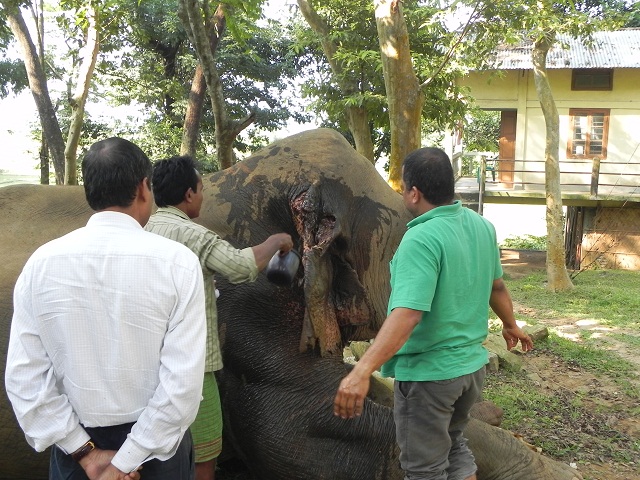
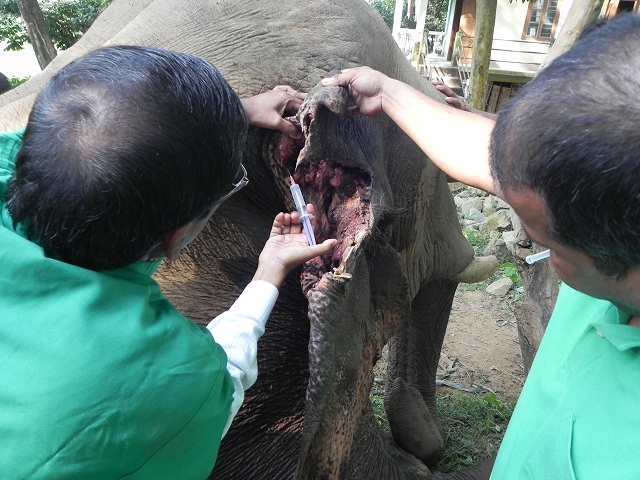
    The expert mahout staff managed Bahabur while Drs. Bhupen Sarma and Anjan Talukdar assessed the injury. In a natural self-medicating fashion, Bahabur had packed the gaping wound with dirt, which needed to be removed before surgery could begin.

    Without complaint Bahabur reclined in a half-sitting position, giving the veterinarians access to the wound. No one yelled, hit or in any way badgered Bahabur. Instead they spoke calmly and confidently, patiently waiting for Bahabur to respond to their commands and get comfortably situated.

    In soft tones, treatment instructions were given. The wound was cleaned, flushed out with clean water and Betadine.

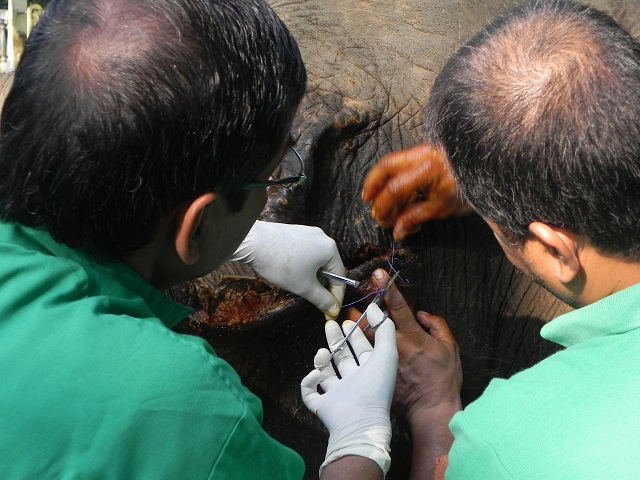
    The veterinarians and mahouts worked seamlessly together, voices low as they repaired the half-severed ear of this full-grown bull elephant.

    From time to time Bahabur needed to stand in order to readjust and, I believe, to distract himself from the pain. After a few seconds standing he would once again respond to the patient command given by his mahout to recline.

    With only a local anesthetic to deaden the pain in the area to be sutured, Bahabur’s ear was expertly reconstructed; the torn cartilage stitched together with sutures and ripped flesh reconnected. The result was amazing.

    Bahabur is a mesmerizing example of this highly evolved, profoundly intelligent species, who for so long has captured my respect and awe.

  • Monsoon Season is Over – September E-Newsletter

    Monsoon Season is Over – September E-Newsletter

    There are more than one hundred elephants awaiting pedicures in India and Nepal. Wow — I can hardly catch my breath at the thought of it!

    This is my passion these days — foot trimming. The joy of being at the ground level, literally, of elephant welfare, is thrilling. I know we cannot fix all the problems facing captive elephants in Asia, but foot care is a very immediate and concrete way to improve their lives.

    India: Care center plans

    I will be in India through October, visiting with colleagues about prospective care center projects (and, of course, trimming elephant feet!). The care center project in Bannerghatta stalled due to property ownership issues and lack of government clearance. Disappointing as it is, we have decided to cancel the Bannerghatta care center project and concentrate on other more promising locations.

    This will be my third visit to Guwahati, in India’s north. It is stunningly beautiful elephant country. Unlike my last visit, which was a six-hour whirlwind blur, I will spend several days studying the area proposed for a new care center. I also plan to meet with the chief warden of Assam about a proposed care center in his state.

    This will be my second meeting with the warden. My colleague from the Assam Elephant Foundation and I are encouraged by the interest he has shown in this project. In fact, it was the warden’s idea and it is only with his endorsement that the project can move forward.

    The last time we met, the warden committed an area of land to the proposed center and agreed to permit the residents of our center to have access to the surrounding forest. This is an exciting start. I will keep you posted as we proceed.

    I will make a repeat visit to Wildlife SOS-India, outside New Delhi. This time I will have the opportunity to provide pedicures for all the elephants before heading off to see their new project, a four hundred-acre elephant rescue center under construction in Mathura. I have heard so much about this project—I can’t wait to see it.

    Nepal: Pedicures, chain-free yards, waste disposal and retirement center

    When I arrive in Nepal in November, I will have my work cut out for me: pedicures for more than one hundred elephants; we hope the construction of several more chain-free yards; development of environmentally sound elephant waste disposal practices; and brainstorming on plans for an elephant retirement center in Sauraha. What a productive time this will be!

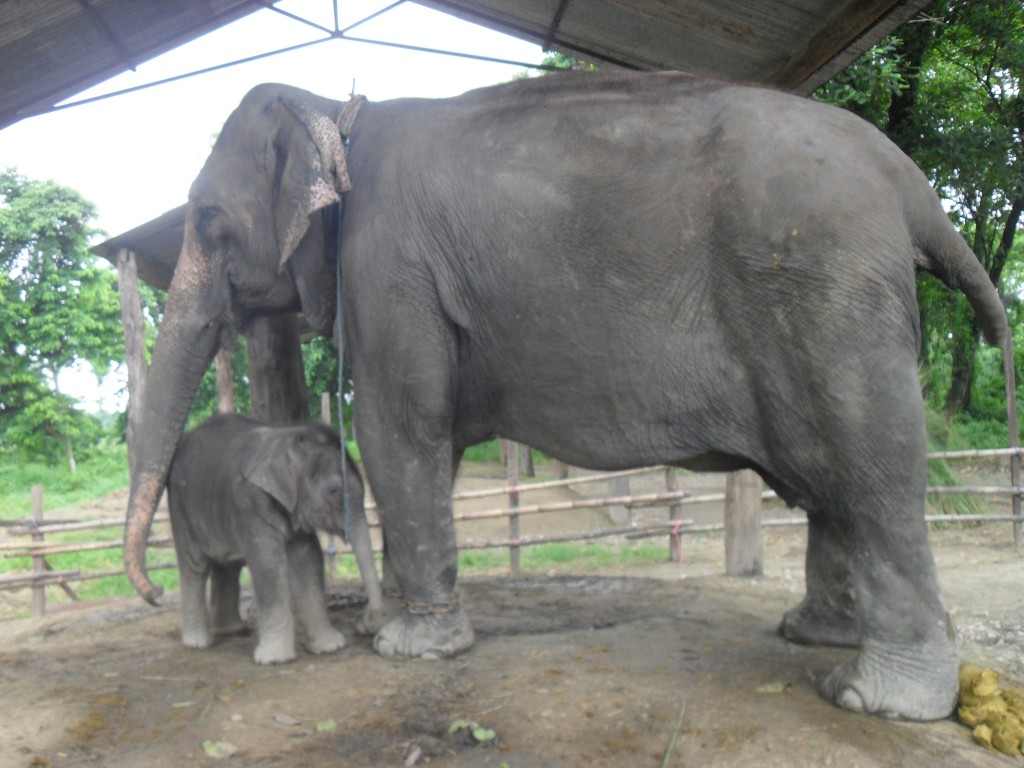
    Our first candidates for a chain-free yard are Man Kali and her two-month-old baby Hem Gaj. Currently, Man Kali is chained but little Hem Gaj is chain-free, kept with his mom in a wooden corral built by the mahouts.

    But the wooden corral won’t hold him in for long!

    After watching how Sweetie Kali blossomed in her chain-free yard, the mahouts want the same for her baby brother. They are determined that Hem Gaj will not be put on chains and have asked us to build a yard for him and his mother.

    Help us build a yard for Man Kali and Hem Gaj!

    Enclosing one acre of land with the power fence required to keep captive elephants in and wild elephants out, costs close to $4,000US. Adding water storage tanks, plumbing and a drinking trough, adds another $2,000US.

    Help us remove the heavy chains from Man Kali’s legs and ensure that baby Hem Gaj will never feel the pain of cold steel around his ankles.

    Just say yes! I want to contribute $10 / $25 / $50 / $75 / $100 / or other $_____ to build a one-acre, chain-free yard for Man Kali and her two-month old baby, Hem Gaj.

    If you prefer to donate by check, please make your check payable to Elephant Aid International and send it to:

    Elephant Aid International

    P.O. Box 106

    Hohenwald, TN 38462

    931-796-1466

    As you might expect, we won’t stop there. As the funds are raised, we will build more yards for more elephants.

    We are making great progress in Nepal. The mahouts welcome my return and are engaged in the changes we are making. They have embraced the chain-free yard concept, are excelling at pedicures and want to learn more humane ways of working with their elephants. The future of elephant welfare in Nepal is in their hands.
    You make it possible

    We have made it this far because we believe in the power of one. Each one of you makes it possible to help one elephant, then another and another.

    As I head off to the Far East once again, I am eternally grateful for your continuing support and encouragement. Knowing that you are behind me one hundred percent gives me the determination to forge ahead, helping one elephant at a time, then another and another. It’s working and it’s all thanks to you!

    Please follow the progress of our work on my blog and thank you, as always, for your support.

    Namaste,

    Carol

  • Drag Chains and Training

    Drag Chains and Training

    Elephant’s World posted two videos on YouTube last week of me training a young elephant named Jon (you can view them here and here). I was surprised to see the videos and happy to know they exist.

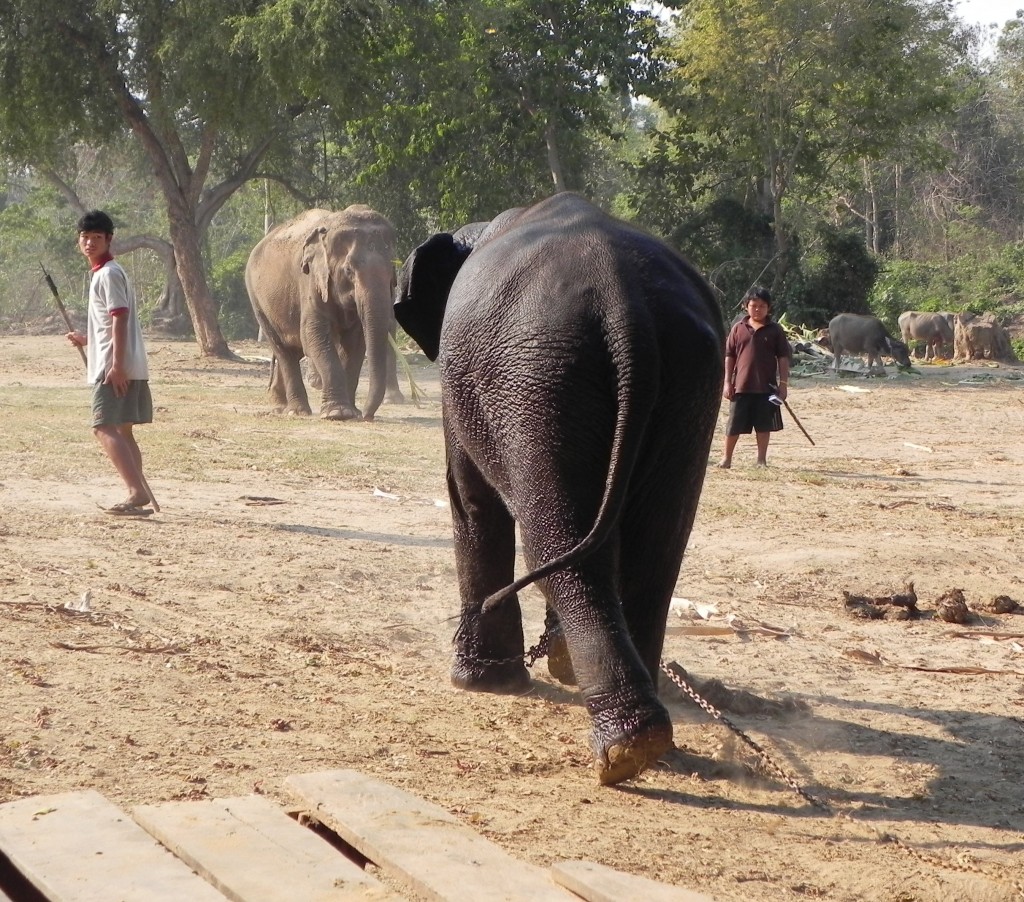
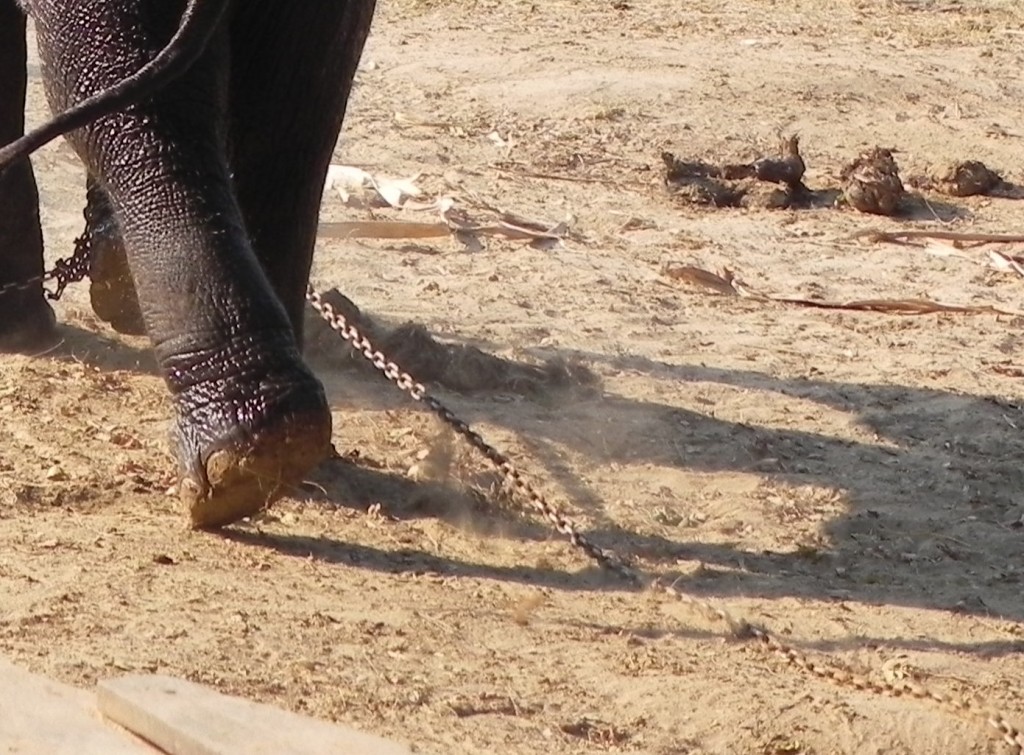
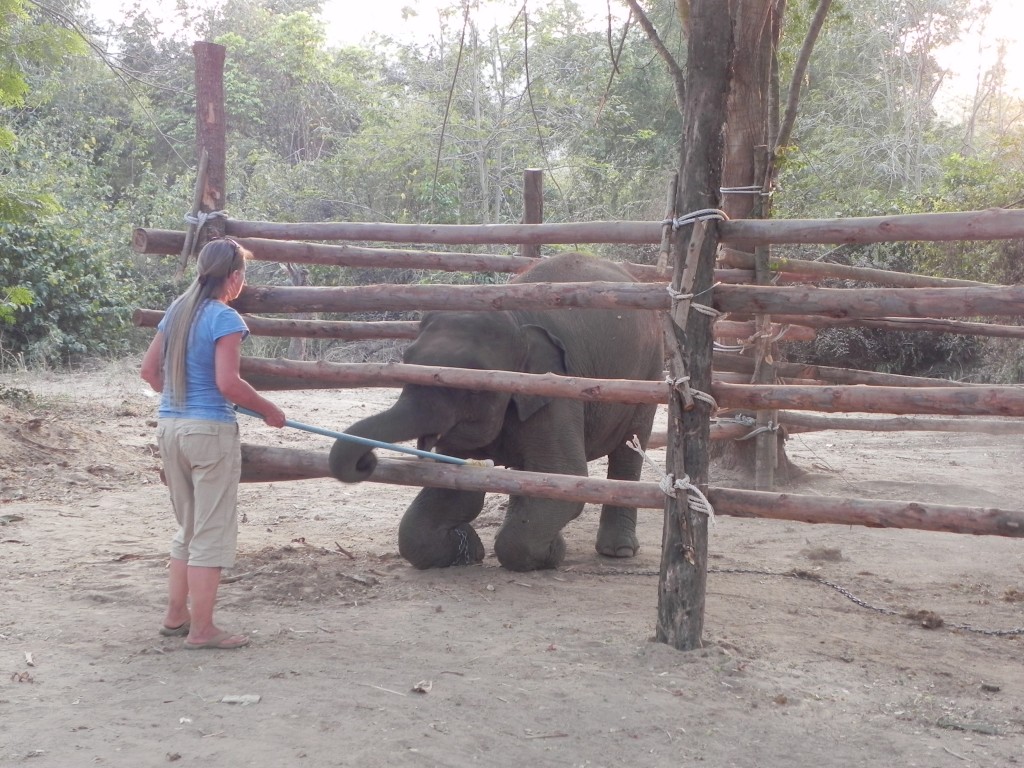
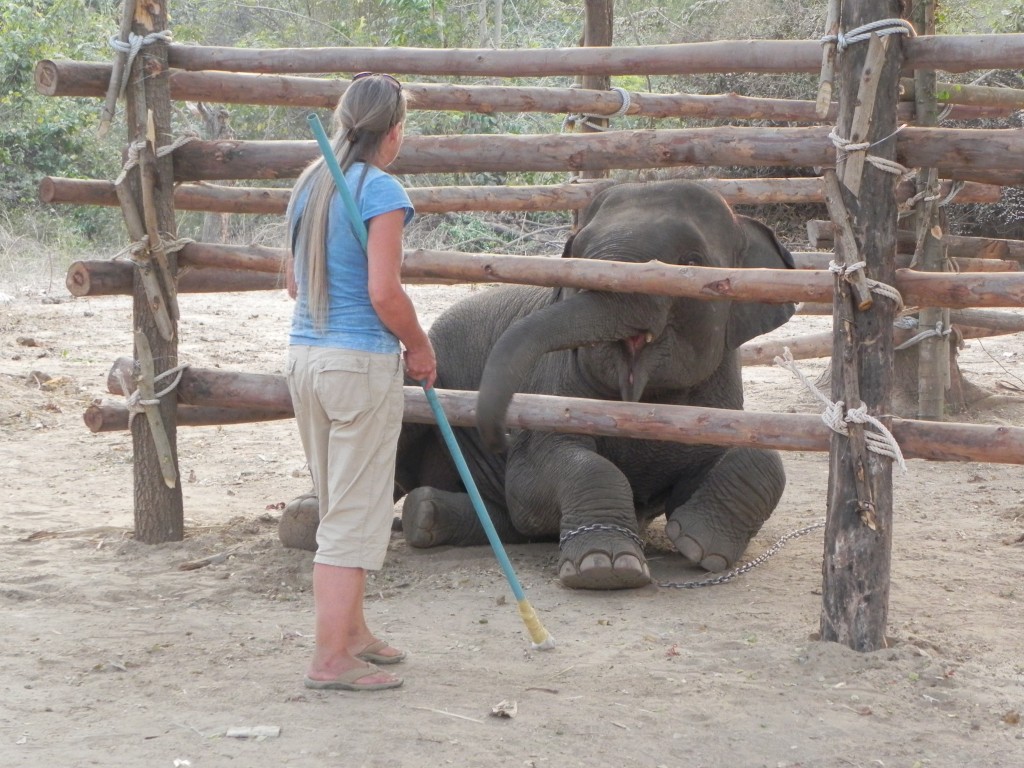
    Many people found the videos interesting and some have asked why Jon is wearing a chain. The chain is called a drag chain; in Asia it is used to prevent an elephant from running away. One end of the long chain is fastened around an elephant’s wrist and the other end drags behind.

    When a mahout is afraid that his elephant will run away, he puts a drag chain on him. If the elephant runs, the mahout wraps the loose end of the chain around a tree to stop him.

    The mahouts at Elephant’s World were resistant to non-dominance training and even more resistant to removing Jon’s drag chain. In order to be allowed to demonstrate positive reinforcement target training, I agreed to the drag chain for the first two sessions. One end of the chain was on Jon’s ankle and the other end was loose.

    My adherence to their tradition gave the mahouts time to get comfortable with the new training method I offered. They observed firsthand that Jon was more interested in the training game than in trying to get away.

    Jon showed such promise that after the second training session the mahouts agreed to remove the chain.

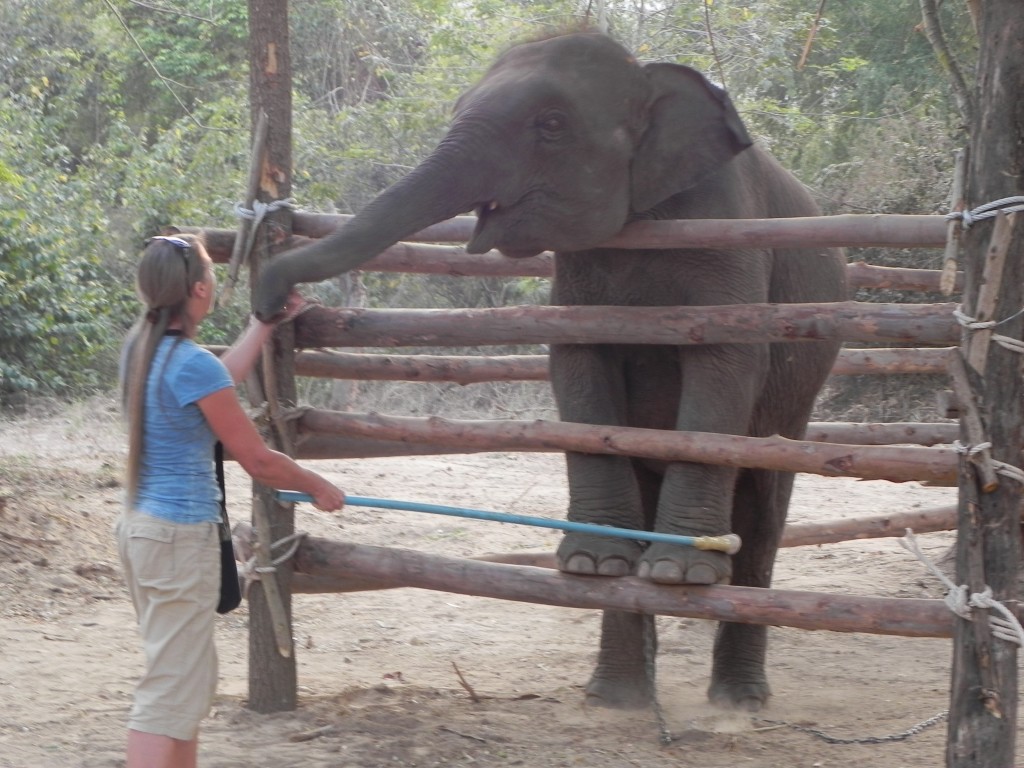
    There have also been questions about the “stick” used during training. The stick, or target as it is called, is a flexible pole with a soft cushion on the end. Watch my training tutorial to see how the target is used and learn the basic concept of target training.

    The goal is to teach an elephant the name/word for different body parts, such as foot, head, ear, side, etc. Once understood—which takes most elephants only minutes to grasp—the elephant will voluntarily offer that body part when asked. The key is to ask, not demand, and always provide praise and a treat as a reward.

    Before watching the videos of Jon’s training sessions, I suggest that you view the tutorial a couple of times. Then watch Jon’s first training session and see if you can identify what body parts Jon is learning. Notice that when Jon becomes frustrated he walks away, but returns almost immediately to try again.

    Positive Reinforcement Target Training gives the elephant the freedom to walk away, take a moment to reflect on what is happening and return when he is ready to try again. Walking away reduces frustration and increases the elephant’s willingness to participate.

    You will also notice in the video that Jon offers behaviors–kneel and lie down. This is common in initial training sessions. Many times the elephant will offer what s/he already knows before starting to “problem solve” and figure out what the trainer is trying to teach.


    Learning to think for themselves is the first thing the elephants learn. After that, training is a breeze.