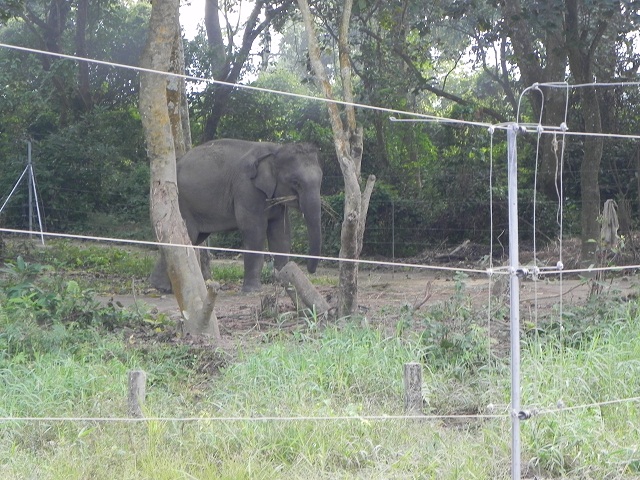
The first two corrals at Kasara hattisar are finally ready.
The air is charged with anticipation.
Rescuing an elephant to sanctuary or releasing them from chains brings the same mix of emotions — anticipation, apprehension and excitement.
Each elephant is a unique individual with a distinct personality. Life’s experiences mold their behavior, shaping them as they mature. Each of them responds differently to different situations.
Himal Gaj
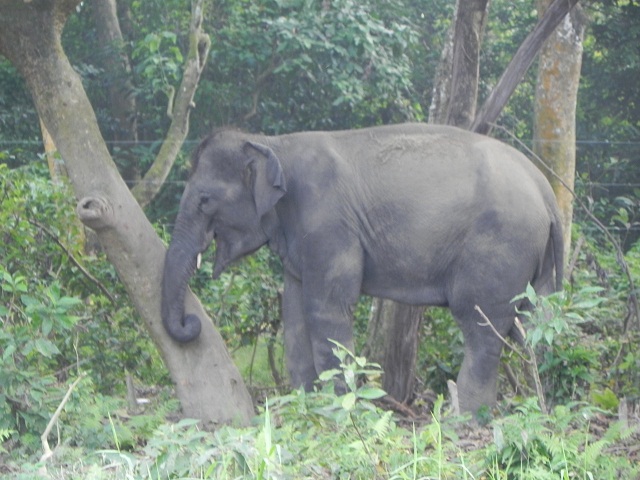
When I first arrived at the Kasara hattisar, I noticed that young Himal Gaj was resistant to his mahouts. He appeared fearful. An old scar at the base of his trunk indicated a past confrontation.
Watching the mahouts struggle through the morning routine, preparing Himal Gaj for duty, was disconcerting. I wondered how he and the mahouts would respond to going chain-free.
The mahouts were also concerned. They feared for their safety.
As a result, it was decided that Himal Gaj would be released from his tether but would wear loose hobbles until the mahouts felt safe around him.
It was disappointing that Himal Gaj would not immediately be completely free, but the compromise was the first step to his future freedom. If the mahouts fear for their safety, Himal Gaj would be destined for a life in chains.
With time and Compassionate Elephant Care training I hoped Himal Gaj would settle down and become more responsive.
The chains come off
The elephants usually return from their anti-poaching patrol duties around 4pm. Chief Conservation Officer Kamal Kunwar postponed a scheduled meeting so he could be present for this auspicious occasion.
Just before 4pm, the hattisar suba arrived. He’d been out of office for a couple of weeks. He and Kamal discussed the plan in Nepali. I would soon see that following their brief conversation plans would change dramatically.
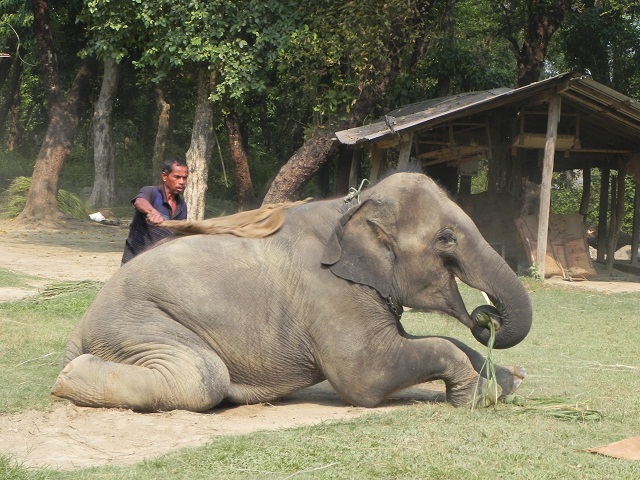
The elephants arrived back from the forest. To my surprise and contrary to the plan, Himal Gaj was walked directly into his new chain-free corral. He was not put on loose hobbles. Calmly and confidently, his mahout gave the command to bite (stretch out on his sternum). Without hesitation or fear, Himal Gaj calmly responded.
I realized that the mahout I’d seen with Himal Gaj the past week was now assisting, rather than riding.
In that moment things became perfectly clear. The mahout to whom Himal Gaj was resistant to this past week was the junior mahout. And now that his main mahout was back from vacation, everything was fine.
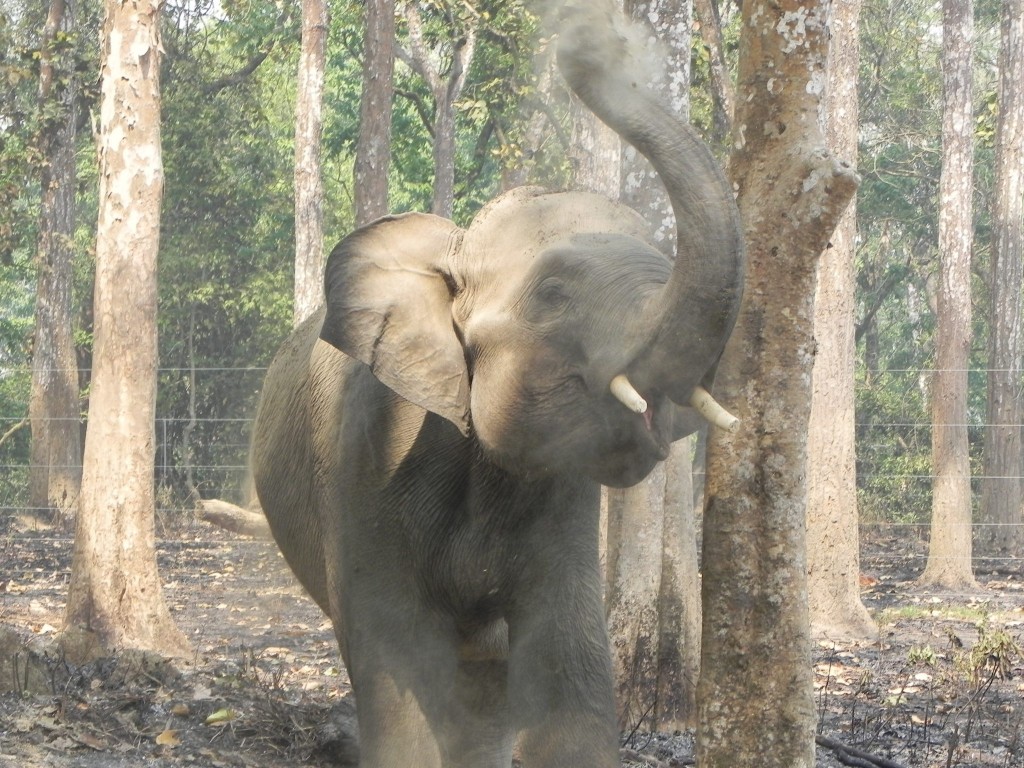
Himal Gaj waited patiently as his gear was removed. Then he rose and immediately began dusting, as his friend and senior mahout left the corral.
What a difference a good relationship makes.
Kamal Kunwar’s turn
Tamor Kali
I did not have time to dwell on the glory of Himal Gaj’s transformation because Tamor Kali was about to enter her chain-free corral for the first time.
Kamal Kunwar was sincerely excited, filming her first chain-free steps like a proud father.
After seeing how well Himal Gaj responded to his mahout, everyone was engaged and relaxed. They gestured at both young elephants free-of-chains with huge smiles on their faces.
Now was the time to stand back and savor the moment. The instant that life changed for two young elephants and their family of mahouts.
The three other elephants stood chained under their shelter watching the scene.
I whispered, “You’re next ladies.”
It will be close to a week before the other corrals are completed. Without a doubt, Khosi Kali, Laxmi Kali and Prayna Kali, who have all been prisoners to chains for decades, will transition seamlessly.
Imagine the joy when they are all chain-free. Heart bursting JOY!
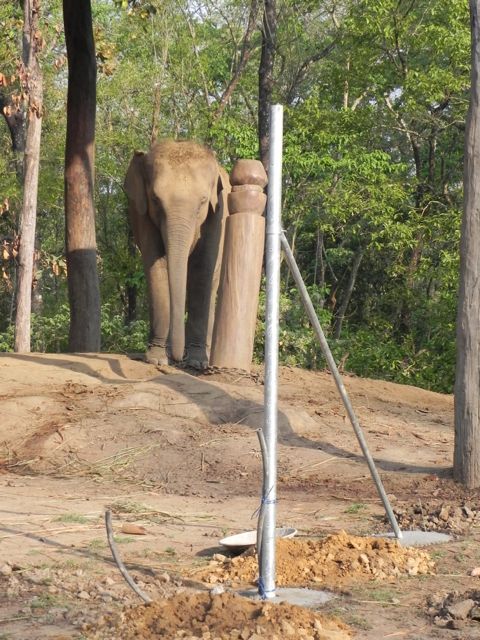
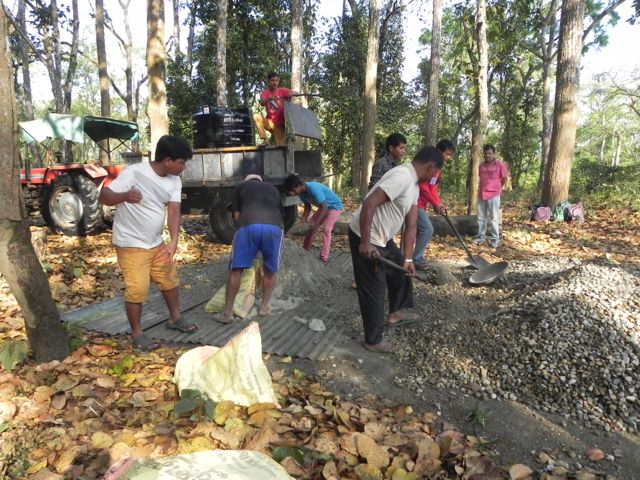
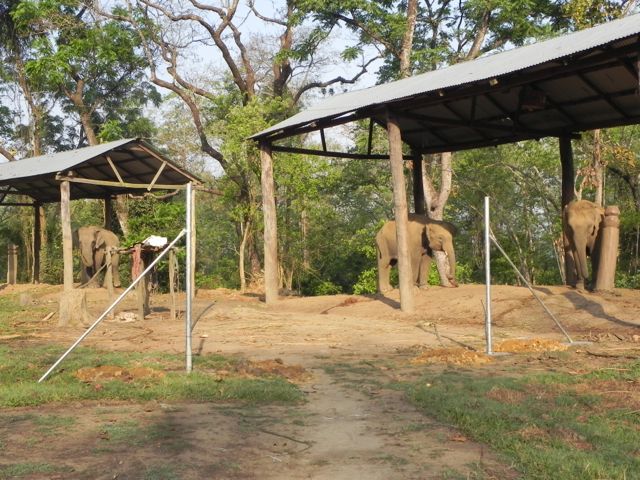
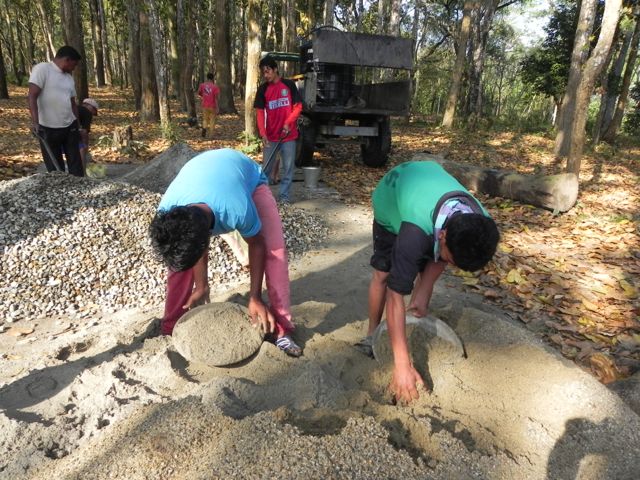
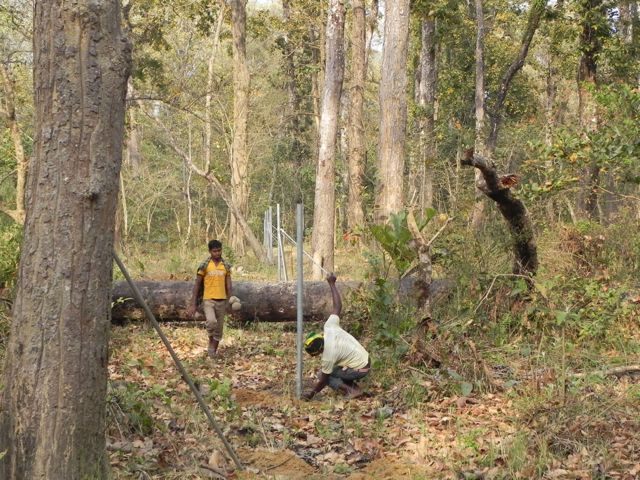
The framework for all six chain-free corrals at the Kasara hattisar is in place.
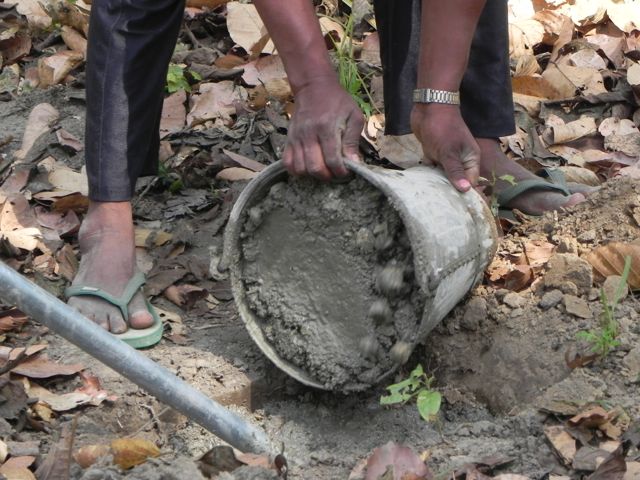
Support and brace posts are concreted. Gateposts mark the entrance to each new corral.
Heart work
Eyeing the progress of this project, my heart pounds. Here it comes, that joyfully intoxicating feeling cursing through my veins.
My eyes transport the image to my heart. My heart responds, sending a warm glow through my body, filling my eyes with tears. My heart swells with the promise of a better life for these elephants.
In this moment I stand in my personal space of pure peace. I caress it. Breathe it in deeply. I don’t attempt to own it, only experience it, knowing the feeling is a gift meant to be experienced not possessed.
Some people meditate, others run, cycle or climb mountains to connect to that place within where they feel most themselves, most centered, most peaceful.
This is the place of autonomy and personal freedom.
Such activity can literally become an addiction, in the best sense of the word.
Watching the chain-free corrals come to life before my eyes is my addiction. Knowing that my actions help reduce the suffering of captive-held elephants brings me great joy! It is heart work, soul fulfilling work. My meditation.
At times the joy is overwhelming and I just have to cry. Seeing elephants gain even a semblance of autonomy moves me to do more. Knowing that we are able to help bring some peace and freedom to their lives drives me.
I may never know any of these elephants personally. But that is not the point of my work. I am not here to expand my elephant family. I am here to better the lives of these elephants.
They know we are helping them. That is good enough for me.
Construction continues
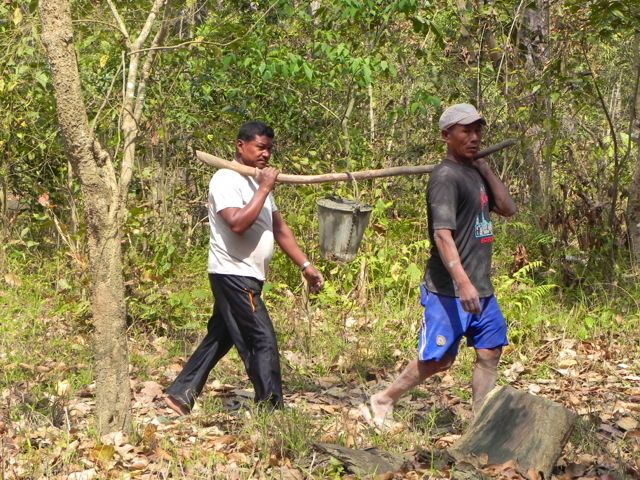
The next step is to string the wire between support posts and hand-build the topes (post protectors).
Each corral is one full acre in size. It is equipped with six strands of wire equaling nearly one mile of wire per corral.
Ditches will be dug to bury the wires that enable each corral to operate independently.
Last, the steel box that contains and protects the energizer and batteries will be installed and wired to the solar panel that powers the system.
A perfect vantage point
From the open-air raised platform that I have claimed for my new office, I survey the work site. What a gift to witness this miracle unfolding right before my eyes.
A humble thanks to Kamal Kunwar, Chitwan National Park chief conservation officer, the entire hattisar staff, our IBEX fence crew and all of you who have contributed to this worthwhile project.
Together we are improving elephant welfare, showing due respect to these wise, kind and self-aware beings who grace our planet and our lives.
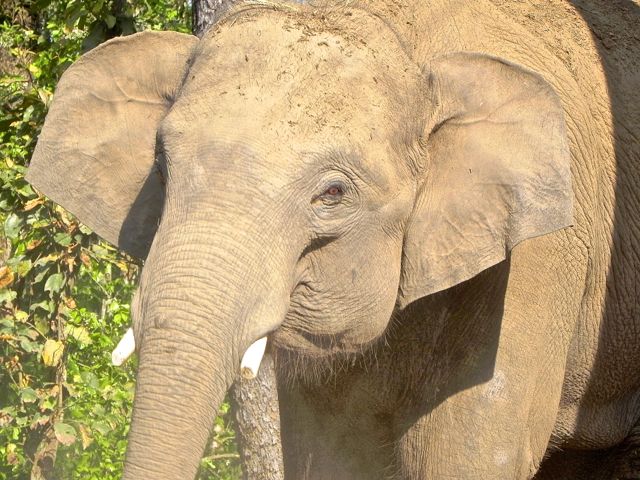
Himal Gaj is a six-year-old captive born elephant. His father is the dominant wild bull in the area. His mother is a wild born, captive resident of the elephant breeding center at Khosor, Chitwan, Nepal.
Himal Gaj was one of five young elephants trained together at the breeding center several months ago. Until their formal training, they lived with their mothers.
All five elephants were chained from the age of three months. Chaining is the practice all over Asia. Domestic livestock and captive elephants are tied or chained. It is the cheapest way to keep them in one place.
The training technique used with Himal Gaj and the others at the breeding center was a deviation from the traditional pujan, a brutal breaking of spirit. Introduced by a foreign NGO, a mixture of traditional methods was used—including the use of koonkie elephants, negative reinforcement and punishment—combined with positive reinforcement techniques known to be successful with domestic horses.
Unfortunately, once training began, Himal Gaj showed signs of aggression and resistance. He was frightened by the training process and responded poorly to his mahouts. A few months later his training was deemed unsuccessful.
No video, photographic or written records exist to document the daily training process and Himal Gaj’s progress and difficulties.
But it does not take such documentation to see that Himal Gaj is a very insecure individual.
Although Himal Gaj responds well when his mahout is riding, his weakness is responding to commands when his mahout is on the ground.
Himal Gaj is a good example of the importance of sound training techniques, mahout training and follow through.
Captive elephants are not domesticated—they are wild animals living in a captive environment. Even generations born in captivity are not domesticated. The scientific process of breeding selected individuals for specific traits is the process required to create a domestic species. This has never been undertaken with elephants.
In the case of all elephants born at the breeding facility in Khosor, the mothers are wild born living in captivity and the fathers are wild born living in the wild.
Himal Gaj’s mahouts are as gentle as I have seen anywhere. They are patient but frustrated. What the training process failed to do was give them the tools necessary to help Himal Gaj learn.
As a result, all are left feeling like failures. Without intervention, Himal Gaj is doomed to be a dangerous elephant for the remainder of his life.
The good news is that the mahouts and Kamal Kunwar, the chief commanding officer of Chitwan National Park, are receptive to Himal Gaj receiving additional training. His private training course will begin soon.
This is such exciting news. I feared Himal Gaj would remain a lost cause in the minds of the mahouts. But before his chain-free corral is completed Himal Gaj, will be well on his way to understanding what is expected of him and his mahouts will have gained the humane tools to understand and assist him in his training process.
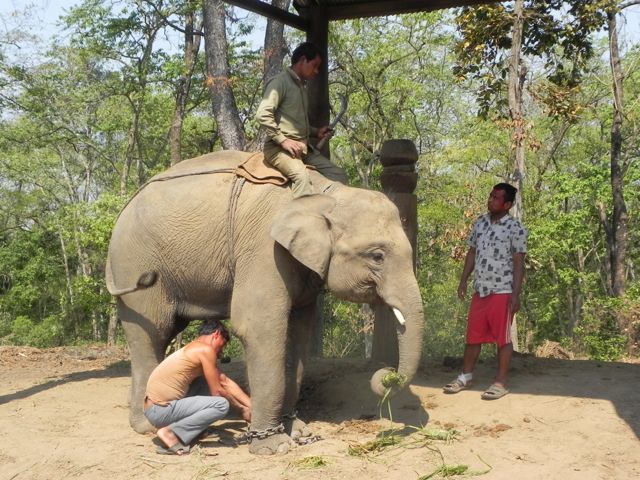
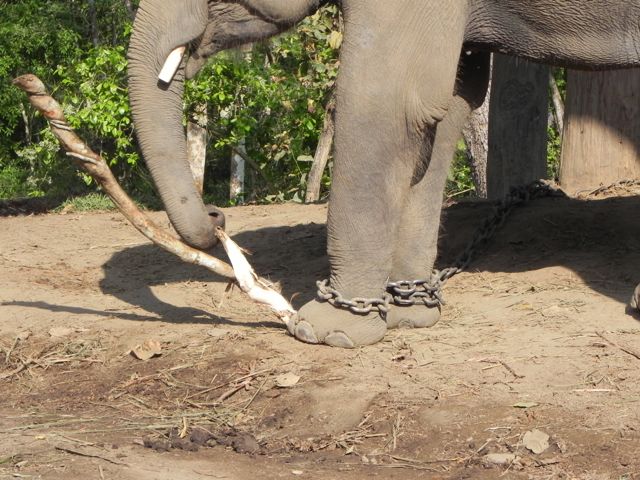
It’s easy to look at an elephant shackled by both front feet to the ground, with open wounds, and blame the mahout.
But I challenge you to learn the facts.
Elephants belong to hotel owners
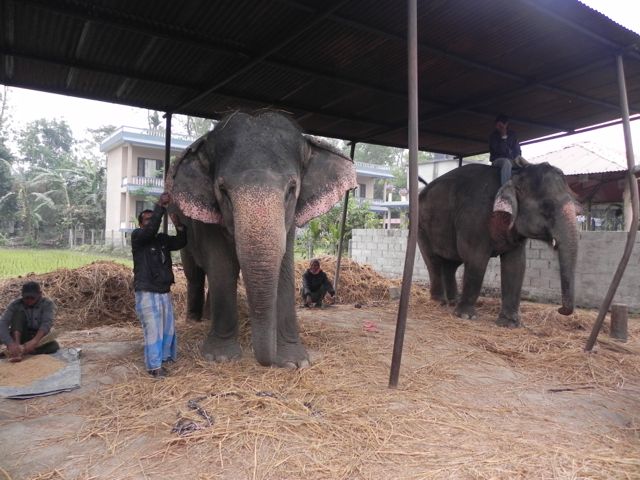
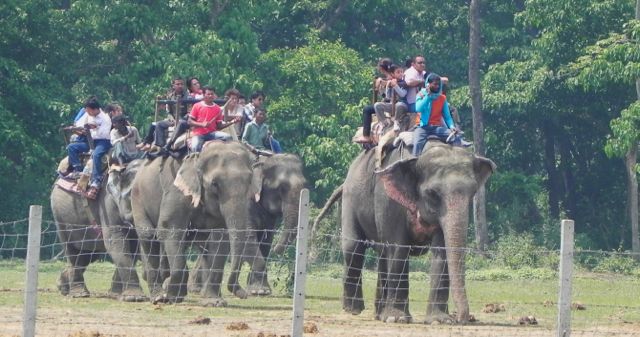
In Chitwan, Nepal, mahouts do not own elephants. Elephants are the private property of hotel owners, who use them to augment their income by offering elephant back safaris to overnight guests and daytrippers coming to Chitwan in search of fun and adventure.
Elephant back safaris not only provide a bountiful financial benefit for the owner, they are actually the life’s blood of Chitwan.
In Sauraha, Chitwan’s tourist destination, every shopkeeper, restaurant owner, hotel, bar, service provider, wilderness guide, money changer, street vendor and orphanage owe their survival to these elephants. Many falsely claim that without elephant safaris, this tourist destination would cease to exist.
Grueling work schedule
All day long, 24/7, mahouts and elephants give safari rides in the community forest.
Mahouts train, feed and ready the elephants for the rides. It is a grueling job for both. Up at 4:30am, the pair sets out on the long trek to the safari loading area as the rising sun lights up the morning sky.
During what is supposed to be a one-hour lunch and rest period, the elephants instead are taken to a riverfront area where tourists mount them to have their photo taken.
Walking back and forth to the safari ride area, tourist bathing area and home stable, while carrying hundreds of pounds of tourists for hours at a time, takes its toll on elephant and mahout alike.
At dusk, and even into the dark of night, elephants can be seen silhouetted against the sky trudging down the paved roads of Chitwan toward their home stable.
Mahouts: Overworked, underpaid and devalued
Elephant owners know nothing about elephants and rely on the mahouts to keep the elephants alive and working without killing tourists. This is a heavy burden to put on overworked, underpaid and devalued employees.
When mahouts “ask for more,” be it food for themselves or the elephants, they are chastised. Many owners view the mahouts as stupid, uneducated and unmotivated and blame them for the elephant’s unsanitary living conditions and poor health.
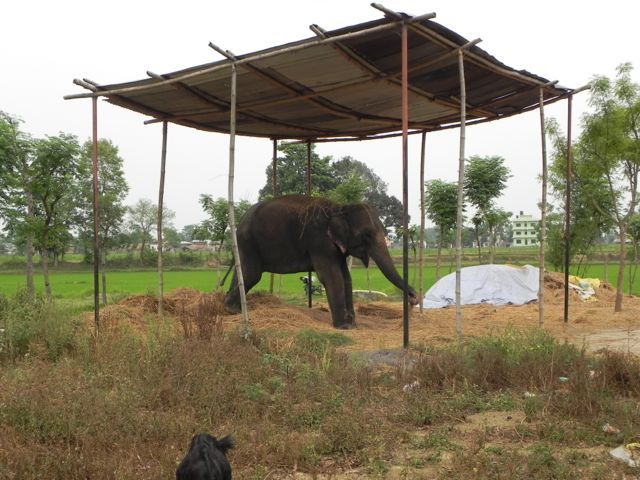
Yet mahouts are not provided even the most basic supplies to ensure the health and wellbeing of the elephants in their care. Owners fail to supply nutritious food but blame the mahouts for the elephant’s poor health. Stables are rancid cesspools because no provision is made for waste disposal. Many stables don’t even have a source of fresh water. For this, the mahout is unjustly blamed.
A marginalized community
The truth is that the mahouts are a marginalized community. The custom of treating them as poorly as the elephants is woven into the fabric of society and their living conditions are a mirror image of those of the elephants.
Mahouts learn their trade on the job, from senior mahouts. Their lot in life dictates they do as they are told without question. They hit the elephants because they are taught they must in order to ensure the elephant does not kill them.
Still, this does not excuse how the mahouts mistreat the elephants.
Abuse can be eliminated
Through education and culture shifting, elephant abuse can be eliminated.
Demonizing either owners or mahouts is not the solution.
The first step is understanding why the situation exists and accepting the challenge to help move culture forward.
Owners must be held responsible and mahouts and tourists must be educated.
This will result in improved welfare for the elephants in Chitwan.
How we can help
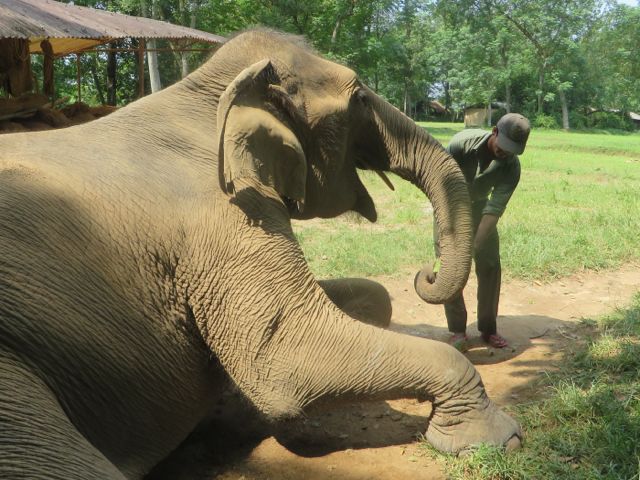
Developing sustainable assistance programs is essential. Live demonstrations, educational resources such as videos and manuals, translators and hands-on assistance are needed to improve mahout knowledge and understanding of new approaches to elephant care.
This is Elephant Aid International’s mission. By providing bi-annual foot trimming; training mahouts and vet techs in the skill of foot trimming; teaching positive reinforcement training philosophy and techniques; and constructing chain-free corrals, we are laying the foundation for positive change.
EAI doesn’t blame the mahouts. We give them the tools necessary to take better care of their elephants.
It was a 10-hour drive through mountains on rough roads. The 19-year-old driver of our rental truck scared the daylights out of all of us with his speeding, passing trucks on blind curves and nearly missing oncoming vehicles. Oh man — it was a stressful ten hours!
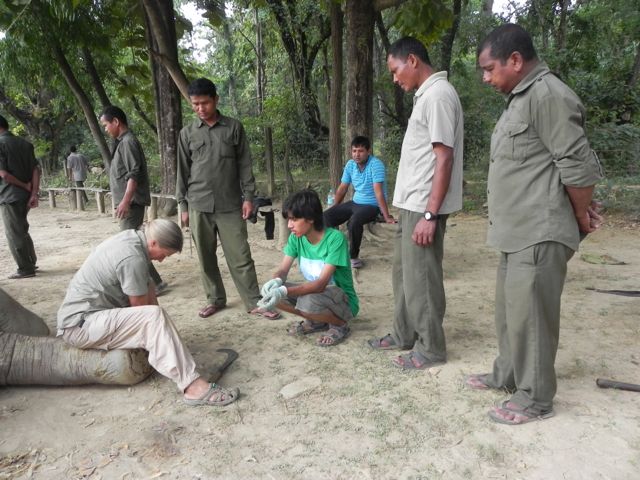
But our foot trimming program was a grand success. We had a fabulous trimming team: Dr. Gairhe; Kiran the vet tech; Hira, Kirti Kali’s phanet (head mahout) from the NTNC hattisar; and I.
Our students included Chantelle, our intern; Surajan, a new friend and translator; and the vet tech from Bardia.
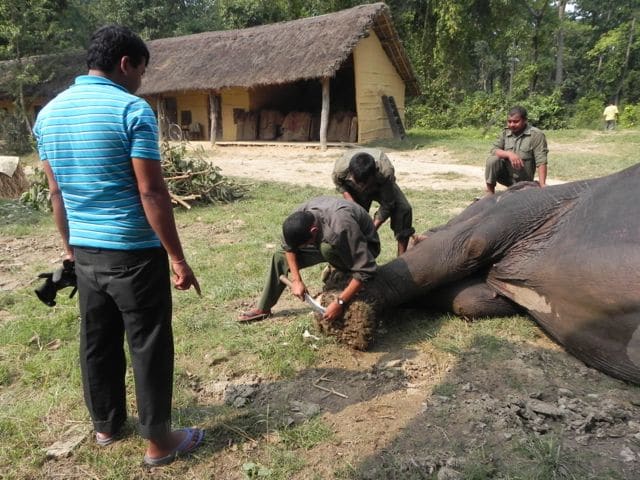
In two short days we trimmed the feet of 24 government and privately owned elephants.
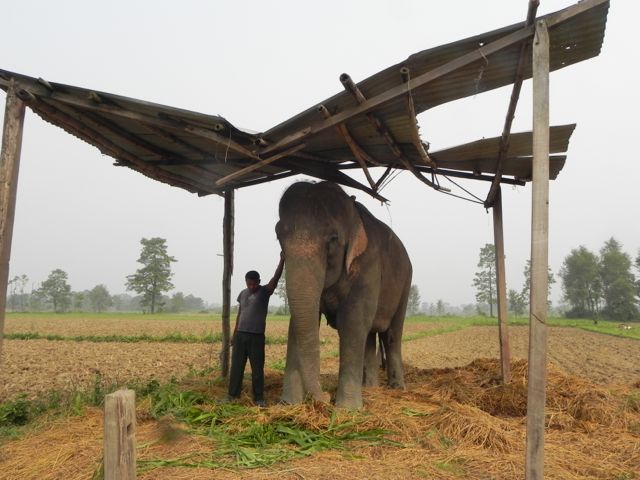
Honestly, the condition of the privately owned elephant’s feet was criminal, similar to the privately owned elephants in Chitwan. Their pads were dry, cracked and severely overgrown. The nails were equally as dry and overgrown and many had splits and deep cracks.
Private owner, broken shelter
I am always shocked to see how poorly the privately owned elephants are kept, especially since they are the breadwinners for their owners.
The good news is that 24 more elephants received pedicures and their mahouts were introduced to foot care. With time things can change for these over-used, abused and neglected elephants…I hope.
A huge thank-you goes out to the trimming team. Without their enthusiasm and hard work we could not have accomplished our goal to provide foot care for elephants in Bardia!
You can make a difference in the life of a captive elephant by supporting our Foot Care project. Thanks for your help.
Chain-Free Hattisar Project
National Trust for Nature Conservation – Biodiversity Conservation Center
Chitwan, Nepal
REPORT
Project completed Jan 10, 2013
Department of National Parks and Wildlife Conservation Jhamak Karki, Chief Warden-Chitwan National Park
Dr. Kamal Gairhe, Senior Wildlife Veterinarian-Chitwan National Park
National Trust for Nature Conservation Naresh Subedi, Senior Conservation Officer
Chiranjibi Pd. Pokheral, Senior Conservation Officer-Biodiversity Conservation Center
Babu Ram Lamichhane, Conservation Officer-Biodiversity Conservation Center
Dr. Arjun Pandit, Staff Veterinarian- Biodiversity Conservation Center
In collaboration with
Elephant Aid international-USA Carol Buckley, Founder and CEO
INTRODUCTION
In January 2013, construction was completed on a solar-powered chain-free hattisar at the National Trust for Nature Conservation’s Biodiversity Conservation Center (NTNC-BCC).
This first-of-its-kind pilot project was developed to study the benefits of working elephants in Nepal living chain-free.
Six elephants, ranging from seven months to seventy-plus years, currently live in five interconnected chain-free corrals designed to improve their welfare.
The elephants spend an average of fifteen hours in the hattisar each day. In the past they were hobbled by both front legs, chained under a shelter that prevented natural posturing and healthy physical activity.
Now, living in the chain-free corral, each elephant is free to move at will and engage in natural behavior such as dusting, foraging, sleeping, bathing, walking, playing. In the case of Man Kali and her children, eight-year-old daughter Prakriti Kali and seven-month-old son Hem Gaj, this related family is able to engage in normal social behavior.
Corral construction and operating system
The corral’s operating system is a solar-powered energizer with a double battery back-up. Three hours of sunlight is required to keep the batteries charged for 10 days.
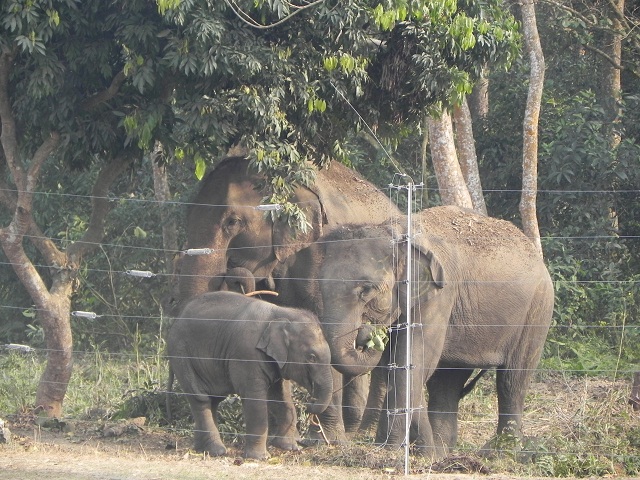
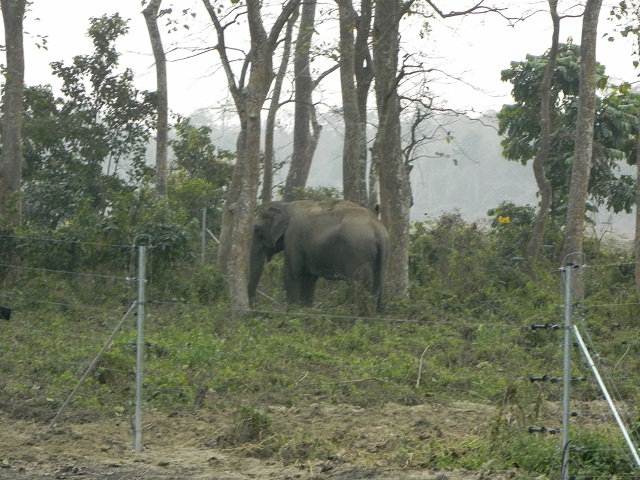
Specifically designed for wildlife, the corral administers a mild shock upon contact. Due to the pulsating current, it is virtually harmless. Being highly sensitive to the clicking sound of the current, most elephants avoid the fence without ever coming into contact with it.
The chain-free hattisar consists of five interconnected corrals on approximately two-and-one-half acres of open and wooded land.
The corrals stand seven feet tall, constructed of rust-free steel posts and six strands of high tensile wire. Each post is encased in a protective tope.
Each corral has a front, back and side gate for ease of access for cleaning, feeding, moving elephants in and out and providing socialization opportunities.
The energizer and batteries are housed inside the mahout residence; two solar panels that charge the batteries are attached to the roof of the residence.
Each corral is equipped with a cut-off switch enabling independent operation.
This design has proven successful in many areas of Asia to prevent entry by wild bull elephants.
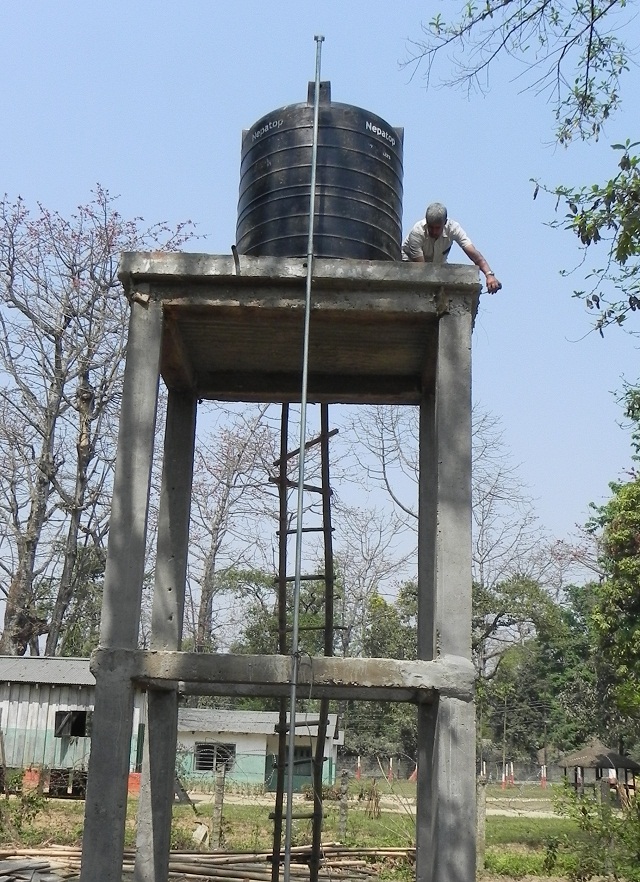
Fresh water is stored in an elevated water tank and troughs are filled by gravity feed.
All corrals have a custom-made concrete water trough that provides clean water.
Healthy trees are an important component of the chain-free corrals, providing shade, browse and a natural scratching surface.
To prevent serious damage to trees from elephant tusking activity, protectors were built around select trees.
GOALS AND OBJECTIVES
Reduce or eliminate stereotypical behavior caused by chaining
Eliminate low-level long-term stress caused by chaining
Increase physical activity
Encourage engagement in natural species-specific behavior such as foraging, dusting, bathing, walking, playing, socializing and exploring
Eliminate injuries and bone and joint damage
Improve foot health
Maintain elephants’ compliance with mahout authority
METHODS
Ethogram
Husbandry protocol
Management protocol
Feeding protocol
1. ETHOGRAM
In order to quantify the effectiveness of the chain-free corral, an ethogram spreadsheet was created to track a list of natural and stereotypical behaviors, including walking, eating, dusting, playing, exploring, drinking, socializing, sleeping and exhibiting stereotypic behaviors.
2. HUSBANDRY PROTOCOL
Manure removal and corral cleanliness standards were established to ensure the highest level of hygiene.
3. MANAGEMENT PROTOCOL
Training and management practices for inside the corral were established to give elephants a sense of freedom and security.
4. FEEDING PROTOCOL
Changes to traditional feeding practices were established to promote activity and alleviate boredom.
PROGRESS AND PRELIMINARY RESULTS
Each elephant spends approximately 15 hours each day in the chain-free corrals. The remainder of their time is spent in Chitwan National Park engaged in grass collecting, anti-poaching patrols and conservation work and jungle safaris.
Upon first introduction to the chain-free corrals, each elephant calmly explored the area, foraging, dusting and scratching on trees. Each evening they dig in the soft dirt of the forest, creating a comfortable sleeping spot; none return to the stable area to sleep.
The related family of Man Kali, Prakriti Kali and Hem Gaj are housed together. They bonded immediately when united in the chain-free corral and continue to exhibit healthy elephant behavior, with Prakriti Kali assuming the role of big sister to Hem Gaj.
A survey was conducted to track the behavior of the elephants toward the mahouts and drivers. Mahout compliance has not changed. Each elephant continues to respond favorably to mahouts and drivers—both inside and outside the corral—at the same high level as before being released from chains.
Photographic records are being kept to track foot health and bone and joint conditions.
Collectively, the elephants’ behavior represents a substantial improvement in natural activity and reduction in stress and stereotypical behavior.
CONCLUSION
The goal to eliminate stress from chaining and the resulting stereotypic behavior is realized. Adherence to the new feeding protocol ensures that both Prakriti Kali and Mel Kali do not engage in stereotypic, food anticipatory behavior. Since being introduced into the chain-free corral hattisar, all elephants engage in appropriate, beneficial, species-specific behavior; respond favorably to their mahouts; and appear to be calm and comfortable in their new environment, indications that the project is meeting its goals and objectives.
A hauntingly familiar sound of clanking chains passed by my window, so close I thought perhaps my wall would be crushed. The clink clink clink of cold metal bracelets was unmistakable; an escapee was passing by my room in his effort to disappear into the freedom of the bordering National Park.
Switching off the lights to avoid attracting attention, I pushed open the screen door and stepped into the darkness.
The rattle of chains chilled me to the bone as a silhouette passed in front of me. First one and then a second, moving silently except for the clanging of the chain hobbles secured around the front ankles of the smaller elephant.
On this, the night before I leave Sauraha, I wondered why I was to witness another unbearable scene of captive elephant suffering.
The escapee had entered through the front gate at NTNC-BCC and slowed when he found himself fenced in. The second elephant, a koonki, was being used to subdue and calm the young male, whose ivory glistened in the moonlight.
When the bull stopped, the mahout began to speak in a soft but firm tone. He told his elephant, the koonki, to bite, which means to stretch out on her sternum. By assuming this vulnerable position, the elephant appeared to bring comfort to the escapee.
It was then that I saw a mahout precariously perched on top of the young bull, no doubt frightened half out of his wits, with nothing at all to secure himself.
As soon as the koonki reclined, a command was given for the bull to recline, which he did without hesitation. The reality is that he was frightened and I believe the mahouts involved realized this. As soon as he reclined the mahouts switched elephants and the koonki left silently.
A little more rattling of the chains and the hobbles were removed, and the young bull moved swiftly back from where he’d come–the government hattisar (elephant stable) next door.
Not willing to witness the brutal scene I assumed would follow, I called out into the night, no pita (don’t hit). No response. As the elephant and mahout passed my room I called out again, which was when I saw a flashlight-wielding man walking behind the elephant.
“Government center hattie (elephant)?” I asked.
“Yes, Raj, from the government center,” he politely replied.
“The elephant is afraid,” I said. ”Do not add to his misery by beating him.”
“You are foot trimming lady, right?” he asked. “You trimmed Raj a few days ago–he had a bad nail.”
“Be kind, Raj is a wild animal,” I said.
”No, not a wild elephant, government elephant,” was his reply.
“Yes, a government elephant and wild,” I said.
There we stood under a bright near-full moon discussing the fact that although these elephants are living in captivity they remain wild animals, never formally domesticated and always to remain wild. When I said they deserve to be treated with compassion because of their circumstances, the mahout nodded in polite agreement. He spoke surprisingly good English and appeared to understand what I was saying. In seconds he vanished into the darkness, leaving me to contemplate what I had just witnessed.
For some time I stood listening to hear if Raj would be brutalized for his attempted escape. But this night I would not have to be reminded of the elephant suffering that permeates this tourist destination in Nepal. The only sound that pierced the night air was the soft repetition of forest birds and chirping insects.
Working in Asia the past two years I have learned a tremendous amount about how culture and tradition affect collaborative conservation efforts. Among the most important lessons is the need to ensure project sustainability. No matter how groundbreaking or beneficial the project promises to be, it must be sustainable to be successful.
Ways to sustain the project must be identified during the planning stage, otherwise the effort put into it will have been wasted. Sustainability determines success and people ensure sustainability.
Before returning to Chitwan, I wondered if our chain-free yard pilot project for Sweetie Kali, aka Prakriti Kali, would prove to be sustainable. Although I prepared myself for less, I hoped the mahouts had truly embraced this welfare project. Success hinged on their acceptance of this approach to elephant care, which is nearly the polar opposite to their tradition.
As I approached the elephant stables I saw Sweetie Kali foraging in her personal forest. The dense scrubs were a faint memory but the mature trees were standing tall, providing shade and enrichment, just as they had when we built the yard last May.
I was pleased and honestly a bit relieved to see that the chain-free fence was in pristine condition. The staff, under the direction of Chiran Pokheral, the officer in charge, did a fabulous job of ensuring the success of our pilot project.
It’s my nature to push headlong into the next project forgetting to take a moment to bask in the glow of a collaborative project well done. It is too easy to get swept away in the excitement of something new and forget to thank the people responsible for making everything happen.
In addition to Paspat and the mahouts, who were completely receptive to the changes in their routine that a chain-free yard required, many other individuals, including Chiran Pokheral, Dr. Gairhe, Ram Kumar, Babu Ram, Nandu, Vishnu and Dibyendu and his crew, made this project possible. Without their support and assistance, this project would never have come to fruition, much less become sustainable.
Special thanks goes to Chiran Pokheral who, after securing the required clearances, made sure I had access to plumbers, electricians and day laborers, and the cooperation of everyone needed to complete the project. Without Chiran we would still be dreaming about a chain-free yard instead of watching Prakriti Kali thrive in it.
Dr. Gairhe, the senior government veterinarian, also played a key role in the project’s success. A true conservationist, Dr. Gairhe’s endorsement and oversight of the project provided the much-needed assurance at the government level.
Now that I am back in Sauraha, it’s time to identify a location for the second chain-free yard. This yard will be for Man Kali and her three-and-a-half month old calf Hem Gaj. Once again we turn to Chiran Sir, Dr. Gairhe and the NTNC staff to lead us in our effort to improve elephant welfare in Nepal.
My first morning in Assam, I awoke to learn there was an elephant emergency.
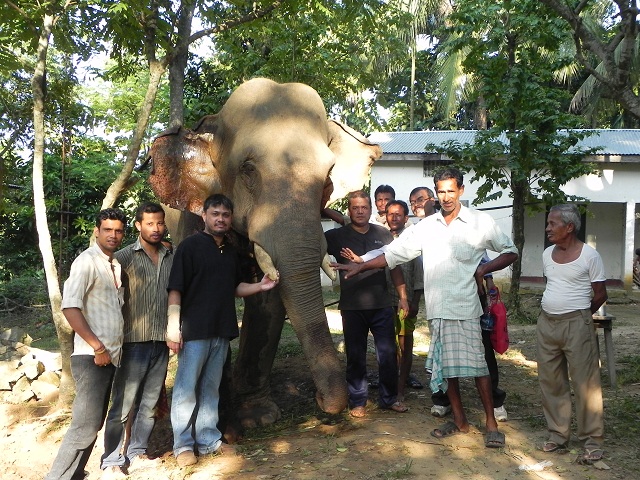
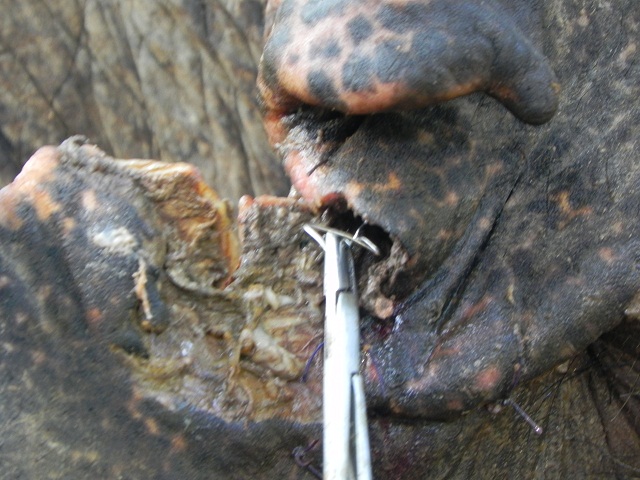
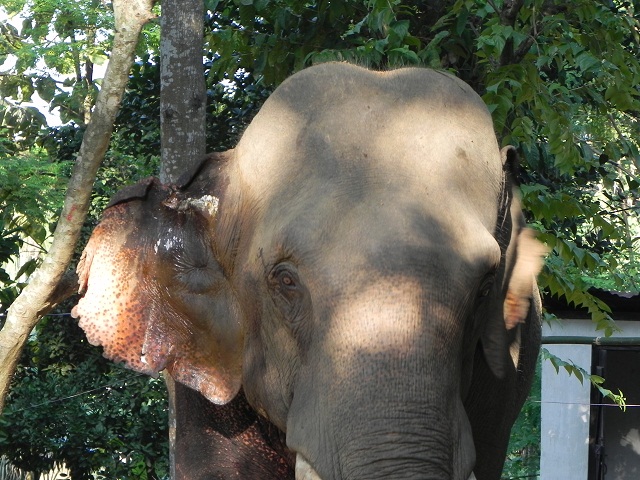
Thirty-five-year-old, Bahabur, a skilled koonki (elephants trained to assist mahouts in the capture, training and management of wild elephants) who only days before successfully pulled a wild rhino from a mud bog nearly lost his right ear in a fight with a wild bull elephant.
Bahabur is intimately familiar with both captive and wild elephants. He lives with a non-related herd of koonki elephants whose job it is to assist their wild kin by participating in human-elephant conflict mitigation.
When wild elephants emerge from the forest in search of food and water, they raid crops and create havoc. In an effort to protect both elephants and humans, Bahabur and his herd, guided by their mahouts, becomes a formidable barrier between wild elephants and trouble, literally saving the wild elephants’ lives.
Many elephants are killed as result of crop raiding–poisoned, shot, electrocuted, their mouths blown apart by bomb-laden food. These koonkis are the front line of protection for their brethren and the villagers whose encroachment and farming activity create such a dangerous situation for everyone involved.
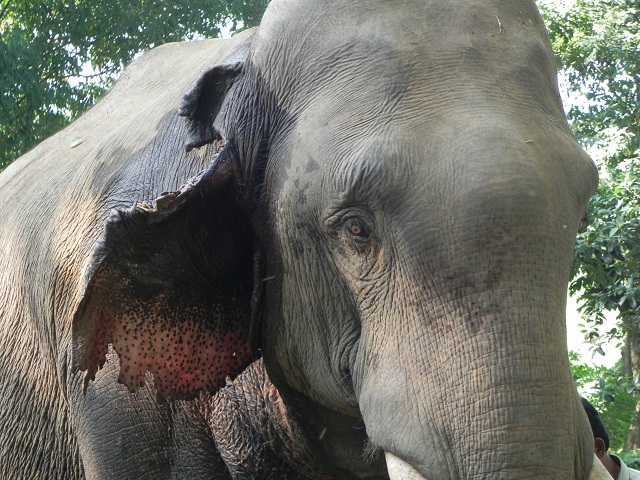
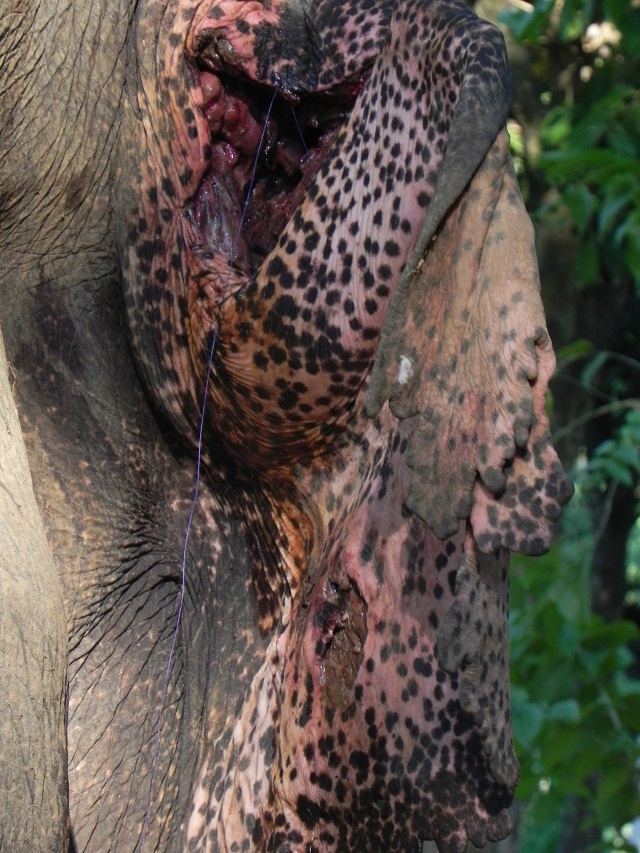
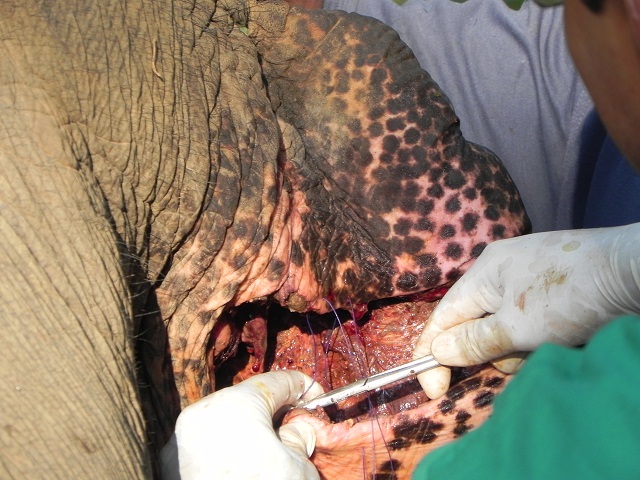
Bahabur stood motionless, his right ear ripped in half, dangling painfully under its own weight. The cartilage was ripped apart at the top ridge of his ear. The flesh that covered the back of his ear was torn from the ear, creating a huge gaping pocket between the skin and cartilage. It was a seriously gruesome sight and no doubt painful.
The attack had happened eight to 12 hours before, after Bahabur, just coming into his annual musth season, had uprooted his tether tree and headed straight into trouble.
Mahouts tracked Bahabur and received no resistance when they instructed him to return home.
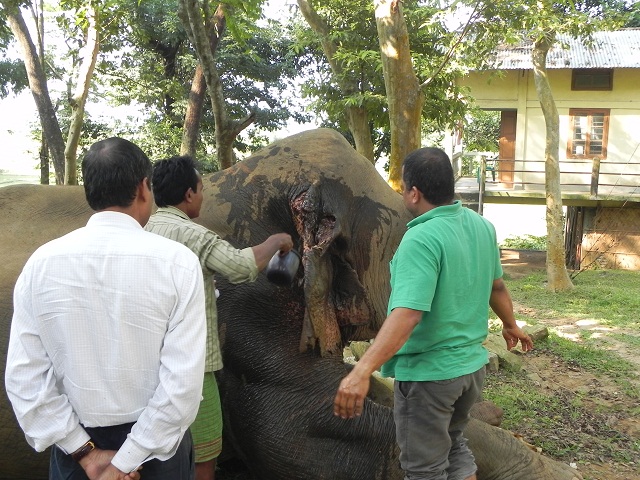
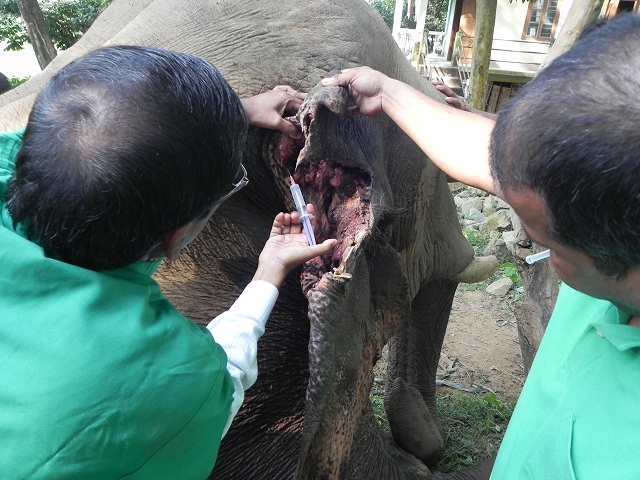
The expert mahout staff managed Bahabur while Drs. Bhupen Sarma and Anjan Talukdar assessed the injury. In a natural self-medicating fashion, Bahabur had packed the gaping wound with dirt, which needed to be removed before surgery could begin.
Without complaint Bahabur reclined in a half-sitting position, giving the veterinarians access to the wound. No one yelled, hit or in any way badgered Bahabur. Instead they spoke calmly and confidently, patiently waiting for Bahabur to respond to their commands and get comfortably situated.
In soft tones, treatment instructions were given. The wound was cleaned, flushed out with clean water and Betadine.
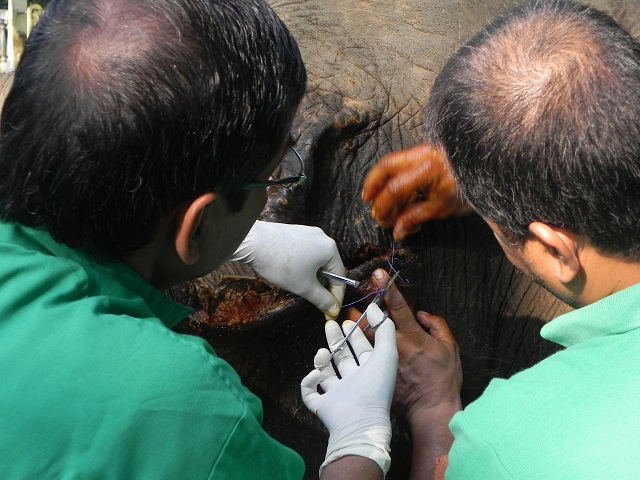
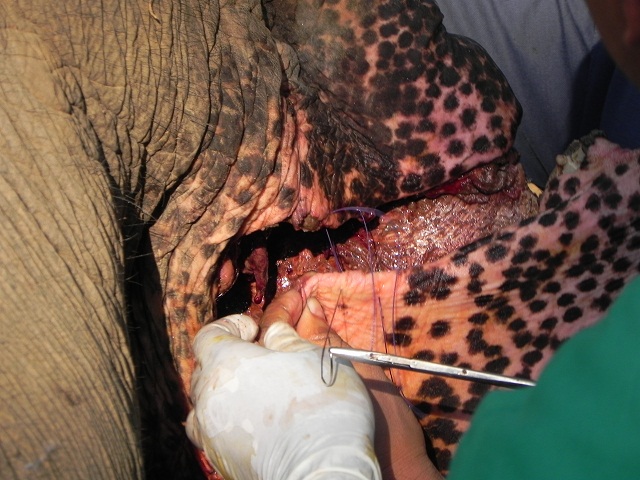
The veterinarians and mahouts worked seamlessly together, voices low as they repaired the half-severed ear of this full-grown bull elephant.
From time to time Bahabur needed to stand in order to readjust and, I believe, to distract himself from the pain. After a few seconds standing he would once again respond to the patient command given by his mahout to recline.
With only a local anesthetic to deaden the pain in the area to be sutured, Bahabur’s ear was expertly reconstructed; the torn cartilage stitched together with sutures and ripped flesh reconnected. The result was amazing.
Bahabur is a mesmerizing example of this highly evolved, profoundly intelligent species, who for so long has captured my respect and awe.
When Paspat, the mahout supervisor at National Trust for Nature Conservation, asked about a water trough for Sweetie Kali, I nearly fell off my chair. Seriously— his question was a shocker because captive elephants are not given free-choice access to anything in Asia. The belief is that allowing them to make choices will spoil them for their mahouts. The great fear is that if elephants experience a sense of freedom and are content, they will refuse to respond to their mahouts.
The fact that Paspat asked for a water trough reinforced my belief that he genuinely cares about his elephants’ welfare. Even in the United States— land of the brave, home of the free—many captive elephants are not given free-choice access to water.
I was deeply touched by Paspat’s request—so outside of the normal thinking of mahouts—and I assured him I would make it happen. The grin that spread across his face when he understood my response was priceless.
It struck me that this might be the first time Paspat was in a position to create a practice contrary to tradition. A chill ran up my spine as I looked long and hard at this man, who supported the chain-free yard concept and suggested free-choice water. Even though we do not share one word of a common language, I felt the connection loud and clear.
First stop: the concrete factory
After securing the required authorization to add a water trough to Sweetie Kali’s yard, I posed my challenge to Kiran, the veterinary tech/nail cutter extraordinaire. He was excited to help.
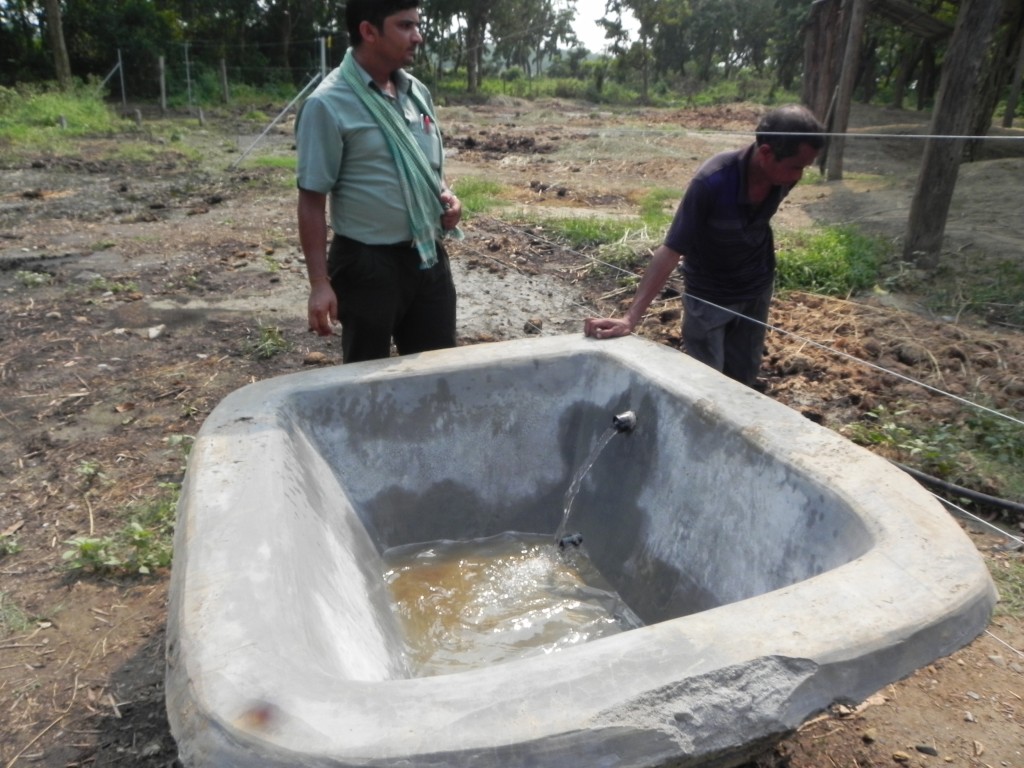
I explained what I needed: a sturdy, bathtub-shaped, concrete drinking trough, with inlet and outlet holes, heavy enough that Sweetie Kali cannot knock it over.
In his broken English Kiran said he knew a man who could make the trough for us. So off we went on his motorcycle, zooming down the pothole-rutted village road toward the other side of town.
We arrived at the concrete factory. There was a yard full of custom-made concrete posts for building supports and culverts used for septic tanks but I did not see anything that vaguely resembled a water trough.
I also did not see a single person.
Kiran parked his bike and charged over to a three-sided shack, calling out to someone. There was a man inside who was fast asleep.
Kiran entered the building without so much as knocking. The man, who was lying on a thin mattress on a wood-frame sleeping platform, was the soundest sleeper I ever saw. Kiran was nearly yelling—and the guy did not move. It was only when Kiran shook him that he awoke.
Midday is nap time as it is too hot to do much else. The bewildered look on the shopkeeper’s face was not as result of being woken abruptly but out of surprise to see us out and active in the sweltering heat.
The man rubbed his sleepy eyes as he sat up, trying to understand what Kiran was asking. I watched—which is how things work when you don’t speak the language—once again ever thankful for Kiran’s willingness to be my translator.
Finally the man seemed to understand what we wanted and began asking questions. Kiran included me in the three-way animated conversations, complete with crude drawing on the shop’s dirt floor. We decided on the width, length, height and wall thickness. I kept emphasizing to Kiran that it had to be heavy and strong enough that Sweetie Kali cannot pull it over or break it.
We decided on a free-standing version because if the trough was ground-level, dirt would get into it.
There was much discussion about the wall thickness and amount of steel bar required to make it strong enough. Explaining the inlet and drain holes was a bit challenging. When I finally saw the shopkeeper’s eyes light up in comprehension, I knew he understood what we wanted.
I kept pushing for an estimate but the shopkeeper was reluctant to give one. He had never created a trough before and clearly did not want to underestimate the cost. After much prodding on Kiran’s part, though, we had a bid in hand and commitment that he would start on our project the next day. I was so excited!
How would he actually make it?
At no time during the process did I think to ask how he would create the mold for the trough. He would build a frame out of two by fours and plywood and pour the concrete in, of course. How else?
The concrete factory was halfway between Kiran’s house and Sauraha. He passed the shop each morning on his way to pick me up for foot trimming and kept me apprised of the progress. Indeed, work had begun immediately, as promised, with an estimated curing time of ten days.
The wait was excruciating, so after about five days I just had to check on progress myself.
When we arrived the yard was empty. My heart sank when I saw nothing that resembled a water trough. But as we drove slowly toward the back of the yard, which borders a neighbor’s cornfield, I saw it.
The mold was not what I expected but, considering available resources, it made perfect sense. A hole the exact dimensions of the outside of the trough had been dug into the earth, then the concrete was poured and molded by hand. It was stunning!
I could not help but ask how he would get that heavy trough out of the ground. Kiran laughed and explained that several men would pull the trough from the ground by hand and load it onto a wagon for delivery. I did not think to ask how it would be off-loaded into Sweetie Kali’s yard.
The trough arrives
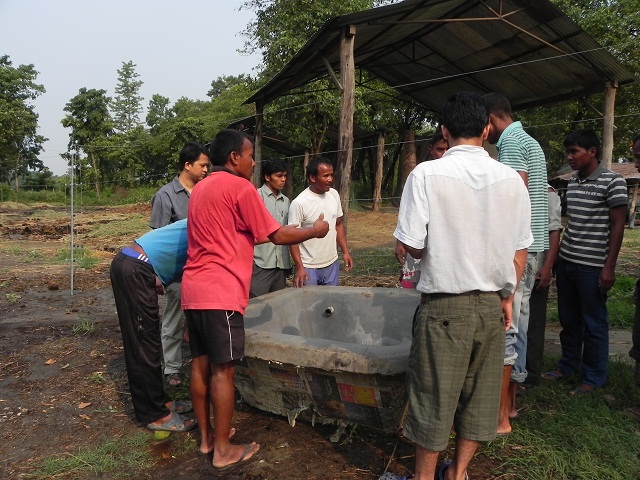
The day finally arrived and the wagon carrying the water trough was backed into Sweetie’s yard. All the mahouts gathered around, very willing to be of assistance.
I watched as the deliverymen discussed the best way to unload this 700-pound tub of concrete and steel. The weight and slick bottom of the trough made it a dangerous situation.
They decided to park the wagon at an angle, place a large tire on the ground just below the tailgate and slide the trough off the trailer onto the tire. I kept my nose out of the planning but two things nagged at me—the steep angle of the trailer and the weight of the trough. But, the deliverymen were in charge, so I kept my mouth shut.
Then it happened, catching the men by surprise. One tug on the trough sent it careening toward the open end of the wagon—and all the men. As it picked up speed, the men scattered. I heard my own “oh no!” pierce the silence as the trough became airborne, turned in mid-air and landed with a thump on its side, feet from its intended landing spot on the tire.
I scanned the scene to see if the trough had landed on anyone. The area was clear and everyone looked fine. But then I noticed Paspat rapidly exiting the scene with Babu Ram close behind. He was holding his hand high in the air. It was then that I saw blood running down his hand.
Paspat had caught his hand between the trough and the bed of the trailer, slicing across the top of it from thumb to baby finger. It was not a pretty sight.
Nandu fired up his motor cycle. Paspat climbed aboard, but not before washing the blood from his good hand so as not to soil the bike. With the entire group looking on in silence, Paspat was raced to the local clinic, hand held high above his head to help slow the bleeding.
The men wrestled the trough into place in a most unceremonious manner. The accident had dampened everyone’s spirits.
Within minutes we learned that Paspat had no broken bones, but the muscles in his hand were pressed back toward his wrist. The muscles were massaged back into place and he received twelve stitches. The biggest concern was infection. Paspat is diabetic so the doctor was concerned about how well he would heal.
Hand healed, trough in place
More than a week has passed and I am happy to report that Paspat’s hand healed without complication.
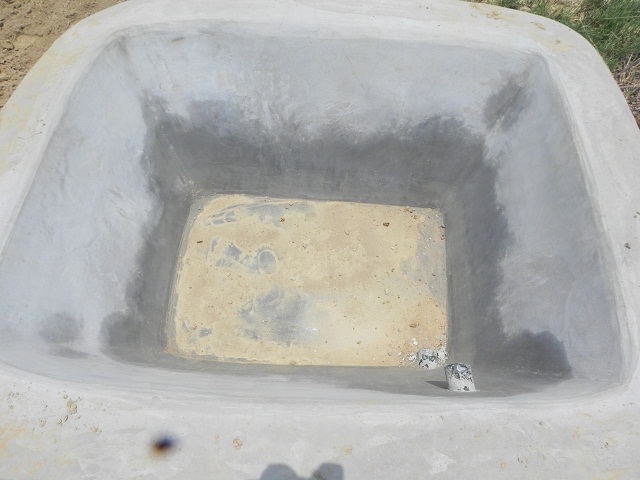
As for the trough, it is a work of art. Every angle is perfect, all the surfaces smooth to ensure that Sweetie does not scratch her trunk and that it is easy to keep clean. I marveled at the amount of work that went into the mold and the craftsmanship it required. I could not have been happier.
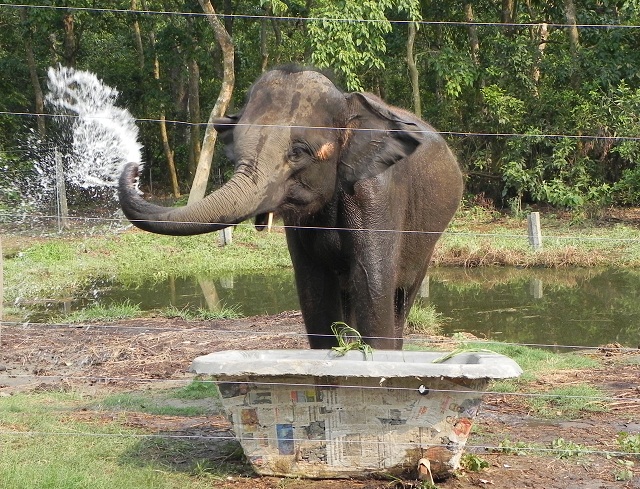
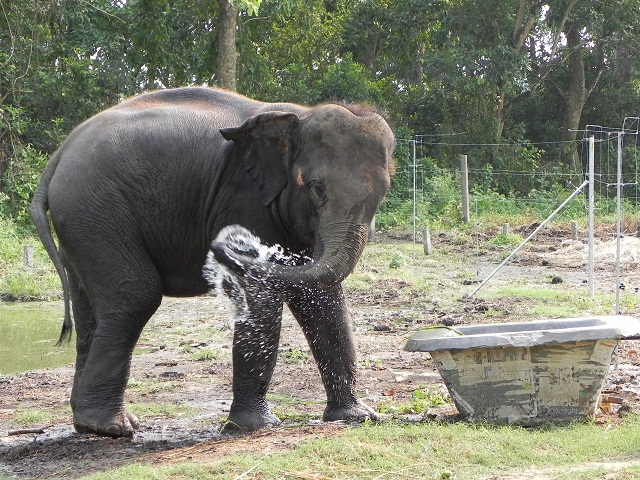
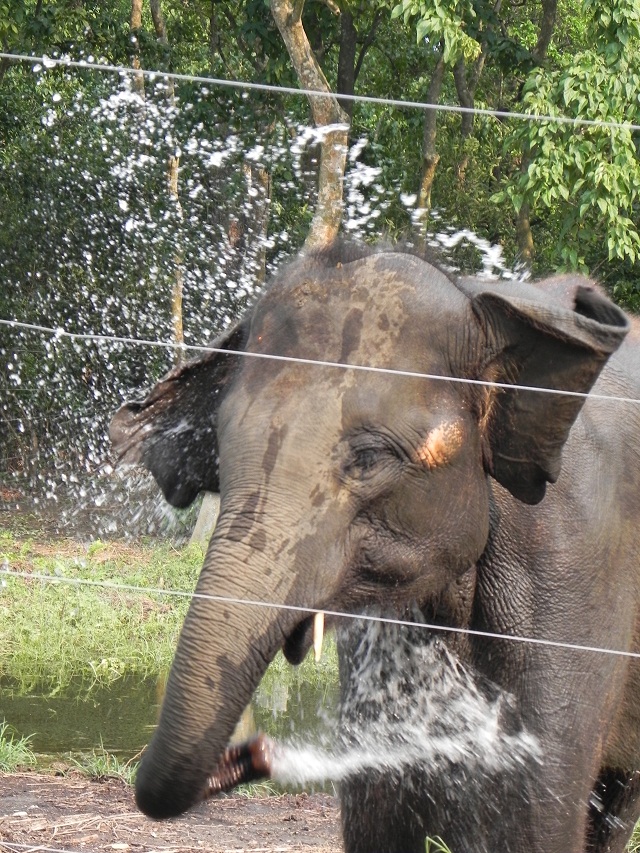
Sweetie Kali wasted no time making use of her trough. The mahouts seem to enjoy watching her almost as much as she enjoys splashing, bathing and drinking.
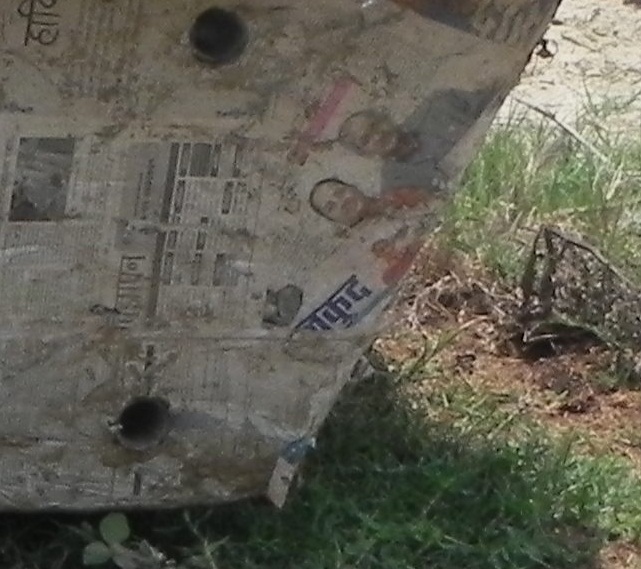
Some of you commented on the newspaper that covers the outside of the trough, making it look like papier mache. The newspaper was used to line the inside of the earthen mold to keep the concrete clean; now it’s nearly one with the concrete so the mahouts decided to leave it.
A huge thank-you goes to the mahouts for their willingness to try something new and to all the supporters who underwrote the cost of adding this trough to Sweetie Kali’s yard.
When Nandu learned that I wanted to accompany Sweetie Kali on her anti-poaching patrol he directed me to Ram Kumar who graciously cleared my request with Paspat, the mahout supervisor. Realizing how much is lost in translation, I felt it best to experience Sweetie’s patrol duty first hand. I planned to walk instead of ride, which, for the most part, I did.
It was reassuring to watch Sweetie Kali voluntarily exit her yard without hesitation. The deepest concern shared by mahouts was that after being chain-free she would refuse to respond to her mahout. That fear has proven to be unfounded. Puntea, Sweetie’s phonet (lead mahout) used a burlap bag to “slap off” the thick layer of fine dirt Sweetie had spent the last several hours throwing on her back. In places where the dirt was very thick he struck her firmly with blunt side of his crew pa (machete), creating an avalanche of silt cascading to the ground.
This approach to sweeping dirt off Sweetie appears a bit rough and indeed it is. But she showed no concern, moving gracefully from a lying, to half-sitting and then standing position to accommodate the process. I did catch myself questioning—for the umpteenth time–why the mahouts handle their elephants in such a rough manner. Nothing is gentle — not a touch or a word; no silent tactile moment of praise.
Reconsidering the decision to walk
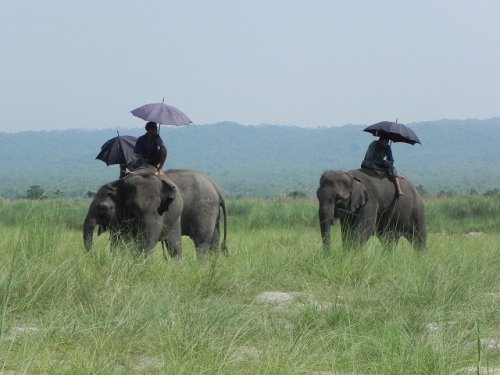
In seconds we were on our way, me with a satchel of essentials — camera, water, hat, umbrella and Chap Stick — and Puntea perched on Sweetie Kali’s back with the multi-functional burlap bag as a seat cushion. He carried a small wooden switch and badly tattered umbrella. I noticed immediately that he was not carrying a bottle of water and mistakenly took it as a sign that our outing would not be rugged.
Keeping pace with Sweetie on foot was no problem. Her mahout allowed her to amble at a comfortable speed.
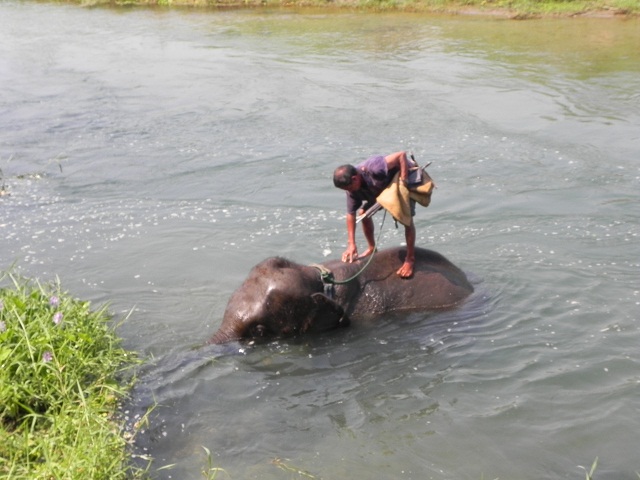
Our first stop was the river — spectacular. With ease, Sweetie Kali submerged herself in the water with Puntea still perched atop her back. He managed not to get so much as a toe wet — for what reason I don’t know, since it was already sweltering hot. Following one word commands, Sweetie tilted from side to side in the strong current, bobbing like a buoy.
At this point I realized my plan to make this excursion on foot was flawed. The current would make crossing a challenge but the bigger issue was slithering down the river in our direction—a large crocodile. Apologizing to Sweetie for the extra burden, I clambered aboard and we crossed safely to the opposite shore.
Grass: food and trimming tool
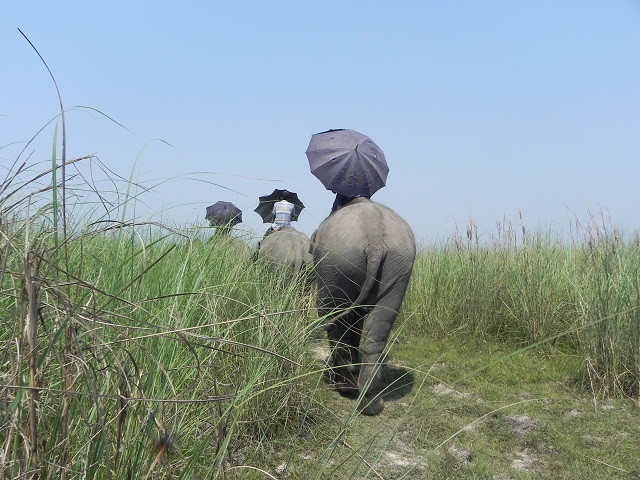
In front of us lay a vast grassland, high as an elephant’s eye, as the saying goes. In stark contrast, in the hazy distance rose a mountain range dense in vegetation, its forest seeming to pulsate in the early morning heat.
As Sweetie effortlessly ambled through the tall grass she reached to the side, grasped a trunkful of grass, pulled it tight and, with her next step, severed it at the soil line with a strike of her foot. All this without missing a step.
I remember watching in awe at the Sanctuary the first time I watched Jenny cutting grass in the same manner as she grazed. With each step she’d grab a trunkful of grass, casually swung her foot forward and effortlessly sever the grass with her toenails. There is quite a hypnotizing, even relaxing, rhythm to this action. The abrasive quality of grass works as a natural trimming tool; this is one way elephants keep their nails, cuticles and pads trimmed to a healthy length.
Joining the patrol
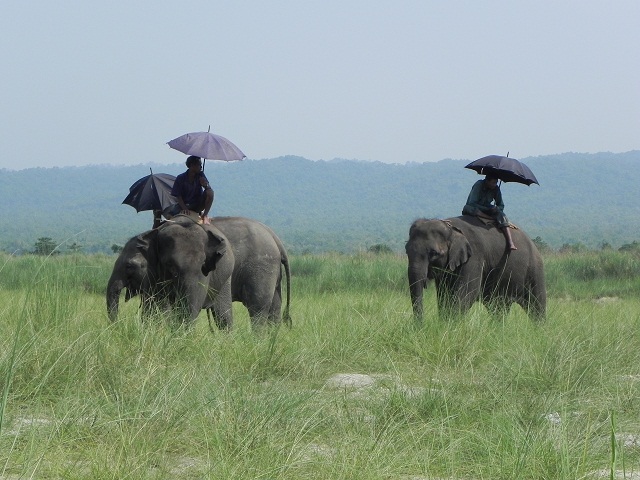
We traveled in complete silence for some time, umbrellas balanced overhead to shade ourselves from the scorching sun. But soon the silence was pierced when from out of nowhere we were joined by two young elephants and their mahouts. For the next five hours the mahouts chattered nonstop, like school girls at a slumber party. Since I don’t speak the language, I soon drifted off into my own world, taking in every scent and plant and animal sighting.
Two hours into our patrol we approached a circle of high arching trees where many elephants and mahouts had gathered. Some mahouts were sprawled out, fast asleep on elephant back, while others napped on the ground while elephants grazed close by.
In the middle of the partially shaded clearing an energetic young mahout was putting his equally young elephant through what appeared to be a training exercise.
I breathed a sigh of relief to think we were about to take a break. I was ready to continue this excursion on foot as planned. But instead of stopping we crossed through the clearing, exiting the other side.
The next hour-and-a-half was spent in serious patrolling, or at least that is how it appeared. The mahouts ventured off the trail continually, ducking under low hanging trees scouring the undergrowth for “something.” Obviously they never found what they were looking for or I would know what it was.
Rest stop
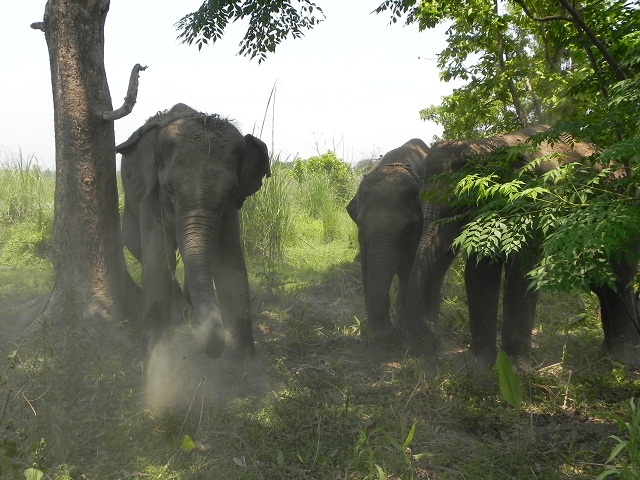
Then we came upon a circle of towering shade trees that created the perfect place for a rest stop. We no sooner disembarked when all three elephants moved outside the circle to cover their bodies with a fine layer of dirt flung effortlessly onto their backs.
I watched silently, wondering if they would exchange tactile greeting or show any sign of recognition. Although they stood centimeters from each other, they acted as if the other did not exist. The lack of physical interaction seemed so unnatural, and unfortunate. These three girls, close to the same age, have so much in common, including knowing that forming relationships with each other was discouraged by their mahouts.
They grazed the tall grass while we napped, burlap bags used as bed rolls. About fifteen minutes into our slumber Sweetie Kali tiptoed over to my sleeping spot. I felt her approach. When realizing she intended to make a personal visit I casually propped myself up into a sitting position from where I could quickly stand if need be — and cleared my throat. I would have loved to share a special moment with Sweetie but the truth is, we do not have a relationship and having her so close could be dangerous.
I know from experience that even while asleep, mahouts are on high alert. Hearing my unspoken warning sign, Puntea got to his feet and Sweetie retreated to the company of the other elephants.
My role
One trade-off that I have reconciled myself with is that I am a distant figure in the lives of these elephants. It is not appropriate to insert myself into their lives. I am here to improve their welfare. It is not about me having the chance to form a close relationship with them; it is about me encouraging the mahouts to form a healthy relationship with them. When we establish the retirement home things will be different and I will have a close relationship with all the residents, but for these elephants who are not under my direct care, a relationship between us would only complicate their lives.
The mahout-elephant relationship
The day was long and hot for everyone concerned. When we reached an offshoot of the river the elephants submerged while the mahouts quenched their thirst from a spring oozing from the side of the bank. All parties drank their fill.
The next hour was spent leisurely grazing the sandy grassland that borders the river. When we finally crossed we were immediately immersed in a dense vibrant forest. The temperature dropped by at least ten degrees, the trees blocked the glare and penetrating heat from the sun.
Umbrellas were closed and stored, mine in my satchel and others, hung by the handle from the back of the mahout’s shirt. What a novel idea and handy hanging location; the neckline of the shirt works perfectly.
Tree branches invaded the trail, making passage difficult. I was told that the noise in the trees was monkeys but I never caught a glimpse of one. Spotted deer and birds were abundant. At least one tiger had walked the same sandy path recently, leaving behind huge paw prints. Seeing the size of the prints made me reconsider—once again— my decision to walk instead of ride.
Soon and without a verbal farewell, our fellow patrollers turned off at different paths, disappearing into the dense bush, on their way to a different hattisar. As we traveled the last mile of our patrol I was lost in thought about the relationship between mahout and elephant. It is a strange one — no outward display of affection, no praise, continual directions and corrections. It takes a strong individual to do this job day in and day out, both elephant and human.
I am sincerely grateful, as I know are Sweetie Kali and the entire NTNC staff, for your generosity toward the creation of Sweetie Kali’s chain-free yard.
The funds raised to date cover the cost of Sweetie’s one-acre power fence enclosure, which she has immersed herself in from day one; her custom water trough, which will be installed tomorrow; and two shovels and a new wheel barrel requested by the mahout staff.
The mahouts are so proud of this pilot project.
The second half of the funding goal was intended for a training wall, which is not necessary at this time. Those funds can be raised at a later date and the wall built in a few months when I return to Nepal.
So, consider this fundraiser a grand success! Pat yourselves on the back. Without you this history-making event would not be possible. Together we have created the first chain-free elephant corral in Nepal, hopefully starting a trend that will change how captive elephants are kept in Asia!
 This is the place of autonomy and personal freedom.
 Watching the chain-free corrals come to life before my eyes is my addiction. Knowing that my actions help reduce the suffering of captive-held elephants brings me great joy! It is heart work, soul fulfilling work. My meditation.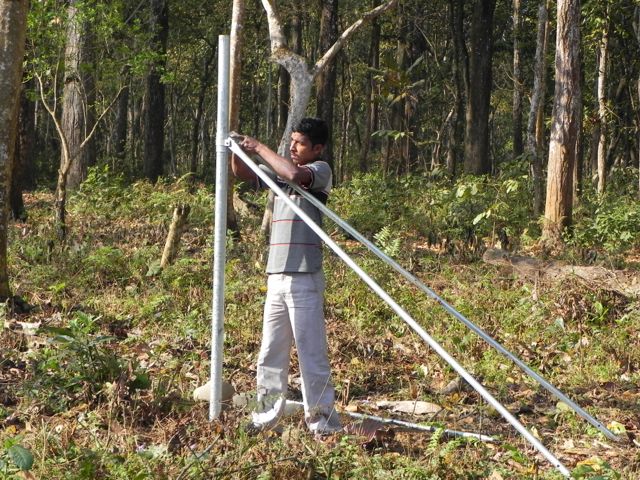
 They know we are helping them. That is good enough for me.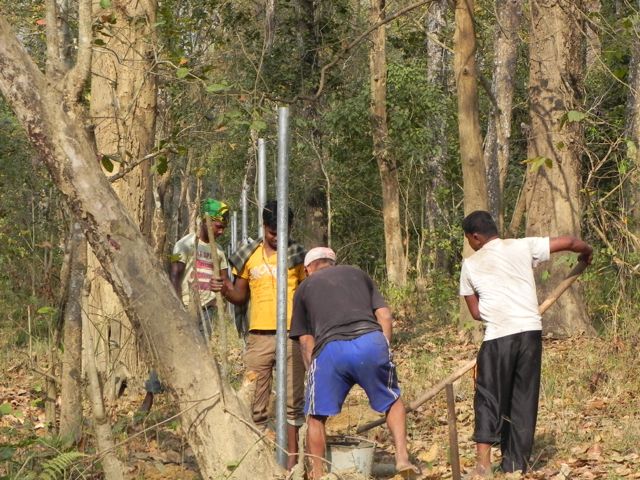
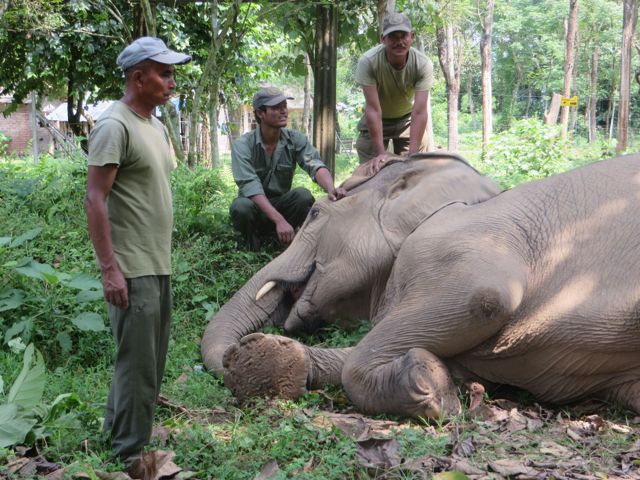
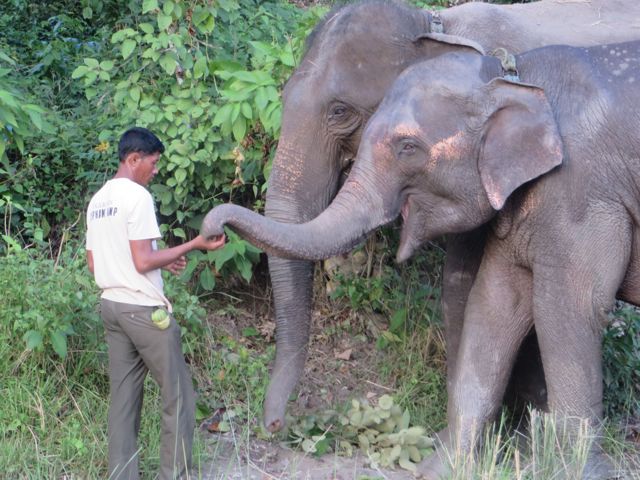
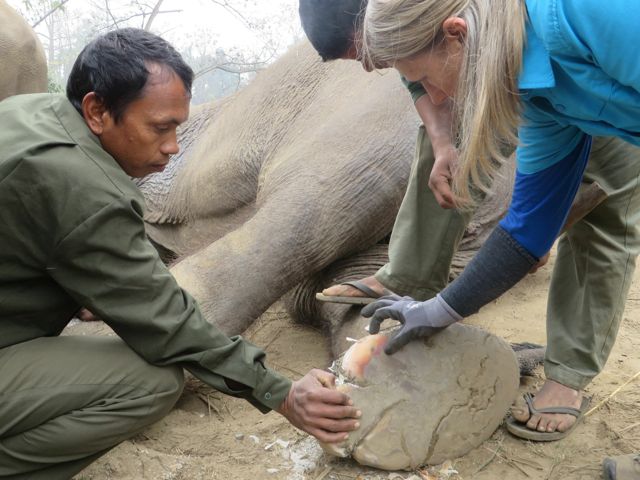 Developing sustainable assistance programs is essential. Live demonstrations, educational resources such as videos and manuals, translators and hands-on assistance are needed to improve mahout knowledge and understanding of new approaches to elephant care.