Tag: working elephants

  • Update on Nepal pilot project

    Starting on May 8th, 2012, I put everything on hold while I focused exclusively on Sweetie Kali’s new chain-free corral. The bandh (country-wide strike) caused a bit of delay in the beginning, forcing the fence crew to wait several hours at the Nepal boarder before entering. Clearing customs with 400 KG of power fence materials added to the delay.

    Dibyandu Ghosh and PaspatUpon arrival, Dibyandu Ghosh, the contractor, explained that his fences are not only functional but beautiful as well. He was not exaggerating. No matter the challenge—including keeping a captive elephant in while at the same time keeping wild bulls out—he never balked and consistently came up with solutions that were both functional and visually pleasing.

    Realizing that I did not speak the local language, Dibyendu quickly identified the go-to man, Paspat, the mahout supervisor. They hit it off immediately, as if they had worked together for years.

    Once construction started, it progressed quickly. Each morning Sweetie Kali would leave her stable for a day of patrolling and grazing the forest, leaving several men working diligently around her yard. Each evening she returned to be chained in her stable with the men still busy at work. She was soon encircled by the project.

    watching Sweetie KaliAs the fence began to take shape, the mahouts became more interested. Seeing is a powerful tool to grasping a concept. By the end of four days, the corral had been completed and everyone gathered to witness Sweetie Kali’s release.

    I wouldn’t say that anyone was apprehensive, but there was definitely a feeling of doubt. One researcher with years of wild elephant and rhino experience commented that the mahouts would now have to be with Sweetie Kali constantly since she would be off chains. His comment caught me off guard but showed clearly that the chain-free concept was difficult for them to comprehend. While I tried to explain that the fencing is what contains her, making a mahout unnecessary, his reasoning was revealed. He stated his concern that without the mahouts Sweetie Kali would not be able to function, would not know what to do, where to walk, even how to walk. I was dumbfounded. My response was, just watch, she will do just fine.

    mahout group

    I thought long and hard about this mindset — that elephants cannot function without their mahouts ordering them around. It actually made me sad to have to accept how misunderstood elephants truly are.

    The chains come off

    When Sweetie Kali’s chains were removed for the final time, she stood motionless next to her mahout. Indeed, she was waiting for instruction, expecting discipline if she acted without direction.

    Her mahout obviously did not comprehend his role either. When he was told to walk away from Sweetie Kali and leave the yard, he stood frozen, apparently confused.

    When the mahout finally left the yard, it took a matter of moments for Sweetie to realize she was chain-free. She took a tentative step away from her stable area and abruptly stopped, ears perked, anticipating a sharp correction. When no correction was forthcoming, she relaxed a bit and began to walk the fence line. Unable to let go, the mahout also hovered at the fence line. Sweetie Kali was clearly apprehensive. The other mahouts, administrators and vet techs looked on in anticipation.

    feeding cuchie to KaliI grabbed some kuchi (rice and molasses wrapped in grass) and tried to get the mahout to walk the fence line into the forest and throw the kuchi deep inside. As always, training the elephant trainers is always more difficult than training the elephant, so it took several attempts, in his native tongue, for the mahout to understand that he was not to hand feed the kuchi, but to disperse it in the habitat.

    Chain-free environment and free-choice food are two equally incomprehensible concepts to most mahouts. But after much-repeated instruction from his peers, Sweetie Kali’s mahout finally, almost reluctantly, hurled the last kuchi into the forest.

    Kali's backsideThat was Sweetie Kali’s signal that she was free to roam the premises. The last thing everyone saw of her was her petite backside as she disappeared into the dense brush. I felt like saying, “Sweetie Kali has left the building!” but realized my humor would be lost on this crowd.

    Bundles of fresh cut grass were deposited on the edge of her forest to be consumed at her leisure and the tech set up watch to record Sweetie Kali’s behavior until dark.

    Reinforcing: No chains

    mahout hutThe next morning, Sweetie was still nowhere in sight, which pleased everyone tremendously. As I sat in the open-air mahout hut reveling in the success of the project, Sweetie’s mahout entered her yard. Watching silently, I wondering if the schedule had changed; was she going to the forest early or was there a special tracking program? But then I realized that the mahout intended to chain Sweetie Kali under her shelter.

    Papsat and KaliI leapt from my seat. With as much composure as possible I rallied the mahouts, telling them, “No chains, no chains.” My heart sank but then Paspat, the mahout supervisor, appeared out of nowhere. Usually a quiet, mild-mannered guy, he barreled over to the mahout with raised voice and expressive body language to deal with the situation.

    The mahout explained that he wanted to stick to Sweetie’s normal morning routine, which of course included chaining, but was told, in no uncertain terms, that chaining was not allowed. He now clearly understood his directions. When the drama died down I suggested that the chains be removed from the stable area so they would not “accidentally” be used.

    New routines

    That afternoon when Sweetie returned to the hattisar and was released into her yard, she knew exactly what to do. Without hesitation she made a beeline for the forest and did not come out again until it was dinnertime.

    Before mealtime, kuchi and bundles of grass are stored outside each shelter, inches from the elephants’ reach. The routine is to feed the kuchi first, placing them at the elephants’ feet, and then piling the fresh-cut grass within reach. The elephant knows from years of experience that dinner is served precisely at 6 pm.

    Being chain-free meant Sweetie Kali was free to approach the inviting pile of food and beg to be fed early, thereby creating a situation where she might begin to bob in frustration.

    Everything had been progressing so well, I wanted to avoid creating such a situation. Getting the mahout to disperse the cuchie in the forest earlier than Sweetie Kali’s normal feeding time was not a problem, but then I saw that he put all her grass in one pile under her shelter.

    His fellow mahouts were all talking at the same time, telling him to take the grass to the forest. But he simply ignored them and walked away.

    dragging grassThis time Paspat did not come to the rescue. I was the only one who did not know he was off-grounds. Luckily, another official appeared and after several phone calls got the mahout to return. In a melodramatic display of unwillingness, he dragged the grass to the proper location—and then stomped off, muttering that he would not take orders from junior mahouts.

    By the next day Sweetie Kali’s mahout was over his seniority snit and began to show great pride in the accomplishments of his elephant.

    Many thanks

    GanashThat’s it, the entire story. Every day, Sweetie Kali immerses herself in her personal forest when she is back at the hattisar. She comes out to play in the dirt pit or chase birds and was seen and heard dashing in and out of the trees during the last big storm, but otherwise she is basically unseen except by Ganash, the young tech assigned to her behavior study, which he has taken on with great seriousness. Recording her behavior is an important tool for documenting her response to chain-free living.

    When Sweetie Kali leaves for her daily patrol of the forest, I inspect for habitat damage. I am pleasantly surprised at how little damage there is. She excavated a relatively small sleeping area, sheltered by huge trees and another smaller area for dusting. Aside from the thick curtains of edible hanging vines that are rapidly thinning, the damage is minimal.

    NTNC-BCC

    Sweetie KaliI have so many people to thank for the success of this pilot project including all the staff at NTNC-BCC, the forest department, Naresh, Ram Kumar, Chitran, Dr. Gairhe, Paspat, Nandu, Babu, Kiran, Ganash, Veena and Vishnu at IBEX Gallagher, Dibyendu and crew and especially the mahouts, because without their cooperation, the project would not have been possible.

    And finally, I thank Sweetie Kali for unknowingly volunteering to participate in this important pilot project, one that will undoubtedly have a huge impact on how captive elephants are kept in Nepal.

    Please visit EAI’s Facebook page so I can keep you updated on our progress as it happens!

  • EAI’s May e-newsletter

    Two exciting new projects are underway in Nepal!

    This e-newsletter kicks off EAI’s first fundraising projects for Nepal this year. I hope you will help make it a success by telling your friends and neighbors how far the US dollar stretches in Nepal. Be part of the solution, one world, one elephant at a time!

    No more chains

    Between trimming feet and brainstorming about a retirement center for elephants in Sauraha, Nepal, we—you, I and all of EAI’s supporters—are about to embark on a very exciting pilot project at the National Trust for Nature Conservation Biodiversity Conservation Center (NTNC-BCC) hattisar (elephant stable).

    Pursuing last year’s recommendation to create chain-free enclosures for the BCC’s five forest patrol elephants, Naresh Subedi, an EAI advisor, and other NTNC officials have enthusiastically agreed to allow EAI to build a chain-free enclosure to demonstrate its functionality.

    No chains = cooperative elephants

    This is huge. It gives us the opportunity to show mahouts how cooperative elephants can become when allowed the freedom to move around unrestricted.

    Sweetie KaliEight-year-old Sweetie Kali will be the lucky recipient of this new and improved yard, where she will be off chains 24/7.

    In addition to the direct benefits to her psychological and physical wellbeing, Sweetie Kali will demonstrate to the mahouts and NTNC administrators that elephants do not “go wild” when allowed to spend unsupervised time off chains.

    Sweetie Kali, her fellow herd members and most of the government elephants are taken to the forest each day. Although they spend eight hours a day wandering the forest foraging for food, they are still under the strict control of their mahouts. Their lives are measurably better than those of privately owned elephants, who are required to give rides to tourists all day and are tethered in a stable overnight.

    But, together with NTNC, we can do better.

    Sweetie Kali and positive changes to come

    Sweetie Kali

    Sweetie Kali was chosen because she is the youngest elephant in the herd, born at the NTNC-BCC. Her incessant head bobbing is a concern for the mahouts and management alike. The staff was witness to the onset of her stereotypical behavior, which started when she turned 3, following her formal training and induction into the traditional world of chains.

    Sweetie Kali shelterCurrently, all the elephants are tethered under their own private shelters. Once everyone is comfortable that the fence provides the security necessary, chances are that Sweetie’s mother will be allowed to join her in the yard. Imagine what a moving reunion that will be.

    The new chain-free yard will allow Sweetie Kali to engage in natural behaviors she has been prevented from in the past. She will be able to explore her new yard, dust herself to her heart’s content, create mud wallows and feel the soothing sensation of scratching on a huge tree. Instead of sleeping tethered between two poles, she will sleep in any soft and comfortable location she chooses.

    EAI’s goal is to get this corral up and functioning before I leave Nepal in June. That is a rather optimistic expectation but I am determined to move the project forward as quickly as possible.

    Sweetie Kali fence

    Vishnu Narain, a collaborative partner in our Bannerghatta, India, care center project, operates IBEX Gallagher, a power fence company. We could not be more fortunate to have this connection. I have his bid in hand and a commitment to install the fence as soon as we are ready.

    Training and foot care wall — a prototype for Asia

    If we built only the electric fence for the corral it would mean a world of improvement for Sweetie and would keep the cost of the project down. But a training and foot care wall—a two-sided, free standing, steel pipe structure—is essential to our efforts to improve elephant welfare in Nepal. Once the wall is in place, foot care will become a required duty of each mahout, integrated into their elephant care responsibilities, and all the NTNC-BCC and government elephants in Sauraha will have access to it.

    The cost of the electric fence, including area preparation, materials, shipping and installation, is estimated to be $3,240. The training and foot care wall, including pipe, delivery, welding, concrete and labor, nearly doubles the cost of the project. I believe this will be $6,000 well spent as it will create a prototype that can be duplicated throughout Asia.

    Help us hire a veterinarian to oversee our Nepal projects!

    EAI has the exciting opportunity to engage a veterinarian in Sauraha, Chitwan National Park. The timing is perfect!

    This is our third year in Sauraha. With the ongoing foot care and mahout training and the new chain-free enclosure and training and foot care wall, it is essential that we hire a veterinarian to coordinate and supervise our activities. It will also be much easier to expand EAI’s welfare projects in Nepal with a professional in place.

    Simply building a chain-free corral and a training and foot care wall for the mahouts and their elephants is not enough. We also need to formalize our Compassionate Elephant Care training and create incentives to encourage the mahouts to become more engaged in all aspects of their elephants’ care and wellbeing. Once our collaborative effort to create an elephant retirement home is realized, our veterinarian will monitor the daily care of the resident elephants.

    In addition to overseeing EAI’s projects in my absence, our veterinarian will work closely with Dr. Gairhe, the senior government veterinarian, assisting in wildlife captures, rhino counts and regular animal management activities undertaken by NTNC-BCC.

    EAI will be responsible for the vet’s salary as well as all necessary equipment, lab work, travel and any other expenses we deem appropriate. Resumes are currently being reviewed.

    Our budget for the first year is $15,000. Yes, you read that right — $15,000 includes the veterinarian’s salary and other costs associated with his/her work for EAI.

    Update: Elephant Care and Rehabilitation Center Project, Bannerghatta, India

    Earlier this year I learned that a portion of the land intended for our care center project was designated as revenue land.

    care center property - BannerghattaRevenue land is owned by the government and designated for agricultural use or forest restoration. There are cases when the government can gift this land but the recipient must abide by strict use requirements and restrictions, is never allowed to sell it and the government has the legal right to reclaim it.
    The process to acquire permission to use revenue land in India moves slowly and must take into consideration the villagers’ needs and legal rights.

    EAI collaborating partner Vishnu Narain reports that progress continues for the care center. He has met with local government officials and regulators, who expressed support of the project.

    EAI is taking a wait-and-see attitude on this project. Once we have written authorization from the government to fence off and use the land for the intended purpose of an elephant care center, EAI will once again become active in the process moving forward.

    I look forward to keeping you up to date on our exciting new projects.

    Please visit EAI’s Facebook page so we can keep you updated on our progress as it happens!

  • Forest Dwellers

    Forest Dwellers

    Today’s foot trimming adventure was over the top, a marathon day with Dr. Gairhe—the senior government veterinarian—leading the way.

    Kiran and Chitran, the two vet tech/3rd year foot trimming students, and I fit perfectly in the back seat of the full-size pickup truck…or so I thought when we all piled in. If it had not been for the road conditions, the ride would have been…well, let’s say, less memorable. I’m not complaining — far from it — and I enjoyed every minute of our 14-hour adventure.

    One thing that struck me this time in Nepal is realizing my unconscious expectation of comforts that I take for granted in the US. Sitting between two large men, bouncing down a seriously bumpy road and being slammed side-to-side like bumper cars, I realized that I accepted this assignment with an unreasonable expectation of transportation comfort. The reality of the situation made me laugh.

    The Nepalese don’t fret over physical discomfort, they simply accept it. So when I started joking about the guys staying on their own side of the seat, it soon became a humorous game. When Kiran would absent mindedly crowd my space, I drew an imaginary line between us and said, “You have crossed the line,” and like two adolescents we’d crack up with laughter. Soon everyone got into the game of not invading each other’s space, so when Kiran flopped his entire arm over Chitran’s leg, he was abruptly chastised—jokingly. Everyone broke out into hysterical laughter. It was refreshingly silly to experience such discomfort and be able to laugh about it together.

    Humor aside, I realized that if I continued to be thrown back and forth between the football player-size shoulders on either side of me, I was going to be very sore, if not crippled by the end of the day, so I pulled rank (age, actually) and claimed the window seat. This was much better for me as I could press myself against the door and hang onto the armrest for security.

    Four outposts, seven elephants and a canoe like a swimming pool

    Our mission for the day was to visit four government outposts to trim the feet of seven elephants. Our first stop was Gadini outpost, a place we visited last year. After driving for nearly two hours we arrived on the bank of a beautiful river. The flimsy wooden canoe that would carry us to our destination was on the opposite side of the river. The boat man soon appeared and to my amusement proceeded to bail out the canoe—it had taken on quite a bit of water—before heading in our direction.

    In order to board in peaceful waters we hiked a short distance upstream. The day was already steamy hot. Tiny frogs scattered as we approached the water’s edge, disappearing into the calm shallows.

    Our canoe was waiting when we arrived and we gingerly climbed aboard. A real man, or woman for that matter, sits on the floor of the boat. But customs are changed for foreigners. The government guard post on our side of the river provided tiny wooden seats for our canoeing comfort—and to keep our backsides dry. I kind of wondered where the life jackets were, since the canoe was already taking on water through cracks in the flimsy wooden planks strapped together with giant metal staples. To add to the drama, Dr. G asked “Can you swim?” I can’t remember not knowing how to swim, and wondered the level of fear one would experience crossing this fast-moving river in a boat that resembled a swimming pool, not knowing how to swim.

    With a smooth push off from a ten-foot bamboo pole, the boat master expertly guided us into the swiftly moving current. The water picked up volume and speed and within minutes we were deposited on the opposite bank without incident. We disembarked and hiked the short distance into the forest to the outpost. The forest was lush and green and teaming with active, boisterous bird life.

    Gadini outpost: Healthy feet and relaxed elephants

    Namastes were exchanged and then it was right to work. Kiran requested that the crew pa (machete) be sharpened, which is effectively done on a large rock with sand. No power sharpening tools here: they use the available resources and manage just fine.

    Elephants Sano Chanchal Kali and Rampyari were tethered under separate shelters bordered by the forest. The stables were clean and the girls looked on calmly.

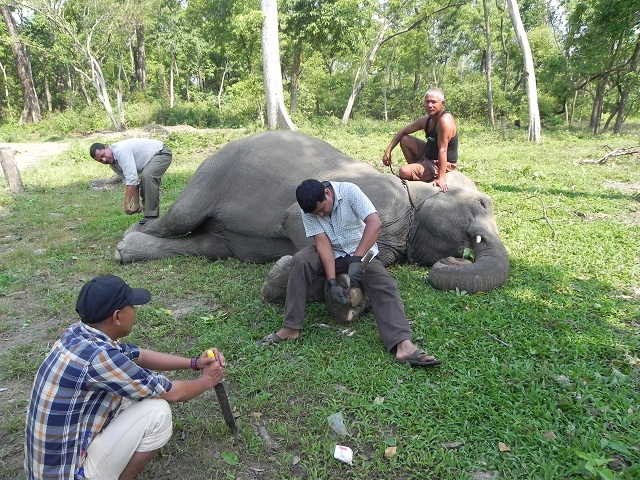
    With a simply utterance of bite (lie down), Sano Chanchal Kali slowly folded to the ground without resistance or concern. We were all so pleased to see that her pads were healthy and evenly worn and her nails were only slightly overgrown.

    As I took “before” photos, put on my girly gloves and prepared my exacto blades, which are also kind of girly, the guys were already trimming excess nail with precision that is hard to imagine when using a machete. I am in awe of how well the men handle this tool, but they grow up using it, starting with cutting grass to feed livestock and later as a knife to cut anything.

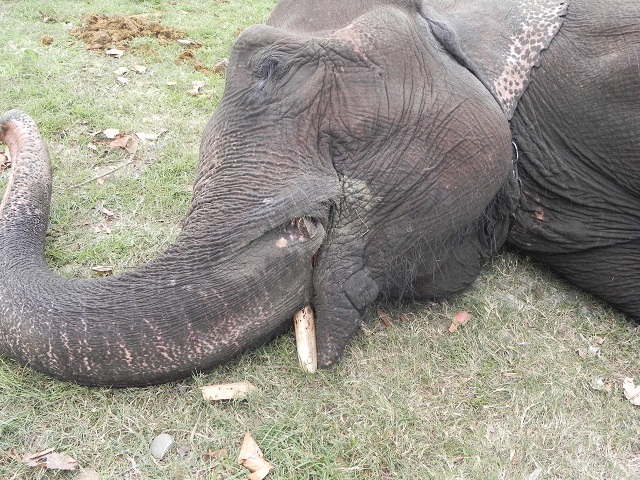
    Sano Chanchal Kali took this special time of hati la na pita (don’t hit the elephant) to drop off into a fairly sound sleep for most of her trimming. She shifted to her other side without resistance and allowed us to give her one of the most beautiful pedicures to date!

    Almost in an identical fashion to her sister, Rampyri folded to the ground following a simple verbal command. The mahouts have gotten the word: if you want this crew to trim feet, no hitting allowed. Refreshing for us and for the elephant. Rampyri’s feet were another pleasant surprise, pads evenly worn and supple, nails only slightly overgrown and no sign of decay or infection. The crew commented on “what easy feet” these were.

    Our work in this camp was completed in record time thanks to the healthy condition of the elephants’ feet and the relationship they share with their mahouts.

    Honestly, I can’t remember if we had our home cooked meal at this outpost or the next — those details seem to blur together — but I do remember that to get to the second outpost we got back into the canoe and floated downstream for some time. A black egret fished on the shoreline ahead and a white breasted Kingfisher swooped past us in pursuit of a meal. Without any initial sign of elephant or mahout life, we landed again on the riverbank and hiked a short distance to the second camp.

    These camps are inside the national forest, which, in this location, is an island. Dr. G told us that wild bulls do not cross the river encircling this island. No one knows why, but as result of this phenomenon, captive bulls can be kept on the island without fear of being attacked by wild bulls.

    Kurauli post: More healthy feet and easy pedicures

    As with Gideni, the elephants at Kurauli post were aware of our arrival. Dhirendra Kali and Gandaki Kali, were waiting—mahouts casually mounted on top—surveying the approaching team.

    Before having hardly a chance to settle in, I heard “bit” followed by “raw,” which meant our first client had reclined and was awaiting her pedicure. We now operate quite smoothly as a crew. While I unpacked trimming tools, gloves and camera, the others examined the client’s feet and prepared for trimming by sharpening the machetes.

    We all commented on how great Dhirendra Kali’s feet looked. I liked the pattern I was seeing. The more remote the outpost, the better condition the elephants and their feet were in, the more skilled the mahouts were and the less pressure the elephants experienced when requests were made for their compliance. But of course, they were living in their element with the river nearby, sheltered under giant trees, on natural substrate and plenty of exercise combing the forest for poachers.

    With such healthy feet, there was little work for the crew. Shave off overgrown nails a little, check for decayed areas and she was done. Another easy pedicure!

    When Dhirendra Kali left the trimming area she let out a “Queenie-squeak.” It transported me back in time to the Sanctuary overlook at the Q-barn with Minnie, Lottie and Queenie playing in the mud, Queenie making her distinctive squeaks nonstop. Dhirendra Kali’s gentle sound brought back a very a pleasant memory for me. I accepted it as the gift it was.

    But this was not time for daydreaming because Gandaki Kali was already in place and waiting for her pedicure. I was pleased to see that her nails and pads were also healthy and only slightly overgrown.

    It is so encouraging to see that these elephants are getting sufficient exercise, on appropriate substrate, which is why their feet are so healthy.

    To be continued….

  • a shared moment of silence in his honor

    I read a very disturbing story about an elephant who was stabbed to death in Vietnam. The photos are so gruesome I cannot post them. This 38-year-old tusker spent his life in captivity entertaining tourists. He was attacked twice last year and it took months to nurse him back to health. This time, the hairs on his tail cost him his life.

    I usually do not post such deeply disturbing stories but I feel a responsibility to this elephant to not let his suffering be in vain. The degree to which humans can harm another being is something I simply cannot comprehend. This elephant was held in captivity to feed tourism, the key component in the abuse and suffering of captive elephants. As long as tourists participate in elephant safaris, shows, rides, photo ops, feeding and petting, elephants will continue to be abused and killed.

    While I was in Nepal this past March/April providing foot care, Dr. Griry, the head government veterinarian, trimmed the tail hairs from elephants to ensure they would not be attacked. I was horrified by stories about attackers in Nepal hacking off the end of an elephant tail to collect the hairs.

    Last update 24/04/2011 04:51:00 PM (GMT+7)

    Da Lat: Elephant stabbed to death

    VietNamNet Bridge – A 38 year old male elephant, named Beckham, was killed in the Tuyen Lam Lake Tourism Area in the resort city of Da Lat on April 24.

    The elephant was found dead near Tuyen Lam forest with two cuts on his two hind legs. It is said that the elephant died because of losing blood from the two cuts. Its ivory and tail however were not removed.

    Phan Thi Hoa, director of the Nam Qua Ecological Tourism Co., Ltd, which owns the elephant, said that the elephant was still healthy on April 23. Its corpse was detected by elephant keepers on the morning of April 24, around 1km from the Tuyen Lam tourist site.

    The elephant was raised by Nam Qua Company to serve tourists in the Tuyen Lam tourist site.

    Before the lunar New Year, this elephant was attacked twice and injured seriously, but fortunately survived the elephant tusk and tail hair hunters.

    “We had to hire a veterinary doctor to take care of him for weeks. It had just recovered four months before it was killed,” said Hoa.

    In August 2010, some elephants in Da Lat’s tourist sites were attacked to take tail hairs. It is said that elephant tail hairs are “sacred objects”, so elephants are often attacked.

    Ninh Phan

    Last update 26/04/2011 03:49:49 PM (GMT+7)

    Da Lat’s elephant corpse is burned

    VietNamNet Bridge – The corpse of the elephant which was killed in the Central Highland city of Da Lat several days ago was burned on April 25, under the witness of local forest protection agency and relevant agencies.

    Ten young staff members at the Tuyen Lam tourist site were mobilized to burn the dead elephant. The task was estimated to take place in one day.

    The entire elephant corpse, including tale and ivory, was burnt by petrol and wood.

    The tourist site’s manager, Anh Vu, said that the elephant, named after British football star Beckham, was dead for one day, but the smell was very bad, so it must be burned urgently.

    Beckham had been bred at the tourist site for a long time and it was the most beautiful elephant in Da Lat. The elephant had both tusks and tail, while other elephants in Da Lat have lost these parts. Beckham was very obedient, gentle and friendly.

    The elephant was around 4 tons, 38 years old. It was bought from the Dak Lak province in 2000, at the price of VND700 million (around US$40,000). Its job was serving tourists at the Tuyen Lam tourist site.

    Beckham was found dead in the forest around 3km from the Tuyen Lam tourist site on April 24, next to pools of blood. The elephant was stabbed and its hind leg tendons were cut off. However, its tusks and tail were not chopped. An axe was found near the elephant corpse.

    Last year the elephant was attacked twice, suffering 38 wounds, and it took him several months to treat the wounds.

    Local police are investigating the case. Some elephant keepers said that the murderer might be familiar to the elephant.

    According to the Da Lat Forest Protection Bureau, there are five elephants at tourist sites in Da Lat now.

    The Central Highland province of Dak Lak currently has the highest number of tamed elephants in Vietnam. In the 1980s, the province had more than 500 elephants, but the current number is only 54.

  • Kasara Camp

    Kasara Camp

    Today I traveled many kilometers through Chitwan National Park to reach my foot trimming clients. To get there, I hiked to the river’s edge, boarded a small sailing vessel, crossed a river and drove through a magnificent forest, crossing over creeks on what I would call barely-bridges (as opposed to sturdy concrete ones). It was a wonderful adventure!

    When I reached the river, the tourists were packed like sardines in their low-rider boats with a boatman steering them lazily down river. Dr. Geare, the head Government veterinarian at Chitwan National Park, Chitra, a vet tech who works with Dr. Geare, and I were ushered onto our private dugout canoe with removable seats (little wooden stools that fold up against the side of the canoe when not in use), which silently glided across the river to the sand bank on the opposite side.

    Our driver magically appeared. We climbed into a truck and I must say had a ride of my life. It was only after we picked up several young soldiers hoofing it back to camp that I was able to release my firm grip on the door frame, the only thing keeping me from bouncing out of my seat and hitting head on the roof. The weight of the men in the back gave the truck better traction and kept the back end from bouncing up and down like a trampoline. It was a great ride through a beautiful forest.

    Within minutes a wild boar had crossed the road, male peacocks could be seen and heard sounding their calls, a monkey clung to the side of a tree, a couple of deer flashed by and too many muggers (crocs) sunned themselves along the back of a small creek.

    Our destination was the Kasara forest camp where four government elephants live. What a shift from Sauraha. Don’t get me wrong — Sauraha is a nice place for the government elephants — but in Kasara the elephants are really living in the forest. If I could only get rid of the chains and hobbles and put up some hot wire fencing, I would really feel as if I was helping them. Okay, one thing at a time — first feet trimming and then more freedom!

    Kiran was not with us today, but Chitra also excels at foot trimming. Upon arrival, I found that instead of the three elephants I was expecting there were actually four. Three elephants were scheduled for foot trims which is why they made it on the list, or maybe it was because the fourth elephant actually is unnamed. She is Laxmi Kali’s year-old calf. When I asked her name, a slight hesitation was followed by, “Her name is Laxmi’s calf.”

    After spending several days trimming the feet of privately owned elephants, I must admit that today really highlighted the differences from those owned by the government. The government mahouts seem to have a much better relationship with their elephants. They do not yell incessantly nor strike their elephants absentmindedly, which is good because Chitra and Dr. Geare had already heard my request for no pit neu. Actually, my request has grown more sophisticated following an impromptu Nepalese lesson I had last night. I was told that no pit neu is nonsensical and that the proper way to get my point across in proper Nepalese is hati lie na pita, which translated means, “Do not hit the elephant.”

    The foot trimming went smoothly, with the mahouts seeing for the first time how to administer proper foot care. They were very interested and helpful, and each appeared proud when his elephant’s trimming was completed.

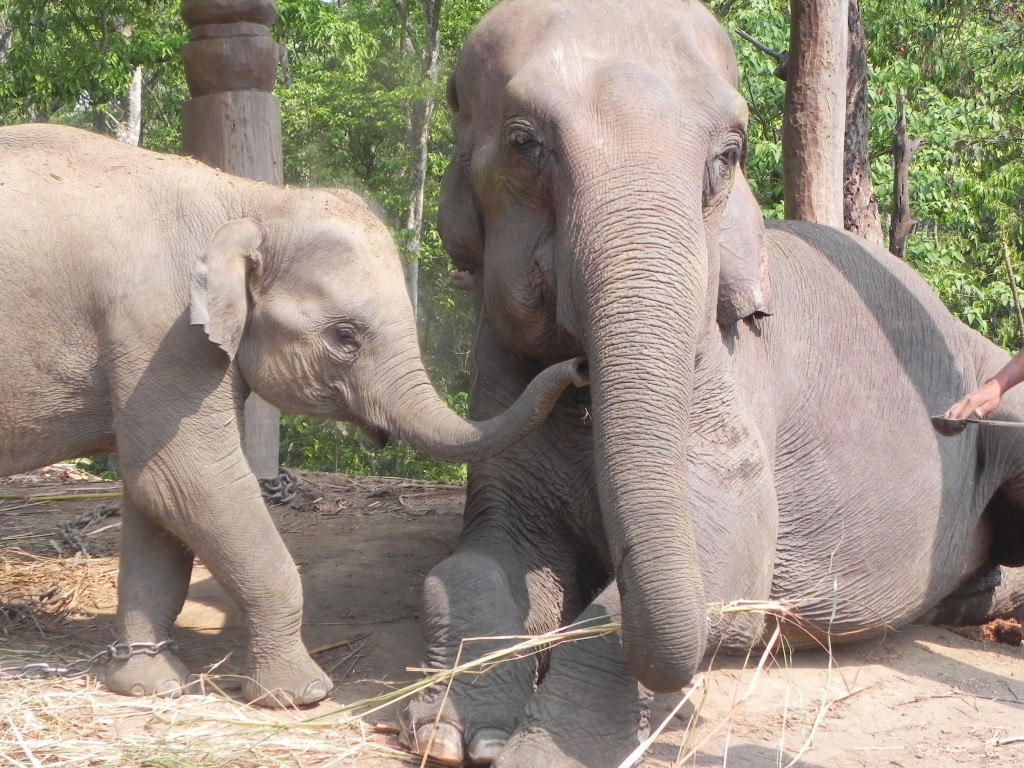
    Just as we were finishing up with Laxmi Kali, her calf decided that it was time for a drink and let out a boisterous “I’m thirsty!” yell. Mom immediately threw her hind leg in the air to get up, a fair warning to the mahouts that she really needed to respond to her calf. We all laughed, knowing how the babies call the shots. Laxmi jumped to her feet and baby got the drink she was so thirsting for.

  • Sweetie Kali

    Upon returning to the National Trust for Nature Conservancy in Chitwan, I was surprised and pleased to see Sweetie Kali still there. Last year I was told she was to be moved to the zoo in Kathmandu.

    Sweetie is less than ten years old so it was difficult for me to understand such a move. In Chitwan, Sweetie has daily access to the forest, the river, free grazing and foraging and lots of other elephants –: a life that provides benefits she would not experience in an urban zoo.

    Today I saw little Sweetie Kali moving at a fast clip, of her own motivation, across the expanse of community forest that borders Chitwan National Park. She and seven of her counterparts were in pursuit of a rhino that was to be radio collared. Gracefully moving faster than the other elephants she accompanied — all were her seniors — Sweetie Kali exuded pride and self confidence.

    I found myself caught in a quandary: why was I feeling positive about Sweetie’s engagement in this rhino search?

    It seems that I had allowed myself to let go of my personal opinion that Sweetie should not be working and allowed myself to experience Sweetie’s reaction to her involvement. Her self-motivation was obvious; there was no fear or apprehension or even hesitation on her part. Quite the contrary. A hint of a smile graced her baby face when she was able, without prodding, to overtake the other elephants in her group.

    The fact that Sweetie was part of the search party is testament to her skill and confidence level. Each elephant must contain the confidence to remain in pursuit, even when charged by an angry rhino. Sweetie has proven that she’s got what it takes: not fear of her mahout but confidence in him and most important, in herself.

    Sweetie’s mahout rode gallantly atop her bare neck, projecting the image of a proud father. He never struck her or yelled, but encouraged her to challenge herself to move faster than the others, cutting them off and gaining rank.

    The look on her face was priceless — she reveled in the game. Her age gave her an advantage. Being young, Sweetie does not suffer the aches and pains experienced by her elders. Her gate was smooth as a still lake and her attitude reeked of confidence.

    I saw young Sweetie Kali and all the forest patrol elephants in a different light today. These elephants will never return to a life in the wild; they will spend their entire life in servitude to man. Within such parameters, I cannot think of a better way for them to live than amongst their comrades, immersed in the forests, engaged in stimulating elephant-friendly activity that keeps them fit and confident.

    No, I am not advocating that captive elephants should work for their keep, but they do. What I do support is that they be treated with kindness and respect and allowed to live a life as close to nature as possible. I believe that we can improve upon the life of forest patrol elephants, making improvements to their welfare. But short of returning them to a safe wilderness (which does not exist), these captive elephants are the lucky ones.

  • Breeding Center

    Kiran, the government veterinary technician, and I finished trimming feet at the Government Breeding Center yesterday.

    I was so pleased that things really changed from the first day. I spoke with Kiran about the mahouts hitting the elephants; he was great. Without hesitation, he engaged the mahouts, men he has worked with for many years, and explained why they cannot hit their elephants. From his intonation and body language, I could tell that Kiran took my request very seriously and the phonits (lead mahouts) and mahouts listened intently. . They respect Kiran and followed his direction without hesitation, which was that at no time should they hit the elephants.

    When the first nervous elephant laid down, the mahout unconsciously went to strike her instead of allowing her time to lay her arthritic body gently to the ground. The other mahouts and Kiran cried out in unison – “no pit nau” (show respect-don’t hit).

    Stopping in mid-swing, you could see that the mahout had not realized he was about to hit his elephant; the action is so ingrained there is no thought associated with it. Like breathing, it is automatic. For the next 90 minutes, the mahouts needed to remind each other only a couple of times, and the reflex to hit was quickly under control.

    It was great to see the mahouts monitor each other in an effort to comply with our request. There was even laughter when a mahout would absentmindedly raise his stick and other mahouts would verbally jump all over him. All of the mahouts and phonits got into the act of making sure no elephants were harmed during my time at the center. Joking around with the mahouts and having Kiran present made it possible to create a calm and abuse-free environment. As expected, the elephants relaxed into their pedicures.

    The elephants at the breeding center spend the day out in the forest browsing and the nights chained under a shelter. Mothers and calves are allowed to stay together until the calf is around five, and I must say, the center runs quite smoothly.

    With a good mix of young and senior phonits and mahouts, we had lots of guys jockeying for a turn to trim feet. The competition between men and boys did not hurt a bit, and then add to the mix that a woman was doing trimming. By the second day I was able to instruct the mahouts to do the heavy cutting with the cycle knife (which I refuse to touch), leaving me to do my favorite part: intricate trimming and shaping with my prissy exacto blade. At first the guys laughed at my knife but the smiles melted from their faces when they tried to trim with it. They quickly learned that my knife was designed for precision work, not brute strength, and that it takes some time to get a feel for it. In the end, the guys were opting for the girly knife and doing some really fine trimming on their elephants’ feet.

    Dr. Geare, the head government vet, checked on our progress several times over the past two weeks. He encouraged his staff to learn as much as possible, stating that with proper foot care the center would save money. He said that in the past many elephants developed foot problems requiring drug therapy, antibiotics and anti-inflammatory treatment. He was optimistic that by learning foot trimming skills, the phonits and mahouts could ensure better foot health for their elephants and reduce the need for drug therapy.

    Each morning on our way to the breeding center we stopped at a local produce stand to buy a stock of bananas. Kiran was a champ, never complaining about having to taxi me around on his motorcycle. The road to the breeding center is…well…how do I say? — rocky! Potholes are not the concern; it’s all the boulder-size rocks used to make the paved surface. Watch out when you fall…ouch!

    We did take a spill, once. Luckily we were driving quite slow, crossing another road, when a baby goat, in hot pursuit of breakfast, darted right under the front tire. Kiran successfully avoided the youngster but spilled the bike as result. I saw it coming and was only concerned that we not hit the goat. The local shopkeepers rushed out to brush the dust from our clothes and make sure we were okay. I craned my neck to see the condition of the goat. She was safe and sound a few feet away, suckling from her mom with her twin sister, unconcerned about the commotion she had created. In Asia animals may be treated differently but they are valuable, more valuable than the motorcycle we rode on. If Kiran had harmed or killed the goat he would have had to reimburse the owners for her value. Needless to say, every precaution is taken to avoid harming someone else’s livestock.