Elephant welfare expert Carol Buckley says rescued elephant is in good hands at model facility.
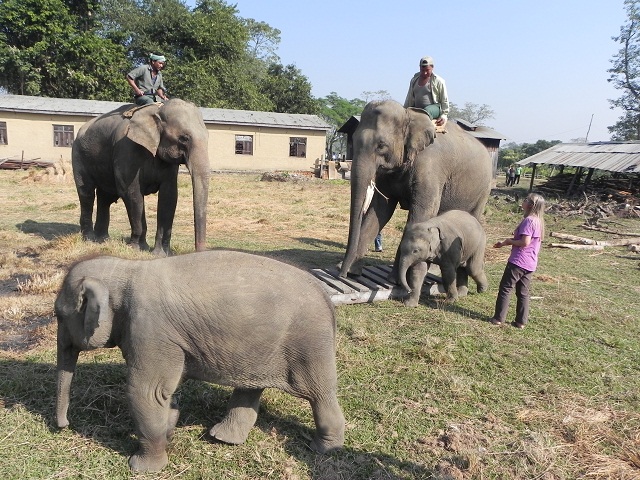
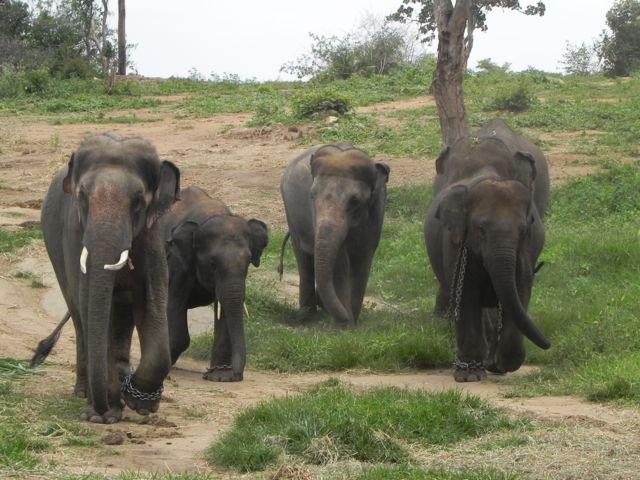
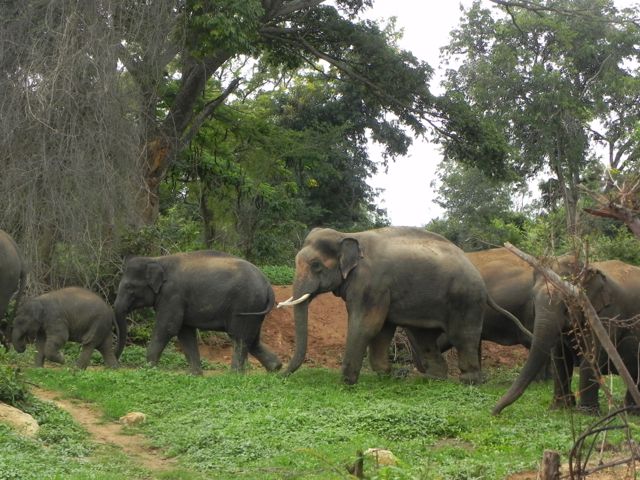
More than a month after his rescue from a life of horrific suffering, 15-year-old bull elephant Sunder is enjoying lush forests, cool ponds and the close companionship of 14 other elephants at the Bannerghatta Biological Park (BBP) outside Bangalore, India.
Sunder’s tragic plight touched the hearts of people from all around the world and galvanized an international social media campaign that helped win his release and recovery.
“Sunder has a new life and a fresh start at a wonderful facility,” said Carol Buckley, an expert in innovative approaches to elephant welfare in captivity, who recently visited Sunder in India to design a chain-free facility at the park where he now lives.
“Thanks to the courage of the Supreme Court of India, which ruled against Sunder’s longtime abusers, the willingness of BBP to accept Sunder for permanent residence and the tireless logistical and legal efforts of PETA India, Sunder’s future looks very bright.”
Buckley, who founded and leads the US-based nonprofit Elephant Aid International, says BBP has all the desired components for captive elephants. Its 122 acres of diverse habitat include open pasture, shaded forests and ponds, where the elephants are free to roam and play during the day. At night, they are given access to the adjoining national park forest for foraging and exploration.
The upcoming construction of a custom designed, solar powered, chain-free perimeter fence system to enclose the entire daytime habitat will give the elephants even more autonomy. The fence creates a safe containment area, eliminating the need for mahouts to dictate the elephants’ activities. It should be completed before the end of the year and will be the first constructed at any zoo in India.
Buckley noted that unlike most elephant facilities throughout the world, BBP’s mahouts manage their captive elephants in a “herder style” manner that supports their physical, emotional and mental health. This style of management acknowledges elephants’ nature as highly social, herd animals, giving them freedom to wander at will while mahouts keep a watchful eye on their whereabouts.
“Bannerghatta Biological Park, working in partnership with PETA India, offers the world an exemplary model for managing captive-held elephants and the best possible new home for Sunder,” said Buckley. “I’m so grateful for their efforts.”
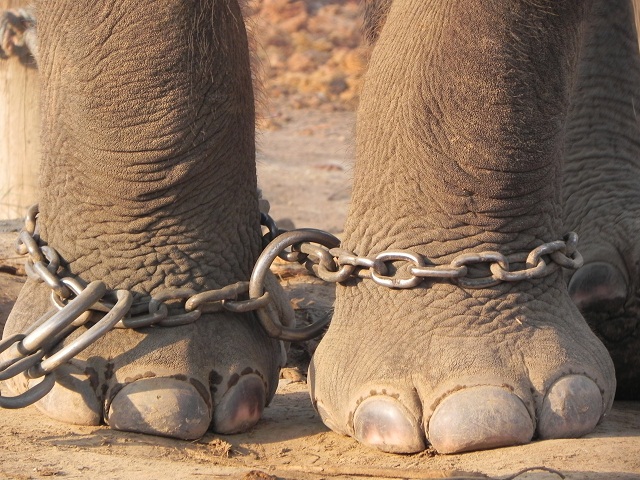
It’s easy to look at an elephant shackled by both front feet to the ground, with open wounds, and blame the mahout.
But I challenge you to learn the facts.
Elephants belong to hotel owners
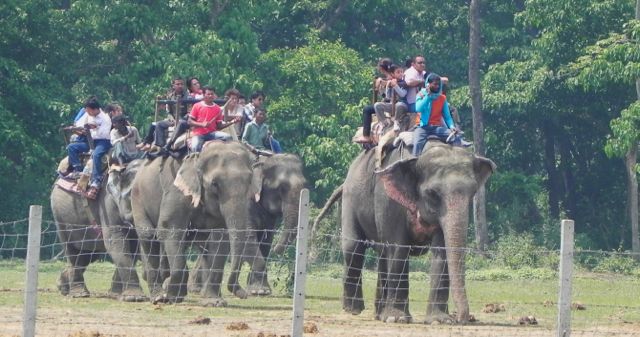
In Chitwan, Nepal, mahouts do not own elephants. Elephants are the private property of hotel owners, who use them to augment their income by offering elephant back safaris to overnight guests and daytrippers coming to Chitwan in search of fun and adventure.
Elephant back safaris not only provide a bountiful financial benefit for the owner, they are actually the life’s blood of Chitwan.
In Sauraha, Chitwan’s tourist destination, every shopkeeper, restaurant owner, hotel, bar, service provider, wilderness guide, money changer, street vendor and orphanage owe their survival to these elephants. Many falsely claim that without elephant safaris, this tourist destination would cease to exist.
Grueling work schedule
All day long, 24/7, mahouts and elephants give safari rides in the community forest.
Mahouts train, feed and ready the elephants for the rides. It is a grueling job for both. Up at 4:30am, the pair sets out on the long trek to the safari loading area as the rising sun lights up the morning sky.
During what is supposed to be a one-hour lunch and rest period, the elephants instead are taken to a riverfront area where tourists mount them to have their photo taken.
Walking back and forth to the safari ride area, tourist bathing area and home stable, while carrying hundreds of pounds of tourists for hours at a time, takes its toll on elephant and mahout alike.
At dusk, and even into the dark of night, elephants can be seen silhouetted against the sky trudging down the paved roads of Chitwan toward their home stable.
Mahouts: Overworked, underpaid and devalued
Elephant owners know nothing about elephants and rely on the mahouts to keep the elephants alive and working without killing tourists. This is a heavy burden to put on overworked, underpaid and devalued employees.
When mahouts “ask for more,” be it food for themselves or the elephants, they are chastised. Many owners view the mahouts as stupid, uneducated and unmotivated and blame them for the elephant’s unsanitary living conditions and poor health.
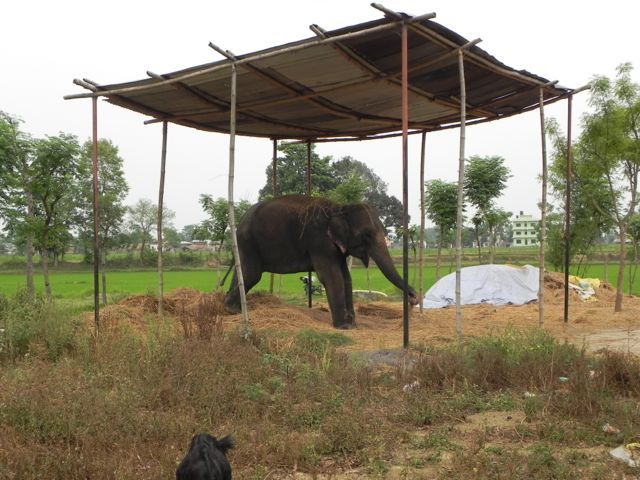
Yet mahouts are not provided even the most basic supplies to ensure the health and wellbeing of the elephants in their care. Owners fail to supply nutritious food but blame the mahouts for the elephant’s poor health. Stables are rancid cesspools because no provision is made for waste disposal. Many stables don’t even have a source of fresh water. For this, the mahout is unjustly blamed.
A marginalized community
The truth is that the mahouts are a marginalized community. The custom of treating them as poorly as the elephants is woven into the fabric of society and their living conditions are a mirror image of those of the elephants.
Mahouts learn their trade on the job, from senior mahouts. Their lot in life dictates they do as they are told without question. They hit the elephants because they are taught they must in order to ensure the elephant does not kill them.
Still, this does not excuse how the mahouts mistreat the elephants.
Abuse can be eliminated
Through education and culture shifting, elephant abuse can be eliminated.
Demonizing either owners or mahouts is not the solution.
The first step is understanding why the situation exists and accepting the challenge to help move culture forward.
Owners must be held responsible and mahouts and tourists must be educated.
This will result in improved welfare for the elephants in Chitwan.
How we can help
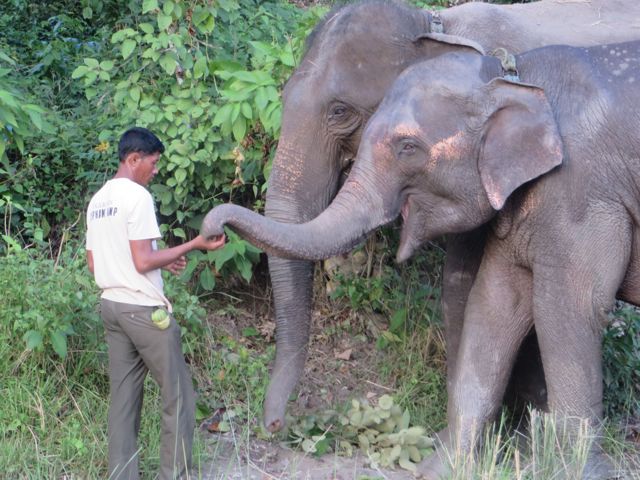
Developing sustainable assistance programs is essential. Live demonstrations, educational resources such as videos and manuals, translators and hands-on assistance are needed to improve mahout knowledge and understanding of new approaches to elephant care.
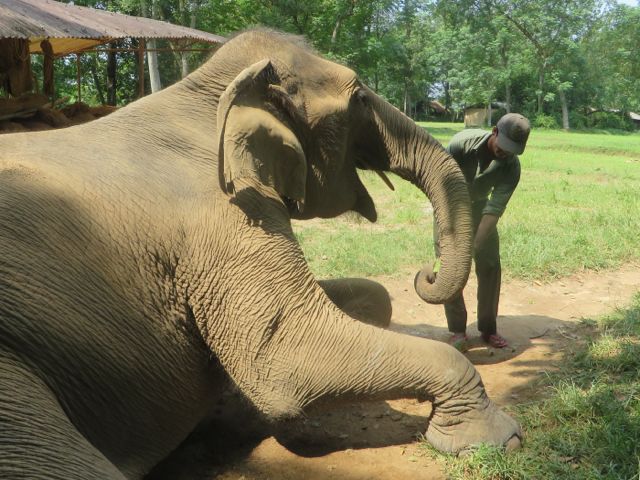
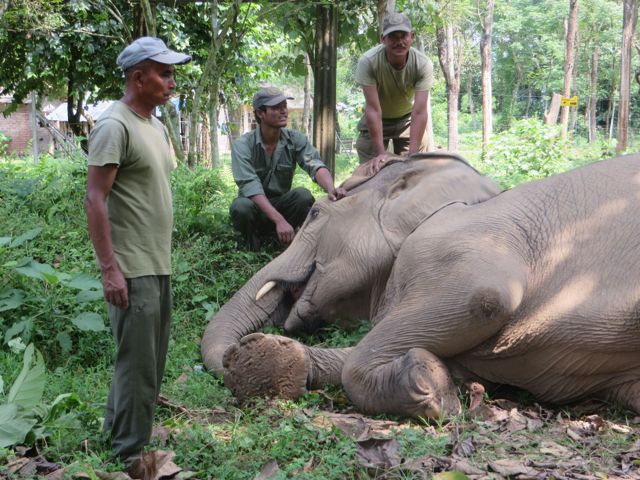
This is Elephant Aid International’s mission. By providing bi-annual foot trimming; training mahouts and vet techs in the skill of foot trimming; teaching positive reinforcement training philosophy and techniques; and constructing chain-free corrals, we are laying the foundation for positive change.
EAI doesn’t blame the mahouts. We give them the tools necessary to take better care of their elephants.
It was a 10-hour drive through mountains on rough roads. The 19-year-old driver of our rental truck scared the daylights out of all of us with his speeding, passing trucks on blind curves and nearly missing oncoming vehicles. Oh man — it was a stressful ten hours!
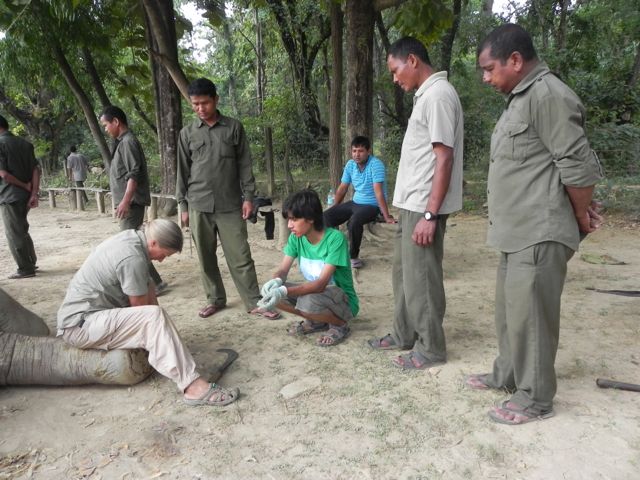
But our foot trimming program was a grand success. We had a fabulous trimming team: Dr. Gairhe; Kiran the vet tech; Hira, Kirti Kali’s phanet (head mahout) from the NTNC hattisar; and I.
Our students included Chantelle, our intern; Surajan, a new friend and translator; and the vet tech from Bardia.
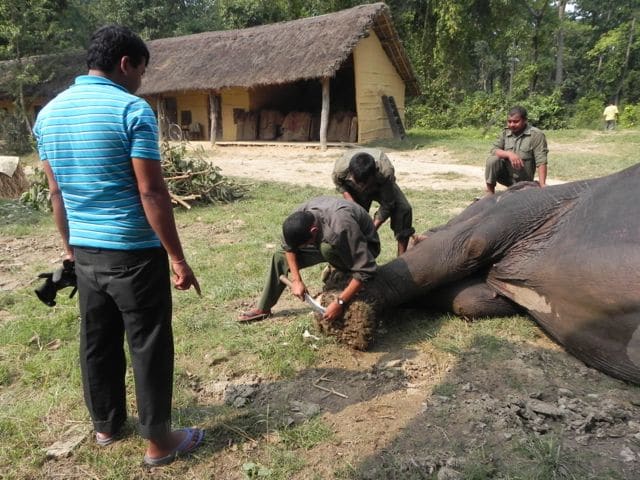
In two short days we trimmed the feet of 24 government and privately owned elephants.
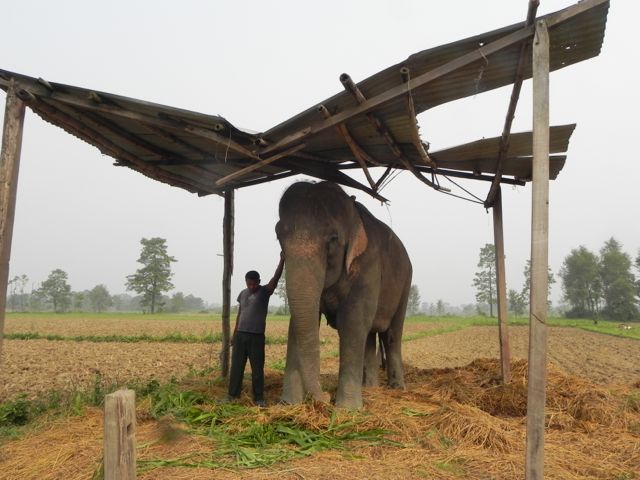
Honestly, the condition of the privately owned elephant’s feet was criminal, similar to the privately owned elephants in Chitwan. Their pads were dry, cracked and severely overgrown. The nails were equally as dry and overgrown and many had splits and deep cracks.
Private owner, broken shelter
I am always shocked to see how poorly the privately owned elephants are kept, especially since they are the breadwinners for their owners.
The good news is that 24 more elephants received pedicures and their mahouts were introduced to foot care. With time things can change for these over-used, abused and neglected elephants…I hope.
A huge thank-you goes out to the trimming team. Without their enthusiasm and hard work we could not have accomplished our goal to provide foot care for elephants in Bardia!
You can make a difference in the life of a captive elephant by supporting our Foot Care project. Thanks for your help.
Chain-Free Hattisar Project
National Trust for Nature Conservation – Biodiversity Conservation Center
Chitwan, Nepal
REPORT
Project completed Jan 10, 2013
Department of National Parks and Wildlife Conservation Jhamak Karki, Chief Warden-Chitwan National Park
Dr. Kamal Gairhe, Senior Wildlife Veterinarian-Chitwan National Park
National Trust for Nature Conservation Naresh Subedi, Senior Conservation Officer
Chiranjibi Pd. Pokheral, Senior Conservation Officer-Biodiversity Conservation Center
Babu Ram Lamichhane, Conservation Officer-Biodiversity Conservation Center
Dr. Arjun Pandit, Staff Veterinarian- Biodiversity Conservation Center
In collaboration with
Elephant Aid international-USA Carol Buckley, Founder and CEO
INTRODUCTION
In January 2013, construction was completed on a solar-powered chain-free hattisar at the National Trust for Nature Conservation’s Biodiversity Conservation Center (NTNC-BCC).
This first-of-its-kind pilot project was developed to study the benefits of working elephants in Nepal living chain-free.
Six elephants, ranging from seven months to seventy-plus years, currently live in five interconnected chain-free corrals designed to improve their welfare.
The elephants spend an average of fifteen hours in the hattisar each day. In the past they were hobbled by both front legs, chained under a shelter that prevented natural posturing and healthy physical activity.
Now, living in the chain-free corral, each elephant is free to move at will and engage in natural behavior such as dusting, foraging, sleeping, bathing, walking, playing. In the case of Man Kali and her children, eight-year-old daughter Prakriti Kali and seven-month-old son Hem Gaj, this related family is able to engage in normal social behavior.
Corral construction and operating system
The corral’s operating system is a solar-powered energizer with a double battery back-up. Three hours of sunlight is required to keep the batteries charged for 10 days.
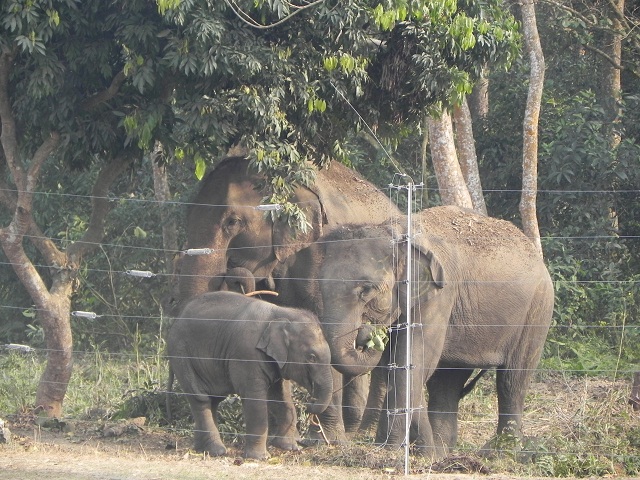
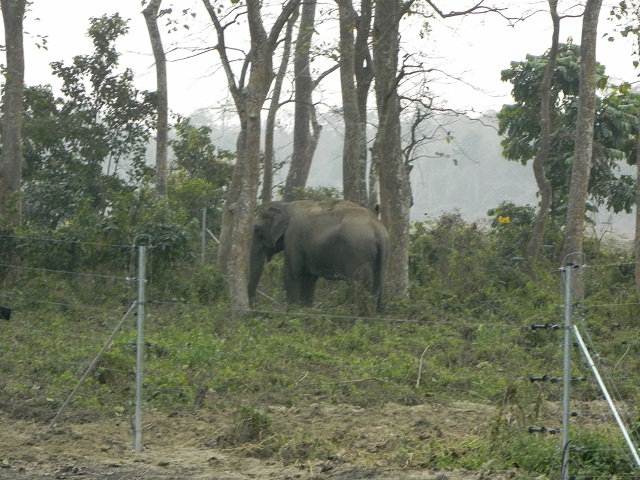
Specifically designed for wildlife, the corral administers a mild shock upon contact. Due to the pulsating current, it is virtually harmless. Being highly sensitive to the clicking sound of the current, most elephants avoid the fence without ever coming into contact with it.
The chain-free hattisar consists of five interconnected corrals on approximately two-and-one-half acres of open and wooded land.
The corrals stand seven feet tall, constructed of rust-free steel posts and six strands of high tensile wire. Each post is encased in a protective tope.
Each corral has a front, back and side gate for ease of access for cleaning, feeding, moving elephants in and out and providing socialization opportunities.
The energizer and batteries are housed inside the mahout residence; two solar panels that charge the batteries are attached to the roof of the residence.
Each corral is equipped with a cut-off switch enabling independent operation.
This design has proven successful in many areas of Asia to prevent entry by wild bull elephants.
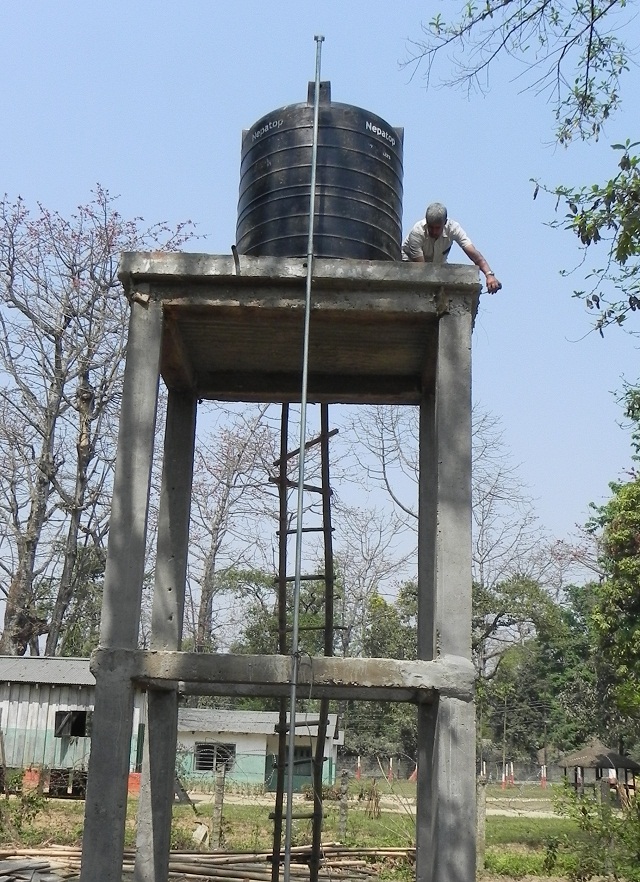
Fresh water is stored in an elevated water tank and troughs are filled by gravity feed.
All corrals have a custom-made concrete water trough that provides clean water.
Healthy trees are an important component of the chain-free corrals, providing shade, browse and a natural scratching surface.
To prevent serious damage to trees from elephant tusking activity, protectors were built around select trees.
GOALS AND OBJECTIVES
Reduce or eliminate stereotypical behavior caused by chaining
Eliminate low-level long-term stress caused by chaining
Increase physical activity
Encourage engagement in natural species-specific behavior such as foraging, dusting, bathing, walking, playing, socializing and exploring
Eliminate injuries and bone and joint damage
Improve foot health
Maintain elephants’ compliance with mahout authority
METHODS
Ethogram
Husbandry protocol
Management protocol
Feeding protocol
1. ETHOGRAM
In order to quantify the effectiveness of the chain-free corral, an ethogram spreadsheet was created to track a list of natural and stereotypical behaviors, including walking, eating, dusting, playing, exploring, drinking, socializing, sleeping and exhibiting stereotypic behaviors.
2. HUSBANDRY PROTOCOL
Manure removal and corral cleanliness standards were established to ensure the highest level of hygiene.
3. MANAGEMENT PROTOCOL
Training and management practices for inside the corral were established to give elephants a sense of freedom and security.
4. FEEDING PROTOCOL
Changes to traditional feeding practices were established to promote activity and alleviate boredom.
PROGRESS AND PRELIMINARY RESULTS
Each elephant spends approximately 15 hours each day in the chain-free corrals. The remainder of their time is spent in Chitwan National Park engaged in grass collecting, anti-poaching patrols and conservation work and jungle safaris.
Upon first introduction to the chain-free corrals, each elephant calmly explored the area, foraging, dusting and scratching on trees. Each evening they dig in the soft dirt of the forest, creating a comfortable sleeping spot; none return to the stable area to sleep.
The related family of Man Kali, Prakriti Kali and Hem Gaj are housed together. They bonded immediately when united in the chain-free corral and continue to exhibit healthy elephant behavior, with Prakriti Kali assuming the role of big sister to Hem Gaj.
A survey was conducted to track the behavior of the elephants toward the mahouts and drivers. Mahout compliance has not changed. Each elephant continues to respond favorably to mahouts and drivers—both inside and outside the corral—at the same high level as before being released from chains.
Photographic records are being kept to track foot health and bone and joint conditions.
Collectively, the elephants’ behavior represents a substantial improvement in natural activity and reduction in stress and stereotypical behavior.
CONCLUSION
The goal to eliminate stress from chaining and the resulting stereotypic behavior is realized. Adherence to the new feeding protocol ensures that both Prakriti Kali and Mel Kali do not engage in stereotypic, food anticipatory behavior. Since being introduced into the chain-free corral hattisar, all elephants engage in appropriate, beneficial, species-specific behavior; respond favorably to their mahouts; and appear to be calm and comfortable in their new environment, indications that the project is meeting its goals and objectives.
I have held off writing this blog for weeks hoping that my experience was anecdotal. I also wondered if sharing my experience and expressing my concern could be beneficial or would simply broaden the already huge culture gap that divides humans who view all beings as sentient and those who do not. As the situation continues to repeat itself over and over again I realize—even though I am still unsure of the outcome—that an expression of my concern is required.
Over the past four months I have been immersed in creating a healthy environment for six captive held elephants in Nepal. The challenge to improve their welfare is relatively easy, their transition seemingly effortless. The problems we experience are not with the elephants, it’s with people.
Although the facility where I am working is a private NGO conducting wildlife conservation studies, the general public feels it is their right to enter the grounds and act in any manner they please, which at a minimum consists of invading the animals’ personal space to take photos—not of the animal but of themselves standing next to the animal. Sadly, the animal is insignificant; it is a photo of themselves that they wish to save for prosperity.
It has become increasingly distressing to witness the degree to which people disregard and abuse animals. Even authority figures are unable to protect captive held wildlife and wild animals from insidious abuse by humans.
This exasperating situation is repeated all over Asia, where wildlife, both captive and in-situ, find themselves harassed by frenzied mobs of non-empathetic humans.
Take, for example, the recent craze in Coimbatore forests in India, where crowds of people gather on a regular basis to incite wild elephants to become aggressive. Who has the power to change the mindset that gives people permission to harass wild animals on this grand scale? Where is common decency? And where does religion come into play in the cultural abuse of non-human animals?
It has been my observation that policing authorities have little influence on crowds of people unless batons and violence are employed. A seemingly docile crowd can erupt into an angry, violent mob in seconds. The trigger that transforms a crowd of people is simple: ask someone to stop doing what s/he is doing.
For example, request that a person not enter a private area and your request will be met with a refusal, followed by immediate argument. All the while, the offender will continue to enter the premises, totally ignoring the request.
The problem is compounded if the person is not alone but accompanied by others, which is most often the case. Everyone will equally ignore the request and add their voice to the argument. The volume of verbal resistance increases until a confrontation ensues, with the offending crowd encircling the requester, yelling their refusal in an attempt to intimidate.
The offenders appear to cross all lines of common decency, causing stress and trauma to the wildlife, who have no other way to respond but to become aggressive to protect themselves. At this point the animal is viewed as the offender and made to suffer further for his/her response to the abusive crowd of unruly people.
Trying to stop the abuse
I wonder almost every day what can be done to prevent widespread, systematic animal abuse. Education is the most obvious, but until such time as a new generation can be sensitized to the pain and suffering of non-human animals, the question remains, what can be done to protect the innocent?
We have tried posting signs, which are torn down and spat upon. Placing an educator in key locations to speak with the public, both about the wildlife and the appropriate human behavior in the presence of wildlife, proved equally ineffective. The public argues, demands to be allowed past the barrier, pushes past, verbally abuses the educator and demands to touch, feed and have their photo taken touching the captive wildlife.
I witness crowds of people taunting wild animals and intentionally abusing domestic livestock and street dogs on a regular basis. The lack of empathy and even malice shown toward non-human animals is mirrored in the manner in which a rioting crowd responds to authority figures. On too many occasions I have witnessed a complete disregard and disrespect for a reasonable and legal request, such as “please do not feed, tease, hit or touch the animal.” Surprisingly, many people appear to view these activities as one of their inalienable rights.
It is not possible for me to turn my back and walk away when animals are being abused. As result, on too many occasions, I have become the focus of an enraged crowd of near-violent humans ready to bash my head in because I have told them to stop harassing the elephants, to not hit the dog or even to refrain from tormenting the baby rhino. Admittedly, nothing I have tried has worked to stop the violence except to stand between the tormentors and the animal they have targeted. But this approach is not sustainable. So then, what to do?
Fencing has been used to keep captive wildlife in. Until a new empathetic generation emerges it appears the same approach must be taken to keep the human wildlife out.
I am back in Nepal. So much has happened during my first month here!
I accepted a kind offer from the National Trust for Nature Conservation’s Biodiversity Conservation Center to live on-grounds. It was a good decision. There is always something interesting going on, local and foreign students visiting and opportunities to learn about the work of the many conservationists on NTNC-BCC’s staff.
We have already trimmed feet at the two government centers, NTNC and some private stables, but foot trimming has taken a back seat to other projects for now.
Expanding the chain-free corral in a big way
When I arrived, the first order of business was identifying a location for an additional chain-free corral at NTNC-BCC for Man Kali and her new calf. After I described my long-term aspirations for NTNC’s elephants, senior staff suggested that we petition to expand our chain-free corral pilot project to include the entire hattisar (elephant compound). I was deliriously happy with the idea that we might be given permission to convert the entire hattisar all at once.
Chitwan National Park’s chief warden and senior veterinarian, the Department of National Parks and Wildlife Conservation’s ecologist and NTNC’s officer-in-charge explored the idea and unanimously endorsed it. The project is scheduled to begin December 15th.
The funds to build the expanded corral were donated by EAI’s dedicated supporters including a most generous and timely donation from the Harrison Sanford Jackson estate. This donation has come at the perfect time for EAI to make a serious impact on elephant welfare in Nepal with this chain-free hattisar, the first of its kind in the country.
Not only does the chain-free corral expansion mean that all six NTNC-BCC hattisar elephants will never again be shackled, the design enables them to socialize with each other.
Reuniting the family
Knowing the importance of the mother and calf bond, you can imagine how excited I was when Dr. Gairhe, Chitwan National Park’s senior government veterinarian, suggested that the family group at NTNC be allowed to live together in the same corral.
Even though Prakriti Kali and her mother both live in the same hattisar, they have not been allowed to socialize for four years, since Prakriti Kali was formally trained. This practice of separation is traditional, meant to break the mother/calf bond.
But onlookers can see that the bond between Prakriti Kali and her mother is still strong. On occasion when they are relatively close, Prakriti Kali rumbles, her mom responds and Prakriti Kali instantly assumes a posture that the mahouts refer to as “four feet together”: an awkward, stereotypical posture she exhibits when she appears to be soliciting comfort.
Dr. Gaihre’s recommendation and the blessing of PasPat, the mahout supervisor, means that Prakriti Kati will be reunited with her biological mother after four years of separation. She will also meet her baby brother Hem Gaj, for the very first time. Together the three will share a chain-free space designed specifically for them.
Anyone who has witnessed the reunion of Shirley and Jenny in the award-winning documentary “The Urban Elephant” can imagine what this reunion will look and sound like. Elephant reunions–there is nothing more moving.
Watch this short video on EAI’s work and hear from Prakriti Kali’s (aka Sweetie Kali) mahout about the difference a chain-free corral has made in her life:
A life lost to herpes
Shortly after I arrived in Nepal, a two-year-old calf at the Government Breeding Center succumbed to the herpes virus. This insidious disease is relatively new to Nepal but has claimed the lives of many captive-born elephants in the US, where extensive research is being conducted.
The loss of any elephant is heart wrenching, but to lose a baby is particularly difficult. The mahouts were quite obviously grief stricken as they gathered in near-silence to bury one of the youngest members of their family. Incense was burned and prayers given as the mahouts dropped flowers into her grave. One of the young veterinarians in attendance said that the mahouts view the elephant as having personhood status. To them, losing this calf was the same as losing a family member.
Since herpes is a virus, there is no vaccination to guard against it. It appears and kills quickly, usually within days of the first signs (lethargy and dark spots on the tongue). The medication prescribed to help combat the disease has had mixed results and, as I found out, is not available in Nepal. Thankfully, our friends at Wildlife SOS-India came to our rescue. Dr. Yaduraj spent days locating the volume of drug required. After three shippers refused to ship to Nepal, he found one who was willing. There was one last delay—when the package was returned to Wildlife-SOS for additional address information—then it was finally sent on its way. Our sincerest thanks go to Dr. Yaduraj for his assistance purchasing and shipping the medication to us.
Getting accurate weights in case
All babies and their mothers at the breeding center were weighed. If any of the babies become ill, Dr. Gaihre will be able to prescribe an accurate dose of medicine.
If treatment is needed, the veterinarian must know the patient’s weight in order to prescribe the accurate dose of medication. It was decided that all the elephants should be weighed in the event another baby is stricken with the virus. There is a scale on-grounds but the elephants needed to be trained to step onto the platform. They all did great but the calves were especially fabulous. They all took their turn to step onto the platform. None showed a bit of fear; each of them walked confidently across the platform to receive a tasty treat.
Checking tongues
As an added precautionary measure, the babies were also trained for tongue examinations, a simple and painless procedure to detect the disease in its early stages.
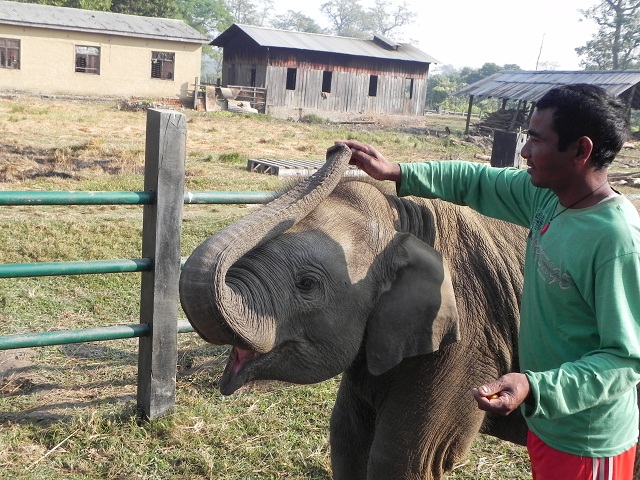
The babies were willing participants in the Compassionate Elephant Care training method, which uses only positive reinforcement. Within three days all the calves were happily laying their trunk back across their forehead and sticking out their tongue for their reward: a juicy orange slice. With the trunk and tongue in this position mahouts can easily examine the calf’s tongue for abnormalities.
EAI paid for a shipment of medication used to combat herpes and worked with mahouts to show them how to train the babies for tongue examinations.
The mahouts are now checking the babies’ tongues twice a day–once in the morning before going to the forest and then again in the evening when they return. Hopefully the virus will not strike again but, if it does, the mahouts’ vigilance could make all the difference.
Still fighting for Mali
Efforts to move Mali from her solitary existence in a zoo in the Philippines to a sanctuary in Thailand continue. An op ed by Carol comparing Mali’s life to that of Tina, who came to live at The Elephant Sanctuary, appeared this summer in a paper in the Philippines. Since then, Carol’s op ed has also appeared in Sri Lanka’s Sunday Times and, most recently, the Bangkok Post.
And now we are three
EAI will soon celebrate its third anniversary. It’s hard to believe we have come so far and accomplished so much in such a short period of time.
We have been able to do so much – and have such an impact – because you share our dream and continue to support the important work we do. With so many needy elephants in situations that, at times, are overwhelming, it is essential to know that you are backing our efforts to make life better for captive-held elephants in Asia.
It doesn’t matter if we are building chain-free corrals, teaching mahouts to handle their elephants in a gentler manner, providing pedicures to any elephant in need or stockpiling medicine to treat baby elephants infected with the herpes virus, you are always there to make sure that we are able to provide swift and humane assistance, one elephant at a time.
We cannot do it without you. At a time when elephants are fighting for their very existence across Asia and Africa, you help EAI make a real difference. I know you will remember these hardworking and many times neglected elephants in your year-end giving.
2013 promises to be another year of challenges and change for the better. I look forward to continuing our work together.
It’s been a pretty intense week. A two-year-old female calf at the breeding center was diagnosed with herpes. Even though she received treatment, she passed away two days later.
Herpes is near-epidemic among elephants in the US and recently reared its ugly head in Chitwan. Young calves between the ages of one and three seem to be most susceptible but there are records of juveniles and adults dying from the disease as well.
You’ll remember Bhadra, the fabulous flaming redhead we trained with positive reinforcement in Sauraha, Nepal. He died of the herpes virus last year, shortly before his second birthday. His mahout was so devastated that he left his job and returned to his home village.
Famciclovir, the treatment of choice for herpes, is not available in Nepal and must be imported from India. A small elephant can require as many as 1000 pills to fight the virus. The exorbitant cost—75 cents per pill—and large quantity needed, made stockpiling the medication impossible.
The calf was given available medication and was under treatment and constant surveillance as I arrange for a shipment of Famciclovir from friends at Wildlife SOS-India. Unfortunately, the drug did not arrive in time to save her. She died in the night with her mother stoically standing by. Records indicate that even with Famciclovir many calves do not survive.
I accompanied the team for the necropsy and somber burial; both were done with the utmost respect. All the mahouts were present and, for the first time in my observation, near silent. As Dr. Gaihre led the exploratory necropsy, examining and collecting tissue samples for lab work, the mahouts dug a grave. It was a sad and sobering experience. This calf had the classic symptoms of herpes–severe hemorrhaging–but otherwise was a very healthy elephant.
When it came time to lay her body to rest, I instinctively glanced around for wild flowers to place on her grave, just as we always did at the Sanctuary. After her precious body was covered with a sparkling clean white linen cloth, incense was lit and ceremonial red powder and flowers were sprinkled over her covered body. When the flowers I collected left my hand and floated down into her grave, a wave of gentle remembering engulfed my heart as I thought of the beloved elephants who had lived and died at the Sanctuary. At this moment we were all one, sharing the loss of a sacred soul.
The senior wildlife staff presided over the burial. Although the words spoken over her grave were in Nepalese and foreign to my ear, I knew exactly what the prayers were. It was the same ceremony, the same prayers uttered each time we buried another precious elephant at the Sanctuary. Like never before, I felt a connection with the mahouts who care as deeply for their elephants as we do ours.
Preparing for next time
The signs of herpes include dark spots on the tongue. By checking the tongue twice a day, the disease can be diagnosed in the early stages. In an effort to monitor the other three young calves at the breeding center, I was asked to train them for tongue examinations, a request that I was happy to fulfill.
The first day of training was a heart-lifting success. We were able to get the calves to place their trunks on their foreheads—for a tasty piece of banana—and took photos of their tongues.
Additionally, I ordered Famciclovir. Even though the drug may expire before it can be used, I feel strongly that having it on-hand whenever possible is important. We were not able to help one precious elephant but if the disease strikes again we will be better prepared.
Earlier this month, Elephant Aid International, in collaboration with the National Trust for Nature Conservation, engaged Dr. Arjun Pandit to oversee its elephant welfare projects in Nepal.
Dr. Arjun Pandit
While interviewing Dr. Pandit I was pleased to learn of his interest in elephants. We’re very fortunate to secure the services of such a highly motivated individual. He will make a great addition to our team, expanding our ability to develop and monitor elephant welfare programs in Nepal.
Dr. Pandit will have full-time oversight of the many projects developed by EAI/NTNC over the next few years. When I am in Nepal, he will assist with foot care and facility and welfare projects, as well as monitoring the health and welfare of the NTNC elephants. In my absence, he will oversee all of our projects, ensuring that they stay on track.
Dr. Kamal Giarde, the senior government veterinarian has graciously agreed to allow Dr. Pandit to participate in field work to increase his experience and expertise. Dr. Giarde has dedicated his life to elephant welfare and recognizes the importance of mentoring to build sustainable elephant welfare programs. Dr. Pandit and the elephants he will care for over the next many decades will benefit from Dr. Giarde’s guidance.
I am honored to work with such a dedicated team of like-minded conservationists at NTNC. We share a commitment to the welfare of Nepal’s elephants.
We are currently raising funds necessary to provide a salary and purchase equipment and supplies for Dr. Pandit for the next year.
When Paspat, the mahout supervisor at National Trust for Nature Conservation, asked about a water trough for Sweetie Kali, I nearly fell off my chair. Seriously— his question was a shocker because captive elephants are not given free-choice access to anything in Asia. The belief is that allowing them to make choices will spoil them for their mahouts. The great fear is that if elephants experience a sense of freedom and are content, they will refuse to respond to their mahouts.
The fact that Paspat asked for a water trough reinforced my belief that he genuinely cares about his elephants’ welfare. Even in the United States— land of the brave, home of the free—many captive elephants are not given free-choice access to water.
I was deeply touched by Paspat’s request—so outside of the normal thinking of mahouts—and I assured him I would make it happen. The grin that spread across his face when he understood my response was priceless.
It struck me that this might be the first time Paspat was in a position to create a practice contrary to tradition. A chill ran up my spine as I looked long and hard at this man, who supported the chain-free yard concept and suggested free-choice water. Even though we do not share one word of a common language, I felt the connection loud and clear.
First stop: the concrete factory
After securing the required authorization to add a water trough to Sweetie Kali’s yard, I posed my challenge to Kiran, the veterinary tech/nail cutter extraordinaire. He was excited to help.
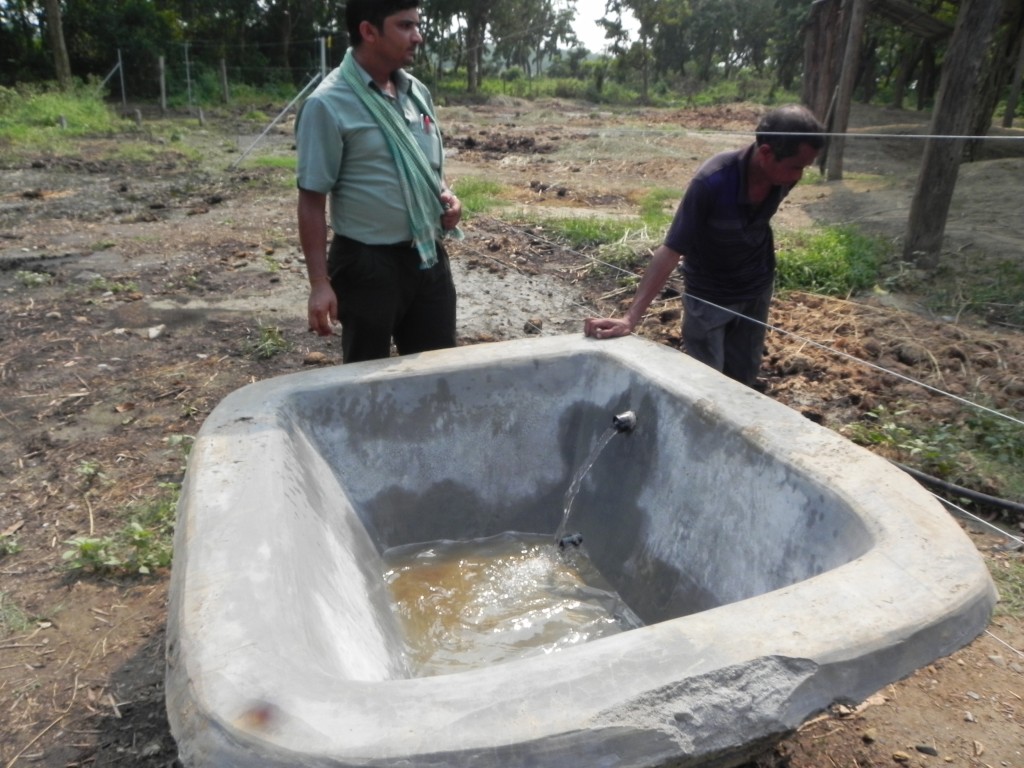
I explained what I needed: a sturdy, bathtub-shaped, concrete drinking trough, with inlet and outlet holes, heavy enough that Sweetie Kali cannot knock it over.
In his broken English Kiran said he knew a man who could make the trough for us. So off we went on his motorcycle, zooming down the pothole-rutted village road toward the other side of town.
We arrived at the concrete factory. There was a yard full of custom-made concrete posts for building supports and culverts used for septic tanks but I did not see anything that vaguely resembled a water trough.
I also did not see a single person.
Kiran parked his bike and charged over to a three-sided shack, calling out to someone. There was a man inside who was fast asleep.
Kiran entered the building without so much as knocking. The man, who was lying on a thin mattress on a wood-frame sleeping platform, was the soundest sleeper I ever saw. Kiran was nearly yelling—and the guy did not move. It was only when Kiran shook him that he awoke.
Midday is nap time as it is too hot to do much else. The bewildered look on the shopkeeper’s face was not as result of being woken abruptly but out of surprise to see us out and active in the sweltering heat.
The man rubbed his sleepy eyes as he sat up, trying to understand what Kiran was asking. I watched—which is how things work when you don’t speak the language—once again ever thankful for Kiran’s willingness to be my translator.
Finally the man seemed to understand what we wanted and began asking questions. Kiran included me in the three-way animated conversations, complete with crude drawing on the shop’s dirt floor. We decided on the width, length, height and wall thickness. I kept emphasizing to Kiran that it had to be heavy and strong enough that Sweetie Kali cannot pull it over or break it.
We decided on a free-standing version because if the trough was ground-level, dirt would get into it.
There was much discussion about the wall thickness and amount of steel bar required to make it strong enough. Explaining the inlet and drain holes was a bit challenging. When I finally saw the shopkeeper’s eyes light up in comprehension, I knew he understood what we wanted.
I kept pushing for an estimate but the shopkeeper was reluctant to give one. He had never created a trough before and clearly did not want to underestimate the cost. After much prodding on Kiran’s part, though, we had a bid in hand and commitment that he would start on our project the next day. I was so excited!
How would he actually make it?
At no time during the process did I think to ask how he would create the mold for the trough. He would build a frame out of two by fours and plywood and pour the concrete in, of course. How else?
The concrete factory was halfway between Kiran’s house and Sauraha. He passed the shop each morning on his way to pick me up for foot trimming and kept me apprised of the progress. Indeed, work had begun immediately, as promised, with an estimated curing time of ten days.
The wait was excruciating, so after about five days I just had to check on progress myself.
When we arrived the yard was empty. My heart sank when I saw nothing that resembled a water trough. But as we drove slowly toward the back of the yard, which borders a neighbor’s cornfield, I saw it.
The mold was not what I expected but, considering available resources, it made perfect sense. A hole the exact dimensions of the outside of the trough had been dug into the earth, then the concrete was poured and molded by hand. It was stunning!
I could not help but ask how he would get that heavy trough out of the ground. Kiran laughed and explained that several men would pull the trough from the ground by hand and load it onto a wagon for delivery. I did not think to ask how it would be off-loaded into Sweetie Kali’s yard.
The trough arrives
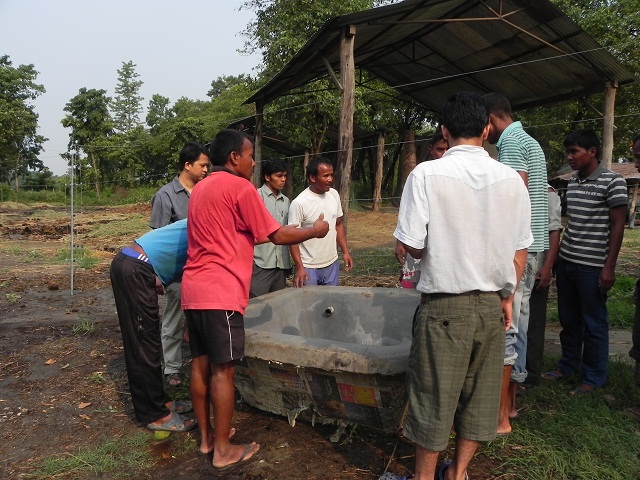
The day finally arrived and the wagon carrying the water trough was backed into Sweetie’s yard. All the mahouts gathered around, very willing to be of assistance.
I watched as the deliverymen discussed the best way to unload this 700-pound tub of concrete and steel. The weight and slick bottom of the trough made it a dangerous situation.
They decided to park the wagon at an angle, place a large tire on the ground just below the tailgate and slide the trough off the trailer onto the tire. I kept my nose out of the planning but two things nagged at me—the steep angle of the trailer and the weight of the trough. But, the deliverymen were in charge, so I kept my mouth shut.
Then it happened, catching the men by surprise. One tug on the trough sent it careening toward the open end of the wagon—and all the men. As it picked up speed, the men scattered. I heard my own “oh no!” pierce the silence as the trough became airborne, turned in mid-air and landed with a thump on its side, feet from its intended landing spot on the tire.
I scanned the scene to see if the trough had landed on anyone. The area was clear and everyone looked fine. But then I noticed Paspat rapidly exiting the scene with Babu Ram close behind. He was holding his hand high in the air. It was then that I saw blood running down his hand.
Paspat had caught his hand between the trough and the bed of the trailer, slicing across the top of it from thumb to baby finger. It was not a pretty sight.
Nandu fired up his motor cycle. Paspat climbed aboard, but not before washing the blood from his good hand so as not to soil the bike. With the entire group looking on in silence, Paspat was raced to the local clinic, hand held high above his head to help slow the bleeding.
The men wrestled the trough into place in a most unceremonious manner. The accident had dampened everyone’s spirits.
Within minutes we learned that Paspat had no broken bones, but the muscles in his hand were pressed back toward his wrist. The muscles were massaged back into place and he received twelve stitches. The biggest concern was infection. Paspat is diabetic so the doctor was concerned about how well he would heal.
Hand healed, trough in place
More than a week has passed and I am happy to report that Paspat’s hand healed without complication.
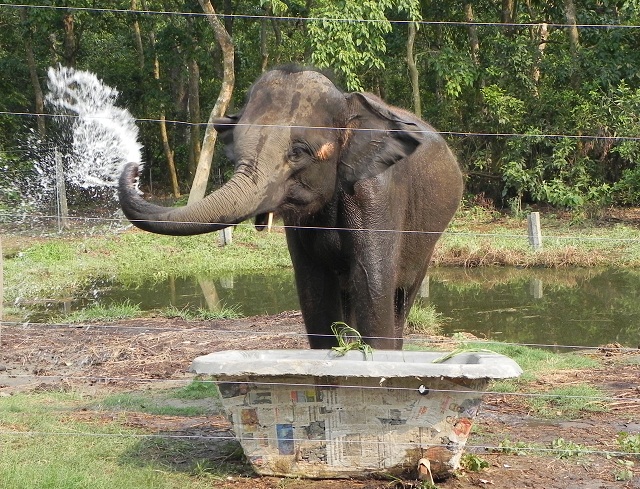
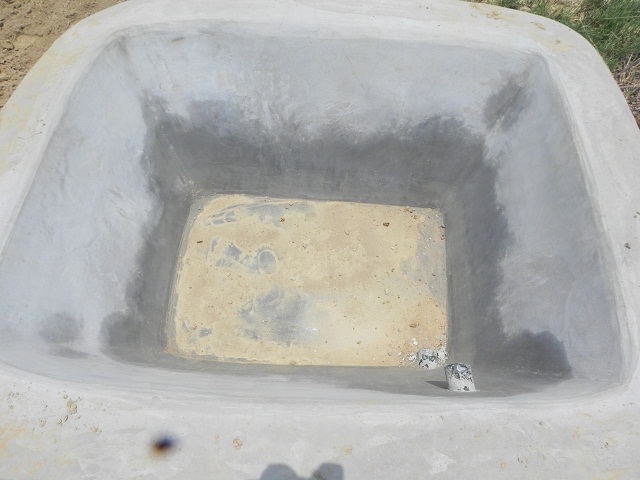
As for the trough, it is a work of art. Every angle is perfect, all the surfaces smooth to ensure that Sweetie does not scratch her trunk and that it is easy to keep clean. I marveled at the amount of work that went into the mold and the craftsmanship it required. I could not have been happier.
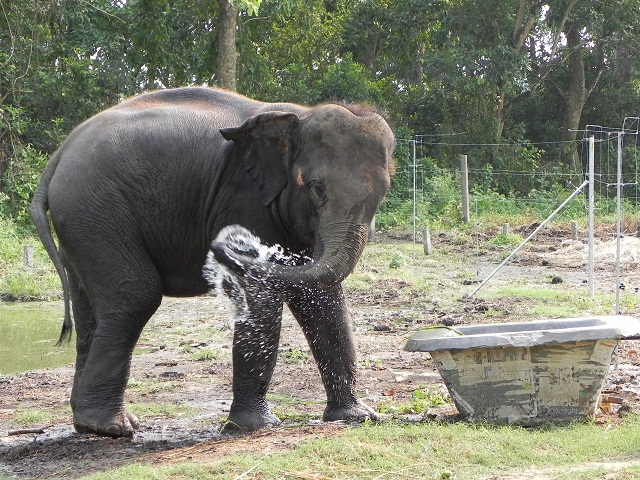
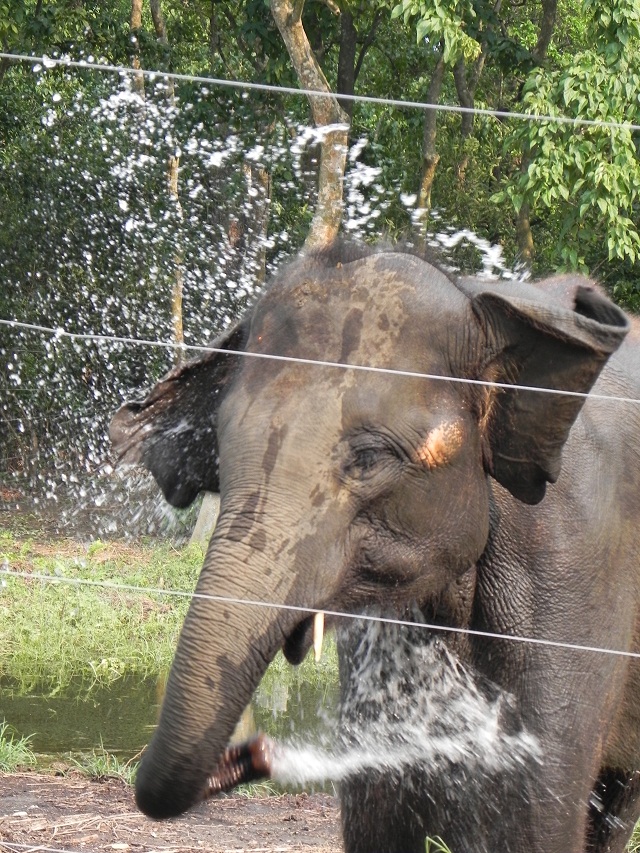
Sweetie Kali wasted no time making use of her trough. The mahouts seem to enjoy watching her almost as much as she enjoys splashing, bathing and drinking.
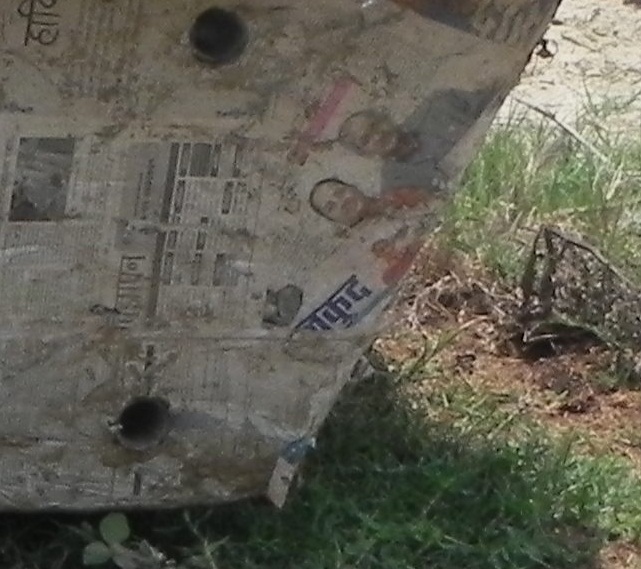
Some of you commented on the newspaper that covers the outside of the trough, making it look like papier mache. The newspaper was used to line the inside of the earthen mold to keep the concrete clean; now it’s nearly one with the concrete so the mahouts decided to leave it.
A huge thank-you goes to the mahouts for their willingness to try something new and to all the supporters who underwrote the cost of adding this trough to Sweetie Kali’s yard.
Tuesday I spoke at a Kentucky Department of Fish and Wildlife Resources (KDFWR) public hearing in opposition to the proposed amendment to state regulation 301KAR2:082. If this amendment passes, elephant rides will be allowed in the state of Kentucky for the first time since 2005.
KDFWR representatives appeared receptive to the information I provided regarding elephant behavior, harsh trainer treatment and the risks the city accepts when allowing an inherently dangerous exotic animal to share common space with the public. If they grasp the immense risk elephant rides pose, they will surely oppose the amendment.
What prompted the ban nearly seven years ago was an elephant attack at the Louisville zoo that left a man seriously injured. The elephant, Kenya, was privately owned and contracted by the zoo for elephant rides.
The day of the attack Kenya was in an off-exhibit area with her trainer. It was standard practice for Kenya to wander around the enclosed area unchained. But while the trainer was distracted in another area of the enclosure, Kenya opened a gate and wandered out into the zoo.
It was the end of the day and very few zoo visitors were present. A man saw Kenya and walked up to her. Reports indicate that he tried to control her, but she lashed out at him, inflicting serious injury.
The incident resulted in lawsuits against the zoo, the city and Kenya’s owner. The man recovered and Kenya was not harmed.
Following the attack, in recognition of the dangers posed by some species of wild and exotic animals, KDFWR banned public contact with a long list of inherently dangerous animals, including elephants.
One supporter of the ban is the Primate Rescue Center, co-founded by April Truitt. Many of the species that her organization rescues and protects are included in the ban.
Currently KDFWR is being lobbied by the Kosair Shriners to amend the regulation and allow elephant rides. The Kosair Shriners continue to offer elephant rides at their annual circus fundraiser in defiance of the regulation. Their position at the meeting was that elephants are not dangerous, at least not the ones they hire.
Lobbying to stop elephant rides does not guarantee better welfare for elephants but it does provide an opportunity to educate people about the inappropriateness of the activity.
Send your comments to:
Ms Rose Mack
Kentucky Department of Fish and Wildlife Resources
An article by Carol Buckley and G.A. Bradshaw, Ph.D., Ph.D., on how sanctuary creates a healing trans-species community in which humans and elephants live together. In sanctuary, the humans function as catalysts, interpreters and negotiators of relational repair for elephants in recovery from trauma.
Hohenwald, TN, October 27, 2011 – Elephant Aid International (EAI), a Carol Buckley Project, announces its official partnership with the Wildlife Rescue & Rehabilitation Centre (WRRC), one of India’s foremost wildlife organizations, to create the first prototype Elephant Care and Rehabilitation Center in Karnataka, Bangalore, India.
With the endorsement of the Indian government, this private project will serve as a model for future care and rehabilitation centers throughout the country. The center will rehabilitate elephants who have been removed from the confines of zoos, circuses and temples, and offer them a more natural lifestyle, free of chains and negative management techniques.
Carol Buckley, founder, president and CEO of EAI, will supervise the Center’s development, training of mahouts (elephant handlers) and elephant acquisition and relocation. This first facility will house up to seven elephants.
“We are honored to partner with WRRC on this landmark project,” said Buckley. “I believe this care center will be a beacon of hope and a challenge for change for people working to improve the lives of captive elephants.
There is an urgent need for care centers (what are known as sanctuaries in the U.S.) in India. In November 2009, the country’s Central Zoo Authority mandated that all elephants be removed from zoos and placed in alternative facilities better suited to address their needs. India’s wildlife parks and game sanctuaries are not well suited for zoo elephants and, until now, no other alternative existed.
In August 2010, the Elephant Task Force of India’s Ministry of Environment and Forests issued a set of recommendations, including the creation of state-of-the-art lifetime care centers.
Designed to provide freedom of movement and a healthy social environment, care and rehabilitation centers will provide a safe place for elephants to escape the abuses of captivity.
The centers will support the rehabilitation of elephants suffering from physical and psychological trauma by providing a more naturalistic environment.
They will not involve tourism.
The grounds will be fenced, eliminating the need to restrain elephants with leg chains.
All mahouts will be trained in Compassionate Elephant Care techniques, a system developed by Buckley that is based on understanding elephant biology, physiology and psychology; relationship building between the mahouts and their elephants; and positive reinforcement.
The number of elephants housed at the Center will be limited to ensure there is adequate vegetation for them on-site and in the bordering national forest. The elephants will have access to areas of the forest during daylight hours and will return to the Center at night.
The Center is based on The Elephant Sanctuary in Tennessee, which Buckley co-founded and led to international recognition as one of the leading models of humane management of elephants in captivity.
 “Sunder has a new life and a fresh start at a wonderful facility,” said Carol Buckley, an expert in innovative approaches to elephant welfare in captivity, who recently visited Sunder in India to design a chain-free facility at the park where he now lives.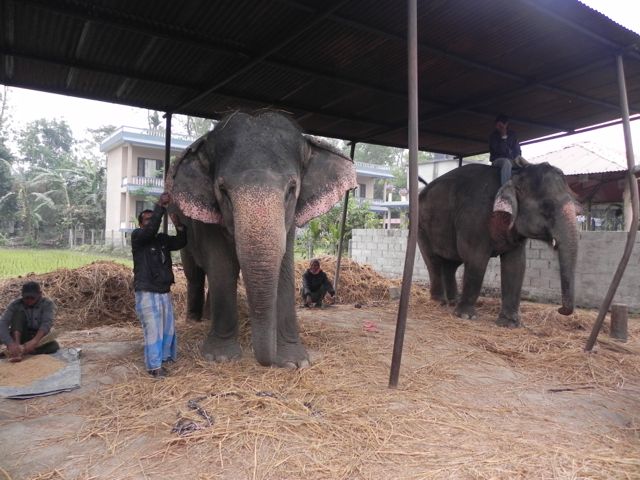
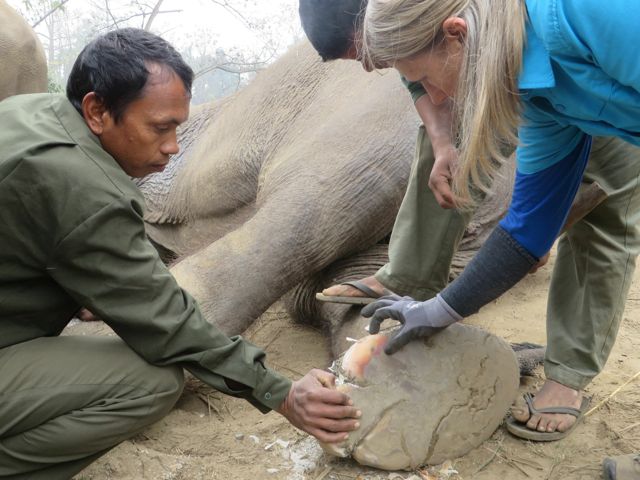 Developing sustainable assistance programs is essential. Live demonstrations, educational resources such as videos and manuals, translators and hands-on assistance are needed to improve mahout knowledge and understanding of new approaches to elephant care.