Category: Elephants in Asia

  • Sweetie Kali

    Upon returning to the National Trust for Nature Conservancy in Chitwan, I was surprised and pleased to see Sweetie Kali still there. Last year I was told she was to be moved to the zoo in Kathmandu.

    Sweetie is less than ten years old so it was difficult for me to understand such a move. In Chitwan, Sweetie has daily access to the forest, the river, free grazing and foraging and lots of other elephants –: a life that provides benefits she would not experience in an urban zoo.

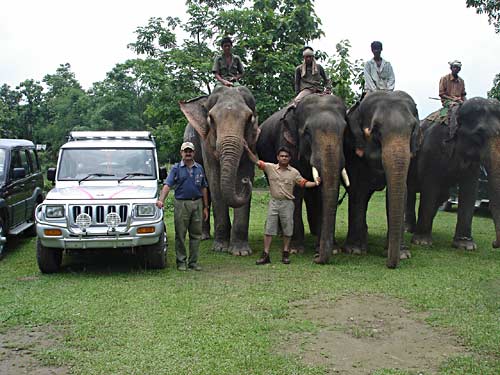
    Today I saw little Sweetie Kali moving at a fast clip, of her own motivation, across the expanse of community forest that borders Chitwan National Park. She and seven of her counterparts were in pursuit of a rhino that was to be radio collared. Gracefully moving faster than the other elephants she accompanied — all were her seniors — Sweetie Kali exuded pride and self confidence.

    I found myself caught in a quandary: why was I feeling positive about Sweetie’s engagement in this rhino search?

    It seems that I had allowed myself to let go of my personal opinion that Sweetie should not be working and allowed myself to experience Sweetie’s reaction to her involvement. Her self-motivation was obvious; there was no fear or apprehension or even hesitation on her part. Quite the contrary. A hint of a smile graced her baby face when she was able, without prodding, to overtake the other elephants in her group.

    The fact that Sweetie was part of the search party is testament to her skill and confidence level. Each elephant must contain the confidence to remain in pursuit, even when charged by an angry rhino. Sweetie has proven that she’s got what it takes: not fear of her mahout but confidence in him and most important, in herself.

    Sweetie’s mahout rode gallantly atop her bare neck, projecting the image of a proud father. He never struck her or yelled, but encouraged her to challenge herself to move faster than the others, cutting them off and gaining rank.

    The look on her face was priceless — she reveled in the game. Her age gave her an advantage. Being young, Sweetie does not suffer the aches and pains experienced by her elders. Her gate was smooth as a still lake and her attitude reeked of confidence.

    I saw young Sweetie Kali and all the forest patrol elephants in a different light today. These elephants will never return to a life in the wild; they will spend their entire life in servitude to man. Within such parameters, I cannot think of a better way for them to live than amongst their comrades, immersed in the forests, engaged in stimulating elephant-friendly activity that keeps them fit and confident.

    No, I am not advocating that captive elephants should work for their keep, but they do. What I do support is that they be treated with kindness and respect and allowed to live a life as close to nature as possible. I believe that we can improve upon the life of forest patrol elephants, making improvements to their welfare. But short of returning them to a safe wilderness (which does not exist), these captive elephants are the lucky ones.
  • Breeding Center

    Kiran, the government veterinary technician, and I finished trimming feet at the Government Breeding Center yesterday.

    I was so pleased that things really changed from the first day. I spoke with Kiran about the mahouts hitting the elephants; he was great. Without hesitation, he engaged the mahouts, men he has worked with for many years, and explained why they cannot hit their elephants. From his intonation and body language, I could tell that Kiran took my request very seriously and the phonits (lead mahouts) and mahouts listened intently. . They respect Kiran and followed his direction without hesitation, which was that at no time should they hit the elephants.

    When the first nervous elephant laid down, the mahout unconsciously went to strike her instead of allowing her time to lay her arthritic body gently to the ground. The other mahouts and Kiran cried out in unison – “no pit nau” (show respect-don’t hit).

    Stopping in mid-swing, you could see that the mahout had not realized he was about to hit his elephant; the action is so ingrained there is no thought associated with it. Like breathing, it is automatic. For the next 90 minutes, the mahouts needed to remind each other only a couple of times, and the reflex to hit was quickly under control.

    It was great to see the mahouts monitor each other in an effort to comply with our request. There was even laughter when a mahout would absentmindedly raise his stick and other mahouts would verbally jump all over him. All of the mahouts and phonits got into the act of making sure no elephants were harmed during my time at the center. Joking around with the mahouts and having Kiran present made it possible to create a calm and abuse-free environment. As expected, the elephants relaxed into their pedicures.

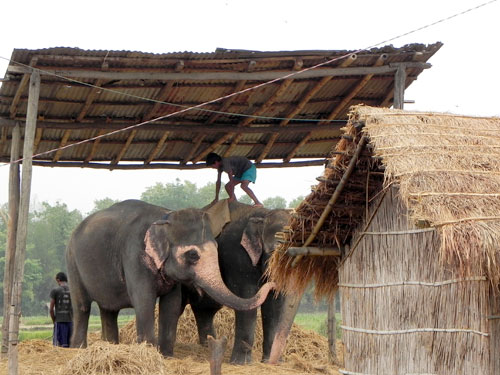
    The elephants at the breeding center spend the day out in the forest browsing and the nights chained under a shelter. Mothers and calves are allowed to stay together until the calf is around five, and I must say, the center runs quite smoothly.

    With a good mix of young and senior phonits and mahouts, we had lots of guys jockeying for a turn to trim feet. The competition between men and boys did not hurt a bit, and then add to the mix that a woman was doing trimming. By the second day I was able to instruct the mahouts to do the heavy cutting with the cycle knife (which I refuse to touch), leaving me to do my favorite part: intricate trimming and shaping with my prissy exacto blade. At first the guys laughed at my knife but the smiles melted from their faces when they tried to trim with it. They quickly learned that my knife was designed for precision work, not brute strength, and that it takes some time to get a feel for it. In the end, the guys were opting for the girly knife and doing some really fine trimming on their elephants’ feet.

    Dr. Geare, the head government vet, checked on our progress several times over the past two weeks. He encouraged his staff to learn as much as possible, stating that with proper foot care the center would save money. He said that in the past many elephants developed foot problems requiring drug therapy, antibiotics and anti-inflammatory treatment. He was optimistic that by learning foot trimming skills, the phonits and mahouts could ensure better foot health for their elephants and reduce the need for drug therapy.

    Each morning on our way to the breeding center we stopped at a local produce stand to buy a stock of bananas. Kiran was a champ, never complaining about having to taxi me around on his motorcycle. The road to the breeding center is…well…how do I say? — rocky! Potholes are not the concern; it’s all the boulder-size rocks used to make the paved surface. Watch out when you fall…ouch!

    We did take a spill, once. Luckily we were driving quite slow, crossing another road, when a baby goat, in hot pursuit of breakfast, darted right under the front tire. Kiran successfully avoided the youngster but spilled the bike as result. I saw it coming and was only concerned that we not hit the goat. The local shopkeepers rushed out to brush the dust from our clothes and make sure we were okay. I craned my neck to see the condition of the goat. She was safe and sound a few feet away, suckling from her mom with her twin sister, unconcerned about the commotion she had created. In Asia animals may be treated differently but they are valuable, more valuable than the motorcycle we rode on. If Kiran had harmed or killed the goat he would have had to reimburse the owners for her value. Needless to say, every precaution is taken to avoid harming someone else’s livestock.

  • out in the field again!

    Out in the field…what a concept, I love it. When I get back to internet access I will report in. In the meantime be assured that I am enjoying every minute of this fabulous adventure!

    Namaste

  • Pawan Kali’s Support

    May 10

    As I prepared to experience my final day in Kathmandu I was ever grateful for Joy’s expert navigational skills. Without incident we arrived at the narrow pedestrian lane that leads to the zoo. Behind a fenced in area adjacent to the zoo a large group of school children were engaged in a sports event. Two teams were assembled on either side of what resembled a volley ball net, but that is where the similarity to volleyball ended. The teams were darting around the court, hitting the ball, sending it over the net and back again. But they did not use their hands, instead they used their feet. The organized mayhem was being cheered on by a bleacher full of enthusiastic classmates.

    I found my way inside the zoo through the security entrance, where an attentive young guard was stationed. He listened politely as I asked to see Dr. Jeewan Thapa. After repeating Jeewan’s name a couple of times the guard’s eyes lit up in recognition. It is fabulous how forgiving the Nepalese are with my pronunciation. I am sure I make mincemeat of their language but they seem to appreciate my effort.

    Jeewan, myself and Director Sarita Jnawali met. We discuss Pawan Kali’s move to Chitwan. I was assured that we would be kept up to date when the time arrived for Pawan Kali to be moved. Director Jnawali graciously accepted the donation generated by Pawan Kali’s new supporters and was sincerely touched by the show of kindness for Pawan Kali.

    The donation was handled very officially. The accountant was summoned to witness and record the donation and issue a receipt. It was all very formal. Director Jnawali asked permission to write about the contribution for Pawan Kali in their zoo publication. Of course, I assured her that the friends of Pawan Kali would be honored to have their support recognized in such a way. Once I get a copy of the publication I will make sure to post it.

    I was pleased to be reminded of the beauty of this zoo, with its manicured grounds and peaceful park-like setting. Thanks to the support of caring individuals affiliated with IEA, another bridge has been built. A relationship has been initiated which hopefully will have a ripple effect  not only for Pawan Kali and the Central Zoo in Kathmandu, but for a consciousness worldwide that we are all connected in a deep and real way. One elephant at a time is not a slogan, it is a goal.

  • Elephants Everywhere

    Elephants Everywhere

    April 18

    The town of Sauraha borders on Chitwan National Park and is a world away from Kathmandu. What an inspiring place. Exotic bird vocalizations fill what otherwise would be a serene silence. Every manner of chirp, caw, twitter and call creates an exhilarating backdrop for this pleasant forest atmosphere.

    The people and the local dogs are refreshingly friendly!  The traditional namaste greeting, hands clasped together at chest level accompanied by a polite head bow, encourages interaction, bridging an otherwise seemingly insurmountable gap caused by the language barrier.  But with this bow and respectful greeting, cultures merge and friendships are born. For the veteran members of the ECI team, friendships with the locals are rekindled and strengthened; everyone is extremely happy to see the foreign vet team back in Sauraha.

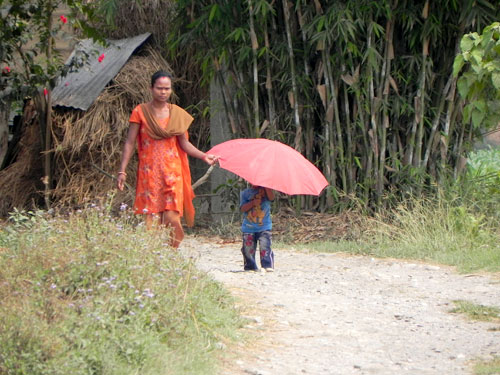
    The short walk from our lodging into town is rich with color and contrast.  Beautifully clad women, parasol in hand, gracefully walking down dirt roads flanked by tethered buffalo, foraging goats, a scattering of chickens and elephants. It is surreal; in less than a half-mile stretch of road, nine elephant stables dot the landscape. These elephants, used for tourist safaris, appear no more out of place here than the family dog in the backyards of suburban America.

    Today was a day for silent observation as each turn in the rugged road brought another stable and tethered elephant into view.  In their mini-environments, elephants stand under a covered stable with a water source to one side, the mahouts residence directly in front and a trough for disposing dung directly behind. Under foot is an ample supply of fresh-cut “elephant grass.” The elephants appeared calm and relatively uninterested in passers-by, even though most are only a few feet off of the road. Once I get over the culture shock of seeing elephants literally around every corner I will concentrate on getting to know each elephant and their history, and of course I will share that information with you.

  • Meeting Pawan Kali

    Meeting Pawan Kali

    April 16

    As I sit here composing my blog update the electricity has gone off, resulting in the steady hum of backup generators adding to the pulse of the city.  A thin stream of smoke gracefully dances skyward from the mosquito coil in the middle of my room. After hesitating at the door frame, a small furry rodent scurried across the open doorway as two geckos cling to the ceiling directly overhead. They are as still as silence, imitating a wall painting…they are so cute!

    Today’s activities included meetings at the National Trust for Nature Conservation (NTNC) and the Central Zoo.  Dr. Susan Mikota has developed quite a reputation here in Nepal; she is held in high esteem. While at the zoo we were given a tour, met some of the zoo staff and, from a respectable distance, met Pawan (paw-wan) Kali, the pride of the zoo.

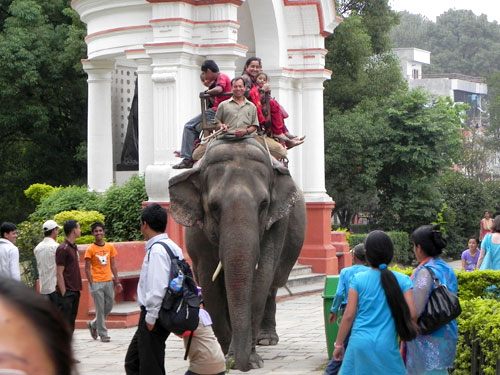
    Pawan Kali is believed to be in her 60s. She is stately and beautiful, an impressive Kali (female) elephant who stands close to 11 feet tall.  I was told that Tuesdays are recognized by the zoo as the day to honor Ganesh.  On this day, Pawan Kali and local residents are treated to a well received tradition: the zoo provides special food that the public can hand feed to Pawan Kali. We were not witness to this weekly ritual but there is no doubt that both Pawan Kali and the local residents enjoy the special activity.

    During my conversation with Dr. Jeewan (g-wan) Thapa, the zoo’s veterinarian, I learned that plans are being considered to retire Pawan Kali to the National Trust Nature Conservancy stable at Chitwan National Park. Not having visited the facility yet I can’t say what this change would mean for Pawan Kali, who has lived at the zoo for nearly 35 years.  I questioned Jeewan about how Pawan Kali might respond to the move and he responded confidently that she would have no problem. Interestingly enough, Pawan Kali lived at the NTNC prior to moving to the zoo. It is unclear if she would be reunited with any of her former herd members but wouldn’t that be exciting if her return meant a reunion. Just the fact that Pawan Kali will once again live with elephants after being alone for so long is a very exciting prospect.

  • Elephant Aid International

    Elephant Aid International

    These elephants benefit from the mobile health care program I established over five years ago.

    Welcome to my new blog! I am so excited to share this great news with you. Never one to stand around and watch the grass grow, I decided to create a new nonprofit organization called

    Elephant Aid International.

    I guess that makes all of you ELEAIDS.

    The mission of Elephant Aid International is to assist elephants worldwide…one elephant at a time. I believe in the power of one, that every elephant counts. On my travels I will be searching for opportunities to learn about elephant and mahout life in Nepal, India and Thailand. Whenever and wherever possible, I hope to impart what elephants have taught me about non-dominance passive-control management and the sanctuary life style.

    It is my good fortune to be invited by elephant experts to participate in field work, elephant medical care and even brainstorming with other like-minds for the creation of elephant sanctuaries in Nepal and India. I am focusing on the future, thankful for this opportunity to be of service on a much grander scale.  This trip is humbling, a fabulous opportunity to further my studies of this magnificent species and a chance to give back.

    Imagine the prospect of sharing what I have learned from our girls to benefit their relatives, in their homeland. It is more than I ever dreamed possible. Talk about coming full circle and paying it forward.

    I can’t wait to see what the future holds. My flight to Kathmandu leaves April 12. After a pit stop in Bangkok I join up with a team of veterinarians and technicians for the first leg of my trip. I will blog as often as possible to include you in the adventure and, of course, introduce you to each and every elephant I am blessed to meet along the way. The future is indeed BRIGHT.

    Namaste,

    Carol