Category: Foot care

  • Breeding Center

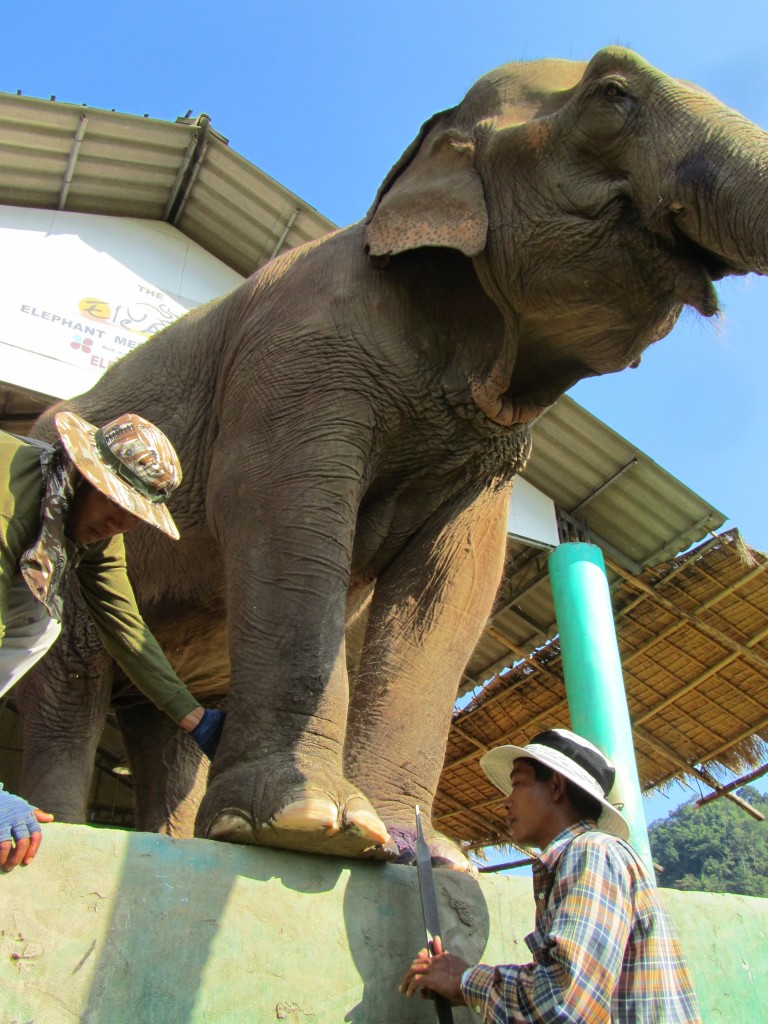
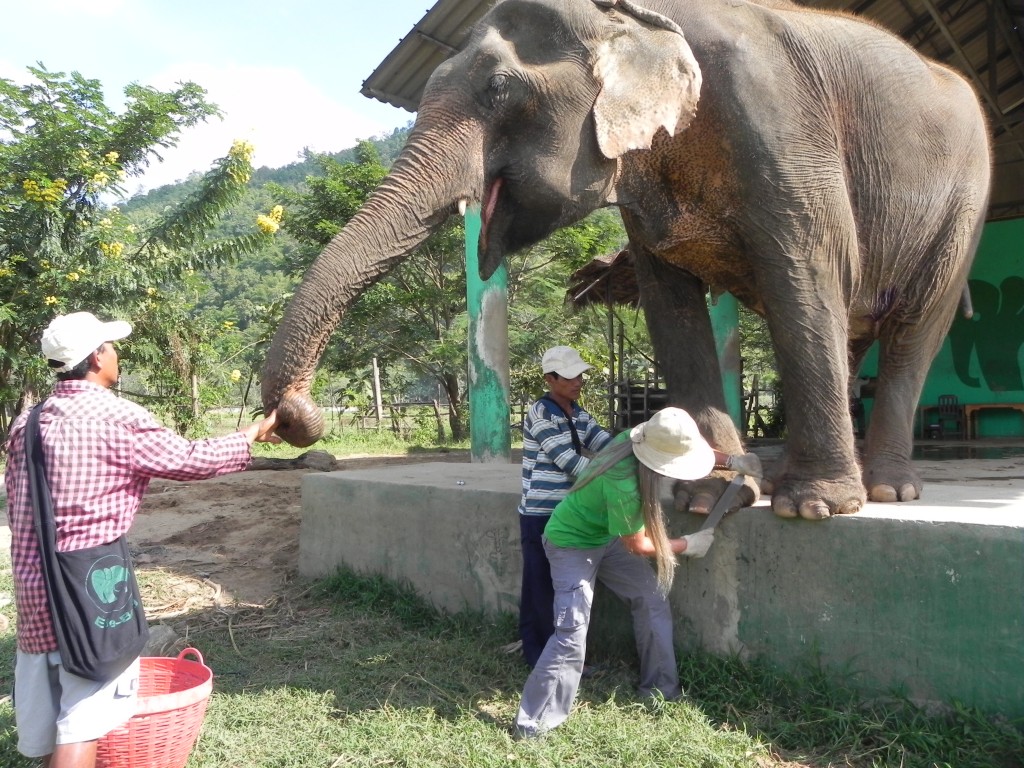
    Kiran, the government veterinary technician, and I finished trimming feet at the Government Breeding Center yesterday.

    I was so pleased that things really changed from the first day. I spoke with Kiran about the mahouts hitting the elephants; he was great. Without hesitation, he engaged the mahouts, men he has worked with for many years, and explained why they cannot hit their elephants. From his intonation and body language, I could tell that Kiran took my request very seriously and the phonits (lead mahouts) and mahouts listened intently. . They respect Kiran and followed his direction without hesitation, which was that at no time should they hit the elephants.

    When the first nervous elephant laid down, the mahout unconsciously went to strike her instead of allowing her time to lay her arthritic body gently to the ground. The other mahouts and Kiran cried out in unison – “no pit nau” (show respect-don’t hit).

    Stopping in mid-swing, you could see that the mahout had not realized he was about to hit his elephant; the action is so ingrained there is no thought associated with it. Like breathing, it is automatic. For the next 90 minutes, the mahouts needed to remind each other only a couple of times, and the reflex to hit was quickly under control.

    It was great to see the mahouts monitor each other in an effort to comply with our request. There was even laughter when a mahout would absentmindedly raise his stick and other mahouts would verbally jump all over him. All of the mahouts and phonits got into the act of making sure no elephants were harmed during my time at the center. Joking around with the mahouts and having Kiran present made it possible to create a calm and abuse-free environment. As expected, the elephants relaxed into their pedicures.

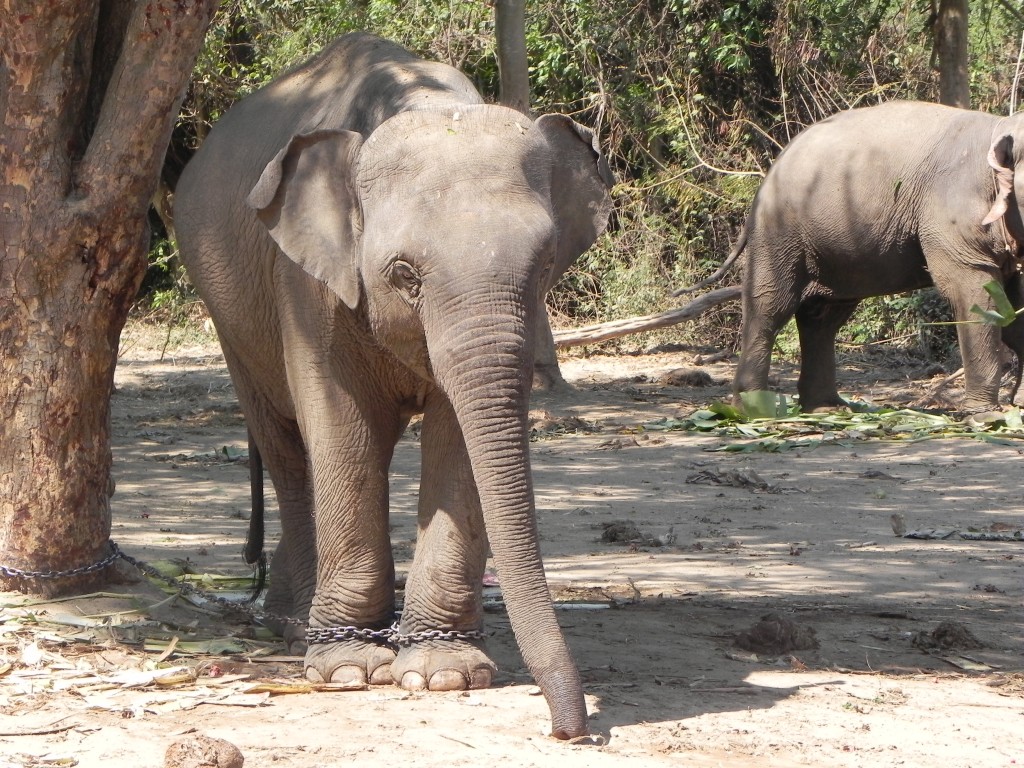
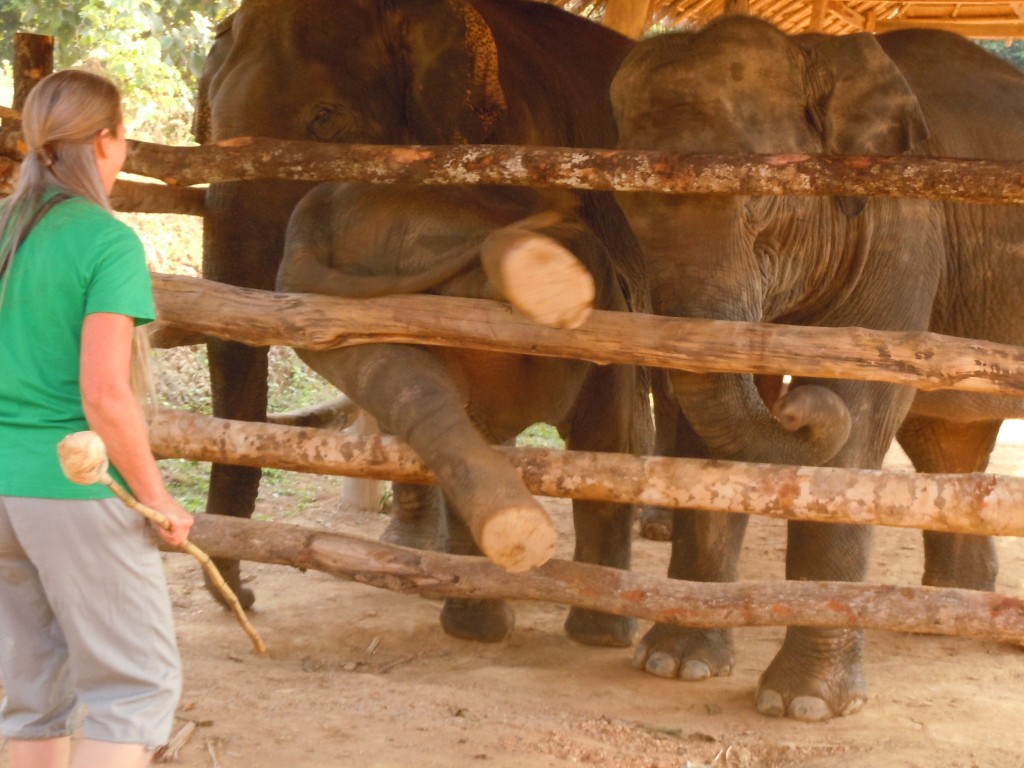
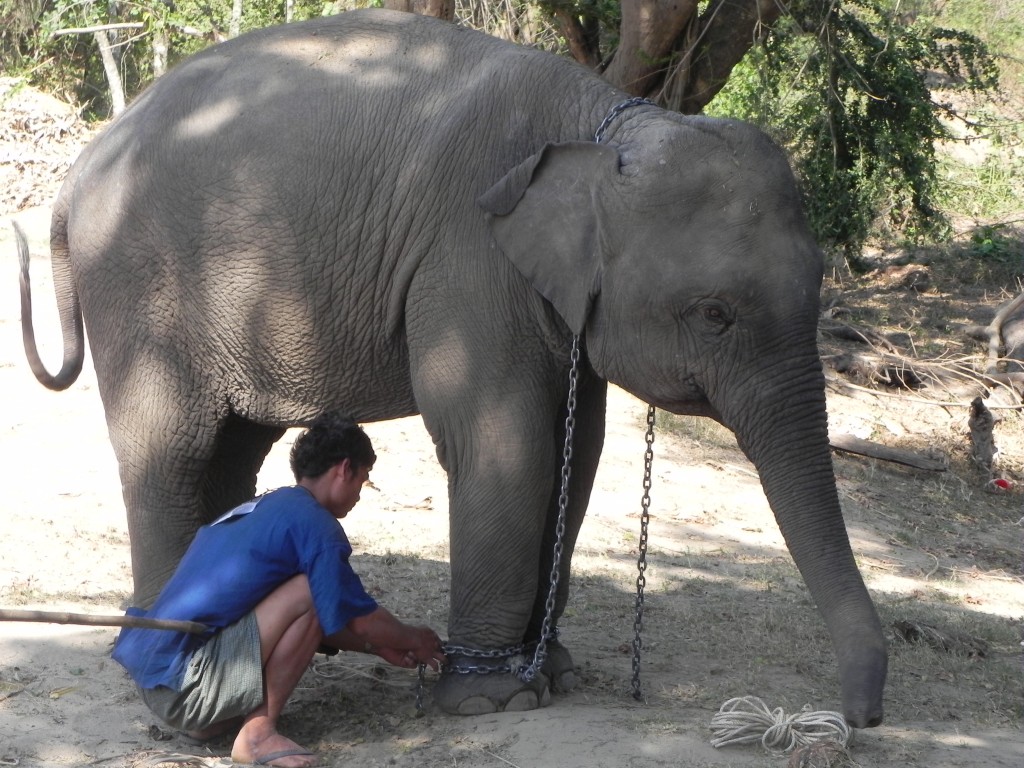
    The elephants at the breeding center spend the day out in the forest browsing and the nights chained under a shelter. Mothers and calves are allowed to stay together until the calf is around five, and I must say, the center runs quite smoothly.

    With a good mix of young and senior phonits and mahouts, we had lots of guys jockeying for a turn to trim feet. The competition between men and boys did not hurt a bit, and then add to the mix that a woman was doing trimming. By the second day I was able to instruct the mahouts to do the heavy cutting with the cycle knife (which I refuse to touch), leaving me to do my favorite part: intricate trimming and shaping with my prissy exacto blade. At first the guys laughed at my knife but the smiles melted from their faces when they tried to trim with it. They quickly learned that my knife was designed for precision work, not brute strength, and that it takes some time to get a feel for it. In the end, the guys were opting for the girly knife and doing some really fine trimming on their elephants’ feet.

    Dr. Geare, the head government vet, checked on our progress several times over the past two weeks. He encouraged his staff to learn as much as possible, stating that with proper foot care the center would save money. He said that in the past many elephants developed foot problems requiring drug therapy, antibiotics and anti-inflammatory treatment. He was optimistic that by learning foot trimming skills, the phonits and mahouts could ensure better foot health for their elephants and reduce the need for drug therapy.

    Each morning on our way to the breeding center we stopped at a local produce stand to buy a stock of bananas. Kiran was a champ, never complaining about having to taxi me around on his motorcycle. The road to the breeding center is…well…how do I say? — rocky! Potholes are not the concern; it’s all the boulder-size rocks used to make the paved surface. Watch out when you fall…ouch!

    We did take a spill, once. Luckily we were driving quite slow, crossing another road, when a baby goat, in hot pursuit of breakfast, darted right under the front tire. Kiran successfully avoided the youngster but spilled the bike as result. I saw it coming and was only concerned that we not hit the goat. The local shopkeepers rushed out to brush the dust from our clothes and make sure we were okay. I craned my neck to see the condition of the goat. She was safe and sound a few feet away, suckling from her mom with her twin sister, unconcerned about the commotion she had created. In Asia animals may be treated differently but they are valuable, more valuable than the motorcycle we rode on. If Kiran had harmed or killed the goat he would have had to reimburse the owners for her value. Needless to say, every precaution is taken to avoid harming someone else’s livestock.
  • a powerful lesson

    I am back in Sauraha, feeling like I have come full circle. For the past week I have trimmed feet at the government center. The majority of elephants who have received pedicures are adult males used for night patrol in the forest to protect wildlife from poachers. Their lives are far removed from their birthright but at least they spend a portion of their time walking on the soft forest floor, taking in the sights and sounds of the natural world. They are a shadow of their true selves; where those selves have gone, I don’t know.

    Today I began work at the elephant breeding center, another government project in Chitwan. I was disappointed to leave behind the mahouts I had spent the previous week training, but felt confident that these mahouts would learn as quickly.

    Most of the elephants at the breeding center are young, as you would expect: there are fewer adult males and lots of females and young calves. The first thing I noticed is that the mahouts are not as gentle or patient as the mahouts at the government center. It registered as I realized I was hearing the thump thump thump of a stick hitting a young male on the head.

    I was reminded of the wise words of Karl, a fellow elephant caregiver at the Elephant Nature Park. I am paraphrasing, but his words went something like: “Even when we think we are helping elephants, many times it is more about us than about them.”

    Karl’s words came to me loud and clear as I was trimming the feet of a young elephant. I was so intent on providing a service that I ignored the fact that he was suffering because of me. He was quite frightened to lie down for the pedicure, and the mahouts were insensitive to his fear.

    When I finally allowed myself to realize what was happening, I froze in my tracks. What good could my help possibly be if this little elephant was being hurt to enable me to do my work?

    I took a step back to reevaluate the situation. Even though I was not participating in the abuse, I allowed it to happen, and in that way I was a party to it. Karl’s words helped me to see my error; I want to make sure that no elephant is harmed in my presence or as part of my giving assistance.

    I owe Karl a great deal for his wisdom and plan to be more conscious from this moment forward. Just because the mahouts have no concept of na pit neu (don’t hit) is no reason for me to assume they cannot learn.

    My next pedicure session is in a couple of hours. I plan to bring a bag of treats for the young male, learn his name and have his mahout lie him down without hitting him. I will then instruct the mahout to give the elephant the treats as I apologize to him for my insensitivity. I will not trim his feet; only give him the opportunity, perhaps for the first time in his captive life, to experience what it feels like to be respected.

  • Menaka missed her pedicure appointment

    Today I was supposed to give Menaka a pedicure to address two problem areas on her front feet.

    I met Menaka in India last May. At that time she was living at the Bangalore Zoo, having recently been confiscated by the government from a temple. She was thin, nervous and a bit aggressive, and her feet did not look good.

    Menaka no longer lives at the zoo, which is good news. Instead, she resides at the wildlife rehab center run by CUPA, which happens to be next door to the zoo. She is not on exhibit, which suits her well, but still receives the fringe benefits, such as spending the night loose in the forest with the zoo’s related herd of elephants.

    When I visited Menaka a few days ago, I didn’t recognize her. She was calm, her weight was good and her feet were on the mend. We set an appointment for today to trim her feet but I just got an unexpected phone call. All of the elephants, including Menaka, had not returned from the forest but instead were hanging out with a herd of wild elephants. Imagine the director of a US zoo receiving such a call from his lead elephant trainer telling him the elephants would not be on exhibit as planned due to their gallivanting with wild cousins.

    I could not be happier about the pedicure cancellation. Foot care can be done anytime; hanging out with your wild friends definitely takes precedent!

  • a chance to help another calf in need

    a chance to help another calf in need

    The drive from Kanchatanaburi to Elephants World took about 30 minutes, the scenery quickly changing from bustling city to serene country side. I noticed acres upon acres of cultivated elephant grass, the first sign that a plan was underway to ensure that the elephants held in captivity are guaranteed a healthy food supply.

    It’s the dry season and the landscape shows it. The countryside is dry and sparsely treed in comparison to Northern Thailand. I made a mental note to ask if the seemingly barren hills that jutt up from the fertile valley floor are naturally treeless or the result of logging. I later learned that the hills are actually covered in bamboo. Since they are presently dormant the bamboo looks like dried brush, but learning that it is dormant bamboo made me see the distant rocky peaks in a much different light — they are mountains of elephant food.

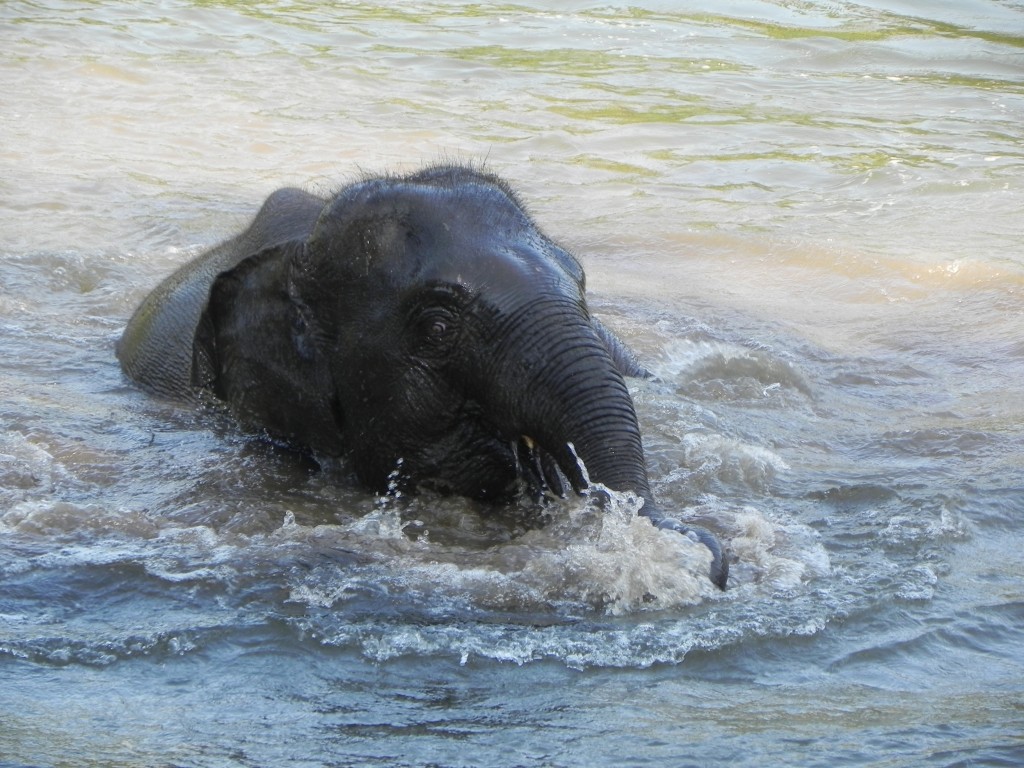
    Elephants World is a new project with several rescued elephants ranging from 3.5-year-old Jon to the two ancient wise females affectingly referred to as the old ladies. A most magnificent river runs through the property, the jewel of the place and probably the best reason to create an elephant sanctuary in this location. They do allow visitors and most are Thais, who are different from the demanding foreigners who think every elephant was born to be ridden. The Thais are rather quiet and reserved in such a public setting. They were happy to sit on a wooden tree house platform on the river’s edge and watch in silence as the elephants enjoyed a lively swim.

    While observing, we discuss the center’s plans, dreams and current challenges. The discussion quickly focused on Jon, who is a wild calf who arrived in December after losing his mom. He is quite aggressive. There is concern among the staff about how to manage him humanely. His young mahout has done well with him, but the vet hopes to teach the mahout gentler ways.

    It only took about twenty minutes before I heard myself agreeing to come back to train Jon and his mahout and to trim the elephant’s feet as well. My mind was racing a hundred miles an hour because there were so many travel arrangements to change; well, not so many — nothing is ever permanent — and I simply cannot turn down an opportunity to help hands-on, making life better for elephants.

    The staff was excited when I said I would be happy to change my plans and return; it truly is my pleasure. We discussed the corral that needed to be constructed. The mahouts were so engaged, conferring with the vet and volunteer coordinator determining exactly where it would be, the size and construction and where the materials would come from. After a bit a discussion the vet turned to me and said that the mahouts will start collecting the supplies tonight and begin to build the corral tomorrow. I was pleasantly surprised because this is not an example of Thai time. It is an example of people seriously interested in improving their elephants’ lives and knowing that things need to be done now. What could I say but, of course, I will change my plans!

  • a special day for BLES visitors

    a special day for BLES visitors

    The guests at BLES had a very educational experience today, their second day observing Mee Chok’s target training session and Pang Suai’s pedicure. In both cases they observed in silence, and later expressed sheer amazement at how relaxed and confident Pang Suai was today.  Yesterday was her first experience with the new foot trimming ramp and pedicure. It took her close to thirty minutes to walk up the ramp and settle in for her first-ever pedicure. But today, she casually sauntered up the ramp without hesitation, presenting her toes off the end like a pro.


    The guests commented on the difference in her comfort level from yesterday, recognizing that her positive experience yesterday contributed to her confidence today. Pang Suai cooperated fully, without reservation or resistance. She actually appeared to enjoy the foot trim and extra attention.

    As soon as Pang Suai’s pedicure was complete, Mee Chok and family emerged from the pond and headed toward the training corral. He was full of energy and wasted no time showing off what he had learned the day before.  Within minutes we were all in stitches watching his antics. Mee Chok was fully engaged and nearly over-the-top with enthusiasm.  Seriously over the top!

    As soon as he heard me say “telle,” he effortlessly scaled the corral and with complete control flung his front feet over the railing—the top railing! His legs were dangling quite comfortably over the railing which is higher than he is tall.

    It was the funniest sight and a most amazing display of agility. The entire group of onlookers and I were roaring with laughter, which of course fed Mee Chok’s sensational mood. He was having such fun and loving the reaction of the onlookers. But what he did next sent us all into fits of hysterical laughter.

    When asked for “kalang”(back leg), Mee Chok flung one back leg over the railing, followed instantly by the other leg, which he placed on the railing above, resulting in both his back legs sticking through the space between the horizontal railing.  Then, in one graceful continual motion, Mee Chok effortlessly walked his back legs up the rungs of railing, nimble as a spider monkey.  I could hardly believe what I was seeing: his front feet on the ground, back legs poking through the upper railings with his bum sticking high up in the air.

    It was hilarious! I couldn’t help it; I totally lost my composure and joined everyone in laughter-of-appreciation for Mee Chok’s agility and humor. Athletic only begins to describe this little man’s physical coordination; he is seriously agile. He was exhibiting unbridled enthusiasm for the game, his joy was contagious. It was impossible to take this session too seriously — Mee Chok had taken the training game to a whole new silly level!

    The guests were in awe of Mee Chok’s agility, ability to learn so quickly and his willingness, even eagerness, to engage in the training game. Each expressed their sincere appreciation for the opportunity to witness the foot trimming and training sessions. It was marvelous to hear them comment on their surprise at “how smart elephants really are,” how “after only one session Pang Suai was completely comfortable with climbing onto the ramp today” and how “Mee Chok learned so much in only fifteen minutes.”  Listening to their observations filled me with gratitude for a lifetime spent with elephants.

  • Mee Chok and Pang Suai

    Jan 24

    It’s my first day back at BLES and I am over-the-moon excited about what has taken place. As promised, Katherine had a sturdy exercise/training pen constructed and a raised concrete platform for foot trimming. With everything well in place and the mahouts briefed on the plans, Pang Suai made her way to the foot trimming platform. At first she was apprehensive about walking to the edge of the platform. Snaking her trunk over the side examining the distance between herself and the ground, she hesitated to get too close to the edge. The mahouts were fabulous, one on her neck in a position she finds familiar and another at her side reassuring her that she was okay. No elephant hooks, knives, nails or weapon were used, only patience and the talent developed over years of being with this elephant. It is an honor to work with these mahouts.

    Uncharacteristic of other elephants whom I have provided pedicures for, Pang Suai preferred that I trim her back feet instead of her front. This is unusual but I accepted her preference. After she relaxed into the back foot trims, we were able to trim her front nails and pads.

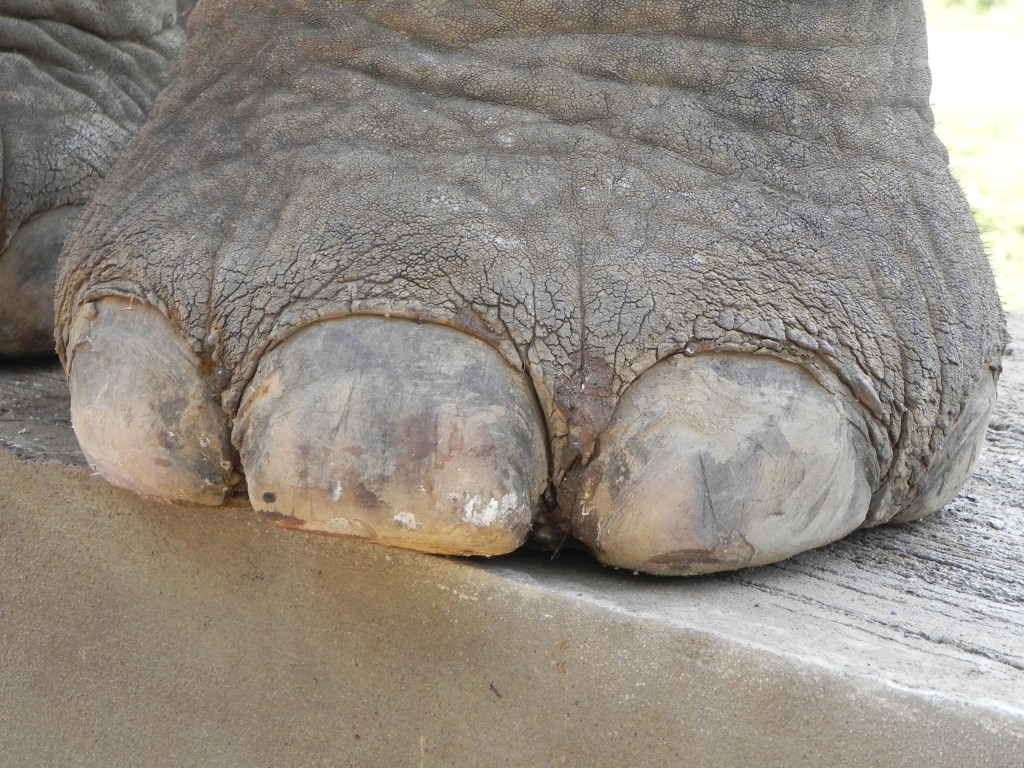
    Her pads and nails are healthy and only slightly overgrown, no cracks or serious decayed areas. Her cuticles were little overgrown but the pedicure took care of that. Like proud parents the mahouts could not stop bragging about how beautiful Pang Suai’s feet were. One mahout commented that her feet were so beautiful he would ask her to marry him!

    Still aglow from the success of the foot trimming session, I was told that Mee Chok would soon be available for his training session. With a bucket of cut bananas and a flexible target pole in hand, we made our way over to the training area. Mee Chok had just emerged from a refreshing swim in the pond with Lom and Pang Tong. All three made the gradual climb up to the empty elephant stalls. The elephants don’t stay in the stalls so it’s a bit of a ghost town with empty stalls dotting the area.

    With a little encouragement Mee Chok and his adopted family entered the stall, curious about the new enclosure. Stoic Pang Tong stayed at the far end while Lom and Mee Chok engaged in the new training activity. Mee Chok was full of energy, moving around a lot but always returning to the area of activity, which was the target, whistle and banana treats. He and Lom did well, and he started to get the idea after only 15 minutes. I did have to laugh at all the distractions, which in other training environments would be squelched — electric saws at a construction site, staff discussing their morning duties and a large delivery truck dropping off supplies. The elephants were aware and responded to the different distractions but continued to show interest in the training.

    That was the morning session, Mee Chok’s first session.

    When Kat asked how I felt Mee Chok did, I said he did well, by  the end of the session grasping the concept of the training. My guess was that he would spend the next few hours pondering the activity.

    Wow, did he ever ponder. When the family arrived for the second session, Mee Chok immediately responded to the “target” request. He had it! I pointed the spongy end of the target toward the stall and said “target.” Without hesitation, moving at a fast clip, singularly focused, Mee Chok walked right up and placed his forehead square on the target. BINGO, he got it!

    What came next was so exciting, a firestorm of activity driven by his comprehension of the game. What a joy to see Mee Chok engage in this game, so foreign but so stimulating. In no time he was striking the target with his feet at the word  “talle.” And then he decided that if one foot on the horizontal bar was good enough to get a piece of banana, two feet must be even better. Was he ever proud of himself, and I was filled with joy knowing that yet another baby elephant in Thailand will benefit from positive reinforcement training.

    The mahouts were smiling from ear to ear and giving us the thumbs ups. They could not have been more pleased. The session continued for about fifteen minutes with Mee Chok fully engaged and anxious to learn more. To say this was a good day would be an understatement!

  • Returning to BLES

    My time at BLES was supposed to be devoted to foot trimming for all the elephants and target training with Mee Chok. If I have learned anything during my travels in Asia, it is patience.

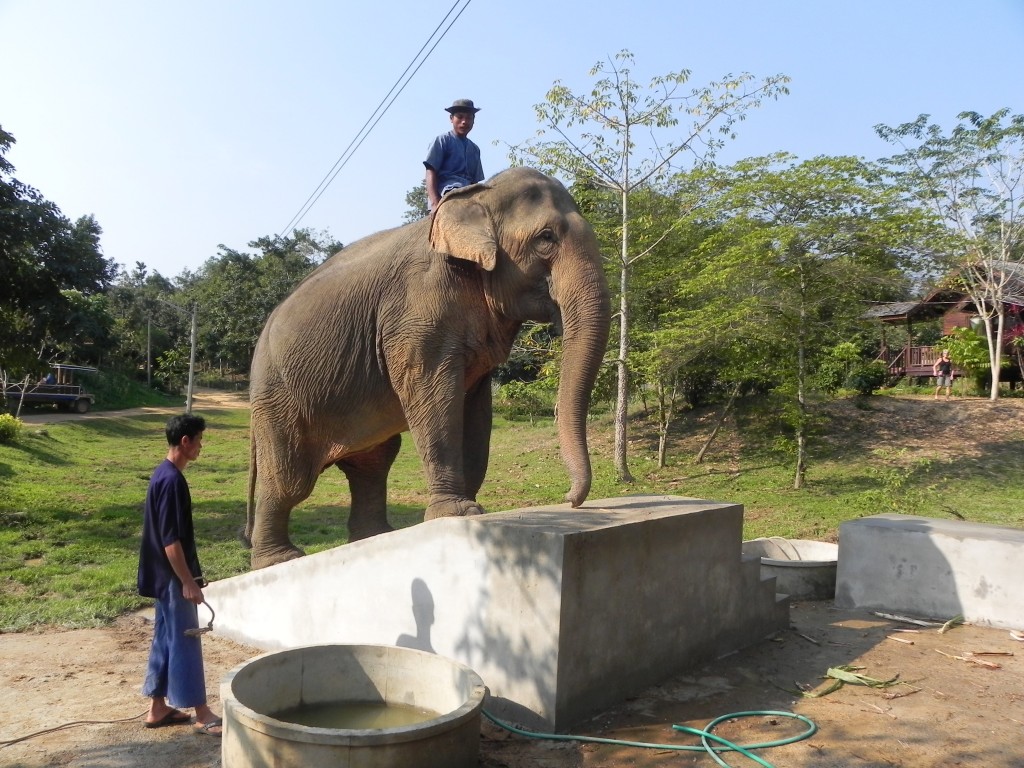
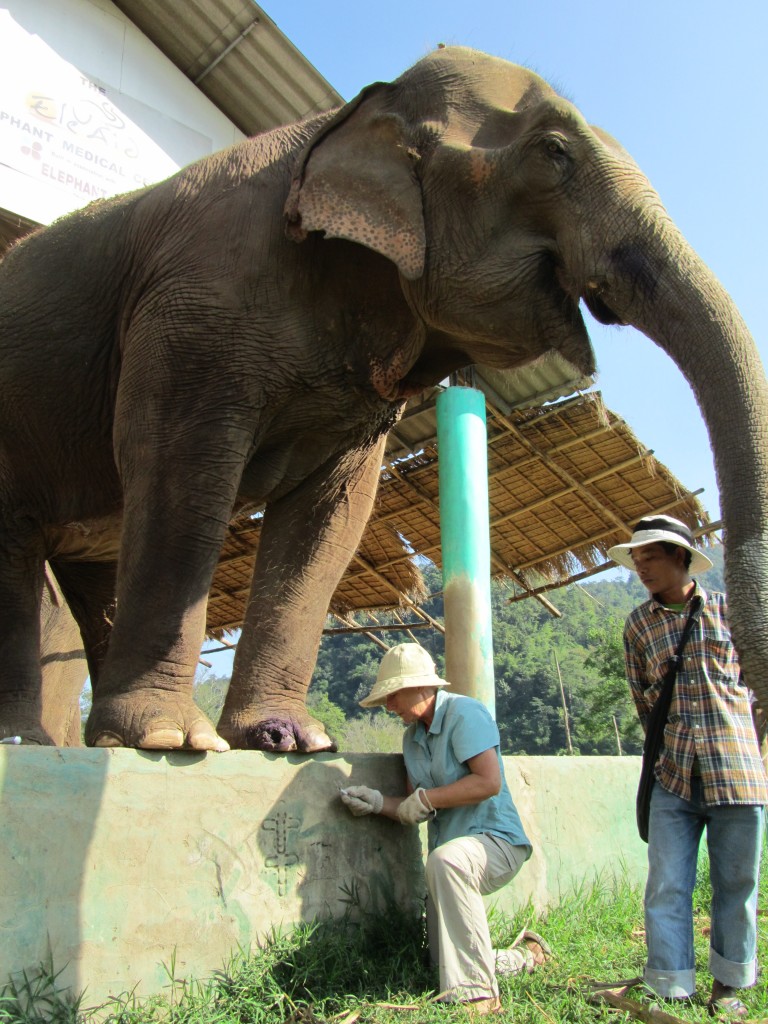
    Elephants in Asia were never trained to receive foot care, which means they don’t bend their front foot backwards at the ankle to rest it on a trimming stool. Since my goal is to avoid causing the elephants stress, I have found other ways to accomplish trimming. One way that works very well is using a ramped raised area. The elephants walk up the ramp and hang their toes off the end for trimming. It works great. The elephants do not stress and I can trim the pad and the nails.

    When I first arrived at BLES we looked around for an appropriate raised area but found nothing suitable. Kat got right on the project but it will be days before a sturdy elephant ramp can be constructed…so I will return to BLES for foot trimming.

    My other purpose for going to BLES was to introduce Mee Chok to target training. Everyone was quite excited about the prospect. Mee Chok is a wonderfully docile calf with a loving family in Lom and Pang Tong, the ever protective matriarch. He has never been confined or chained since he’s been at BLES but we needed to create a fenced area to contain him during training.

    Well, this was quite comical. The mahouts got right on the project and converted an open air stable into what resembled a boxing ring with ropes and chains strung horizontally to create a barrier.

    Unfortunately it did not work. Lom wanted in with Mee Chok, who had no idea that the goal was for him to stay inside. Mee Chok was not nervous but he thought it was by accident that he had become separated from his family. He effortlessly climbed over the barrier, causing the mahouts to burst into laughter. The mahouts’ reaction is so refreshing. They do not begrudge the elephants for acting like elephants and using their superior intelligence to problem solve.

    So, before we can start working with Mee Chok a corral needs to be erected. Once that is in place I will return to BLES, not only to provide foot care but also to instruct the eager mahouts on how to use target training with Mee Chok and the other elephants.

    My time at BLES was not wasted. I was able to spend time with Kat and Anon hiking the new land they want to buy and learning about their plans for land expansion, fencing and the release of many of their elephants into a semi-wild, chain-free environment. I am in awe of the direction BLES is moving, a direction that definitely puts the elephants first.

    I look forward to my return to BLES and want to thank all of you for making it possible for me to provide these services to elephants in Asia.

  • Being With The Family

    My days are filled with shadowing the “family” in the habitat and doing foot trimming and target training. I am having a blast! It really is a gift to be able to focus solely on these limited responsibilities. Even though the days are long, each brings immeasurable rewards.

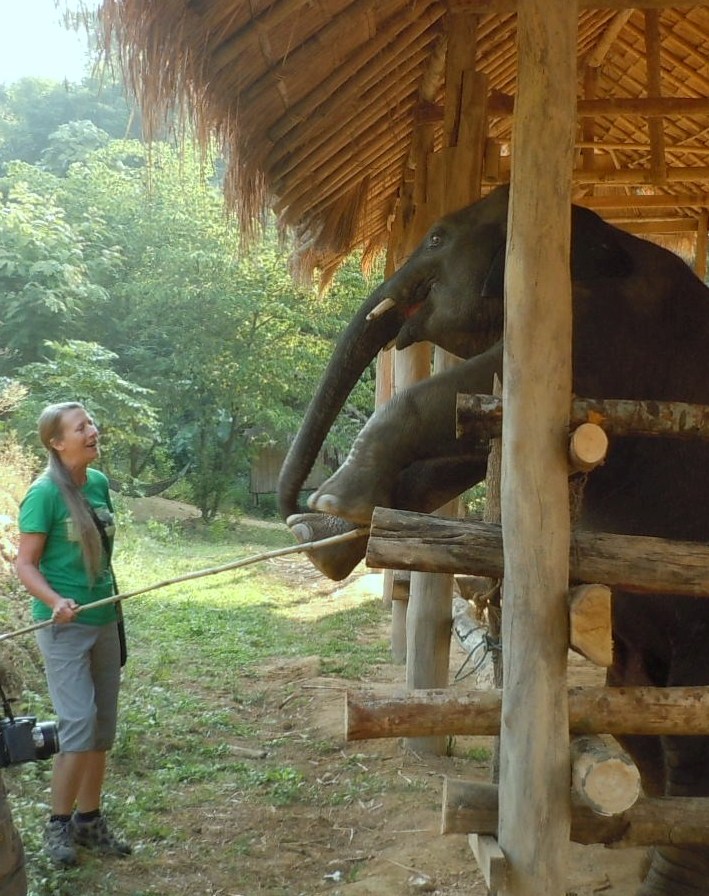
    Target training has really caught on. Now all the family members are joining in. It is so much fun to play the training game with a wall of eager students, ranging from senior citizens to calves. It is a riot as they jockey for the prime spot and the opportunity to respond to requests for their feet, ears, forehead and side. They all excel at moving their side into the target — it is so cute. Once they understand the request for side, they respond with a quick movement, leaving their front feet in place and swinging their hip around to make contact with the target. When they are all competing for a turn it is like a chorus line of feet and ears. What a joy!

    Getting to know the family is an unexpected experience, one I cherish deeply. Today I felt a sense of belonging to an elephant family again as I moved along with the herd, like a ripple in a stream, flowing together effortlessly across the pasture. I had not inserted myself into the family because my time here is limited, but today I felt that unnamed energy that is elephant, all inclusive, the matriarchal collective, being part of a loving family. I soaked in the acceptance they radiated, grateful for each one of these magnificent individuals.

    Later I met two new Park residents, grande dames I had not had the pleasure to meet before. Much patience was required because they were so frightened by the idea of having their feet touched. The mahouts did their best to reassure them and, although I didn’t complete a full manicure, we made some progress. A little at a time — fine, I am in no hurry. My goal is for these elephants to know that when they come to my pedicure salon they will be treated kindly and with respect. If they leave without experiencing a pedicure, that is okay.

  • the ENP pachyderm pedicure clinic is open

    the ENP pachyderm pedicure clinic is open

    Nineteen elephants at ENP have been identified as candidates for foot care. The schedule is set to provide pachyderm pedicures at the hospital building twice daily.

    When I was in Thailand last June I did a great deal of foot work on Mae Kham Geao.  Her nails were abscessed and pads sloughing. She was confined day and night to the hospital area with little opportunity to walk and bathe herself. Fortunately I was able to convince the veterinarian to give Mae Kham Geao and her best friend Mae Tee unrestricted daily access to the pasture and river. The results were fabulous.

    It was a pleasure to see the improvement in Mae Kham Geao’s feet and her confidence in receiving her pedicure. Her pads are supple and healthy. Her nails are no longer infected but they had four months of over-growth that needed to be trimmed away.

    Mae Kham Geao’s mahout, Dame, is a kind and experienced caregiver. His interest in foot care has grown in my absence. After a few minutes of reviewing the procedure, he picked up a rasp and began to trim his elephant’s feet. His initiative and confidence will have an influence on the other mahouts, a real plus in the training process.

     My foot care client for the past two days has been Jun Peng, a wonderful older female, who nearly sprinted up the ramp of the concrete loading dock being used as a foot-trimming platform. A basket of freshly cut produce was all that was needed to entice her to present her feet for trimming.

    Jun Peng was a perfectly lovely client, calmly standing in place for more than 30 minutes each session. Her nails were quite overgrown but very healthy. The pads of both front feet showed signs of past trauma but no new problems.

    Tomorrow’s pachyderm client will arrive at the pedicure clinic at 10:30 am. I am excited to see who she is.

  • foot care kits

    THANK YOU to everyone who helped us reach our goal to underwrite 40 elephant foot care kits! In less than 48 hours following the challenge from an EAI supporter, you did it — you reached the goal! I am seriously impressed! You met this need with such generosity and enthusiasm.

    Mahouts are people of few material belongings, yet they shoulder a huge responsibility for the elephants in their care.  Your support demonstrates a genuine appreciation for their work and is sincerely appreciated by the mahouts, me and everyone affiliated with Elephant Aid International. It’s not appropriate for me to speak for the elephants but I am sure it’s safe to say they appreciate your support as well.

    Since everyone seemed to enjoy the chipin challenge so much, I will make sure that our most urgent need is always posted with a chipin challenge on the EAI site.

  • Mae Tee and Kham Geao

    July 5th

    The past week has been humbling, filled with joy and gratitude. Upon the vet’s return from a trip to Cambodia, the first thing on his agenda was a crash course in foot trimming. I had been waiting for the opportunity and was honored to be invited to provide a workshop.

    Most of the elephants at the park have no need for foot trimming. They walk in the lush grass, wade in the brisk moving river and graze through varied substrate all day. These activities keep their pads and nails naturally trimmed.

    But Mae Tee and Kham Geao are aged and arrived at the Park with stiff wrists as a result of injuries from their logging days. Before my arrival, these two ladies had been spending extended periods inside the hospital yard, which resulted in a reduction of physical activity. Upon evaluation, it was determined that along with foot soaks and foot trims, both elephants would benefit from free-choice access to the habitat. Now they will spend as many daylight hours as they wish, out in the pasture grazing and bathing with the other elephants.

    After a short conditioning period, both elephants were voluntarily participating in medicated foot soaks and pedicures. The mahouts, painfully shy and unable to speak  much English or Thai, struggled to understand the directions at first. But the elephants demonstrated that they could easily understand “the whistle and banana game.” Soon the mahouts began to understand as well; in fact, very well, to the point that very little direction needed to be given.

    Most of the communication was through body language and the mahouts soon understood what I needed the elephants to do in order to trim their feet. In no time the elephants and the mahouts were fully engaged in the procedure.

    Foot and nail trimming has always been one of my favorite activities. It is so rewarding to have the elephant voluntarily cooperate. Elephants quickly seem to understand that I have no intention of hurting them. Their comfort level is my priority. With mahouts handing pieces of banana to the elephants for standing in place, the elephants settle in and allow me to trim away overgrown pad and nails.

    The challenge for me is to find what combination of position, pace and human participation provides the atmosphere that allows the elephant to relax enough to cooperate with the procedure. When it all comes together resulting in the elephant standing still for an extended period of time, I am overjoyed. I can’t help but be seriously proud of the effort made by the elephants. I feed off elephants wanting to be cooperative participants.

    I think what I find most rewarding is that the elephants are permitted to engage or not. It is their choice. At first the mahouts thought they needed to ensure that the elephant stayed in place. But soon they understood time-outs are important, not as punishments but as a sign of respect for the elephant’s needs. The mahouts also saw that the elephants returned in moments, to get more bananas of course.

    After a few days the mahouts really became engaged. They would be waiting for us when we arrived for foot trims. Beaming with pride for their elephants, the mahouts started asking if I would come back later that day or the next day for more trimming. On the day before my departure I told them that I would not be back tomorrow. I was touched at their response. These mahouts, guarded when I first arrived, were now very willing to allow me to help them care for their elephants.

    Mae Tee, Kham Geao and their mahouts have enriched my life with their acceptance of my assistance. The vet seemed to enjoy the workshop as well.

  • So Much To Learn

    May 17

    I have spent the past several days traveling with Dr. K.K. Sarma, Ph.D., and his team of skilled veterinarians, assistants and driver, to various elephant health camps in Assam. I have seen and learned so much. The experience gives me hope for the elephants in this region.

    Dr. Sarma is an Associate Professor in the Department of Surgery and Radiology at the College of Veterinary Science, AAU Khanapara, Guwahati, Assam, India. Spending time with such a dedicated professional has caused me to realize that although we may be spread across this planet, elephant caregivers share the same mind, the same vision: a more humane and healthy existence for elephants.

    Years ago, I held a hardline opinion against providing assistance for elephants held in captivity in Asia. But several years ago my opinion changed as I came to believe that regardless of how I feel personally about the deprived life captivity provides, elephants suffer in captivity and require our assistance. A person who influenced my change of mind was Mr. A. Christy Williams, who at the time was completing his studies focused on wild elephant populations in the Northern National Parks of India.  After being much impressed by Christy’s work I decided that The Elephant Sanctuary should do what we could to initiate a pilot program to assist privately owned elephants in need in Asia. We collaborated with Christy and later Dr. Sarma to create a Mobile Veterinary Care program in Assam.

    This program has been supported by the Sanctuary for years. It has been seriously successful thanks to Dr. Sarma’s expertise and dedication to elephant health care. You can always tell a true elephant devotee — they will drop everything at a moment’s notice, at great cost to themselves and their bank account, to assist a needy elephant.

    About five years ago, Christy informed me that Dr. Sarma’s camps were increasing in demand. He was traveling great distances on a regular basis and Christy felt that a valuable addition to the project would be a reliable vehicle. Not only was Dr. Sarma not being paid for his services, he used his own vehicle for travel. Christy wondered if the Sanctuary would consider entering into a formal agreement to support Dr. Sarma’s work for another five years.

    This request came at a time when the Sanctuary was experiencing increased support as result of the National Geographic documentary that featured the reunion of Jenny and Shirley. This proposed commitment by the Sanctuary would require a large upfront expenditure to purchase a four-wheel drive vehicle for the mobile veterinary care work. I saw this commitment as a way of paying forward the support we were experiencing. There was no question in my mind that the Sanctuary was well advised to increase our support of Dr. Sarma’s important service.

    In addition to setting up elephant health camps, where elephants arrive en mass at a predetermined location, Dr. Sarma tends to individual elephants whenever called upon.  Over the 20 plus years that Dr. Sarma has provided free veterinary care to the elephants of Assam, he has developed a well-deserved reputation. His work is extensive; he assists as many as 400 elephants in this region, resulting in a wealth of experience. On any occasion possible, time off or after hours, you will find Dr. Sarma in pursuit of better health care for the elephants of Assam. Teaching at the Veterinary College is his profession but caring for the elephants of Assam is Dr. Sarma’s passion.

    Attending three days of scheduled camps and a bull recovering from partial paralysis of the left side of his body has meant driving great distances. From Guwahati we drove to our first camp in Lamari, then Satsimalu, and then Biswanath Chariali in the Sonitar District. Driving through the countryside of Assam plays tricks on me because it looks and feels just like the landscape of Hohenwald, Tennessee. This elephant country with its lush vegetation, humidity, streams, rivers, pastures and forest lands is a mirror image of The Elephant Sanctuary. I do wonder how I found the pearl of place in America that so resembles and perfectly fits the needs of Asian elephants.

    This past week I have been fortunate to document Dr. Sarma and his team attending to forty-four elephants…so far: calves, datals (tusker), maikis (mikee) females, and makhanas (mock-naw) naturally tuskless males, ranging from a few months of age to 60 years. The camps are well organized, well attended and attract more than the elephants it is organized to help. The locals come out in droves and, unlike any public gathering I have ever observed involving elephants, all of the bystanders are respectful, quiet and reserved.

    The level of respect shown to the elephants, their mahouts and the veterinary team was an eye opener for me. Imagine close to 20 elephants, many of them mature males, gathered in an area half the size of a football field. Each elephant is assigned a number. When their number is called, the elephant and mounted mahout jockey into place. Other elephants, some riderless, left untethered and munching on cut banana trees, shift to make room for the next patient.

    As result of the elephant gathering, a sea of local people congregated to watch the open-air clinic. At first I was concerned about the crowd of people but quickly noticed that they respectfully keep their distance. Not once did a person, adult or child, need to be reprimanded for getting too close, becoming a nuisance or teasing an elephant. This phenomenon alone caused me to look on the people of Assam in admiration.

    In this culture the elephant is a god, which may begin to explain the respectful attitude I observed.  But it is more than that. As time passed some of the village children and men would move in closer, especially when an elephant reclined on its side to receive an injection or have the foot pads examined. Crowded around in complete silence, their curiosity was palatable. Although shoulder to shoulder, watching intensely, they were never in the way.

    At the camps a full body examination is conducted. Eyes are checked, fecals done and any wounds or problems discussed and treated. In the case of logging elephants, the mahouts provide details about any trauma or accidents that their elephant may have sustained during the course of their work. The mahouts are very engaged in the discussion about their elephant’s health and appear completely receptive to recommendations made by Dr. Sarma and his team.

    Surprisingly, contrary to what I had expected to find, the elephants appear healthy, in good weight, calm and cared for. I saw little of the scarring and wounds I feared I would see. According to Dr. Sarma, the biggest problem he encounters is parasites. Thanks to the trust he has developed with the mahouts and owners, Dr. Sarma is allowed to provide worming medicine, inoculations for tetanus, Vitamin B shots and mineral supplements.

    At one of the camps, three of the elephants were pregnant. The Phandis of these mothers-to-be proudly posed for a photograph, displaying the bag of mineral supplement provided by Dr. Sarma. Even though each man remained silent, their faces could not hide the pride they felt for their elephant.

    The elephants of Assam have an obvious advantage over elephants living in captivity in other areas of the world. These elephants, although in human care, live in wilderness areas. They spend the majority of their time grazing and foraging on natural vegetation, walk and sleep on natural substrate and are sheltered from the sun by the forest canopy. With the exception of the privately owned elephants who are taken to neighboring countries for logging, the elephants of Assam are not overworked. Most are used for anti-poaching patrols of the national parks to protect not only rhinos but other treasured and endangered animals.

    Participating in Dr. Sarma’s health camps have caused me to consider what more we can do to help him help the elephants of Assam. I am thinking that a small laboratory would be a welcome asset. It would not need to be lavish; just the basics would enable Dr. Sarma and his team to do even more. Fecals are done in the field but blood must be transported back to Guwahati to be processed. Given his own lab, I believe Dr. Sarma would be able to conduct additional non-invasive testing in a timely manner, all under his direct supervision.

    When I get access to internet where I can upload photos I will.

    Namaste