Category: Mahouts

  • Why do mahouts ride on their elephant?

    Why do mahouts ride on their elephant?

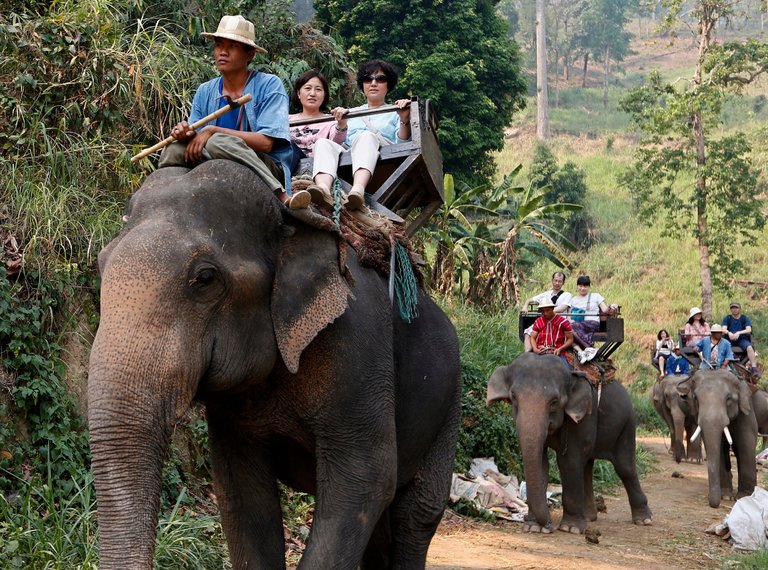
    Mahouts ride bareback on their elephant for safety reasons. Please read the post in its entirety to understand that anti poaching patrol elephants working in Chitwan National Park, Nepal, live a much different life than elephants living in tourist parks in other parts of Asia. We engage in welfare improvements wherever captive-elephants live.


    Many of you ask why mahouts ride on their elephant on anti poaching patrol in Chitwan National Park, Nepal. You say, “set them free.”

    Elephants are not domesticated, no matter how well trained, cooperative and well behaved they may be.

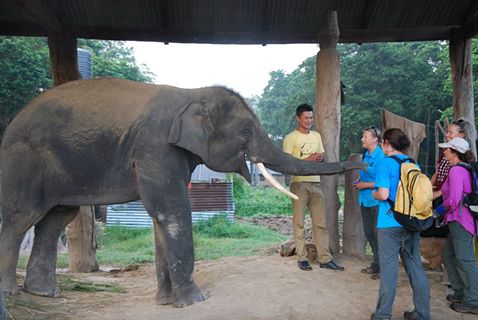
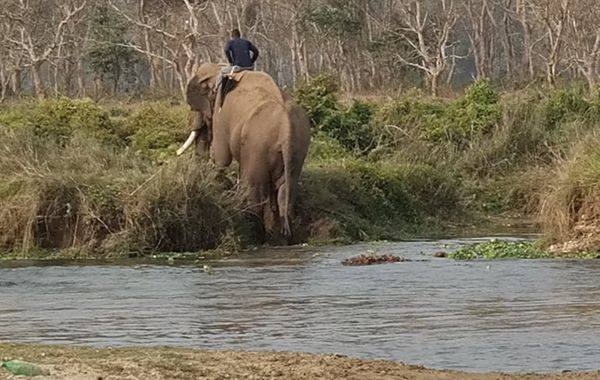
    In the Western world elephant trainers position themselves on the ground. In Asia mahouts position themselves on the elephant’s back.

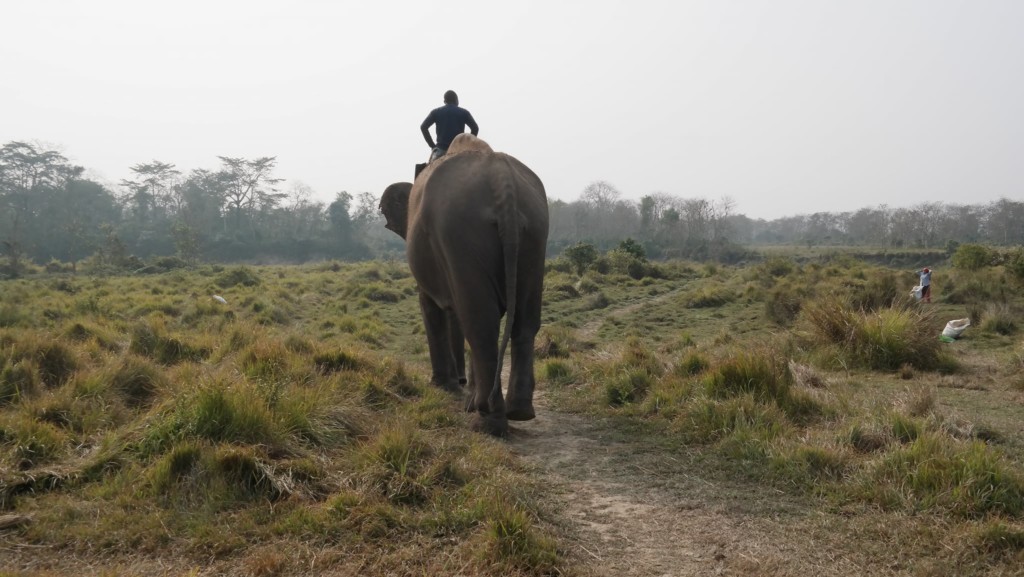
    Being on top of the elephant, as opposed to being on the ground next to the elephant, provides a degree of protection from an aggressive elephant. Also, from this vantage point the mahout can more easily detect wildlife dangers and protect innocent bystanders who potentially could be harmed by the elephant.

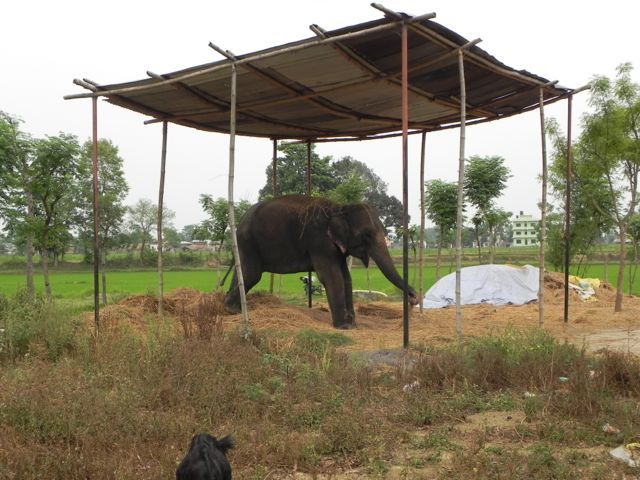
    mahout riding elephant in asia
    Look to the right in this photo. There is a village woman collecting grass for her livestock. She is extremely vulnerable being on the ground. If elephants were allowed to wander unattended, people would be in danger.

    In order to provide a shared environment where elephants are allowed access to the natural habitat of the Park, and humans can collect the resources required to sustain themselves, elephants are ridden.

    The alternative is that elephants remain on chains, which is something none of us want, including the mahouts and the villagers who share this landscape.

  • How to Be a Responsible Ele-Tourist

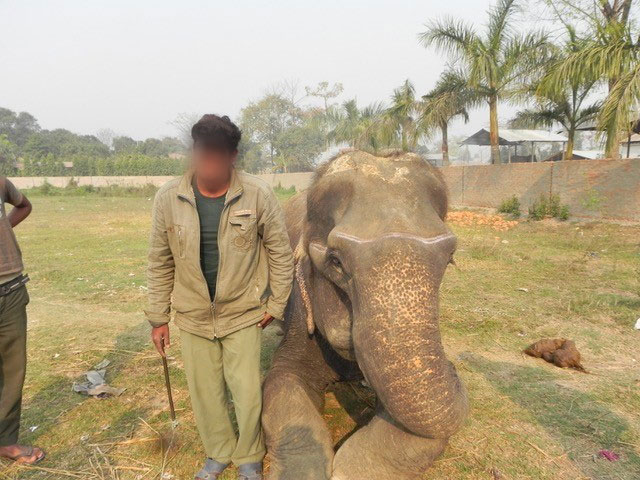
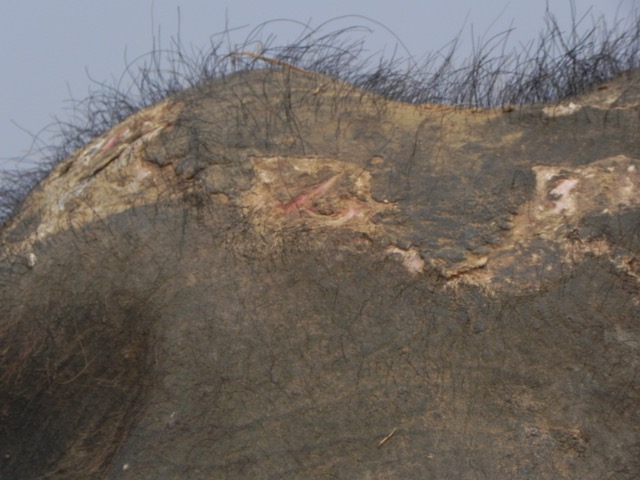
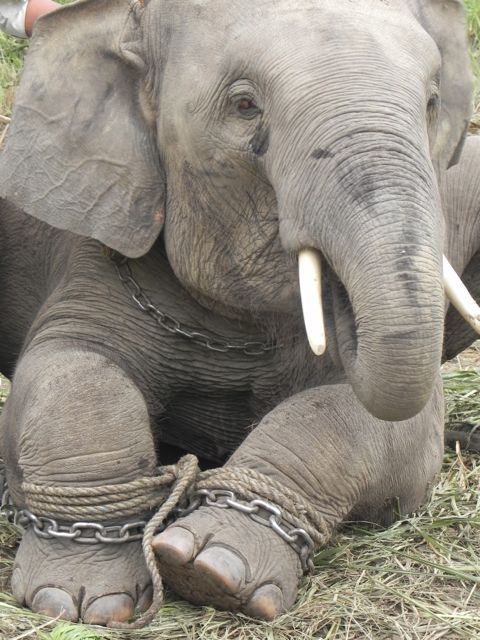
    These photos of captive-held elephants in Asia are not unique. I am posting them to document what happens when an elephant is struck on the head with a stick, ankus (elephant hook), axe or other weapon. They illustrate how these elephants suffer for the tourist industry.

    The practice of hitting an elephant on the head with force is traditional across Asia. Abusive dominance is believed to be the only way to control an elephant. It is the form of dominance and punishment taught to and expected of mahouts (handlers).

    It’s easy to blame the mahout but, if we do, that blame is misplaced. Mahouts are poorly educated and paid, low-status workers. According to the cast system, if they want to work , they do what they are told, without question.

    It might be hard for us as westerners to comprehend such blind obedience but in many Asian countries, it is expected of low-status citizens.

    Tourists are key

    Rather than blaming the mahout we should look hard and long at those who control the mahouts — elephant owners and supervisors — and those who finance the system, tourists.

    Yes, tourists are key. Tourists pay to get close and interact with elephants. In many cases, unscrupulous supervisors and owners force mahouts to allow the dangerous interactions tourists want, making the mahout responsible for their safety.

    I have witnessed many examples of young children of higher social standing demand that a mahout allow them to interact with his elephant in a dangerous manner. The mahout and his elephant are required to oblige their whims. These privileged adolescents will even strike the elephant and mahout with a weapon to demonstrate their position of power.

    Hitting and striking

    The mahout is required to keep his elephant under control at all times. When an elephant does not respond quickly to a command, the mahout is, by training, required to strike him/her forcibly with a weapon across the bony surface of the forehead.

    Hitting an elephants’ skull with force causes a thunderous noise and vibration inside the head, as well as physical pain.

    Repeated hitting causes tissue damage. After several harsh blows, the tissue is irreversibly damaged. It abscesses, dies, rots away, scabs over and then sloughs off, leaving a light colored scar.

    An elephant’s physical response to injury is no different from that of humans’. The process from injury to scar takes weeks, during which time the elephant is suffering painfully.

    No research has been conducted to evaluate the damage done to an elephants’ brain by beatings and subsequent infection. It is known, however, that mammals can contract encephalitis from a brain infection.

    What you can do

    When you travel in Asia you’ll see that most elephants used in the tourist industry have wounds and scars from being beaten. The abuse is driven by tourists’ desire to interact with elephants, requiring mahouts to use force to control their elephants during the interactions.

    Here are three ways you can reduce the suffering of captive-held elephants and contribute to change:

    • Eliminate elephant rides, bathing, painting, entertaining, selfies and hand feeding from your bucket list. If you refrain from direct contact with an elephant, the handler has no need to abuse his elephant to accommodate and protect you.

    • Educate friends and family who plan to visit Asia about the how elephants are used in the tourist industry.

    • Support only organizations that offer ele-friendly programs. Ele-friendly programs prohibit direct physical contact between tourists and elephants. Instead, they allow you to observe the elephants from a safe distance as they go about their daily routine.

    If you or someone you know is preparing for a trip to Asia, there are a few organizations that provide ele-friendly programs: in India, Wildlife SOS India; in Thailand, Boon Lott’s Elephant Sanctuary and The Mahouts Elephant Foundation; and in Nepal, Tiger Tops and the Association Moey.

    An informed tourist is a responsible tourist.

  • Are Mahouts to Blame for Elephant Cruelty?

    Are Mahouts to Blame for Elephant Cruelty?


    Revisiting an important blog, posted by Carol. Are mahouts to blame for elephant cruelty? Not necessarily. Mahouts are underpaid, devalued, and lack education for caring for elephants. We don’t place blame on the mahouts – we give them the tools and education to make a positive difference in the lives of elephants.


    In addition to the large numbers of illegal poaching, legal poaching is a concern in some areas of Africa. Currently, elephants are fleeing from Namibia, Zambia, and Angola – where elephant poaching is legal – to Botswana’s Chobe National Park. Elephants fear for their lives and are forced to find safe areas for refuge. Click here to read more.


    We are so grateful for The Animal Rescue Site and the generous donor who set up the fundraiser for fencing for ERNA. Each donation is DOUBLED for the greatest impact. Thank you to everyone who is supporting and contributing to this helpful fundraiser.


    Due to the elephant poaching pandemic, reports have shown that 98% of female elephants in Addo Elephant National Park in South Africa are tuskless. Researchers fear that the entire species of African elephants will eventually be born without tusks – leaving them safe from poachers, but defenseless to natural threats.


    Last Tuesday, people all over the world donated to charities and causes to add a touch of philanthropy to the holiday shopping season. In honor of Giving Tuesday, please consider donating in support of Elephant Refuge North America — to help provide a home for elephants to thrive. Donate today at: elephantaidinternational.org/support

    Are you shopping on Amazon this holiday season? If so, please consider using AmazonSmile in support of Elephant Aid International. When you shop at smile.amazon.com and select EAI, the AmazonSmile Foundation will donate 0.5% of your purchase price to EAI. Give gifts to your loved ones while helping elephants in need. You shop, Amazon gives, and elephants smile!

  • TripAdvisor no longer makes money off animal suffering

    TripAdvisor no longer makes money off animal suffering

    11tripadvisor-animals-master768Making steady progress for animal welfare: TripAdvisor to Stop Selling Tickets to Many Animal Attractions.

    14615856_1286567708040254_7526071632518963441_oThe progress in Nepal is driven by the mahouts’ willingness to learn how to provide better care for captive elephants.

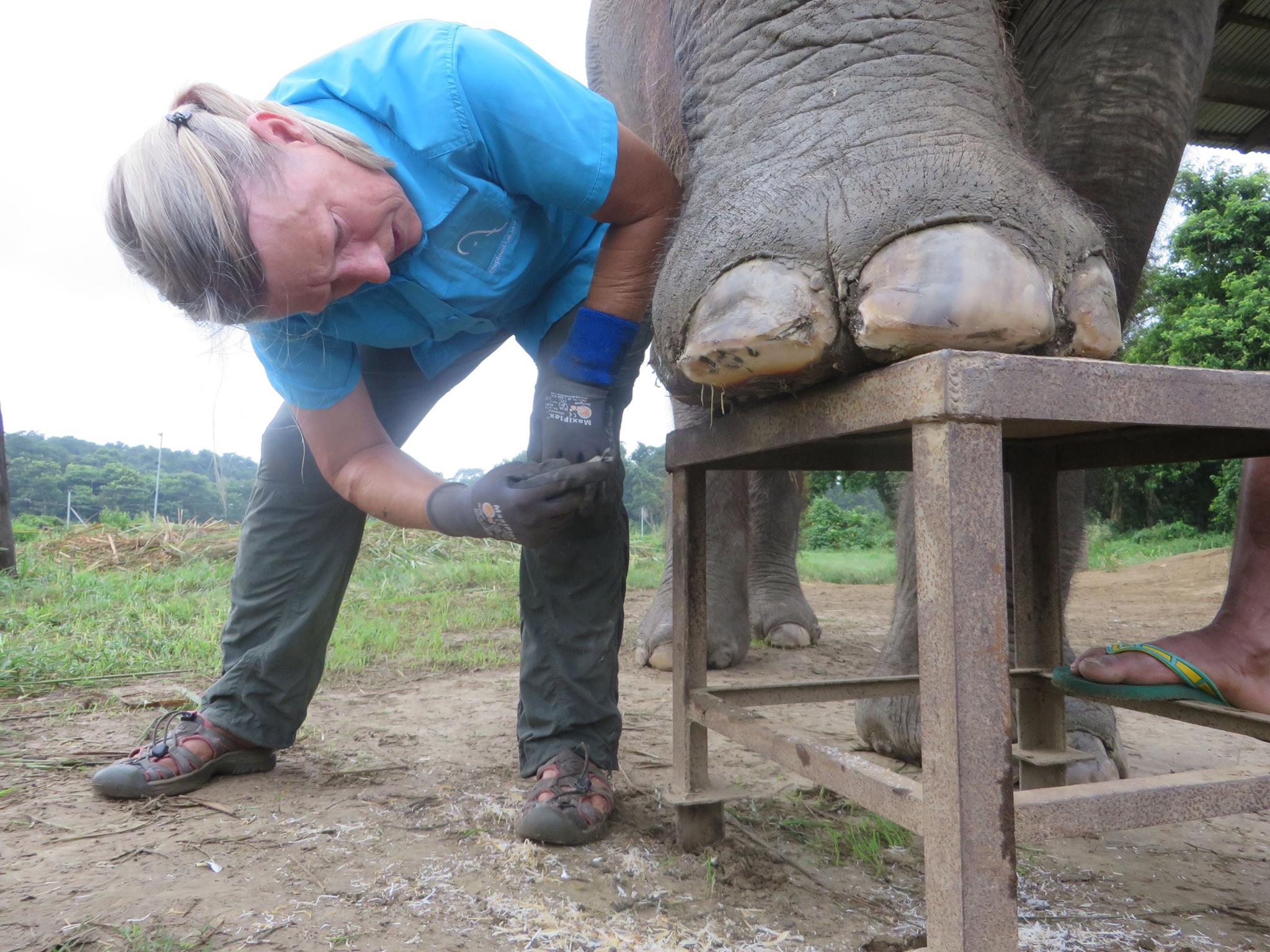
    14566427_1286789894684702_1653308219345432894_oFoot disease is epidemic among elephants living in captive environments. Captivity-induced foot diseases among these long-lived beings can lead to physical collapse and death. Proper elephant foot care is vital for elephant health.

    14650303_1287513497945675_8147598989740765811_nIf we want a future of compassion toward elephants, we must teach our children to care for all creatures.

    14707902_1288403497856675_4883728828528651954_o28 DAYS UNTIL CLOSING! Only four weeks remain until the finalization of the ERNA land sale, and the elephants still need your help. Even the smallest contribution allows you to personally support the elephants in need of an environment to thrive. Donate today!

    14724476_1289593234404368_7665143081699443228_nAnother incredible picture of a sweet elephant from Nepal.

  • The Measure of Success

    The Measure of Success

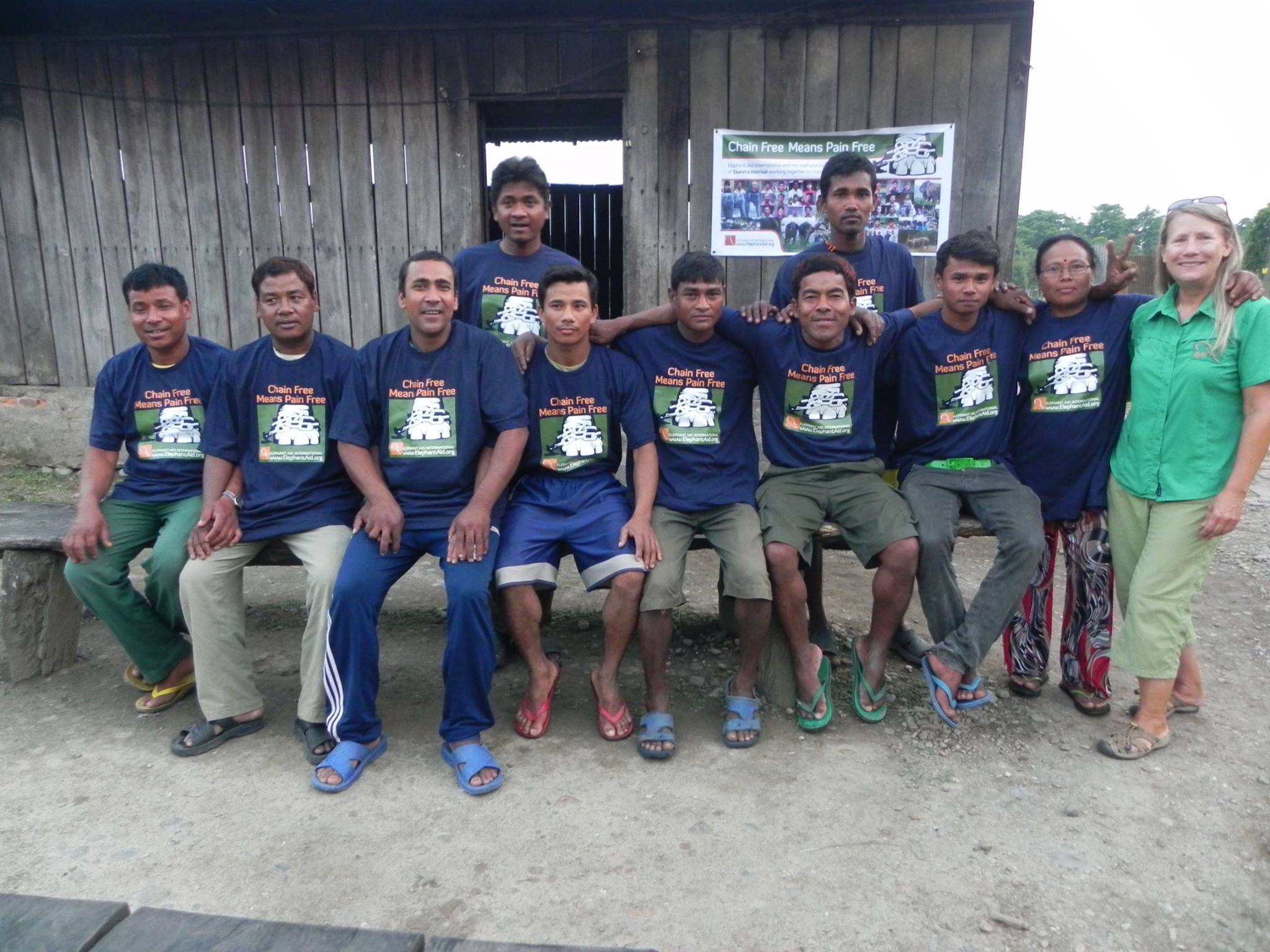
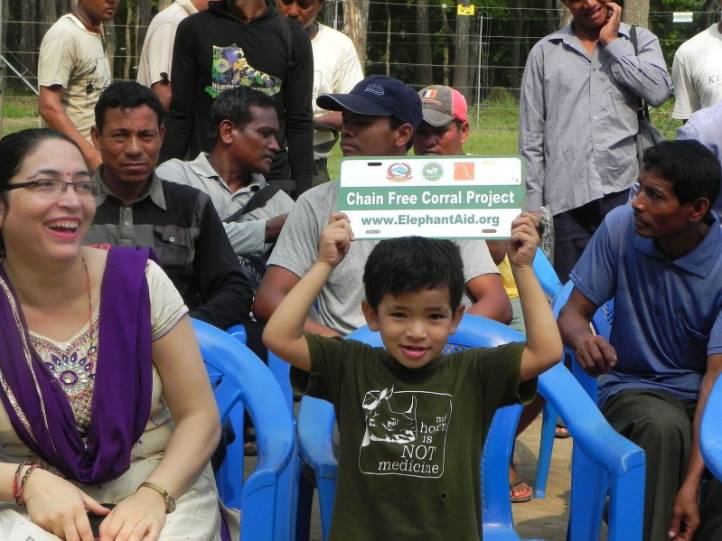
    EAI’s Chain Free Means Pain Free project, which frees elephant from chains is the first of its kind in Asia. Honestly I was surprised to learn that such an effort had never before been attempted for the thousands of captive-held elephants used in the tourist industry all over Asia.

    Solar powered high tensile wire fencing is a simple and relatively inexpensive solution to the decades-long practiced of chaining elephants to a stake in the ground.
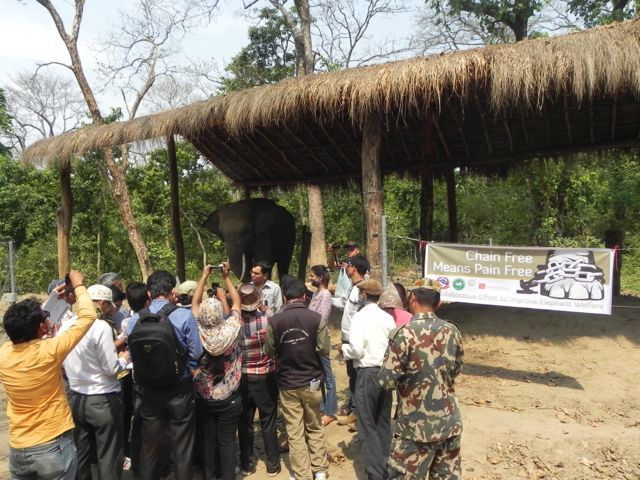
    Nepal chain free done Apr 2015

    When our Chain Free Means Pain Free project was completed in Nepal in April 2015, I breathed a sigh of relief and felt flush with appreciation for what we’d accomplished.

    It was not an easy project, working in remote areas, many times with no means to transport fencing materials, except on our backs. We crossed rivers, hiked through miles of jungle and dealt with hostile locals who saw the areas selected by the government for elephant corrals as their domain.

    And then there were the naysayers, people incapable of embracing change, who made progress slower than necessary.

    But through all the trials and tribulations, downpours, leaky roofs, river crossings, miles hiked in the searing heat and skeptics, we prevailed, creating corrals for 54 elephants and releasing them into their personal chain-free sanctuaries.

    Without exception, introductions to the corrals were a phenomenal success, including for a few adult males with long tusks. Why not? The elephants clearly understood the freedom they were being given. Freedom and autonomy are great healers for a soul enslaved for decades. Each, without hesitation or concern, melted into the lush habitat that was their new home.

    Mahouts feared change

    Before their elephants were released from chains, the mahouts lost sleep, fearing that their elephant would take advantage of the freedom and become feral.

    The consistency of the their fear surprised me. I naively assumed that mahouts knew elephant behavior and understood that freedom from chains reduces stress, which results in the elephants relaxing and becoming more cooperative. But they thought the opposite.

    It was from this experience, repeated with every mahout, that I learned how little mahouts actually know about elephant psyche and behavior.

    Hours spent in the hattisar (elephant stable) with the mahouts and the elephants taught me that most mahouts do not recognize an elephant’s most characteristic behaviors, such as playing, socializing, bonding and grieving.  Mahout knowledge is limited to how to control an elephant and avoid getting killed. So much of what they think they know is superstition and folklore.

    The first time the mahouts observed an adult elephant playing in her new corral they panicked. The mahouts wanted to stop her, control her, because they thought she was becoming aggressive. Awareness of an elephant’s emotional life or physical suffering is not something they are taught. Even minor physical problems are ignored until they become serious and require veterinary attention.

    Different approach to unchaining pays off

    As result of the time I spent observing the mahouts with their elephants, I realized I needed to approach the unchaining process differently. I needed to teach the mahouts about their elephants—their behavior, fears, likes and dislikes—and explain why unchaining affects elephants in a positive way.

    This approach paid off. Even though some mahouts remained skeptical, most felt more confident in my promise that their relationship with their elephant would get better, not worse.

    No success without sustainability

    Another lesson I’ve learned though our Chain Free Means Pain Free project is that we must build sustainability into foreign projects.

    It is not enough to provide a great product with stellar results if the locals are not able or willing to sustain it.

    I returned to Nepal eight months after completing 54 chain-free corrals to find that few were actually still functioning and being used. I was devastated.

    It seemed incomprehensible that minor repairs were not even attempted. In some cases, fully functioning corrals housed elephants on chains!

    But I knew there had to be a solution. I simply would not give up. Sustainability is the measure of success and I was determined to keep these elephants off chains.

    EAI hires Nepali manager

    Last November, thanks to generous underwriting from supporter Donna Marshall, EAI hired a manager for our projects in Nepal.
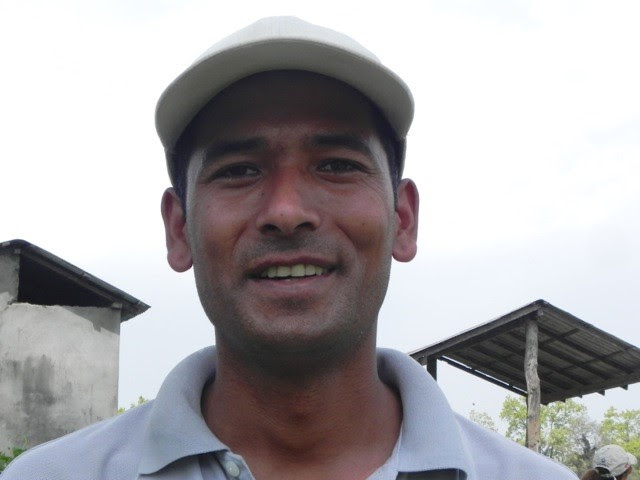
    Kulendra Kunwar

    Kulendra Kunwar, a native Nepali, was well known to EAI prior to being hired. He’d volunteered in the spring of 2015 during corral construction at the largest hattisar in Khorsor. He proved to be a valuable asset then and the perfect manager for our project now.

    In just a few short months, thanks to Kulendra’s ability to repair corrals and educate and motivate the mahouts, 14 out of 15 hattisars now have corrals that are fully functional.

    Of these 14 hattisars, all but two keep their elephants chain free 24/7. Those two keep their elephants chain free during daylight hours but, due to fear of the area’s poisonous king cobra snakes and tigers, the elephants are chained close to the home fires of the mahout housing at night.

    New mahout housing means chain-free elephants

    There is an easy solution for the two hattisars (Sukivar and Khoria Mohan) that fear the poisonous snakes and tigers.

    Currently, the mahout housing—a simple two-room wooden shack, outhouse and outdoor cooking area—is several hundred yards from the corrals.

    If we raise the funds to build mahout housing adjacent to the corrals, the elephants will be left off chains 24/7.

    Our goal is to raise $16,500 for improvements at the two hattisars. As soon as the funds are raised, housing in both hattisars can be built and the elephants can once again be left chain free 24/7. If you would like to donate, you can do so here.

    I am quite the optimist, dogged about my dreams. Hard work and seemingly impossible challenges don’t scare me off, although I do wonder why some things have to be so difficult. Then I remember that there is Nepali time and there is U. S. time, polar opposites in many ways. But there is never a time to give up.

    Please join me in continuing to dream the dream that releases elephants from chains, reunites loved ones and changes culture to benefit captive-held elephants and the people who care for them.
  • Elephant Slaves

    Elephant Slaves

    Another predawn awakening, like a recurring dream.

    I’m woken abruptly from a deep sleep by the heart wrenching cries of a suffering elephant. All I can do is swing open my window and yell into the pitch black night, “Hatti la na pita!” (Don’t hit the elephant!). My plea echoes through the darkness, landing on deaf ears.

    It is not yet dawn, the time when most elephants savor their sleep. My heart clinches when I hear the too familiar crack of a bamboo stick across the hide of an elephant slave.

    I try to block the sound and associated pain from my ears but I cannot. The reality and degree of suffering experienced by captive-held elephants in Chitwan National Park is unconscionable.

    If it were not for a drive to improve the lives of the elephants used in Chitwan National Park, admittedly I would never come back to this place. The air is perpetually thick with the sights and sounds of elephant suffering.

    tourist safari

    The apathy among tourists and owners alike is mind-boggling. Both the mahouts and the elephants in their care are merely money-making machines, no more.

    The elephants’ day begins before sunrise and ends after most tourists are in their rooms preparing for sleep.

    Before the rooster crows, the chained elephants are roused from their slumber and forced by threat of physical punishment to eat, drink and be readied for safari rides for the hundreds of tourists who visit Chitwan National park every day of the year.

    The elephants’ food consists of cuchi—rice wrapped in mildewed, dehydrated rice hay—so unpalatable they must be beaten to eat it. The mahouts will strike them repeatedly with bamboo sticks until they have eaten.

    Mel Kali—the lucky one

    Mel Kali

    In the far distance I hear the familiar trumpet call of Mel Kali. She is one of the lucky elephants in Nepal.

    Mel Kali was retired two years ago. She is the only retired elephant in Nepal. As a result of her advanced age—72—and near-death experience two years ago, Mel Kali is finally allowed to live a pseudo-elephant life, free to wander the national park free of riders and the continual domination of her mahouts.

    Abuse woven into the fabric

    Many tourists come to Chitwan National Park for elephant entertainment, but I come because of the elephant suffering. To experience their pain and not make an effort to help seems unconscionable.

    It is not possible for me to return to my relatively cushy life in the US and forget the elephants’ pain. Their cries tear at my heart. Their incarceration and treatment boggle my mind. It seems like a dream, but it is reality for the elephants 24/7, 365 days a year, for their entire lives. It is an elephant slave camp.

    When I am in Nepal it is my policy to stay only at guest houses that do not own an elephant. It is my way of not contributing to the exploitation and abuse.

    But it is impossible to avoid the abuse completely; it is woven into the fabric of Chitwan National Park.

    At all hours of the morning and evening, the haunting cries of elephants echo across the landscape of dozens of tourist hotels. They live in filthy stables, experience continual harassment and beatings and work from sun-up to sundown carrying heavy loads of riders seeking a fun day in the national park. I cannot help but absorb the feelings of despair and pain the elephants experience. How can the tourists, elephant owners, conservation organizations and locals be oblivious to such obvious suffering? What has become of the human race that we are so insensitive to the cries of others?

    Progress is slow but steady

    Hatti la na pita—do not hit the elephant¬—were the first words I learned after arriving in Nepal five years ago. A phase lost on most. But now, all these years later, the mahouts are familiar with my request. Although they do not comprehend why I ask that they not hit their elephants, out of respect for my work, most refrain from hitting their elephant in my presence.

    But seeing the abuse is not the only way to sense an elephant’s suffering. I am now hyper-sensitive to the sharp crack of the bamboo stick, the body language of an abused elephant, the demanding guttural commands of the mahouts and the oppressive energy in the elephant slave camps.

    After spending more than two dozen months in Nepal working closely with our Nepali partners to improve elephant welfare, I am discouraged by the slow process.

    But I must remember that we have succeeded in influencing many mahouts to treat their elephants more kindly; educated private and government owners alike about the welfare needs of elephants; and, most recently, freed 56 captive-held elephants from chains by creating chain-free corrals. The lives of these elephants are seriously improved.

    And we will not stop until all elephants in Nepal are treated and fed properly, and are living chain-free.

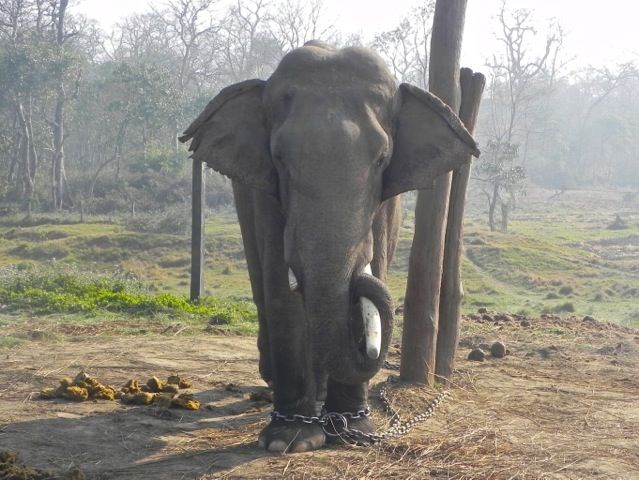
    close-up chained ele

  • Male Elephants in Captivity

    Male Elephants in Captivity

    Caring for male elephants in captivity is a challenge at best.

    Attempts to provide a quality of life within the parameters dictated by their captivity produce poor results. Their size, natural tendency toward dominance and drive to breed, combined with their innate wildness, is a recipe for disaster in a captive situation.

    Males are especially dangerous when they are in musth, a natural biological function when testosterone levels increase. During their annual musth season, captive-held males become too aggressive to approach and stop responding to their mahouts.

    EAI respects the true nature of each elephant and would prefer that no elephant live in captivity. But elephants whose lives are forever altered by captivity need our help.

    Lambodhar Prasad: In musth, out of water

    Lambodhar Prasad

    We were building chain-free corrals when Lambodhar Prasad came into musth. He was unapproachable. His front wrists were chained together, secured to a large wooden timber that was buried 10 feet deep to prevent his escape. He had no shelter from the hot sun, the seasonal storms that pellet him with golf ball-size hail or the frightening earthquake that devastated entire villages in Nepal earlier this month.

    And he had no access to water to drink unless the mahouts brought it to him.

    Because of his aggressive state, mahouts could not get close enough to Lambodhar Prasad to give him water, which concerned them and made them anxious to find a solution. Their only option was to offer Lambodhar Prasad water in a large metal cooking pot.

    Out of trunk’s reach, several mahouts struggled to push the heavy pot close to Lambodhar Prasad with a long bamboo pole. A thick handmade rope was tied to one handle of the pot in order to pull it back, out of Lambohdar Prasad’s reach, after he finished drinking.

    But things did not go as planned. Lambodhar Prasad was irritable, not in a mood to cooperate. He grabbed the pot with his trunk and before the mahouts could yank it away, he crushed it under his foot.

    The mahouts were out of ideas and had no resources to solve the problem, so they came to EAI for help.

    A simple solution

    An immediate solution was devised, simple but effective.

    EAI volunteers headed to town to buy a replacement cooking pot/water dish. We purchased an electric water pump and water hose and hired a plumber to hook it up to the existing well where the mahouts bathe and wash their cloths and dishes. The Chitwan National Parks Department provided a large water storage tank as a back-up for when the electricity is out, which in Nepal is more often then not.

    While the plumber was installing the pump, connecting the water hose and setting up the water tank, the mahouts wasted no time wiring the pump at a nearby building.

    There are no inspections required or codes for electric and plumbing work at the hattisar. You just do it!

    In a couple of hours our solution was up and running. The mahouts were relieved and excited about the prospect of being able to water Lambodhar Prasad and give him a bathe as well.

    Then came the moment to test out the new watering system.

    As suggested, the mahouts filled the water pot before maneuvering it in front of Lambodhar Prasad. He was seriously thirsty and drank hurriedly for several minutes. But as he quenched his thirst, his drive for dominance surfaced.

    The muscles in his face tightened as he grabbed for the pot in an act of defiance. The mahouts recognized his attitude shift and pulled the pot out of his reach. The pot lived to provide water for another day.

    Learn how you can support EAI’s pilot project to build Lambodhar Prasad his own steel pipe corral.

    Mahouts know we care

    Every effort in Nepal is unnecessarily difficult due to limited or nonexistent resources, expertise and motivation. Generations of mahouts have grown to believe that nothing can or will be done to make their job easier or the lives of the elephants in their care better. They have stopped asking for help, or perhaps they never started.

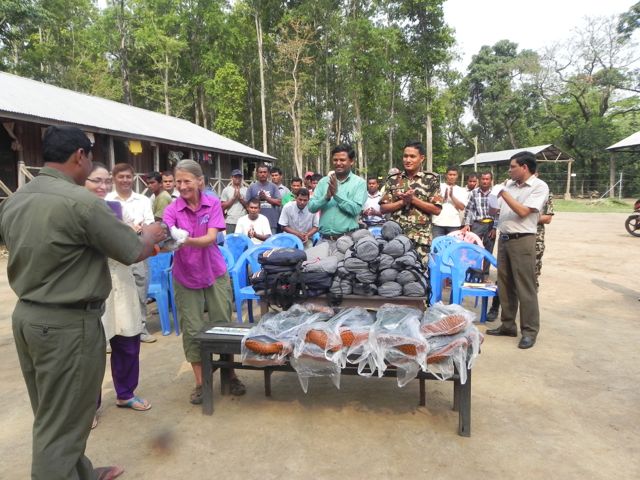
    supplies to mahouts

    But now, because you, our supporters, have enabled EAI to offer new resources, options and solutions, the mahouts know that there are people who truly care about them and the welfare of their elephants. They have begun to ask for help. They have begun to believe that when they ask, their concerns will be heard and their need for assistance will be answered.

    The most encouraging shift we have observed is that mahouts are beginning to speak up for their elephants. Improvements in elephant welfare can be encouraged from the outside but true sustainability comes from within. The mahouts are the key to improved elephant welfare in Nepal.

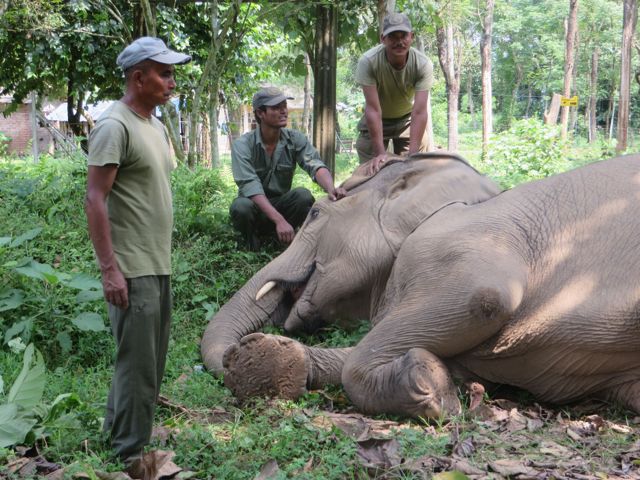
    3 mahouts & eles

    EAI is honored to partner with them. Learn how you can support mahouts and their elephants.

  • Changing minds, changing culture

    Changing minds, changing culture

    This release was a surprise to all of us and the reason we build a chain-free corral for each elephant, even if we are told the elephant will remain on chains.

    You just never know what will happen tomorrow. Changing minds, changing culture!

    Yesterday was a day of celebration for EAI and all who support our work. In addition to the work over the past year and a half, culminating in the release of tens of elephant from chains, it was the day you could actually feel the consciousness at the Khorsor hattisar shift.

    Without prompting, Puja Kali’s mahouts released her from chains.

    Earlier in the week, mahouts insisted that Puja Kali could not be released from chains due to her history of aggression. But they brainstormed and decided that if three mahouts were present when they approached Puja Kali, the situation would be safe.

    Without any further discussion they released her from chains.

    11016965_946096498754045_6101301223297155402_n

    This is a seriously significant turn of events. It is the first time we have witnessed the mahouts trouble shooting a problem, putting the elephants’ needs first.

    The mahouts deserve all the credit!

  • The Work Continues to Get Elephants Off Chains

    Good news! Baby Tec Gaj was released from chains.

    Unfortunately, it is not all good news because his mother, Puja Kali, was not.

    Two-year-old, captive-born Tec Gaj and his mother Puja Kali reside in Khorsor, ‪Nepal, at the government breeding center.

    Puja Kali is quite aggressive, known to attack her mahouts even while she is on chains.

    Such aggression is an indication of great suffering, usually on a mental and emotional level.

    Responding to Puja Kali’s aggression with corporal punishment compounds her condition but mahouts find themselves with few alternatives.

    Aggressive behavior exhibited by ‪elephants triggers retaliatory aggressive behavior by the mahouts. Aggression breeds aggression, resulting in a vicious cycle in which neither man nor elephant benefits.

    EAI does not endorse the use of any negative means to manage elephants and we empathize with the position the mahouts and captive-held elephants find themselves in.

    Hopefully, with our continued efforts, the day will come when aggressive elephants will no longer be used for activities that put them and their mahouts in danger. And, mahouts will learn alternative ways to care for their elephants.

  • Why Does That Elephant Have A Chain Around His Neck?

    Why Does That Elephant Have A Chain Around His Neck?

    For the past few years, most of my time and energy has been devoted to freeing captive held elephants from chains.

    Working alongside Nepali partners, we have created 37 chain free corrals, in 15 different elephant facilities. Before years end, we will add another five chain free corrals in two facilities in Thailand and a huge 100 acre habitat in India.

    Chain Free Means Pain Free has caught on.

    As more elephants are freed from leg chains, attention is shifting to the neck harness elephants wear during anti poaching patrol.

    In the case of elephants in Nepal, the neck harness serves one purpose. It enables a mahout  to stay seated if his elephant becomes frightened and runs.

    Some neck harnesses are made of rope. Others are a combination of rope and light weight chain. All are loose fitting and have loops for the mahouts’ feet. These loops lie flat along the side of the elephants’ neck, behind each ear.

    Remaining seated when an elephant spins around and runs away is virtually impossible, unless your feet are strapped in.

    In the case of Laxman Gaj and his twin brother Ram Gaj, a combination harness is used. The bottom half of the harness is chain. The half that goes over the top of their neck is rope.

    Laxman and Ram are young elephants, only six years old. Regardless of their youth, they are required to participate in daily anti poaching patrol activities in Chitwan National Park. Being young, they are easily frightened when surprised by a wild rhino or tiger.

    They wear the harness because when an elephant is frightened, he or she runs away. Spinning and then sprinting at speeds up to 30 miles per hour, can cause a rider to fall off.

    Having a harness adds a sense of security for the mahout who clearly knows that if he falls from his elephant, while in proximity of a wild rhino or tiger, he will be killed.

    When the elephant recovers from his or her fright, the patrol resumes.

    When an elephant learns s/he is able to escape a frightening situation, their self confidence builds. With each exposure to wildlife their fear level is further diminished. By the time they reach adulthood, the elephant has gained the experience necessary to fearlessly encounter wild tigers, rhinos and bears.

    Undoubtedly, some will insist that the harness is unnecessary as elephants should simply be returned to the wild. I have no problem with this argument. But, until such time as society evolves, some elephants are destined to remain in captivity.

    Constructed and used properly, a neck harness is harmless and provides measurable benefits. The mahouts’ personal safety is guarded, while a young elephant is allowed his natural response to fear, without being punishment.


  • Elephant Back Safaris: Misery for Elephants

    Elephant Back Safaris: Misery for Elephants

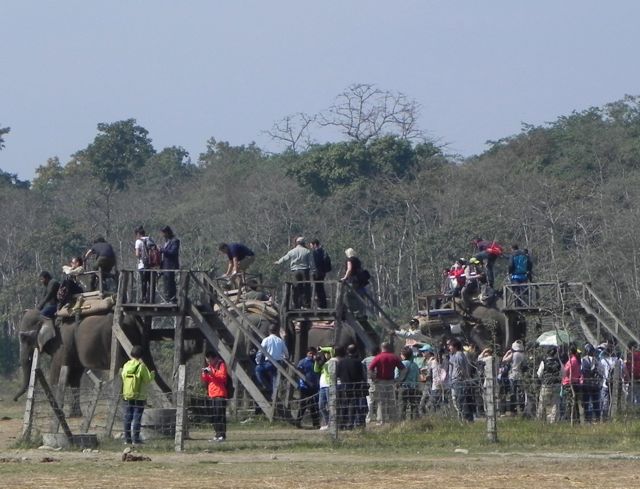
    boarding safari rides

    May 24, 2014, 8:30AM, Sauraha, Nepal.

    The temperature is already 32 degrees Celsius (about 90 degrees Fahrenheit).

    Tens of elephants are already hard at work.

    Each morning at dawn, seven days a week, elephants are saddled up in preparation for another day of carrying tourists on safaris.

    This is the routine the elephants will follow, year in and year out, until they die.

    First, they are forced to lower themselves onto their elbows to accept the saddle. This unnatural position causes pain and irreversible damage to their elbows.

    Next, a heavy canvas pad and ill-fitting howdah (saddle) are placed on their back. The pad and howdah are each so heavy, it takes two men to lift them, one at a time.

    Then, a howdah strap is cinched tightly around their chest, lacerating sensitive flesh in their armpits and cutting the tissue of their breasts.

    A second synthetic rope is tied from the back of the saddle under their tail, ripping deep gashes in the flesh around their anus.

    The life of the safari elephant

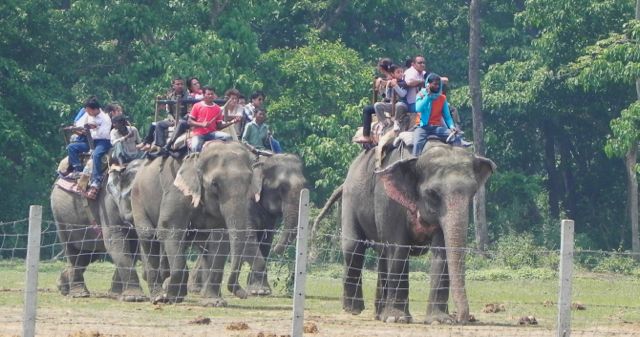
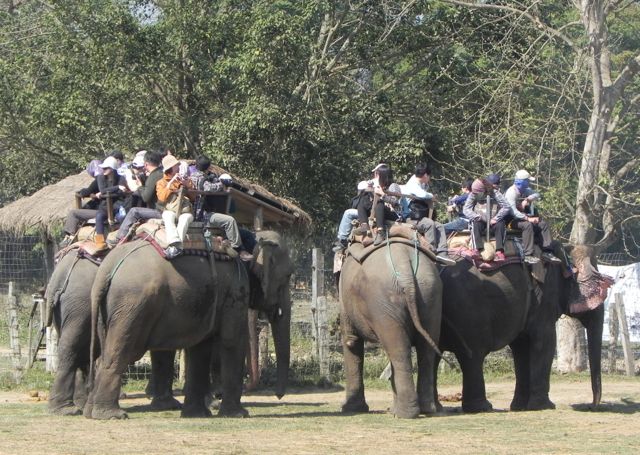
    3 eles carrying tourists

    Safari elephants spend the day carrying tourists — four to six at a time — through the jungle in sweltering heat.

    Elephants are poorly suited for this activity. The pad and howdah cause huge blisters that fester into deep abscesses that can take months to heal.

    According to a study published in the Journal of Experimental Biology, four hours of exercise in the sun causes overheating and can be fatal. Laboring in direct sunlight, carrying too much weight – pad, saddle and tourists — elephants quickly become overheated.

    What does it take to force an elephant to work under such conditions?

    Brutality.

    Mahouts hit the elephants over the head with heavy sticks, metal knives and axes. The wounds remain infected for weeks.

    Bright white scarring can be observed across the forehead of virtually every working elephant in Nepal. The abuse is systematic, accepted by elephant owners, locals and the tourists.

    The images haunt me.

    I can’t help but wonder: Is this the memory of Nepal tourists want to take home with them? And what will it take for them to see the abuse?


  • Change is Afoot

    Change is Afoot

    March 29

    The first two corrals at Kasara hattisar are finally ready.

    The air is charged with anticipation.

    Rescuing an elephant to sanctuary or releasing them from chains brings the same mix of emotions — anticipation, apprehension and excitement.

    Each elephant is a unique individual with a distinct personality. Life’s experiences mold their behavior, shaping them as they mature. Each of them responds differently to different situations.

    Himal Gaj
    Himal Gaj

    When I first arrived at the Kasara hattisar, I noticed that young Himal Gaj was resistant to his mahouts. He appeared fearful. An old scar at the base of his trunk indicated a past confrontation.

    Watching the mahouts struggle through the morning routine, preparing Himal Gaj for duty, was disconcerting. I wondered how he and the mahouts would respond to going chain-free.

    The mahouts were also concerned. They feared for their safety.

    As a result, it was decided that Himal Gaj would be released from his tether but would wear loose hobbles until the mahouts felt safe around him.

    It was disappointing that Himal Gaj would not immediately be completely free, but the compromise was the first step to his future freedom. If the mahouts fear for their safety, Himal Gaj would be destined for a life in chains.

    With time and Compassionate Elephant Care training I hoped Himal Gaj would settle down and become more responsive.

    The chains come off

    The elephants usually return from their anti-poaching patrol duties around 4pm. Chief Conservation Officer Kamal Kunwar postponed a scheduled meeting so he could be present for this auspicious occasion.

    Just before 4pm, the hattisar suba arrived. He’d been out of office for a couple of weeks.  He and Kamal discussed the plan in Nepali. I would soon see that following their brief conversation plans would change dramatically.

    The elephants arrived back from the forest. To my surprise and contrary to the plan, Himal Gaj was walked directly into his new chain-free corral. He was not put on loose hobbles. Calmly and confidently, his mahout gave the command to bite  (stretch out on his sternum).  Without hesitation or fear, Himal Gaj calmly responded.

    I realized that the mahout I’d seen with Himal Gaj the past week was now assisting, rather than riding.

    In that moment things became perfectly clear. The mahout to whom Himal Gaj was resistant to this past week was the junior mahout. And now that his main mahout was back from vacation, everything was fine.

    Himal Gaj waited patiently as his gear was removed. Then he rose and immediately began dusting, as his friend and senior mahout left the corral.

    What a difference a good relationship makes.

    Kamal Kunwar’s turn

    tamor-kali-female2
    Tamor Kali

    I did not have time to dwell on the glory of Himal Gaj’s transformation because Tamor Kali was about to enter her chain-free corral for the first time.

    Kamal Kunwar was sincerely excited, filming her first chain-free steps like a proud father.

    After seeing how well Himal Gaj responded to his mahout, everyone was engaged and relaxed. They gestured at both young elephants free-of-chains with huge smiles on their faces.

    Now was the time to stand back and savor the moment. The instant that life changed for two young elephants and their family of mahouts.

    The three other elephants stood chained under their shelter watching the scene.

    I whispered, “You’re next ladies.”

    It will be close to a week before the other corrals are completed. Without a doubt, Khosi Kali, Laxmi Kali and Prayna Kali, who have all been prisoners to chains for decades, will transition seamlessly.

    Imagine the joy when they are all chain-free. Heart bursting JOY!