When Tarra was twelve we participated in an elephant training course offered by Smokey Jones and Gary Johnson. Gary had purchased two wild caught baby elephants from Africa. For a fee, keepers were invited to attend the course to learn how to train an elephant.
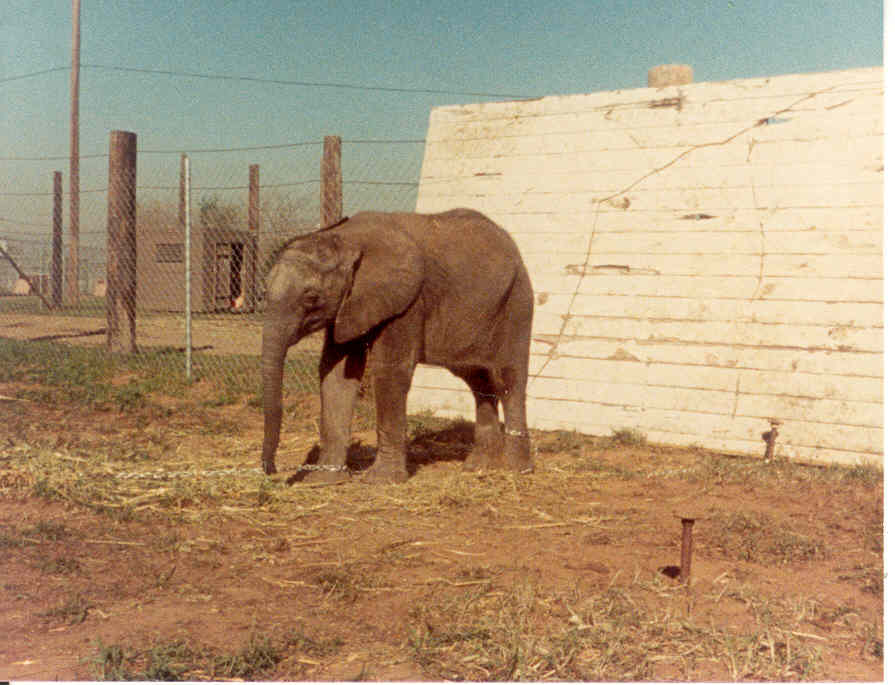
When we arrived Tarra joined Gary’s elephants. A short distance away stood a tiny African calf, chained and alone.
Tarra and I stayed for a week. During this time the baby elephant was trained several times a day. She was kept separate from the other elephants. Tarra never had an opportunity to meet her close up and personal. But I did. I still remember thinking how tiny her trunk was and how she hardly uttered a sound the entire time I was there.
When her training was completed she was loaded up into a trailer to begin her life as a performing elephant. She was the namesake of a newly formed circus.
Nearly twenty years later our lives came full circle when Flora arrived at the Sanctuary. Without question she had grown into one of the most magnificent elephants I had ever seen. As she gracefully stepped from the trailer onto sanctuary grounds, I flashed back to the first day we met and thought…another miracle.
Earlier this week I was once again on a plane. My mission was to assist in animal control officer training. The more an officer knows about elephants, the better equipped they are to protect elephants and the public.
The officers were seriously interested in the information provided. From my assessment, their new knowledge will enhance their ability to identify elephant suffering.
Animal control officers are on the front lines. In some cases, they are a performing elephants’ only empowered champion. The more informed these officers are, the greater their chances are of protecting performing elephants in their jurisdiction.
Today Chang Yim and So Sac, his mahout, had their first lesson in positive reinforcement training; they were fabulous! Little Chang Yim is not yet one year old and he is as sharp as a tack. He took to the training readily.
The language barrier was made easier by Kat, the mahout manager who speaks very good English. Within a couple of minutes and a handful of bananas Chang Yim was walking between two trainers, clearly understanding the training game.
At first I wondered how Chang Yim would do with all the distractions, including guests hand feeding the adult elephants in the same corral. He was unphased by the guests and the elephant blockades. It was great to see this little fellow weave around the adults, under chins and through legs to get to the mahout calling his name. He was brilliant. Of course it was all about the bananas.
It struck me that being a herd elephant was not a deterrent to the training session; in fact, his conditioning to live, eat and play alongside the family activities was an advantage. It should be no surprise that learning from his mahout in this environment would not be problematic.
I must admit that seeing Chang Yim respond to his mahout with such ease brought me great joy. Lek is determined to make sure that her baby elephants never experience the pain of traditional training. I know that Chang Yim has a chance to learn without experiencing negative reinforcement.
I have enjoyed being able to spend an extended period of time observing different facilities and programs. One day is really not enough time to get a true sense of how a program works. This, my second day at Lek’s Elephant Nature Park brought a deeper understanding of the operation.
The elephants genuinely spend the majority of their time out on the pasture grazing, paying little attention to the volunteers and guests that occupy the boardwalks bordering their habitat. I have watched for hours trying to figure out why the elephants do not return to the public areas to beg for food. One reason might be that each elephant has a mahout who follows them around to ensure their safety. The mahouts might encourage the elephants to stay out in the pasture but I really saw no indication that elephants were prevented from moving anywhere they pleased, except the construction area of course.
The other reason might be because of the designated feeding time. The elephants are released from their stables at 7am and guests are allowed to feed them produce from a feeding platform at 10:30am. A “feeding bell” is rung and the elephants can be seen heading for the feeding platform right on time with no encouragement from their mahouts. After eating, they head back out to pasture until evening, when they return to the platform for a second guest feeding, and then return to the stables for the night. In between they go to the river twice a day for bathing. It is all very calm and casual. The elephants move around like cattle with no noticeable prodding from the mahouts. It is obvious that the elephants are comfortable with the day’s routine. It is designed around them to meet their needs.
Today I was honored to be asked to assist the mahout of the youngest calf. He is not yet one year old and already a handful. Understandably, he is the focus of the guests’ attention and, since he has contact with the guests from behind a wooded corral, he can be a little pushy.
The first session with the mahout and calf went well. The calf is sharp as a tack and in no time he was responding to his mahout’s request to “come here.” After a few minor instructions, the mahout was expertly maneuvering the calf from one side of the stall to the other. Of course this is easy to do, since the calf was given a piece of banana as a reward.
Lek has a new project in Surin that I plan to visit next week. In conjunction with the government, Lek is helping to design a new pilot project for mahouts and their elephants. I look forward to seeing the projects and reporting back about it. Lek has accomplished so much in such a short period of time, and there is no sign that she plans to stop. Elephants and elephant lovers alike owe her a debt of gratitude.
Today’s health camp was held at Pabitora, a wilderness sanctuary where nine elephants reside. National parks and wilderness sanctuaries are government-run and hold different classifications, with national parks holding a higher ranking. In both cases the animals are protected and tourism is not aggressively commercially marketed .
At 16 square kilometers, Pabitora is considered small but it protects the largest concentration of Indian rhino in the world. Their renowned breeding success is enhanced thanks to the cooperation of the local people; poaching is not a problem. The landscape is unbelievably beautiful with a year-round clean river running through it; by all accounts Pabitora is an Eden.
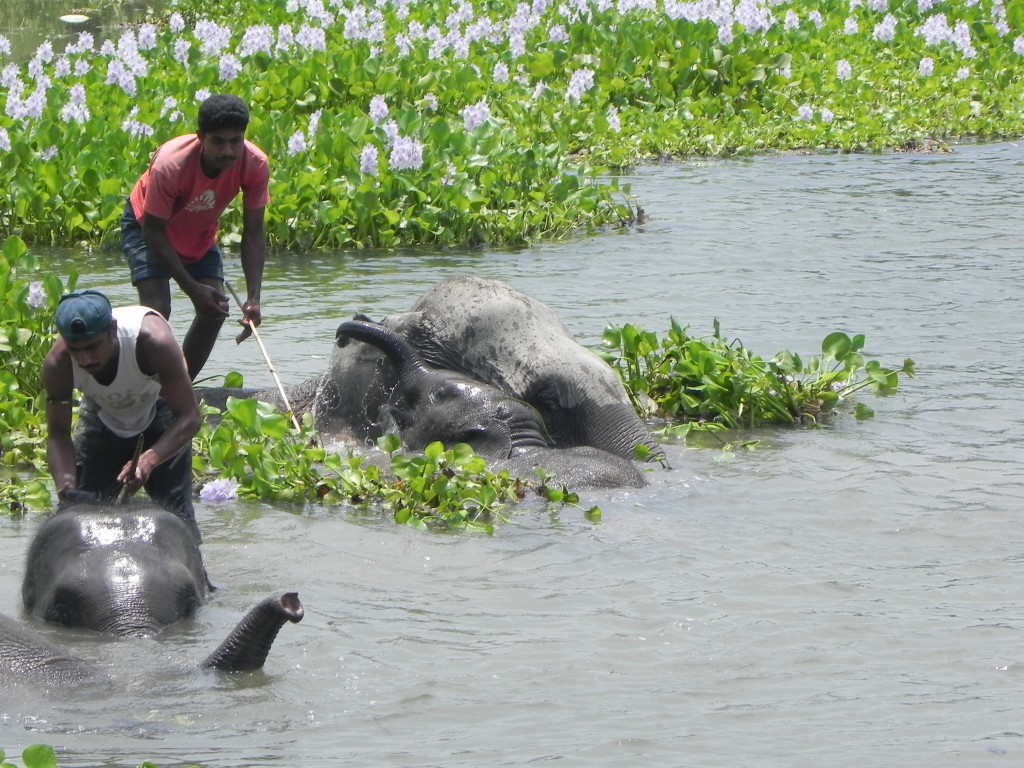
The elephants were beginning to gather when we arrived. Some had just finished their morning bath while others where just taking the plunge. Bishwajit stuck close to his mother as she carefully maneuvered the river bank entering the shallows. At four months of age Bishwajit is already an expert swimmer, resembling a 500-pound bobbing cork.
Phulmati is an experienced mother, calm and confident. She never lost sight of her lively calf as she gracefully waded around him. When she lowered herself in the shallows to allow her Phandis (lead mahout) to scrub her skin with a fistful of vegetation, little Bishwajit took full advantage. His comical play included climbing on his ever-patient mother’s face and over her head, concluding with a belly flop off the other side. In between submarine dives Bishwajit would surface and extend his tiny trunk, making contact with his mother’s face every thirty seconds or so.
Bohagi, Phulmati’s first calf, is already five years old and recently completed her formal training. I looked closely to see if I could find the scars I was confident she would be wearing as result of the training process but to my surprise there were none.
By the time Bishwajit and his mother emerged from the river, the camp was well underway. The males here outnumbered the females six to three. Two of the males, Naga and Rudra, were recently moved to the sanctuary from the Guwahati Zoo. Even though, in theory, the move is in their best interest as now they live in a natural habitat with access to clean water and live vegetation, their initial introduction was problematic. Bikaram, the sanctuary’s resident mature male was not impressed with the new arrivals and was extremely aggressive toward them. Determining if and how captive males should be introduced to semi-wild environments already occupied by mature males is a subject that will need to be studied to ensure the welfare of all concerned.
Each elephant has a Phandis, their trainer and caregiver, who attends to their needs, takes them on anti-poaching patrols and ensures they spend many hours each day in prime grazing and foraging habitat. I know we would love to think of these elephants as being free to wander at will and do as they please but that is not possible. The parks are not fenced and human settlements encircle the national parks and wildlife sanctuaries. In the recent past some captive elephants have been released into the wild only to pay a horrific price when they wandered outside the boundaries of their protection and become a pest to the locals. Of the options, including illegal logging, tourist safaris and unemployment, which can be disastrous for their welfare, it would appear that these elephants are in the best situation currently available to them.
Consistent with Dr. Sarma’s other camps, the elephants received a thorough physical examination, inoculations, fecal exams and deworming when needed. A large abscess on Phulmati’s back right leg was the biggest issue of the day. Unfortunately for Phulmati, some time back a veterinarian had administered a high volume of drug at a single injection site, resulting in an infection. Dr. Sarma had been called in to address the problem and was pleased at the condition of the wound since his last visit. While dressing the wound he remarked that it was healing nicely.
Bishwajit was full of himself, desperate for someone to play with. He figure-eighted under his mom’s belly and around her legs as she patiently accepted her abscess treatment. Cleaning out the wound and placing new dressing inside took about 15 minutes, during which time the ever-active calf made a nuisance of himself. At his tender age he knows no authority except his mother, thank goodness for that. And in the case of his mom, like most experienced elephant moms, Bishwajit could do no wrong. When he found that the humans would not engage in elephant games he targeted a nearby dog, promptly chasing it off.
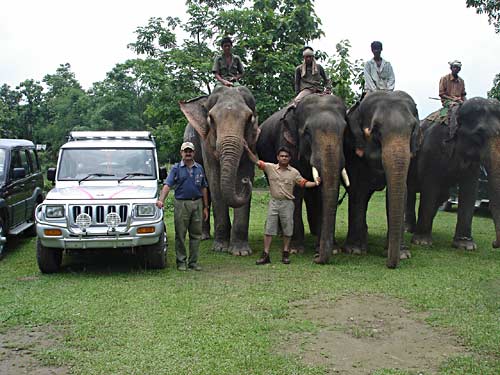
During the camp, all the elephants, Phandis and mahouts mingled around the site. Only after all the elephants had completed a physical examination and treatment did the exit process begin. A seemingly discarded piece of burlap was silently grasped and effortlessly flung by an elephant over her head to the waiting Phandis. Serving as a seat cushion of sorts, the rider placed the burlap just behind the elephant’s shoulder blades. He settled comfortably on the burlap, draped his legs behind her ears and tucked his feet on the inside of the neck rope. Each Phandis signaled to his elephant in foot-language and the elephants responded. In a synchronized dance they fanned out in different directions, all leading to the same place, the forest.
Now the elephants will spend hours grazing and foraging and later in the day they will patrol their home. Protecting the endangered rhinos is their job. Considering the alternatives for elephants living in captivity in Asia, theirs is a relatively good life.
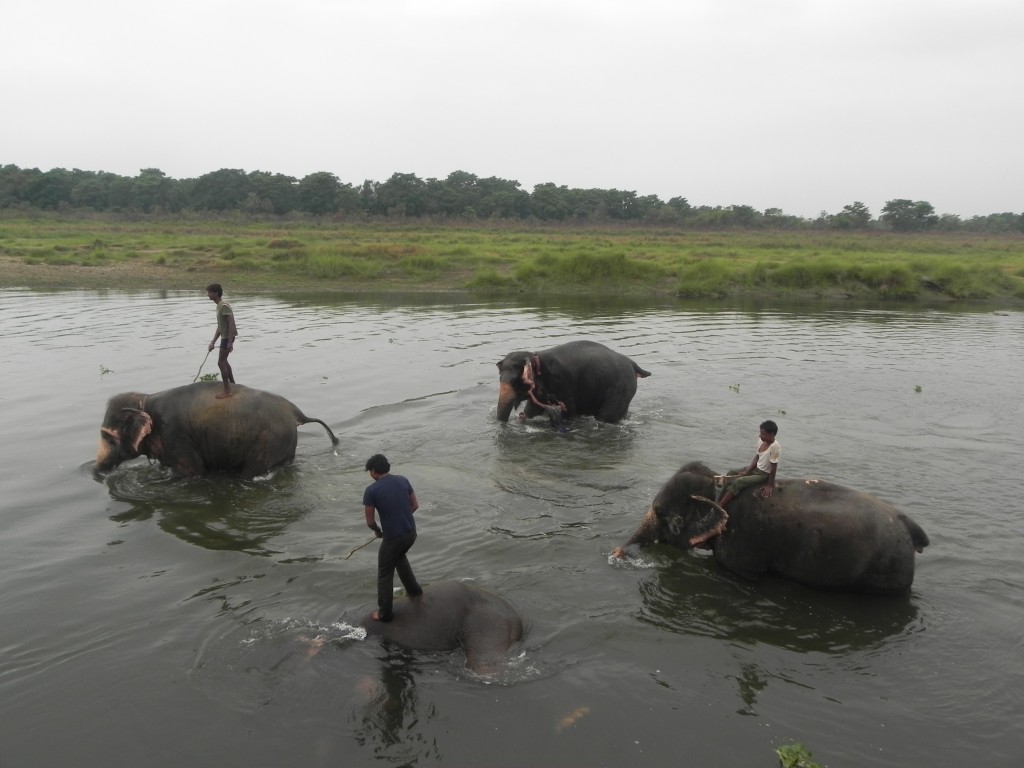
This morning I followed the elephants down to the river for their morning bath. The sheer joy of immersing in water is universal with elephants. It gave me goose bumps to see them so relaxed, splashing water, throwing trunkfuls over their backs and drinking freely.
When I am standing, quietly observing the Sauraha elephants, I can’t help but notice similarities between this group of elephants and my girls. There is one who is Sissy’s twin in looks and temperament and another that is a younger version of Billie-Sue. This elephant caught my eye the first day I met her, not only because she looked so much like Billie-Sue but also because she seems very insecure, much like Billie-Sue when she was first rescued.
Sissy’s look-a-like!
My most memorable time this morning was when one of the elephants “accidentally” dumped her handler into the water. I of course was silently cheering for the elephant as the young man tried to maneuver in the shallow water to remount his elephant.
The elephant took full advantage of her temporary freedom, turning her hind end to the boy each time he got close. I don’t know exactly what he was saying but he was not happy that the elephant was not responding. His commands got louder and louder, his embarrassment at her outsmarting him was obvious.
Ignoring his attempts to control her, the elephant continued to cover herself with trunkfuls of the cool river water, until another man appeared. He yelled a few commands to the elephant and climbed onto her back while she was still in the river. She continued to play, trying to ignore him as well but it was obvious that she respected him more than the boy.
The phanit was aware of being watched and thankfully did not physically punish the elephant. Instead he made her go through a series of repetitive commands like turning from side to side and lying down in the water. She was not willing to give it over right away and did a “Minnie stunt,” dropping her head to the river bottom with her rear and one hind leg sticking up in the air.
The handler was obviously her phanit. Although she was making it difficult to stay on top of her back, he succeeded. He actually laughed, which relieved my concern that she had gone too far and would pay for her disobedience. I exhaled, realizing only then that I had been holding my breath.
The pachuwa stood looking dejected on the river bank. No doubt he had just learned some valuable training lessons and, hopefully, a deeper respect for the intelligence of his elephant.
A young pachuwa fell off his elephant
The reality is that no matter the amount of academic training a person has, practical experience is essential in order to develop an expertise with elephants. The number of different elephants and situations a handler is exposed to is key to developing skills. Each lesson an elephant teaches the handler is a building block for the next lesson in the unending series of lessons that brings valuable insight into who elephants are.
I am doing my best to understand, without judgment, the traditions held in Sauraha regarding elephants and handlers. The more I learn about the traditions, the better prepared I will be to effect some degree of change. The elephant owners and handlers are receptive, which gives me cause to be optimistic. Change can occur, it will just take time.
These elephants benefit from the mobile health care program I established over five years ago.
Welcome to my new blog! I am so excited to share this great news with you. Never one to stand around and watch the grass grow, I decided to create a new nonprofit organization called
Elephant Aid International.
I guess that makes all of you ELEAIDS.
The mission of Elephant Aid International is to assist elephants worldwide…one elephant at a time. I believe in the power of one, that every elephant counts. On my travels I will be searching for opportunities to learn about elephant and mahout life in Nepal, India and Thailand. Whenever and wherever possible, I hope to impart what elephants have taught me about non-dominance passive-control management and the sanctuary life style.
It is my good fortune to be invited by elephant experts to participate in field work, elephant medical care and even brainstorming with other like-minds for the creation of elephant sanctuaries in Nepal and India. I am focusing on the future, thankful for this opportunity to be of service on a much grander scale. This trip is humbling, a fabulous opportunity to further my studies of this magnificent species and a chance to give back.
Imagine the prospect of sharing what I have learned from our girls to benefit their relatives, in their homeland. It is more than I ever dreamed possible. Talk about coming full circle and paying it forward.
I can’t wait to see what the future holds. My flight to Kathmandu leaves April 12. After a pit stop in Bangkok I join up with a team of veterinarians and technicians for the first leg of my trip. I will blog as often as possible to include you in the adventure and, of course, introduce you to each and every elephant I am blessed to meet along the way. The future is indeed BRIGHT.