Tag: elephants

  • blessing the land

    blessing the land

    I’ve seen footprints and elephant boluses and heard stories about the herds of wild elephants that frequent the area, but last night at 10:35pm I heard proof — my first wild elephant trumpet. It sounded like s/he was just outside my front door. The familiar sound brought an instant smile to my face. I stood motionless on my porch listening for more, any other sign of elephants. But there was only pitch dark and silence. I figured the music maker had moved on. But honestly, just hearing that one joyful trumpet was enough for me, for now.

    I’ve been thinking deeply about our project, wondering what impact, if any, it will have on the wild ones. Of course my desire is to do no harm, so educating myself regarding wild elephant activity in the region is imperative.

    This morning as I recounted the elephant music of the night before, the resident security man came roaring up on his scooter to announce that he had seen a herd of elephants. The night before they entered the property through a wide opening in the forest wall and proceeded to feast on bamboo, a fruitless mango tree and the huge Banyan tree that dwarfs the outdoor classroom area used occasionally for schoolchildren from Bangalore.
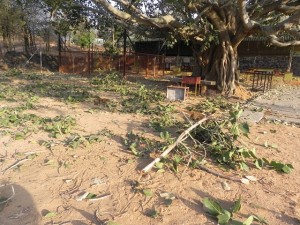
    Several piles of manure suggested the size of the herd and age of some of its members. From the fertilizer they left behind it appeared that this herd included at least two youngsters, one only a few months old.
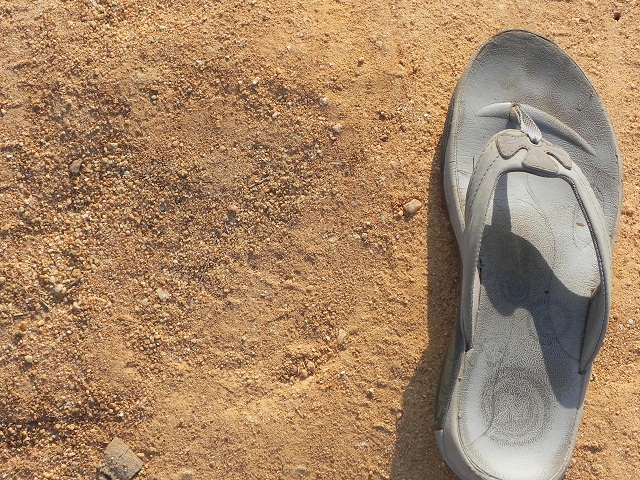
    This sandal is a size 7, so you can see how small this calf’s foot is.

    Out of curiosity we tracked the elephants’ movements, following piles of manure, footprints and discarded vegetation. A horizontal chain that extended across a dirt road lay in two pieces on the ground. The heavy lock that previously held it together was splayed open and discarded. Most likely one of the larger elephants stood on the chain until the lock gave way.
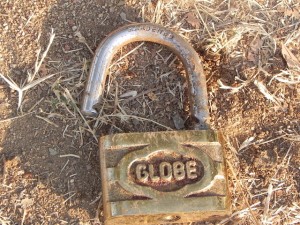
    The amount of damage done was nil unless you consider leaf litter and a couple of broken branches a problem. After filling their bellies, the herd appeared to leave the way they entered.

    I am getting such an education — wild elephant lifestyles in the Bannerghatta forest 101. Living on the land shared by wild elephants is a gift and a responsibility. I look forward to the days and weeks ahead. I am realizing that this project has the potential to be much more than anticipated. One world, one elephant at a time has taken on a much more complicated meaning.

    One world, one elephant at a time — both wild and captive.
  • India Calls

    It is time for me to return to Asia. My Elephant Care and Rehabilitation Center is calling.

    Learning from my past, I have decided to stop for a least one second to stand in the glow of this monumental moment. This time around I plan to rejoice in each tiny success, revel in each new development and give thanks for the progress made each and every day. I look forward to the challenge of staying in the moment as much as I can, recognizing that each unique moment will slip by without acknowledgement if I don’t make the effort to cherish it.

    So many people are with me on this journey. I feel you shoulder-to-shoulder traveling with me and, of course, those at my back, pushing me forward. This is truly a time of celebration. Thanks for joining me on this fabulous journey.

    I recently sent the following appeal to EAI’s loyal supporters. The response has been overwhelming.

    Our Elephant Care and Rehabilitation Center project in Bangalore, India, finally received the government endorsement we have been waiting for. I cannot tell you how excited I am that we are finally able to move forward on this project to provide a humane home for elephants in India. I know you share my enthusiasm.

    The property for the center has been secured. It is fantastic — complete with two large ponds, woods and pasture area — and it borders a national forest that we have received government permission to use.

    Can you believe it? Our elephants will be allowed to use the national forest as if it were their home! This really is a dream come true!

    In the surprisingly short time since I founded EAI, it has already had a notable impact on the welfare of captive elephants living in Thailand, Nepal and India. Hundreds of elephants have received pedicures and mahouts have been introduced to a kinder, gentler way to manage their elephants.

    And now we are preparing to create a care and rehabilitation center – the first of its kind – that promises to change how captive elephants live in Asia.

    Helping one elephant at a time takes the efforts of many. I need your help now.

    Before we can rescue even one elephant we must complete the infrastructure including perimeter fencing, construct chain-free corrals and build night shelters to provide protection from wild elephants and poachers. A sanitary water collection and containment system must be installed to ensure a continuous supply of clean water. And we need a small vet clinic to support each elephant’s recovery following his/her rescue.

    Elephants like 12-year-old Menaka, who will be our first resident. Chained in a temple for most of her life, Menaka has experienced horrors we cannot even imagine. She spent day and night standing on concrete, forced to stand at attention in the hot sun for hours and bless temple worshipers. Whenever Menaka attempted to move, she was punished harshly with bullhooks. At night she was left alone and hungry, with heavy chains tied around her legs; her attempts to free herself caused painful wounds that went untreated.

    Fortunately, once Menaka arrives at the center, her life will be forever changed and her past will become a distant memory.

    I can’t wait to see the gleam in young Menaka’s eyes when she enters her chain-free corral and realizes her new-found freedom.

    The cost of the infrastructure required to provide sanctuary for needy elephants like Menaka is estimated at $200,000.

    I have complete confidence that we can reach this goal. But, I cannot accomplish this alone. I depend on you to help me make this dream a reality.

    Your donation can help Menaka be the first of many elephants rescued to our care center. They will make history, living proof of a better, kinder way of caring for elephants living in captivity.
    Please help us meet our goal. As with all my projects, every dollar you contribute goes directly to helping the elephants.

    I know we have a big job ahead of us. But my experience of creating The Elephant Sanctuary in Tennessee has taught me that we can accomplish anything we set our mind to. Together we can create this care center, a solution for India’s suffering elephants and a model for the rest of Asia.

    Thank you for your support and for being a part of the solution!

    Carol Buckley

    P.S. Please contact me if you have questions or suggestions.


  • Jenny and Shirley’s reunion

    Jenny and Shirley’s reunion

    Recently, a friend emailed me a question: “During the filming of “The Urban Elephant” documentary, what was going on in your mind (and heart) when Shirley and Jenny were trying to get close to each other?”

    I realize many of you may be curious as well, so I decide to share with all of you.

    “The Urban Elephant” film crew had been at the Sanctuary all day and had just left for dinner when Jenny approached the barn. She and Shirley had not yet met.

    When Jenny first stepped inside the barn she was calm, but when she saw Shirley she became agitated. She reached through the stall toward Shirley, intensely focused on her. Shirley showed little interest but finally responded to Jenny’s attention by stepping close enough to be touched.

    Jenny’s agitation grew. She extended her trunk all the way through the bars, reaching out, touching, talking to Shirley. Shirley stood parallel to the corral allowing Jenny to touch all over her, but continued to show very little interest. Jenny began to work herself up into frenzy, very uncharacteristic behavior for her.

    Scott and I were sitting inside the barn only a few feet away, watching. I was filming.

    Jenny was animated and anxious; she wanted to get closer to Shirley. Shirley remained calm. But when Jenny placed her truck up to Shirley’s mouth, Shirley froze. Her posture changed, she became a little rigid and then turned to look at Jenny. She reached over to touch Jenny’s mouth and what followed was undefinably powerful and life changing for all present.

    Looking straight into Jenny’s eyes, Shirley erupted into a huge baritone roar. Caught completely off guard, I thought a bomb and an earthquake had simultaneously hit the barn. Her bellows ignited Jenny’s bellows, which together literally shook the barn.

    With her head held high and mouth gaping open, Shirley roared and gently touched all over Jenny’s smiling face. Jenny’s body immediately relaxed as she continued to grope and pull at Shirley through the bars and bellow. The volume of their shared roars was deafening.

    The energy in the barn was so intense I had to step outside the door to catch my breath. Seriously, I could not breathe. I did not yet fully understand what was happening. I had only seen such a display of emotion once before when a baby elephant at a breeding facility was separated from his mother for the first time. The two nearly killed themselves trying to climb over the corral to get back together. Their roars were one and the same with Jenny and Shirley’s.

    This memory flashed though my mind and within seconds I understood. Jenny and Shirley had known each other before and during that time had forged an intensely close relationship. This was a reunion.

    The powerfully joyful vocalizations continued for some time, with Jenny and Shirley groping each other all over. I cannot convey how thick the love was in the air. I was too caught up in the emotional exchange to register just how long this went on but it could have lasted close to 30 minutes.

    By the time the volume of their reunion subsided, Shirley was emitting short, sweet sighs and Jenny had melted into the steel bars that separated them, their trunks draped across each other faces.

    I knew I had just witnessed a miracle, the first of many that I would be privileged to witness in the years to come.

  • Bunny

    Bunny

    Bunny — what a sensitive and loving lady. It was a joy to bring her to the Sanctuary. Her immersion into the habitat and bonds with the other elephants exceeded even our wildest dreams. She made an immediate and complete transition into Sanctuary life. In fact, she was the first elephant to sleep under the stars and was responsible for her sisters beginning to sleep outdoors overnight as well.

    I spent five years working for Bunny’s release from the Mesker Park Zoo in Evansville, IN. The zoo had been her home for four decades. From the time my effort began, I placed a weekly phone call to the zoo to discuss Bunny and her possible relocation. Ron Young, the zoo director, and Ted Grannan, the assistant director, were gracious but firm: Bunny would never leave the zoo.

    They continued to accept my calls and humor my periodic visits, but their response to my interest in discussing Bunny’s relocation was a consistent no. I realized that these were kind and caring people. My goal was to familiarize them with the Sanctuary so they could understand what we had to offer to their beloved Bunny.

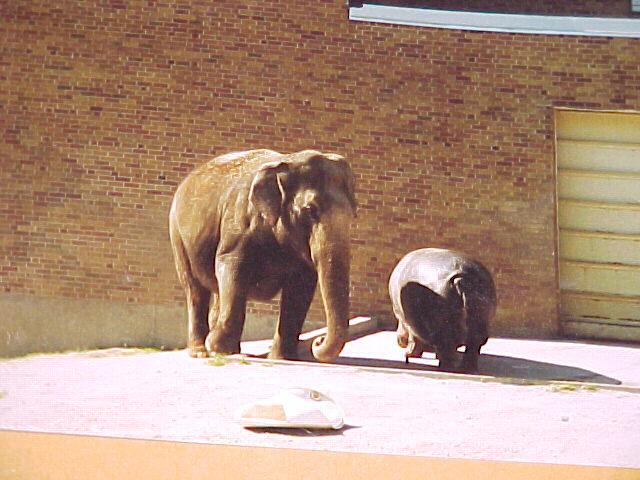
    On one of my many visits to the zoo, Bunny was having “play time” with her next-door neighbor Daisy, a hippo. They had lived in adjacent enclosures for four decades. On special occasions Daisy was allowed into Bunny’s yard for a visit. It was quite cute to watch, but sad to realize how these two had to rely on another very different species for companionship. Bunny gently herded Daisy around the yard, as much as one can herd a hippo, with Daisy paying little attention.

    My persistence began to pay off, but in a roundabout way. Ron soon began passing my phone calls off to Ted, who remained pleasant and engaging. He would listen patiently to my latest update and end the conversation with the zoo’s mantra, “Bunny will never leave the Mesker Park Zoo.”  My no-pressure-but-let-me-tell-you-this approach was sincere — and effective. We shared a common interest in Bunny’s welfare, which soon brought us closer together. My message began to get through and I saw that Ted was beginning to question the wisdom of their position.

    Until this time, I was told that Bunny could not be moved for a myriad of reasons, including that it would break her heart to leave the zoo. With stories about our other retirees as evidence to contradict that concern, Ron finally admitted that the idea simply could not be considered because the Association of Zoos and Aquariums (AZA) would not allow it.

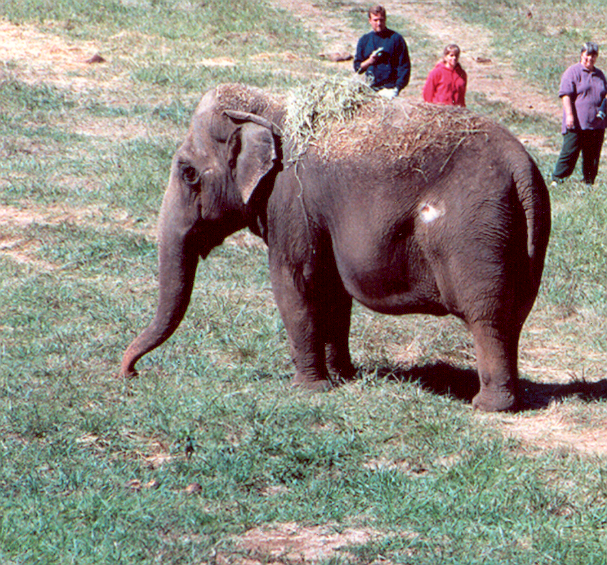
    After years of open communication and education I was able to demonstrate that Bunny not only deserved to move to the Sanctuary but her very health depended on it. Her enclosure offered limited natural substrate and her pool had been empty for years. As result of years spent on the hard surfaces of her exhibit, Bunny had developed a chronic foot disease that could soon develop into osteomyilis. This captivity-induced disease is responsible for the deaths of nearly all adult captive Asian elephants living in zoos. Bunny was on her way to being yet another statistic but I knew that Sanctuary life could spare her such a fate.

    Bunny was surrounded by a loving staff, attentive veterinarian and adoring public. They began to grasp the gravity of Bunny’s condition and, ultimately, the people responsible for Bunny’s care, including Ron and Ted, became the champions for her release.

    On September 29, 1999, Bunny arrived at the Sanctuary. Her retirement was celebrated by two communities united by one deeply loved elephant.

  • Tarra meets a baby bird

    Tarra meets a baby bird

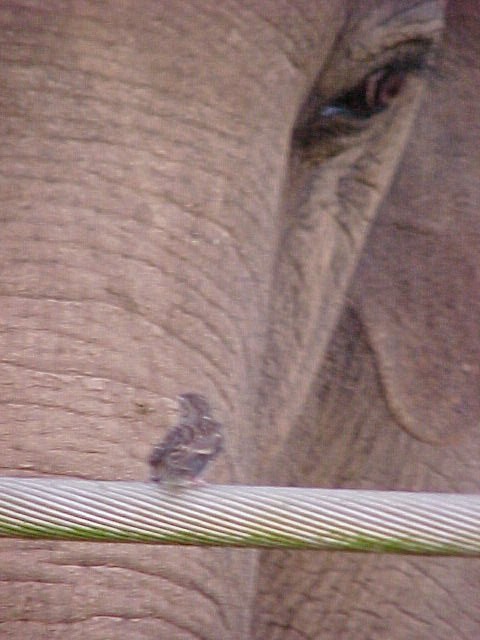
    The story that goes with this touching photo taken in 2001 is equally amazing. I went out to the back of the Phase ll barn and found Tarra staring at the fledging on the horizontal corral cable. I was without camera and said to Tarra, “Don’t move, don’t scare it — I’m going to get the camera.  I’ll be right back!”

    I ran back the length of the barn and up the stairs, found my camera, ran back down the stairs and out to the back of the barn. It had to have taken me two to three minutes. When I came back around the corner, Tarra was standing perfectly still, in the exact same spot as when I left her. I swear she was holding her breath.

    I was able to take three photos before the fledgling flew off.

    I praised Tarra for standing so still and for not trying to touch the baby bird, which I could tell she was dying to do. Her eyes were still as large as saucers, sparkling with excitement. She squeaked, took a deep breath and let out a piercing trumpet.

    Another magical moment with Tarra.

  • Ojai remembers Tarra

    Craig Walker from the Ojai Valley Museum contacted me recently. He was interested in an update about Tarra since our time living in Ojai. His article brought back fond memories of Tarra and me, and the community’s warm embrace of our unique relationship.

    I am always amazed to hear recollections from people who have meet Tarra over the years.  Some of the stories are simply outlandish. One such story that really made me laugh was Matt’s memory of seeing Tarra skating down Matilija Canyon Road with three or four guys on horses holding her back with ropes.

    WOW. Even though that might  sound fun, it never happened. I don’t doubt for a moment that Matt and his friends actually saw Tarra with her horse, donkey, pygmy goats and dogs in tow, but there were no ropes or skates involved.  Most likely what Matt witnessed was Tarra and family darting across Hwy 33 on our way to Matilija Lake. I admit that Tarra runs as smooth as a gazelle, so perhaps she appeared to be roller skating!

    Many have asked where the skating gimmick came from. Truth is, it was just another inspiration on the road to sanctuary.

    As Tarra grew, performing became increasingly boring for her. I struggled to find a way for her to enjoy the work. Since retiring was not yet in the cards, I looked for other ways to provide her a lifestyle she would enjoy.  By the time she was eight years old, that quest had already taken us from amusement park performer to circus performer to private party entertainer, to Hollywood bit player to watercolor artist. Keeping the work varied helped alleviate the boredom that seemed the greatest threat to Tarra’s cheery attitude.

    While discussing my dilemma with a friend, I jokingly said, “I should teach her to rollerskate. It’s easy, fun and all the rage right now.”

    We looked at each other and burst into excited laughter. He said, “That’s it! She’ll love it – Tarra, the world’s only roller skating elephant.”

    The research that followed resulted in a set of clunky steel-frame skates with custom-made knee-high boots and industrial casters that rolled forward only. A star was born.

    In those days I was unfamiliar with animal activism. I knew Tarra very well and was not surprised when she took to her skates like a fish to water…almost too much in fact. I know that animal activists reading this post will cringe at the very thought of me discussing Tarra’s skating in any positive light at all. But the truth is the truth. Tarra loved it.

    Each skate fit like a glove and strapped on with seat belts. There was no way that anyone could have forced Tarra into her skates; she had to put them on herself. She would step inside the 12-inch high boot and wiggle her foot around until her toes slipped into custom designed padded toe spaces. Her assistants, all three of us, would then strap the sides of the boots and pull the seat belt straps tight.

    Getting suited up with her skates took close to 20 minutes. The entire time she would chatter, trumpet and purr in anticipation of the fun. The hardest part was getting her to wait until she was completely and securely strapped in before bolting off, trunk and tail extended, in a mad dash around the roller rink.

    It might come as a surprise why Tarra stopped skating. She never tired of the fun, but I learned how opposed to such unnatural activity certain people were.

    One day, while Tarra was skating before a large crowd in an open parking lot, a well-dressed woman approached me, grabbed my arm and started yelling, “Animal abuse!” Of course I looked around to see what she was talking about and then realized she was talking about me.

    I was shocked, unable to understand how this person could ever see Tarra’s play as abuse.  But that was the point: Tarra was having fun but skating was sending the wrong message.

    I really grew up that day, realizing that perception is everything. If even one person saw Tarra’s skating as abusive, we could not do it. I began researching the animal activist movement and retired Tarra’s skates.

    I believe that Tarra’s skating was not just another effort on my part to enrich her life. I believe it was another step along the road to sanctuary.

  • The Art of Cultural Brokerage: Recreating Elephant-Human Relationship and Community

    An article by Carol Buckley and G.A. Bradshaw, Ph.D., Ph.D., on how sanctuary creates a healing trans-species community in which humans and elephants live together. In sanctuary, the humans function as catalysts, interpreters and negotiators of relational repair for elephants in recovery from trauma.

    Read the full article.

  • Seeds of Change

    Seeds of Change

    April 13

    My work in Sauraha has come to an end, at least for the time being.  Seeds of change have been planted. From the looks of it, some seeds are already growing, quietly shifting the soil around their sprouting roots. Experiencing the fruits of my labor so instantaneously fills me with hope.

    Yesterday when Kiran and I arrived for Bhadra’s morning session we were told that Ramji, his mahout, was off making preparations for the New Year’s Day celebration. I jumped at the chance to work with Bhadra in Ramji’s absence.  But my excitement was quickly doused when Bhadra made it perfectly clear that he would work with me but under protest.

    After completing each request Bhadra would do a mini mock lunge from behind the protective barrier. It seemed that he was clearly bothered about something to do with me. He was responding but being snotty. I have seen this type of behavior before when training a new mahout who struggles to keep pace with an advanced elephant student. I did not make that analogy until sometime later.

    The next day, the motivation behind Bhadra’s behavior became apparent. In our absence, Ramji had risen to a challenge from Kiran to prove his skill with Bhadra within three months. The ultimate goal: to show everyone how far he could take Bhadra with positive reinforcement training.

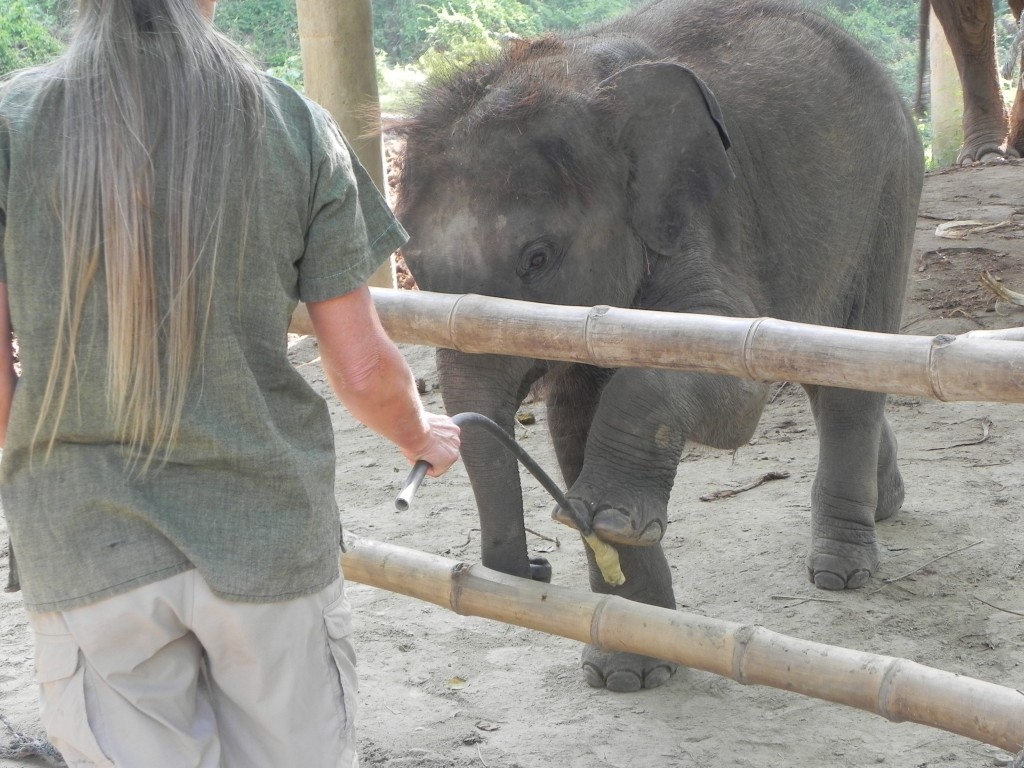
    Ramji proved his skills beyond question when he surprised us by calling Bhadra from the protection of the corral and proceeded to ask him to present his feet and ears, move to the side, back up and put his head down. I was stunned. They were fabulous. Ramji, all cool, calm, and collected, Bhadra listening intently and responding to each verbal cue. I wish you could have been there to see it for yourself, but I did catch it on video. This type of breakthrough must be documented in order for others to believe.

    Needless to say, Kiran was pleasantly surprised at the immediate progress in less than a week!  Ramji obviously took the challenge seriously, resulting in a display that had me grinning from ear to ear, joyful with disbelief.

    Ramji earned much deserved respect today, and Bhadra…well, he already has my heart. He has now joined the ranks of the “MIGHTY TYKES,” the young elephants in Thailand and now Nepal participating in this important case study of positive reinforcement training. These youngsters are the hope of the future: what they teach us and their mahouts will shape elephant training of the future. They are demonstrating how positive reinforcement training can be used with captive elephants in a hands-on working situation.  We owe them and their mahouts a great debt of gratitude.

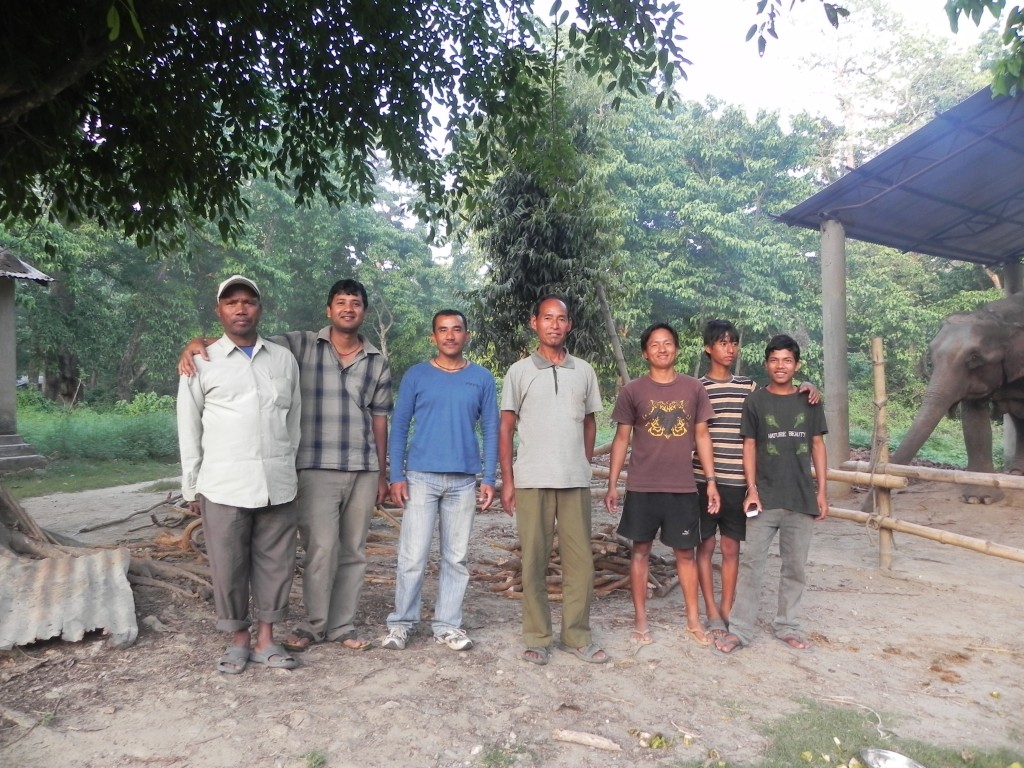
    Kiran knew instinctively that witnessing Bhadra and Ramji’s incredible accomplishments would make my day, my last in Sauraha. It was wonderful to see how proud he was. Kiran has been an invaluable asset throughout the training process. I doubt he realizes the role he has played in this cultural shift of mahout attitudes, which has the potential to change the future for captive elephants. The future is bright indeed.

    I left Sauraha today with a heavy heart, heavy with the joy of knowing that we have planted a seed. I for one cannot wait to see how it grows.

  • a fiery red head

    a fiery red head

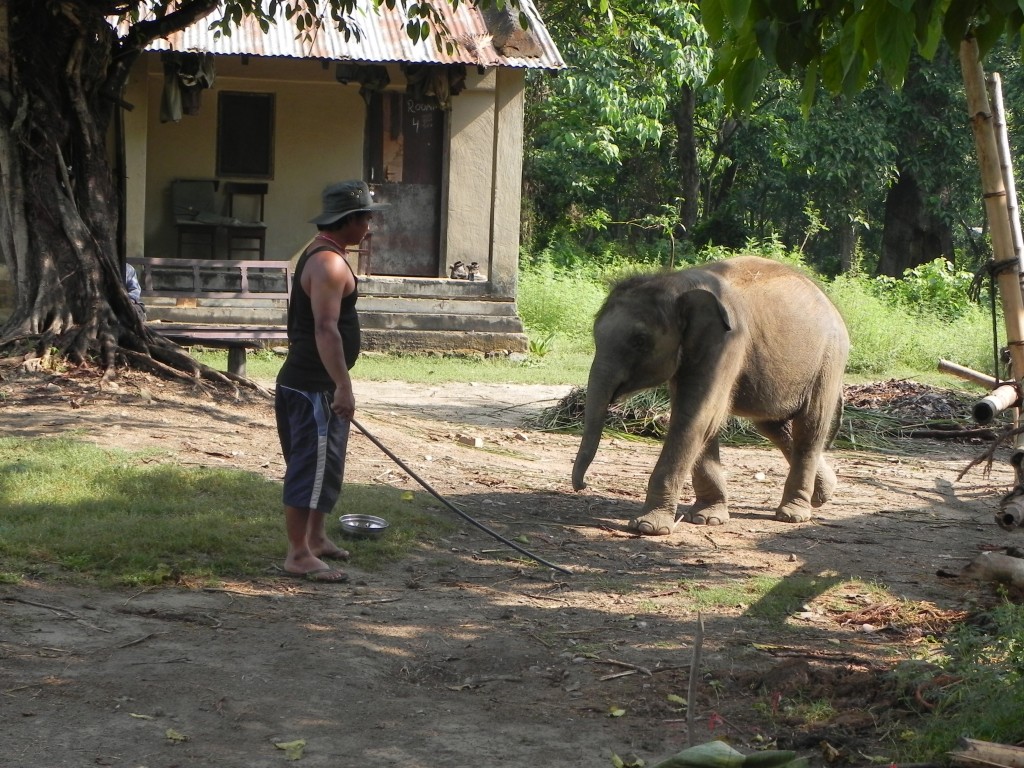
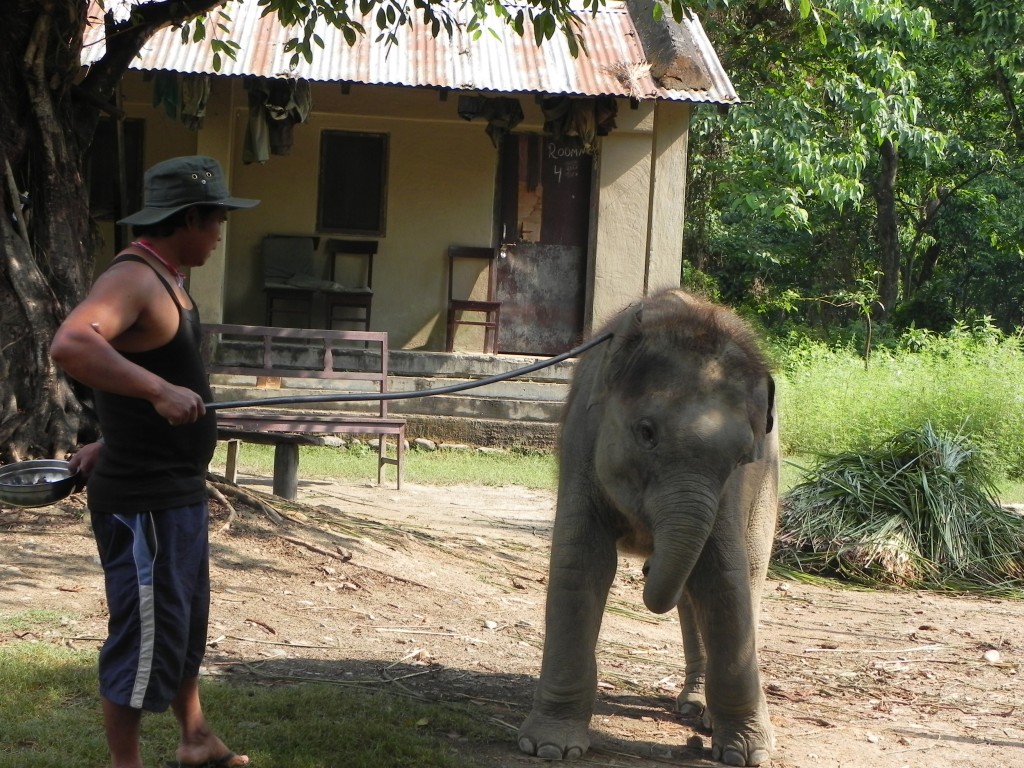
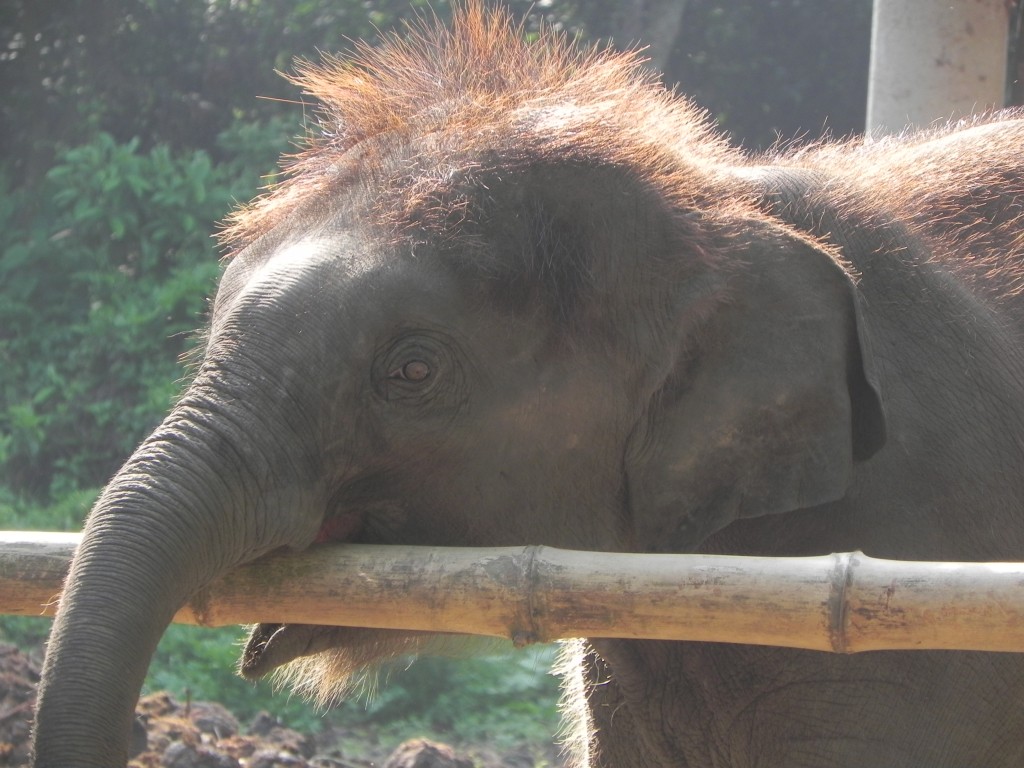
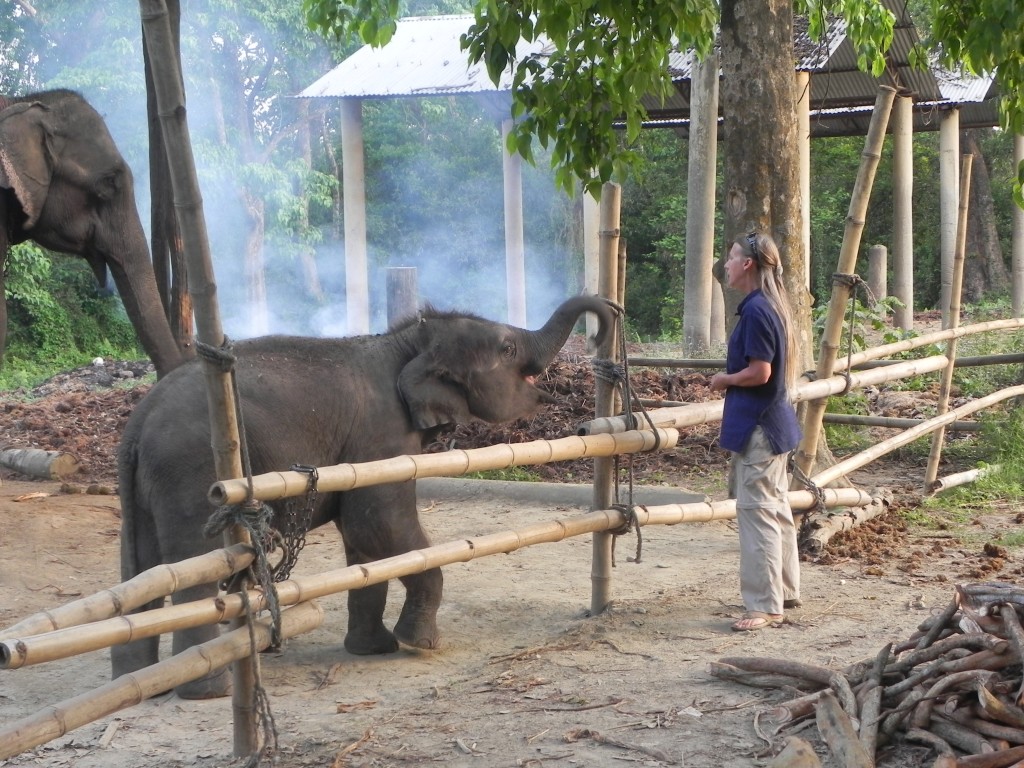
    I’ve got a new heartthrob. He is smart, dark and seriously handsome, with a full head of fiery red hair! Admittedly on the young side, Bhadra still lives with his mom and spends the entire day gallivanting in the Chitwan National Forest.

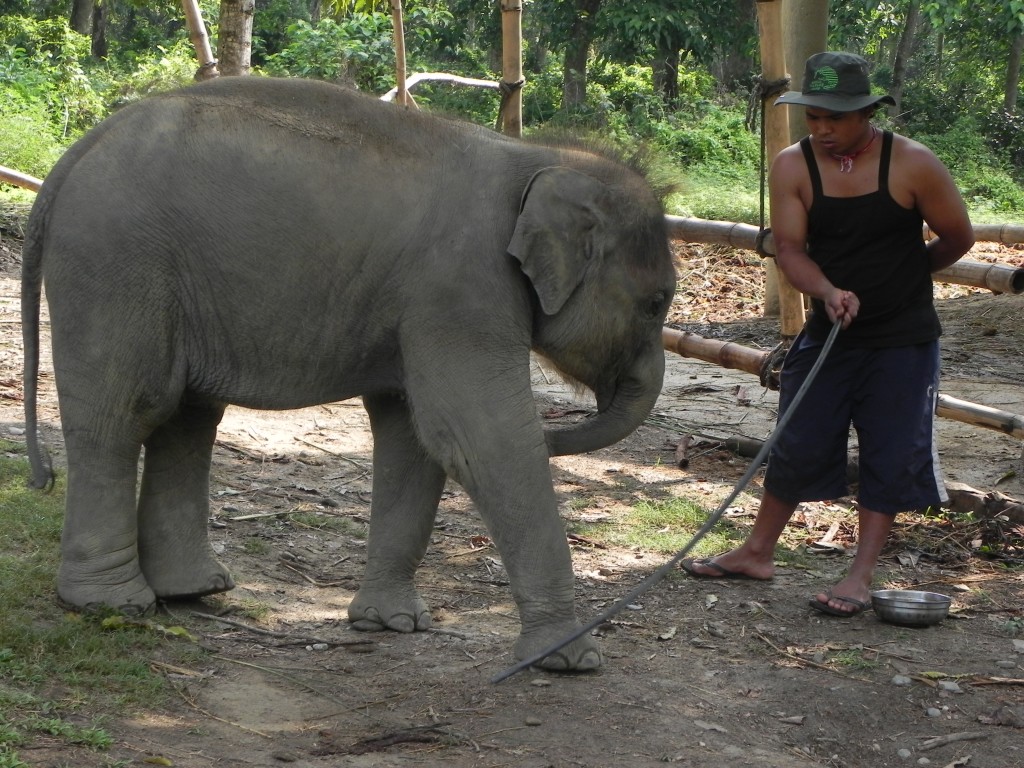
    We met two days ago and have spent only limited time together but let me tell you this little boy is smart. He is my latest ele-student, one year old and full of spunk and sweetness. There goes another piece of my heart!

    Bhadra lives at a private resort on the border of Chitwan National Park with his mother, his sister and other non-related family. The resort has been closed for a couple of years, making life that much easier on this elephant family. No tourist rides, just lazy days in the forest and short training sessions, when Bhadra gets to demonstrate to his mahouts what elephants are capable of when trained through positive reinforcement.

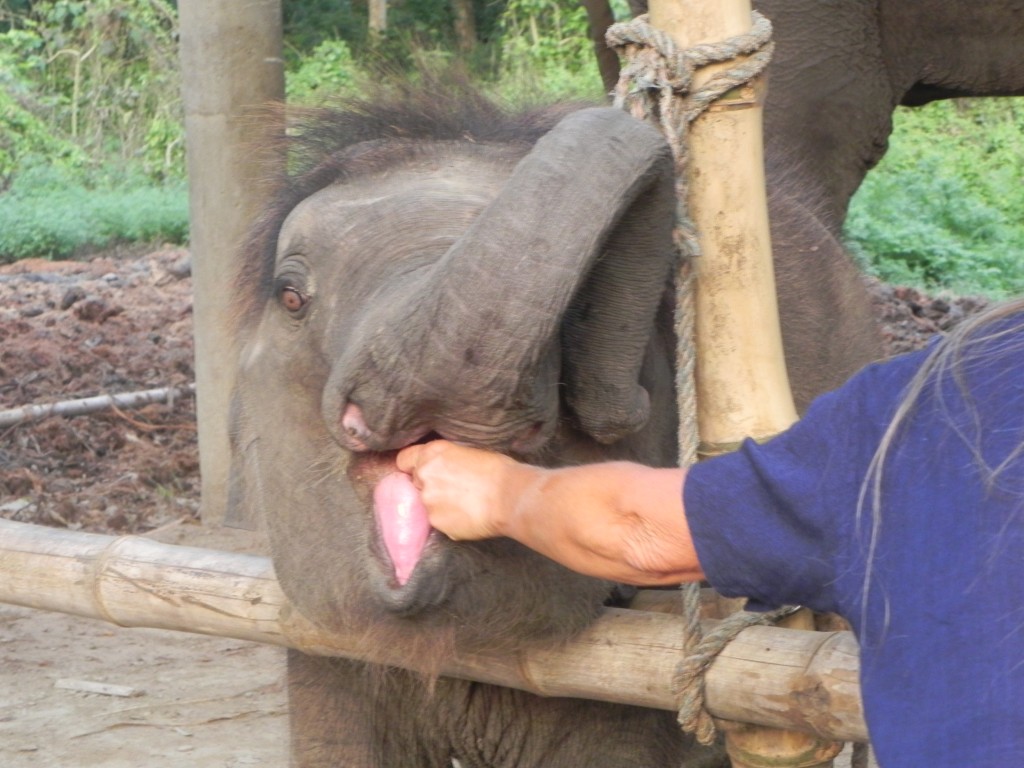
    The mahouts have been fabulous, very interested and engaged. Bhadra has only had four 15-minute sessions over the past two days and now responds to agot (come here) and ra (stand still), and presents his pow (foot), kan (ear) and thuk mud (head) when asked. Things were a little slow getting started because Bhadra surprised me by not liking bananas or apples. His mahouts knew exactly what he would like — molasses. One taste of the favored treat and he was all ears, head and feet!

    What a blessing it has been to work with him. Hopefully together we have planted a seed with these young mahouts.

  • Kasara Camp

    Kasara Camp

    Today I traveled many kilometers through Chitwan National Park to reach my foot trimming clients. To get there, I hiked to the river’s edge, boarded a small sailing vessel, crossed a river and drove through a magnificent forest, crossing over creeks on what I would call barely-bridges (as opposed to sturdy concrete ones). It was a wonderful adventure!

    When I reached the river, the tourists were packed like sardines in their low-rider boats with a boatman steering them lazily down river. Dr. Geare, the head Government veterinarian at Chitwan National Park, Chitra, a vet tech who works with Dr. Geare, and I were ushered onto our private dugout canoe with removable seats (little wooden stools that fold up against the side of the canoe when not in use), which silently glided across the river to the sand bank on the opposite side.

    Our driver magically appeared. We climbed into a truck and I must say had a ride of my life. It was only after we picked up several young soldiers hoofing it back to camp that I was able to release my firm grip on the door frame, the only thing keeping me from bouncing out of my seat and hitting head on the roof. The weight of the men in the back gave the truck better traction and kept the back end from bouncing up and down like a trampoline. It was a great ride through a beautiful forest.

    Within minutes a wild boar had crossed the road, male peacocks could be seen and heard sounding their calls, a monkey clung to the side of a tree, a couple of deer flashed by and too many muggers (crocs) sunned themselves along the back of a small creek.

    Our destination was the Kasara forest camp where four government elephants live. What a shift from Sauraha. Don’t get me wrong — Sauraha is a nice place for the government elephants — but in Kasara the elephants are really living in the forest. If I could only get rid of the chains and hobbles and put up some hot wire fencing, I would really feel as if I was helping them. Okay, one thing at a time — first feet trimming and then more freedom!

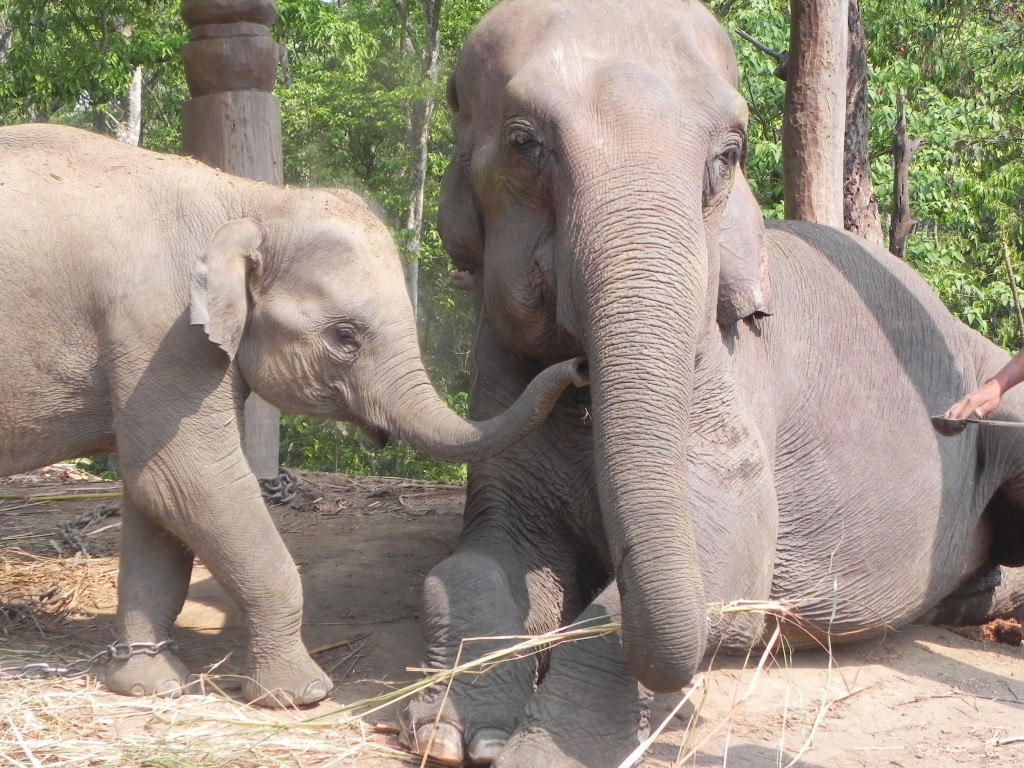
    Kiran was not with us today, but Chitra also excels at foot trimming. Upon arrival, I found that instead of the three elephants I was expecting there were actually four. Three elephants were scheduled for foot trims which is why they made it on the list, or maybe it was because the fourth elephant actually is unnamed. She is Laxmi Kali’s year-old calf. When I asked her name, a slight hesitation was followed by, “Her name is Laxmi’s calf.”

    After spending several days trimming the feet of privately owned elephants, I must admit that today really highlighted the differences from those owned by the government. The government mahouts seem to have a much better relationship with their elephants. They do not yell incessantly nor strike their elephants absentmindedly, which is good because Chitra and Dr. Geare had already heard my request for no pit neu. Actually, my request has grown more sophisticated following an impromptu Nepalese lesson I had last night. I was told that no pit neu is nonsensical and that the proper way to get my point across in proper Nepalese is hati lie na pita, which translated means, “Do not hit the elephant.”

    The foot trimming went smoothly, with the mahouts seeing for the first time how to administer proper foot care. They were very interested and helpful, and each appeared proud when his elephant’s trimming was completed.

    Just as we were finishing up with Laxmi Kali, her calf decided that it was time for a drink and let out a boisterous “I’m thirsty!” yell. Mom immediately threw her hind leg in the air to get up, a fair warning to the mahouts that she really needed to respond to her calf. We all laughed, knowing how the babies call the shots. Laxmi jumped to her feet and baby got the drink she was so thirsting for.

  • Nepal Mobile Pedicure Parlor

    Nepal Mobile Pedicure Parlor

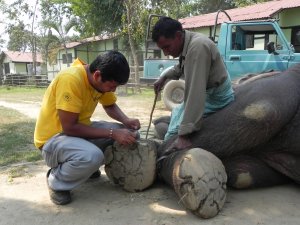
    Foot trimming with the privately owned elephants started yesterday. Once again Kiran, a veterinary technician working with NTNC and the government in Chitwan National Park, came through, setting up the foot trimming schedule and arranging for the elephants to be at the stable.

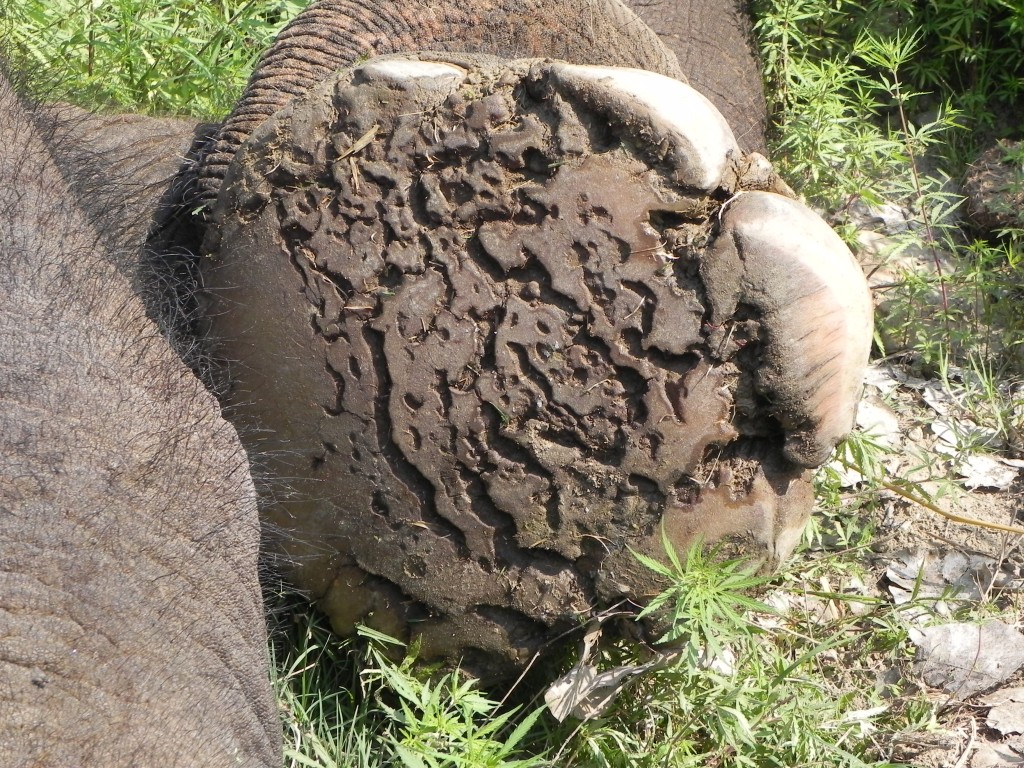
    Sona Kali laid down to expose feet in dire need of trimming. Her back pads were okay but the nails on all four feet were severely overgrown, decayed and split. The pads of her front feet had deep black tracks of bacteria.

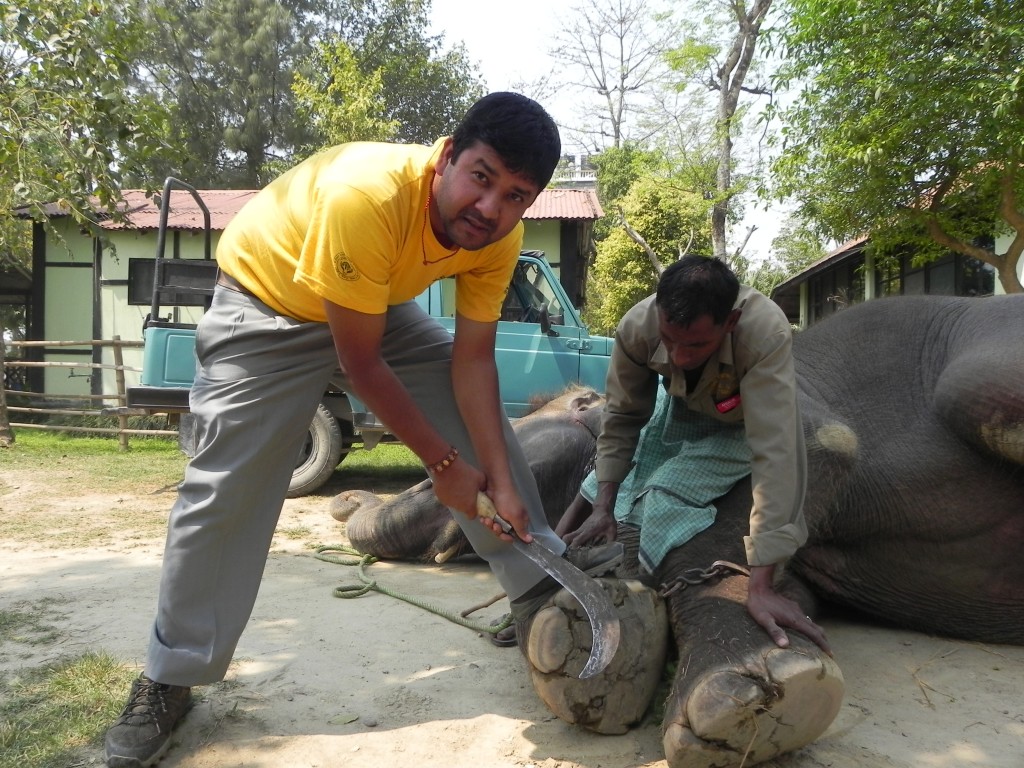
    The first difficulty we experienced was the mahout’s failure to respond to Kiran’s direction. At first I thought he was ignoring Kiran and then it seemed he did not understand what Kiran was saying. Araw means stop and, even if you don’t speak Nepalese, a mahout would know that word because they use it with their elephants continually. But when Kiran said “araw,” the mahout kept cutting. Without hesitation, Kiran took the knife and continued the trimming himself. The mahout training was a bit slow at first but when he finally started following Kiran’s directions, it seemed that he could end up being a good foot trimmer.

    Kiran’s and my partnership is well established. He starts with the big cutting, shaving down the overgrown nails, and I follow up with digging out the rotten areas, taking off more of the overgrown nail and shaping everything into place. It is a pleasure to work with him, not only because he does a good job but because he takes pride in doing a good job. When I am deep in concentration focused on a problem area Kiran will say, “Carol, please,” which I have come to understand means “move out of the way with that sissy knife and let me cut away more of that excess nail.” I am happy to oblige him because I can save my energy for sculpting.
    I must admit that Sona Kali’s feet had me sweating — they were definitely the most overgrown so far. We were able to trim her nails into shape but the thick tracks of bacteria were so deep between the toes of her front feet, it will take several follow-up visits over the next many weeks to bring her feet back to health.

    With all that Kiran has done to make this Nepal Mobile Pedicure Parlor a success, I want to raise some funds to show appreciation. There are forty private owned elephant here in Sauraha so we have our work cut out for us, but the effort is worth it: the elephants will have healthier feet and the mahouts will acquire additional skills. The truth is that I could not have provided this service without Kiran’s assistance.

  • Sweetie Kali

    Upon returning to the National Trust for Nature Conservancy in Chitwan, I was surprised and pleased to see Sweetie Kali still there. Last year I was told she was to be moved to the zoo in Kathmandu.

    Sweetie is less than ten years old so it was difficult for me to understand such a move. In Chitwan, Sweetie has daily access to the forest, the river, free grazing and foraging and lots of other elephants –: a life that provides benefits she would not experience in an urban zoo.

    Today I saw little Sweetie Kali moving at a fast clip, of her own motivation, across the expanse of community forest that borders Chitwan National Park. She and seven of her counterparts were in pursuit of a rhino that was to be radio collared. Gracefully moving faster than the other elephants she accompanied — all were her seniors — Sweetie Kali exuded pride and self confidence.

    I found myself caught in a quandary: why was I feeling positive about Sweetie’s engagement in this rhino search?

    It seems that I had allowed myself to let go of my personal opinion that Sweetie should not be working and allowed myself to experience Sweetie’s reaction to her involvement. Her self-motivation was obvious; there was no fear or apprehension or even hesitation on her part. Quite the contrary. A hint of a smile graced her baby face when she was able, without prodding, to overtake the other elephants in her group.

    The fact that Sweetie was part of the search party is testament to her skill and confidence level. Each elephant must contain the confidence to remain in pursuit, even when charged by an angry rhino. Sweetie has proven that she’s got what it takes: not fear of her mahout but confidence in him and most important, in herself.

    Sweetie’s mahout rode gallantly atop her bare neck, projecting the image of a proud father. He never struck her or yelled, but encouraged her to challenge herself to move faster than the others, cutting them off and gaining rank.

    The look on her face was priceless — she reveled in the game. Her age gave her an advantage. Being young, Sweetie does not suffer the aches and pains experienced by her elders. Her gate was smooth as a still lake and her attitude reeked of confidence.

    I saw young Sweetie Kali and all the forest patrol elephants in a different light today. These elephants will never return to a life in the wild; they will spend their entire life in servitude to man. Within such parameters, I cannot think of a better way for them to live than amongst their comrades, immersed in the forests, engaged in stimulating elephant-friendly activity that keeps them fit and confident.

    No, I am not advocating that captive elephants should work for their keep, but they do. What I do support is that they be treated with kindness and respect and allowed to live a life as close to nature as possible. I believe that we can improve upon the life of forest patrol elephants, making improvements to their welfare. But short of returning them to a safe wilderness (which does not exist), these captive elephants are the lucky ones.