Lek’s Surin Project

Written by

in

,

June 23

The Surin Project is a new effort that Lek has undertaken. I was not aware of just how many projects Lek is involved in. Her plate is full.

We arrived in Surin after a 13-hour overnight bus trip. Even though the accommodations on the bus were top of the line, 13 hours in the same seat can wear on you. We joked about being able to fly to Australia and back in the same amount of time. Regardless of the temporary uncomfortable situation, the long bus ride was worth it; no words could effectively describe what we would experience over the next week’s time.

For the Surin trip I joined a group of Elephant Nature Park volunteers from around the world — the US, Australia, England and the Netherlands. It was a diverse and dedicated group of elephant lovers ranging from 16 to 56, what fun!

Lek’s Nature Park Surin Project is in conjunction with the Thai government. In an effort to get elephants off the streets of Bangkok, the Surin Provincial government has set aside 2000 acres. Mahouts are given a place to stay with their elephant and paid to have their elephant on display. Unfortunately, display means chaining the elephant up all day — not much of an improvement for the elephants, but it’s a start. Mahouts are paid extra if they put their elephant in the show that is presented to the public twice daily.

160 elephants currently reside at the government center, half of them males. As you might imagine having so many individually owned elephants in a relatively small area can be challenging. The biggest problem right now is lack of available food for the elephants. The monsoons are late in coming and everything is quite dry. The demand for food has resulted in owners having to drive great distances and pay higher prices to feed their elephants. Many elephants are quite thin as result of the shortage.

The number of calves on grounds is frightening. Each elephant an owner has increases the amount of money he receives from the government. I don’t believe owners are breeding just for the money but it is uncertain what will happen over the next decade with so many calves being born.

The government has big plans for this place. They plan to dump 60 million into developing this project as a tourist destination. Their goal is to return Surin to its previous status as the elephant capital of Thailand.

So far we have prepared elephant grass for planting, planted two fields of elephant grass, constructed a shade structure, weeded areas where elephant grass and bamboo were previously planted and spent time with our sponsored elephants in the forest, ponds and river.

Everywhere you turn there are elephants; the place feels a bit crowded to me.  It is set up like a reservation with elephants being the prominent fixture of the landscape, tethered under trees, shade structures or in the direct sunlight without shade. Most are alone, unable to interact with other elephants.

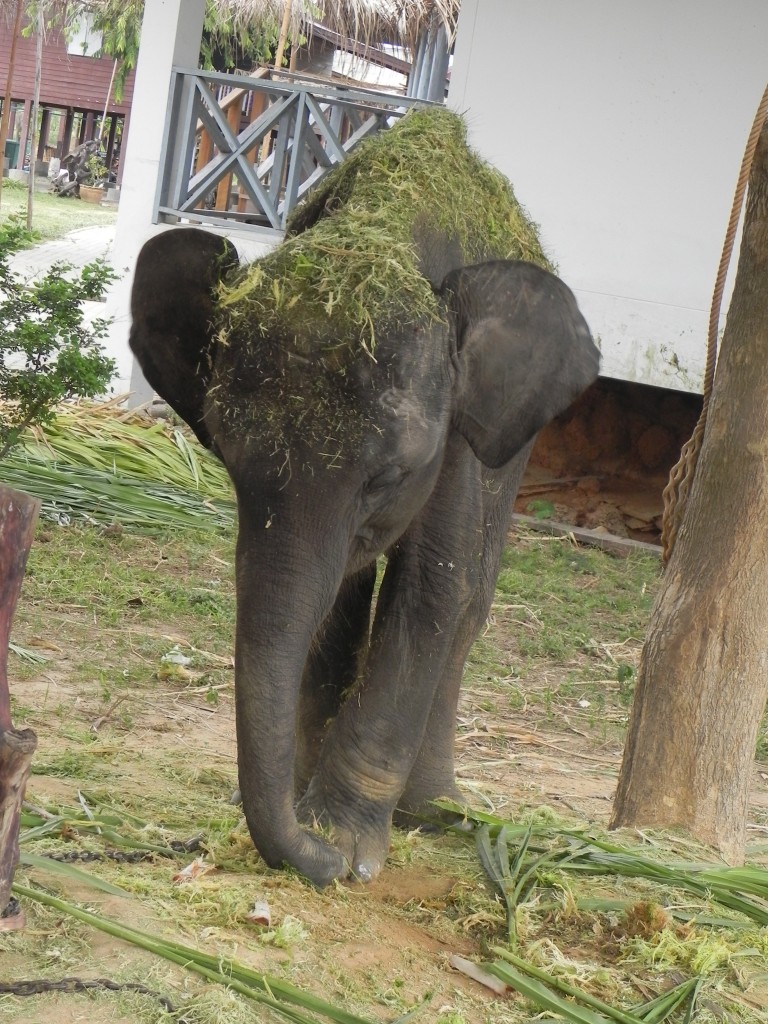
A two-year-old calf has caught my attention. She was recently separated from her mom because the mother’s milk supply had dried up. I was also told that the mom was difficult to handle whenever the calf was around so they separated them to gain control over the mom. The calf is seriously thin and has a problem eating grass. She is ravenous, chewing mouthfuls of broad leaf grasses to a pulp. But after chewing the grass she spits it out instead of swallowing it.

The vet was on grounds today. Alex, the project manager, spoke with her at length about this baby.  The problem of ownership, authority and the lack of elephant welfare awareness was offered up as the challenges the vet faces when trying to help one of the elephants.  The vet has no authority to intervene if an elephant is sick and suffering.

The calf’s owner does not live on-grounds but, by sending her to the facility each day, he receives a monthly payment. The calf walks two kilometers roundtrip daily, to be chained on display and make an appearance in the show.

I was so pleased today when the vet engaged Alex regarding the calf’s condition. Her medical history was shared and recommendations for tests that I received from Dr. Mikota were discussed.  Hopefully we will be able to get help for this baby.

In the meantime, I continued to try to find a supplement she will eat. For two days I have been experimenting with different rice mixtures. This afternoon I succeeded and Baby finally started eating. I will keep you posted.
Comments

8 responses to “Lek’s Surin Project”

  1. willabelle Avatar
    willabelle

    Hi, Carol. Have you gotten to see Medo at ENP ?? I’m very curious as to how she is doing. Does she seem content and in (relatively) good health, given her condition ?? Any information on her would be greatly appreciated. Thanks so much for sharing your experiences with us – I eagerly look for updates every day. Take good care (of yourself and the eles) and thanks again for all you do !!

  2. anndwyer Avatar
    anndwyer

    Thank you so much for taking the time from your extremely full days and nights to share with us the details of your visual experiences as well as your personal impressions. Your insightful ethnographies are an extraordinary learning experience for us who cannot be in that distant world. The cultural relativity regarding the elephants’ place in different situations and environments is alarmingly contradictory and phenomenally challenging in some regards. It is staggering how you experienced within a period of two days, the extremes of Hell at the nightmarish tourist facility and then to the Heaven of Lek’s wonderful facility. And yet the previous pictures you paint of the instances of respect and compassion, as well as the openness to suggestions for improvement, have been surprisingly uplifting in spite of the enormity of critical need in many places. They are indeed very fortunate to have your knowledgeable input as an ambassador of Hope and Change.
    Blessings and continued safe journeys.

  3. trunkhugs Avatar
    trunkhugs

    sounds like they really need you there, Carol.
    These elephants really need help.
    Bless you for being there for all of them and Lek too! <3

  4. Anna Avatar
    Anna

    What an amazing set of experiences and memories you are collecting! I am entranced by it – from the heartbreaking to the heartwarming. I look forward to the day you can also share your photos, and add your integrated analysis of your overall trip.

    Many blessings to you for your commitment to the well-being of elephants.

  5. Anita C. Avatar
    Anita C.

    I remember reading the elephant diaries of the Sheldrick orphanage where they mentioned initially Daphne Sheldrick tried and failed to find a formula for the milk dependent babies. After much effort and much heartache the supplement they finally gave the elephants contained coconut. I am particularly interested in this venture of yours because I’m curious as to whether the Asian elephants would benefit from the same baby formula as the African elephants. If anybody can do it, you can. If I’m not mistaken, you raised and fed Tarra when she was a milk dependent baby and look how well she’s doing! Please keep us posted.

    Good luck, Carol.

  6. sherryheim Avatar
    sherryheim

    It seems that there are different societial ideas about elephant care each place you go. Thankfully, there also seems to be a few like-thinkers in each of these places you have visited. To think of elephants handled like cattle is pain-inducing to say the least. While it is uncomfortable to see cattle packed into gates squeezed together, it appears that cows don’t mind that so much; they seem relaxed and fine with the idea, or at least conditioned to it. Then we have elephants who would no more wish to stand around packed together, in an area saturated with stale urine and feces, than do headstands. One has to wonder why anyone would assume that this was a satisfactory way to keep elephants. While it is all agrivating, at least these elephants have a pretty good chance at survival, unlike many of their wild roaming sisters and brothers who will be killed for impingement on human areas. I am trying to keep a balance in my head about all of this but it is difficult when I know that each elephant deserves the opportunity to be who they are and to be granted their dignity. Elephants are too intelligent to be handled in these manners and I know that elephants thrive when allowed to just be elephants. You have so wisely said, “One elephant at a time.” but I wish I could wave some magic stick and change things for all of them, immediately. Again, you have treated us to another priceless adventure, even the parts that are difficult to accept. Perhaps it is in wrapping our brains around the bad things that happen to elephants that will stimulate us to work even harder to free them all. Some of what you have related makes me feel that, perhaps, even a zoo elephant has better care and communication. Thank you for sharing, I love your “Travelog blog”. Be safe and enjoy your time with the elephants. Hopefully, one day soon, you will be sitting under a tree, relating all your stories to “our girls” in Tennessee. God bless you,Carol, because each elephant who has touched your life is blessed by having known you. Never give up the fight for elephants, for your home and for complete ownership of your dreams.
    Namaste

  7. Beth Avatar
    Beth

    Oh Carol, I will be thinking of this little calf now. I hope you do find the right mixture in feeding this baby. I know it took Dame Daphne Sheldrick years to find the proper feeding mixture for her orphans in Nairobi….maybe someone could get in touch with the Trust there? Yes, please keep us posted….

  8. guyroberts_1 Avatar
    guyroberts_1

    Carol

    Carol, your blog makes very interesting reading and I am really pleased you were able to make it to the Elephant Study Centre in Surin and get first hand experience of the wonderful work Lek and her team do there to help support the mahouts and their families, as well as the elephants. I was saddened to read about your thoughts on the baby elephants at the park. Lets hope they are not borne out, as it would a terrible unintended consequence.

    Just so as your readers know, you can actually get an overnight sleeper train between Bangkok and Chiang Mai and then either the train or bus from Bangkok to Surin, which having done so myself sounds much more comfortable than doing the entire journey in a mini bus.

    I look forward to reading your future posts.

Leave a Reply

Your email address will not be published. Required fields are marked *