Author: Carol

  • Mudumalai Tiger Reserve

    Mudumalai Tiger Reserve

    May 30

    Finally…I have seen my first wild elephants. Two small herds: one with four females — two adults with two young calves; the other with two young calves, two adults and an adolescent tusker. They grazed on the tender grass growing in the speckled shade, protected from the direct sunlight by a mature canopy. Our presence went undetected as we, following the rules, did not stop our vehicle. It was a calming sight to behold.

    My time was spent meeting the forest authorities, including veterinarian Dr. Kalai, who toured me through the facility. The pride he has for his work was obvious. Knowledgeable and engaging, Dr. Kalai was a fountain of information about how the camp operates.

    It makes sense that the wealth of knowledge Asia’s experts possess about their elephants is unmatched by any other nation. Living with this indigenous species has provided Asia with a wealth of knowledge, not only of elephant life in the wild and captivity but, more recently, the challenge that is threatening the Asian elephant’s existence: human-elephant conflict. The forest personnel, professors, biologists and researchers I’ve met all show a genuine desire to find solutions before it is too late. So many bright and dedicated people unified to save this flagship species so important to its habit and fellow creatures, including mankind.

    This forest camp is expertly run from top to bottom. In the food prep area the camp elephants’ diets were listed on a huge board with the ingredients and supplements included in individual diets. I got my first look at the “cooked” diets I had heard so much about. Lined up in neat rows on the diet table were blocks of precooked foods recently removed from their moulds.  Some were topped with salt and other additives, sitting ready for the next stage in the process of elephant diet making.

    Sanctuary volunteers who tired of the endless produce chopping which dominated their service at the Sanctuary have nothing on the assistant mahouts in these camps. They are solely responsible for measuring, cooking, moulding and finally hand mixing each elephant’s diet, a process that demands precision and effort, not to mention repetition. Needless to say I was impressed.

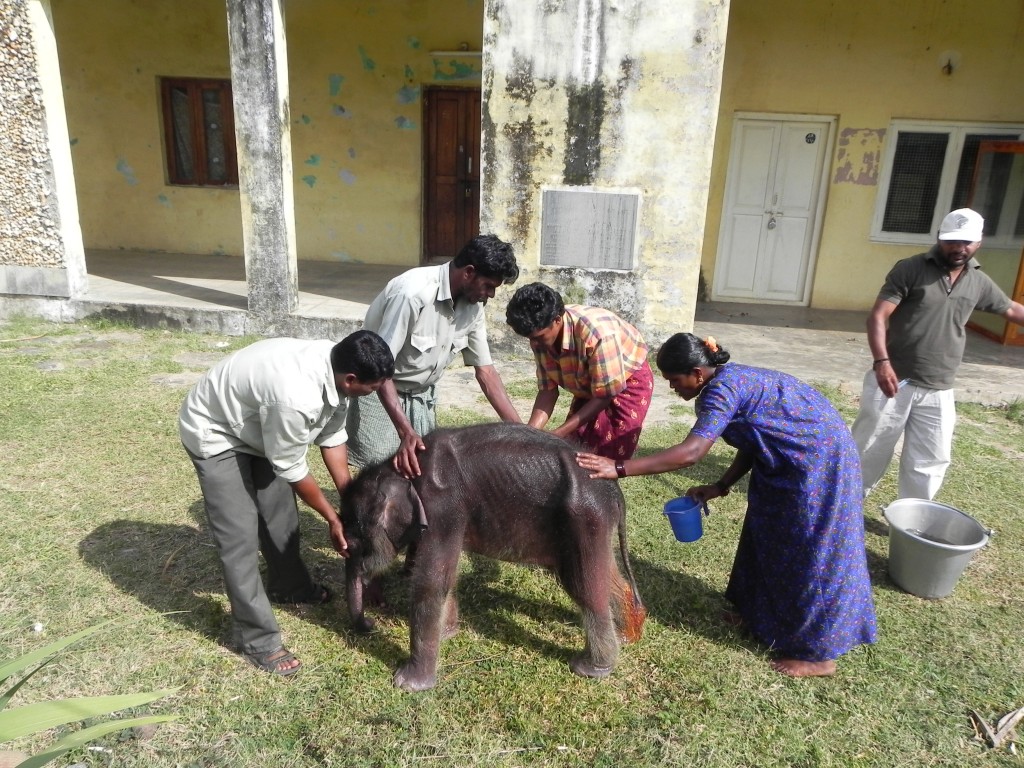
    Only a few days before my visit an infant calf had to be rescued after being attacked by a crocodile. He survived the attack but his mother and family could not be located. Every effort possible is made to avoid bringing a calf into captivity but in this case there was no other choice.

    I observed firsthand that, indeed it takes a village, or should I say a tribe, to hand raise an elephant calf. The family responsible for this calf’s care had only recently turned over parenting of a young female calf they had raised for the past three years. They surely needed a break from the constant demand of a baby but took the new orphan in without question.

    Watching the parenting dance the family gracefully engaged in was mesmerizing. The father of the family was the calf’s primary caregiver. The matriarch prepared and provided the formula. The veterinarian directed veterinary care, which was provided by the veterinary technician. Each person has a role to play in the calf’s care. An older child assisted with tasks to support the calf’s care and medical treatment and a young granddaughter babysat, expertly I must say. They did not actually fawn over the calf but provided the security he needed. So young, he was obviously unable to understand his circumstances. Relying on survival instinct he followed around after a warm body. I am told that in a few weeks he will differentiate between the warm bodies but for now any warm body will do.

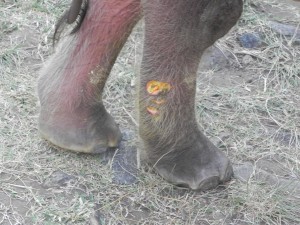
    His wounds were deep and treatment was painful. Throughout, his entire family showed care and gentleness, their skills expert, their compassion palatable. My heart went out to this little guy, who was sort of walking in a fog but, if he had to be separate from his mother and herd, he could not have been in better hands.

  • Changes for the Better

    May 26

    Today’s quest for knowledge about elephants living in captive environments in Asia took me to an ashram. Two elephants live here: a mature male and adolescent female. Both were gifts from devotees.

    The massive ornate buildings, expansive outdoor theater, manicured lawns and extensive landscaping suggested that this organization was experiencing good fortune. I felt sure the elephants must be benefiting from the organization’s success as well.

    I was told the organization owns 200 acres. On our drive to the location where the elephants were kept we saw how developed the property was. On this day there were hundreds of devotees on grounds. The gift shop was well stocked and crowded. The lakeside was being utilized by many people. The place was spotless with many well dressed staff members walking around grounds, obviously engaged in a variety of duties.

    When we drove up to the stable area I saw a large tusker in full musth. He was double chained by one front and one back leg. A fresh pile of corn stocks lay at his front feet and, due to his musth condition, a dark viscous fluid drained down the sides of his face. He was rocking from side to side while activities unrelated to him were conducted around him.

    The young female who was around eight years old was lying perfectly still in a concrete bathing pool while the Phandis scrubbed her entire body with a plastic bristle brush. After thoroughly scrubbing the young elephant on one side he commanded her to rise halfway and to lie down on her opposite side. She responded obediently.

    There was so much activity going on and people walking around the area that I wondered how the tusker was dealing with it.  A group of men were constructing a shade roof over a concrete pad for the young female. The Phandis did not allow her to dust herself, which was difficult as she was kept on dirt. When the shade structure was completed both elephants would be living and sleeping on concrete.

    It made me really nervous when two people approached the tusker. His musth condition was obvious. The first person reached his hand out. When the tusker did not respond, the visitor walked away.  The second person took two more steps closer. She was attempting to get the elephant to touch her, or more accurately “bless her.” Luckily one of the staff yelled for the devotee to move away from the elephant. It was pretty good timing as the elephant did turn and look at this woman, who was within his reach. Fortunately no one got hurt but the environment this musth male is being kept in is dangerous for visitors and unhealthy for him.

    Just about this time a squeaky clean elephant emerged from the bathing pool and was prepared for her afternoon duties. Her Phandis painstakingly, and with quite an artistic flare, drew flowering vines across her forehead and ear flaps and down the side of her face. Not once did this young elephant attempt to touch the chalk design being drawn on her.  She was behaved, but skittish. When she was escorted a few hundred yards away to be outfitted with a neck-bell and name plate, getting her to move past a small plastic canopy proved difficult. The staff explained that “this elephant is afraid of everything.”

    To my complete surprise an audience with the center’s founder was granted. Unfortunately, trying to have a serious conversation about the condition of his elephants and improvements needed for their welfare was hampered.

    The bejeweled, expertly painted and full of devilish energy elephant that I had observed at the bathing pool was groping the master as he feed her apples. This young elephant seems to know clearly that in the presence of the master she would not be reprimanded for being pushy. She took full advantage.

    It is not that I feel she should be well behaved but her proximity to a group of onlookers and willingness to wrap her trunk completely around this rather frail looking man made me cringe. The display escalated to the point that the elephant was pulling the master into her chest to get her apples. Smiling ear to ear, he resembled a limp rag doll; I had to turn away.

    Yes, I was concerned for the master who obviously had no idea the danger of his position, but I also felt really bad for the elephant. One day when she becomes too pushy she will pay the price, so many elephants in captivity do. I only hope her circumstances change before an accident happens, sparing her and the master.

    So the good news is that we met and spoke for a short time with the master. The organization has the land and money to implement improvements so that the elephants can live off chains, have access to tens of acres of wooded area and pasture and are free to bathe at will in the large natural lake on grounds.

    The idea is to reverse the current way the elephants are being utilized. Instead of the elephants going onto facility grounds to bless the devotees, improvements will include building a fabulous place that meets the elephants’ needs and discontinuing the practice of the elephants walking on grounds.

    Instead of the elephant placing her trunk on the devotees’ head for a blessing, the devotees will receive a blessing of another kind. They will be witness to the improvements their support of the ashram has meant for these two elephants living in captivity.

    The master stated that he did not like seeing the tusker in chains. He stated that if recommendations can be provided they will be implemented. This organization has the support and funding to do whatever they need for these elephants. Plans are being discussed with the hopes that implementation will occur quickly.

  • CUPA

    May 24

    I spent the day with Suparna Ganguly, a trustee of CUPA, Compassion Unlimited Plus Action,  a well-respected animal welfare NGO doing fabulous work in India.

    In addition to running a dog and cat shelter, CUPA operates a rehabilitation facility outside of the city, adjacent to the Bannerghatta Biological Park. Suparna is actively involved in many animal welfare projects, with welfare of elephants in captivity currently a main focus.

    CUPA underwrites the cost of care, including the mahout’s salary, for an elephant confiscated from a temple who is currently residing at the zoo.

    The rehabilitation facility sits on seven acres enclosed by a substantial electric fence.  The village is on one side and the wilderness on the other.  Wild elephants come down into the village and raid the farmer’s fields so the government is constructing a block wall to keep the elephants out. From what I understand the wall has been under construction for a few years and is now close to completion.

    CUPA’s rehab facility was built on land donated by the government, on the elephant side of the wall. Only two nights back a wild bull elephant took down several sections of the electric fence, giving him full access to the rehab facility. He did no damage to the buildings but he did eat a couple banana trees, sampled a few other varieties of trees and no doubt was observed by the rehabbing monkeys, since the banana trees he ate were inches from their cage.  He damaged more fencing on his way out as he exited on the opposite side from where he entered. It was sort of surreal to be inspecting a fence that so recently was damaged by a wild bull elephant.

    I toured the spotless grounds with cages, aviaries, ICU and a surgery room. The varieties of the soon-to-be-released birds and mammals were mostly foreign to me, some quite rare.

    When the veterinarian appeared, we were ushered off to one of the flight cages to release several kites who were ready to be set free. Being unfamiliar with the process, I was dumbfounded when a handsome adult bird, the size of a large rooster, was handed to me for release. The timid creature held his/her head down, mouth open and held very still, no doubt quite scared.

    “Throw it up into the air!” I was told. I scanned the immediate area for a fairly unobstructed flight route and threw the bird skyward. With little effort she spread her wings with grace and precision, catching the hot-air draft and flew off. What a thrill to be able to set this magnificent bird free. I have never experienced anything like it.

    In fairly quick succession four birds were released, leaving several more in the flight cage. Their time for release would come soon. As we walked back toward the building I glanced up to see five gently soaring kites overhead. The newly released birds were floating, catching a draft, swooping down and then back up again, riding the invisible sky waves. The new arrivals to the sky had been joined by another of their kind; now all five danced over the rehab facility, blessing the place that had protected them and given them back their freedom.

    The main reason for my visit to the rehab facility was to evaluate it for elephants. I learned that CUPA hopes to acquire an adjacent 55-acre parcel of land and develop it for elephants. The land, once over-used by the villagers, is beginning to recover. The grasses are spreading and a few trees have begun to grow.  A rock formation that was used as a quarry now serves as a water basin, holding hundreds of gallons of rain water.

    We walked the property as I listened to the plans to create room, initially for two rescued elephants. India’s new regulations requiring all zoo elephants to be moved to sanctuaries has caused quite a stir in the country, with strong opinions on both sides of the issue. CUPA would like to create a prototype of what can be done in an effort to move the process forward.

    We discussed, among other things, available water, shade and access to the adjacent government-owned forest land for the elephants’ night release. There is a lot to consider but the fact that India wants to make internal changes to address elephant welfare is incredibly encouraging. I am honored that my input has been solicited.

  • Final Day in Assam

    May 22

    Yesterday was my last day with Dr. K. K. Sarma and his health camp team: Kalita (elephant owner and management expert), Manav (assistant vet to Dr. Sarma) and the ever-inspiring elephants of Assam.

    Interestingly enough, I find myself somewhat desensitized to my foreign surrounding. That is, until I get into a vehicle, but that is a story for another time. At all other times I feel no borders between us. I am fortunate that my companions speak such fluent English; they can’t say the same for my Assamese. My attempt to casually respond in conversation brings polite smiles or confused looks. Everyone has been very kind to accept my effort to communicate in their native tongue.

    The two privately owned elephants we visited today had recently returned from logging in a nearby province. Well, not so nearby. One of the elephants, 65-year-old Jaymala, walked more than 150 miles in a few days to return to her owner’s home. She was a bit underweight from her labors and the walk, resulting in a strong tongue lashing for the Phandis from both Jaymala’s owner and Dr. Sarma.

    Apparently the Phandis had pushed to get home after completing the logging job in order to be with his family. Although one can understand his desire to return home, he was reminded that while employed as Jaymala’s Phandis his first and foremost responsibility is to her welfare. A discussion between Dr. Sarma and the owner followed, focused on the challenges of finding good staff. I soon realized that no matter how different our customs, staffing issues appear to be universal.

    In addition to her regular Phandis, Jaymala has a young mahout in training. I believe he falls into the category of Ghansi; the grass cutter and assistant to the Phandis. He could not be older than thirteen years but moved with confidence while attending to Jaymala. It was obvious that she was very comfortable with this boy, standing millimeters from him as he prepared her daily ration of ceremoniously-folded banana leaves dipped in a rice mixture.

    The rhythm of the food preparation was mesmerizing. Focused but unhurried, the Ghansi cut a long banana stock in half and chopped off the end. Precisely driving his multi-purpose knife a few inches into the end of the stock, he then used the curved knife to pry the stock in half lengthwise. With a thud, the knife was driven into a nearby stump, freeing his hands to fold the banana stock, including the large feathery leaves, much the same way kuchi is folded. The stock was folded over onto itself and the leaves wrapped around the stock. Then the organic bundle was dipped into a bucket of liquid rice mixture and placed ever so gently into Jaymala’s mouth.

    Calm and comfortable, Jaymala chewed as her Ghansi prepared her next ration, opening her mouth as he completed the process of making the next bundle. When the boy became distracted by the visiting veterinary team, Jaymala would reach out attempting to take a banana leaf herself. Obviously she knew this was not allowed and readily accepted the Ghansi’s verbal instruction to leave it alone.

    My observation was that Jaymala had trained her Ghansi quite well. When he slowed his process all she had to do was attempt to help herself and he would get right back to work. I am unaware of the length of time devoted to this process but it went on for the entire time we were there and would continue until the heaping pile of fresh cut banana leaves and bucket of rice mixture were consumed.

    Later we met up with 55-year-old Anguronala in the town of Goalbara. She was on military grounds, behind a guarded gate, grazing peacefully when we arrived. Recently she had been brought to this area, hired as a koonki to drive away a problematic wild bull that had killed a couple of villagers. The koonki represents a second chance for wild elephants who cause damage in human settlements. In many cases the koonki can drive the wild elephants, including a bull, away, which results in their lives being spared. If a problematic elephant cannot be driven off, the government has only two options, both equally unacceptable: capture or kill.

    Anguronala showed the wear and tear consistent with logging elephants, including an old injury that resulted in a deformity to her back leg. A large log had rolled into the leg, causing a fracture below the knee. I saw a few other elephants with this same deformity, which reminded me of the injury that left Shirley crippled while she was performing in the circus. In each case the crippling injury could have been avoided if the elephant lived in a natural setting and was not forced to engage in harmful commercial activities.

    So many logging elephants have such injuries from being struck by heavy logs while working. Of course the injuries are avoidable — the answer is not to log — but the owners claim that the elephants have to work. Believe me, I am brainstorming with colleagues to come up with ways to help elephants out of this highly dangerous activity. It is a huge challenge but there are many experts who are working to find a solution.

  • thought you would like to know

    May 20

    A few tidbits of information

    In India:

    • Thik ase hobo (teak aw-say hobo) is a polite way to say NO
    •  Nehi nehi (nay nay) is the way to say YES
    •  Tika  means OK

    Bicycles are a popular mode of transportation in India. One bike can accommodate four riders, although most of the time there are only one or two. Most bikes are equipped with a SARI-GUARD. This is the safety devise designed to prevent a female rider’s sari from becoming entangled in the chain and spokes of the bike.

    Vehicles drive on the left side of the road.

    Pedestrians do not have the right-of-way when crossing the street. It can be dangerous and appear strangely comical at the same time.

    Due to the hot temperatures during the day, it is illegal to work elephants between the hours of 10am and 4pm, at least in the state of Assam. It is a welfare issue since elephants will become overheated if worked during the heat of the day.

  • One Elephant at a Time

    May 19

    Yesterday’s camp left me feeling conflicted. These elephants, denied a natural life, yet living within their home range country, seem to be the ultimate in contradictions.

    Elephants represent so much in one being: wild animal, god, beast of burden and fellow earth resident. Coming to terms with the reality of their lives, the lives of all elephants in captivity worldwide, challenges me.

    The Indian government has enacted laws to protect elephants against mistreatment. Regardless, elephants continue to be used for activities that can cause them physical injury. Their godly status does not protect them from servitude. The contradictions are so profound that I find it difficult to find peace with the realities of their existence.

    The human population in this country has exploded. Politics and long-held traditional beliefs fuel the continuation of current elephant management. Long-held traditions could have serious implications for the life and future of one of this country’s most revered and endangered indigenous residents. The beauty of the land and animals stands in sharp contrast to the cruelty man is capable of.

    Yesterday I chastised myself for not doing more when I observed a heavy-handed Phandis treating his elephant harshly. Remaining silent was not a possibility so I pointed out the cruelty to Dr. Sarma, asking if he could justify such treatment. He could not and immediately requested that the supervisor reprimand the Phandis. A problem existed: the Phandis was newly appointed by a high-ranking official. To criticize the Phandis would surely result in problems for the supervisor.

    The cruelty ceased but, by being witness to it, I left the camp feeling in some way responsible. Dr. Sarma told me later that he spoke with the head warden to inform him of the Phandis’ actions and assured me action would be taken. So today I set out for our next health camp with a heavy heart. I could not get Phulmati’s resigned face out of my mind. Such a nurturing and good-natured elephant. Her plight haunted me.

    Lost in thought, I was caught by surprise to see our first patient, Rupalim, grazing off the side of the highway. Young and beautiful, Rupalim is close to ten years old. She lost her mother when she was four and is the pride of her owner. After completing the road-side physical examination and inoculations, Phandis and Rupalim maneuvered across the busy highway and headed up the muddy hill toward home.

    Many kilometers later we found Geeta, Manimala and Bijulee also waiting for us on the roadside, but in a rural area with little traffic. Fresh banana trees were piled in front of the girls, who munched contently. A small crowd of locals had already gathered. Once the veterinary team assembled their equipment and supplies, the crowd grew.

    Initial visual examination by the vet team caused discussion in low whispers. I did not have to understand the language to get the gist that the vet team was concerned about something.

    In my unofficial capacity as team photographer, I began taking photos of the overall condition of the elephants. I quickly saw what was causing the concern. Manimala had a significantly deep gash across her tail, which the Phandis claimed was caused by her rubbing on bamboo. I listened to the unbelievable claim and knew today was not the day to expect me to keep quiet in the face of injustice.

    I zoomed my camera in close to get a photo of the gash across Manimala’s tail and found several other lesser cuts that crisscrossed down the length of her tail. The smaller ones were superficial and uniform, but proof that bamboo was not the cause of her injury. Dr. Sarma agreed as I pointed out my findings and I stated my opinion about the cause of the injury.

    All attention was on Manimala who continued to tear apart the fibrous banana tree in long strips and place them in her mouth. She appeared unaware that the focus was on her. As I formulated how I would handle this delicate situation, because I definitely would not keep quiet, Dr. Sarma informed me that although the Phandis did not admit to causing the wound, he had been fired on the spot.

    The breath I was holding expelled. I realized that Dr. Sarma was as angered as I about Manimala’s treatment. Without prompting he said, “Such a lovely and gentle elephant, how could anyone harm her?”

    Cruelty to elephants is illegal in India. The Phandis could have been arrested and charged for the offense but not without firsthand evidence. The way to ensure that he could no longer hurt Manimala was to simply fire him. Unfortunately, nothing prevents him from getting another job caring for elephants.

    Later, in the car we discussed the ignorant and cruel treatment by some of the Phandis. The entire team voiced sincere disdain for such treatment. A true solution for the problem of elephant cruelty is to elevate elephant management standards, educate the trainers working with elephants and enforce the law.

    I may be half a world away from home but the problems and solutions for elephants in many captive situations are similar. Fixing the problem in one place can act as a prototype for solutions worldwide.

    I slept better knowing that action was taken to protect Manimala. Hopefully the remaining Phandis learned that their jobs would also be in jeopardy if they treated their elephant in a cruel manner.

    The two situations where I observed elephants being handled in a heavy-handed and cruel manner seems outside of the norm. By and large the forest elephants experience a high level of professional care and management. It seems that the elephants used for logging are the ones most often treated cruelly.

  • Each Government Forest Camp and Wilderness Sanctuary is Different

    Each Government Forest Camp and Wilderness Sanctuary is Different

    May 18

    Today’s health camp was held at Pabitora, a wilderness sanctuary where nine elephants reside. National parks and wilderness sanctuaries are government-run and hold different classifications, with national parks holding a higher ranking. In both cases the animals are protected and tourism is not aggressively commercially marketed .

    At 16 square kilometers, Pabitora is considered small but it protects the largest concentration of Indian rhino in the world. Their renowned breeding success is enhanced thanks to the cooperation of the local people; poaching is not a problem. The landscape is unbelievably beautiful with a year-round clean river running through it; by all accounts Pabitora is an Eden.

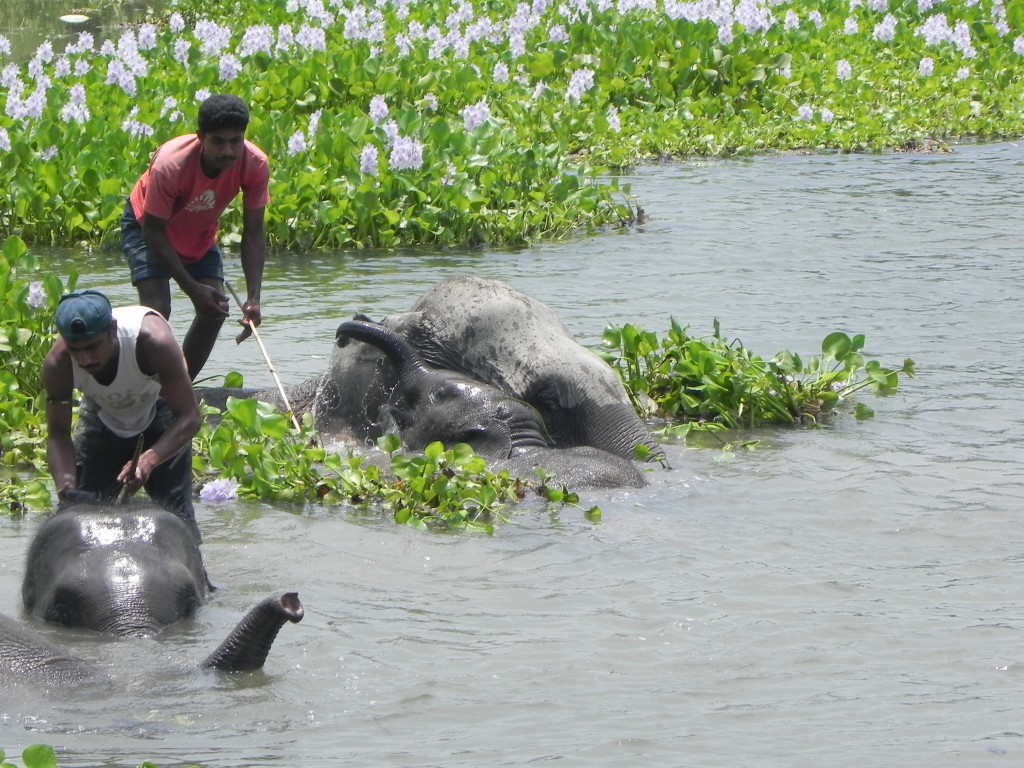
    The elephants were beginning to gather when we arrived. Some had just finished their morning bath while others where just taking the plunge. Bishwajit stuck close to his mother as she carefully maneuvered the river bank entering the shallows. At four months of age Bishwajit is already an expert swimmer, resembling a 500-pound bobbing cork.

    Phulmati is an experienced mother, calm and confident. She never lost sight of her lively calf as she gracefully waded around him. When she lowered herself in the shallows to allow her Phandis (lead mahout) to scrub her skin with a fistful of vegetation, little Bishwajit took full advantage. His comical play included climbing on his ever-patient mother’s face and over her head, concluding with a belly flop off the other side. In between submarine dives Bishwajit would surface and extend his tiny trunk, making contact with his mother’s face every thirty seconds or so.

    Bohagi, Phulmati’s first calf, is already five years old and recently completed her formal training. I looked closely to see if I could find the scars I was confident she would be wearing as result of the training process but to my surprise there were none.

    By the time Bishwajit and his mother emerged from the river, the camp was well underway. The males here outnumbered the females six to three. Two of the males, Naga and Rudra, were recently moved to the sanctuary from the Guwahati Zoo. Even though, in theory, the move is in their best interest as now they live in a natural habitat with access to clean water and live vegetation, their initial introduction was problematic. Bikaram, the sanctuary’s resident mature male was not impressed with the new arrivals and was extremely aggressive toward them. Determining if and how captive males should be introduced to semi-wild environments already occupied by mature males is a subject that will need to be studied to ensure the welfare of all concerned.

    Each elephant has a Phandis, their trainer and caregiver, who attends to their needs, takes them on anti-poaching patrols and ensures they spend many hours each day in prime grazing and foraging habitat. I know we would love to think of these elephants as being free to wander at will and do as they please but that is not possible. The parks are not fenced and human settlements encircle the national parks and wildlife sanctuaries. In the recent past some captive elephants have been released into the wild only to pay a horrific price when they wandered outside the boundaries of their protection and become a pest to the locals. Of the options, including illegal logging, tourist safaris and unemployment, which can be disastrous for their welfare, it would appear that these elephants are in the best situation currently available to them.

    Consistent with Dr. Sarma’s other camps, the elephants received a thorough physical examination, inoculations, fecal exams and deworming when needed. A large abscess on Phulmati’s back right leg was the biggest issue of the day.  Unfortunately for Phulmati, some time back a veterinarian had administered a high volume of drug at a single injection site, resulting in an infection. Dr. Sarma had been called in to address the problem and was pleased at the condition of the wound since his last visit. While dressing the wound he remarked that it was healing nicely.

    Bishwajit was full of himself, desperate for someone to play with. He figure-eighted under his mom’s belly and around her legs as she patiently accepted her abscess treatment. Cleaning out the wound and placing new dressing inside took about 15 minutes, during which time the ever-active calf made a nuisance of himself. At his tender age he knows no authority except his mother, thank goodness for that. And in the case of his mom, like most experienced elephant moms, Bishwajit could do no wrong. When he found that the humans would not engage in elephant games he targeted a nearby dog, promptly chasing it off.

    During the camp, all the elephants, Phandis and mahouts mingled around the site. Only after all the elephants had completed a physical examination and treatment did the exit process begin. A seemingly discarded piece of burlap was silently grasped and effortlessly flung by an elephant over her head to the waiting Phandis. Serving as a seat cushion of sorts, the rider placed the burlap just behind the elephant’s shoulder blades. He settled comfortably on the burlap, draped his legs behind her ears and tucked his feet on the inside of the neck rope.  Each Phandis signaled to his elephant in foot-language and the elephants responded. In a synchronized dance they fanned out in different directions, all leading to the same place, the forest.

    Now the elephants will spend hours grazing and foraging and later in the day they will patrol their home. Protecting the endangered rhinos is their job. Considering the alternatives for elephants living in captivity in Asia, theirs is a relatively good life.

    bath time before health camp examination
  • In memory of Barbara

    May 18

    In Memory of Dear Barbara, a Powerful Spiritual Teacher

    Today I thought…

    A person dreams a dream. That same person so completely believes in the dream, seeing it clearly in her mind and feeling its pulse in her heart that the dream is brought to life. The dream is manifested.

    This transformation from intangible to substance evolves as result of a deep spiritual belief and powerful conviction. The process is not without sacrifice and hardship but the inner drive is so strong and belief so all consuming that all hardships are disregarded.

    Once the dream has been transformed into a tangible state it can be easily appreciated by others. Many will feel a connection from deep inside their being and they too will feel connected and blessed by the manifestation of the dream. These believers will join in to support the further evolution of that dream.

    Because so many have seen and believed in the dream and its manifestation, does it then result that the original dreamer should be made to sever her connection to the dream she dreamt and brought to life? Is it even possible to sever such a connection, which defies all logic and explanation? Is it rational to expect that the dreamer will abandon her dream?  I think not.

    Not only is it illogical but impossible for the dreamer to amputate all emotional, spiritual and psychological connections to that which is her dream. It is my belief that a dreamer’s dream is hers to create and share with others, as she herself will share in the dreams of others. We do a grave injustice when we attempt to squelch another’s dream or take it as our own.

    Each of us carries a seed of hope for the future inside of us. We have a gift to give, unlike any gift another can give. Ours is unique and special to us. It is my belief that attempting to prevent another from fulfilling their dream, their life’s work, is the most serious of human violations that can be committed.

    I have dreamt my dream and manifested that which is uniquely mine to give. From experience I can say with conviction, dream your dream with all your heart and it will become real. Continue to hold that dream close to your heart as a mother would a newborn child. Protect it and keep it safe. Share with others but never hand your dream over to another because only you can dream your dream and keep it alive in the way it was meant to be.

    I am eternally grateful for the guidance that the elephants continue to provide me.

  • thank you

    May 18, 2010

    what a wonderful surprise to wake up to so many Happy Birthday greetings, thanks so much!

  • out in the field again!

    Out in the field…what a concept, I love it. When I get back to internet access I will report in. In the meantime be assured that I am enjoying every minute of this fabulous adventure!

    Namaste

  • So Much To Learn

    May 17

    I have spent the past several days traveling with Dr. K.K. Sarma, Ph.D., and his team of skilled veterinarians, assistants and driver, to various elephant health camps in Assam. I have seen and learned so much. The experience gives me hope for the elephants in this region.

    Dr. Sarma is an Associate Professor in the Department of Surgery and Radiology at the College of Veterinary Science, AAU Khanapara, Guwahati, Assam, India. Spending time with such a dedicated professional has caused me to realize that although we may be spread across this planet, elephant caregivers share the same mind, the same vision: a more humane and healthy existence for elephants.

    Years ago, I held a hardline opinion against providing assistance for elephants held in captivity in Asia. But several years ago my opinion changed as I came to believe that regardless of how I feel personally about the deprived life captivity provides, elephants suffer in captivity and require our assistance. A person who influenced my change of mind was Mr. A. Christy Williams, who at the time was completing his studies focused on wild elephant populations in the Northern National Parks of India.  After being much impressed by Christy’s work I decided that The Elephant Sanctuary should do what we could to initiate a pilot program to assist privately owned elephants in need in Asia. We collaborated with Christy and later Dr. Sarma to create a Mobile Veterinary Care program in Assam.

    This program has been supported by the Sanctuary for years. It has been seriously successful thanks to Dr. Sarma’s expertise and dedication to elephant health care. You can always tell a true elephant devotee — they will drop everything at a moment’s notice, at great cost to themselves and their bank account, to assist a needy elephant.

    About five years ago, Christy informed me that Dr. Sarma’s camps were increasing in demand. He was traveling great distances on a regular basis and Christy felt that a valuable addition to the project would be a reliable vehicle. Not only was Dr. Sarma not being paid for his services, he used his own vehicle for travel. Christy wondered if the Sanctuary would consider entering into a formal agreement to support Dr. Sarma’s work for another five years.

    This request came at a time when the Sanctuary was experiencing increased support as result of the National Geographic documentary that featured the reunion of Jenny and Shirley. This proposed commitment by the Sanctuary would require a large upfront expenditure to purchase a four-wheel drive vehicle for the mobile veterinary care work. I saw this commitment as a way of paying forward the support we were experiencing. There was no question in my mind that the Sanctuary was well advised to increase our support of Dr. Sarma’s important service.

    In addition to setting up elephant health camps, where elephants arrive en mass at a predetermined location, Dr. Sarma tends to individual elephants whenever called upon.  Over the 20 plus years that Dr. Sarma has provided free veterinary care to the elephants of Assam, he has developed a well-deserved reputation. His work is extensive; he assists as many as 400 elephants in this region, resulting in a wealth of experience. On any occasion possible, time off or after hours, you will find Dr. Sarma in pursuit of better health care for the elephants of Assam. Teaching at the Veterinary College is his profession but caring for the elephants of Assam is Dr. Sarma’s passion.

    Attending three days of scheduled camps and a bull recovering from partial paralysis of the left side of his body has meant driving great distances. From Guwahati we drove to our first camp in Lamari, then Satsimalu, and then Biswanath Chariali in the Sonitar District. Driving through the countryside of Assam plays tricks on me because it looks and feels just like the landscape of Hohenwald, Tennessee. This elephant country with its lush vegetation, humidity, streams, rivers, pastures and forest lands is a mirror image of The Elephant Sanctuary. I do wonder how I found the pearl of place in America that so resembles and perfectly fits the needs of Asian elephants.

    This past week I have been fortunate to document Dr. Sarma and his team attending to forty-four elephants…so far: calves, datals (tusker), maikis (mikee) females, and makhanas (mock-naw) naturally tuskless males, ranging from a few months of age to 60 years. The camps are well organized, well attended and attract more than the elephants it is organized to help. The locals come out in droves and, unlike any public gathering I have ever observed involving elephants, all of the bystanders are respectful, quiet and reserved.

    The level of respect shown to the elephants, their mahouts and the veterinary team was an eye opener for me. Imagine close to 20 elephants, many of them mature males, gathered in an area half the size of a football field. Each elephant is assigned a number. When their number is called, the elephant and mounted mahout jockey into place. Other elephants, some riderless, left untethered and munching on cut banana trees, shift to make room for the next patient.

    As result of the elephant gathering, a sea of local people congregated to watch the open-air clinic. At first I was concerned about the crowd of people but quickly noticed that they respectfully keep their distance. Not once did a person, adult or child, need to be reprimanded for getting too close, becoming a nuisance or teasing an elephant. This phenomenon alone caused me to look on the people of Assam in admiration.

    In this culture the elephant is a god, which may begin to explain the respectful attitude I observed.  But it is more than that. As time passed some of the village children and men would move in closer, especially when an elephant reclined on its side to receive an injection or have the foot pads examined. Crowded around in complete silence, their curiosity was palatable. Although shoulder to shoulder, watching intensely, they were never in the way.

    At the camps a full body examination is conducted. Eyes are checked, fecals done and any wounds or problems discussed and treated. In the case of logging elephants, the mahouts provide details about any trauma or accidents that their elephant may have sustained during the course of their work. The mahouts are very engaged in the discussion about their elephant’s health and appear completely receptive to recommendations made by Dr. Sarma and his team.

    Surprisingly, contrary to what I had expected to find, the elephants appear healthy, in good weight, calm and cared for. I saw little of the scarring and wounds I feared I would see. According to Dr. Sarma, the biggest problem he encounters is parasites. Thanks to the trust he has developed with the mahouts and owners, Dr. Sarma is allowed to provide worming medicine, inoculations for tetanus, Vitamin B shots and mineral supplements.

    At one of the camps, three of the elephants were pregnant. The Phandis of these mothers-to-be proudly posed for a photograph, displaying the bag of mineral supplement provided by Dr. Sarma. Even though each man remained silent, their faces could not hide the pride they felt for their elephant.

    The elephants of Assam have an obvious advantage over elephants living in captivity in other areas of the world. These elephants, although in human care, live in wilderness areas. They spend the majority of their time grazing and foraging on natural vegetation, walk and sleep on natural substrate and are sheltered from the sun by the forest canopy. With the exception of the privately owned elephants who are taken to neighboring countries for logging, the elephants of Assam are not overworked. Most are used for anti-poaching patrols of the national parks to protect not only rhinos but other treasured and endangered animals.

    Participating in Dr. Sarma’s health camps have caused me to consider what more we can do to help him help the elephants of Assam. I am thinking that a small laboratory would be a welcome asset. It would not need to be lavish; just the basics would enable Dr. Sarma and his team to do even more. Fecals are done in the field but blood must be transported back to Guwahati to be processed. Given his own lab, I believe Dr. Sarma would be able to conduct additional non-invasive testing in a timely manner, all under his direct supervision.

    When I get access to internet where I can upload photos I will.

    Namaste

  • Different but the same

    May 11

    I just cleared security at the Kolkata (Calcutta) Airport. It was similar to the checking-in process that we go through in the States with the exception that women form one line and men another. You are frisked several times and bags checked more than once on your way to your departure gate. A simple namaste seems to do the trick when language poses a communication challenge. I find that namaste opens hearts and doors.

    The departure gate was clearly marked, although written in a language foreign to me. Luckily the flight number was included in English. I settled into one of the reclining chairs that suggested extended waits were common but pushed that thought from my mind. Glancing around I could not help but notice how unhurried the travelers appeared. None were fidgeting, pacing, or arguing with the attendant at the counter. Equally interesting, none were reading or working on computers. Many were chatting away in a casual way on their cell phone, while others napped or watched TV.

    Most of the travelers were male and a good majority of them were watching a cricket match on ESPN. As I absentmindedly watched this sports match, which appeared to be an interesting cross of stick ball, baseball and hockey, a message scrolled across the bottom of the screen. I had to wait for the message to repeat to read it fully since the first time it scrolled by I really was not paying attention. The message, or should I say warning, clearly stated, “If you are viewing this sports event it is pirated.”

    I found myself looking around, thinking that any minute an armed security guard would approach the TV and switch it off…silly me. Other viewers showed no reaction to the posted violation even though the warning was now scrolling along the bottom, the top and the middle of the television monitor. I had to chuckle at the absurdity of it. Here we were in a major airport watching a pirated sports event in full view and knowledge of the authorities that run the airport. It made me laugh!