Author: Carol

  • the start of a new year

    My departure to India is fast approaching–really fast–I leave Jan 18th. I am grateful for your well wishes and support.

    It’s time to pack my bags, put the phone on “vacation,” make arrangements to store my vehicle and deliver Java to her Auntie Kate. The two are best friends which makes leaving Java behind more bearable.

    Although my plane ticket is round trip, I do not know when I will return. That will depend on how quickly the Care Center Project progresses. Top on the list of priorities are two chain-free elephant corrals, the perimeter fencing and a fresh water well.

    Without unforeseen delays we should be operational in a few months!

  • India Calls

    It is time for me to return to Asia. My Elephant Care and Rehabilitation Center is calling.

    Learning from my past, I have decided to stop for a least one second to stand in the glow of this monumental moment. This time around I plan to rejoice in each tiny success, revel in each new development and give thanks for the progress made each and every day. I look forward to the challenge of staying in the moment as much as I can, recognizing that each unique moment will slip by without acknowledgement if I don’t make the effort to cherish it.

    So many people are with me on this journey. I feel you shoulder-to-shoulder traveling with me and, of course, those at my back, pushing me forward. This is truly a time of celebration. Thanks for joining me on this fabulous journey.

    I recently sent the following appeal to EAI’s loyal supporters. The response has been overwhelming.

    Our Elephant Care and Rehabilitation Center project in Bangalore, India, finally received the government endorsement we have been waiting for. I cannot tell you how excited I am that we are finally able to move forward on this project to provide a humane home for elephants in India. I know you share my enthusiasm.

    The property for the center has been secured. It is fantastic — complete with two large ponds, woods and pasture area — and it borders a national forest that we have received government permission to use.

    Can you believe it? Our elephants will be allowed to use the national forest as if it were their home! This really is a dream come true!

    In the surprisingly short time since I founded EAI, it has already had a notable impact on the welfare of captive elephants living in Thailand, Nepal and India. Hundreds of elephants have received pedicures and mahouts have been introduced to a kinder, gentler way to manage their elephants.

    And now we are preparing to create a care and rehabilitation center – the first of its kind – that promises to change how captive elephants live in Asia.

    Helping one elephant at a time takes the efforts of many. I need your help now.

    Before we can rescue even one elephant we must complete the infrastructure including perimeter fencing, construct chain-free corrals and build night shelters to provide protection from wild elephants and poachers. A sanitary water collection and containment system must be installed to ensure a continuous supply of clean water. And we need a small vet clinic to support each elephant’s recovery following his/her rescue.

    Elephants like 12-year-old Menaka, who will be our first resident. Chained in a temple for most of her life, Menaka has experienced horrors we cannot even imagine. She spent day and night standing on concrete, forced to stand at attention in the hot sun for hours and bless temple worshipers. Whenever Menaka attempted to move, she was punished harshly with bullhooks. At night she was left alone and hungry, with heavy chains tied around her legs; her attempts to free herself caused painful wounds that went untreated.

    Fortunately, once Menaka arrives at the center, her life will be forever changed and her past will become a distant memory.

    I can’t wait to see the gleam in young Menaka’s eyes when she enters her chain-free corral and realizes her new-found freedom.

    The cost of the infrastructure required to provide sanctuary for needy elephants like Menaka is estimated at $200,000.

    I have complete confidence that we can reach this goal. But, I cannot accomplish this alone. I depend on you to help me make this dream a reality.

    Your donation can help Menaka be the first of many elephants rescued to our care center. They will make history, living proof of a better, kinder way of caring for elephants living in captivity.
    Please help us meet our goal. As with all my projects, every dollar you contribute goes directly to helping the elephants.

    I know we have a big job ahead of us. But my experience of creating The Elephant Sanctuary in Tennessee has taught me that we can accomplish anything we set our mind to. Together we can create this care center, a solution for India’s suffering elephants and a model for the rest of Asia.

    Thank you for your support and for being a part of the solution!

    Carol Buckley

    P.S. Please contact me if you have questions or suggestions.
     

  • When Jenny Met Shirley

    Jenny and Shirley first met each other in 1976 at the Carson and Barnes Circus winter quarters in Oklahoma. Jenny was a youngster, newly imported from Asia. Shirley was recovering from a broken leg she sustained from an elephant attack many months prior.

    Circuses are known to keep elephants chained side-by-side according to size, largest to smallest. Since Shirley was unstable, having only three good legs, she was chained at the far end of the picket line away from the big elephants and right next to Jenny.

    Their time together was short-lived, only a couple of months. In early spring of 1977, Jenny was sent out on the road to perform with the circus and Shirley was sold to the Louisiana Purchase Gardens and Zoo in Monroe, LA.

    Twenty-three years passed. The next time they saw each other was when Jenny stepped inside her barn at The Elephant Sanctuary on July 6, 1999.

  • Jenny and Shirley’s reunion

    Jenny and Shirley’s reunion

    Recently, a friend emailed me a question: “During the filming of “The Urban Elephant” documentary, what was going on in your mind (and heart) when Shirley and Jenny were trying to get close to each other?”

    I realize many of you may be curious as well, so I decide to share with all of you.

    “The Urban Elephant” film crew had been at the Sanctuary all day and had just left for dinner when Jenny approached the barn. She and Shirley had not yet met.

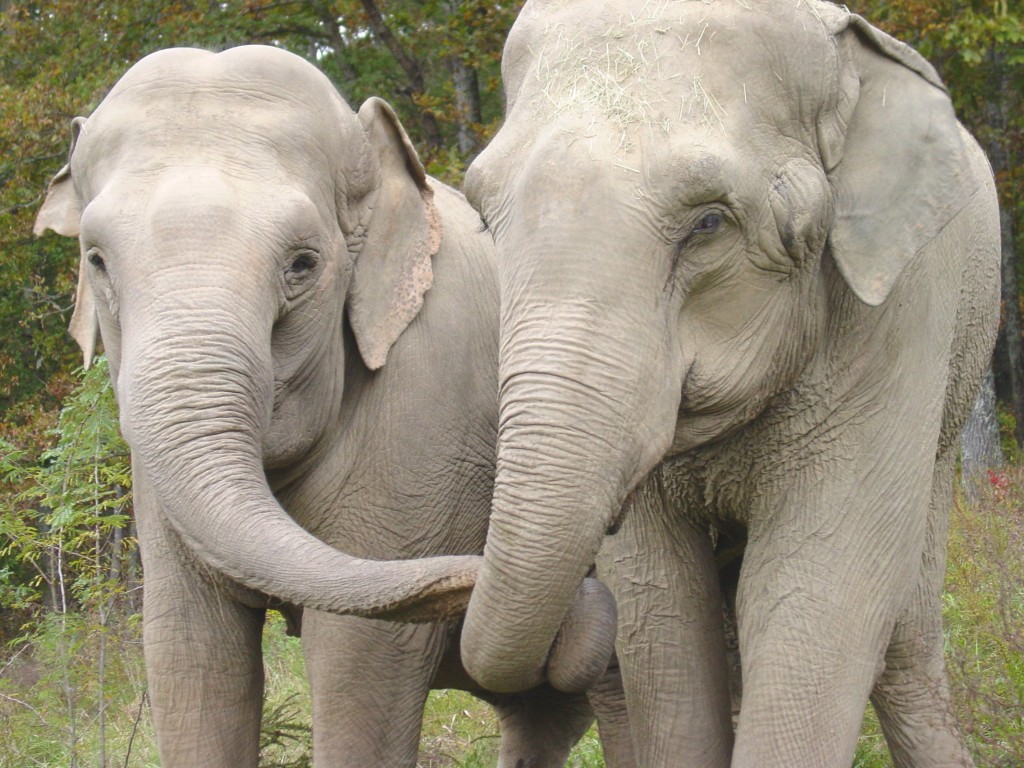
    When Jenny first stepped inside the barn she was calm, but when she saw Shirley she became agitated. She reached through the stall toward Shirley, intensely focused on her. Shirley showed little interest but finally responded to Jenny’s attention by stepping close enough to be touched.

    Jenny’s agitation grew. She extended her trunk all the way through the bars, reaching out, touching, talking to Shirley. Shirley stood parallel to the corral allowing Jenny to touch all over her, but continued to show very little interest. Jenny began to work herself up into frenzy, very uncharacteristic behavior for her.

    Scott and I were sitting inside the barn only a few feet away, watching. I was filming.

    Jenny was animated and anxious; she wanted to get closer to Shirley. Shirley remained calm. But when Jenny placed her truck up to Shirley’s mouth, Shirley froze. Her posture changed, she became a little rigid and then turned to look at Jenny. She reached over to touch Jenny’s mouth and what followed was undefinably powerful and life changing for all present.

    Looking straight into Jenny’s eyes, Shirley erupted into a huge baritone roar. Caught completely off guard, I thought a bomb and an earthquake had simultaneously hit the barn. Her bellows ignited Jenny’s bellows, which together literally shook the barn.

    With her head held high and mouth gaping open, Shirley roared and gently touched all over Jenny’s smiling face. Jenny’s body immediately relaxed as she continued to grope and pull at Shirley through the bars and bellow. The volume of their shared roars was deafening.

    The energy in the barn was so intense I had to step outside the door to catch my breath. Seriously, I could not breathe. I did not yet fully understand what was happening. I had only seen such a display of emotion once before when a baby elephant at a breeding facility was separated from his mother for the first time. The two nearly killed themselves trying to climb over the corral to get back together. Their roars were one and the same with Jenny and Shirley’s.

    This memory flashed though my mind and within seconds I understood. Jenny and Shirley had known each other before and during that time had forged an intensely close relationship. This was a reunion.

    The powerfully joyful vocalizations continued for some time, with Jenny and Shirley groping each other all over. I cannot convey how thick the love was in the air. I was too caught up in the emotional exchange to register just how long this went on but it could have lasted close to 30 minutes.

    By the time the volume of their reunion subsided, Shirley was emitting short, sweet sighs and Jenny had melted into the steel bars that separated them, their trunks draped across each other faces.

    I knew I had just witnessed a miracle, the first of many that I would be privileged to witness in the years to come.

  • Bunny

    Bunny

    Bunny — what a sensitive and loving lady. It was a joy to bring her to the Sanctuary. Her immersion into the habitat and bonds with the other elephants exceeded even our wildest dreams. She made an immediate and complete transition into Sanctuary life. In fact, she was the first elephant to sleep under the stars and was responsible for her sisters beginning to sleep outdoors overnight as well.

    I spent five years working for Bunny’s release from the Mesker Park Zoo in Evansville, IN. The zoo had been her home for four decades. From the time my effort began, I placed a weekly phone call to the zoo to discuss Bunny and her possible relocation. Ron Young, the zoo director, and Ted Grannan, the assistant director, were gracious but firm: Bunny would never leave the zoo.

    They continued to accept my calls and humor my periodic visits, but their response to my interest in discussing Bunny’s relocation was a consistent no. I realized that these were kind and caring people. My goal was to familiarize them with the Sanctuary so they could understand what we had to offer to their beloved Bunny.

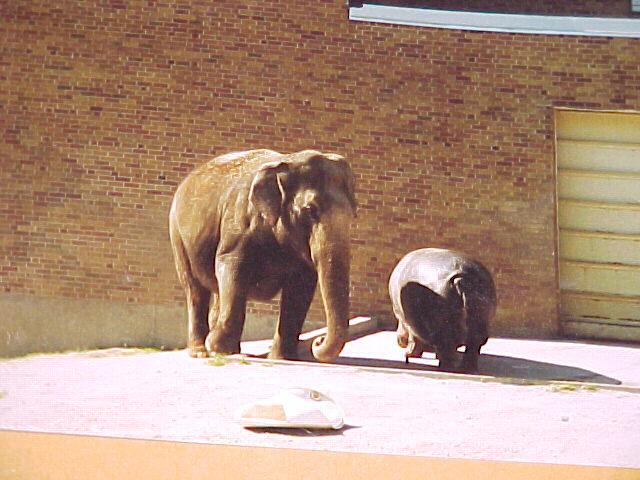
    On one of my many visits to the zoo, Bunny was having “play time” with her next-door neighbor Daisy, a hippo. They had lived in adjacent enclosures for four decades. On special occasions Daisy was allowed into Bunny’s yard for a visit. It was quite cute to watch, but sad to realize how these two had to rely on another very different species for companionship. Bunny gently herded Daisy around the yard, as much as one can herd a hippo, with Daisy paying little attention.

    My persistence began to pay off, but in a roundabout way. Ron soon began passing my phone calls off to Ted, who remained pleasant and engaging. He would listen patiently to my latest update and end the conversation with the zoo’s mantra, “Bunny will never leave the Mesker Park Zoo.”  My no-pressure-but-let-me-tell-you-this approach was sincere — and effective. We shared a common interest in Bunny’s welfare, which soon brought us closer together. My message began to get through and I saw that Ted was beginning to question the wisdom of their position.

    Until this time, I was told that Bunny could not be moved for a myriad of reasons, including that it would break her heart to leave the zoo. With stories about our other retirees as evidence to contradict that concern, Ron finally admitted that the idea simply could not be considered because the Association of Zoos and Aquariums (AZA) would not allow it.

    After years of open communication and education I was able to demonstrate that Bunny not only deserved to move to the Sanctuary but her very health depended on it. Her enclosure offered limited natural substrate and her pool had been empty for years. As result of years spent on the hard surfaces of her exhibit, Bunny had developed a chronic foot disease that could soon develop into osteomyilis. This captivity-induced disease is responsible for the deaths of nearly all adult captive Asian elephants living in zoos. Bunny was on her way to being yet another statistic but I knew that Sanctuary life could spare her such a fate.

    Bunny was surrounded by a loving staff, attentive veterinarian and adoring public. They began to grasp the gravity of Bunny’s condition and, ultimately, the people responsible for Bunny’s care, including Ron and Ted, became the champions for her release.

    On September 29, 1999, Bunny arrived at the Sanctuary. Her retirement was celebrated by two communities united by one deeply loved elephant.

  • Helping a Fellow Elephant Welfare Advocate

    Dr. Deepani Jayantha, a dear friend and dedicated elephant welfare colleague working in Sri Lanka, is hoping to attend a conservation conflict resolution course being offered in DC next month. The course is not cheap ($1,500) and neither is the airfare ($2,000), but it promises to benefit her elephant welfare projects in Sri Lanka.

    While in Sri Lanka last year I toured Dr. Jayantha’s projects. I am confident that the knowledge she gains from attending this course will enhance any project she manages.

    I am hoping that someone has air miles to contribute for Dr. Jayantha’s flight from Colombo, SL to DC, USA.  Underwriting would work as well.  Here is a way for us to make a difference for the human/elephant conflict in a personal way.

  • Proposed elephant rides in Kentucky

    Tuesday I spoke at a Kentucky Department of Fish and Wildlife Resources (KDFWR) public hearing in opposition to the proposed amendment to state regulation 301KAR2:082. If this amendment passes, elephant rides will be allowed in the state of Kentucky for the first time since 2005.

    KDFWR representatives appeared receptive to the information I provided regarding elephant behavior, harsh trainer treatment and the risks the city accepts when allowing an inherently dangerous exotic animal to share common space with the public. If they grasp the immense risk elephant rides pose, they will surely oppose the amendment.

    What prompted the ban nearly seven years ago was an elephant attack at the Louisville zoo that left a man seriously injured. The elephant, Kenya, was privately owned and contracted by the zoo for elephant rides.

    The day of the attack Kenya was in an off-exhibit area with her trainer. It was standard practice for Kenya to wander around the enclosed area unchained. But while the trainer was distracted in another area of the enclosure, Kenya opened a gate and wandered out into the zoo.

    It was the end of the day and very few zoo visitors were present. A man saw Kenya and walked up to her. Reports indicate that he tried to control her, but she lashed out at him, inflicting serious injury.

    The incident resulted in lawsuits against the zoo, the city and Kenya’s owner. The man recovered and Kenya was not harmed.

    Following the attack, in recognition of the dangers posed by some species of wild and exotic animals, KDFWR banned public contact with a long list of inherently dangerous animals, including elephants.

    One supporter of the ban is the Primate Rescue Center, co-founded by April Truitt.  Many of the species that her organization rescues and protects are included in the ban.

    Currently KDFWR is being lobbied by the Kosair Shriners to amend the regulation and allow elephant rides. The Kosair Shriners continue to offer elephant rides at their annual circus fundraiser in defiance of the regulation. Their position at the meeting was that elephants are not dangerous, at least not the ones they hire.

    Lobbying to stop elephant rides does not guarantee better welfare for elephants but it does provide an opportunity to educate people about the inappropriateness of the activity.

    Send your comments to:

    Ms Rose Mack

    Kentucky Department of Fish and Wildlife Resources

    [email protected]

    (502) 564-5136 (Fax)

  • Tarra meets a baby bird

    Tarra meets a baby bird

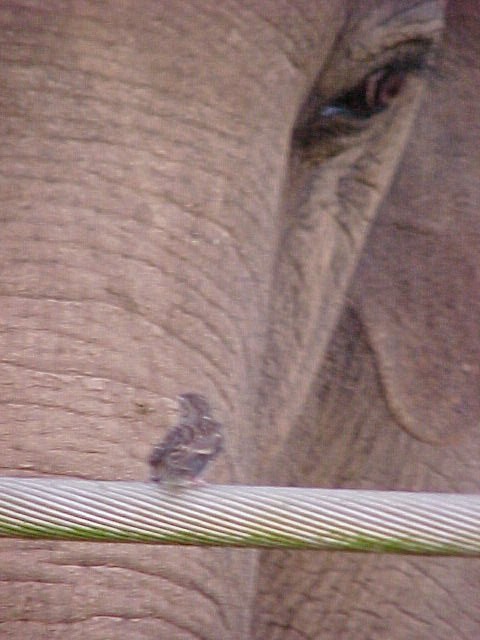
    The story that goes with this touching photo taken in 2001 is equally amazing. I went out to the back of the Phase ll barn and found Tarra staring at the fledging on the horizontal corral cable. I was without camera and said to Tarra, “Don’t move, don’t scare it — I’m going to get the camera.  I’ll be right back!”

    I ran back the length of the barn and up the stairs, found my camera, ran back down the stairs and out to the back of the barn. It had to have taken me two to three minutes. When I came back around the corner, Tarra was standing perfectly still, in the exact same spot as when I left her. I swear she was holding her breath.

    I was able to take three photos before the fledgling flew off.

    I praised Tarra for standing so still and for not trying to touch the baby bird, which I could tell she was dying to do. Her eyes were still as large as saucers, sparkling with excitement. She squeaked, took a deep breath and let out a piercing trumpet.

    Another magical moment with Tarra.

  • Ojai remembers Tarra

    Craig Walker from the Ojai Valley Museum contacted me recently. He was interested in an update about Tarra since our time living in Ojai. His article brought back fond memories of Tarra and me, and the community’s warm embrace of our unique relationship.

    I am always amazed to hear recollections from people who have meet Tarra over the years.  Some of the stories are simply outlandish. One such story that really made me laugh was Matt’s memory of seeing Tarra skating down Matilija Canyon Road with three or four guys on horses holding her back with ropes.

    WOW. Even though that might  sound fun, it never happened. I don’t doubt for a moment that Matt and his friends actually saw Tarra with her horse, donkey, pygmy goats and dogs in tow, but there were no ropes or skates involved.  Most likely what Matt witnessed was Tarra and family darting across Hwy 33 on our way to Matilija Lake. I admit that Tarra runs as smooth as a gazelle, so perhaps she appeared to be roller skating!

    Many have asked where the skating gimmick came from. Truth is, it was just another inspiration on the road to sanctuary.

    As Tarra grew, performing became increasingly boring for her. I struggled to find a way for her to enjoy the work. Since retiring was not yet in the cards, I looked for other ways to provide her a lifestyle she would enjoy.  By the time she was eight years old, that quest had already taken us from amusement park performer to circus performer to private party entertainer, to Hollywood bit player to watercolor artist. Keeping the work varied helped alleviate the boredom that seemed the greatest threat to Tarra’s cheery attitude.

    While discussing my dilemma with a friend, I jokingly said, “I should teach her to rollerskate. It’s easy, fun and all the rage right now.”

    We looked at each other and burst into excited laughter. He said, “That’s it! She’ll love it – Tarra, the world’s only roller skating elephant.”

    The research that followed resulted in a set of clunky steel-frame skates with custom-made knee-high boots and industrial casters that rolled forward only. A star was born.

    In those days I was unfamiliar with animal activism. I knew Tarra very well and was not surprised when she took to her skates like a fish to water…almost too much in fact. I know that animal activists reading this post will cringe at the very thought of me discussing Tarra’s skating in any positive light at all. But the truth is the truth. Tarra loved it.

    Each skate fit like a glove and strapped on with seat belts. There was no way that anyone could have forced Tarra into her skates; she had to put them on herself. She would step inside the 12-inch high boot and wiggle her foot around until her toes slipped into custom designed padded toe spaces. Her assistants, all three of us, would then strap the sides of the boots and pull the seat belt straps tight.

    Getting suited up with her skates took close to 20 minutes. The entire time she would chatter, trumpet and purr in anticipation of the fun. The hardest part was getting her to wait until she was completely and securely strapped in before bolting off, trunk and tail extended, in a mad dash around the roller rink.

    It might come as a surprise why Tarra stopped skating. She never tired of the fun, but I learned how opposed to such unnatural activity certain people were.

    One day, while Tarra was skating before a large crowd in an open parking lot, a well-dressed woman approached me, grabbed my arm and started yelling, “Animal abuse!” Of course I looked around to see what she was talking about and then realized she was talking about me.

    I was shocked, unable to understand how this person could ever see Tarra’s play as abuse.  But that was the point: Tarra was having fun but skating was sending the wrong message.

    I really grew up that day, realizing that perception is everything. If even one person saw Tarra’s skating as abusive, we could not do it. I began researching the animal activist movement and retired Tarra’s skates.

    I believe that Tarra’s skating was not just another effort on my part to enrich her life. I believe it was another step along the road to sanctuary.

  • The Art of Cultural Brokerage: Recreating Elephant-Human Relationship and Community

    An article by Carol Buckley and G.A. Bradshaw, Ph.D., Ph.D., on how sanctuary creates a healing trans-species community in which humans and elephants live together. In sanctuary, the humans function as catalysts, interpreters and negotiators of relational repair for elephants in recovery from trauma.

    Read the full article.

  • in his own words before being offered the CEO position

    19th February 2010

     Dear Sanctuary Directors,

     To the Board of Directors of the Elephant Sanctuary, TN

    I have become aware of the possible imminent departure of Carol Buckley from the Elephant Sanctuary. I have only today found this out and am writing to you in the hope that I am not too late. Please forgive the brevity of this letter and that it is not typed up on headed paper from my institution, but it is late on Friday night 19th February and I believe I must act very quickly.

    Following twelve years scientific research at Oxford University I became Head of the Animal Department at Woburn Safari Park, which held three Asian elephants, and early in my career worked with elephants at London Zoo. For the last ten years I have been Head of Wildlife at the Royal Society for the Prevention of Cruelty to Animals, the world’s largest animal protection organisation. During my time with the RSPCA I have headed a long-running effort to eliminate the terrible issues associated with elephants in zoos and circuses. I have had considerable success, with a reduction in the number of UK zoos holding elephants from 18 in 2002 to 12 today, and a reduction in the elephant population from 90 to 70.

    I work very closely with my colleagues in the US on captive elephant issues. Amongst those colleagues I do not hesitate to single out Carol as the one who has had most influence on my work. I first visited her at the Sanctuary in 2002, and was struck by all she has achieved, by her knowledge and by her compassion for elephants. What Carol does with elephants without the use of force, bullhooks, electric hotshots, chains or negative reinforcement of any sort is nothing short of remarkable.

    You may not be aware of the massive regard the elephant protection movement has for Carol. She is a beacon of hope to us, because she proves elephants, even the damaged and dangerous, can be loved and cared for and returned to happiness. Accordingly there are many, many zoos which fear her. She does with elephants what none of them has ever achieved or could hope to achieve.

    Carol has an integrity no-one else in our movement can match because of her first hand experience and success; she has nothing left to prove. I remember a colleague of mine, a UK zoo curator, talking to me and Carol in Boston in 2005. This man had been exposed to the lies and confusion of the elephant keeping world, yet having spoken to Carol – who in many ways was his “enemy” – he said “I hear so much and do not know what to believe – but for some reason I believe you”. This says much about Carol’s credibility.

    Carol is an outstanding spokesperson for the Sanctuary. The Sanctuary, its staff and elephants come first, but her impact and influence extends far beyond the Sanctuary’s borders. She is articulate and naturally charming. She is extremely politically astute and wise.

    Carol has made the Sanctuary into a living, breathing model of what elephant management can and should be – and I speak as someone opposed to elephants in captivity. There is only one place I personally would want a captive elephant to live, and that is with Carol at the Sanctuary. Carol has underpinned the Sanctuary’s work with a deep, ethically sound philosophy which gives it its strength. Science is revealing more and more of the complex emotional lives elephants lead, and they are easily traumatised. Please do not underestimate the knowledge needed to understand the minds of these abused and traumatised animals nor the skill involved in aiding their recovery, and in instructing other caregivers to do the same safely. The elephants and the Sanctuary need Carol’s skill, heart and wisdom. I have met elephant carers all over the world, and been one myself, but I have never met anyone like Carol.

    I cannot emphasise enough what it would cost the Sanctuary, captive elephants and the elephant protection movement if we lose Carol; it does not bear thinking about.

    With my best wishes,

    Yours sincerely,

    Rob Atkinson.

    Dr. Robert Atkinson, BSc (London), MSc, PhD (Oxford)

    Head of Wildlife Department,

    Royal Society for the Prevention of Cruelty to Animals,

    Wilberforce Way,

    Southwater,

    Horsham,

    West Sussex

    United Kingdom.

    Tel +44 (0)300 123 0205

    Email [email protected]

  • Showing Compassion

    As we all struggle to make sense of Bella’s tragic death and the trauma Tarra experienced witnessing it, peace of mind does not come easily. Losing a loved one is difficult enough without the death being violent and the witness being helpless to stop it.

    Tarra has seen many dog fights. Not once did she approach the fighting; instead she rapidly recoiled, squeaking fearfully, trunk tucked under her chin, moving away from the confrontation.

    It is not that Tarra would not have wanted to come to Bella’s aid, but she does not possess that intense protective nature that drives a mother to defend her young. Tarra loved Bella with every cell in her being and saw her as a playmate and friend.

    We can all agree that Tarra has experienced a serious trauma. Suggesting that in three short days she has come to terms with Bella’s death is not rational. Experts the world over have documented the depth of emotional and social bonds elephants possess. They grieve their dead in ceremonial fashion for days. They return to the place of death year after year, rekindling their memories. Mothers carry their dead calf for miles, refusing to leave the body until it decays.

    To recognize that elephants are sentient beings means to understand the depth of their emotions. You cannot truly know them without recognizing their highly evolved reasoning capacity. The greatest mistake that can be made is to arrogantly underestimate an elephant’s intelligence and complexity or assume that you can truly know an elephant after only a few short months. Such errors can result in mismanagement.

    There was a day when the Sanctuary would rally around a traumatized individual, immediately enlisting every resource possible. In all situations, recovery support was a priority. To deny Tarra anything in her time of need is heartless.