Blog

  • Som Boon

    Dec 22, 2010

    This morning I woke to the sad reality of death. Som Boon passed during the night. Thumbing through my notes, I see that on day two of my time at ENP I saw Som Boon and jotted down in my book that she had “small ears” and decayed teeth.

    The entire time I have been at the Park, Som Boon has been experiencing health problems. First she was not eating well, and then sores developed on the roof of her mouth. More recently she was not defecating. I had the opportunity to look in her mouth and saw that her top molars were missing large areas and were black with decay.

    After a brain-storming meeting with Derrick and Jodi, a long-time American volunteer who lives at the Park, Derrick ordered a shredder for Som Boon’s food.  The shredder idea came from the experience of an emaciated elephant who arrived at the Sanctuary with a very poor appetite.

    When Sissy came to the Sanctuary, she had difficulty masticating her food. We used a shredder to cut her hay into small “pre-digested” pieces. After several months her appetite improved, she gained several hundred pounds and she was able to return to eating non-shredded hay.

    The goal was that Som Boon would benefit from the shredded hay but, unfortunately, she had stopped eating by the time the shredder was delivered. Staff tried many approaches to get her to eat, drink and defecate, to no avail.

    During her necropsy, a large blockage was discovered in her large intestine. Estimated to weigh fifty pounds, the obstruction consisted of unmasticated and poorly digested pasture grass. The obstruction was completely dry, resembling a massive brick.

    Som Boon had lived at ENP for more than seven years and was dearly loved by all. She will be missed by her entire ENP family.
  • Research at Anantara

    Josh Plotnik, PhD, heads elephant research at Golden Triangle Asian Elephant Foundation, Anantara Golden Triangle, Thailand. Josh conducted the mirror study at the Bronx Zoo

    I was fortunate to meet Josh on his recent visit to ENP, where several years ago he conducted behavioral studies. Currently, four elephants at Anantara participate in Josh’s studies to measure elephant intelligence.

    The different apparatuses that Josh has designed are quite ingenious and the elephants seem to enjoy the activity. The mahouts are quite engaged as well, which makes the project enjoyable for all involved.

  • An added benefit of non-invasive research

    Earlier this week I had the opportunity to visit two more elephant facilities in Thailand.

    Anantara, near the Golden Triangle, was my first stop. Although long, the bus trip north was well worth the time.

    Anantara is a spacious resort nestled in lush forests bordering Myanmar. I was told that on rare occasions an elephant has silently swum across the river to foreign soil. An unsanctioned border crossing for sure.

    The elephant program at Anantara is well thought out. With the exception of the first few elephants acquired by the organization in its early development, all of the elephants are rented, providing continued employment for their owners. The mahouts’ families relocate from their homes in Surin, where street begging is a staple employment. Renting the elephant instead of buying has many advantages, including the quality of mahout, the beneficial long-term relationship between the mahout and elephant and removing begging elephants from city streets.

    Due to the number of captive elephants available in Surin, Anantara can insist on renting elephants with skilled mahouts who properly care for their elephants. By renting the elephant instead of buying, Anantara also avoids creating a market for elephant sales. (In the last few years, dealers have figured out that they can sell a sick or injured elephant and with the revenue buy a couple more.)

    The company pays a higher than average rental fee to encourage owners to stay long-term. They provide village-style accommodations and ensure that the children of the mahouts receive an education.

    What I observed at Anantara were relaxed elephants who had what appeared to be a healthy relationship with their mahouts. They were playful, responsive to their mahouts and displayed no fear or anxiety.

    Anantara is conducting non-invasive research on elephant intelligence, which was very interesting to observe. I cannot divulge information about the exact projects currently being conducted, but from what I saw this work will definitely add to the current deficient body of scientific knowledge about elephant intelligence. I am anxious to see what will be learned over the next few years.

    A by-product of the research is behavioral enrichment. Since these elephants, like all elephants in Asia, spend many hours each day on chains, the research benefits the elephant because they are off chains and engaged. Of course I would like to see the elephants off chains many more hours, if not completely, and posed that idea to John Roberts, the program manager. A progressive thinker with an open mind, John is motivated to explore ways to increase the elephants’ quality of life. Hot wire is a proven effective way to confine elephants without using chains and is already used in a small area of the elephant stable area. At first the mahouts were resistant to its use but they now seem to accept the new idea. I feel confident that in the future Anantara will utilize hot wire yards to increase the elephants’ freedom of movement.

    One of the most commendable things about Anantara is that all of the funds generated by its elephant program go directly to elephant conservation projects that benefit Asian elephants.

    In my next entry I will tell you about the second facility I visited.

  • Being With The Family

    My days are filled with shadowing the “family” in the habitat and doing foot trimming and target training. I am having a blast! It really is a gift to be able to focus solely on these limited responsibilities. Even though the days are long, each brings immeasurable rewards.

    Target training has really caught on. Now all the family members are joining in. It is so much fun to play the training game with a wall of eager students, ranging from senior citizens to calves. It is a riot as they jockey for the prime spot and the opportunity to respond to requests for their feet, ears, forehead and side. They all excel at moving their side into the target — it is so cute. Once they understand the request for side, they respond with a quick movement, leaving their front feet in place and swinging their hip around to make contact with the target. When they are all competing for a turn it is like a chorus line of feet and ears. What a joy!

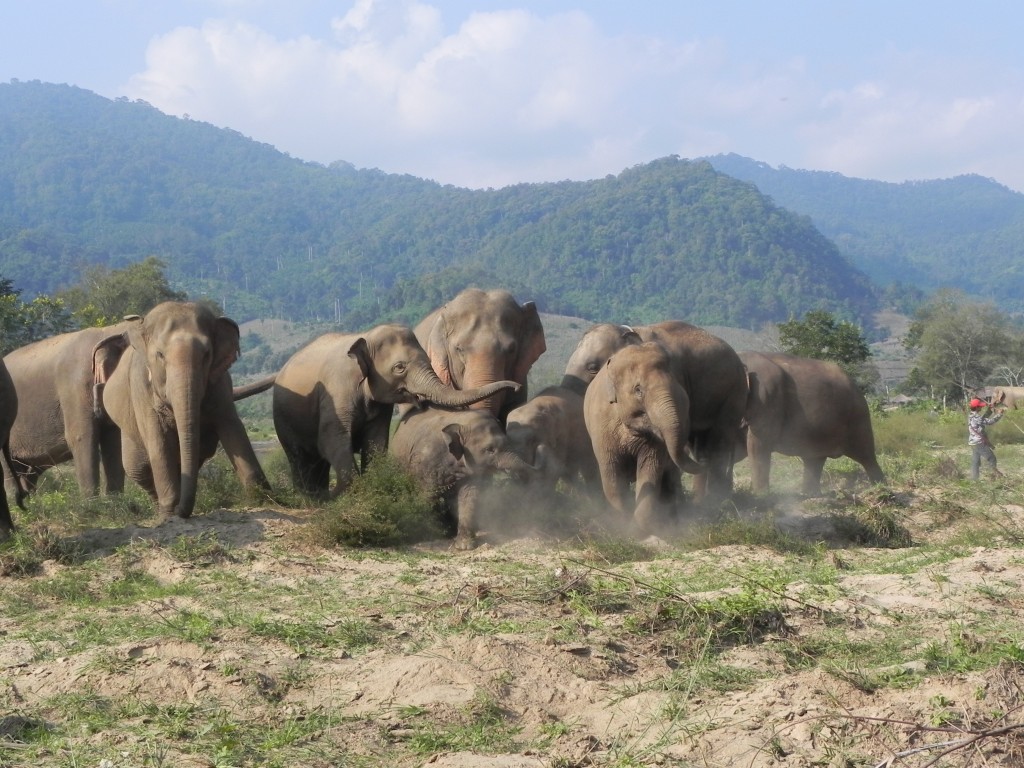
    Getting to know the family is an unexpected experience, one I cherish deeply. Today I felt a sense of belonging to an elephant family again as I moved along with the herd, like a ripple in a stream, flowing together effortlessly across the pasture. I had not inserted myself into the family because my time here is limited, but today I felt that unnamed energy that is elephant, all inclusive, the matriarchal collective, being part of a loving family. I soaked in the acceptance they radiated, grateful for each one of these magnificent individuals.

    Later I met two new Park residents, grande dames I had not had the pleasure to meet before. Much patience was required because they were so frightened by the idea of having their feet touched. The mahouts did their best to reassure them and, although I didn’t complete a full manicure, we made some progress. A little at a time — fine, I am in no hurry. My goal is for these elephants to know that when they come to my pedicure salon they will be treated kindly and with respect. If they leave without experiencing a pedicure, that is okay.

  • Chang Yim’s Progress Report

    Chang Yim’s Progress Report

    Chang Yim has been in training for less than two weeks. His progress has surprised everyone… except Karl and me.

    Lek returned to the Park today after being away for a few days. She commented on how calm Chang Yim has become. Indeed, he has shifted, no longer an angry young boy.

    Target training has helped to boost Chang Yim’s self-confidence and trust in Karl, the significant person in his life. It has been a gift to watch Chang Yim relax instead of always being on the defensive, quick to display rebellious behavior. His bouts of aggression have become an oddity instead of the norm.

    Positive reinforcement training has had a marked affect on Yim’s attitude and behavior, but other changes in his management have contributed to his improvement as well. Visitors are no longer allowed to approach him without a mahout present. No one plays the “chase me” teasing game responsible for Chang Yim’s pushy behavior. Inexperienced mahouts who ignorantly antagonized Chang Yim have been told that their treatment of Chang Yim is inappropriate. All of these changes have made Chang Yim feel safe.

    We are very proud of Chang Yim. From his calm demeanor and sparkling eyes, it seems Chang Yim shares that pride.

  • the ENP pachyderm pedicure clinic is open

    the ENP pachyderm pedicure clinic is open

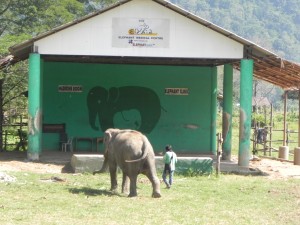
    Nineteen elephants at ENP have been identified as candidates for foot care. The schedule is set to provide pachyderm pedicures at the hospital building twice daily.

    When I was in Thailand last June I did a great deal of foot work on Mae Kham Geao.  Her nails were abscessed and pads sloughing. She was confined day and night to the hospital area with little opportunity to walk and bathe herself. Fortunately I was able to convince the veterinarian to give Mae Kham Geao and her best friend Mae Tee unrestricted daily access to the pasture and river. The results were fabulous.

    It was a pleasure to see the improvement in Mae Kham Geao’s feet and her confidence in receiving her pedicure. Her pads are supple and healthy. Her nails are no longer infected but they had four months of over-growth that needed to be trimmed away.

    Mae Kham Geao’s mahout, Dame, is a kind and experienced caregiver. His interest in foot care has grown in my absence. After a few minutes of reviewing the procedure, he picked up a rasp and began to trim his elephant’s feet. His initiative and confidence will have an influence on the other mahouts, a real plus in the training process.

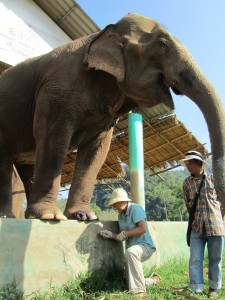
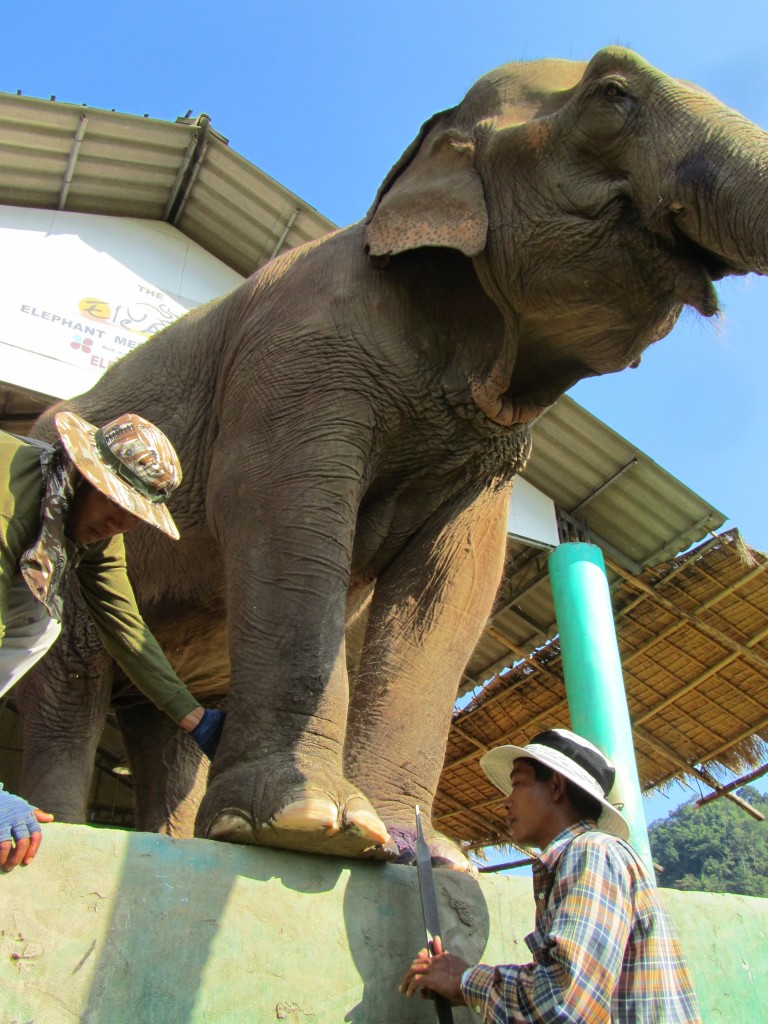
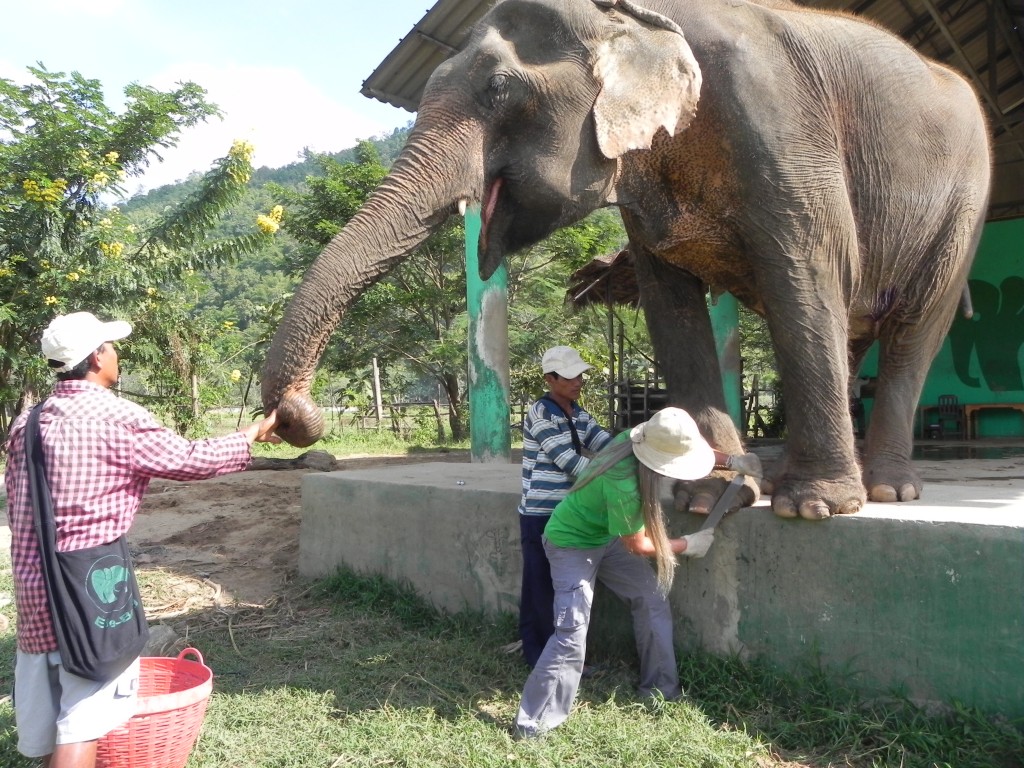
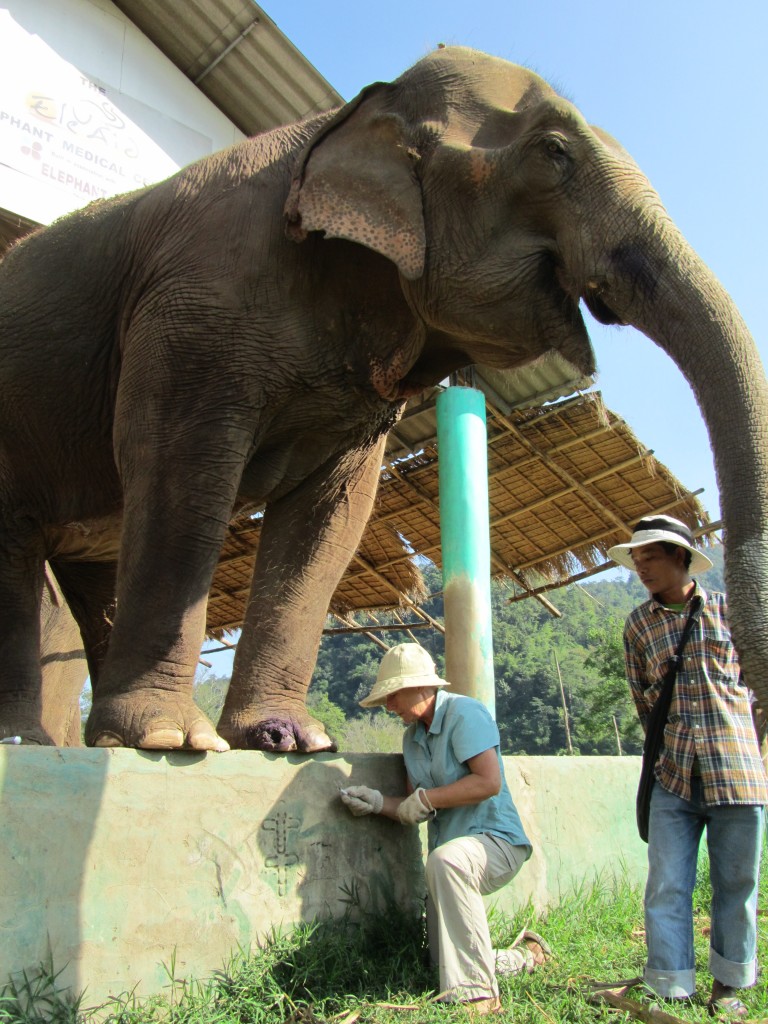
     My foot care client for the past two days has been Jun Peng, a wonderful older female, who nearly sprinted up the ramp of the concrete loading dock being used as a foot-trimming platform. A basket of freshly cut produce was all that was needed to entice her to present her feet for trimming.

    Jun Peng was a perfectly lovely client, calmly standing in place for more than 30 minutes each session. Her nails were quite overgrown but very healthy. The pads of both front feet showed signs of past trauma but no new problems.

    Tomorrow’s pachyderm client will arrive at the pedicure clinic at 10:30 am. I am excited to see who she is.

  • Chang Yim

    Chang Yim

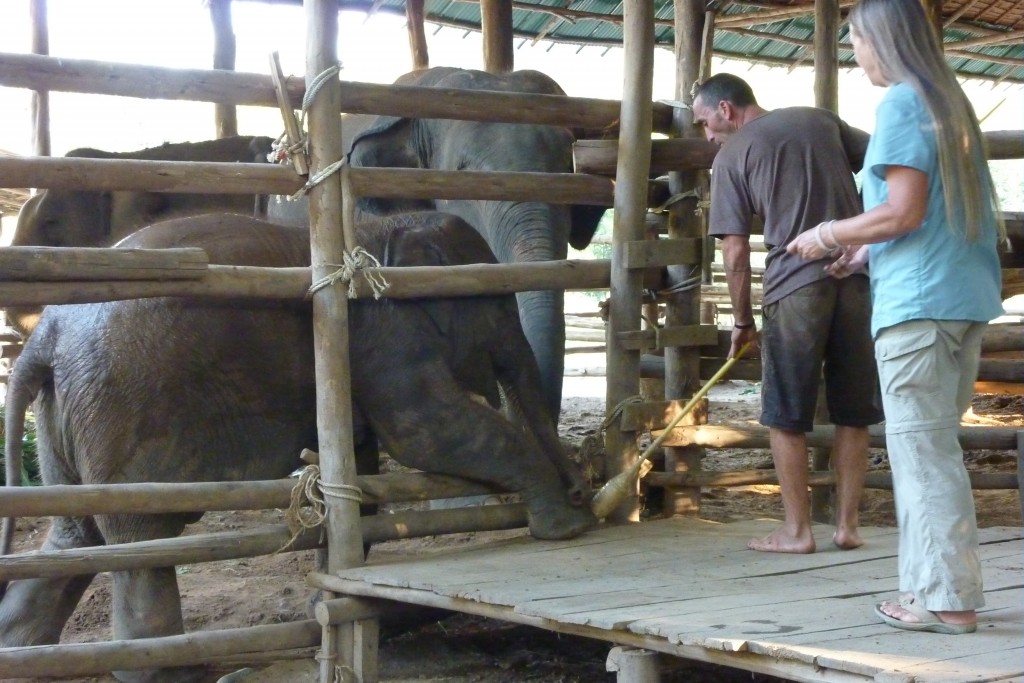
    Even though elephants have relative freedom at ENP, they are still living in a captive environment, necessitating that they learn basic behaviors, such as presenting their feet for trimming and their ears for blood draws. These easily learned behaviors are essential to ensure the elephants’ health and well-being.

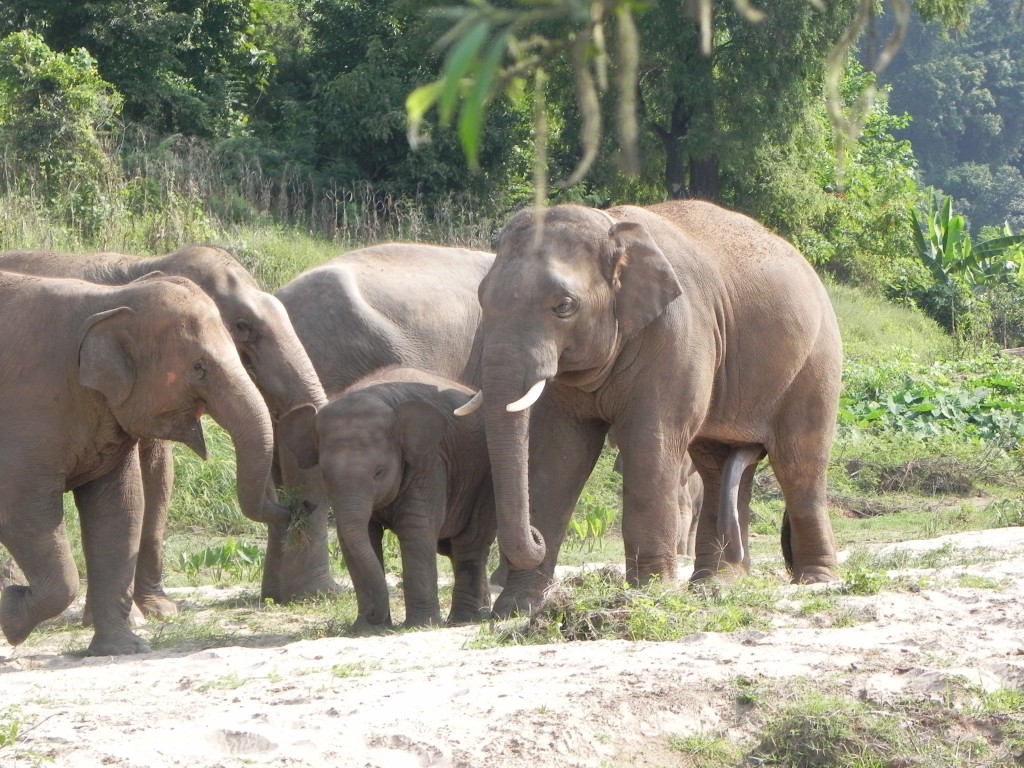
    Chang Yim is the second calf born at ENP.  He is experiencing a near-to-natural family environment living in a herd with his birth mother.  “The Family,” as they are affectionately referred to by staff and visitors, consists of Yim and his mother Doc Ngern; Faa Mai, also born at the park, and her birth mother Bua Thoug; adolescents Faa Sai and Thong Jan; and self-appointed aunties Ma Lai Thong, Sri Noon and Thai.

    Chang Yim is 16 months old. True to his age and nature, he has bouts of defiance toward his mahouts. The majority of the time, he is busy being an elephant, engaged with his family and exploring the habitat.

    But when his mahouts need to guide his behavior, Yim’s resistance to being told what to do has become problematic. Karl, Yim’s mahout, is learning positive reinforcement target training in order to teach him some basic behaviors so he can be examined and cared for safely and effectively.

    It is exciting to see Chang Yim’s progress, knowing how essential this training is to his future.

  • The TARGET of target training

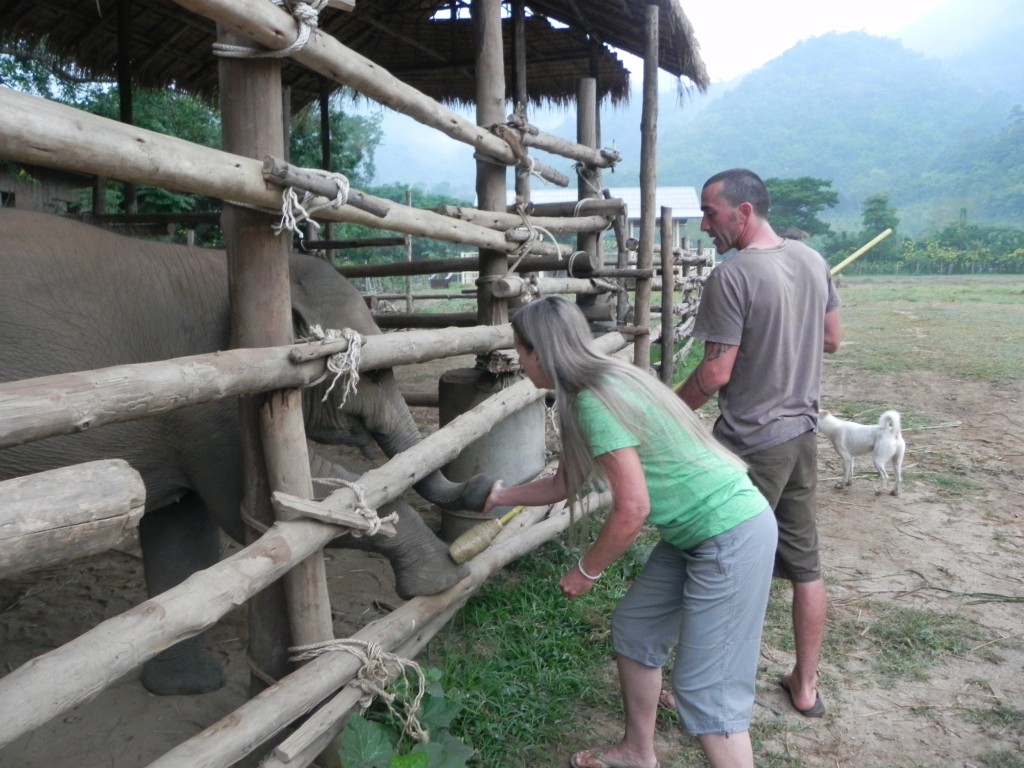
    A target is a tool — a flexible pole with a spongy end — used to shape behaviors. Its purpose is to create a focal point, a benign object for the elephant to focus on.

    To start, we touch Chang Yim’s head gently and say “target.” When he makes contact, we blow a whistle and give him a treat. Chang Yim quickly connects the whistle with the touch and, of course, the treat with the whistle. Throughout the training we touch the target to different parts of Chang Yim’s body — his foot, ear, leg and side — following the same process, giving each body part a name.

    When Chang Yim understands what we want, he responds by touching the appropriate body part to the target. The whistle sounds and he receives a reward, a treat. In moments, Yim makes the connection. He is quickly learning his ear, head, side, feet and back.

    The purpose of this training is to gain Chang Yim’s cooperation for medical procedures and foot care. He is never told no and can never fail, which helps boost his self-confidence and willingness to engage in the game. Done properly, the training becomes a much-anticipated activity that Chang Yim freely participates in.

    Learn the basics of target training.

  • feeling at home

    feeling at home

    Everyday I intend to post an update but surprisingly there has been no time. My day starts at 6am. I am sure that those who know me laugh at the thought of me rising with the sun as I am a natural night owl. But the change is good.

    Karl and I start with Chang Yim’s morning training sesson and then accompany “the family” out to the habitat for morning observations. I have started trimming feet in the afternoon, followed by two more training sessions.

    In between there are feeds, trips to the river for elephant baths and opportunities for the public to view the elephants. And there are always unscheduled occurrences and visitors that fill in the gaps of what otherwise would be extra time each day.

    Chang Yim is fabulous. He is responding exceptionally to the training game as you would expect from such an intelligent boy.

    The sticky rice balls used for his reward is an effective motivator.  He has learned to target his head and front feet. Today we started teaching him to target his side  and added holding the different positions for a few seconds. Chang Yim is doing great and so is Karl!

  • Rescue

    Rescue

    November 21, 2010

    One year ago today my life took an unexpected turn. At the time I would never have imagined that today, exactly one year later, I would be party to the rescue of an elephant in Surin, Thailand.

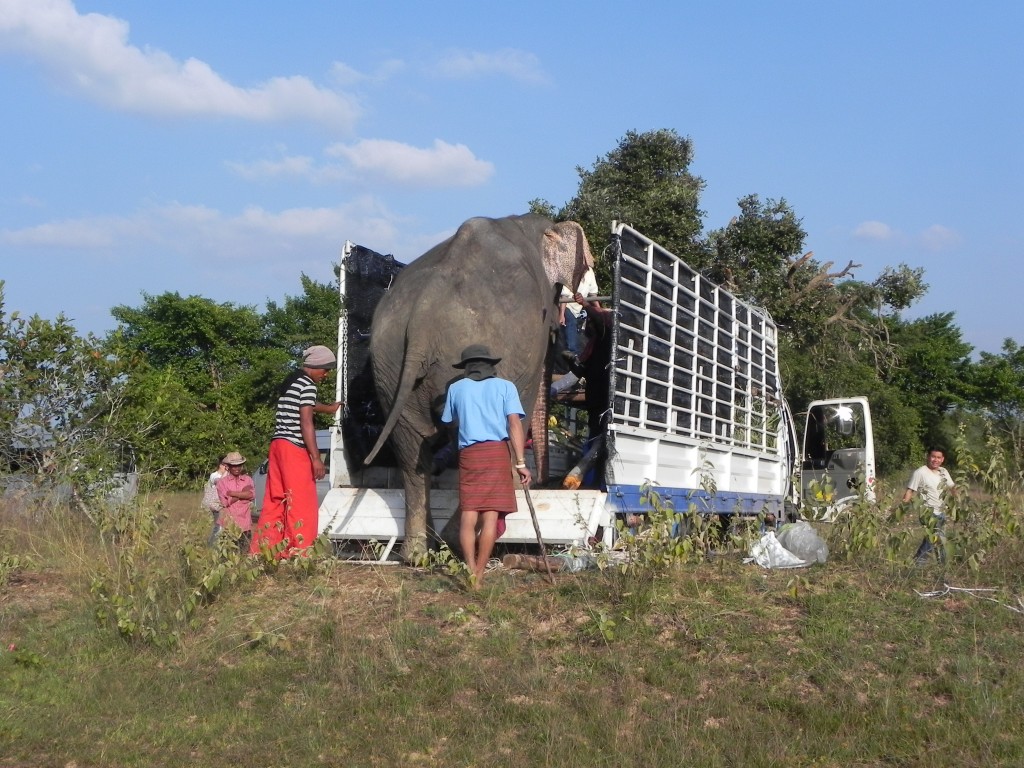
    Hours after arriving in Bangkok I boarded a train to Surin to meet up with Lek, founder of the Elephant Nature Park (ENP). I knew we would be observing elephants at the annual elephant round-up and meet with the governor of Surin. But I did not realize that in less than 48 hours we would rescue an elephant, load her for transport and move her to ENP.

    Observing the entire procedure was an opportunity for me to learn more about how elephant rescues take place in Thailand. Quite different from rescues in the US, all arrangements, including payment for the elephant, travel logistics, health status report and travel papers, were concluded in a matter of hours.

    This rescue was made possible partly by a 9-year-old New Zealand boy named Jack. He visited ENP with his parents nearly two years ago and left determined to raise the funds to rescue an elephant. He reached his goal in a short eighteen months.  Over the past three days Jack took an active role in preparing for the rescue, including purchasing elephant food for the trip. He was given the honor of choosing a new name for the elephant, a tradition held by ENP to give the elephant a new start. Jack researched the name himself and chose Kwan Jai, which in Thai means beloved. Kwan Jai, estimated to be 55 years old, is thin and dehydrated.  A serious logging accident left her crippled years ago. The break in her back right leg led to a misalignment of her spin, making working difficult. But even elephants with broken legs are used for street begging and tourist rides.

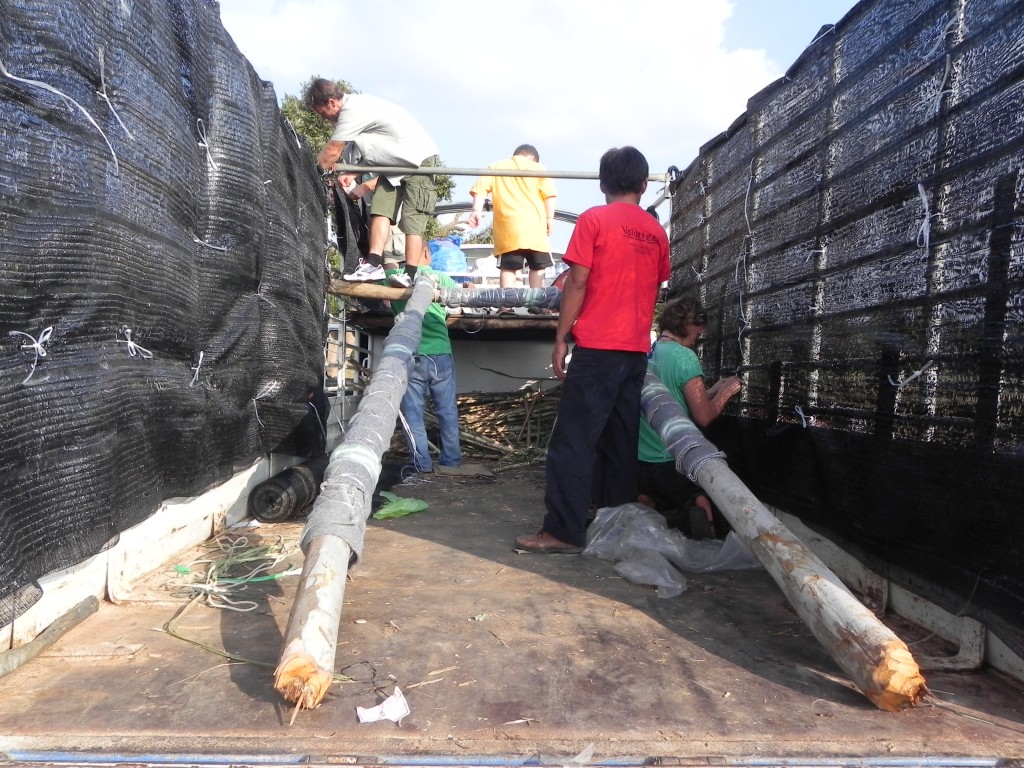
    Prior to loading Kwan Jai into the straight-bed truck, mahouts, veterinarian, Lek, Darrick (Lek’s husband), Antoinette (of Bring the Elephant Home) and several volunteers, along with Jack and his proud parents, spent the next two hours securing the vehicle for a safe trip.

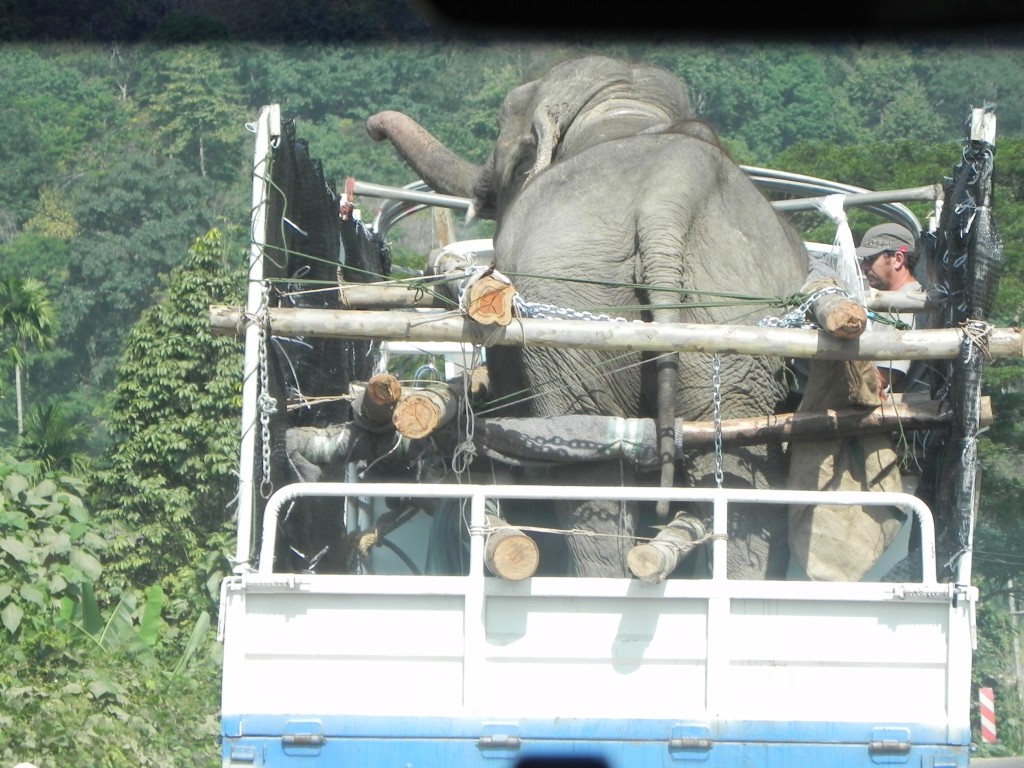
    They strapped wind-break material along the side walls of the truck and built a corral of large timbers ensuring that Kwan Jai would stand safely in the center of the truck bed.

    Kwan Jai is a seasoned travel, so she loaded into the truck without hesitation.

    Nearly 24 hours later, driving through the night and a good part of the next day, Kwan Jai arrived at her forever home at the Elephant Nature Park.

    What an honor it was to be a part of the life-changing event not only for Kwan Jai but for all the people involved.

  • CBS Assignment America

    After the recent airing of a CBS Assignment America piece by Steve Hartman, many of you were seeking clarification.

    The statement that has caused confusion is toward the end of the piece when I seem to say that elephants don’t need people or human interaction. The sound bite was an excerpt from an interview done two years earlier for the Tarra and Bella story.

    If there had been more time for the expansion of my statement, you would have heard me say something like…..“Elephants don’t benefit from public visitation by strangers. But elephants thrive on relationships with caregivers with whom they form deep bonds.”

    The media has limited time to report on any single subject, which can result in misunderstandings. Without a doubt, Steve Hartman knows of Tarra’s capacity to bond with another individual of a different species. He was the one who first introduced Tarra and Bella’s endearing relationship to the world.

    My intention for the Sanctuary was to provide a rich captive environment for elephant rehabilitation: an environment where elephants have autonomy, can rediscover themselves and form deep bonds with others.

    The Sanctuary is not the wild; caregivers are an essential part of the equation.  The goal is to train caregivers how to develop sincere relationships with the elephants.  The deeper the relationship between the elephant and caregiver, the more effective the caregiver can be in his/her job. Without a deep and respectful relationship, the caregiver could be a source of stress for the elephant.

    The “people” I referred to in my comment are strangers. Of course elephants living in captivity will form strong bonds with their caregivers. It is an elephant’s nature to form deep relationships with other herd members. For elephants in captivity their relationships extend to the caregivers who provide for them on a daily basis. Caregivers are an elephant’s extended family and their relationships should be strong and healthy.

    Provided that an elephant in captivity lives in a healthy environment with ample space, the freedom to make his/her own choices, other individuals to bond with and access to an abundance of live vegetation, s/he doesn’t need the distraction of and interaction with strangers. (Some zoo and circus elephants live in such a deprived environment that they benefit from such distraction and interaction.)  Elephants in healthy environments thrive on mutually respectful long-term relationships with elephants and other individuals they consider members of their family.

  • Gratitude on so many levels

    There has been a whirlwind of activity on the EAI website since it launched less than two weeks ago.  The response to our mission, goals and programs has been outstanding. Our 2010 focus on Thailand, India and Nepal has been met with enthusiastic support.

    Elephant Aid International is humbled by the many elephant experts who have agreed to be on our Advisory Council. It is my honor to welcome these renowned professionals, people distinguished by  their contributions to elephant welfare. These accomplished individuals will assist EAI’s efforts, providing expertise and direction for EAI’s elephant welfare programs and the care of individual elephants . We welcome the Advisory Council with sincere appreciation, recognizing that our combined efforts will further benefit elephants worldwide.

    The two people responsible for the design, development and content of our stunning website may prefer to remain behind the scenes but their brilliance must be acknowledged. This site will continue to be a vehicle to move our work forward. It will be a source of news, features and information; a place for all of us to stay engaged.

    As for the outpouring of support from elephant lovers, trainers, caregivers, keepers, activists, veterinarians, scientists, researchers and educators, thank you from the bottom of my heart. Your trust and support of this work is the catalyst that will spur our programs forward.  Without you we simply could not accomplish this important work. Personally, I plan to harness the enormous volume of positive energy flowing into EAI to empower our vision for elephants.

    Namaste