Category: Elephant welfare

  • An elephant palace…not

    An elephant palace…not

    July 6

    I took the overnight train from Chiang Mai to Bangkok for my final day in Thailand. I was asked to visit one more location before leaving the country so I hopped on the train, back in the direction I had just come.

    The Elephant Palace, also known as the Elephant Village in Ayutthaya, is a blazing symbol of what has become of Thailand’s revered elephants. Reduced to a tourist attraction with no resemblance of their true selves, blanketed elephants are paraded in crowded lines, laden with smiling tourists.

    I will admit this experience, and the life these elephants are subjected to, hits an all time low for Thailand. Advertised as a historical experience on elephant back, riders are treated to a ride on a gravel road flanked by idling tour buses spewing smelly diesel fumes.
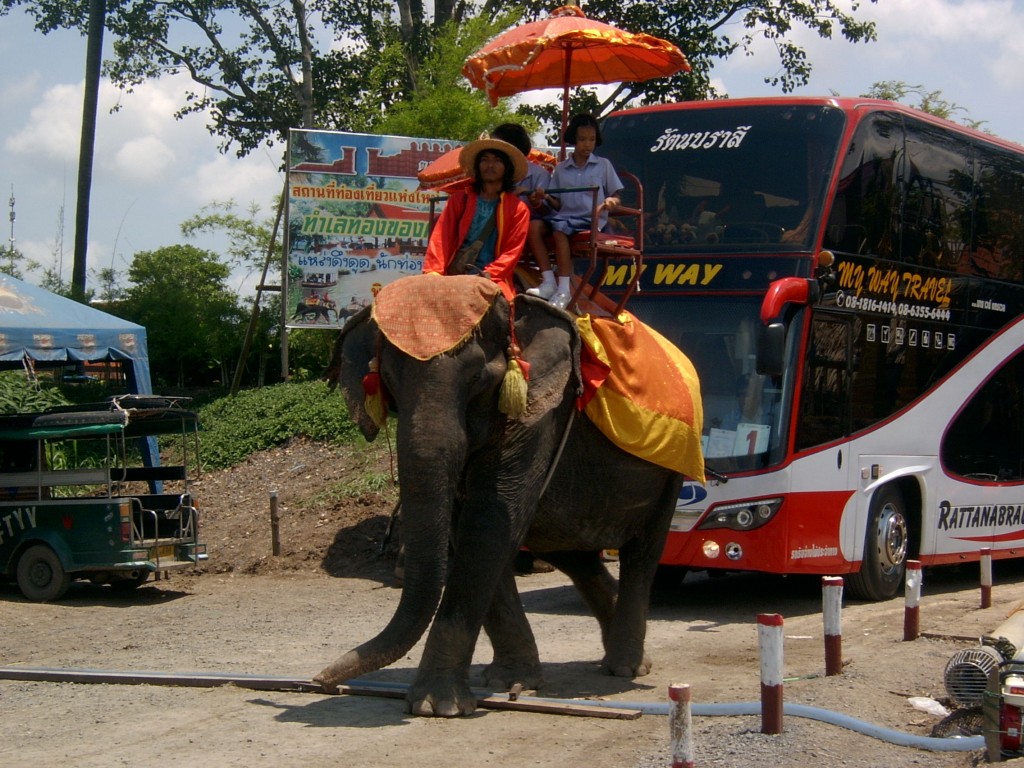
    At the end of the 100-yard gravel road, the elephant is directed back to the loading platform. On the left stand the ruins, but towering tour buses blocked the riders’ view.

    The elephants became jumpy as tour buses drove within inches of their backside. Mahouts responded by turning the skittish elephant to face the offender, allowing the diesel spewing machine to pass.

    The elephants I saw were suffering from a variety of physical conditions, including:

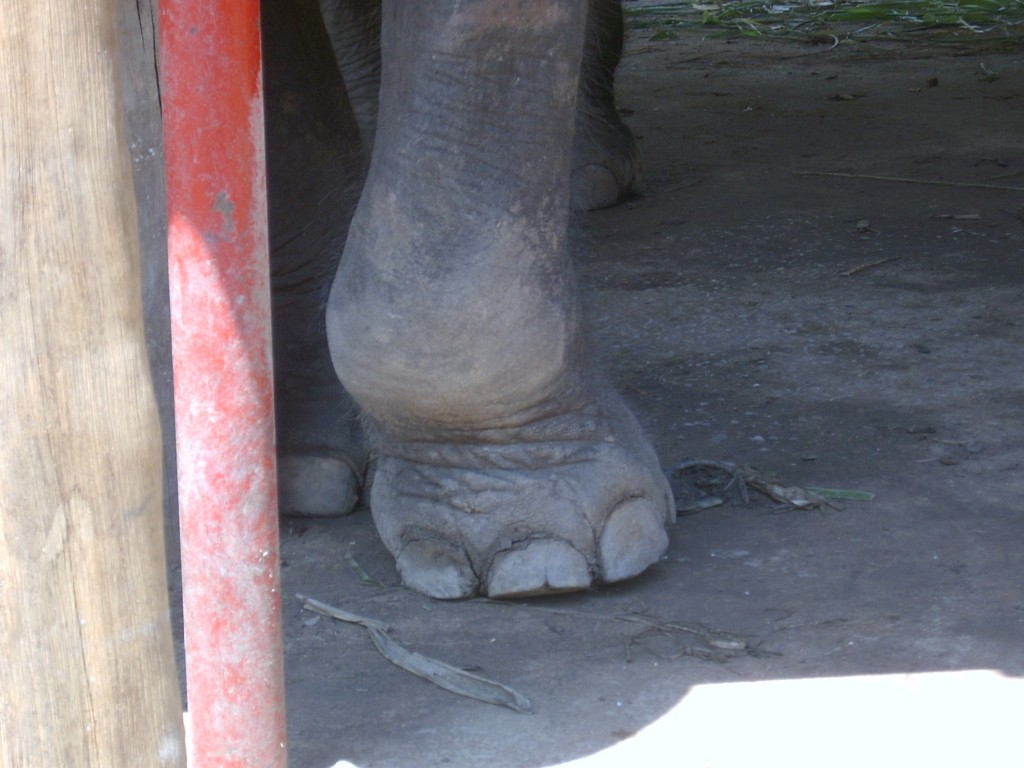
    • a severely deformed wrist consistent with injuries caused by logging accidents
    • abscessed cheek
    • edemas
    • stiff wrists
    • injured back legs
    • fresh wounds on the forehead
    • overheat
    • malnourishment

    All this I observed in the first five minutes of my visit. It was difficult to remain longer.

    On my way out I went to the stable area, located feet from the riding platform. There I found another 25 elephants chained by neck and feet, saddled and ready for work. One mahout showered his saddled/blanketed elephant. She was dosing, eyes closed, never acknowledging her mahout or the shower.  Another young female paced and pulled on her chain. When tourists barged in with armfuls of sugarcane the elephants grabbed for the food. Mahouts stood by observing the activity.
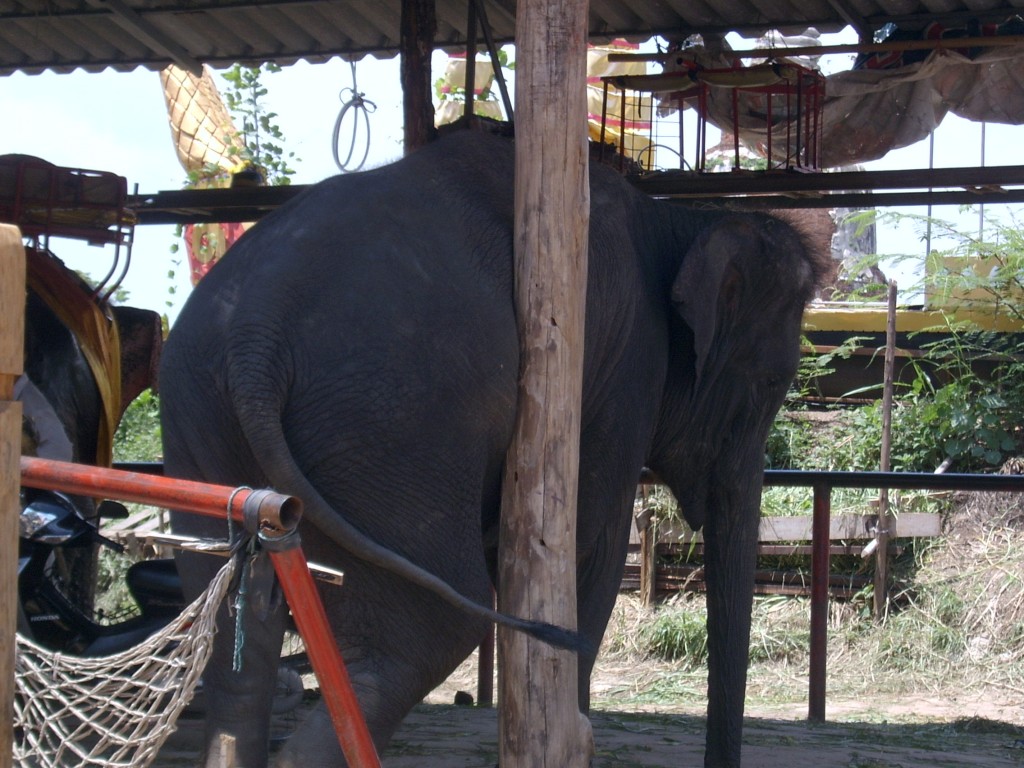
    Knowing that The Elephant Village had another facility where other elephant stayed until they were needed for rides, I found a taxi driver to take me to the kraal. This facility is not advertised and, in fact, several people denied that elephants live at the facility. I was warned that I would encounter the denial so I persevered. I was traveling with a friend and we finally found a driver who agreed to drive us there. Even then we were dropped off at a site down the road from our target destination. We could see the stables in the distance. When the driver saw us walking in the right direction he reappeared and drove us to the stables.

    A group of volunteers wearing mahout training t-shirts were gathered around two elephants in washing racks. They were scrubbing elephants, receiving instructions from a foreigner who appeared to be in charge of this mahout training experience, one of the many ways tourists can engage with elephants. Interestingly, I did not see a Thai mahout anywhere near the mahout-in-training foreigners.

    All around stood tethered elephants, tied to posts adjacent to or under shade stables. I wandered around a corner trying to avoid the piles of trash that were so uncharacteristic of Thailand. Every type of broken machinery and equipment was scattered and piled on the property, including a tanker truck stuck in a mud hole. A lone tusker stood in the sun tethered next to the tanker; head hanging, eyes half open. There was not a speck of food or even remains of any food around him. His long tusks dug into the soft mud. Except for a wasted effort to cool himself with a spray of water collected from a reserve stored down his throat, he stood motionless.

    The scene was one of poverty. Encircling a yard of muck stood the mahouts’ dilapidated dwellings, littered with empty beer bottles and trash. This was not the scene I had observed in other places in Thailand. I wondered who was responsible for this depressing environment.

    Even though I wished my final experience of Thailand could have been more pleasant, reality is a powerful motivator. I will be back.
  • Mae Tee and Kham Geao

    July 5th

    The past week has been humbling, filled with joy and gratitude. Upon the vet’s return from a trip to Cambodia, the first thing on his agenda was a crash course in foot trimming. I had been waiting for the opportunity and was honored to be invited to provide a workshop.

    Most of the elephants at the park have no need for foot trimming. They walk in the lush grass, wade in the brisk moving river and graze through varied substrate all day. These activities keep their pads and nails naturally trimmed.

    But Mae Tee and Kham Geao are aged and arrived at the Park with stiff wrists as a result of injuries from their logging days. Before my arrival, these two ladies had been spending extended periods inside the hospital yard, which resulted in a reduction of physical activity. Upon evaluation, it was determined that along with foot soaks and foot trims, both elephants would benefit from free-choice access to the habitat. Now they will spend as many daylight hours as they wish, out in the pasture grazing and bathing with the other elephants.

    After a short conditioning period, both elephants were voluntarily participating in medicated foot soaks and pedicures. The mahouts, painfully shy and unable to speak  much English or Thai, struggled to understand the directions at first. But the elephants demonstrated that they could easily understand “the whistle and banana game.” Soon the mahouts began to understand as well; in fact, very well, to the point that very little direction needed to be given.

    Most of the communication was through body language and the mahouts soon understood what I needed the elephants to do in order to trim their feet. In no time the elephants and the mahouts were fully engaged in the procedure.

    Foot and nail trimming has always been one of my favorite activities. It is so rewarding to have the elephant voluntarily cooperate. Elephants quickly seem to understand that I have no intention of hurting them. Their comfort level is my priority. With mahouts handing pieces of banana to the elephants for standing in place, the elephants settle in and allow me to trim away overgrown pad and nails.

    The challenge for me is to find what combination of position, pace and human participation provides the atmosphere that allows the elephant to relax enough to cooperate with the procedure. When it all comes together resulting in the elephant standing still for an extended period of time, I am overjoyed. I can’t help but be seriously proud of the effort made by the elephants. I feed off elephants wanting to be cooperative participants.

    I think what I find most rewarding is that the elephants are permitted to engage or not. It is their choice. At first the mahouts thought they needed to ensure that the elephant stayed in place. But soon they understood time-outs are important, not as punishments but as a sign of respect for the elephant’s needs. The mahouts also saw that the elephants returned in moments, to get more bananas of course.

    After a few days the mahouts really became engaged. They would be waiting for us when we arrived for foot trims. Beaming with pride for their elephants, the mahouts started asking if I would come back later that day or the next day for more trimming. On the day before my departure I told them that I would not be back tomorrow. I was touched at their response. These mahouts, guarded when I first arrived, were now very willing to allow me to help them care for their elephants.

    Mae Tee, Kham Geao and their mahouts have enriched my life with their acceptance of my assistance. The vet seemed to enjoy the workshop as well.

  • Taking Care of Baby

    June 26, 2010

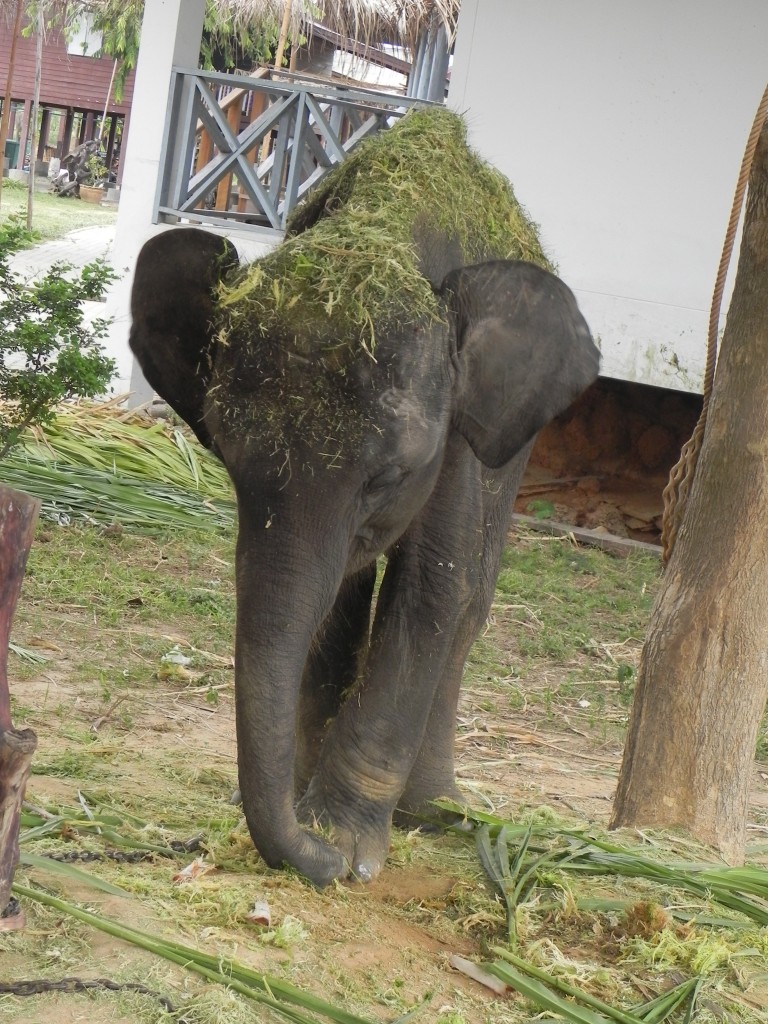
    Baby has captured my heart. Her condition is serious but it seems no one at the government center is concerned. Her owner gets paid to have her at the Elephant Study Center all day. He is absent. I have seen several different mahouts working her.

    At a little more than two years old, Baby is trained to perform in the show twice daily and walk two kilometers round trip daily, to and from her home stable.

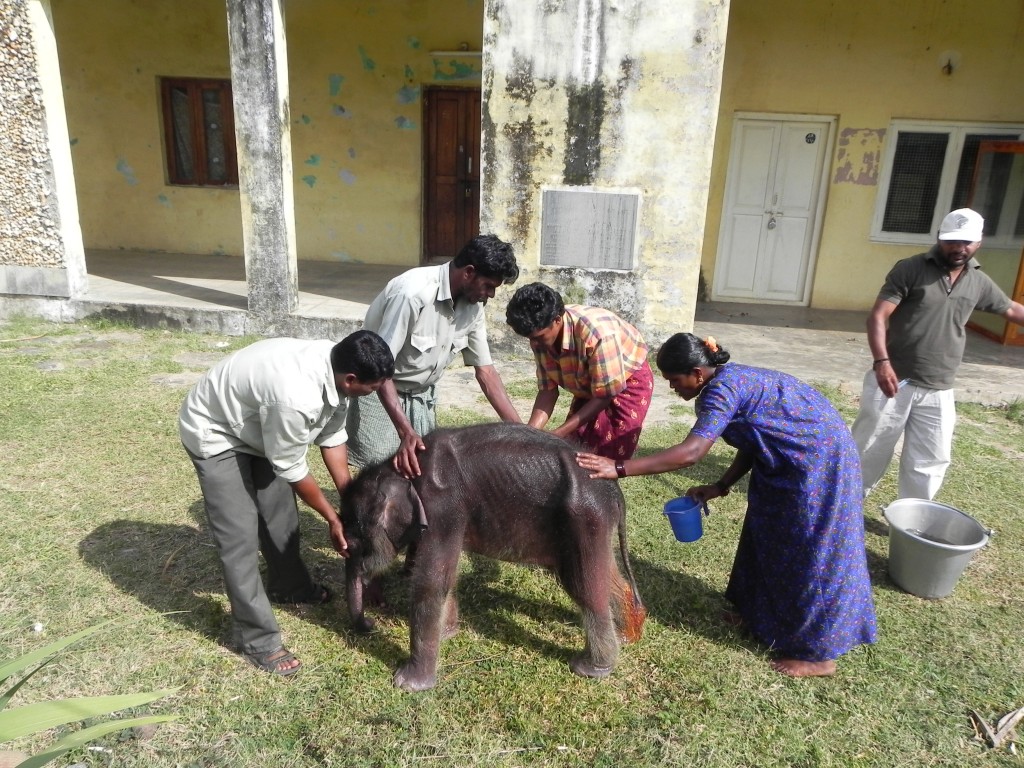
    She is scrawny and malnourished, with a ravenous hunger. It’s encouraging to see her grab for long-stem grasses and stuff them into her mouth, chew nonstop and grab another.

    Luckily Baby likes the rice and coconut milk supplement I am feeding her 3 times a day. The first two days my effort to help was tentatively accepted by the mahouts. But Baby reached out eagerly, looking for the bowl she knows contains the new tasty food. Now the senior mahout welcomes me with a smile and casual greeting. He thanks me after Baby eats.

    Today is my last day with Baby.

  • Lek’s Surin Project

    Lek’s Surin Project

    June 23

    The Surin Project is a new effort that Lek has undertaken. I was not aware of just how many projects Lek is involved in. Her plate is full.

    We arrived in Surin after a 13-hour overnight bus trip. Even though the accommodations on the bus were top of the line, 13 hours in the same seat can wear on you. We joked about being able to fly to Australia and back in the same amount of time. Regardless of the temporary uncomfortable situation, the long bus ride was worth it; no words could effectively describe what we would experience over the next week’s time.

    For the Surin trip I joined a group of Elephant Nature Park volunteers from around the world — the US, Australia, England and the Netherlands. It was a diverse and dedicated group of elephant lovers ranging from 16 to 56, what fun!

    Lek’s Nature Park Surin Project is in conjunction with the Thai government. In an effort to get elephants off the streets of Bangkok, the Surin Provincial government has set aside 2000 acres. Mahouts are given a place to stay with their elephant and paid to have their elephant on display. Unfortunately, display means chaining the elephant up all day — not much of an improvement for the elephants, but it’s a start. Mahouts are paid extra if they put their elephant in the show that is presented to the public twice daily.

    160 elephants currently reside at the government center, half of them males. As you might imagine having so many individually owned elephants in a relatively small area can be challenging. The biggest problem right now is lack of available food for the elephants. The monsoons are late in coming and everything is quite dry. The demand for food has resulted in owners having to drive great distances and pay higher prices to feed their elephants. Many elephants are quite thin as result of the shortage.

    The number of calves on grounds is frightening. Each elephant an owner has increases the amount of money he receives from the government. I don’t believe owners are breeding just for the money but it is uncertain what will happen over the next decade with so many calves being born.

    The government has big plans for this place. They plan to dump 60 million into developing this project as a tourist destination. Their goal is to return Surin to its previous status as the elephant capital of Thailand.

    So far we have prepared elephant grass for planting, planted two fields of elephant grass, constructed a shade structure, weeded areas where elephant grass and bamboo were previously planted and spent time with our sponsored elephants in the forest, ponds and river.

    Everywhere you turn there are elephants; the place feels a bit crowded to me.  It is set up like a reservation with elephants being the prominent fixture of the landscape, tethered under trees, shade structures or in the direct sunlight without shade. Most are alone, unable to interact with other elephants.

    A two-year-old calf has caught my attention. She was recently separated from her mom because the mother’s milk supply had dried up. I was also told that the mom was difficult to handle whenever the calf was around so they separated them to gain control over the mom. The calf is seriously thin and has a problem eating grass. She is ravenous, chewing mouthfuls of broad leaf grasses to a pulp. But after chewing the grass she spits it out instead of swallowing it.

    The vet was on grounds today. Alex, the project manager, spoke with her at length about this baby.  The problem of ownership, authority and the lack of elephant welfare awareness was offered up as the challenges the vet faces when trying to help one of the elephants.  The vet has no authority to intervene if an elephant is sick and suffering.

    The calf’s owner does not live on-grounds but, by sending her to the facility each day, he receives a monthly payment. The calf walks two kilometers roundtrip daily, to be chained on display and make an appearance in the show.

    I was so pleased today when the vet engaged Alex regarding the calf’s condition. Her medical history was shared and recommendations for tests that I received from Dr. Mikota were discussed.  Hopefully we will be able to get help for this baby.

    In the meantime, I continued to try to find a supplement she will eat. For two days I have been experimenting with different rice mixtures. This afternoon I succeeded and Baby finally started eating. I will keep you posted.

  • Lek has accomplished so much

    June 16

    I have enjoyed being able to spend an extended period of time observing different facilities and programs. One day is really not enough time to get a true sense of how a program works. This, my second day at Lek’s Elephant Nature Park brought a deeper understanding of the operation.

    The elephants genuinely spend the majority of their time out on the pasture grazing, paying little attention to the volunteers and guests that occupy the boardwalks bordering their habitat. I have watched for hours trying to figure out why the elephants do not return to the public areas to beg for food. One reason might be that each elephant has a mahout who follows them around to ensure their safety. The mahouts might encourage the elephants to stay out in the pasture but I really saw no indication that elephants were prevented from moving anywhere they pleased, except the construction area of course.

    The other reason might be because of the designated feeding time. The elephants are released from their stables at 7am and guests are allowed to feed them produce from a feeding platform at 10:30am. A “feeding bell” is rung and the elephants can be seen heading for the feeding platform right on time with no encouragement from their mahouts.  After eating, they head back out to pasture until evening, when they return to the platform for a second guest feeding, and then return to the stables for the night. In between they go to the river twice a day for bathing. It is all very calm and casual. The elephants move around like cattle with no noticeable prodding from the mahouts. It is obvious that the elephants are comfortable with the day’s routine. It is designed around them to meet their needs.

    Today I was honored to be asked to assist the mahout of the youngest calf. He is not yet one year old and already a handful. Understandably, he is the focus of the guests’ attention and, since he has contact with the guests from behind a wooded corral, he can be a little pushy.

    The first session with the mahout and calf went well. The calf is sharp as a tack and in no time he was responding to his mahout’s request to “come here.”  After a few minor instructions, the mahout was expertly maneuvering the calf from one side of the stall to the other. Of course this is easy to do, since the calf was given a piece of banana as a reward.

    Lek has a new project in Surin that I plan to visit next week. In conjunction with the government, Lek is helping to design a new pilot project for mahouts and their elephants. I look forward to seeing the projects and reporting back about it. Lek has accomplished so much in such a short period of time, and there is no sign that she plans to stop. Elephants and elephant lovers alike owe her a debt of gratitude.

  • A little piece of heaven!

    June 15, 2010

    After a ninety-minute drive I arrived at Lek’s Elephant Nature Park, north of Chiang Mai. Although I have known Lek for years, this was my first visit to the Nature Park. I have always marveled at the similarities shared between our two facilities but seeing the place for myself amplified just how similar our philosophies and work for elephants is.

    The first thing shared was a piercing glance and sincere condolences for what had transpired in my life over the past several months. Lek shot me a glance, no words necessary, and instantly I felt that she knew exactly how I felt. When she did speak her words were simple, “Never give up. You can’t give up.”

    Lek comes from a place of knowing that to give up is just not an option. The reason that both of us have been able to create what we have is because of who we are; giving up is simply not in our vocabulary.

    So I must say, the day started on a good note and continued throughout the day. Lek’s place is more developed than I imagined. It is well designed and organized. With nearly 200 employees and a dozen volunteers, the place is quite busy. A new river wall is being constructed which made me feel right at home.

    Dump trucks full of large rock and cement trucks came on grounds all day, reminding me of our corral construction of recent. The difference being that instead of the elephants racing over to the noisy trucks to investigate and play like our girls do, Lek’s elephants kept their distance. I asked and was told they are not attracted to the trucks. Instead they remained in the vast grazing area, paying little attention to the comings and goings of the roaring engines and clatter of the rock being dumped in the construction zone.

    Of course there always has to be one or maybe two elephants who do not follow the norm. In this case it was the youngest members of the herd — two yearling calves who found the activity at the construction site irresistible. The mahouts did their job well, following the playful young elephants like dutiful nannies, never chastising, only shadowing their huge babies. Verbally they encouraged the calves to return to the pasture with the other elephants. Of course, the antics of the calves was quite comical for observers. Only after grabbing a bolt cutter, tossing it on the ground and trying to put a head print into a sheet of plywood were the playful elephants escorted out of the construction site and back out to pasture.

    While visitors were given instruction on the day’s routine, safety parameters, proper elephant observation, feeding and bathing etiquette, the staff, volunteers and elephant keepers expertly went about the business of caring for the guest and elephants.

    This is a very well-run organization. In stark contrast to the stressed-out elephants I observed yesterday, the elephants at Lek’s Nature Park are calm and comfortable with their lives. I can’t say I was surprised to see how comfortable the elephants are; the facilities provide for the elephants’ every need. They are indeed very lucky elephants.

  • Unprepared

    June 14, 2010

    I was not at all prepared for what I would experience this afternoon.  Still flying high from my experience at Boon Lott’s Elephant Sanctuary, I was caught off guard as we drove north of Chiang Mai to one of the many tourist attractions that feature elephants. I was shocked at what I saw…and smelled. In fact, I had a hard time accepting everything about this elephant show camp.

    More than fifty elephants, mostly adult females, were chained on concrete under a stable shelter, with no food or water in sight. They were edgy, grabbing at each other, pacing, swaying and showing signs of discomfort and agitation.

    Fresh-cut grass, enough for two elephants, was bundled in a storage area out of the elephants’ reach. The place reeked of urine. I realized that the entire time at Boon Lott’s I had not once caught a whiff of urine or feces even though ten elephants lived on the property. This facility was not Boon Lott’s.

    Aside from the owner and two other men, we were the only people at this tourist attraction; something seemed out of place. Where were the tourists?  Where was the elephant food? Why were there nearly fifty elephants chained under rows and rows of shelters?  It reminded me of a state fair with livestock in the exhibition barns.  Everywhere I looked there were chained elephants.

    And there were more than I thought. Around the next corner and the next, elephants seemed to be piled on top of each other. To make things even more unbelievable, there were two babies, each with an adult, in a 10×12 wooden corral.

    Even though there was hardly room for the adult to walk two steps, both the adults and the calves were chained. The older calf — we were told that he was less than two years old — had chains on both front legs tied to two separate posts, severely restricting his movement. His anxiety level was painful; it was very difficult to watch him. The other calf was also chained on one front leg and his front feet were hobbled together. We were told that this calf was only seven months old.

    I cannot begin to understand how these young calves can be treated in such a barbaric manner. As I watched, it seemed obvious that the adult elephants were not the mothers of these two calves. At no time did the calves attempt to suckle or solicit comfort from the adult elephant.

    Their bugged-out eyes said it all. They were agitated and displayed some aggressive behavior toward the people who came near the cage. The adults were as stressed as the calves and were of no comfort to each other.

    Bluntly put, this tourist attraction felt like a cross between a puppy mill and a prisoner of war camp. Elephants were lashing out at each other, fidgeting, pacing and generally acting quite stressed. In my career I have never seen such an unhealthy situation for elephants.

    On top of many of the stables was storage for rows and rows of elephant saddles. In fact, even though it was the hottest time of the day, one tusker was saddled up and chained in the stall, even though not one tourist was there to ride him.

    In the middle of the stables stood a small arena surrounded by wooden bleachers. Rows of painting easels, musical instruments and basketball hoops were standing ready for the next show, whenever that would be.

    The owner explained that tourism had dropped off and he needed to sell some baby elephants in order to pay his mahouts, who, from what he said, had not been paid in three weeks. Unfortunately, this owner of more than fifty elephants did not think he should have to dip into savings to pay staff; if the tourists did not come, the mahouts did not get paid and, from the looks of it, the elephants did not get fed.

    As we were driving out we found even more elephants crowded into more stables: a tusker in musth surrounded by other elephants and two more calves who looked less than six months old. The entire scene was devastating.

    Thailand has a serious elephant problem and using them for tourism in this way is not helping the problem. The more tourists who go to these elephant show camps, the less likely it is that an alternative elephant-friendly solution will be created. But, honestly, I cannot imagine what tourists think when they visit a place like this. How can a person overlook the obvious pain and suffering? If the Asian elephant is to survive and recover in Thailand, exploitative situations like this one need to be closed down.

    Thailand has a huge challenge in front of them. Definitely the solution is not easy but exploiting this nation’s treasure should not be acceptable. Hopefully Thailand will enact and enforce strict laws that will protect their elephants; the alternative is unthinkable.

  • My First Stop in Thailand

    June 14, 2010

    At the break of dawn I left a little piece of heaven called Boon Lott’s Elephant Sanctuary. Completely removed from the real world, this elephant paradise is a ray of hope for Asian elephants. I am thankful that I decided to stay a few days because that is the only way to take in everything that is Boon Lott’s.

    Inspired by the short life and death of a brave baby elephant named Boon Lott, this sanctuary has done something no other has. What they have created is a model for others to imitate and honestly I hope many do.

    It seems that it takes an “outsider” to break all the rules. It also appears that women are willing to work outside the box for elephant welfare. Thank goodness! The founders of Boon Lott’s share a love of elephants; one, a lifetime mahout, the other an English woman who championed for a baby elephant named Boon Lott. Together they are making a mark on the story which is elephant. Their future is bright.

    The facilities are designed with the elephant’s welfare and comfort in mind — well designed, functional, artistic and meticulously spotless. Kat and Anon have dedicated their lives and their every effort to elephants. The family atmosphere includes not only Kat, Anon and their children but the mahouts, their families and the elephants they have built their lives around. All of the elephants are rescues with staggering stories to tell.

    Even though Kat and Anon allow visitors an intimate perspective into the lives of the elephants, they do not exploit the elephants to do so. No rides are offered. The visitors are allowed to observe the elephants as they go about their day from dawn to dusk, starting with a morning bath, followed by a long walk to grazing and foraging habitat, afternoon swim time and another excursion to the forest, where the elephants are tethered overnight. The events of the day are not designed for the visitor; they are the elephant’s daily activities and the visitor is permitted to observe.

    The Sanctuary is young, not five years old yet, and already they are home to ten rescued elephants. The goal is to expand land holdings so that areas can be fenced, making it possible to release the elephants tether-free overnight. Fencing is a must in order to accomplish this goal in order to ensure the elephants’ safety.

    Their challenges are many but Kat and Anon have beaten the odds so far, creating a model sanctuary. I am honored to know these two amazing people and the talented team of forward-thinking mahouts and their families that make Boon Lott’s the special place that it is. The elephants that call Boon Lott’s home are lucky elephants indeed.

    I have high hopes for Kat and Anon. Much pressure will be on them over the next many years, to continue what they have started. Blazing this trail is hard but the progress that has already been made is astonishing. I know this team and the elephants they care for will help change the face of elephant management in Thailand.

  • Leaving India

    June 8

    I am sitting on my duffel bag, back up against a pillar, facing the platform in the Dehradun train station. So far the activity resembles any high traffic transport area but it mostly reminds me of Grand Central station in New York City. A variety of messages are broadcast over the loud speaker system nonstop. Not only are arriving and departing trains announced, travelers are also advised, “To the kind attention of passengers, please do not accept packages from strangers as they might contain intoxicants.”

    This will be my first train ride in India and the last of my adventures here…for now.

    My train will travel overnight to Delhi, then I will fly to Bangkok. This will be my last full day in India. It has been a whirlwind trip.

    My exposure to the different situations for captive and wild elephants has been extensive. I look forward to a few days off to collect and record my thoughts, organize my photos as well as the information that I have gathered. There was so much to see, so many elephants to observe. I know much will come of this trip.

    I cannot thank my colleagues enough for organizing everything to ensure my time was spent observing the elephants of India and their management. Without a doubt the trip could not have been more fruitful and jam packed. The success of my trip is thanks to Christy Williams, Dr. K.K. Sarma, Suparna Ganguly of CUPA and Surendra Varma.  I look forward to the many collaborations that will follow.

  • Mudumalai Tiger Reserve

    Mudumalai Tiger Reserve

    May 30

    Finally…I have seen my first wild elephants. Two small herds: one with four females — two adults with two young calves; the other with two young calves, two adults and an adolescent tusker. They grazed on the tender grass growing in the speckled shade, protected from the direct sunlight by a mature canopy. Our presence went undetected as we, following the rules, did not stop our vehicle. It was a calming sight to behold.

    My time was spent meeting the forest authorities, including veterinarian Dr. Kalai, who toured me through the facility. The pride he has for his work was obvious. Knowledgeable and engaging, Dr. Kalai was a fountain of information about how the camp operates.

    It makes sense that the wealth of knowledge Asia’s experts possess about their elephants is unmatched by any other nation. Living with this indigenous species has provided Asia with a wealth of knowledge, not only of elephant life in the wild and captivity but, more recently, the challenge that is threatening the Asian elephant’s existence: human-elephant conflict. The forest personnel, professors, biologists and researchers I’ve met all show a genuine desire to find solutions before it is too late. So many bright and dedicated people unified to save this flagship species so important to its habit and fellow creatures, including mankind.

    This forest camp is expertly run from top to bottom. In the food prep area the camp elephants’ diets were listed on a huge board with the ingredients and supplements included in individual diets. I got my first look at the “cooked” diets I had heard so much about. Lined up in neat rows on the diet table were blocks of precooked foods recently removed from their moulds.  Some were topped with salt and other additives, sitting ready for the next stage in the process of elephant diet making.

    Sanctuary volunteers who tired of the endless produce chopping which dominated their service at the Sanctuary have nothing on the assistant mahouts in these camps. They are solely responsible for measuring, cooking, moulding and finally hand mixing each elephant’s diet, a process that demands precision and effort, not to mention repetition. Needless to say I was impressed.

    Only a few days before my visit an infant calf had to be rescued after being attacked by a crocodile. He survived the attack but his mother and family could not be located. Every effort possible is made to avoid bringing a calf into captivity but in this case there was no other choice.

    I observed firsthand that, indeed it takes a village, or should I say a tribe, to hand raise an elephant calf. The family responsible for this calf’s care had only recently turned over parenting of a young female calf they had raised for the past three years. They surely needed a break from the constant demand of a baby but took the new orphan in without question.

    Watching the parenting dance the family gracefully engaged in was mesmerizing. The father of the family was the calf’s primary caregiver. The matriarch prepared and provided the formula. The veterinarian directed veterinary care, which was provided by the veterinary technician. Each person has a role to play in the calf’s care. An older child assisted with tasks to support the calf’s care and medical treatment and a young granddaughter babysat, expertly I must say. They did not actually fawn over the calf but provided the security he needed. So young, he was obviously unable to understand his circumstances. Relying on survival instinct he followed around after a warm body. I am told that in a few weeks he will differentiate between the warm bodies but for now any warm body will do.

    His wounds were deep and treatment was painful. Throughout, his entire family showed care and gentleness, their skills expert, their compassion palatable. My heart went out to this little guy, who was sort of walking in a fog but, if he had to be separate from his mother and herd, he could not have been in better hands.

  • Changes for the Better

    May 26

    Today’s quest for knowledge about elephants living in captive environments in Asia took me to an ashram. Two elephants live here: a mature male and adolescent female. Both were gifts from devotees.

    The massive ornate buildings, expansive outdoor theater, manicured lawns and extensive landscaping suggested that this organization was experiencing good fortune. I felt sure the elephants must be benefiting from the organization’s success as well.

    I was told the organization owns 200 acres. On our drive to the location where the elephants were kept we saw how developed the property was. On this day there were hundreds of devotees on grounds. The gift shop was well stocked and crowded. The lakeside was being utilized by many people. The place was spotless with many well dressed staff members walking around grounds, obviously engaged in a variety of duties.

    When we drove up to the stable area I saw a large tusker in full musth. He was double chained by one front and one back leg. A fresh pile of corn stocks lay at his front feet and, due to his musth condition, a dark viscous fluid drained down the sides of his face. He was rocking from side to side while activities unrelated to him were conducted around him.

    The young female who was around eight years old was lying perfectly still in a concrete bathing pool while the Phandis scrubbed her entire body with a plastic bristle brush. After thoroughly scrubbing the young elephant on one side he commanded her to rise halfway and to lie down on her opposite side. She responded obediently.

    There was so much activity going on and people walking around the area that I wondered how the tusker was dealing with it.  A group of men were constructing a shade roof over a concrete pad for the young female. The Phandis did not allow her to dust herself, which was difficult as she was kept on dirt. When the shade structure was completed both elephants would be living and sleeping on concrete.

    It made me really nervous when two people approached the tusker. His musth condition was obvious. The first person reached his hand out. When the tusker did not respond, the visitor walked away.  The second person took two more steps closer. She was attempting to get the elephant to touch her, or more accurately “bless her.” Luckily one of the staff yelled for the devotee to move away from the elephant. It was pretty good timing as the elephant did turn and look at this woman, who was within his reach. Fortunately no one got hurt but the environment this musth male is being kept in is dangerous for visitors and unhealthy for him.

    Just about this time a squeaky clean elephant emerged from the bathing pool and was prepared for her afternoon duties. Her Phandis painstakingly, and with quite an artistic flare, drew flowering vines across her forehead and ear flaps and down the side of her face. Not once did this young elephant attempt to touch the chalk design being drawn on her.  She was behaved, but skittish. When she was escorted a few hundred yards away to be outfitted with a neck-bell and name plate, getting her to move past a small plastic canopy proved difficult. The staff explained that “this elephant is afraid of everything.”

    To my complete surprise an audience with the center’s founder was granted. Unfortunately, trying to have a serious conversation about the condition of his elephants and improvements needed for their welfare was hampered.

    The bejeweled, expertly painted and full of devilish energy elephant that I had observed at the bathing pool was groping the master as he feed her apples. This young elephant seems to know clearly that in the presence of the master she would not be reprimanded for being pushy. She took full advantage.

    It is not that I feel she should be well behaved but her proximity to a group of onlookers and willingness to wrap her trunk completely around this rather frail looking man made me cringe. The display escalated to the point that the elephant was pulling the master into her chest to get her apples. Smiling ear to ear, he resembled a limp rag doll; I had to turn away.

    Yes, I was concerned for the master who obviously had no idea the danger of his position, but I also felt really bad for the elephant. One day when she becomes too pushy she will pay the price, so many elephants in captivity do. I only hope her circumstances change before an accident happens, sparing her and the master.

    So the good news is that we met and spoke for a short time with the master. The organization has the land and money to implement improvements so that the elephants can live off chains, have access to tens of acres of wooded area and pasture and are free to bathe at will in the large natural lake on grounds.

    The idea is to reverse the current way the elephants are being utilized. Instead of the elephants going onto facility grounds to bless the devotees, improvements will include building a fabulous place that meets the elephants’ needs and discontinuing the practice of the elephants walking on grounds.

    Instead of the elephant placing her trunk on the devotees’ head for a blessing, the devotees will receive a blessing of another kind. They will be witness to the improvements their support of the ashram has meant for these two elephants living in captivity.

    The master stated that he did not like seeing the tusker in chains. He stated that if recommendations can be provided they will be implemented. This organization has the support and funding to do whatever they need for these elephants. Plans are being discussed with the hopes that implementation will occur quickly.

  • CUPA

    May 24

    I spent the day with Suparna Ganguly, a trustee of CUPA, Compassion Unlimited Plus Action,  a well-respected animal welfare NGO doing fabulous work in India.

    In addition to running a dog and cat shelter, CUPA operates a rehabilitation facility outside of the city, adjacent to the Bannerghatta Biological Park. Suparna is actively involved in many animal welfare projects, with welfare of elephants in captivity currently a main focus.

    CUPA underwrites the cost of care, including the mahout’s salary, for an elephant confiscated from a temple who is currently residing at the zoo.

    The rehabilitation facility sits on seven acres enclosed by a substantial electric fence.  The village is on one side and the wilderness on the other.  Wild elephants come down into the village and raid the farmer’s fields so the government is constructing a block wall to keep the elephants out. From what I understand the wall has been under construction for a few years and is now close to completion.

    CUPA’s rehab facility was built on land donated by the government, on the elephant side of the wall. Only two nights back a wild bull elephant took down several sections of the electric fence, giving him full access to the rehab facility. He did no damage to the buildings but he did eat a couple banana trees, sampled a few other varieties of trees and no doubt was observed by the rehabbing monkeys, since the banana trees he ate were inches from their cage.  He damaged more fencing on his way out as he exited on the opposite side from where he entered. It was sort of surreal to be inspecting a fence that so recently was damaged by a wild bull elephant.

    I toured the spotless grounds with cages, aviaries, ICU and a surgery room. The varieties of the soon-to-be-released birds and mammals were mostly foreign to me, some quite rare.

    When the veterinarian appeared, we were ushered off to one of the flight cages to release several kites who were ready to be set free. Being unfamiliar with the process, I was dumbfounded when a handsome adult bird, the size of a large rooster, was handed to me for release. The timid creature held his/her head down, mouth open and held very still, no doubt quite scared.

    “Throw it up into the air!” I was told. I scanned the immediate area for a fairly unobstructed flight route and threw the bird skyward. With little effort she spread her wings with grace and precision, catching the hot-air draft and flew off. What a thrill to be able to set this magnificent bird free. I have never experienced anything like it.

    In fairly quick succession four birds were released, leaving several more in the flight cage. Their time for release would come soon. As we walked back toward the building I glanced up to see five gently soaring kites overhead. The newly released birds were floating, catching a draft, swooping down and then back up again, riding the invisible sky waves. The new arrivals to the sky had been joined by another of their kind; now all five danced over the rehab facility, blessing the place that had protected them and given them back their freedom.

    The main reason for my visit to the rehab facility was to evaluate it for elephants. I learned that CUPA hopes to acquire an adjacent 55-acre parcel of land and develop it for elephants. The land, once over-used by the villagers, is beginning to recover. The grasses are spreading and a few trees have begun to grow.  A rock formation that was used as a quarry now serves as a water basin, holding hundreds of gallons of rain water.

    We walked the property as I listened to the plans to create room, initially for two rescued elephants. India’s new regulations requiring all zoo elephants to be moved to sanctuaries has caused quite a stir in the country, with strong opinions on both sides of the issue. CUPA would like to create a prototype of what can be done in an effort to move the process forward.

    We discussed, among other things, available water, shade and access to the adjacent government-owned forest land for the elephants’ night release. There is a lot to consider but the fact that India wants to make internal changes to address elephant welfare is incredibly encouraging. I am honored that my input has been solicited.