Category: Sanctuaries

  • When Jenny Met Shirley

    Jenny and Shirley first met each other in 1976 at the Carson and Barnes Circus winter quarters in Oklahoma. Jenny was a youngster, newly imported from Asia. Shirley was recovering from a broken leg she sustained from an elephant attack many months prior.

    Circuses are known to keep elephants chained side-by-side according to size, largest to smallest. Since Shirley was unstable, having only three good legs, she was chained at the far end of the picket line away from the big elephants and right next to Jenny.

    Their time together was short-lived, only a couple of months. In early spring of 1977, Jenny was sent out on the road to perform with the circus and Shirley was sold to the Louisiana Purchase Gardens and Zoo in Monroe, LA.

    Twenty-three years passed. The next time they saw each other was when Jenny stepped inside her barn at The Elephant Sanctuary on July 6, 1999.

  • Jenny and Shirley’s reunion

    Jenny and Shirley’s reunion

    Recently, a friend emailed me a question: “During the filming of “The Urban Elephant” documentary, what was going on in your mind (and heart) when Shirley and Jenny were trying to get close to each other?”

    I realize many of you may be curious as well, so I decide to share with all of you.

    “The Urban Elephant” film crew had been at the Sanctuary all day and had just left for dinner when Jenny approached the barn. She and Shirley had not yet met.

    When Jenny first stepped inside the barn she was calm, but when she saw Shirley she became agitated. She reached through the stall toward Shirley, intensely focused on her. Shirley showed little interest but finally responded to Jenny’s attention by stepping close enough to be touched.

    Jenny’s agitation grew. She extended her trunk all the way through the bars, reaching out, touching, talking to Shirley. Shirley stood parallel to the corral allowing Jenny to touch all over her, but continued to show very little interest. Jenny began to work herself up into frenzy, very uncharacteristic behavior for her.

    Scott and I were sitting inside the barn only a few feet away, watching. I was filming.

    Jenny was animated and anxious; she wanted to get closer to Shirley. Shirley remained calm. But when Jenny placed her truck up to Shirley’s mouth, Shirley froze. Her posture changed, she became a little rigid and then turned to look at Jenny. She reached over to touch Jenny’s mouth and what followed was undefinably powerful and life changing for all present.

    Looking straight into Jenny’s eyes, Shirley erupted into a huge baritone roar. Caught completely off guard, I thought a bomb and an earthquake had simultaneously hit the barn. Her bellows ignited Jenny’s bellows, which together literally shook the barn.

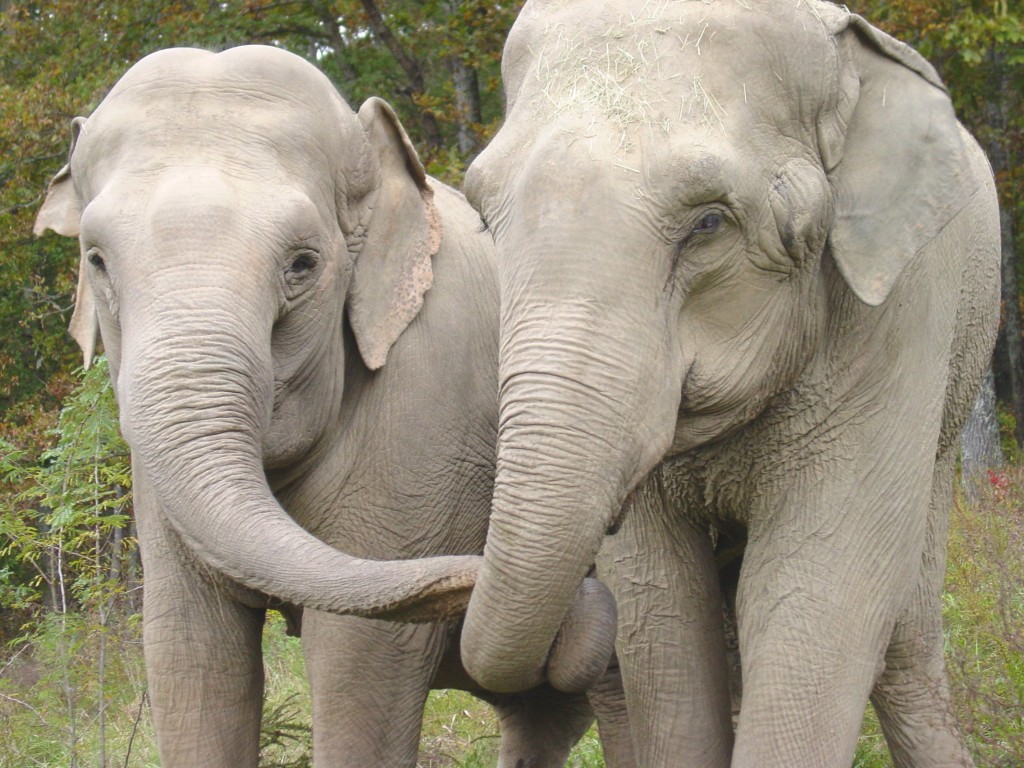
    With her head held high and mouth gaping open, Shirley roared and gently touched all over Jenny’s smiling face. Jenny’s body immediately relaxed as she continued to grope and pull at Shirley through the bars and bellow. The volume of their shared roars was deafening.

    The energy in the barn was so intense I had to step outside the door to catch my breath. Seriously, I could not breathe. I did not yet fully understand what was happening. I had only seen such a display of emotion once before when a baby elephant at a breeding facility was separated from his mother for the first time. The two nearly killed themselves trying to climb over the corral to get back together. Their roars were one and the same with Jenny and Shirley’s.

    This memory flashed though my mind and within seconds I understood. Jenny and Shirley had known each other before and during that time had forged an intensely close relationship. This was a reunion.

    The powerfully joyful vocalizations continued for some time, with Jenny and Shirley groping each other all over. I cannot convey how thick the love was in the air. I was too caught up in the emotional exchange to register just how long this went on but it could have lasted close to 30 minutes.

    By the time the volume of their reunion subsided, Shirley was emitting short, sweet sighs and Jenny had melted into the steel bars that separated them, their trunks draped across each other faces.

    I knew I had just witnessed a miracle, the first of many that I would be privileged to witness in the years to come.

  • Bunny

    Bunny

    Bunny — what a sensitive and loving lady. It was a joy to bring her to the Sanctuary. Her immersion into the habitat and bonds with the other elephants exceeded even our wildest dreams. She made an immediate and complete transition into Sanctuary life. In fact, she was the first elephant to sleep under the stars and was responsible for her sisters beginning to sleep outdoors overnight as well.

    I spent five years working for Bunny’s release from the Mesker Park Zoo in Evansville, IN. The zoo had been her home for four decades. From the time my effort began, I placed a weekly phone call to the zoo to discuss Bunny and her possible relocation. Ron Young, the zoo director, and Ted Grannan, the assistant director, were gracious but firm: Bunny would never leave the zoo.

    They continued to accept my calls and humor my periodic visits, but their response to my interest in discussing Bunny’s relocation was a consistent no. I realized that these were kind and caring people. My goal was to familiarize them with the Sanctuary so they could understand what we had to offer to their beloved Bunny.

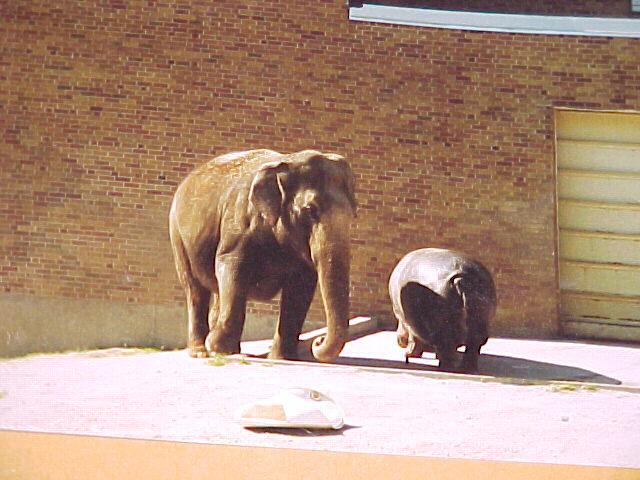
    On one of my many visits to the zoo, Bunny was having “play time” with her next-door neighbor Daisy, a hippo. They had lived in adjacent enclosures for four decades. On special occasions Daisy was allowed into Bunny’s yard for a visit. It was quite cute to watch, but sad to realize how these two had to rely on another very different species for companionship. Bunny gently herded Daisy around the yard, as much as one can herd a hippo, with Daisy paying little attention.

    My persistence began to pay off, but in a roundabout way. Ron soon began passing my phone calls off to Ted, who remained pleasant and engaging. He would listen patiently to my latest update and end the conversation with the zoo’s mantra, “Bunny will never leave the Mesker Park Zoo.”  My no-pressure-but-let-me-tell-you-this approach was sincere — and effective. We shared a common interest in Bunny’s welfare, which soon brought us closer together. My message began to get through and I saw that Ted was beginning to question the wisdom of their position.

    Until this time, I was told that Bunny could not be moved for a myriad of reasons, including that it would break her heart to leave the zoo. With stories about our other retirees as evidence to contradict that concern, Ron finally admitted that the idea simply could not be considered because the Association of Zoos and Aquariums (AZA) would not allow it.

    After years of open communication and education I was able to demonstrate that Bunny not only deserved to move to the Sanctuary but her very health depended on it. Her enclosure offered limited natural substrate and her pool had been empty for years. As result of years spent on the hard surfaces of her exhibit, Bunny had developed a chronic foot disease that could soon develop into osteomyilis. This captivity-induced disease is responsible for the deaths of nearly all adult captive Asian elephants living in zoos. Bunny was on her way to being yet another statistic but I knew that Sanctuary life could spare her such a fate.

    Bunny was surrounded by a loving staff, attentive veterinarian and adoring public. They began to grasp the gravity of Bunny’s condition and, ultimately, the people responsible for Bunny’s care, including Ron and Ted, became the champions for her release.

    On September 29, 1999, Bunny arrived at the Sanctuary. Her retirement was celebrated by two communities united by one deeply loved elephant.

  • Tarra meets a baby bird

    Tarra meets a baby bird

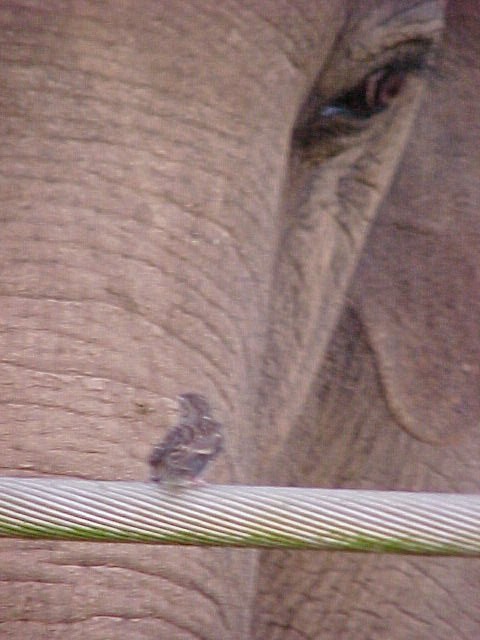
    The story that goes with this touching photo taken in 2001 is equally amazing. I went out to the back of the Phase ll barn and found Tarra staring at the fledging on the horizontal corral cable. I was without camera and said to Tarra, “Don’t move, don’t scare it — I’m going to get the camera.  I’ll be right back!”

    I ran back the length of the barn and up the stairs, found my camera, ran back down the stairs and out to the back of the barn. It had to have taken me two to three minutes. When I came back around the corner, Tarra was standing perfectly still, in the exact same spot as when I left her. I swear she was holding her breath.

    I was able to take three photos before the fledgling flew off.

    I praised Tarra for standing so still and for not trying to touch the baby bird, which I could tell she was dying to do. Her eyes were still as large as saucers, sparkling with excitement. She squeaked, took a deep breath and let out a piercing trumpet.

    Another magical moment with Tarra.

  • The Art of Cultural Brokerage: Recreating Elephant-Human Relationship and Community

    An article by Carol Buckley and G.A. Bradshaw, Ph.D., Ph.D., on how sanctuary creates a healing trans-species community in which humans and elephants live together. In sanctuary, the humans function as catalysts, interpreters and negotiators of relational repair for elephants in recovery from trauma.

    Read the full article.

  • Elephant Aid International Creates First-Ever Elephant Care Center in India

    Hohenwald, TN, October 27, 2011 – Elephant Aid International (EAI), a Carol Buckley Project, announces its official partnership with the Wildlife Rescue & Rehabilitation Centre (WRRC), one of India’s foremost wildlife organizations, to create the first prototype Elephant Care and Rehabilitation Center in Karnataka, Bangalore, India.

    With the endorsement of the Indian government, this private project will serve as a model for future care and rehabilitation centers throughout the country. The center will rehabilitate elephants who have been removed from the confines of zoos, circuses and temples, and offer them a more natural lifestyle, free of chains and negative management techniques.

    Carol Buckley, founder, president and CEO of EAI, will supervise the Center’s development, training of mahouts (elephant handlers) and elephant acquisition and relocation. This first facility will house up to seven elephants.

    “We are honored to partner with WRRC on this landmark project,” said Buckley. “I believe this care center will be a beacon of hope and a challenge for change for people working to improve the lives of captive elephants.

    There is an urgent need for care centers (what are known as sanctuaries in the U.S.) in India. In November 2009, the country’s Central Zoo Authority mandated that all elephants be removed from zoos and placed in alternative facilities better suited to address their needs. India’s wildlife parks and game sanctuaries are not well suited for zoo elephants and, until now, no other alternative existed.

    In August 2010, the Elephant Task Force of India’s Ministry of Environment and Forests issued a set of recommendations, including the creation of state-of-the-art lifetime care centers.

    Designed to provide freedom of movement and a healthy social environment, care and rehabilitation centers will provide a safe place for elephants to escape the abuses of captivity.

    • The centers will support the rehabilitation of elephants suffering from physical and psychological trauma by providing a more naturalistic environment.
    • They will not involve tourism.
    • The grounds will be fenced, eliminating the need to restrain elephants with leg chains.

    All mahouts will be trained in Compassionate Elephant Care techniques, a system developed by Buckley that is based on understanding elephant biology, physiology and psychology; relationship building between the mahouts and their elephants; and positive reinforcement.

    The number of elephants housed at the Center will be limited to ensure there is adequate vegetation for them on-site and in the bordering national forest. The elephants will have access to areas of the forest during daylight hours and will return to the Center at night.

    The Center is based on The Elephant Sanctuary in Tennessee, which Buckley co-founded and led to international recognition as one of the leading models of humane management of elephants in captivity.

  • UPDATE: Elephant Care Center

    In 2009, India’s Central Zoo Authority mandated that all elephants living in zoos had to be moved to national parks and sanctuaries. Unfortunately, facilities to accommodate the displaced elephants do not yet exist.

    My goal is to create an elephant care center prototype in India that can be easily replicated countrywide, ensuring that all zoo elephants can be relocated to more suitable environments.

    Serious discussion for the development of Elephant Aid International’s first elephant care center (sanctuary) in India, which has been underway for many months, is in the final stages. A fabulous piece of land bordering a National Forest has been selected, complete with forests, pastures and ponds. It is a wonderful location for rescued elephants.

    Last week, at our request, government officials toured the property. They asked questions about management and funding, voiced concerns about co-mingling of wild and captive elephants and requested follow-up information regarding our plans. All concerns were minor and easily addressed.

    Although government endorsement is not a requirement for the creation of the elephant rescue center, enlisting government input will serve to strengthen relationships essential for a successful project. We are confident of an emerging rescue center reality! Stay tuned for future updates. We hope to confirm government endorsement within a few weeks.

  • Animals Asia

    January 12, 2011

    My last full day in Vietnam was spent at the Animals Asia bear rescue center outside of Hanoi. Many thanks to Jill Robinson, founder of this superb facility, for introducing me to her project. You need to check out this project on-line at www.animalsasia.org.

    Hundreds of bears benefit from the efforts of Jill and her competent staff. The facilities are well designed and the staff are experts in their field. As for the bears, well they are pure bundles of joys, so immersed in their freedom that visitors do not get a second glance. Actually, visitors don’t get a first glance, a sign that Jill and her colleagues are succeeding at their efforts to rehabilitate bears rescued from bile farms. I so appreciate the time Jill and her staff spent with me and recommend that you support their efforts.

  • for the elephants

    I wish you could have been here to experience the exhilarating tour we took of “the land.” Hiking the forest, we found wild elephant dung and massive foot prints near a large pond, and a deep ditch designed to keep the wandering tuskers out.

    As the sun began to descend we were driven to the top of a rock mountain. It was spectacular. The view was endless, the horizon hidden behind multiple layers of sprawling mountains. In the valley below, tiny billows of smoke spiraled up into the soft blue sky from fires set by villagers along the periphery of the park boundary, a sad reminder of the challenges of survival faced by humans and wildlife who reside so close together.

    Nearby stood a towering metal observation platform with the perfect impression of a wild elephant’s head in the steel upright support. Without doing further damage the bull left his mark, an “I was here” signature.

    Lizards scurried over the massive rock mountain top where stone graves remain, mostly intact, from an earlier time. From this vantage point the entire property could be viewed, giving a greater comprehension of the layout of the land. Then it started to rain — so very refreshing. As we left the forest I began to see it from the elephant’s perspective, vast, wild and private — home.

    As we sat on the veranda talking, the sun set, the birds quieted and the glorious storm continued. We spoke of a wonderful project to create a safe and healthy place for captive elephants, a care center that will benefit a few individuals and serve as a model for improved elephant welfare for India’s precious elephants living in captivity.

  • Khan Kluay shows a softer side

    Khan Kluay shows a softer side

    I thought about renting a car on my next trip to Thailand but realized that would be silly because even though I would have convenient transportation at my finger tips, I would get lost everywhere I drove.

    Navigating today’s trip from Phetchaburi to Wildlife Friends Foundation Thailand (WFFT) would have been quite stressful without a local person at the wheel. Street signs are not in English and asking for directions results in a blank stare followed by a toothy grin. So for now I will be satisfied with public transportation and the gracious offering of transport from facilities like WFFT. It is much appreciated.

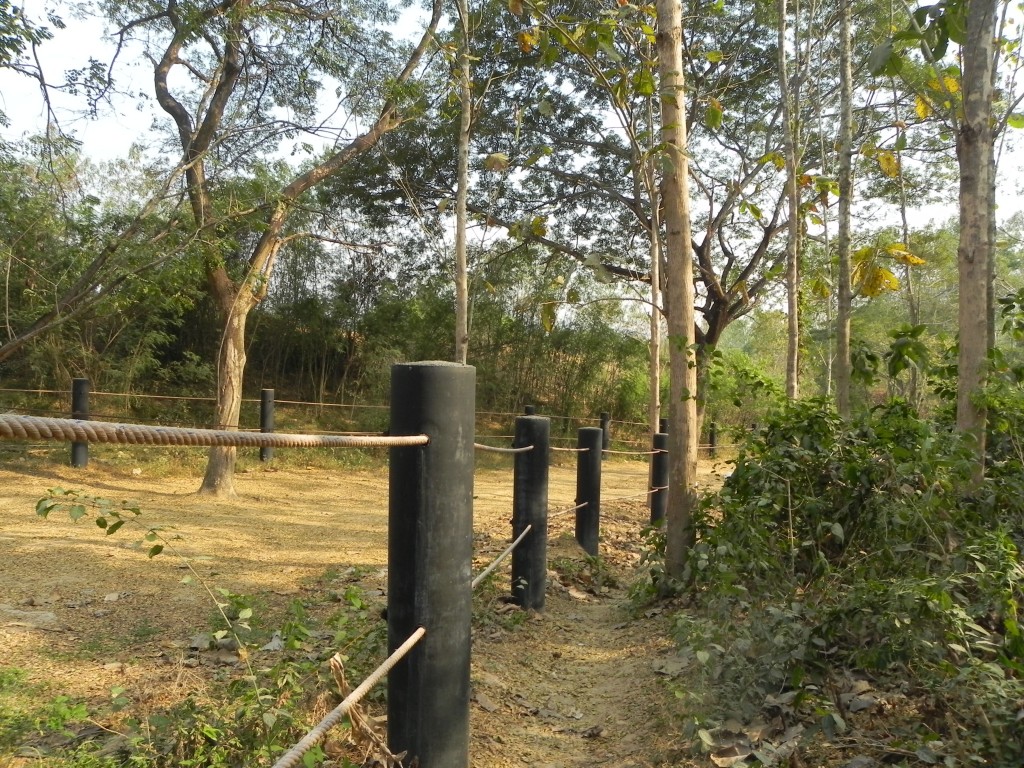
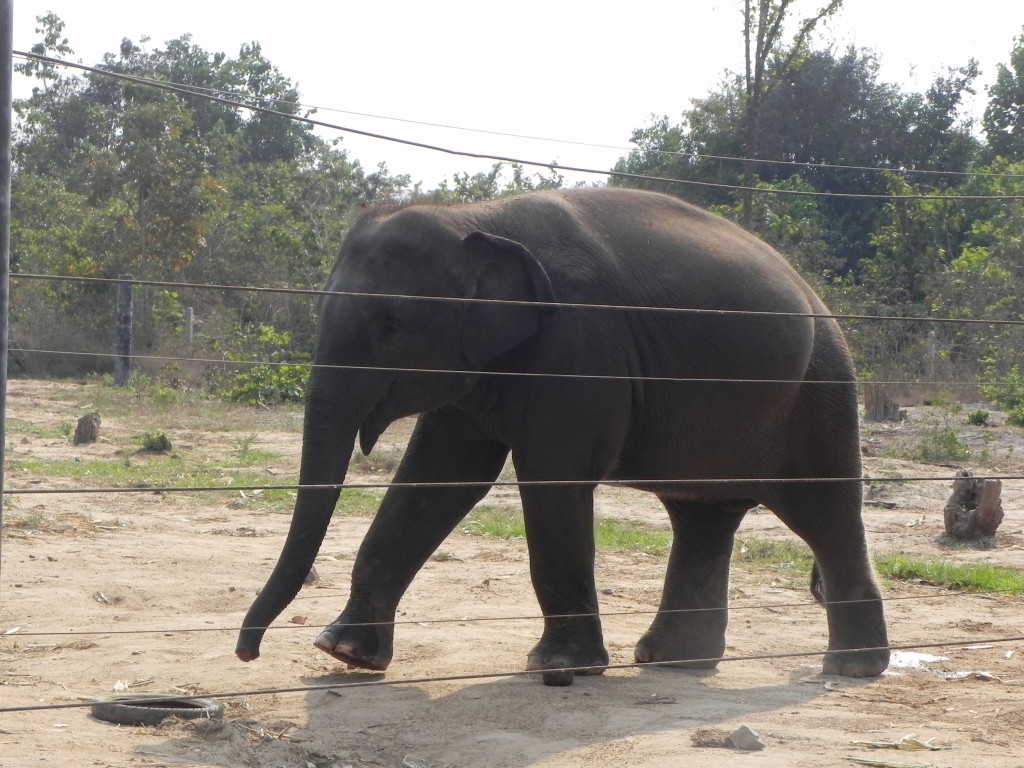
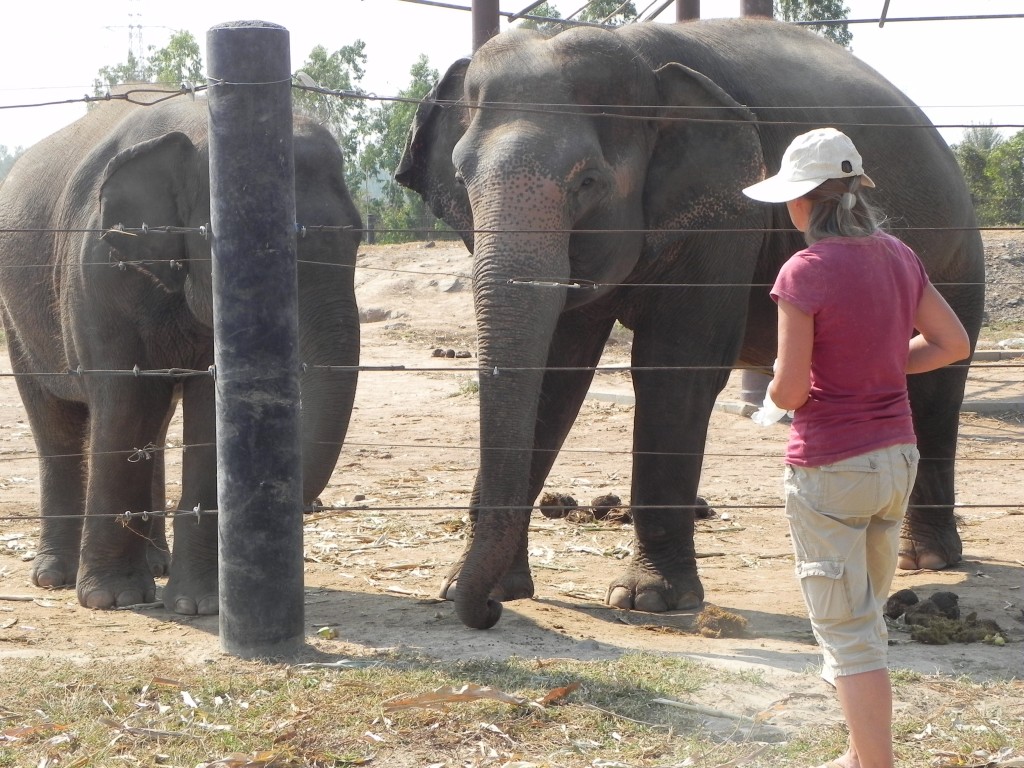
    This afternoon I arrived at WFFT and was pleasantly surprised to see that all five elephants live chain-free. Their pipe and cable corrals are a time-tested fencing design. The electric fence attached on the inside of the corral as a secondary security measure is also time-tested, and a requirement with young Khan Kluay.
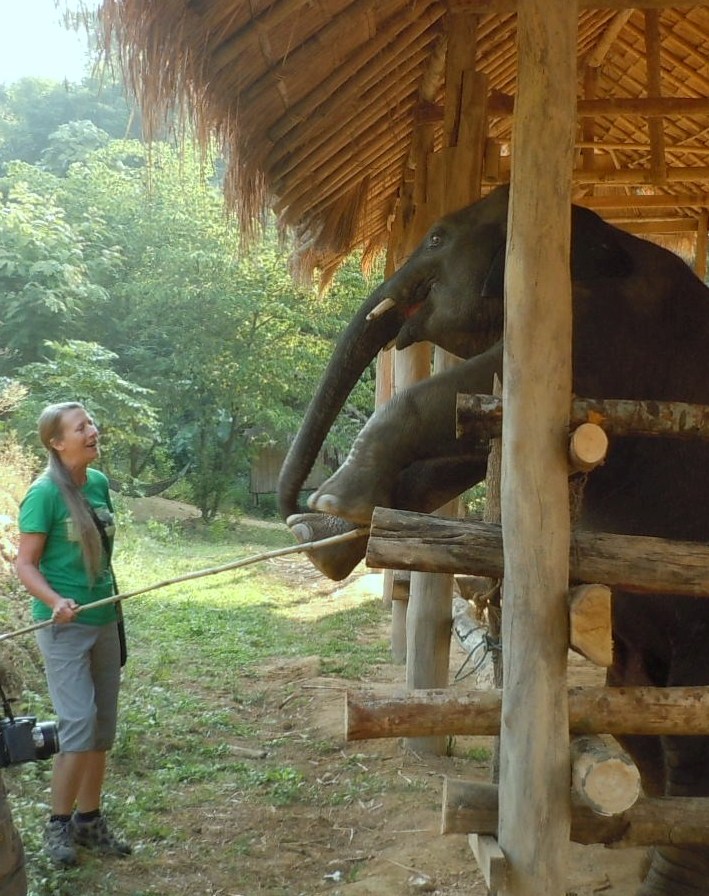
    One of the most beautiful elephants I have seen, Khan Kluay — Bam, as his mahouts call him — is nearly six years old and recently started acting out aggressively. After a mahout was injured the wise decision was made by the foreign management to go protected contact. Since the elephants live chain-free, the change does not affect Bam in a negative way. It may make the mahout’s job a bit more challenging because he must gain Bam’s cooperation, but for Bam, it’s all good.
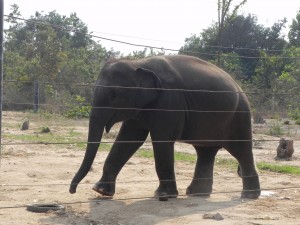
    My observation is that Bam is insecure and hides behind a mask of spurts of aggression. He lives with 40-year-old Som Boon; they appear to enjoy each others company. She is gorgeous with flowing polka-dotted ears and a well-rounded figure. An old injury to her back left leg has left her with a limp but she is agile and active – a very lovely lady.
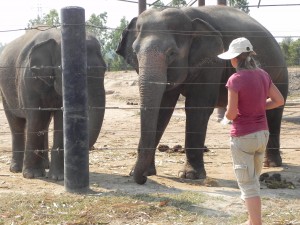
    After a brief tour of the facilities and elephants, we returned to Bam’s yard to watch his behavior around the mahouts, who were preparing his evening feed. He shadowed the mahouts as they walked the fence line, threw dirt in their direction and mock charged them. The mahouts did not react so the display of aggression was short lived. Without difficulty, a mahout shifted both Bam and Som Boon into an adjacent holding area so that volunteers could clean the yard and put fresh food and treats out for the elephants.

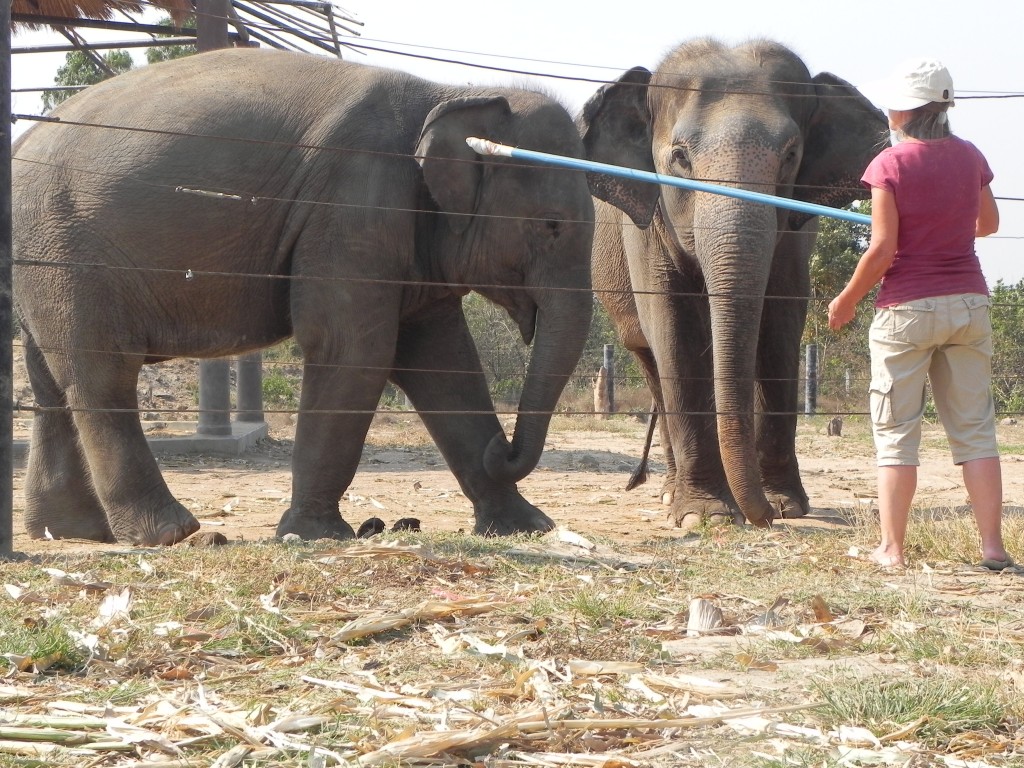
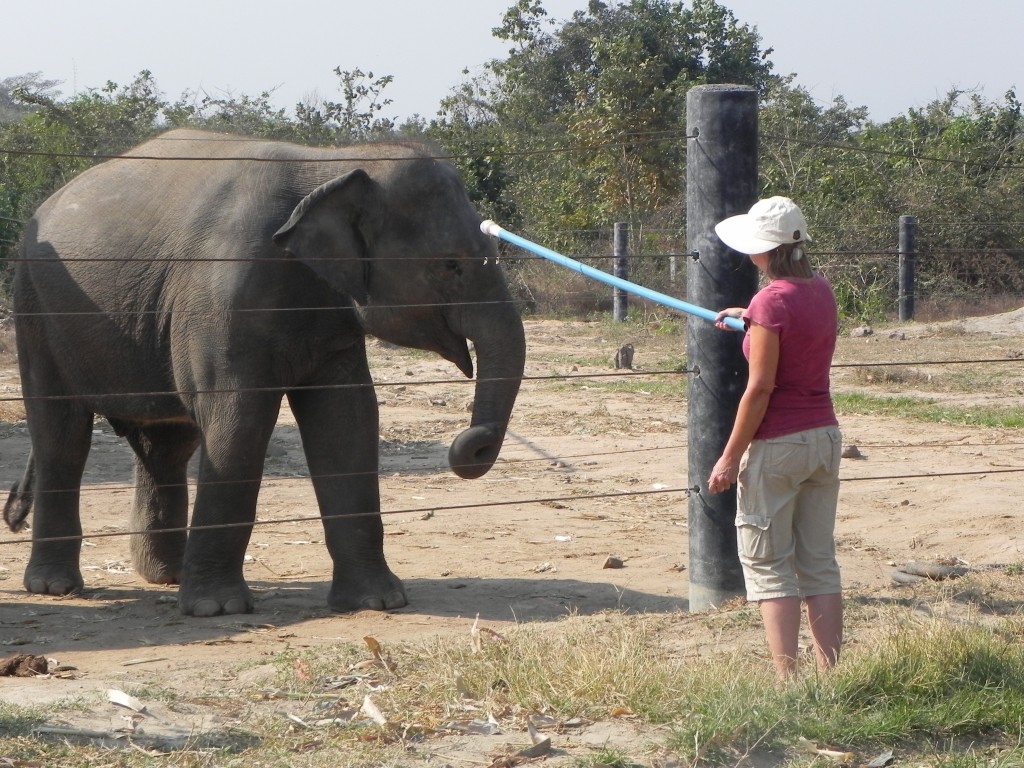
    Lucy and Tom, two of WFFT’s permanent staff, helped me quickly manufacture a target pole out of a scrap piece of plastic pipe, a portion of a burlap bag (for the soft end), a length of elastic and a bit of surgical tape. This ingenious effort resulted in a functional target that would serve Bam well.
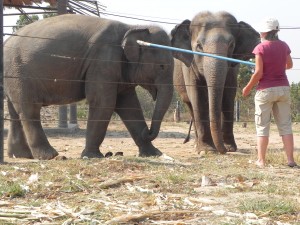
    When I started working with Bam it was immediately apparent to me that he was a bit of a bully toward the mahouts but deep inside he is a frightened boy. He shied away from the target as I ever so slowly slid it over the cable into the corral. He inched forward, wanting desperately to get near the bright blue pole, wiggled his head back and forth, wanting to touch it and fearing it at the same time. He danced around the target like a prizefighter, but at no time did he show any aggression.

    It took a few minutes but Bam finally mustered up the courage to touch the target with his forehead. He was so cute, dancing around the pole, walking a few steps away only to return with more courage. Finally the soft end of the target made gentle contact with his forehead.
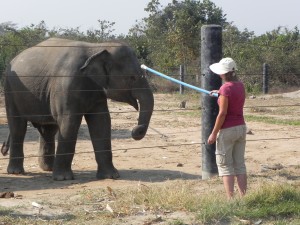
    That was all it took. He soon was touching the target with his forehead fearlessly. Yes, he had a grin on his face and a sparkle in his eyes. He offered and I captured parts of his body – “sapoke” (hip) and “kalang” (back leg) – and when the fifteen-minute session ended, he was playing with the idea of presenting his “who” (ear). I am ecstatic over his participation. He relaxed right into the game, something I was not sure would happen, having been forewarned about his behavior.

    Once again, positive reinforcement target training proves to be a positive way to engage with elephants, even ones who display aggressive behavior. It warms my heart to see Bam playfully engaged in the game, a tool that the mahouts can use to build and strengthen their relationship with him.

    Much appreciation goes to WFFT’s  founder Erwin Wiek and his dedicated staff for hosting my visit. The center is a model for others striving to create a safe and healthy environment for captive-held elephants in Thailand.
  • a special day for BLES visitors

    a special day for BLES visitors

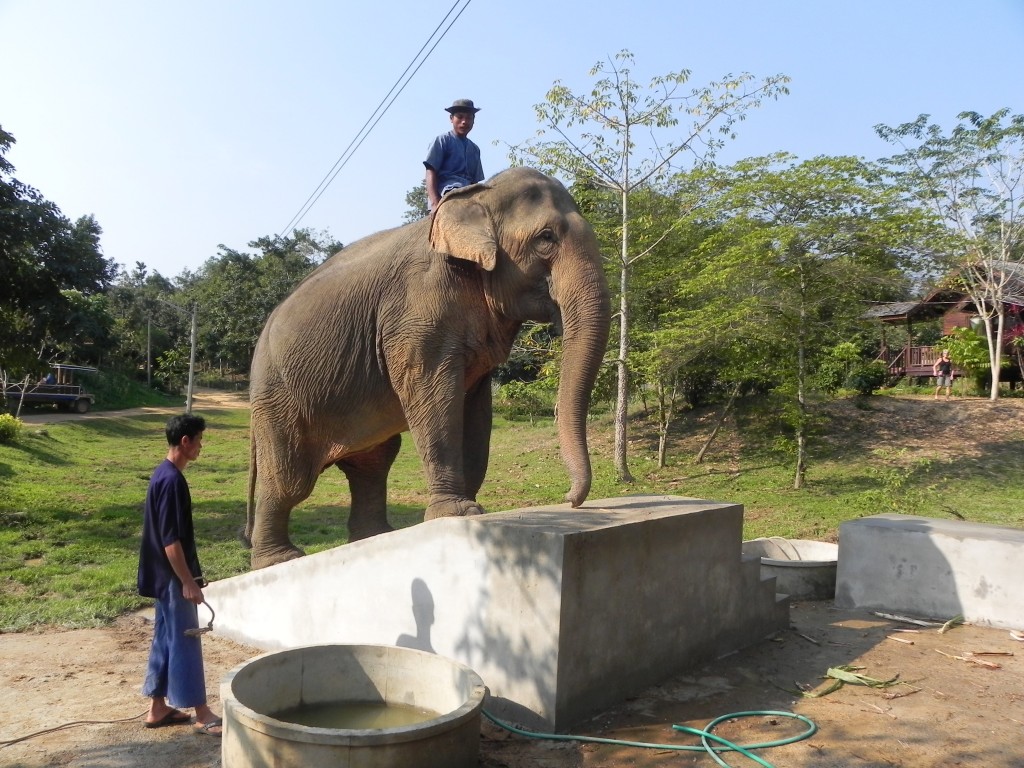
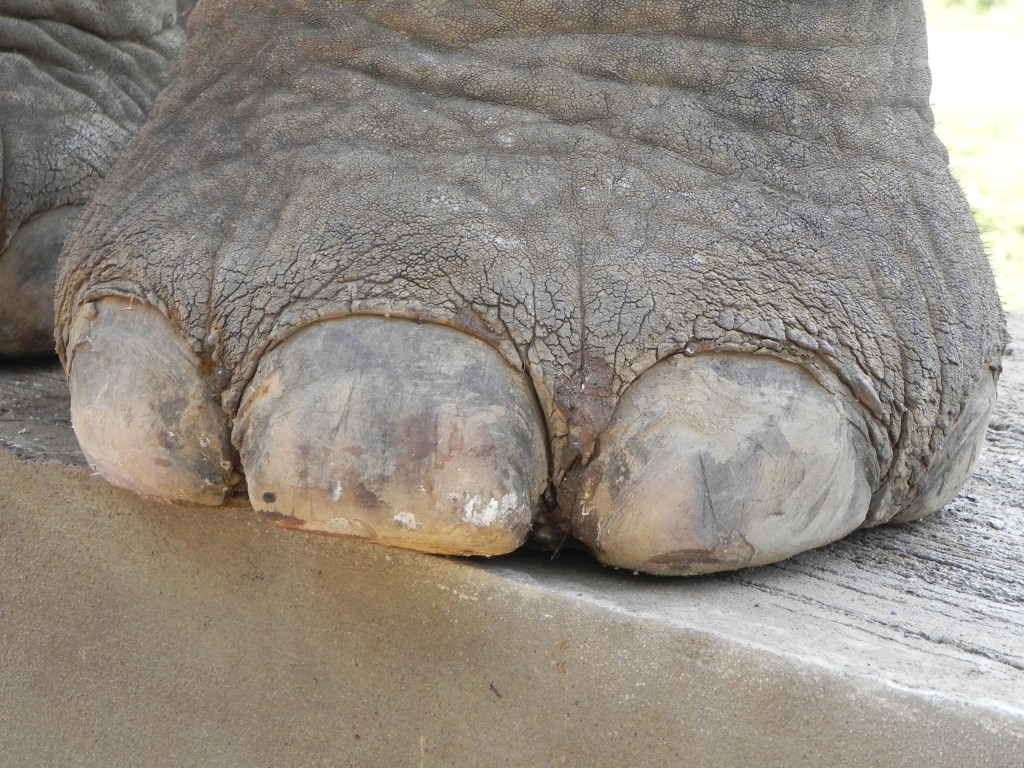
    The guests at BLES had a very educational experience today, their second day observing Mee Chok’s target training session and Pang Suai’s pedicure. In both cases they observed in silence, and later expressed sheer amazement at how relaxed and confident Pang Suai was today.  Yesterday was her first experience with the new foot trimming ramp and pedicure. It took her close to thirty minutes to walk up the ramp and settle in for her first-ever pedicure. But today, she casually sauntered up the ramp without hesitation, presenting her toes off the end like a pro.


    The guests commented on the difference in her comfort level from yesterday, recognizing that her positive experience yesterday contributed to her confidence today. Pang Suai cooperated fully, without reservation or resistance. She actually appeared to enjoy the foot trim and extra attention.

    As soon as Pang Suai’s pedicure was complete, Mee Chok and family emerged from the pond and headed toward the training corral. He was full of energy and wasted no time showing off what he had learned the day before.  Within minutes we were all in stitches watching his antics. Mee Chok was fully engaged and nearly over-the-top with enthusiasm.  Seriously over the top!

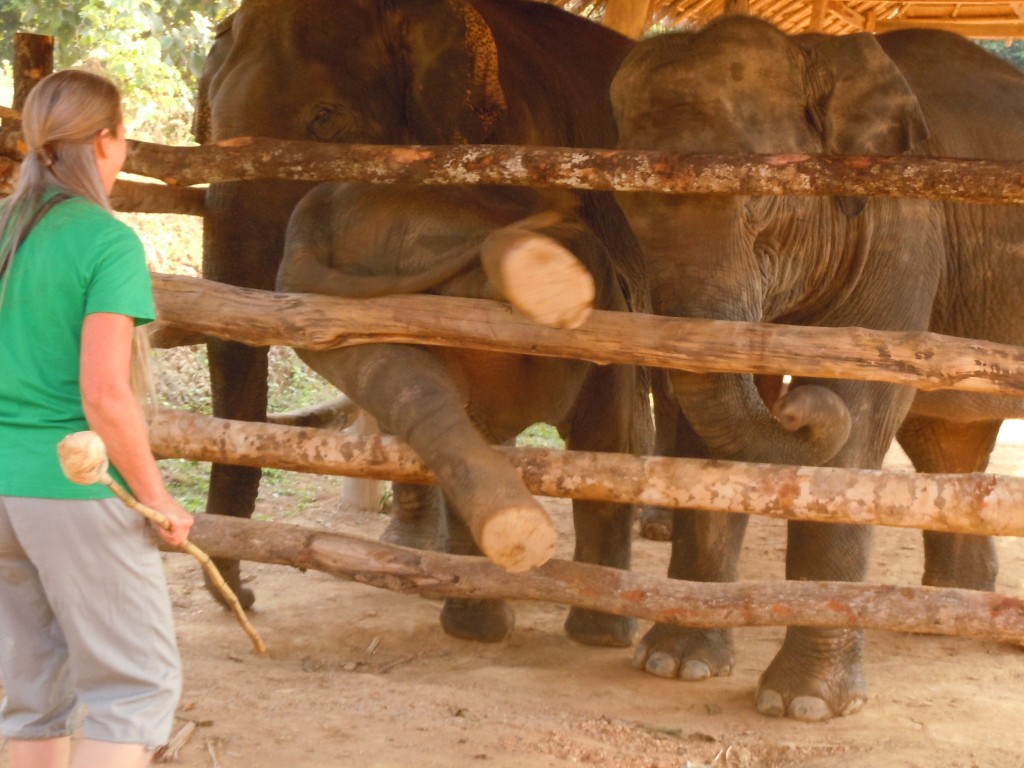
    As soon as he heard me say “telle,” he effortlessly scaled the corral and with complete control flung his front feet over the railing—the top railing! His legs were dangling quite comfortably over the railing which is higher than he is tall.

    It was the funniest sight and a most amazing display of agility. The entire group of onlookers and I were roaring with laughter, which of course fed Mee Chok’s sensational mood. He was having such fun and loving the reaction of the onlookers. But what he did next sent us all into fits of hysterical laughter.

    When asked for “kalang”(back leg), Mee Chok flung one back leg over the railing, followed instantly by the other leg, which he placed on the railing above, resulting in both his back legs sticking through the space between the horizontal railing.  Then, in one graceful continual motion, Mee Chok effortlessly walked his back legs up the rungs of railing, nimble as a spider monkey.  I could hardly believe what I was seeing: his front feet on the ground, back legs poking through the upper railings with his bum sticking high up in the air.

    It was hilarious! I couldn’t help it; I totally lost my composure and joined everyone in laughter-of-appreciation for Mee Chok’s agility and humor. Athletic only begins to describe this little man’s physical coordination; he is seriously agile. He was exhibiting unbridled enthusiasm for the game, his joy was contagious. It was impossible to take this session too seriously — Mee Chok had taken the training game to a whole new silly level!

    The guests were in awe of Mee Chok’s agility, ability to learn so quickly and his willingness, even eagerness, to engage in the training game. Each expressed their sincere appreciation for the opportunity to witness the foot trimming and training sessions. It was marvelous to hear them comment on their surprise at “how smart elephants really are,” how “after only one session Pang Suai was completely comfortable with climbing onto the ramp today” and how “Mee Chok learned so much in only fifteen minutes.”  Listening to their observations filled me with gratitude for a lifetime spent with elephants.

  • Mee Chok and Pang Suai

    Jan 24

    It’s my first day back at BLES and I am over-the-moon excited about what has taken place. As promised, Katherine had a sturdy exercise/training pen constructed and a raised concrete platform for foot trimming. With everything well in place and the mahouts briefed on the plans, Pang Suai made her way to the foot trimming platform. At first she was apprehensive about walking to the edge of the platform. Snaking her trunk over the side examining the distance between herself and the ground, she hesitated to get too close to the edge. The mahouts were fabulous, one on her neck in a position she finds familiar and another at her side reassuring her that she was okay. No elephant hooks, knives, nails or weapon were used, only patience and the talent developed over years of being with this elephant. It is an honor to work with these mahouts.

    Uncharacteristic of other elephants whom I have provided pedicures for, Pang Suai preferred that I trim her back feet instead of her front. This is unusual but I accepted her preference. After she relaxed into the back foot trims, we were able to trim her front nails and pads.

    Her pads and nails are healthy and only slightly overgrown, no cracks or serious decayed areas. Her cuticles were little overgrown but the pedicure took care of that. Like proud parents the mahouts could not stop bragging about how beautiful Pang Suai’s feet were. One mahout commented that her feet were so beautiful he would ask her to marry him!

    Still aglow from the success of the foot trimming session, I was told that Mee Chok would soon be available for his training session. With a bucket of cut bananas and a flexible target pole in hand, we made our way over to the training area. Mee Chok had just emerged from a refreshing swim in the pond with Lom and Pang Tong. All three made the gradual climb up to the empty elephant stalls. The elephants don’t stay in the stalls so it’s a bit of a ghost town with empty stalls dotting the area.

    With a little encouragement Mee Chok and his adopted family entered the stall, curious about the new enclosure. Stoic Pang Tong stayed at the far end while Lom and Mee Chok engaged in the new training activity. Mee Chok was full of energy, moving around a lot but always returning to the area of activity, which was the target, whistle and banana treats. He and Lom did well, and he started to get the idea after only 15 minutes. I did have to laugh at all the distractions, which in other training environments would be squelched — electric saws at a construction site, staff discussing their morning duties and a large delivery truck dropping off supplies. The elephants were aware and responded to the different distractions but continued to show interest in the training.

    That was the morning session, Mee Chok’s first session.

    When Kat asked how I felt Mee Chok did, I said he did well, by  the end of the session grasping the concept of the training. My guess was that he would spend the next few hours pondering the activity.

    Wow, did he ever ponder. When the family arrived for the second session, Mee Chok immediately responded to the “target” request. He had it! I pointed the spongy end of the target toward the stall and said “target.” Without hesitation, moving at a fast clip, singularly focused, Mee Chok walked right up and placed his forehead square on the target. BINGO, he got it!

    What came next was so exciting, a firestorm of activity driven by his comprehension of the game. What a joy to see Mee Chok engage in this game, so foreign but so stimulating. In no time he was striking the target with his feet at the word  “talle.” And then he decided that if one foot on the horizontal bar was good enough to get a piece of banana, two feet must be even better. Was he ever proud of himself, and I was filled with joy knowing that yet another baby elephant in Thailand will benefit from positive reinforcement training.

    The mahouts were smiling from ear to ear and giving us the thumbs ups. They could not have been more pleased. The session continued for about fifteen minutes with Mee Chok fully engaged and anxious to learn more. To say this was a good day would be an understatement!