Category: Sanctuaries

  • Finishing up my work in Thailand

    Tim Gorski of Rattle the Cage Productions spent all day yesterday at the Park, from sun up to sun down, documenting the relationship between Chang Yim and Karl, his mahout. I was thrilled when Tim decided to wave his fee…he is an authentic animal welfare advocate. Check out his site at www.rattlethecage.org.

    The footage Tim took will provide the visuals necessary for a video comparison of free-contact dominance and free-contact non-dominance elephant training. This footage will be the first of many hours collected in support of positive reinforcement training for elephants.

    Oh boy, was it ever hard leaving ENP today. It was impossible to not get attached to the elephants during my stay because they absorbed me right into their family. I love and respect each one for their good humor, resilience and individuality. They are permanently embedded in my heart.

    I am on my way back to Boon Lott’s Sanctuary for one more week of foot care and positive reinforcement target training with Mee Chok. I can’t wait to see how he responds!

  • Returning to BLES

    My time at BLES was supposed to be devoted to foot trimming for all the elephants and target training with Mee Chok. If I have learned anything during my travels in Asia, it is patience.

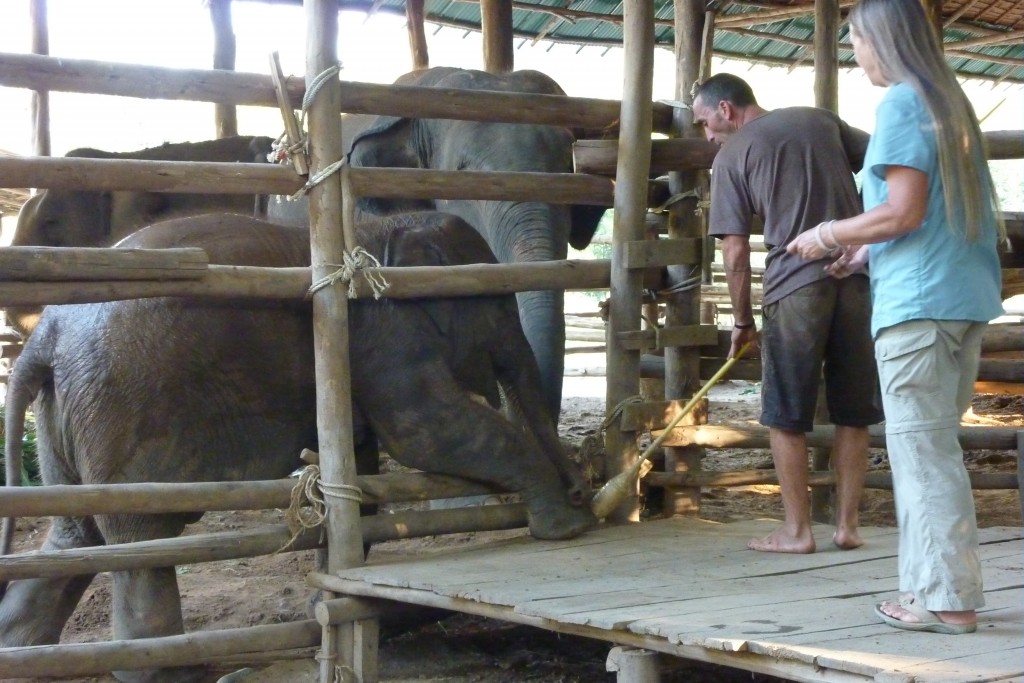
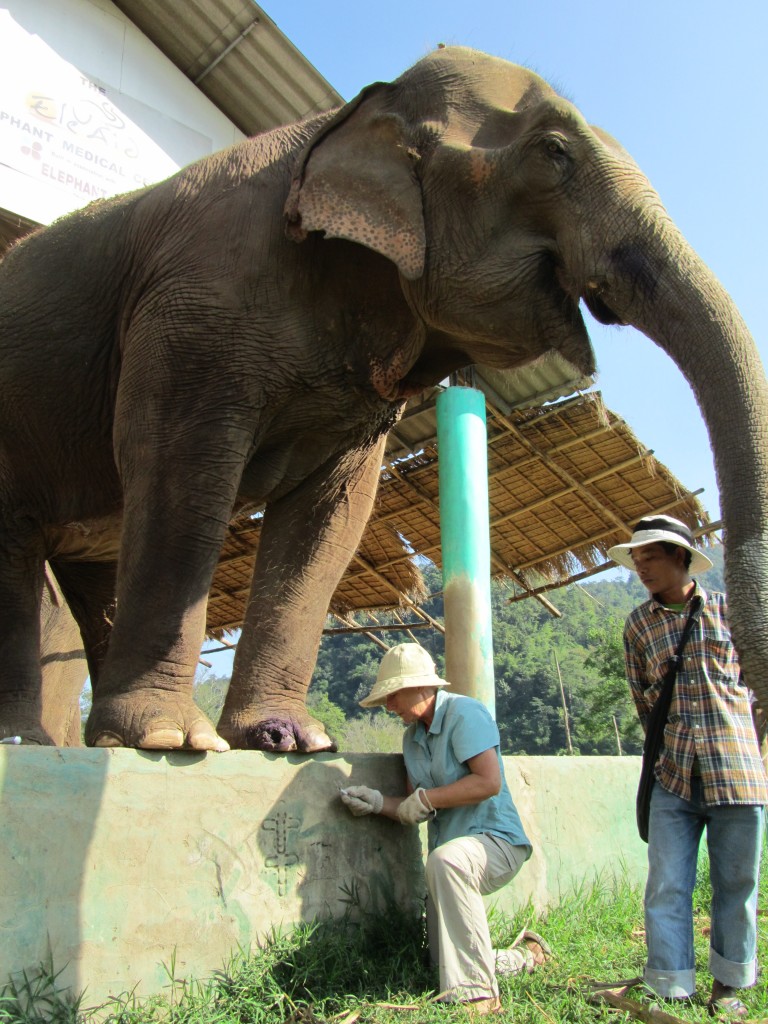
    Elephants in Asia were never trained to receive foot care, which means they don’t bend their front foot backwards at the ankle to rest it on a trimming stool. Since my goal is to avoid causing the elephants stress, I have found other ways to accomplish trimming. One way that works very well is using a ramped raised area. The elephants walk up the ramp and hang their toes off the end for trimming. It works great. The elephants do not stress and I can trim the pad and the nails.

    When I first arrived at BLES we looked around for an appropriate raised area but found nothing suitable. Kat got right on the project but it will be days before a sturdy elephant ramp can be constructed…so I will return to BLES for foot trimming.

    My other purpose for going to BLES was to introduce Mee Chok to target training. Everyone was quite excited about the prospect. Mee Chok is a wonderfully docile calf with a loving family in Lom and Pang Tong, the ever protective matriarch. He has never been confined or chained since he’s been at BLES but we needed to create a fenced area to contain him during training.

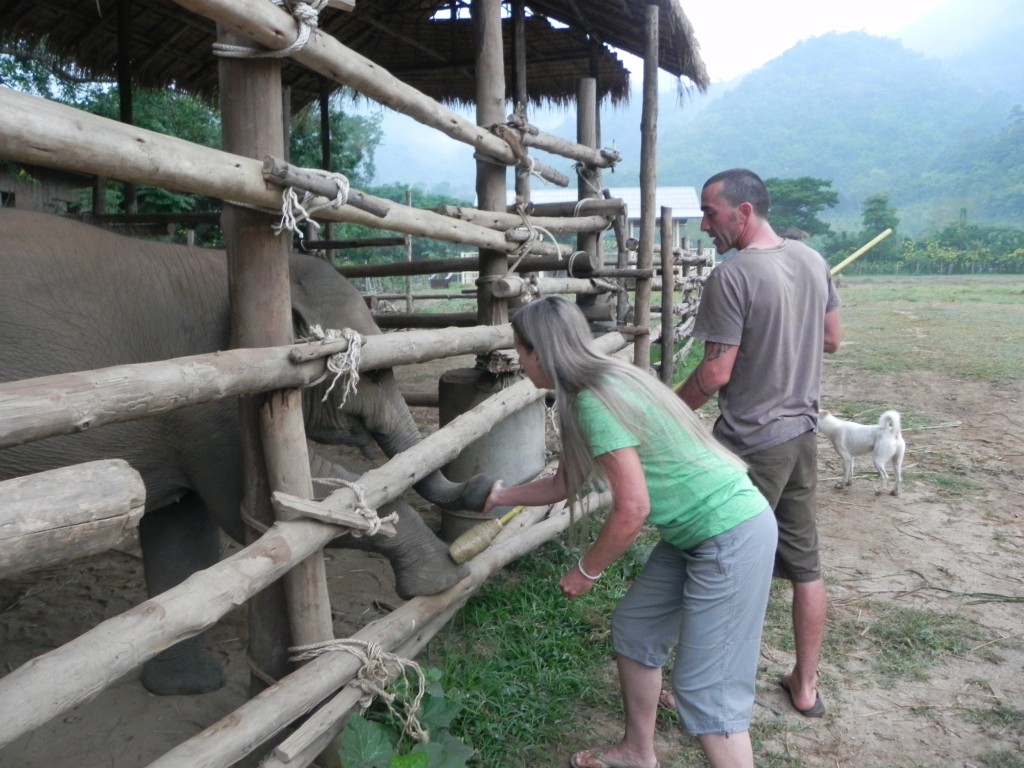
    Well, this was quite comical. The mahouts got right on the project and converted an open air stable into what resembled a boxing ring with ropes and chains strung horizontally to create a barrier.

    Unfortunately it did not work. Lom wanted in with Mee Chok, who had no idea that the goal was for him to stay inside. Mee Chok was not nervous but he thought it was by accident that he had become separated from his family. He effortlessly climbed over the barrier, causing the mahouts to burst into laughter. The mahouts’ reaction is so refreshing. They do not begrudge the elephants for acting like elephants and using their superior intelligence to problem solve.

    So, before we can start working with Mee Chok a corral needs to be erected. Once that is in place I will return to BLES, not only to provide foot care but also to instruct the eager mahouts on how to use target training with Mee Chok and the other elephants.

    My time at BLES was not wasted. I was able to spend time with Kat and Anon hiking the new land they want to buy and learning about their plans for land expansion, fencing and the release of many of their elephants into a semi-wild, chain-free environment. I am in awe of the direction BLES is moving, a direction that definitely puts the elephants first.

    I look forward to my return to BLES and want to thank all of you for making it possible for me to provide these services to elephants in Asia.

  • BLES

    It was a pleasure to be back at BLES. The simple elegance of the sanctuary results in a brilliant function: a peaceful haven for elephant and human alike. Oh yes — the many dogs and cats find the place heavenly as well.

    A feeling of maturity has permeated the sanctuary since my last visit only seven months ago. There is a calm that the mahouts, house-keeping staff, nanny and maintenance staff exude. Needless to say, the comfortable calmness is most obvious with the elephants.

    Tong Yui and Bong Bing have experienced a growth spurt in my absence, both several inches taller, lankier, less calf-like. They are both growing into impressive elephants, healthy and full of promise.

    Tong Yui is a bundle of energy each morning. Her enthusiasm for the new day threatens to explode, making it nearly impossible for her to get through her morning bath without a playful crash through the trees by the wash area.

    I have such fond memories of Tarra at this magical age of seven, not yet fully confident but blossoming into the glorious individual she would grow to be. Full of adventurous energy, eager to explore life and her surroundings, quickly shedding the restraints of childhood. Even her face indicated that little Tong Yui is entering puberty and promises to be a magnificent elephant in her own right.

    I am sure you remember baby Mee Chok, the calf who made such a powerful impact on me the last time I was in Thailand. My last day at BLES during my last visit, we searched for a calf reported to be in distress. Katherine was desperate to find and rescue him. His conditions were devastating. Even though he was corralled with an adult female, it was obvious she was not his mother and they meant nothing to each other. With identical blank stares, their eyes void of life, and identical leg shackles, they did their best to block the unbearable pain they were experiencing.

    Helpless to make a difference in the life of this suffering elephant, I took a single haunting photo of Mee Chok with his head pressed against the wooden posts of his corral. The desperate look in his eyes tells it all. I posted the iconic photo on my site as a reminder of the continued suffering of elephants used for tourism in Thailand.

    You would not recognize Mee Chok today. His recovery is no less than miraculous and testament to the nurturing bestowed upon him at BLES. My sincerest thanks go to Katherine, Anon, the mahouts and all the staff for making BLES such a special place. The environment of love that is BLES revives the life force energy, for elephants and people alike, that in so many cases is near extinguished.

  • A Blessed Way to Spend Christmas Morning

    This afternoon I am leaving ENP for a few weeks. My travels will take me to Vietnam for nearly two weeks and then back to Thailand for a week at Boon Lott’s Elephant Sanctuary. So, as you might imagine, I was feeling anxious about leaving “the family.” Against all efforts I have grown seriously fond of them. In their world I am just another human sharing their days, but they are quite special to me.

    Leaving elephants even for a day has never been easy for me. It’s not that I need them; it’s that I feel so comfortable with them. I feel more like me in their presence. So in anticipation of my noon departure I did not linger at breakfast, knowing they were already out in the pasture.

    The morning was cooler than normal. The mahouts were bundled in jackets and hats. Several were crouched down in a tight circle, the crowns of their heads touching, focused on an activity that I soon realized was fire building.

    The elephants were several meters away, calmly grazing and mingling with each other. From the side I saw comical Faa Sai, frustrated mahout in tow, prancing across the pasture…holding a brand new house broom in her trunk. Obviously her mahout had abandoned his effort to get her to drop the broom, allowing her to bring her newly found “Christmas toy” with her.

    Faa Sai has been acting out for the past few days, since her former mahout left her to work with another elephant. Faa Sai does not respond well to all mahouts — loss of her mahout means that she must get used to a new mahout telling her what to do. Needless to say, she has been giving him fits.

    With Faa Sai back with the family, Dok Ngern started moving further out into the habitat. Instantly a voice rang out telling her to stop, to not go any further. The mahouts were cold and wanted to stay near the fire; if the elephants move, the mahouts are forced to move as well. Since the mahouts call the shots, the elephants sometimes are not allowed to roam as freely as they would like.

    But this morning I decided to take advantage of my designated authority and called to the mahout telling him “chang bai.” I don’t know if that is how it is spelled but it means “elephant go.” The mahout knew exactly what I meant and stared at me hoping I would change my mind. I repeated my request and what followed was glorious, humorous and admittedly probably a little frustrating for the mahouts who are being encouraged to accept some changes in the way they manage their elephants.

    Bua Thong, Faa Mai’s mother, was the first to sense a shift and began to walk slowly, almost guardedly, in the direction of freedom. I took advantage of my position out in front of the family and headed toward the river bed, hoping they would see that as a signal that they were free to follow and go wherever they wished…within reason of course.

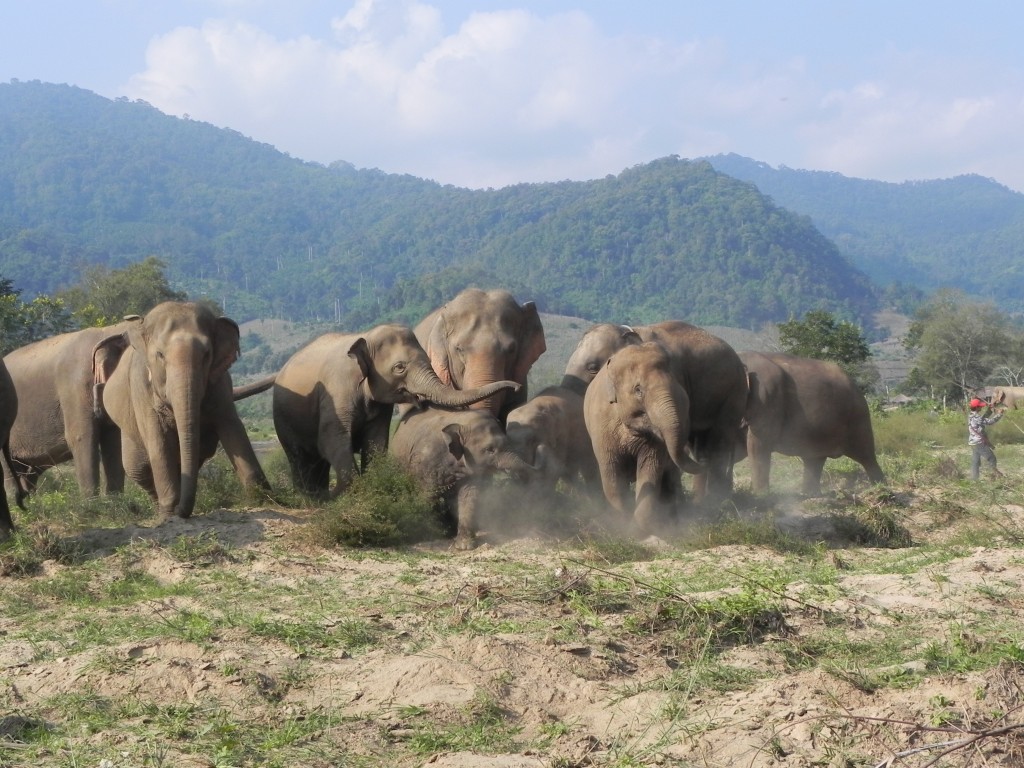
    The family moved like a gentle ripple across the surface of a still pond and only the elders kept an ear out for the command to stop. It did not come so they kept moving. When they reached the edge of the pasture, which drops off into the river bed, Bua Thong and Dok Ngern appeared to shed the invisible cloak of control the mahouts cover them with and led their family out onto the river bottom, sampling the sparse vegetation that remains. The mahouts did not follow. For a moment in time it was the family and me.

    The mood was broken as one mahout left the warmth of the fire and came racing across the pasture intent on turning Bua Thong back. Bua Thong, ever the mature leader wanting only to keep peace and harmony, is easy to turn and, with her, many of the family members. When the mahout’s intent was clear, I called out “chang bai.” Body language goes a long way…luckily. I signaled for him to stop, moved my arms in the direction the elephants were heading and repeated “bai, bai.” His body language suggested he wasn’t happy with the request, but he complied and allowed the elephants to continue in the direction they were headed.

    I motioned for the other mahouts to join us, which they did, actually carrying their fire with them. By now the family had figured out that they were free to explore their environment with the sole restriction to not enter the banana grove and the nearby road. After one more request that the mahouts not prevent the elephants from grazing the tall grasses along the river bank, the elephants settled into a wonderful feast.

    Bua Thong discovered the giant grass and shared it with the others. The babies wallowed in the thick mud as they cruised the embankment selecting tasty trunkfuls of fresh grass. Faa Sai, always the one to push the limit, tried to climb further up the hillside than was acceptable. But she returned to grazing without much fuss, probably because the grasses were lush further down the hill.

    Each time the mahouts got comfortable in their tree beds or huddled around their portable camp fire, the elephants’ natural migrating tendencies forced them to move again. This dynamic is a challenge for elephant management: the elephants want to move but the mahouts would prefer they hang around in one place. On this day, at least as long as I was there, these elephants would be wandering. The mahouts seemed to finally understand the plan and, even if only half-heartedly, got with the program.

    Sitting on the dry sand river bottom with my knees held close to my chest, I took in the glorious scene playing out in front of me. I was filled with joy and gratitude to be here at this moment in time, watching elephants being elephants, in perpetual motion, playing, grazing, drinking, dusting and exchanging the nonstop physical and verbal communication that they are famous for. I forgot the chill of the cool breeze that was cutting across the open space as a feeling of deep contentment warmed my entire body. I felt the morning sun hug me from behind and gave thanks for this blessed moment.

    Walking away from the family was inevitable but I did so knowing that today, at least for the few hours I spent admiring them, they were as close to free as a captive elephant can be.
  • Som Boon

    Dec 22, 2010

    This morning I woke to the sad reality of death. Som Boon passed during the night. Thumbing through my notes, I see that on day two of my time at ENP I saw Som Boon and jotted down in my book that she had “small ears” and decayed teeth.

    The entire time I have been at the Park, Som Boon has been experiencing health problems. First she was not eating well, and then sores developed on the roof of her mouth. More recently she was not defecating. I had the opportunity to look in her mouth and saw that her top molars were missing large areas and were black with decay.

    After a brain-storming meeting with Derrick and Jodi, a long-time American volunteer who lives at the Park, Derrick ordered a shredder for Som Boon’s food.  The shredder idea came from the experience of an emaciated elephant who arrived at the Sanctuary with a very poor appetite.

    When Sissy came to the Sanctuary, she had difficulty masticating her food. We used a shredder to cut her hay into small “pre-digested” pieces. After several months her appetite improved, she gained several hundred pounds and she was able to return to eating non-shredded hay.

    The goal was that Som Boon would benefit from the shredded hay but, unfortunately, she had stopped eating by the time the shredder was delivered. Staff tried many approaches to get her to eat, drink and defecate, to no avail.

    During her necropsy, a large blockage was discovered in her large intestine. Estimated to weigh fifty pounds, the obstruction consisted of unmasticated and poorly digested pasture grass. The obstruction was completely dry, resembling a massive brick.

    Som Boon had lived at ENP for more than seven years and was dearly loved by all. She will be missed by her entire ENP family.

  • Being With The Family

    My days are filled with shadowing the “family” in the habitat and doing foot trimming and target training. I am having a blast! It really is a gift to be able to focus solely on these limited responsibilities. Even though the days are long, each brings immeasurable rewards.

    Target training has really caught on. Now all the family members are joining in. It is so much fun to play the training game with a wall of eager students, ranging from senior citizens to calves. It is a riot as they jockey for the prime spot and the opportunity to respond to requests for their feet, ears, forehead and side. They all excel at moving their side into the target — it is so cute. Once they understand the request for side, they respond with a quick movement, leaving their front feet in place and swinging their hip around to make contact with the target. When they are all competing for a turn it is like a chorus line of feet and ears. What a joy!

    Getting to know the family is an unexpected experience, one I cherish deeply. Today I felt a sense of belonging to an elephant family again as I moved along with the herd, like a ripple in a stream, flowing together effortlessly across the pasture. I had not inserted myself into the family because my time here is limited, but today I felt that unnamed energy that is elephant, all inclusive, the matriarchal collective, being part of a loving family. I soaked in the acceptance they radiated, grateful for each one of these magnificent individuals.

    Later I met two new Park residents, grande dames I had not had the pleasure to meet before. Much patience was required because they were so frightened by the idea of having their feet touched. The mahouts did their best to reassure them and, although I didn’t complete a full manicure, we made some progress. A little at a time — fine, I am in no hurry. My goal is for these elephants to know that when they come to my pedicure salon they will be treated kindly and with respect. If they leave without experiencing a pedicure, that is okay.

  • Chang Yim’s Progress Report

    Chang Yim’s Progress Report

    Chang Yim has been in training for less than two weeks. His progress has surprised everyone… except Karl and me.

    Lek returned to the Park today after being away for a few days. She commented on how calm Chang Yim has become. Indeed, he has shifted, no longer an angry young boy.

    Target training has helped to boost Chang Yim’s self-confidence and trust in Karl, the significant person in his life. It has been a gift to watch Chang Yim relax instead of always being on the defensive, quick to display rebellious behavior. His bouts of aggression have become an oddity instead of the norm.

    Positive reinforcement training has had a marked affect on Yim’s attitude and behavior, but other changes in his management have contributed to his improvement as well. Visitors are no longer allowed to approach him without a mahout present. No one plays the “chase me” teasing game responsible for Chang Yim’s pushy behavior. Inexperienced mahouts who ignorantly antagonized Chang Yim have been told that their treatment of Chang Yim is inappropriate. All of these changes have made Chang Yim feel safe.

    We are very proud of Chang Yim. From his calm demeanor and sparkling eyes, it seems Chang Yim shares that pride.

  • the ENP pachyderm pedicure clinic is open

    the ENP pachyderm pedicure clinic is open

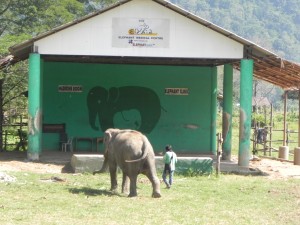
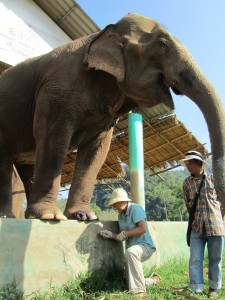
    Nineteen elephants at ENP have been identified as candidates for foot care. The schedule is set to provide pachyderm pedicures at the hospital building twice daily.

    When I was in Thailand last June I did a great deal of foot work on Mae Kham Geao.  Her nails were abscessed and pads sloughing. She was confined day and night to the hospital area with little opportunity to walk and bathe herself. Fortunately I was able to convince the veterinarian to give Mae Kham Geao and her best friend Mae Tee unrestricted daily access to the pasture and river. The results were fabulous.

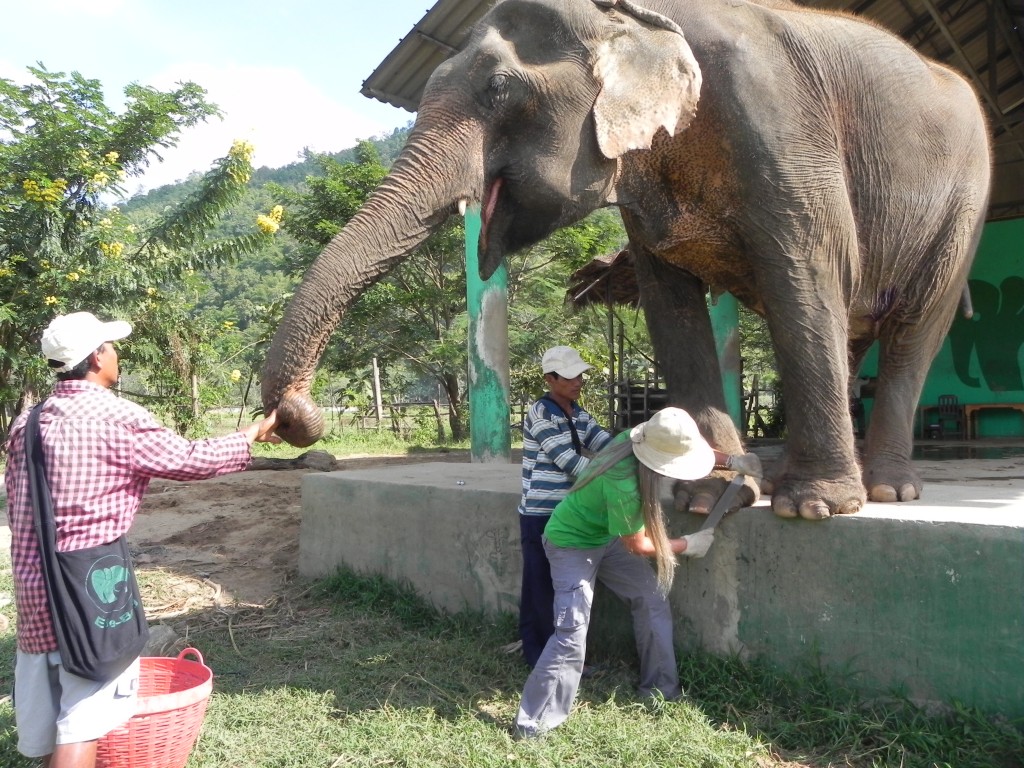
    It was a pleasure to see the improvement in Mae Kham Geao’s feet and her confidence in receiving her pedicure. Her pads are supple and healthy. Her nails are no longer infected but they had four months of over-growth that needed to be trimmed away.

    Mae Kham Geao’s mahout, Dame, is a kind and experienced caregiver. His interest in foot care has grown in my absence. After a few minutes of reviewing the procedure, he picked up a rasp and began to trim his elephant’s feet. His initiative and confidence will have an influence on the other mahouts, a real plus in the training process.

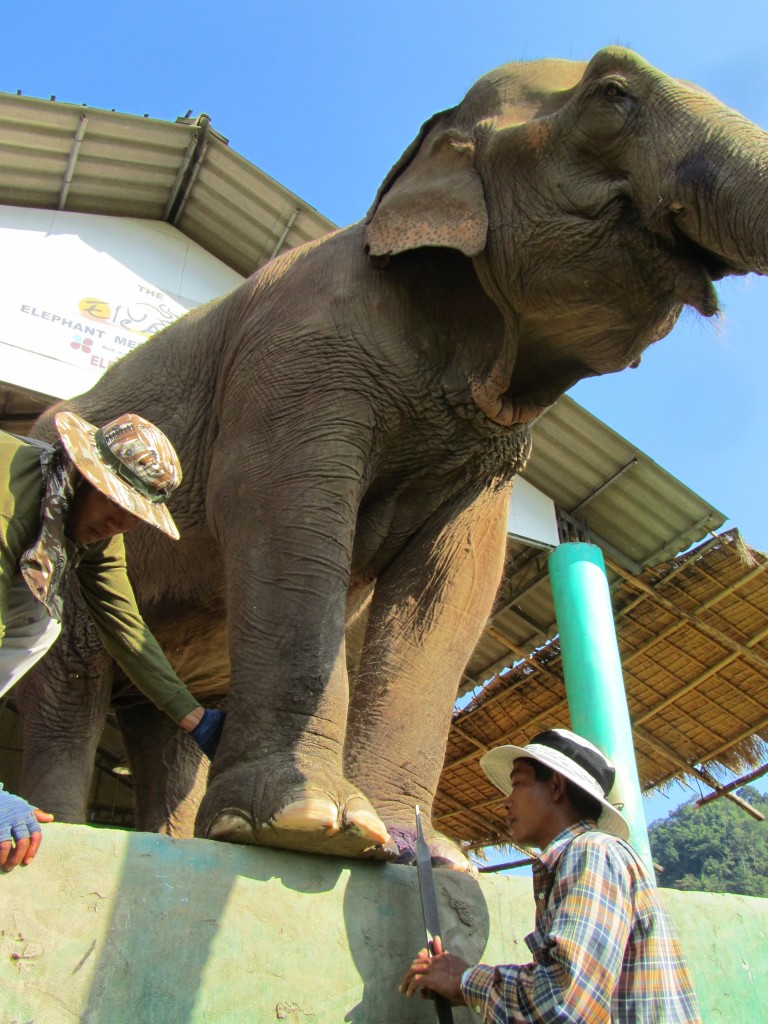
     My foot care client for the past two days has been Jun Peng, a wonderful older female, who nearly sprinted up the ramp of the concrete loading dock being used as a foot-trimming platform. A basket of freshly cut produce was all that was needed to entice her to present her feet for trimming.

    Jun Peng was a perfectly lovely client, calmly standing in place for more than 30 minutes each session. Her nails were quite overgrown but very healthy. The pads of both front feet showed signs of past trauma but no new problems.

    Tomorrow’s pachyderm client will arrive at the pedicure clinic at 10:30 am. I am excited to see who she is.

  • Chang Yim

    Chang Yim

    Even though elephants have relative freedom at ENP, they are still living in a captive environment, necessitating that they learn basic behaviors, such as presenting their feet for trimming and their ears for blood draws. These easily learned behaviors are essential to ensure the elephants’ health and well-being.

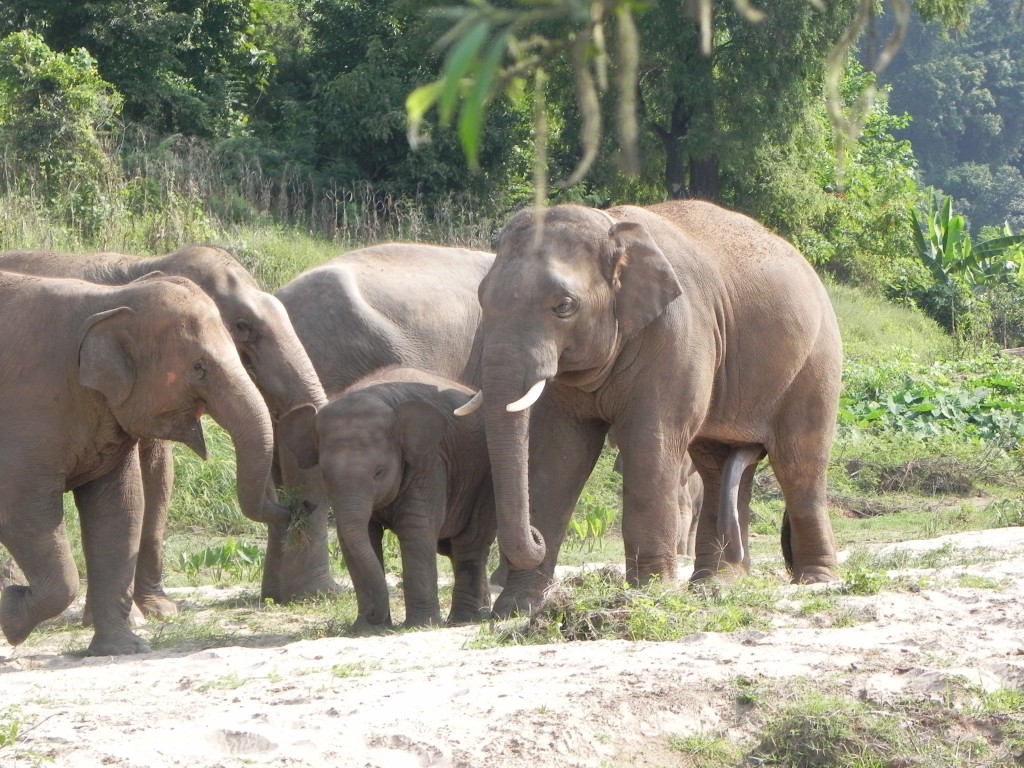
    Chang Yim is the second calf born at ENP.  He is experiencing a near-to-natural family environment living in a herd with his birth mother.  “The Family,” as they are affectionately referred to by staff and visitors, consists of Yim and his mother Doc Ngern; Faa Mai, also born at the park, and her birth mother Bua Thoug; adolescents Faa Sai and Thong Jan; and self-appointed aunties Ma Lai Thong, Sri Noon and Thai.

    Chang Yim is 16 months old. True to his age and nature, he has bouts of defiance toward his mahouts. The majority of the time, he is busy being an elephant, engaged with his family and exploring the habitat.

    But when his mahouts need to guide his behavior, Yim’s resistance to being told what to do has become problematic. Karl, Yim’s mahout, is learning positive reinforcement target training in order to teach him some basic behaviors so he can be examined and cared for safely and effectively.

    It is exciting to see Chang Yim’s progress, knowing how essential this training is to his future.

  • feeling at home

    feeling at home

    Everyday I intend to post an update but surprisingly there has been no time. My day starts at 6am. I am sure that those who know me laugh at the thought of me rising with the sun as I am a natural night owl. But the change is good.

    Karl and I start with Chang Yim’s morning training sesson and then accompany “the family” out to the habitat for morning observations. I have started trimming feet in the afternoon, followed by two more training sessions.

    In between there are feeds, trips to the river for elephant baths and opportunities for the public to view the elephants. And there are always unscheduled occurrences and visitors that fill in the gaps of what otherwise would be extra time each day.

    Chang Yim is fabulous. He is responding exceptionally to the training game as you would expect from such an intelligent boy.

    The sticky rice balls used for his reward is an effective motivator.  He has learned to target his head and front feet. Today we started teaching him to target his side  and added holding the different positions for a few seconds. Chang Yim is doing great and so is Karl!

  • Rescue

    Rescue

    November 21, 2010

    One year ago today my life took an unexpected turn. At the time I would never have imagined that today, exactly one year later, I would be party to the rescue of an elephant in Surin, Thailand.

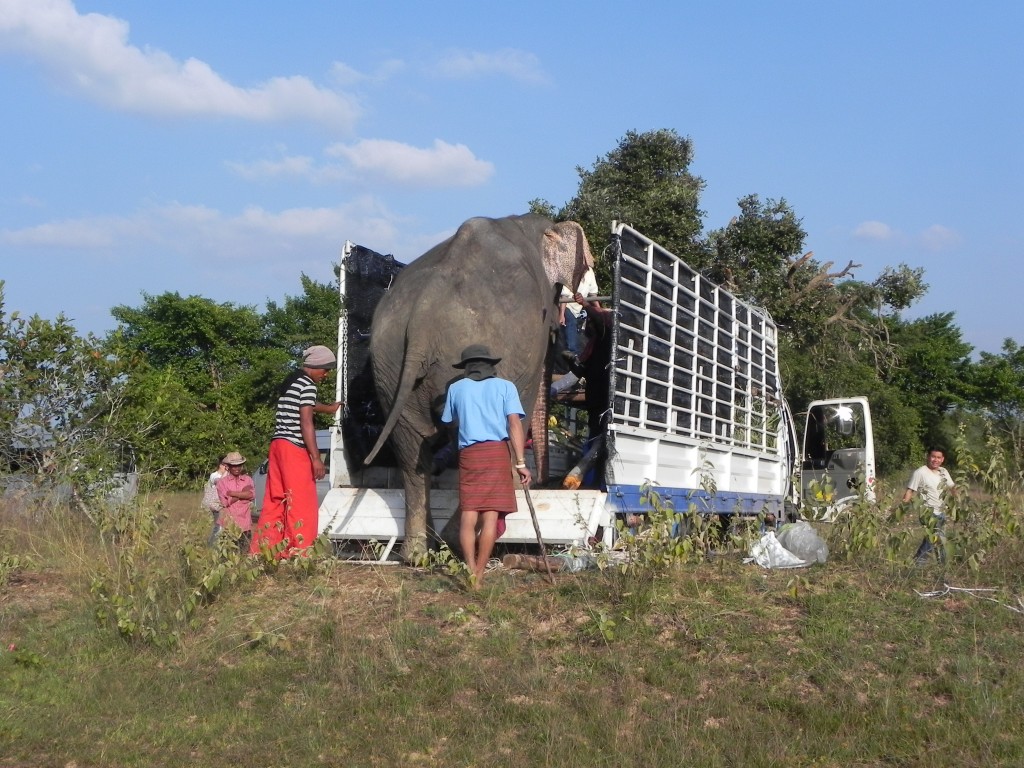
    Hours after arriving in Bangkok I boarded a train to Surin to meet up with Lek, founder of the Elephant Nature Park (ENP). I knew we would be observing elephants at the annual elephant round-up and meet with the governor of Surin. But I did not realize that in less than 48 hours we would rescue an elephant, load her for transport and move her to ENP.

    Observing the entire procedure was an opportunity for me to learn more about how elephant rescues take place in Thailand. Quite different from rescues in the US, all arrangements, including payment for the elephant, travel logistics, health status report and travel papers, were concluded in a matter of hours.

    This rescue was made possible partly by a 9-year-old New Zealand boy named Jack. He visited ENP with his parents nearly two years ago and left determined to raise the funds to rescue an elephant. He reached his goal in a short eighteen months.  Over the past three days Jack took an active role in preparing for the rescue, including purchasing elephant food for the trip. He was given the honor of choosing a new name for the elephant, a tradition held by ENP to give the elephant a new start. Jack researched the name himself and chose Kwan Jai, which in Thai means beloved. Kwan Jai, estimated to be 55 years old, is thin and dehydrated.  A serious logging accident left her crippled years ago. The break in her back right leg led to a misalignment of her spin, making working difficult. But even elephants with broken legs are used for street begging and tourist rides.

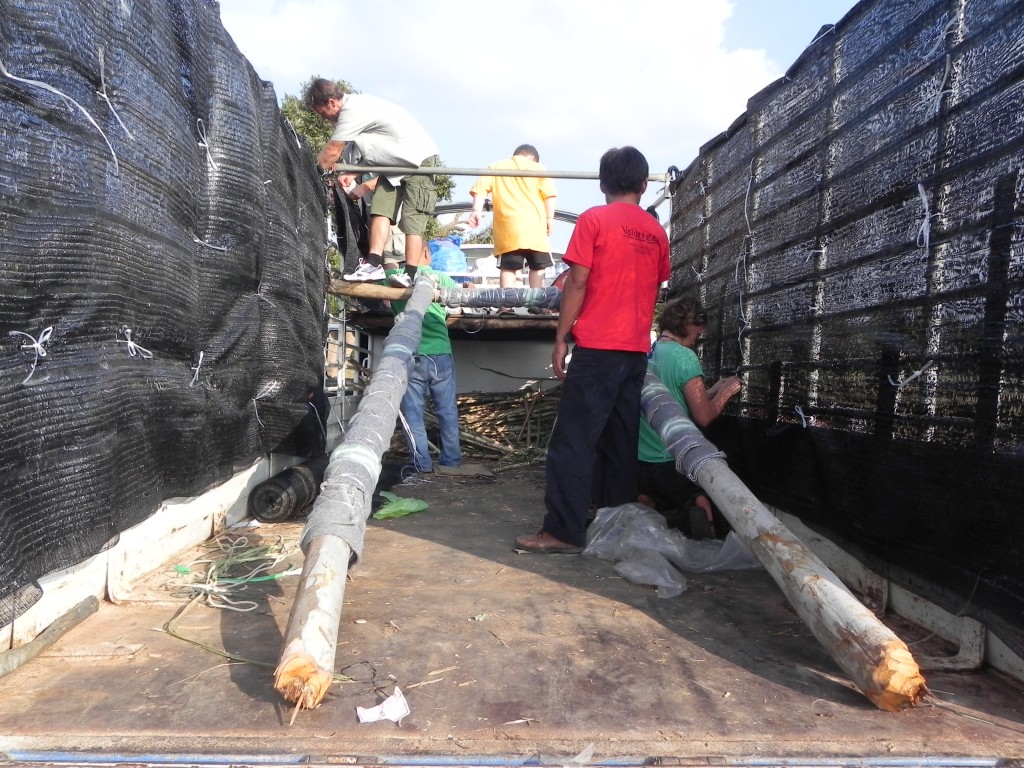
    Prior to loading Kwan Jai into the straight-bed truck, mahouts, veterinarian, Lek, Darrick (Lek’s husband), Antoinette (of Bring the Elephant Home) and several volunteers, along with Jack and his proud parents, spent the next two hours securing the vehicle for a safe trip.

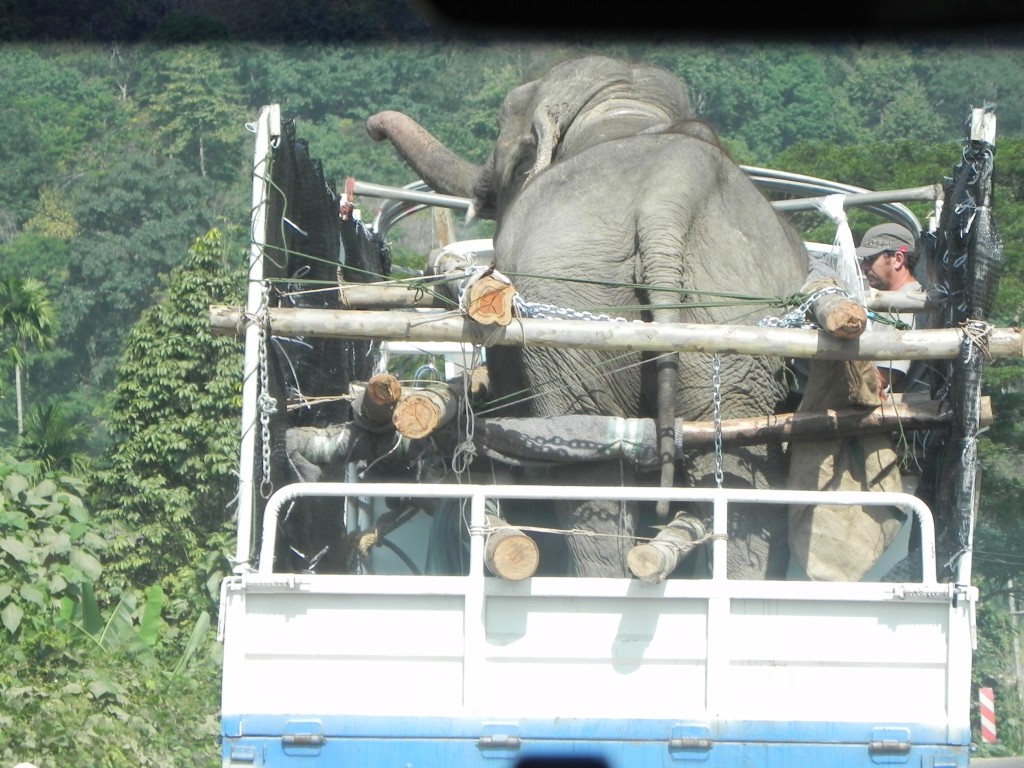
    They strapped wind-break material along the side walls of the truck and built a corral of large timbers ensuring that Kwan Jai would stand safely in the center of the truck bed.

    Kwan Jai is a seasoned travel, so she loaded into the truck without hesitation.

    Nearly 24 hours later, driving through the night and a good part of the next day, Kwan Jai arrived at her forever home at the Elephant Nature Park.

    What an honor it was to be a part of the life-changing event not only for Kwan Jai but for all the people involved.

  • CBS Assignment America

    After the recent airing of a CBS Assignment America piece by Steve Hartman, many of you were seeking clarification.

    The statement that has caused confusion is toward the end of the piece when I seem to say that elephants don’t need people or human interaction. The sound bite was an excerpt from an interview done two years earlier for the Tarra and Bella story.

    If there had been more time for the expansion of my statement, you would have heard me say something like…..“Elephants don’t benefit from public visitation by strangers. But elephants thrive on relationships with caregivers with whom they form deep bonds.”

    The media has limited time to report on any single subject, which can result in misunderstandings. Without a doubt, Steve Hartman knows of Tarra’s capacity to bond with another individual of a different species. He was the one who first introduced Tarra and Bella’s endearing relationship to the world.

    My intention for the Sanctuary was to provide a rich captive environment for elephant rehabilitation: an environment where elephants have autonomy, can rediscover themselves and form deep bonds with others.

    The Sanctuary is not the wild; caregivers are an essential part of the equation.  The goal is to train caregivers how to develop sincere relationships with the elephants.  The deeper the relationship between the elephant and caregiver, the more effective the caregiver can be in his/her job. Without a deep and respectful relationship, the caregiver could be a source of stress for the elephant.

    The “people” I referred to in my comment are strangers. Of course elephants living in captivity will form strong bonds with their caregivers. It is an elephant’s nature to form deep relationships with other herd members. For elephants in captivity their relationships extend to the caregivers who provide for them on a daily basis. Caregivers are an elephant’s extended family and their relationships should be strong and healthy.

    Provided that an elephant in captivity lives in a healthy environment with ample space, the freedom to make his/her own choices, other individuals to bond with and access to an abundance of live vegetation, s/he doesn’t need the distraction of and interaction with strangers. (Some zoo and circus elephants live in such a deprived environment that they benefit from such distraction and interaction.)  Elephants in healthy environments thrive on mutually respectful long-term relationships with elephants and other individuals they consider members of their family.