Tag: asianelephants

  • March update on India Care Center Project

    March update on India Care Center Project

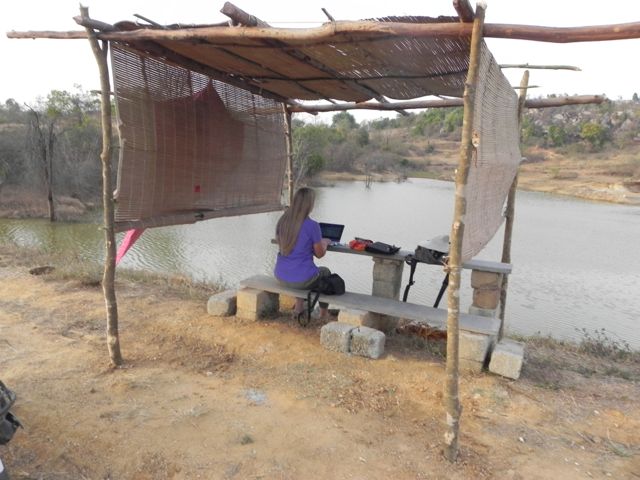
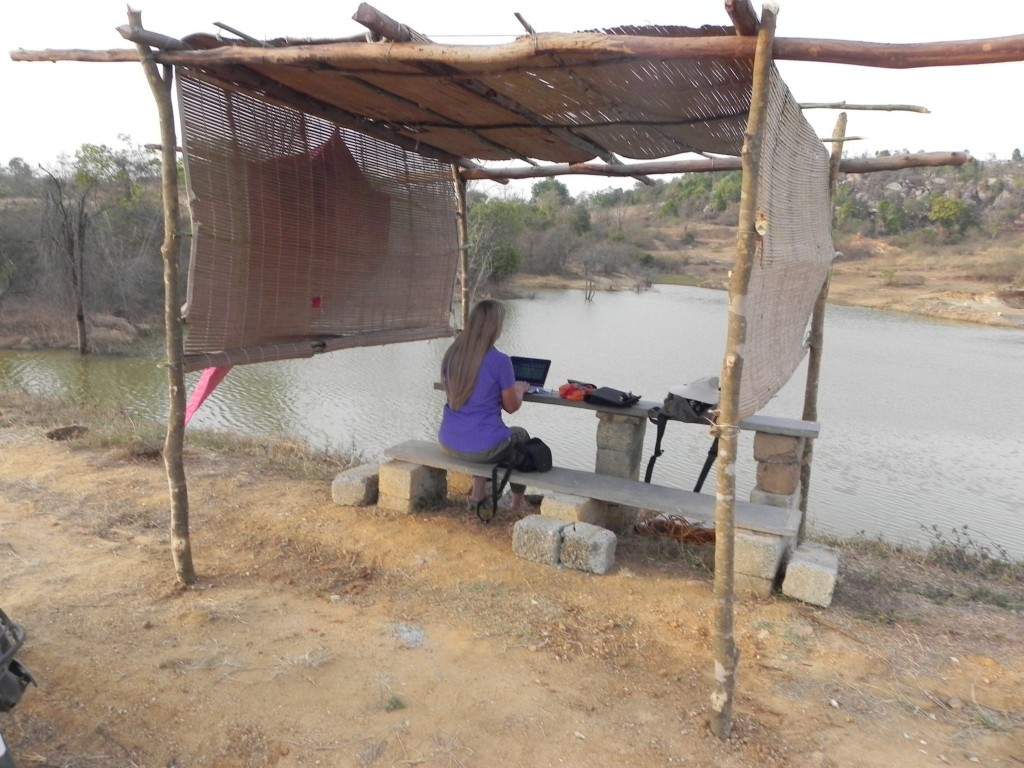
    Carol in her officeFrom my lake-front office, Bannerghatta, India

    The two months since my arrival in India have been filled — with meetings, brainstorming sessions, hiking through cinder-dry forests and continual reality checks.

    It is so important that I am here now—on the care center site—to study the land, the wild elephant activity in the adjacent forest, the habits of the local villagers and the laws that govern land ownership and use. There is so much to learn, I am ever thankful that everyone I am working with speaks fluent English.

    The project’s scope widens

    The project has remained focused on elephant welfare but its scope and approach has shifted a bit…for the better.

    Initially, we planned to have a relatively small plot of land in exchange for the care center elephants being allowed access to the national forest. Allowing elephants nighttime access to the forest is standard practice for the forest department’s captive-held elephants and seemed like a viable solution to limited day time space.

    But as I hiked the adjacent national forestland, I was disheartened to see how the forest’s resources are exploited. The forest herself appears to be barely breathing, suffering from over-grazing, intentionally set fires and the destruction of trees by the local villages that border the forest.

    Seeing the poor condition of the forest made me realize how the wild elephants are struggling to survive, with not enough food, water or shelter to sustain them. The idea of adding even a few more elephants to the already stressed habitat—reducing wild elephant resources even further—was a deal breaker for me.

    Following a frank discussion with the collaborators on the project, we decided to expand the land used for the care center, something close to 200 acres, thereby eliminating the need for the center’s elephants to use the forest.

    No chains, no dominance

    This change in operations has resulted in positive shifts in the facility design and style of elephant care.

    The original plan called for a small plot of land and giving the elephants access to the national forest at night. But I recently learned that allowing the elephants into the forest overnight called for a compromise: the elephants would have been required to wear a drag chain on one leg whenever they were in the forest. The chain helps keep them from being mistaken for wild elephants by villagers and makes it easier for the mahouts to track, retrieve and return them to their home during daylight hours.

    But now, with national forest use no longer an issue, there is no compromise required – chains will have no place at the care center.

    You can imagine how excited I am about this unforeseen turn of events! I had almost been convinced that in India elephants will never be completely free of chains. But with our land expansion we will be able to do just that—keep elephants on a large tract of forested land, free of chains and dominance.

    Infrastructure development and acquiring land

    As result of this positive shift in the design of the project, we need more time for preconstruction development than earlier projected. We must conduct an expanded survey to identify land ownership. Surveying the entire tract of land will provide the legal assurance required prior to constructing the miles of necessary trenching and fencing.

    This expansion also requires a follow-up communication to the government informing them of our desire to expand…even before we have begun!

    We also have the challenge of acquiring a small parcel of land that is essential to the project but is currently occupied by another person. We have received assurance that this parcel of land—approximately seven acres—can be acquired.

    In India, land rights are complicated but well defined, if not always enforced. In some cases property owners hold a deed and are permitted to sell to whomever they choose. In other cases, villagers and tribals who receive land from the government are allowed to pass the land down to family members, but are not allowed to sell outright.

    Becoming familiar with the regulations is essential for anyone intending to own, lease or occupy land in India.

    I am told that when it comes to land, possession is nine-tenths of the law and even in cases in which the land cannot be sold, occupants can accept payment to vacate. As I understand, once they have vacated the land, another person can occupy it, with stipulations that it be used for some agricultural purpose or forest restoration and it can never be sold. One small parcel of land essential to our project falls in this category.

    I am keeping a positive outlook about acquiring this piece of land, which stretches across the edge of the lake, one of the essential areas for our elephants. Negotiations are underway. All I can do right now is wait.

    Co-existing with wild elephants

    In the meantime, I am tracking the movement and land use of wild elephants in the area. There is one section of the care center land they frequent. All the collaborators have agreed that no care center land used by wild elephants will be blocked to them. Our goal is to be mindful that our project, although well meaning and helpful to captive elephants, not cause hardship to wild elephants who use the land.

    We have identified a small corridor just inside the care center property, adjacent to the national forest, where wild elephants leave the forest to enter the care center property. They have a well-established path, which will remain open for their use.

    Protecting this wild elephant corridor is another unexpected development that makes me even more excited about the care center project. Being able to create a healthy space for captive elephants to recover and thrive, while at the same time preserving land for wild elephants who migrate through the area, feels like the right thing to do.

    Care center and bird sanctuary

    With an estimated 180 different species of wild birds in the area, the care center property is already a bird sanctuary. Never before have I been so enthralled by bird watching but from day one I was in awe of the many different birds and their beauty.

    The lakes draw a variety of fishing birds, from the Indian Pond Heron to the regal Brahminy Kite. Their nonstop activity, sometimes entertainingly comical, has sparked my interest in studying these winged creatures with whom I now share my space.

    The animated and gutsy Blue Eared Kingfisher was the first to catch my attention. His fishing perch is feet from my outdoor office. The first time I watched him make a catch, I admit to being a bit shocked that this minute blue bundle of constant movement disarmed his prey by bashing its head against a rock.

    I’ve observed Brahminy Kites collecting branches for nest building, a trio of Red-Wattled Lapwings singing a chorus, a Black Shoulder Kite dive-bombing to catch a mouse and a Great Cormorant perching on a branch 30 feet above the lake on its awkward looking webbed feet. I’ve seen egrets of every size follow the resident horses, snatching up displaced insects. Then there were the stunning Rufous Treepie, Red Whiskered Bulbul and a pair of White Browed Wagtails who chased a Crested Serpent Eagle away from their favorite tree.

    Being able to observe so much winged activity has opened a new world to me.

    Survey and land

    Surveying the expanded land is the next step required to move forward on this project. Acquiring the seven-acre parcel of land currently in negotiations will come after that, followed by a government endorsement of our expansion. All this needs to be accomplished before beginning construction.

    Fencing and trenching

    Only after the survey is completed, the extra parcel of land acquired and government approval secured can we begin work on the perimeter trenching and electric fence required to keep wild elephants out and our care center elephants chain-free inside. The fencing is estimated to cost $7 per foot/$36,000 per mile. The approximately four miles of trenching and electric fence will come to about $142,000.

    Compare this to the average $100 per foot elephant sanctuaries in the US spend on fencing. For 7 percent of the cost, we can provide a safe and secure, chain-free environment for needy elephants in their authentic natural habitat while simultaneously protecting wild elephants and their land.

    I am very anxious to move forward on this project but am cognizant that we cannot overlook any step or detail in our enthusiasm to make the care center a reality. If great journeys are launched one step at a time, who knows where helping one elephant at a time will take us.

    Please visit EAI’s Facebook page so I can keep you updated on our progress as it happens!

    Thank you for your interest and continued support. This care center promises to be more than any of us ever expected. Thank you for sharing my dream.

    Carol
  • progress report of sorts

    progress report of sorts

    Each day living at the proposed care center property brings more insight and, in some cases, more unanswered questions.

    The temperature has heated up, causing afternoon activities to slow down. Even the shade offers little relief. Thank goodness for the breeze that has proven to be a near constant in this area.

    Today a group of college students arrived to tour the property. This is a popular education sight for the conservation minded. The students, all city dwellers, were given an opportunity to see how desperate the situation is for the forest in this area.

    Included in the group was a man who has dedicated his life to bringing awareness to India’s conservation issues. We shared a few minutes of conversation and he expressed true dread about the future of the area’s forests. When I commented on how important it is for the youth to become involved in conservation, he bluntly said he felt there was not enough time for us to wait for this new generation to turn things around—at least not in this immediate area. It was a sobering statement from a person who has studied the deterioration first-hand. I felt his desperation.

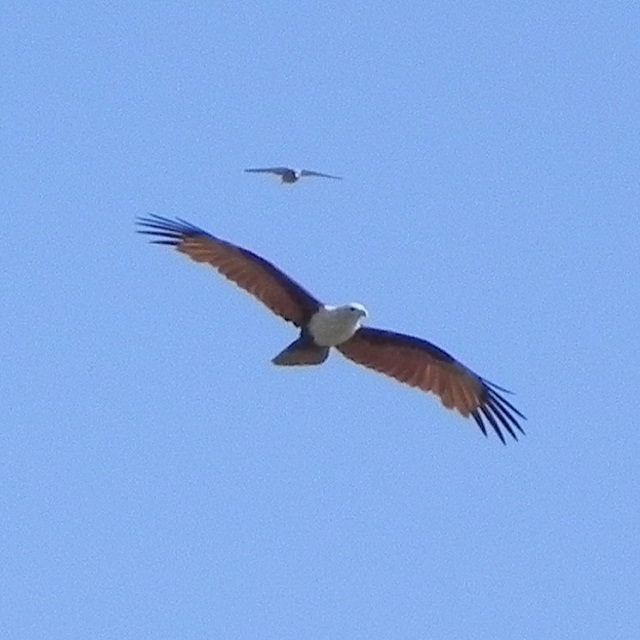
    As the students followed their professor down the levee, responding to his questions about plant life and its purpose in a forest area, the resident Brahminy Kite soared overhead. This was her third cruising over the lake this morning and she was putting on quite a show. Her massive wingspan and grace were spellbinding. Keenly eying the lake below, she circled and soared, gently dipping toward the water.

    A much smaller bird pestered her with dive bombs but the Kite expertly shrugged the pest away with a well-calculated twist, dip and spin whenever the attacker got too close. As she soared overhead I was able to get a few good photos but none that really did her grace and precision justice.

    I am learning, out of necessity, about land holdings here. The jigsaw pieces of this puzzle are finally coming together to give me a clearer picture of how things work. Perhaps I should have read up on India’s land laws before coming but, honestly, the thought never crossed my mind. I naively assumed that you buy land, sell it, lease, rent or give it away. I now have a clearer understanding of other ways a person can acquire land, how land can be occupied and how possession is—or isn’t— regulated.

    According to those I have consulted with, one of the important things for me to know is that occupation is nine-tenths of the law. But more on that later.

    The collaborators on the care center project are meeting regularly to provide progress reports on each partner’s responsibilities and to discuss questions and issues as they arise. Everyone is dedicated to the project and wants to make sure we have considered every eventuality before taking the next step.

    The time that is being taken to ensure we don’t overlook anything in the early planning stage has been invaluable to me. More often than not, I awake in the morning with a much sought-after solution to a challenge or with a new idea that I had not yet considered. The work that is being done on a subconscious level—while I sleep—makes me laugh because, without question, I am working on the project day and night.

    In the process of developing the project I have been fortunate to meet many very kind and gentle people. They share a passion for the project, which is a blessing. I clearly remember while dreaming up the Elephant Sanctuary for Tarra that many people, mostly colleagues, were less than supportive of the idea. Of course my family knew very well that the dream I had been dreaming for so many years would indeed come to fruition and could not have been more supportive. So to have complete strangers, with no vested interest in the success of the care center project, show this degree of interest and support is very gratifying.

    On a wild elephant sighting note: A few nights ago an adolescent male was seen harvesting jack fruit from the tree on the perimeter of the village only a few hundred yards from my house. The fellow was sly and silent; I did not hear a sound. If it had not been for the village dogs sounding the alarm, no one would have witnessed the midnight raid.

  • blessing the land

    blessing the land

    I’ve seen footprints and elephant boluses and heard stories about the herds of wild elephants that frequent the area, but last night at 10:35pm I heard proof — my first wild elephant trumpet. It sounded like s/he was just outside my front door. The familiar sound brought an instant smile to my face. I stood motionless on my porch listening for more, any other sign of elephants. But there was only pitch dark and silence. I figured the music maker had moved on. But honestly, just hearing that one joyful trumpet was enough for me, for now.

    I’ve been thinking deeply about our project, wondering what impact, if any, it will have on the wild ones. Of course my desire is to do no harm, so educating myself regarding wild elephant activity in the region is imperative.

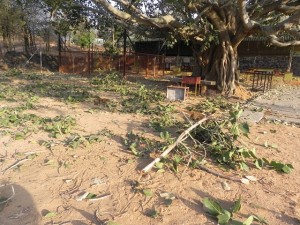
    This morning as I recounted the elephant music of the night before, the resident security man came roaring up on his scooter to announce that he had seen a herd of elephants. The night before they entered the property through a wide opening in the forest wall and proceeded to feast on bamboo, a fruitless mango tree and the huge Banyan tree that dwarfs the outdoor classroom area used occasionally for schoolchildren from Bangalore.

    Several piles of manure suggested the size of the herd and age of some of its members. From the fertilizer they left behind it appeared that this herd included at least two youngsters, one only a few months old.

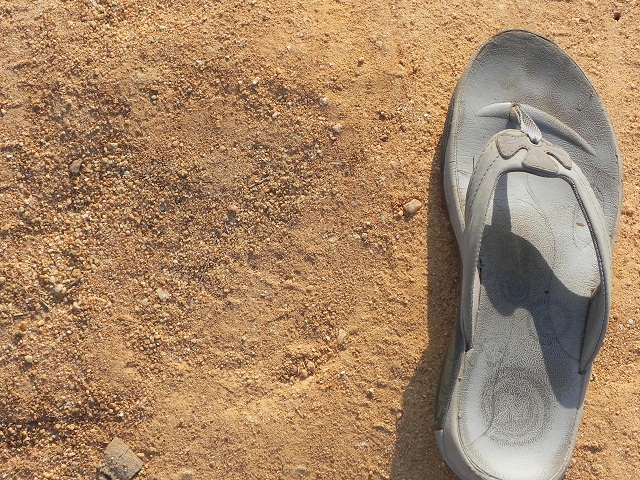
    This sandal is a size 7, so you can see how small this calf’s foot is.

    Out of curiosity we tracked the elephants’ movements, following piles of manure, footprints and discarded vegetation. A horizontal chain that extended across a dirt road lay in two pieces on the ground. The heavy lock that previously held it together was splayed open and discarded. Most likely one of the larger elephants stood on the chain until the lock gave way.

    The amount of damage done was nil unless you consider leaf litter and a couple of broken branches a problem. After filling their bellies, the herd appeared to leave the way they entered.

    I am getting such an education — wild elephant lifestyles in the Bannerghatta forest 101. Living on the land shared by wild elephants is a gift and a responsibility. I look forward to the days and weeks ahead. I am realizing that this project has the potential to be much more than anticipated. One world, one elephant at a time has taken on a much more complicated meaning.

    One world, one elephant at a time — both wild and captive.

  • India Calls

    It is time for me to return to Asia. My Elephant Care and Rehabilitation Center is calling.

    Learning from my past, I have decided to stop for a least one second to stand in the glow of this monumental moment. This time around I plan to rejoice in each tiny success, revel in each new development and give thanks for the progress made each and every day. I look forward to the challenge of staying in the moment as much as I can, recognizing that each unique moment will slip by without acknowledgement if I don’t make the effort to cherish it.

    So many people are with me on this journey. I feel you shoulder-to-shoulder traveling with me and, of course, those at my back, pushing me forward. This is truly a time of celebration. Thanks for joining me on this fabulous journey.

    I recently sent the following appeal to EAI’s loyal supporters. The response has been overwhelming.

    Our Elephant Care and Rehabilitation Center project in Bangalore, India, finally received the government endorsement we have been waiting for. I cannot tell you how excited I am that we are finally able to move forward on this project to provide a humane home for elephants in India. I know you share my enthusiasm.

    The property for the center has been secured. It is fantastic — complete with two large ponds, woods and pasture area — and it borders a national forest that we have received government permission to use.

    Can you believe it? Our elephants will be allowed to use the national forest as if it were their home! This really is a dream come true!

    In the surprisingly short time since I founded EAI, it has already had a notable impact on the welfare of captive elephants living in Thailand, Nepal and India. Hundreds of elephants have received pedicures and mahouts have been introduced to a kinder, gentler way to manage their elephants.

    And now we are preparing to create a care and rehabilitation center – the first of its kind – that promises to change how captive elephants live in Asia.

    Helping one elephant at a time takes the efforts of many. I need your help now.

    Before we can rescue even one elephant we must complete the infrastructure including perimeter fencing, construct chain-free corrals and build night shelters to provide protection from wild elephants and poachers. A sanitary water collection and containment system must be installed to ensure a continuous supply of clean water. And we need a small vet clinic to support each elephant’s recovery following his/her rescue.

    Elephants like 12-year-old Menaka, who will be our first resident. Chained in a temple for most of her life, Menaka has experienced horrors we cannot even imagine. She spent day and night standing on concrete, forced to stand at attention in the hot sun for hours and bless temple worshipers. Whenever Menaka attempted to move, she was punished harshly with bullhooks. At night she was left alone and hungry, with heavy chains tied around her legs; her attempts to free herself caused painful wounds that went untreated.

    Fortunately, once Menaka arrives at the center, her life will be forever changed and her past will become a distant memory.

    I can’t wait to see the gleam in young Menaka’s eyes when she enters her chain-free corral and realizes her new-found freedom.

    The cost of the infrastructure required to provide sanctuary for needy elephants like Menaka is estimated at $200,000.

    I have complete confidence that we can reach this goal. But, I cannot accomplish this alone. I depend on you to help me make this dream a reality.

    Your donation can help Menaka be the first of many elephants rescued to our care center. They will make history, living proof of a better, kinder way of caring for elephants living in captivity.
    Please help us meet our goal. As with all my projects, every dollar you contribute goes directly to helping the elephants.

    I know we have a big job ahead of us. But my experience of creating The Elephant Sanctuary in Tennessee has taught me that we can accomplish anything we set our mind to. Together we can create this care center, a solution for India’s suffering elephants and a model for the rest of Asia.

    Thank you for your support and for being a part of the solution!

    Carol Buckley

    P.S. Please contact me if you have questions or suggestions.


  • Jenny and Shirley’s reunion

    Jenny and Shirley’s reunion

    Recently, a friend emailed me a question: “During the filming of “The Urban Elephant” documentary, what was going on in your mind (and heart) when Shirley and Jenny were trying to get close to each other?”

    I realize many of you may be curious as well, so I decide to share with all of you.

    “The Urban Elephant” film crew had been at the Sanctuary all day and had just left for dinner when Jenny approached the barn. She and Shirley had not yet met.

    When Jenny first stepped inside the barn she was calm, but when she saw Shirley she became agitated. She reached through the stall toward Shirley, intensely focused on her. Shirley showed little interest but finally responded to Jenny’s attention by stepping close enough to be touched.

    Jenny’s agitation grew. She extended her trunk all the way through the bars, reaching out, touching, talking to Shirley. Shirley stood parallel to the corral allowing Jenny to touch all over her, but continued to show very little interest. Jenny began to work herself up into frenzy, very uncharacteristic behavior for her.

    Scott and I were sitting inside the barn only a few feet away, watching. I was filming.

    Jenny was animated and anxious; she wanted to get closer to Shirley. Shirley remained calm. But when Jenny placed her truck up to Shirley’s mouth, Shirley froze. Her posture changed, she became a little rigid and then turned to look at Jenny. She reached over to touch Jenny’s mouth and what followed was undefinably powerful and life changing for all present.

    Looking straight into Jenny’s eyes, Shirley erupted into a huge baritone roar. Caught completely off guard, I thought a bomb and an earthquake had simultaneously hit the barn. Her bellows ignited Jenny’s bellows, which together literally shook the barn.

    With her head held high and mouth gaping open, Shirley roared and gently touched all over Jenny’s smiling face. Jenny’s body immediately relaxed as she continued to grope and pull at Shirley through the bars and bellow. The volume of their shared roars was deafening.

    The energy in the barn was so intense I had to step outside the door to catch my breath. Seriously, I could not breathe. I did not yet fully understand what was happening. I had only seen such a display of emotion once before when a baby elephant at a breeding facility was separated from his mother for the first time. The two nearly killed themselves trying to climb over the corral to get back together. Their roars were one and the same with Jenny and Shirley’s.

    This memory flashed though my mind and within seconds I understood. Jenny and Shirley had known each other before and during that time had forged an intensely close relationship. This was a reunion.

    The powerfully joyful vocalizations continued for some time, with Jenny and Shirley groping each other all over. I cannot convey how thick the love was in the air. I was too caught up in the emotional exchange to register just how long this went on but it could have lasted close to 30 minutes.

    By the time the volume of their reunion subsided, Shirley was emitting short, sweet sighs and Jenny had melted into the steel bars that separated them, their trunks draped across each other faces.

    I knew I had just witnessed a miracle, the first of many that I would be privileged to witness in the years to come.

  • Bunny

    Bunny

    Bunny — what a sensitive and loving lady. It was a joy to bring her to the Sanctuary. Her immersion into the habitat and bonds with the other elephants exceeded even our wildest dreams. She made an immediate and complete transition into Sanctuary life. In fact, she was the first elephant to sleep under the stars and was responsible for her sisters beginning to sleep outdoors overnight as well.

    I spent five years working for Bunny’s release from the Mesker Park Zoo in Evansville, IN. The zoo had been her home for four decades. From the time my effort began, I placed a weekly phone call to the zoo to discuss Bunny and her possible relocation. Ron Young, the zoo director, and Ted Grannan, the assistant director, were gracious but firm: Bunny would never leave the zoo.

    They continued to accept my calls and humor my periodic visits, but their response to my interest in discussing Bunny’s relocation was a consistent no. I realized that these were kind and caring people. My goal was to familiarize them with the Sanctuary so they could understand what we had to offer to their beloved Bunny.

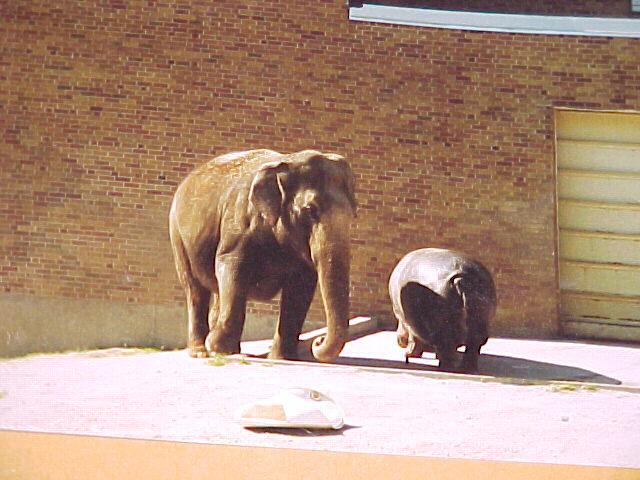
    On one of my many visits to the zoo, Bunny was having “play time” with her next-door neighbor Daisy, a hippo. They had lived in adjacent enclosures for four decades. On special occasions Daisy was allowed into Bunny’s yard for a visit. It was quite cute to watch, but sad to realize how these two had to rely on another very different species for companionship. Bunny gently herded Daisy around the yard, as much as one can herd a hippo, with Daisy paying little attention.

    My persistence began to pay off, but in a roundabout way. Ron soon began passing my phone calls off to Ted, who remained pleasant and engaging. He would listen patiently to my latest update and end the conversation with the zoo’s mantra, “Bunny will never leave the Mesker Park Zoo.”  My no-pressure-but-let-me-tell-you-this approach was sincere — and effective. We shared a common interest in Bunny’s welfare, which soon brought us closer together. My message began to get through and I saw that Ted was beginning to question the wisdom of their position.

    Until this time, I was told that Bunny could not be moved for a myriad of reasons, including that it would break her heart to leave the zoo. With stories about our other retirees as evidence to contradict that concern, Ron finally admitted that the idea simply could not be considered because the Association of Zoos and Aquariums (AZA) would not allow it.

    After years of open communication and education I was able to demonstrate that Bunny not only deserved to move to the Sanctuary but her very health depended on it. Her enclosure offered limited natural substrate and her pool had been empty for years. As result of years spent on the hard surfaces of her exhibit, Bunny had developed a chronic foot disease that could soon develop into osteomyilis. This captivity-induced disease is responsible for the deaths of nearly all adult captive Asian elephants living in zoos. Bunny was on her way to being yet another statistic but I knew that Sanctuary life could spare her such a fate.

    Bunny was surrounded by a loving staff, attentive veterinarian and adoring public. They began to grasp the gravity of Bunny’s condition and, ultimately, the people responsible for Bunny’s care, including Ron and Ted, became the champions for her release.

    On September 29, 1999, Bunny arrived at the Sanctuary. Her retirement was celebrated by two communities united by one deeply loved elephant.

  • Tarra meets a baby bird

    Tarra meets a baby bird

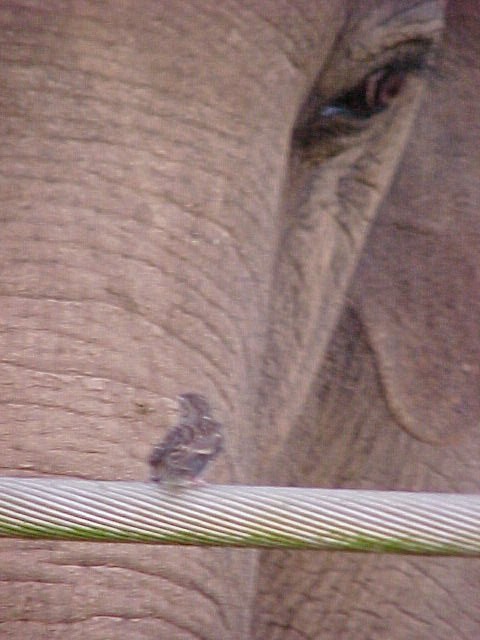
    The story that goes with this touching photo taken in 2001 is equally amazing. I went out to the back of the Phase ll barn and found Tarra staring at the fledging on the horizontal corral cable. I was without camera and said to Tarra, “Don’t move, don’t scare it — I’m going to get the camera.  I’ll be right back!”

    I ran back the length of the barn and up the stairs, found my camera, ran back down the stairs and out to the back of the barn. It had to have taken me two to three minutes. When I came back around the corner, Tarra was standing perfectly still, in the exact same spot as when I left her. I swear she was holding her breath.

    I was able to take three photos before the fledgling flew off.

    I praised Tarra for standing so still and for not trying to touch the baby bird, which I could tell she was dying to do. Her eyes were still as large as saucers, sparkling with excitement. She squeaked, took a deep breath and let out a piercing trumpet.

    Another magical moment with Tarra.

  • Colic in Captive Elephants

    While in Asia this past year I witnessed a serious health problem, rampant in captive elephants: colic. The individuals most affected are in middle to old age, in questionable health, poor drinkers, have tooth problems and a history of colic episodes. Colic usually affects an elephant when there is a sudden change in fodder. The fatal cases always involve lack of water intake or dehydration.

    In Asia, like the US, captive elephants by and large receive their diets from keepers, as opposed to selecting and collecting their own vegetation from a variety of live sources. Even in the best of captive situations, hand cut grass, corn stock, banana plants and pawn frowns are fed, which means a change in food supply. In Asia, hay is seldom stockpiled so throughout the year the elephant is given different plants and trees collected from different sources.

    Elephants not given the benefit of a gradual transition can suffer greatly from the switch between different fodder. Usually the transition goes smoothly, especially when the elephant has access to live vegetation. But in some cases, individuals experience difficulty on a regular basis. Observant keepers anticipate an elephant’s weakness for colic by adding probiotics to support healthy digestion and making a gradual change in diet. But even under the most attentive care, some elephants continue to experience painful bouts of colic.

    My experience in Asia has taught me that dehydration plays a huge role in the onset of colic. A well-hydrated body has a greater chance of avoiding colic than a dehydrated one. An elephant’s inability to effectively digest what she consumes creates pain and distress. The lack of sufficient water intake slows the transit time of the consumed matter. When the digestive progress comes to a screeching halt, with little eaten and nothing eliminated, the elephant is in trouble. Acting immediately can mean the difference between life and death for the elephant. At the first sign of colic, when the elephant postures and then later refuses to eat or drink, a problem already exists.

    One type of colic is a severe stomach ache caused by trapped gasses, as a result of poor digestion. In many cases, physical activity and a large volume of water help the elephant to pass the gas and poorly digested mater. But in cases when a lack of water consumption played a part in the colic, the situation can be dire.

    Over a three-month period I observed several elephants suffer from colic. In most cases dehydration played a role. Poor digestion of newly introduced fodder was complicated by a lack of water intake, resulting in the development of a blockage of fodder in the intestinal track. The onset of symptoms — cramps and pain — leads to further dehydration as the elephant is unwilling to drink and in most cases will eat only a token amount of food. Intuition tells the elephant not to eat more fodder, which would only add to the blockage. The blockage, which forms a hard, dry mass in her intestinal track, becomes too large and dry to be eliminated. The longer the blockage remains lodged in the intestinal tract, the dryer it becomes as the moisture is drawn through the wall of the intestinal track.

    In the cases I observed when the elephant eliminated the blockage and survived, she had been administered gallons of oil that literally lubricated the blockage so it could be passed. Sadly, in one case the blockage was too large and the oil administered too late to help the suffering elephant, who finally succumbed to it. Upon necropsy, a 50-pound mass of dried fodder was removed from her intestinal tract.

    The pain and suffering of captive elephants is unfortunately one of the ways we learn how to help other elephants in our care. Every effort must be made, at the onset of colic symptoms, in order to prevent a tragedy from occurring.

  • Ngo-Hok, aka Jon, at Elephant’s World

    Elephant’s World was one of the locations where I was fortunate to introduce positive reinforcement target training. I will return there to continue training, and to consult on facility development and elephant training and care.

    During my last visit, Elephant’s World owner agreed to the idea of constructing a large fenced-in area so the elephants can be kept off chains. Fundraising is underway and hopefully by the time I return to Thailand in the fall, the fence will be in place.

    Ngo-Hok, aka Jon, the young male elephant with whom I worked, has a history of aggression. Personally, I believe he was emotionally scarred by the traditional brutal training he received prior to coming to Elephant’s World. From the first session he responded enthusiastically to positive reinforcement target training. I was at Elephant’s World for only about a week, but during that time Ngo-Hok/Jon excelled at demonstrating to the mahouts that he can learn and will respond favorably, at least to this technique of training.

    Unfortunately, the language barrier was a challenge. The mahouts tried to understand what I was telling them but they simply could not. Even though Ngo-Hok/Jon was brilliant during his target training sessions, the mahouts failed to continue the training after I left.

    The staff needs further training to grasp the concept and develop the technique of this training which is so foreign to them. I look forward to returning to Elephant’s World to continue the training. This time I will recruit a translator, which is the only way to ensure that the mahouts understand the philosophy and learn the technique.

    Following is an interview that an Elephant’s World volunteer did with Piza, Ngo-Hok/Jon’s mahout. The volunteer posed the questions as if I had asked them.

    Q: How is Ngo-Hok/Jon doing?

    A: He is doing better since the last time you saw him. Sometimes he is stubborn, and then I cannot climb on this back. He is more often around the other elephants, during swimming and eating, but I have to stay close to him because he is playful and annoys the older female.

    He is now very close with Rom Sai, the full-grown tusker, like a father and son. He has escaped a couple of times in the last months but he comes back to stay with Rom Sai. When eating together, he likes to take food from the other elephants. Only Rom Sai will allow this. I believe the other elephants will hit him if I am not there.

    Last evening I didn’t take him to the forest because he did not let me get on his back earlier in the day — he was stubborn. In this way I am trying to teach him. Also, after he is stubborn he will try to escape when I take him out of the forest. I am trying to teach him that if he obeys and allows me on his back, he will be rewarded with a trip to the forest.

    Ngo-Hok/Jon is growing; he is now taller than me. In one month he has gained about 10 kgs. He now weighs close to 800 kgs and eats about 80 kgs a day.

     Q: Do you think Ngo-Hok/Jon can stay with the other elephants?

    A: He can stay with other elephants. He can stay close to Rom Sai, who will protect him. For now he can stay with the females as well because they are older women and he is still young. But as he gets older and new female elephants come in, it will be a problem.

    Q: How do you feel around Ngo-Hok/Jon since he tried to hurt you?

    A: I feel better around him now, but have to be careful all the time. After the accident I was a little bit afraid, but not anymore. When I am with him anyone can come close, but if I am not there, people cannot come close. If I have one day off, Jon is put on hobbles because the other mahouts cannot deal with him. Right now Ngo-Hok/Jon only listens to me.

    Q: Is there anything else you’d like to tell Carol?

    A: I think she should come again and see Ngo-Hok/Jon for herself.

  • a shared moment of silence in his honor

    I read a very disturbing story about an elephant who was stabbed to death in Vietnam. The photos are so gruesome I cannot post them. This 38-year-old tusker spent his life in captivity entertaining tourists. He was attacked twice last year and it took months to nurse him back to health. This time, the hairs on his tail cost him his life.

    I usually do not post such deeply disturbing stories but I feel a responsibility to this elephant to not let his suffering be in vain. The degree to which humans can harm another being is something I simply cannot comprehend. This elephant was held in captivity to feed tourism, the key component in the abuse and suffering of captive elephants. As long as tourists participate in elephant safaris, shows, rides, photo ops, feeding and petting, elephants will continue to be abused and killed.

    While I was in Nepal this past March/April providing foot care, Dr. Griry, the head government veterinarian, trimmed the tail hairs from elephants to ensure they would not be attacked. I was horrified by stories about attackers in Nepal hacking off the end of an elephant tail to collect the hairs.

    Last update 24/04/2011 04:51:00 PM (GMT+7)

    Da Lat: Elephant stabbed to death

    VietNamNet Bridge – A 38 year old male elephant, named Beckham, was killed in the Tuyen Lam Lake Tourism Area in the resort city of Da Lat on April 24.

    The elephant was found dead near Tuyen Lam forest with two cuts on his two hind legs. It is said that the elephant died because of losing blood from the two cuts. Its ivory and tail however were not removed.

    Phan Thi Hoa, director of the Nam Qua Ecological Tourism Co., Ltd, which owns the elephant, said that the elephant was still healthy on April 23. Its corpse was detected by elephant keepers on the morning of April 24, around 1km from the Tuyen Lam tourist site.

    The elephant was raised by Nam Qua Company to serve tourists in the Tuyen Lam tourist site.

    Before the lunar New Year, this elephant was attacked twice and injured seriously, but fortunately survived the elephant tusk and tail hair hunters.

    “We had to hire a veterinary doctor to take care of him for weeks. It had just recovered four months before it was killed,” said Hoa.

    In August 2010, some elephants in Da Lat’s tourist sites were attacked to take tail hairs. It is said that elephant tail hairs are “sacred objects”, so elephants are often attacked.

    Ninh Phan

    Last update 26/04/2011 03:49:49 PM (GMT+7)

    Da Lat’s elephant corpse is burned

    VietNamNet Bridge – The corpse of the elephant which was killed in the Central Highland city of Da Lat several days ago was burned on April 25, under the witness of local forest protection agency and relevant agencies.

    Ten young staff members at the Tuyen Lam tourist site were mobilized to burn the dead elephant. The task was estimated to take place in one day.

    The entire elephant corpse, including tale and ivory, was burnt by petrol and wood.

    The tourist site’s manager, Anh Vu, said that the elephant, named after British football star Beckham, was dead for one day, but the smell was very bad, so it must be burned urgently.

    Beckham had been bred at the tourist site for a long time and it was the most beautiful elephant in Da Lat. The elephant had both tusks and tail, while other elephants in Da Lat have lost these parts. Beckham was very obedient, gentle and friendly.

    The elephant was around 4 tons, 38 years old. It was bought from the Dak Lak province in 2000, at the price of VND700 million (around US$40,000). Its job was serving tourists at the Tuyen Lam tourist site.

    Beckham was found dead in the forest around 3km from the Tuyen Lam tourist site on April 24, next to pools of blood. The elephant was stabbed and its hind leg tendons were cut off. However, its tusks and tail were not chopped. An axe was found near the elephant corpse.

    Last year the elephant was attacked twice, suffering 38 wounds, and it took him several months to treat the wounds.

    Local police are investigating the case. Some elephant keepers said that the murderer might be familiar to the elephant.

    According to the Da Lat Forest Protection Bureau, there are five elephants at tourist sites in Da Lat now.

    The Central Highland province of Dak Lak currently has the highest number of tamed elephants in Vietnam. In the 1980s, the province had more than 500 elephants, but the current number is only 54.

  • checking in at ENP

    checking in at ENP

    My return flight to Los Angeles leaves from Bangkok, which was the perfect excuse to go back to Elephant Nature Park one more time to see the progress made by Chang Yim and Karl.

    Yim never ceases to impress me. He has made yet another transition from Karl to his new mahout, Lai. Karl has worked diligently over the past many weeks training Lai, and Yim has been a real trouper. There is no doubt in my mind that Chang Yim will miss the special relationship between him and Karl, but Yim has a bigger mission. He has the opportunity to teach a “traditional” mahout a different way, a more humane and gentler way to manage him and his family members. This move from Karl to Lai is actually quite monumental in the big picture…Yim is the catalyst for change. I am so proud to know him.

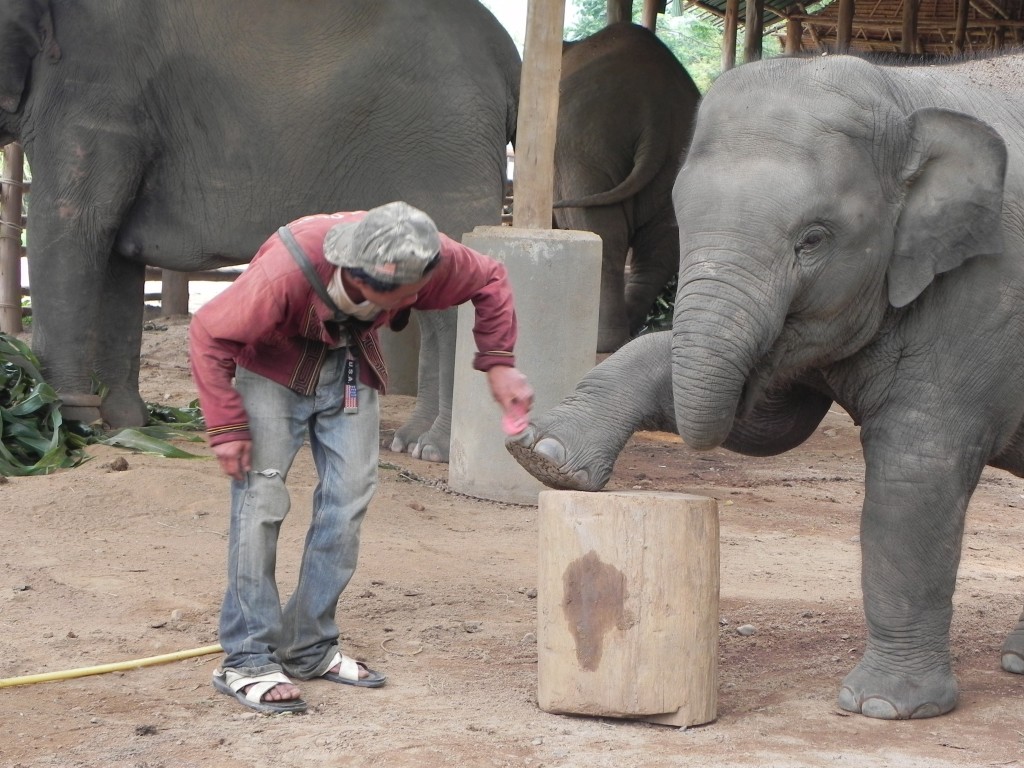
    In addition to satisfying my curiosity about Yim’s progress, my return to ENP was to give Karl some pointers on training the elephants to place their leg on the trimming stool recently built for back foot trims. Once the elephants are trained, I will be able to return and finish the foot care clinic I started.

    Mae Tee and Mae Kham Geao were our first students. The initial hurdle was getting the ladies to start thinking for themselves, no easy task for elephants who for decades had been conditioned not to think. The training was slow and at times appeared to be at a standstill, but, I could see the wheels slowly beginning to turn in their heads. Patience was the key.

    After two days, my time at the park was up. Karl was well on his way to conditioning Mae Tee and Mae Kham Geao to voluntarily lift their back legs, a requirement in order to slide a trimming stood underneath for support. I felt torn leaving—I always do—but I had confidence that Karl would do just fine.

    Today, a little before four, I received a call from Karl. At first I was apprehensive because Faa Mai is experiencing some unidentified health issue. But the news was all good: Faa Mai seems a little better. But the reason Karl had called was not to update me on Faa Mai, it was to tell me that Mae Tee and Mae Kham Geao got it! They were lifting their back legs off the ground and suspending them in the air when asked. The both of them!

    What do you bet they talked about it over the past two days? It comes as no surprise that both ladies, dear friends who spend all their time together, figured out what Karl wanted in the same training session. Karl was so pleased, and WOW — what can I say. I am so proud of everyone involved in this work: Karl, Dam (the Maes’ mahout), Jody and Sophie (treat givers) and especially Maes Tee and Kham Geao, the ladies of the hour. I sure wish I could have been there to share in the cheers and congratulations showered on the ladies, but I was there in spirit. Planting the seed and seeing it grow, one World, one elephant at a time — in this case, two elephants at a time!

  • Seeds of Change

    Seeds of Change

    April 13

    My work in Sauraha has come to an end, at least for the time being.  Seeds of change have been planted. From the looks of it, some seeds are already growing, quietly shifting the soil around their sprouting roots. Experiencing the fruits of my labor so instantaneously fills me with hope.

    Yesterday when Kiran and I arrived for Bhadra’s morning session we were told that Ramji, his mahout, was off making preparations for the New Year’s Day celebration. I jumped at the chance to work with Bhadra in Ramji’s absence.  But my excitement was quickly doused when Bhadra made it perfectly clear that he would work with me but under protest.

    After completing each request Bhadra would do a mini mock lunge from behind the protective barrier. It seemed that he was clearly bothered about something to do with me. He was responding but being snotty. I have seen this type of behavior before when training a new mahout who struggles to keep pace with an advanced elephant student. I did not make that analogy until sometime later.

    The next day, the motivation behind Bhadra’s behavior became apparent. In our absence, Ramji had risen to a challenge from Kiran to prove his skill with Bhadra within three months. The ultimate goal: to show everyone how far he could take Bhadra with positive reinforcement training.

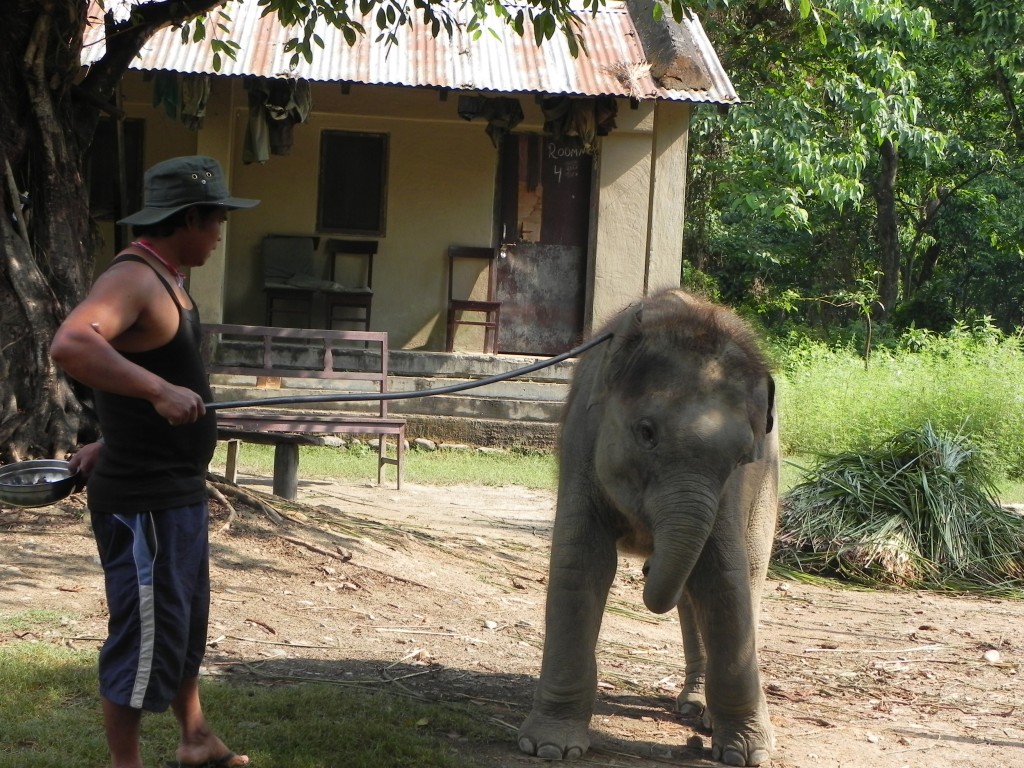
    Ramji proved his skills beyond question when he surprised us by calling Bhadra from the protection of the corral and proceeded to ask him to present his feet and ears, move to the side, back up and put his head down. I was stunned. They were fabulous. Ramji, all cool, calm, and collected, Bhadra listening intently and responding to each verbal cue. I wish you could have been there to see it for yourself, but I did catch it on video. This type of breakthrough must be documented in order for others to believe.

    Needless to say, Kiran was pleasantly surprised at the immediate progress in less than a week!  Ramji obviously took the challenge seriously, resulting in a display that had me grinning from ear to ear, joyful with disbelief.

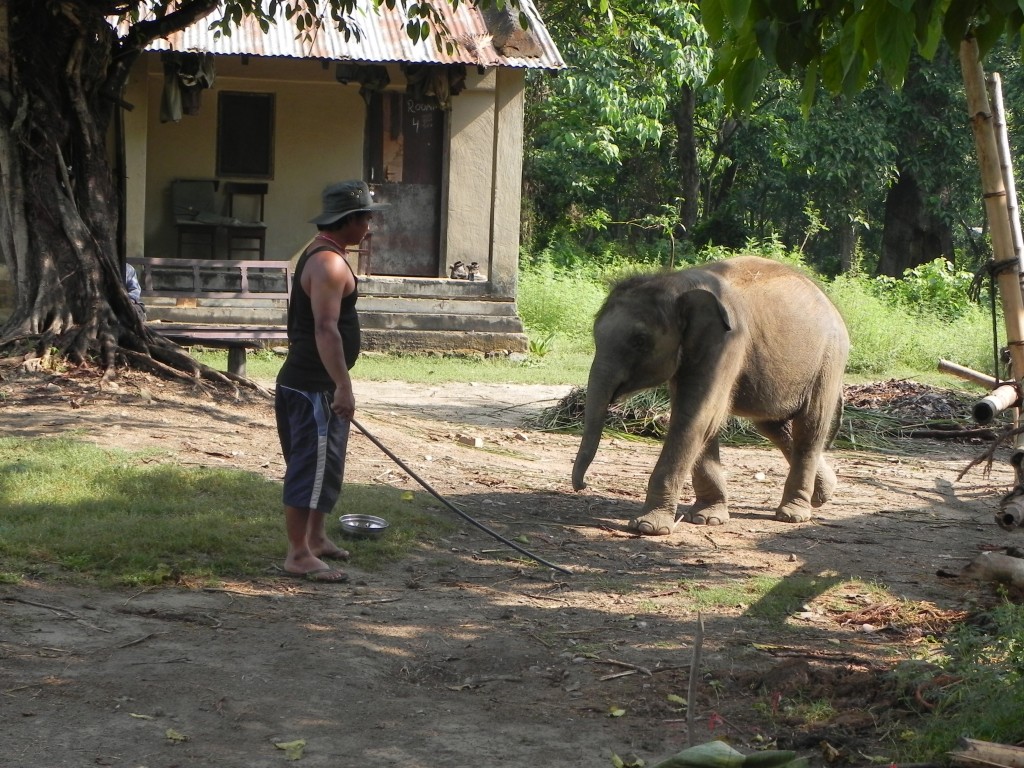
    Ramji earned much deserved respect today, and Bhadra…well, he already has my heart. He has now joined the ranks of the “MIGHTY TYKES,” the young elephants in Thailand and now Nepal participating in this important case study of positive reinforcement training. These youngsters are the hope of the future: what they teach us and their mahouts will shape elephant training of the future. They are demonstrating how positive reinforcement training can be used with captive elephants in a hands-on working situation.  We owe them and their mahouts a great debt of gratitude.

    Kiran knew instinctively that witnessing Bhadra and Ramji’s incredible accomplishments would make my day, my last in Sauraha. It was wonderful to see how proud he was. Kiran has been an invaluable asset throughout the training process. I doubt he realizes the role he has played in this cultural shift of mahout attitudes, which has the potential to change the future for captive elephants. The future is bright indeed.

    I left Sauraha today with a heavy heart, heavy with the joy of knowing that we have planted a seed. I for one cannot wait to see how it grows.