The temperature is already 32 degrees Celsius (about 90 degrees Fahrenheit).
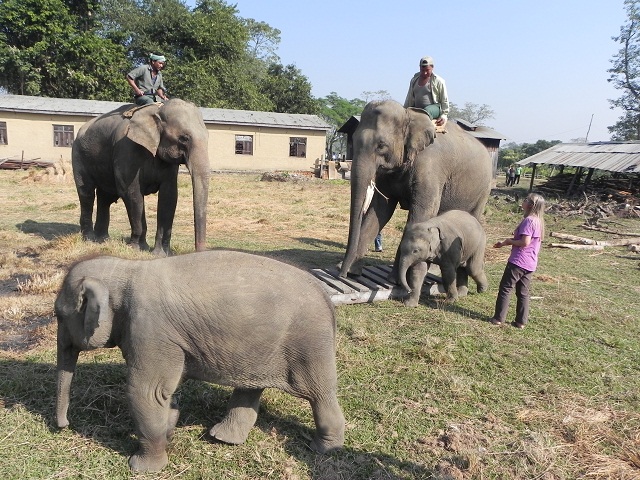
Tens of elephants are already hard at work.
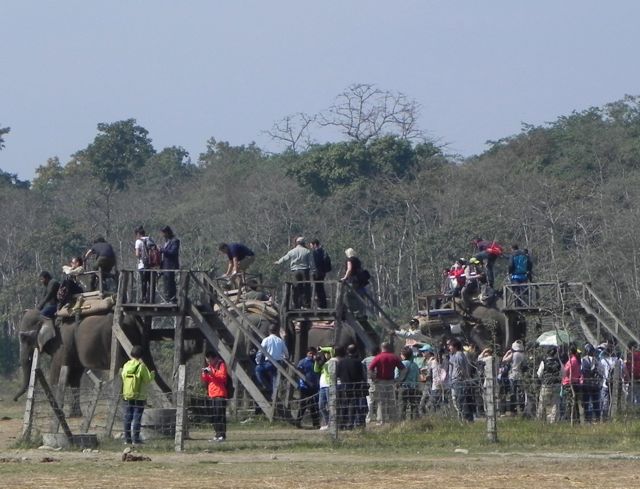
Each morning at dawn, seven days a week, elephants are saddled up in preparation for another day of carrying tourists on safaris.
This is the routine the elephants will follow, year in and year out, until they die.
First, they are forced to lower themselves onto their elbows to accept the saddle. This unnatural position causes pain and irreversible damage to their elbows.
Next, a heavy canvas pad and ill-fitting howdah (saddle) are placed on their back. The pad and howdah are each so heavy, it takes two men to lift them, one at a time.
Then, a howdah strap is cinched tightly around their chest, lacerating sensitive flesh in their armpits and cutting the tissue of their breasts.
A second synthetic rope is tied from the back of the saddle under their tail, ripping deep gashes in the flesh around their anus.
The life of the safari elephant
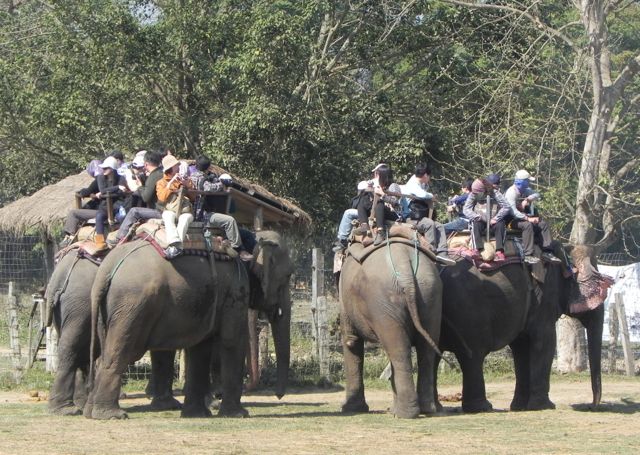
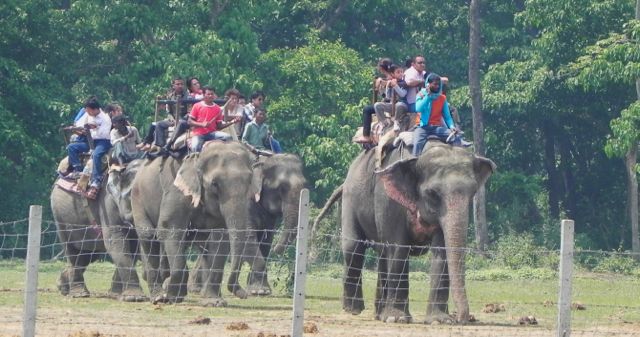
Safari elephants spend the day carrying tourists — four to six at a time — through the jungle in sweltering heat.
Elephants are poorly suited for this activity. The pad and howdah cause huge blisters that fester into deep abscesses that can take months to heal.
According to a study published in the Journal of Experimental Biology, four hours of exercise in the sun causes overheating and can be fatal. Laboring in direct sunlight, carrying too much weight – pad, saddle and tourists — elephants quickly become overheated.
What does it take to force an elephant to work under such conditions?
Brutality.
Mahouts hit the elephants over the head with heavy sticks, metal knives and axes. The wounds remain infected for weeks.
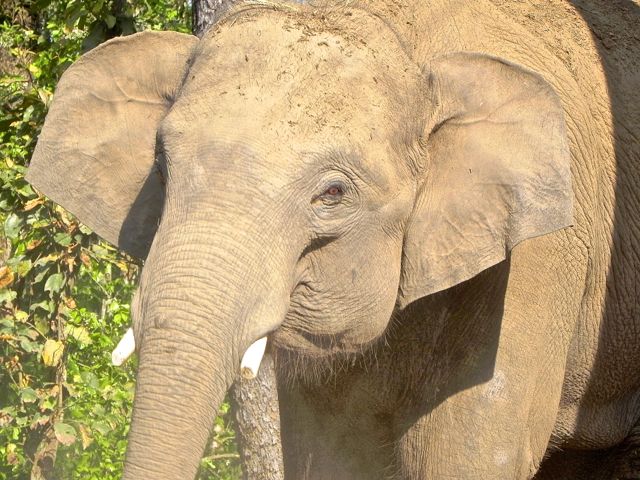
Bright white scarring can be observed across the forehead of virtually every working elephant in Nepal. The abuse is systematic, accepted by elephant owners, locals and the tourists.
The images haunt me.
I can’t help but wonder: Is this the memory of Nepal tourists want to take home with them? And what will it take for them to see the abuse?
Two years ago, a young captive born elephant broke free from an ancient tradition.
That was Prakriti Kali, the first elephant in Nepal to be released from chains.
Six months later, five more elephants were released from a lifetime in chains.
Mel Kali was the record holder in the herd, having lived in chains for nearly 70 years.
Culture shift continues in Nepal
On April 6th, at 4:30pm, Nepal made history again when all five resident elephants at the government’s Kasara hattisar went chain free!
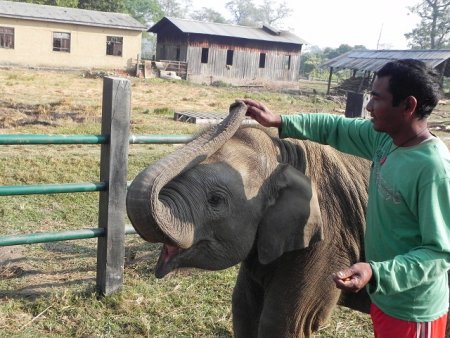
Six-year-olds Tamor Kali and Himal Gaj were the first to be given their freedom.
Tamor Kali
Himal Gaj
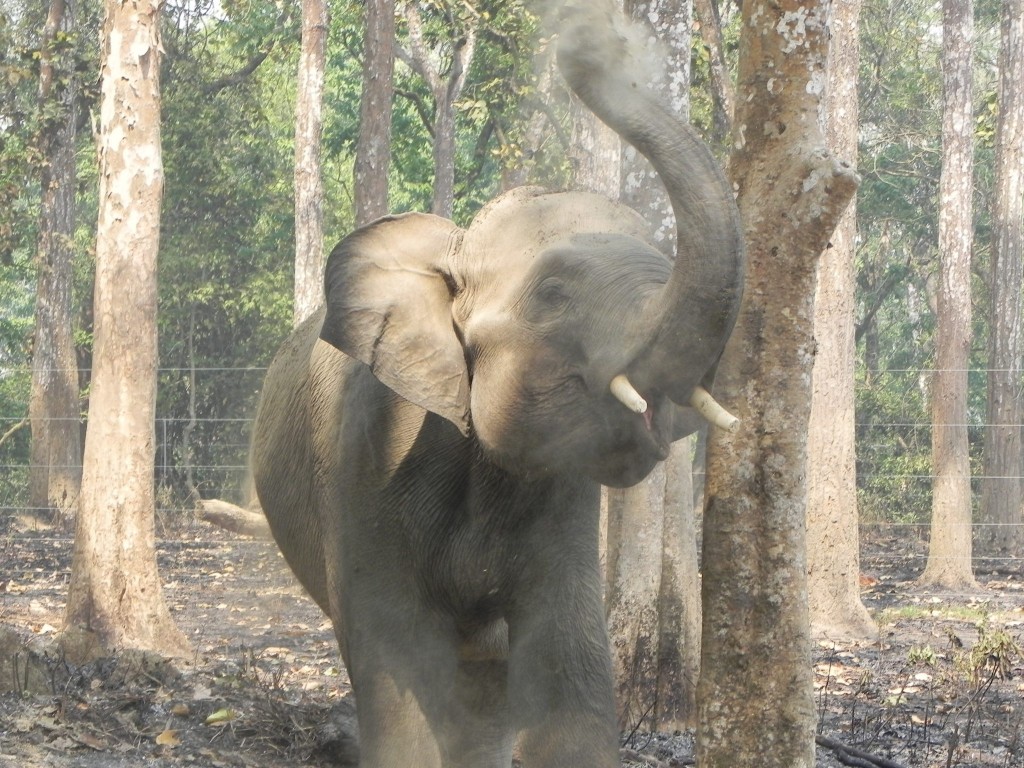
They wasted no time, finding the best scratching trees and dusting bowl.
Then, a few days later, after all six chain free corrals were completed, Prayan Kali, Laxmi Kali and Khosi Kali dropped the chains of tradition and went free as well.
Khosi Kali
Prayan Kali
Laxmi Kali
Transition
Watching the elephants shed their chains and adapt to the change so effortlessly is breathtaking.
Young and old alike seem instinctively to know what is happening.
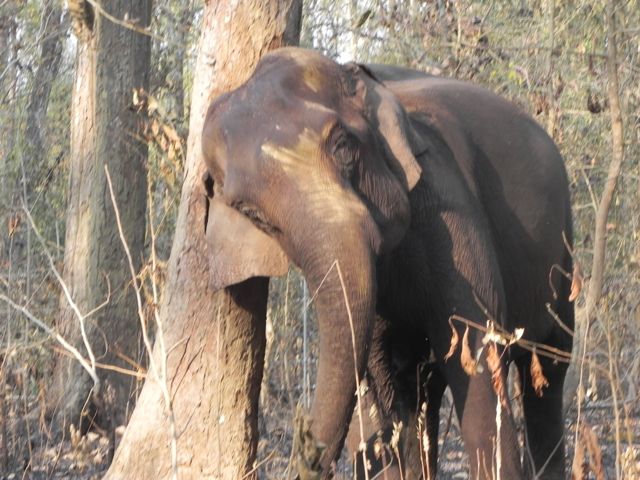
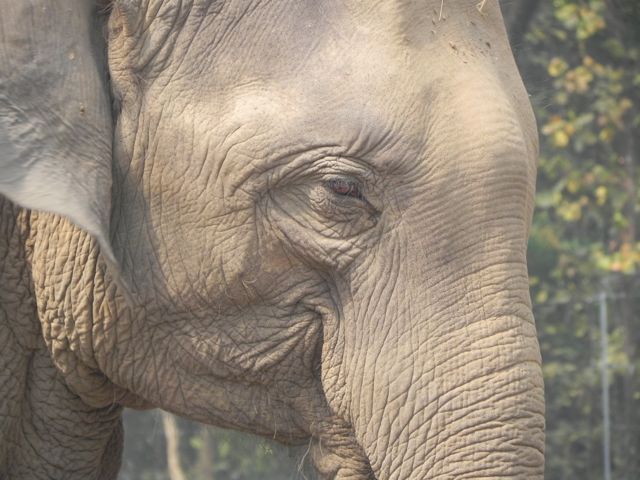
In synchronized movement, they revel in a scratching and dusting ritual. Nearly becoming one with the trees, they exfoliate every inch of their robust body. Even the tender skin behind their ears and under their massive legs get the invigorating treatment.
After the exfoliation is complete they follow up with a full-body dusting. In the most graceful slow motion, they fling trunkfuls of dirt under their bellies, on their backs and everywhere in between. This natural spa experience is essential for maintaining healthy skin.
Chained elephants are denied this opportunity.
Become an elephant
For one minute become an elephant. Close your eyes and step inside their skin. Feel the frustration when denied access to trees for scratching and clean dirt for dusting. Now feel the sensation of scratching every tick bite and itch spot until completely satisfied.
More good news to come
The five elephants in Kasara hattisar are just the beginning. When our project is complete, 63 elephants will enter the ranks of the chain-free.
A huge thank-you goes to Kamal Kunwar, chief conservation officer of Chitwan National Park, the hattisar staff and, of course, all who believe in and support this project.
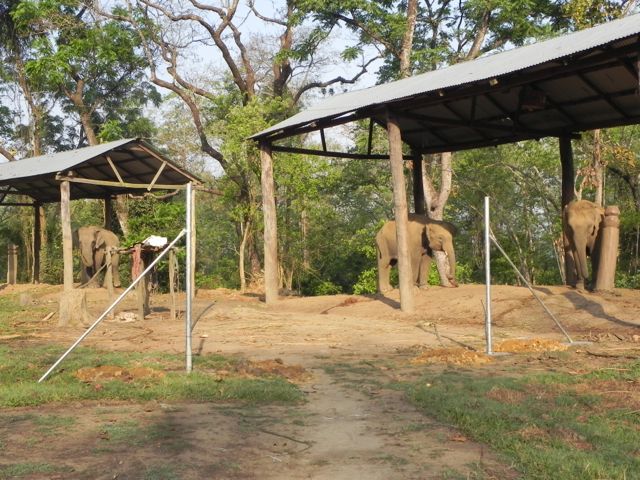
The first two corrals at Kasara hattisar are finally ready.
The air is charged with anticipation.
Rescuing an elephant to sanctuary or releasing them from chains brings the same mix of emotions — anticipation, apprehension and excitement.
Each elephant is a unique individual with a distinct personality. Life’s experiences mold their behavior, shaping them as they mature. Each of them responds differently to different situations.
Himal Gaj
When I first arrived at the Kasara hattisar, I noticed that young Himal Gaj was resistant to his mahouts. He appeared fearful. An old scar at the base of his trunk indicated a past confrontation.
Watching the mahouts struggle through the morning routine, preparing Himal Gaj for duty, was disconcerting. I wondered how he and the mahouts would respond to going chain-free.
The mahouts were also concerned. They feared for their safety.
As a result, it was decided that Himal Gaj would be released from his tether but would wear loose hobbles until the mahouts felt safe around him.
It was disappointing that Himal Gaj would not immediately be completely free, but the compromise was the first step to his future freedom. If the mahouts fear for their safety, Himal Gaj would be destined for a life in chains.
With time and Compassionate Elephant Care training I hoped Himal Gaj would settle down and become more responsive.
The chains come off
The elephants usually return from their anti-poaching patrol duties around 4pm. Chief Conservation Officer Kamal Kunwar postponed a scheduled meeting so he could be present for this auspicious occasion.
Just before 4pm, the hattisar suba arrived. He’d been out of office for a couple of weeks. He and Kamal discussed the plan in Nepali. I would soon see that following their brief conversation plans would change dramatically.
The elephants arrived back from the forest. To my surprise and contrary to the plan, Himal Gaj was walked directly into his new chain-free corral. He was not put on loose hobbles. Calmly and confidently, his mahout gave the command to bite (stretch out on his sternum). Without hesitation or fear, Himal Gaj calmly responded.
I realized that the mahout I’d seen with Himal Gaj the past week was now assisting, rather than riding.
In that moment things became perfectly clear. The mahout to whom Himal Gaj was resistant to this past week was the junior mahout. And now that his main mahout was back from vacation, everything was fine.
Himal Gaj waited patiently as his gear was removed. Then he rose and immediately began dusting, as his friend and senior mahout left the corral.
What a difference a good relationship makes.
Kamal Kunwar’s turn
Tamor Kali
I did not have time to dwell on the glory of Himal Gaj’s transformation because Tamor Kali was about to enter her chain-free corral for the first time.
Kamal Kunwar was sincerely excited, filming her first chain-free steps like a proud father.
After seeing how well Himal Gaj responded to his mahout, everyone was engaged and relaxed. They gestured at both young elephants free-of-chains with huge smiles on their faces.
Now was the time to stand back and savor the moment. The instant that life changed for two young elephants and their family of mahouts.
The three other elephants stood chained under their shelter watching the scene.
I whispered, “You’re next ladies.”
It will be close to a week before the other corrals are completed. Without a doubt, Khosi Kali, Laxmi Kali and Prayna Kali, who have all been prisoners to chains for decades, will transition seamlessly.
Imagine the joy when they are all chain-free. Heart bursting JOY!
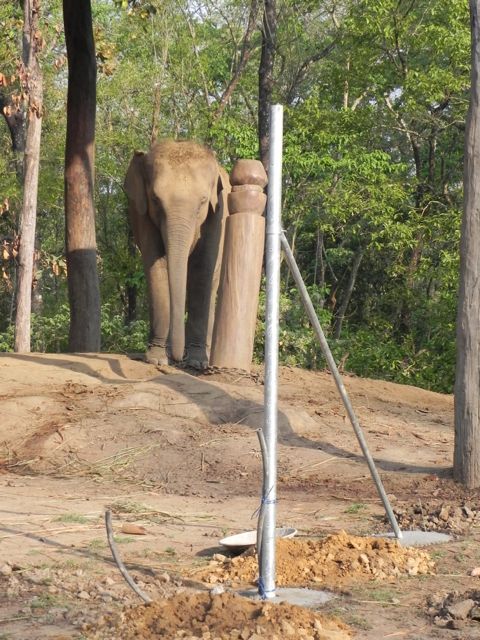
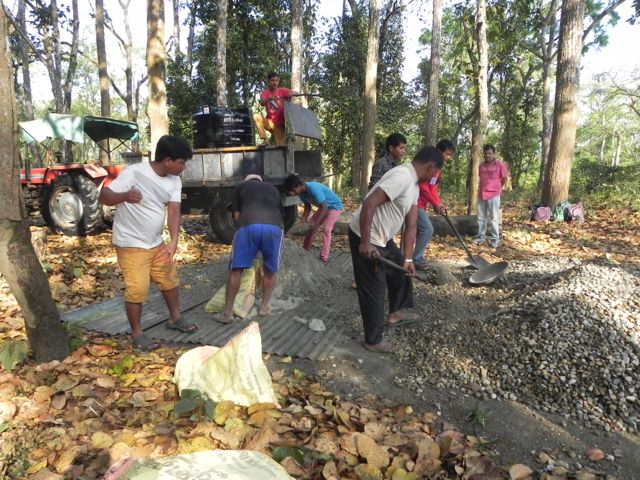
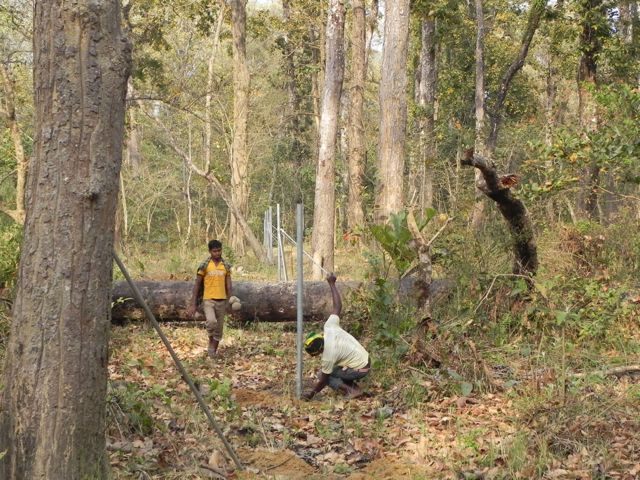
The framework for all six chain-free corrals at the Kasara hattisar is in place.
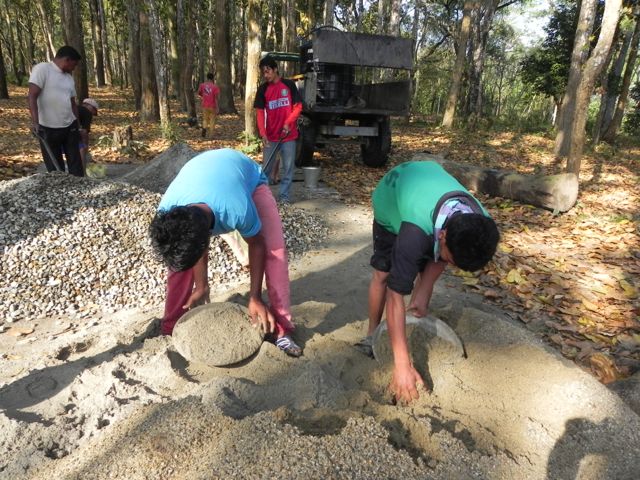
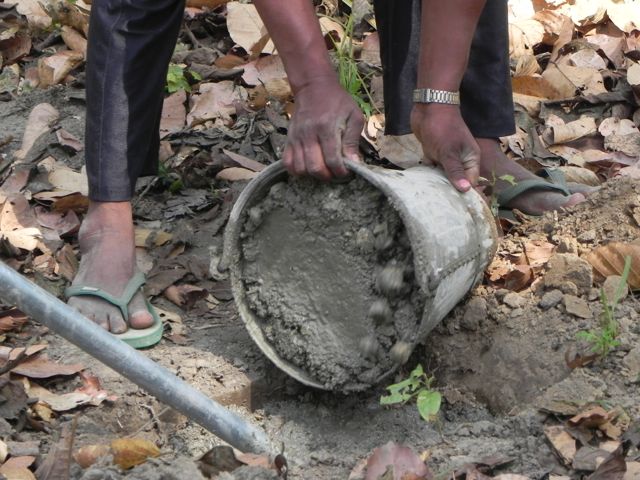
Support and brace posts are concreted. Gateposts mark the entrance to each new corral.
Heart work
Eyeing the progress of this project, my heart pounds. Here it comes, that joyfully intoxicating feeling cursing through my veins.
My eyes transport the image to my heart. My heart responds, sending a warm glow through my body, filling my eyes with tears. My heart swells with the promise of a better life for these elephants.
In this moment I stand in my personal space of pure peace. I caress it. Breathe it in deeply. I don’t attempt to own it, only experience it, knowing the feeling is a gift meant to be experienced not possessed.
Some people meditate, others run, cycle or climb mountains to connect to that place within where they feel most themselves, most centered, most peaceful.
This is the place of autonomy and personal freedom.
Such activity can literally become an addiction, in the best sense of the word.
Watching the chain-free corrals come to life before my eyes is my addiction. Knowing that my actions help reduce the suffering of captive-held elephants brings me great joy! It is heart work, soul fulfilling work. My meditation.
At times the joy is overwhelming and I just have to cry. Seeing elephants gain even a semblance of autonomy moves me to do more. Knowing that we are able to help bring some peace and freedom to their lives drives me.
I may never know any of these elephants personally. But that is not the point of my work. I am not here to expand my elephant family. I am here to better the lives of these elephants.
They know we are helping them. That is good enough for me.
Construction continues
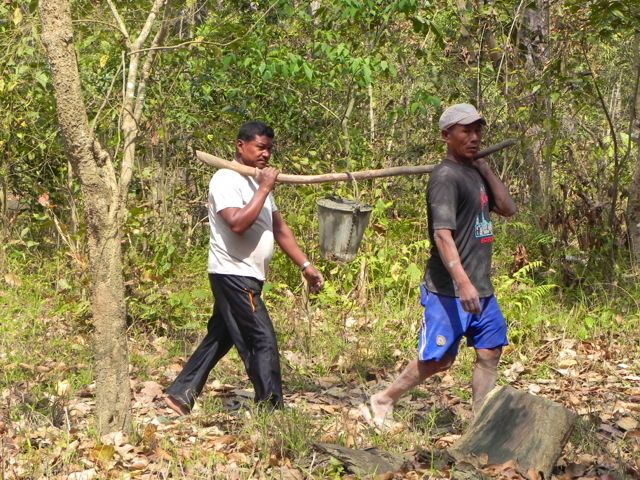
The next step is to string the wire between support posts and hand-build the topes (post protectors).
Each corral is one full acre in size. It is equipped with six strands of wire equaling nearly one mile of wire per corral.
Ditches will be dug to bury the wires that enable each corral to operate independently.
Last, the steel box that contains and protects the energizer and batteries will be installed and wired to the solar panel that powers the system.
A perfect vantage point
From the open-air raised platform that I have claimed for my new office, I survey the work site. What a gift to witness this miracle unfolding right before my eyes.
A humble thanks to Kamal Kunwar, Chitwan National Park chief conservation officer, the entire hattisar staff, our IBEX fence crew and all of you who have contributed to this worthwhile project.
Together we are improving elephant welfare, showing due respect to these wise, kind and self-aware beings who grace our planet and our lives.
Himal Gaj is a six-year-old captive born elephant. His father is the dominant wild bull in the area. His mother is a wild born, captive resident of the elephant breeding center at Khosor, Chitwan, Nepal.
Himal Gaj was one of five young elephants trained together at the breeding center several months ago. Until their formal training, they lived with their mothers.
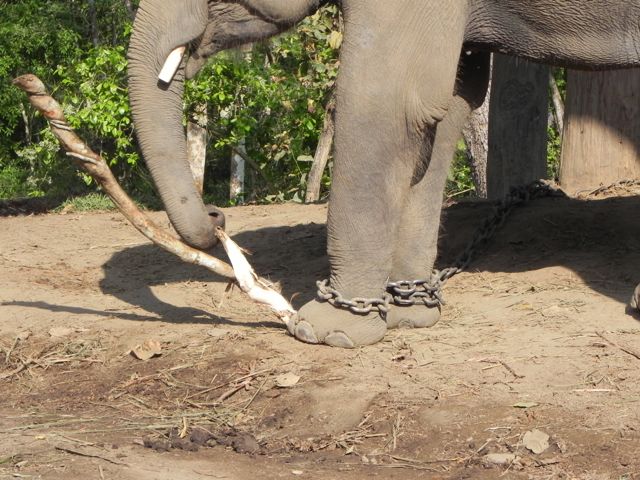
All five elephants were chained from the age of three months. Chaining is the practice all over Asia. Domestic livestock and captive elephants are tied or chained. It is the cheapest way to keep them in one place.
The training technique used with Himal Gaj and the others at the breeding center was a deviation from the traditional pujan, a brutal breaking of spirit. Introduced by a foreign NGO, a mixture of traditional methods was used—including the use of koonkie elephants, negative reinforcement and punishment—combined with positive reinforcement techniques known to be successful with domestic horses.
Unfortunately, once training began, Himal Gaj showed signs of aggression and resistance. He was frightened by the training process and responded poorly to his mahouts. A few months later his training was deemed unsuccessful.
No video, photographic or written records exist to document the daily training process and Himal Gaj’s progress and difficulties.
But it does not take such documentation to see that Himal Gaj is a very insecure individual.
Although Himal Gaj responds well when his mahout is riding, his weakness is responding to commands when his mahout is on the ground.
Himal Gaj is a good example of the importance of sound training techniques, mahout training and follow through.
Captive elephants are not domesticated—they are wild animals living in a captive environment. Even generations born in captivity are not domesticated. The scientific process of breeding selected individuals for specific traits is the process required to create a domestic species. This has never been undertaken with elephants.
In the case of all elephants born at the breeding facility in Khosor, the mothers are wild born living in captivity and the fathers are wild born living in the wild.
Himal Gaj’s mahouts are as gentle as I have seen anywhere. They are patient but frustrated. What the training process failed to do was give them the tools necessary to help Himal Gaj learn.
As a result, all are left feeling like failures. Without intervention, Himal Gaj is doomed to be a dangerous elephant for the remainder of his life.
The good news is that the mahouts and Kamal Kunwar, the chief commanding officer of Chitwan National Park, are receptive to Himal Gaj receiving additional training. His private training course will begin soon.
This is such exciting news. I feared Himal Gaj would remain a lost cause in the minds of the mahouts. But before his chain-free corral is completed Himal Gaj, will be well on his way to understanding what is expected of him and his mahouts will have gained the humane tools to understand and assist him in his training process.
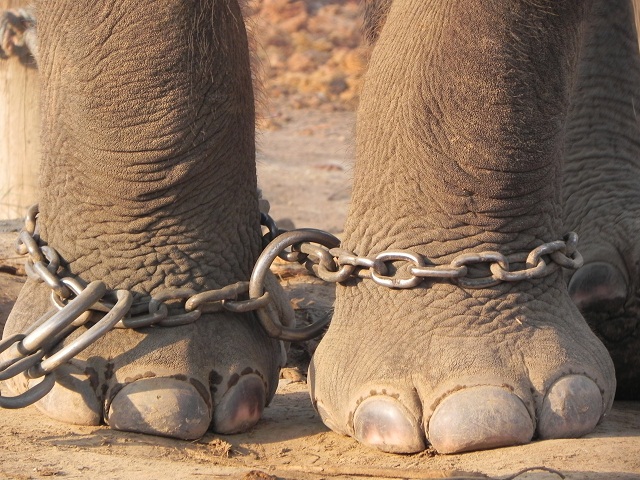
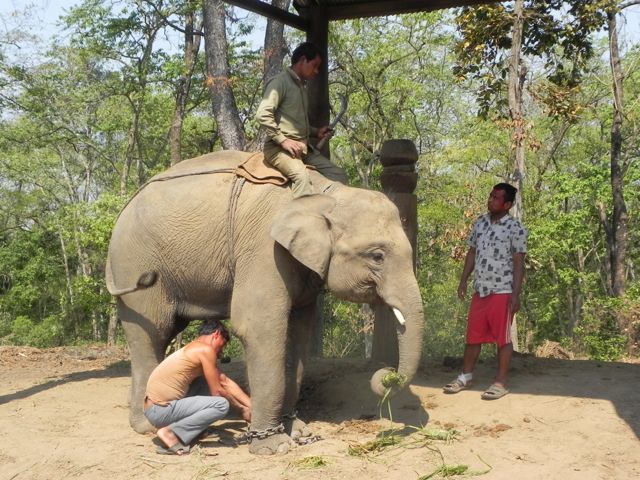
It’s easy to look at an elephant shackled by both front feet to the ground, with open wounds, and blame the mahout.
But I challenge you to learn the facts.
Elephants belong to hotel owners
In Chitwan, Nepal, mahouts do not own elephants. Elephants are the private property of hotel owners, who use them to augment their income by offering elephant back safaris to overnight guests and daytrippers coming to Chitwan in search of fun and adventure.
Elephant back safaris not only provide a bountiful financial benefit for the owner, they are actually the life’s blood of Chitwan.
In Sauraha, Chitwan’s tourist destination, every shopkeeper, restaurant owner, hotel, bar, service provider, wilderness guide, money changer, street vendor and orphanage owe their survival to these elephants. Many falsely claim that without elephant safaris, this tourist destination would cease to exist.
Grueling work schedule
All day long, 24/7, mahouts and elephants give safari rides in the community forest.
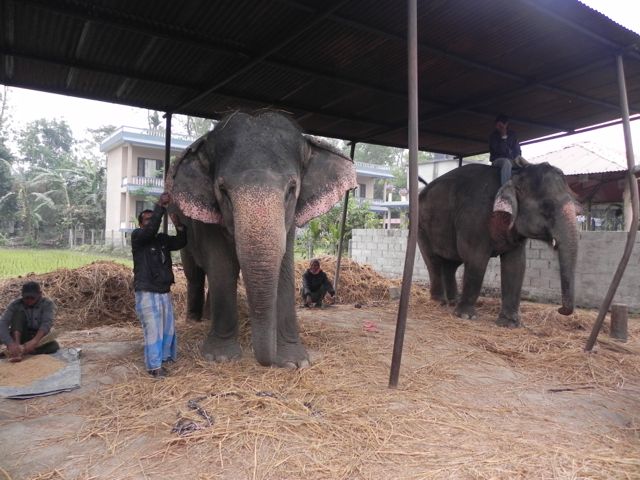
Mahouts train, feed and ready the elephants for the rides. It is a grueling job for both. Up at 4:30am, the pair sets out on the long trek to the safari loading area as the rising sun lights up the morning sky.
During what is supposed to be a one-hour lunch and rest period, the elephants instead are taken to a riverfront area where tourists mount them to have their photo taken.
Walking back and forth to the safari ride area, tourist bathing area and home stable, while carrying hundreds of pounds of tourists for hours at a time, takes its toll on elephant and mahout alike.
At dusk, and even into the dark of night, elephants can be seen silhouetted against the sky trudging down the paved roads of Chitwan toward their home stable.
Mahouts: Overworked, underpaid and devalued
Elephant owners know nothing about elephants and rely on the mahouts to keep the elephants alive and working without killing tourists. This is a heavy burden to put on overworked, underpaid and devalued employees.
When mahouts “ask for more,” be it food for themselves or the elephants, they are chastised. Many owners view the mahouts as stupid, uneducated and unmotivated and blame them for the elephant’s unsanitary living conditions and poor health.
Yet mahouts are not provided even the most basic supplies to ensure the health and wellbeing of the elephants in their care. Owners fail to supply nutritious food but blame the mahouts for the elephant’s poor health. Stables are rancid cesspools because no provision is made for waste disposal. Many stables don’t even have a source of fresh water. For this, the mahout is unjustly blamed.
A marginalized community
The truth is that the mahouts are a marginalized community. The custom of treating them as poorly as the elephants is woven into the fabric of society and their living conditions are a mirror image of those of the elephants.
Mahouts learn their trade on the job, from senior mahouts. Their lot in life dictates they do as they are told without question. They hit the elephants because they are taught they must in order to ensure the elephant does not kill them.
Still, this does not excuse how the mahouts mistreat the elephants.
Abuse can be eliminated
Through education and culture shifting, elephant abuse can be eliminated.
Demonizing either owners or mahouts is not the solution.
The first step is understanding why the situation exists and accepting the challenge to help move culture forward.
Owners must be held responsible and mahouts and tourists must be educated.
This will result in improved welfare for the elephants in Chitwan.
How we can help
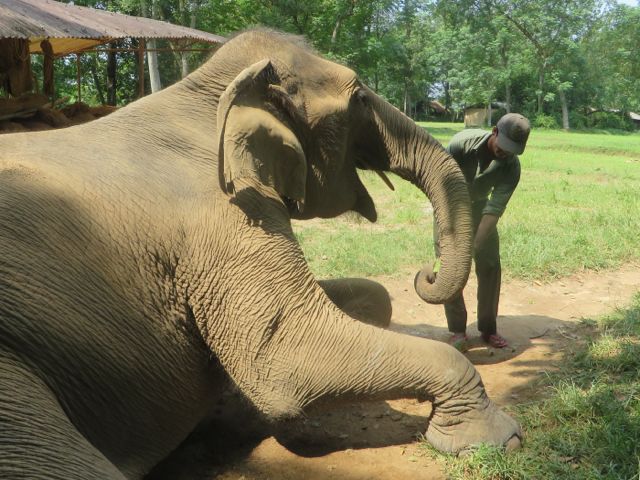
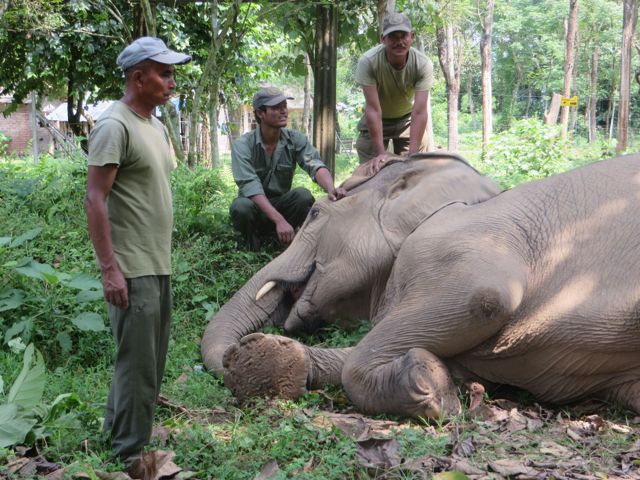
Developing sustainable assistance programs is essential. Live demonstrations, educational resources such as videos and manuals, translators and hands-on assistance are needed to improve mahout knowledge and understanding of new approaches to elephant care.
This is Elephant Aid International’s mission. By providing bi-annual foot trimming; training mahouts and vet techs in the skill of foot trimming; teaching positive reinforcement training philosophy and techniques; and constructing chain-free corrals, we are laying the foundation for positive change.
EAI doesn’t blame the mahouts. We give them the tools necessary to take better care of their elephants.
It was a 10-hour drive through mountains on rough roads. The 19-year-old driver of our rental truck scared the daylights out of all of us with his speeding, passing trucks on blind curves and nearly missing oncoming vehicles. Oh man — it was a stressful ten hours!
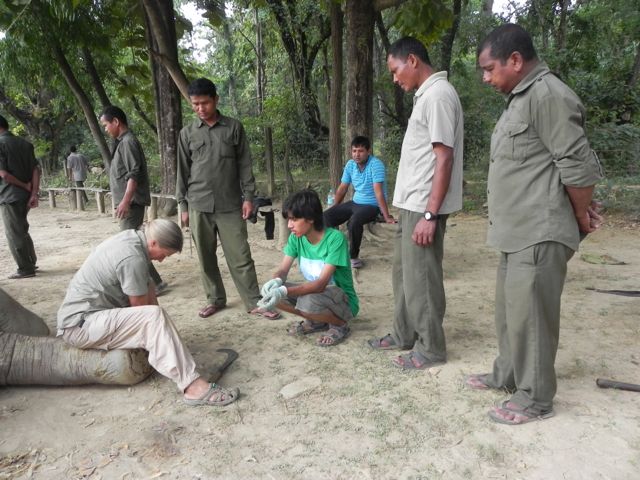
But our foot trimming program was a grand success. We had a fabulous trimming team: Dr. Gairhe; Kiran the vet tech; Hira, Kirti Kali’s phanet (head mahout) from the NTNC hattisar; and I.
Our students included Chantelle, our intern; Surajan, a new friend and translator; and the vet tech from Bardia.
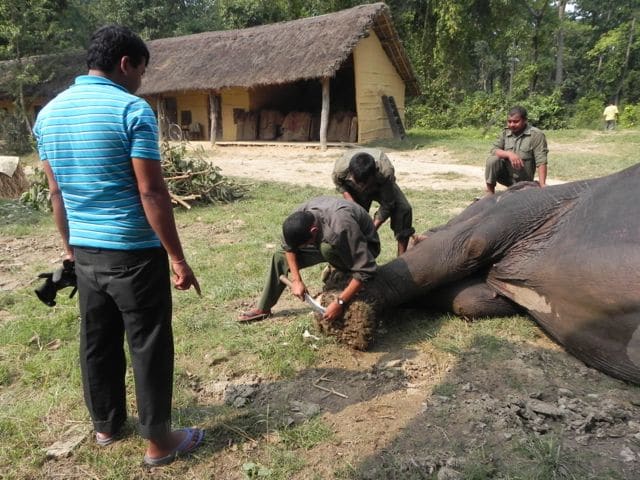
In two short days we trimmed the feet of 24 government and privately owned elephants.
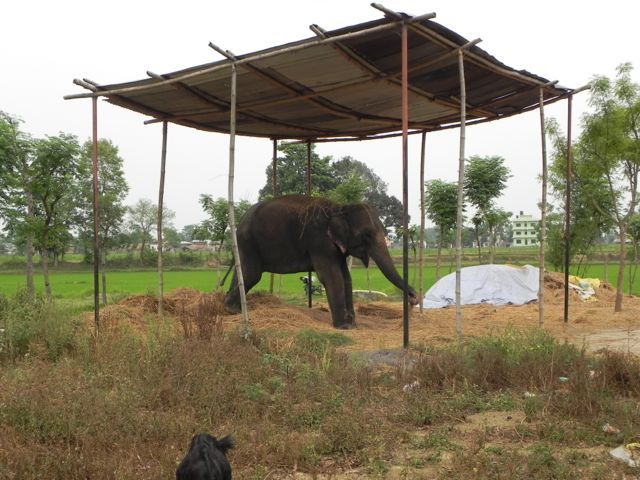
Honestly, the condition of the privately owned elephant’s feet was criminal, similar to the privately owned elephants in Chitwan. Their pads were dry, cracked and severely overgrown. The nails were equally as dry and overgrown and many had splits and deep cracks.
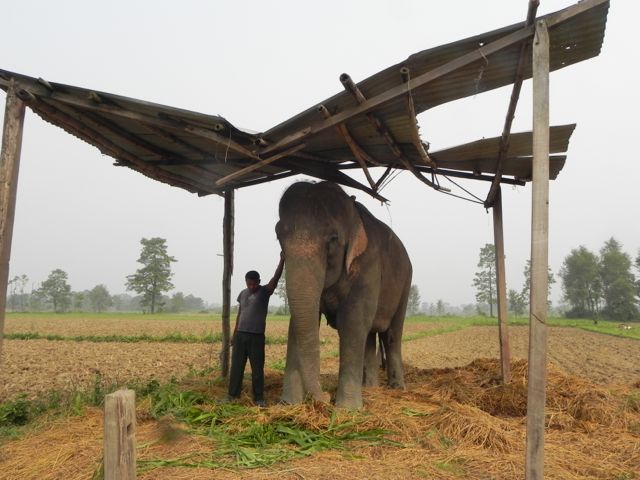
Private owner, broken shelter
I am always shocked to see how poorly the privately owned elephants are kept, especially since they are the breadwinners for their owners.
The good news is that 24 more elephants received pedicures and their mahouts were introduced to foot care. With time things can change for these over-used, abused and neglected elephants…I hope.
A huge thank-you goes out to the trimming team. Without their enthusiasm and hard work we could not have accomplished our goal to provide foot care for elephants in Bardia!
You can make a difference in the life of a captive elephant by supporting our Foot Care project. Thanks for your help.
The competition between humans and elephants for space and resources has reached an all-time high in India. The problem stems from both species’ dependence on forest resources for survival.
Elephants leave their forest home in search of food. Until villagers are given alternative means to meet their daily needs without depleting forest resources, the problem will continue.
Lacking a well-thought-out plan to combat the problem, the Indian government continues to resort to crisis management. Always a step behind the problem, they have failed in their responsibility to the welfare of marginalized people and wild elephants.
Capturing elephants is an ill-conceived, short-term solution to a long-term problem. Although it is ethically repugnant to some, others have no problem incarcerating wild elephants to a life in chains. How a people who profess to believe that Ganesh is god can capture and torture his likeness is disturbing.
To avoid a continued escalation of the problem, the government must devise a way to protect the village people, the wild elephants and their forest home.
Potential solutions to these pressing problems need immediate and thoughtful consideration. The future of the forest, wildlife and the villagers who encroach upon the forest are at stake. Ignoring any aspect of the problem will result in failure–a loss for humans and uncertain future for India’s forests and elephants.
Some foreign NGOs recognize the need to relocate villages and open elephant corridors and are pursuing initiatives. But most efforts by local and foreign NGOs to create protected areas for elephants at no expense to the government have, to date, been thwarted. Government resistance to outsiders bankrolling solutions to the human elephant problem seems counterintuitive and bewildering.
Chain-Free Hattisar Project
National Trust for Nature Conservation – Biodiversity Conservation Center
Chitwan, Nepal
REPORT
Project completed Jan 10, 2013
Department of National Parks and Wildlife Conservation Jhamak Karki, Chief Warden-Chitwan National Park
Dr. Kamal Gairhe, Senior Wildlife Veterinarian-Chitwan National Park
National Trust for Nature Conservation Naresh Subedi, Senior Conservation Officer
Chiranjibi Pd. Pokheral, Senior Conservation Officer-Biodiversity Conservation Center
Babu Ram Lamichhane, Conservation Officer-Biodiversity Conservation Center
Dr. Arjun Pandit, Staff Veterinarian- Biodiversity Conservation Center
In collaboration with
Elephant Aid international-USA Carol Buckley, Founder and CEO
INTRODUCTION
In January 2013, construction was completed on a solar-powered chain-free hattisar at the National Trust for Nature Conservation’s Biodiversity Conservation Center (NTNC-BCC).
This first-of-its-kind pilot project was developed to study the benefits of working elephants in Nepal living chain-free.
Six elephants, ranging from seven months to seventy-plus years, currently live in five interconnected chain-free corrals designed to improve their welfare.
The elephants spend an average of fifteen hours in the hattisar each day. In the past they were hobbled by both front legs, chained under a shelter that prevented natural posturing and healthy physical activity.
Now, living in the chain-free corral, each elephant is free to move at will and engage in natural behavior such as dusting, foraging, sleeping, bathing, walking, playing. In the case of Man Kali and her children, eight-year-old daughter Prakriti Kali and seven-month-old son Hem Gaj, this related family is able to engage in normal social behavior.
Corral construction and operating system
The corral’s operating system is a solar-powered energizer with a double battery back-up. Three hours of sunlight is required to keep the batteries charged for 10 days.
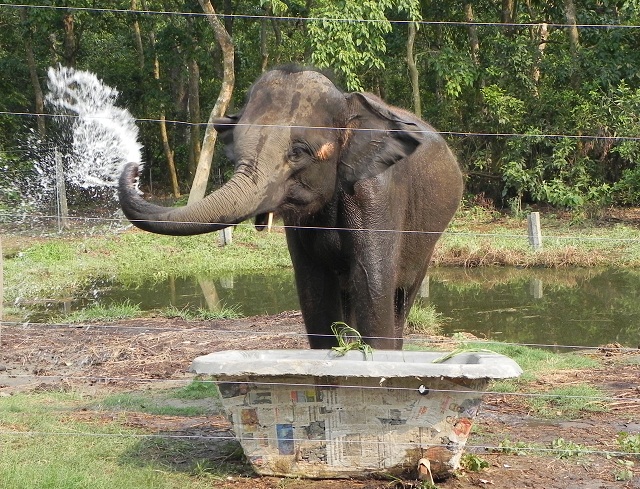
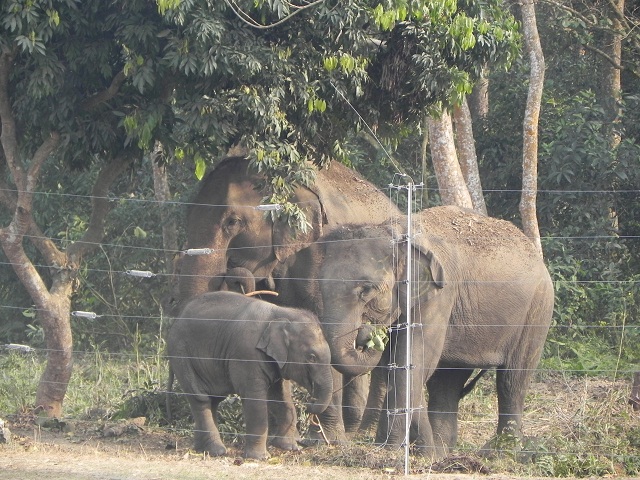
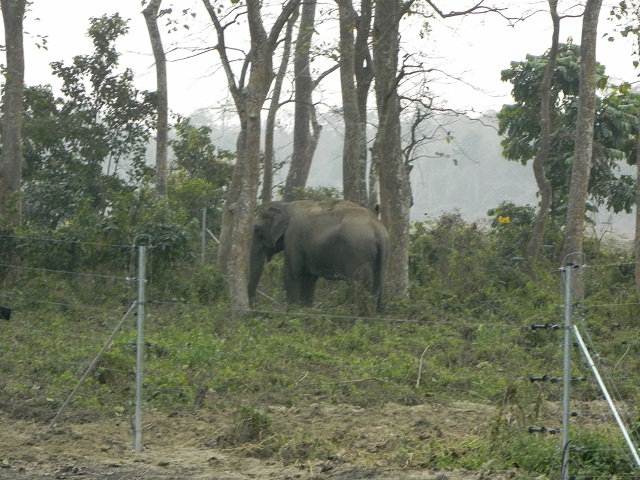
Specifically designed for wildlife, the corral administers a mild shock upon contact. Due to the pulsating current, it is virtually harmless. Being highly sensitive to the clicking sound of the current, most elephants avoid the fence without ever coming into contact with it.
The chain-free hattisar consists of five interconnected corrals on approximately two-and-one-half acres of open and wooded land.
The corrals stand seven feet tall, constructed of rust-free steel posts and six strands of high tensile wire. Each post is encased in a protective tope.
Each corral has a front, back and side gate for ease of access for cleaning, feeding, moving elephants in and out and providing socialization opportunities.
The energizer and batteries are housed inside the mahout residence; two solar panels that charge the batteries are attached to the roof of the residence.
Each corral is equipped with a cut-off switch enabling independent operation.
This design has proven successful in many areas of Asia to prevent entry by wild bull elephants.
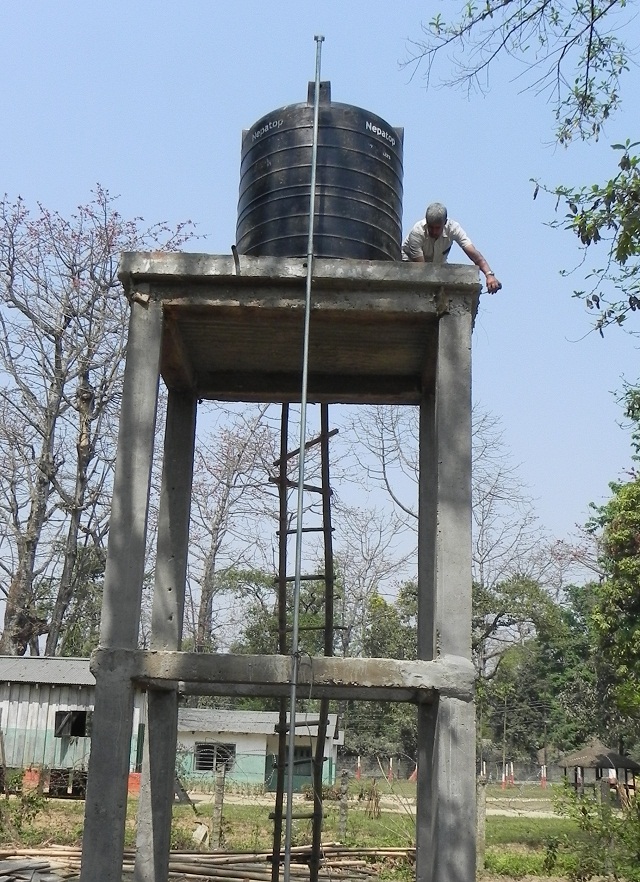
Fresh water is stored in an elevated water tank and troughs are filled by gravity feed.
All corrals have a custom-made concrete water trough that provides clean water.
Healthy trees are an important component of the chain-free corrals, providing shade, browse and a natural scratching surface.
To prevent serious damage to trees from elephant tusking activity, protectors were built around select trees.
GOALS AND OBJECTIVES
Reduce or eliminate stereotypical behavior caused by chaining
Eliminate low-level long-term stress caused by chaining
Increase physical activity
Encourage engagement in natural species-specific behavior such as foraging, dusting, bathing, walking, playing, socializing and exploring
Eliminate injuries and bone and joint damage
Improve foot health
Maintain elephants’ compliance with mahout authority
METHODS
Ethogram
Husbandry protocol
Management protocol
Feeding protocol
1. ETHOGRAM
In order to quantify the effectiveness of the chain-free corral, an ethogram spreadsheet was created to track a list of natural and stereotypical behaviors, including walking, eating, dusting, playing, exploring, drinking, socializing, sleeping and exhibiting stereotypic behaviors.
2. HUSBANDRY PROTOCOL
Manure removal and corral cleanliness standards were established to ensure the highest level of hygiene.
3. MANAGEMENT PROTOCOL
Training and management practices for inside the corral were established to give elephants a sense of freedom and security.
4. FEEDING PROTOCOL
Changes to traditional feeding practices were established to promote activity and alleviate boredom.
PROGRESS AND PRELIMINARY RESULTS
Each elephant spends approximately 15 hours each day in the chain-free corrals. The remainder of their time is spent in Chitwan National Park engaged in grass collecting, anti-poaching patrols and conservation work and jungle safaris.
Upon first introduction to the chain-free corrals, each elephant calmly explored the area, foraging, dusting and scratching on trees. Each evening they dig in the soft dirt of the forest, creating a comfortable sleeping spot; none return to the stable area to sleep.
The related family of Man Kali, Prakriti Kali and Hem Gaj are housed together. They bonded immediately when united in the chain-free corral and continue to exhibit healthy elephant behavior, with Prakriti Kali assuming the role of big sister to Hem Gaj.
A survey was conducted to track the behavior of the elephants toward the mahouts and drivers. Mahout compliance has not changed. Each elephant continues to respond favorably to mahouts and drivers—both inside and outside the corral—at the same high level as before being released from chains.
Photographic records are being kept to track foot health and bone and joint conditions.
Collectively, the elephants’ behavior represents a substantial improvement in natural activity and reduction in stress and stereotypical behavior.
CONCLUSION
The goal to eliminate stress from chaining and the resulting stereotypic behavior is realized. Adherence to the new feeding protocol ensures that both Prakriti Kali and Mel Kali do not engage in stereotypic, food anticipatory behavior. Since being introduced into the chain-free corral hattisar, all elephants engage in appropriate, beneficial, species-specific behavior; respond favorably to their mahouts; and appear to be calm and comfortable in their new environment, indications that the project is meeting its goals and objectives.
A hauntingly familiar sound of clanking chains passed by my window, so close I thought perhaps my wall would be crushed. The clink clink clink of cold metal bracelets was unmistakable; an escapee was passing by my room in his effort to disappear into the freedom of the bordering National Park.
Switching off the lights to avoid attracting attention, I pushed open the screen door and stepped into the darkness.
The rattle of chains chilled me to the bone as a silhouette passed in front of me. First one and then a second, moving silently except for the clanging of the chain hobbles secured around the front ankles of the smaller elephant.
On this, the night before I leave Sauraha, I wondered why I was to witness another unbearable scene of captive elephant suffering.
The escapee had entered through the front gate at NTNC-BCC and slowed when he found himself fenced in. The second elephant, a koonki, was being used to subdue and calm the young male, whose ivory glistened in the moonlight.
When the bull stopped, the mahout began to speak in a soft but firm tone. He told his elephant, the koonki, to bite, which means to stretch out on her sternum. By assuming this vulnerable position, the elephant appeared to bring comfort to the escapee.
It was then that I saw a mahout precariously perched on top of the young bull, no doubt frightened half out of his wits, with nothing at all to secure himself.
As soon as the koonki reclined, a command was given for the bull to recline, which he did without hesitation. The reality is that he was frightened and I believe the mahouts involved realized this. As soon as he reclined the mahouts switched elephants and the koonki left silently.
A little more rattling of the chains and the hobbles were removed, and the young bull moved swiftly back from where he’d come–the government hattisar (elephant stable) next door.
Not willing to witness the brutal scene I assumed would follow, I called out into the night, no pita (don’t hit). No response. As the elephant and mahout passed my room I called out again, which was when I saw a flashlight-wielding man walking behind the elephant.
“Government center hattie (elephant)?” I asked.
“Yes, Raj, from the government center,” he politely replied.
“The elephant is afraid,” I said. ”Do not add to his misery by beating him.”
“You are foot trimming lady, right?” he asked. “You trimmed Raj a few days ago–he had a bad nail.”
“Be kind, Raj is a wild animal,” I said.
”No, not a wild elephant, government elephant,” was his reply.
“Yes, a government elephant and wild,” I said.
There we stood under a bright near-full moon discussing the fact that although these elephants are living in captivity they remain wild animals, never formally domesticated and always to remain wild. When I said they deserve to be treated with compassion because of their circumstances, the mahout nodded in polite agreement. He spoke surprisingly good English and appeared to understand what I was saying. In seconds he vanished into the darkness, leaving me to contemplate what I had just witnessed.
For some time I stood listening to hear if Raj would be brutalized for his attempted escape. But this night I would not have to be reminded of the elephant suffering that permeates this tourist destination in Nepal. The only sound that pierced the night air was the soft repetition of forest birds and chirping insects.
I am back in Nepal. So much has happened during my first month here!
I accepted a kind offer from the National Trust for Nature Conservation’s Biodiversity Conservation Center to live on-grounds. It was a good decision. There is always something interesting going on, local and foreign students visiting and opportunities to learn about the work of the many conservationists on NTNC-BCC’s staff.
We have already trimmed feet at the two government centers, NTNC and some private stables, but foot trimming has taken a back seat to other projects for now.
Expanding the chain-free corral in a big way
When I arrived, the first order of business was identifying a location for an additional chain-free corral at NTNC-BCC for Man Kali and her new calf. After I described my long-term aspirations for NTNC’s elephants, senior staff suggested that we petition to expand our chain-free corral pilot project to include the entire hattisar (elephant compound). I was deliriously happy with the idea that we might be given permission to convert the entire hattisar all at once.
Chitwan National Park’s chief warden and senior veterinarian, the Department of National Parks and Wildlife Conservation’s ecologist and NTNC’s officer-in-charge explored the idea and unanimously endorsed it. The project is scheduled to begin December 15th.
The funds to build the expanded corral were donated by EAI’s dedicated supporters including a most generous and timely donation from the Harrison Sanford Jackson estate. This donation has come at the perfect time for EAI to make a serious impact on elephant welfare in Nepal with this chain-free hattisar, the first of its kind in the country.
Not only does the chain-free corral expansion mean that all six NTNC-BCC hattisar elephants will never again be shackled, the design enables them to socialize with each other.
Reuniting the family
Knowing the importance of the mother and calf bond, you can imagine how excited I was when Dr. Gairhe, Chitwan National Park’s senior government veterinarian, suggested that the family group at NTNC be allowed to live together in the same corral.
Even though Prakriti Kali and her mother both live in the same hattisar, they have not been allowed to socialize for four years, since Prakriti Kali was formally trained. This practice of separation is traditional, meant to break the mother/calf bond.
But onlookers can see that the bond between Prakriti Kali and her mother is still strong. On occasion when they are relatively close, Prakriti Kali rumbles, her mom responds and Prakriti Kali instantly assumes a posture that the mahouts refer to as “four feet together”: an awkward, stereotypical posture she exhibits when she appears to be soliciting comfort.
Dr. Gaihre’s recommendation and the blessing of PasPat, the mahout supervisor, means that Prakriti Kati will be reunited with her biological mother after four years of separation. She will also meet her baby brother Hem Gaj, for the very first time. Together the three will share a chain-free space designed specifically for them.
Anyone who has witnessed the reunion of Shirley and Jenny in the award-winning documentary “The Urban Elephant” can imagine what this reunion will look and sound like. Elephant reunions–there is nothing more moving.
Watch this short video on EAI’s work and hear from Prakriti Kali’s (aka Sweetie Kali) mahout about the difference a chain-free corral has made in her life:
A life lost to herpes
Shortly after I arrived in Nepal, a two-year-old calf at the Government Breeding Center succumbed to the herpes virus. This insidious disease is relatively new to Nepal but has claimed the lives of many captive-born elephants in the US, where extensive research is being conducted.
The loss of any elephant is heart wrenching, but to lose a baby is particularly difficult. The mahouts were quite obviously grief stricken as they gathered in near-silence to bury one of the youngest members of their family. Incense was burned and prayers given as the mahouts dropped flowers into her grave. One of the young veterinarians in attendance said that the mahouts view the elephant as having personhood status. To them, losing this calf was the same as losing a family member.
Since herpes is a virus, there is no vaccination to guard against it. It appears and kills quickly, usually within days of the first signs (lethargy and dark spots on the tongue). The medication prescribed to help combat the disease has had mixed results and, as I found out, is not available in Nepal. Thankfully, our friends at Wildlife SOS-India came to our rescue. Dr. Yaduraj spent days locating the volume of drug required. After three shippers refused to ship to Nepal, he found one who was willing. There was one last delay—when the package was returned to Wildlife-SOS for additional address information—then it was finally sent on its way. Our sincerest thanks go to Dr. Yaduraj for his assistance purchasing and shipping the medication to us.
Getting accurate weights in case
All babies and their mothers at the breeding center were weighed. If any of the babies become ill, Dr. Gaihre will be able to prescribe an accurate dose of medicine.
If treatment is needed, the veterinarian must know the patient’s weight in order to prescribe the accurate dose of medication. It was decided that all the elephants should be weighed in the event another baby is stricken with the virus. There is a scale on-grounds but the elephants needed to be trained to step onto the platform. They all did great but the calves were especially fabulous. They all took their turn to step onto the platform. None showed a bit of fear; each of them walked confidently across the platform to receive a tasty treat.
Checking tongues
As an added precautionary measure, the babies were also trained for tongue examinations, a simple and painless procedure to detect the disease in its early stages.
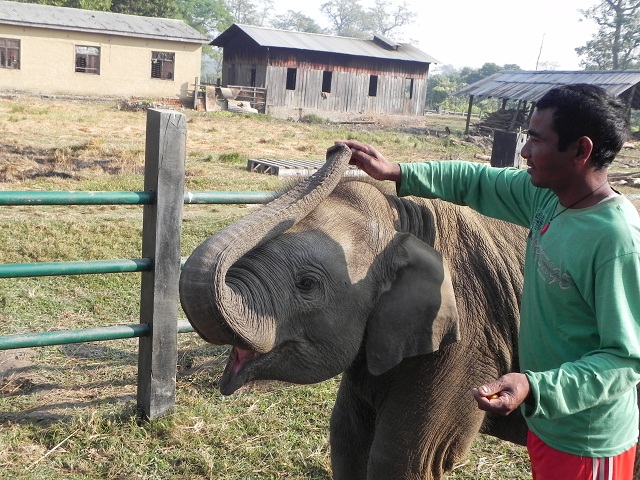
The babies were willing participants in the Compassionate Elephant Care training method, which uses only positive reinforcement. Within three days all the calves were happily laying their trunk back across their forehead and sticking out their tongue for their reward: a juicy orange slice. With the trunk and tongue in this position mahouts can easily examine the calf’s tongue for abnormalities.
EAI paid for a shipment of medication used to combat herpes and worked with mahouts to show them how to train the babies for tongue examinations.
The mahouts are now checking the babies’ tongues twice a day–once in the morning before going to the forest and then again in the evening when they return. Hopefully the virus will not strike again but, if it does, the mahouts’ vigilance could make all the difference.
Still fighting for Mali
Efforts to move Mali from her solitary existence in a zoo in the Philippines to a sanctuary in Thailand continue. An op ed by Carol comparing Mali’s life to that of Tina, who came to live at The Elephant Sanctuary, appeared this summer in a paper in the Philippines. Since then, Carol’s op ed has also appeared in Sri Lanka’s Sunday Times and, most recently, the Bangkok Post.
And now we are three
EAI will soon celebrate its third anniversary. It’s hard to believe we have come so far and accomplished so much in such a short period of time.
We have been able to do so much – and have such an impact – because you share our dream and continue to support the important work we do. With so many needy elephants in situations that, at times, are overwhelming, it is essential to know that you are backing our efforts to make life better for captive-held elephants in Asia.
It doesn’t matter if we are building chain-free corrals, teaching mahouts to handle their elephants in a gentler manner, providing pedicures to any elephant in need or stockpiling medicine to treat baby elephants infected with the herpes virus, you are always there to make sure that we are able to provide swift and humane assistance, one elephant at a time.
We cannot do it without you. At a time when elephants are fighting for their very existence across Asia and Africa, you help EAI make a real difference. I know you will remember these hardworking and many times neglected elephants in your year-end giving.
2013 promises to be another year of challenges and change for the better. I look forward to continuing our work together.
It’s been a pretty intense week. A two-year-old female calf at the breeding center was diagnosed with herpes. Even though she received treatment, she passed away two days later.
Herpes is near-epidemic among elephants in the US and recently reared its ugly head in Chitwan. Young calves between the ages of one and three seem to be most susceptible but there are records of juveniles and adults dying from the disease as well.
You’ll remember Bhadra, the fabulous flaming redhead we trained with positive reinforcement in Sauraha, Nepal. He died of the herpes virus last year, shortly before his second birthday. His mahout was so devastated that he left his job and returned to his home village.
Famciclovir, the treatment of choice for herpes, is not available in Nepal and must be imported from India. A small elephant can require as many as 1000 pills to fight the virus. The exorbitant cost—75 cents per pill—and large quantity needed, made stockpiling the medication impossible.
The calf was given available medication and was under treatment and constant surveillance as I arrange for a shipment of Famciclovir from friends at Wildlife SOS-India. Unfortunately, the drug did not arrive in time to save her. She died in the night with her mother stoically standing by. Records indicate that even with Famciclovir many calves do not survive.
I accompanied the team for the necropsy and somber burial; both were done with the utmost respect. All the mahouts were present and, for the first time in my observation, near silent. As Dr. Gaihre led the exploratory necropsy, examining and collecting tissue samples for lab work, the mahouts dug a grave. It was a sad and sobering experience. This calf had the classic symptoms of herpes–severe hemorrhaging–but otherwise was a very healthy elephant.
When it came time to lay her body to rest, I instinctively glanced around for wild flowers to place on her grave, just as we always did at the Sanctuary. After her precious body was covered with a sparkling clean white linen cloth, incense was lit and ceremonial red powder and flowers were sprinkled over her covered body. When the flowers I collected left my hand and floated down into her grave, a wave of gentle remembering engulfed my heart as I thought of the beloved elephants who had lived and died at the Sanctuary. At this moment we were all one, sharing the loss of a sacred soul.
The senior wildlife staff presided over the burial. Although the words spoken over her grave were in Nepalese and foreign to my ear, I knew exactly what the prayers were. It was the same ceremony, the same prayers uttered each time we buried another precious elephant at the Sanctuary. Like never before, I felt a connection with the mahouts who care as deeply for their elephants as we do ours.
Preparing for next time
The signs of herpes include dark spots on the tongue. By checking the tongue twice a day, the disease can be diagnosed in the early stages. In an effort to monitor the other three young calves at the breeding center, I was asked to train them for tongue examinations, a request that I was happy to fulfill.
The first day of training was a heart-lifting success. We were able to get the calves to place their trunks on their foreheads—for a tasty piece of banana—and took photos of their tongues.
Additionally, I ordered Famciclovir. Even though the drug may expire before it can be used, I feel strongly that having it on-hand whenever possible is important. We were not able to help one precious elephant but if the disease strikes again we will be better prepared.
 This is the place of autonomy and personal freedom.
 Watching the chain-free corrals come to life before my eyes is my addiction. Knowing that my actions help reduce the suffering of captive-held elephants brings me great joy! It is heart work, soul fulfilling work. My meditation.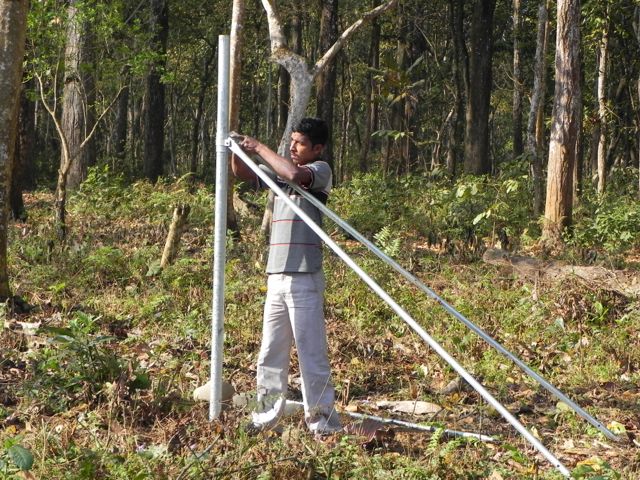
 They know we are helping them. That is good enough for me.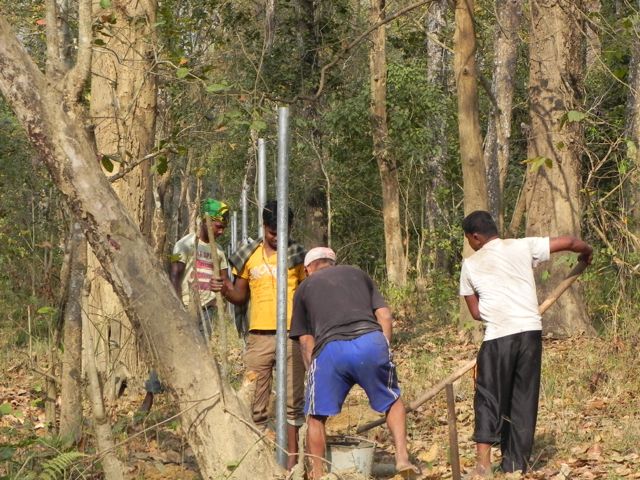
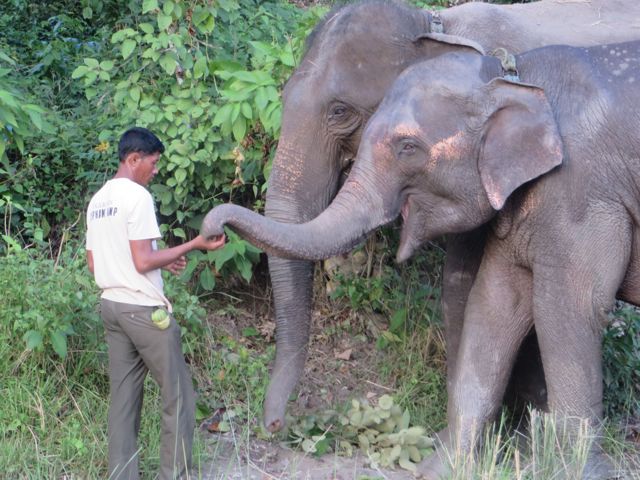
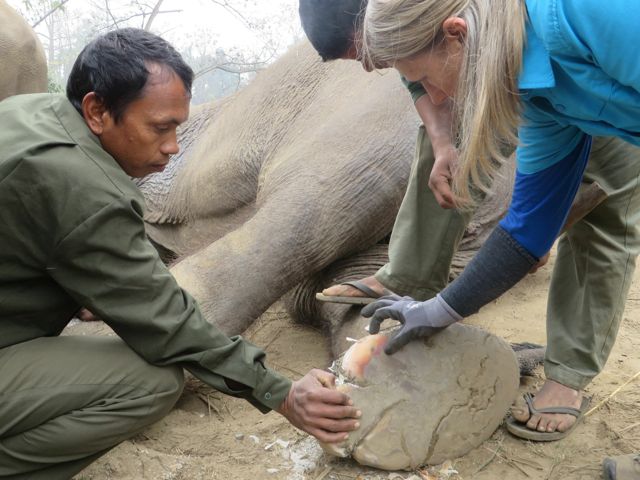 Developing sustainable assistance programs is essential. Live demonstrations, educational resources such as videos and manuals, translators and hands-on assistance are needed to improve mahout knowledge and understanding of new approaches to elephant care.